Why Moving Companies Lose 60% of Their Leads Before Making Contact
The moving industry is one of the most lead-dependent businesses in the service economy. According to the American Moving and Storage Association, approximately 31 million Americans move each year, generating an industry revenue exceeding $20 billion annually. Yet despite this massive demand, the average moving company converts only 15-20% of website inquiries into booked moves — and the primary reason is speed.
When someone decides to move, they request quotes from 3-5 companies simultaneously. The MoveBuddha consumer survey found that 78% of movers choose the first company that provides a detailed estimate. Not the cheapest. Not the one with the best reviews. The fastest responder. Yet the median response time for a moving company to reply to an online quote request is 4-8 hours — and some take 24-48 hours during peak season.
During that delay, the prospect has already received a quote from a competitor, discussed it with their spouse, and booked the move. Your quote arrives after the decision has been made.
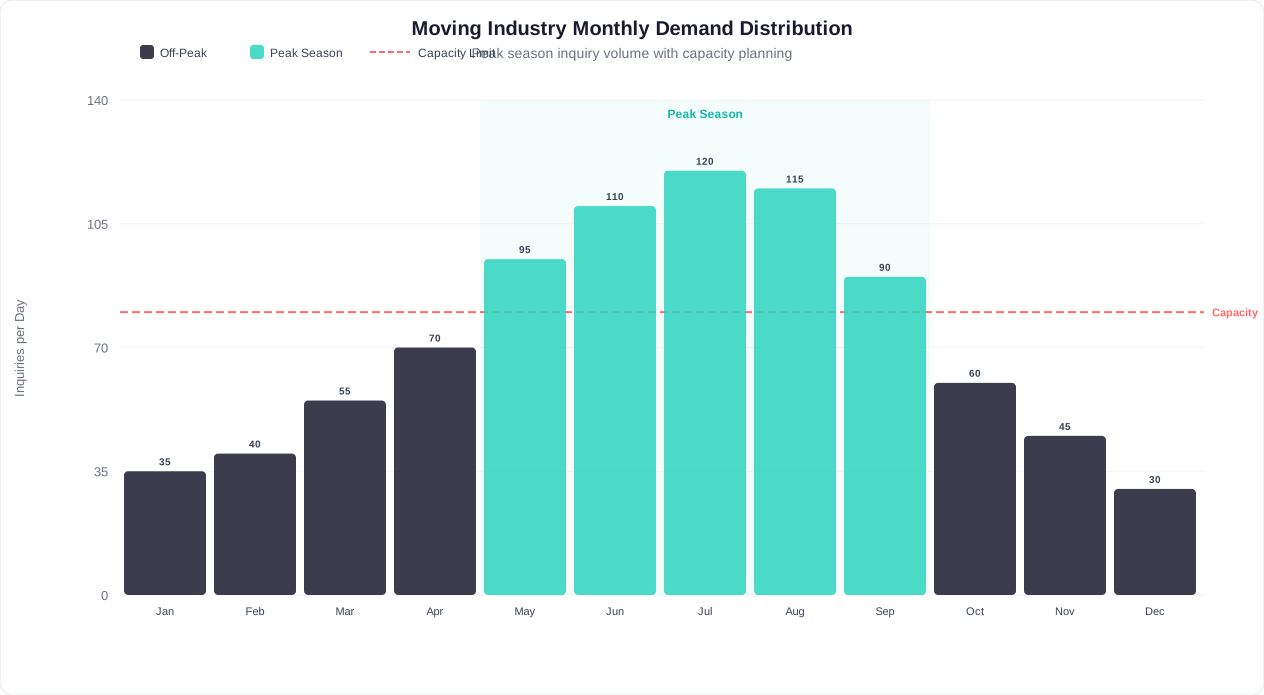
The problem compounds during peak moving season (May through September), when inquiry volumes spike 200-300% above baseline. Office staff who handle 30 quote requests per day in January are suddenly buried under 90-120 requests per day in June. Response times balloon, quote accuracy drops, follow-up disappears, and revenue walks out the door.

A moving company chatbot solves this by generating instant estimates the moment a prospect visits your website — at 2 PM on a Tuesday or 11 PM on a Sunday. The chatbot collects move details (origin, destination, home size, inventory, move date), calculates a preliminary estimate based on your pricing rules, and books the move or schedules an in-home survey — all within a 3-5 minute conversation. No phone calls, no waiting, no back-and-forth emails.
Moving companies using chatbots report 40-55% increases in quote-to-booking conversion rates, 70% reductions in response time, and $15,000-40,000 in additional monthly revenue during peak season from leads that would have otherwise been lost to faster competitors. In an industry where the average job value ranges from $1,500 for a local move to $5,000+ for long-distance, every captured lead has significant revenue impact.
How a Moving Quote Chatbot Works: From Inquiry to Booked Move
A moving company chatbot is a conversational AI assistant that handles the entire front-end of your sales process, streamlining the customer experience in line with American Moving and Storage Association (AMSA) industry standards: collecting move details, generating estimates, answering questions, and converting prospects into booked moves or scheduled surveys. Here is the complete workflow from first contact to confirmed booking.
Stage 1: Welcome and Move Type Classification
The chatbot greets the visitor and identifies the type of move with a simple opening question:
- "Hi! Looking for a moving quote? Let me help. Are you planning a local move, a long-distance move, or do you need a specific service like packing or storage?"
Based on the response, the chatbot routes into the appropriate flow. Local moves (under 50-100 miles depending on your definition) follow a simplified quoting process based on hourly rates. Long-distance moves (interstate or 100+ miles) require more detail for weight-based or cubic-foot pricing. Specialty services (piano moving, antique handling, commercial moves) route to a human estimator.
Stage 2: Move Details Collection
The chatbot collects the information needed to generate an estimate through a natural conversation flow. For a local residential move:
- Origin address or ZIP code: Starting location
- Destination address or ZIP code: Where the move is going
- Home size: Studio, 1-bedroom, 2-bedroom, 3-bedroom, 4+ bedroom, or square footage
- Move date: Specific date or flexible window
- Special items: Piano, pool table, safe, hot tub, large artwork, or other items requiring special handling
- Stairs or elevator: Floor level at origin and destination, elevator availability
- Packing services needed: Full pack, partial pack, fragile items only, or self-packing
- Storage needs: Whether temporary storage is required between move-out and move-in dates
For long-distance moves, the chatbot additionally collects a detailed inventory (either through room-by-room questioning or by having the customer describe their household contents) and asks about access conditions at both locations (narrow streets, long carry distances, parking restrictions).
The NLP engine processes natural language inputs. When a prospect says "I'm moving from a 3-bedroom house in Austin to a 2-bedroom apartment in Denver, probably mid-July," the chatbot extracts all the relevant data points automatically and only asks follow-up questions for missing information.
Stage 3: Instant Estimate Generation
Based on the collected details, the chatbot calculates a preliminary estimate using your pricing rules:
- Local moves: Base rate (number of movers x hourly rate) + estimated hours (based on home size and distance) + surcharges (stairs, long carry, special items) + packing services
- Long-distance moves: Weight or cubic foot estimate (based on home size and inventory) x per-pound/cubic-foot rate + origin/destination charges + special item surcharges + packing + insurance options
The chatbot presents a range ("Your estimated cost is $1,800 to $2,400 based on what you've told me") rather than a single number, setting appropriate expectations while still providing the fast answer the prospect needs.
Stage 4: Conversion — Book or Schedule Survey
After presenting the estimate, the chatbot moves toward conversion:
- For straightforward local moves: "Would you like to reserve this date? I can lock in your move with a $100 deposit." Direct booking reduces the decision gap between estimate and commitment.
- For complex or long-distance moves: "For a more precise quote, I'd like to schedule a free video or in-home survey. What day works best for you?" The chatbot checks estimator availability and books the survey appointment.
- For comparison shoppers: "I'll email you a detailed breakdown of this estimate. Can I follow up in 24 hours to answer any questions?" Captures the email and schedules an automated follow-up.
Stage 5: Post-Quote Follow-Up
If the prospect does not book immediately, the chatbot enters an automated follow-up sequence. 24 hours later: "Hi, just following up on your moving quote for July 15. Our schedule is filling up for that week — would you like to lock in your date?" 72 hours later: "Still planning your move? I can update your quote if anything has changed, or answer any questions." This persistent but polite follow-up recovers 15-25% of initially uncommitted leads.
Handling Seasonal Demand Spikes: The Moving Industry's Biggest Challenge
Moving is one of the most seasonal industries in the service economy. The demand curve is dramatic and unforgiving.
The Numbers Behind the Spike
According to industry data, approximately 80% of residential moves occur between May 1 and September 30. Within that window, June, July, and August account for nearly 50% of all annual moves. The last two weeks of each month are busier than the first two weeks because most leases end on the last day of the month. And weekends account for 65% of preferred move dates.
This creates a capacity nightmare. A moving company staffed to handle January volume is overwhelmed by June volume. A company staffed for June volume has idle capacity from October through March. There is no staffing level that efficiently serves both seasons.
How Chatbots Solve the Seasonal Scaling Problem
A chatbot scales infinitely. Whether you receive 20 quote requests per day in February or 200 per day in July, the chatbot handles every one instantly with the same response time, accuracy, and thoroughness. This solves the three biggest peak-season problems:
Problem 1: Response time degradation. During peak season, human response times often double or triple as staff is overwhelmed. A chatbot's response time is constant — under 5 seconds, regardless of volume. This alone can increase peak-season booking rates by 25-40% compared to companies relying solely on manual quoting.
Problem 2: Quote accuracy drops. Rushed staff produce inaccurate estimates that either lose the job (too high) or lose money (too low). The chatbot applies your pricing rules consistently every time, producing accurate estimates whether it is generating its 5th quote of the day or its 500th.
Problem 3: Follow-up disappears. During slow months, your sales team follows up religiously. During peak season, follow-up is the first thing sacrificed as the team focuses on processing new inquiries. The chatbot automates follow-up year-round, ensuring no lead is left untouched — especially during the high-value peak months when every booking matters most.
Dynamic Pricing and Availability Management
Advanced moving chatbots can implement dynamic pricing based on demand. When your calendar for a particular weekend is nearly full, the chatbot can present premium pricing. When a midweek date has open capacity, it can offer a discount to incentivize flexible customers: "If you can move on Wednesday the 18th instead of Saturday the 21st, I can save you $200. Would that work for your schedule?"
This demand smoothing maximizes crew utilization and revenue per job, addressing one of the biggest profitability challenges in the moving industry: the feast-or-famine nature of seasonal demand.
Off-Season Lead Nurturing
The chatbot is equally valuable during off-season months. Winter inquiries often come from people planning spring or summer moves well in advance. The chatbot captures these early leads, collects their projected move date, and enters them into a nurture sequence — sending periodic check-ins, moving tips, and packing guides. When the move date approaches, the chatbot re-engages with a quote update and booking offer. This pipeline approach fills spring and summer calendars weeks or months before peak season begins, giving you a revenue visibility advantage over competitors who wait for peak-season inquiries to arrive.
Chatbot Strategies for Local vs. Long-Distance Moving Companies
Local and long-distance moves have fundamentally different quoting processes, sales cycles, and customer expectations. Your chatbot should handle both, but the flows differ significantly.
Local Move Chatbot Flow
Local moves are simpler to quote and faster to convert. The typical local move customer is comparing 2-3 companies, wants a quick price, and will book within 24-48 hours. Your chatbot should optimize for speed and simplicity:
- Minimal questions: Origin ZIP, destination ZIP, home size, move date, stairs/elevator, special items. That is enough to generate an hourly-rate estimate.
- Instant pricing: "Based on your 2-bedroom apartment with a 15-mile move, we'd send a 3-person crew at $150/hour. Most 2-bedroom moves take 4-6 hours, so your estimated cost is $600-$900."
- Direct booking: "Want to lock in July 15? I can reserve your crew with a $100 deposit." Offer immediate booking because the decision is simpler and the customer expects a fast process.
- Upsell opportunities: Packing supplies, packing services, furniture disassembly/reassembly, and cleaning services. These add $200-500 to the average job and are easy chatbot upsells: "Want us to handle packing your kitchen and fragile items? We can add that for $250."
Long-Distance Move Chatbot Flow
Long-distance moves are higher value ($3,000-$10,000+) but require more information and a longer sales process. The chatbot's goal is lead qualification and survey scheduling rather than instant booking:
- Detailed inventory collection: Room-by-room inventory (or at minimum, home size and general contents description) to generate a weight/volume estimate
- Access conditions: Elevator availability, parking restrictions, long carry distances at both origin and destination
- Timeline flexibility: Exact date or flexible window, storage needs between locations, earliest and latest acceptable delivery dates
- Insurance and valuation: Explain insurance options (released value vs. full value protection) and collect the customer's preference
- Survey scheduling: Instead of direct booking, the chatbot schedules a virtual video survey or in-home assessment for a binding estimate
The chatbot provides a preliminary range to keep the customer engaged ("Based on your 4-bedroom home, estimated 12,000 pounds, Austin to Denver, your estimate range is $4,500 to $6,500") while clearly explaining that a survey will provide a precise, binding price.
Commercial and Office Moves
Commercial moves represent a lucrative but specialized segment. The chatbot identifies commercial inquiries ("We're moving our office"), collects basic details (current square footage, number of workstations, IT infrastructure, desired move date, any operational continuity requirements), and routes the lead to your commercial moving coordinator. For commercial prospects, the chatbot's role is lead capture and qualification rather than automated quoting, because commercial moves require custom assessment.
ROI Breakdown: What a Moving Company Chatbot Is Actually Worth
Let us quantify the financial impact for a mid-size moving company, using benchmarks aligned with IBISWorld's moving services industry analysis doing $2.5 million in annual revenue with an average job value of $2,000 (blended local and long-distance) and 1,250 annual moves.
Current State (Without Chatbot)
| Metric | Value |
|---|---|
| Monthly website visitors | 4,000 |
| Quote request rate | 8% (320 requests/month) |
| Average response time | 4-8 hours |
| Quote-to-booking conversion | 22% |
| Booked moves per month | 70 |
| Average job value | $2,000 |
| Monthly revenue | $140,000 |
| Staff hours on quoting/month | 160 hours |
| Peak season inquiry overflow (lost) | 30-40% |
With Chatbot
| Metric | Value | Change |
|---|---|---|
| Quote request/chat rate | 15% (600 engagements/month) | +88% (chat is lower friction) |
| Average response time | Instant | -100% |
| Quote-to-booking conversion | 32% | +45% |
| Booked moves per month | 112 | +60% |
| Monthly revenue | $224,000 | +$84,000 |
| Staff hours on quoting/month | 60 hours | -63% |
| Peak season overflow lost | 5-10% | -75% |
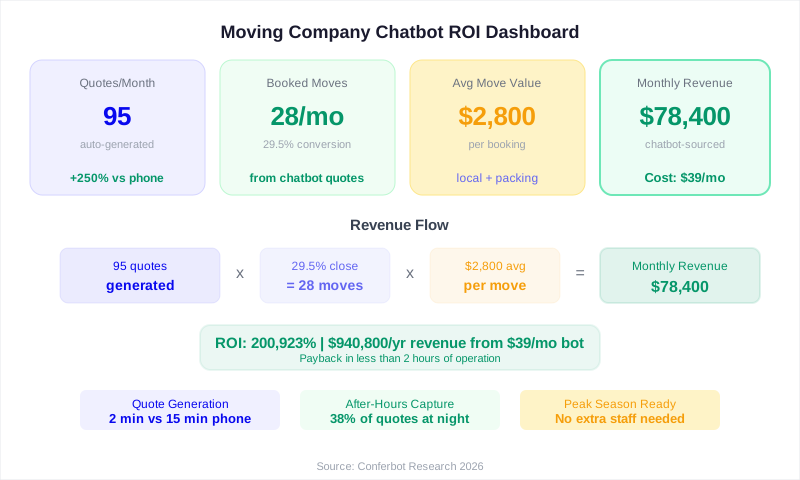
The Math
Additional monthly revenue: $84,000
Monthly labor savings: $5,000 (100 hours at $50/hour loaded)
Total monthly benefit: $89,000
Monthly chatbot cost: $100-200
Monthly ROI: 445-890x return
Even the most conservative scenario — assuming only a 20% increase in bookings from faster response — yields $28,000 in additional monthly revenue. The chatbot is not a marginal improvement; it is a transformation of the sales process that addresses the single biggest revenue leak in the moving business: slow quoting.
For smaller moving companies doing $500,000-$1 million annually, the proportional impact is similar. Two additional bookings per month at $2,000 each adds $48,000 in annual revenue against a $1,200-2,400 annual chatbot cost. The ROI math works at every company size. Check the Conferbot pricing page to find the plan that matches your volume.
Lead Capture, Follow-Up, and Abandoned Quote Recovery
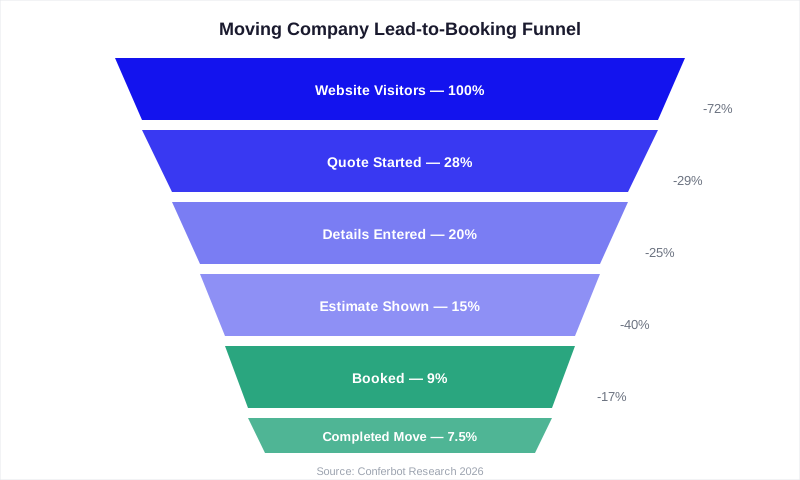
In the moving industry, the gap between receiving a quote and booking a move is where most revenue is lost, a pattern consistent with Salesforce's lead response time research. A prospect requests quotes from multiple companies, receives your estimate, and then goes silent. Without persistent, automated follow-up, that lead is gone. A chatbot closes this gap by capturing every lead with full context and following up systematically until the move is booked or the opportunity is definitively lost.
Capturing Every Lead
The chatbot captures lead information progressively during the conversation. By the time the prospect has asked their first question, the chatbot has already collected their name and email. By the time they have received an estimate, the chatbot has their phone number, move details, and preferred contact method. Even if the prospect leaves without booking, you have a complete lead profile with all the information needed for follow-up.
Compare this to a traditional contact form: 3-5% of website visitors fill out a form, and the information collected is minimal (name, email, "tell us about your move"). A chatbot engages 12-18% of visitors and captures detailed move data that would otherwise require a 10-minute phone conversation. That is 3-4x more leads with 5x more information per lead.
Automated Follow-Up Sequences
The chatbot triggers automated follow-up based on where the prospect dropped off in the process:
Estimate received, no booking (the most common scenario):
- Hour 2: "Thanks for getting a quote with us! Here's a summary of your estimate: [move details and price range]. Have any questions I can answer?"
- Hour 24: "Your moving date is coming up and our calendar is filling up for [month]. Would you like to lock in your preferred date?"
- Day 3: "Still comparing movers? Here's what sets us apart: [insurance coverage, guarantee, reviews]. Happy to adjust the estimate if your plans have changed."
- Day 7: "Last check-in — dates in [month] are going fast. Reply if you'd like to move forward or if I can update your quote."
Started chatbot conversation but did not complete the estimate:
- Hour 1: "Looks like we didn't finish your moving quote. I've saved your information — just a few more details and I can give you an estimate. Want to continue?"
Survey scheduled but not completed:
- 24 hours before survey: "Reminder: Your free moving survey is tomorrow at [time]. Here's what to expect: [brief description]."
- If no-show: "We missed you for today's survey. Would you like to reschedule? I have availability on [dates]."
Abandoned Quote Recovery Results
Moving companies implementing automated chatbot follow-up recover 15-25% of initially uncommitted leads — prospects who received an estimate but did not book. For a company generating 300 estimates per month with a 22% initial booking rate, that is an additional 35-58 bookings per month from leads that would have been lost. At $2,000 per average job, that is $70,000-$116,000 in recovered monthly revenue.
The key is persistence combined with value. Each follow-up message adds new information (calendar urgency, differentiators, flexibility on pricing) rather than simply repeating "are you ready to book?" This approach respects the prospect's decision process while keeping your company top of mind throughout their comparison shopping.
Integrations: Connecting Your Chatbot to Your Moving Business Systems
A chatbot's value multiplies when it connects to your existing business systems, creating an automated pipeline from lead capture through booking, dispatch, and follow-up. Here is how the integration ecosystem works for a moving company chatbot.

CRM Integration
Every chatbot conversation — lead details, move specifications, estimate provided, follow-up status — pushes automatically to your CRM. Whether you use MoveitPro, SmartMoving, Supermove, HubSpot, or Salesforce, the integration eliminates manual data entry and ensures your sales pipeline is always current. Your sales team sees exactly where each lead stands without asking or searching.
Calendar and Scheduling
The chatbot checks your crew availability in real time when offering move dates or survey appointments. This prevents double-booking and ensures that quoted dates are actually available. When a customer books through the chatbot, the move is automatically added to your dispatch calendar with all the details: customer name, addresses, inventory, access conditions, and special requirements.
Payment Processing
For companies that collect deposits at booking, the chatbot can process payments through Stripe, Square, or your existing payment processor. "To confirm your move on July 15, we need a $150 deposit. I can process that securely right now — would you like to pay with a credit card?" In-conversation payment removes the friction of sending a separate invoice and waiting for payment, reducing the gap between commitment and confirmation.
Review Collection
After the move is completed, the chatbot sends an automated satisfaction check: "How was your experience with our crew? Rate us 1-5." Customers who rate 4-5 receive a direct link to leave a Google or Yelp review. Customers who rate 1-3 are routed to your operations manager for resolution before the dissatisfaction becomes a public review. This automated review generation system builds your online reputation — critical in an industry where BrightLocal research shows that 87% of consumers read online reviews before choosing a moving company.
Email Marketing
Chatbot leads that do not convert immediately are added to email nurture sequences via Mailchimp, ActiveCampaign, or your email platform. These sequences deliver moving tips, checklists, packing guides, and periodic quote updates that keep your company in front of the prospect as their move date approaches. The chatbot captures enough data to segment these sequences by move type, timeline, and location for maximum relevance.
Website and Landing Page Integration
Deploy the chatbot on your homepage, service pages (local moving, long-distance moving, packing, storage), and any paid advertising landing pages. The chatbot's greeting adapts based on the page: on the long-distance page, it opens with "Planning a long-distance move? I can give you an estimate in 3 minutes." On the storage page: "Need temporary storage during your move? Let me help you find the right solution." This context-aware deployment is configured through the Conferbot builder without code changes.
How to Build a Moving Company Chatbot: Step-by-Step Setup
Here is the complete implementation roadmap. Most moving companies can go from zero to a live chatbot in a single day.
Step 1: Define Your Pricing Model (30 Minutes)
Before building the chatbot, document your pricing rules clearly so the bot can calculate estimates:
- Local moves: Hourly rate per crew size (2-person, 3-person, 4-person crews), minimum hours, travel time charges, stair/long carry surcharges, special item fees
- Long-distance moves: Per-pound or per-cubic-foot rates by distance tier, origin/destination charges, packing rates, insurance options, storage rates
- Add-on services: Full packing, fragile-only packing, furniture disassembly/reassembly, appliance disconnect/reconnect, cleaning, storage
- Discounts: Midweek discounts, off-season discounts, military/senior discounts, repeat customer discounts
These rules become the pricing logic the chatbot uses to generate estimates.
Step 2: Set Up the Chatbot Platform (15 Minutes)
Sign up for Conferbot and start with a service business template. Configure your branding (company name, colors, logo) and set the chatbot's personality to match your brand — professional, friendly, reassuring (moving is stressful, and your chatbot should acknowledge that).
Step 3: Build the Quote Flow (1 Hour)
Using the no-code flow builder, create the main conversation flow:
- Welcome and move type detection: Local, long-distance, or commercial
- Move details collection: Origin, destination, home size, move date, special items, stairs, packing needs
- Estimate generation: Apply your pricing rules to the collected data and present a range
- Conversion prompt: Book the move, schedule a survey, or email the estimate
- Contact capture: Name, email, phone — collected progressively throughout the conversation
Step 4: Train the Knowledge Base (30 Minutes)
Upload your FAQ content to the knowledge base:
- Service area details (cities, states, regions you serve)
- Insurance and valuation options explained
- What to expect on moving day
- Packing tips and preparation checklist
- Cancellation and rescheduling policies
- Payment terms and accepted methods
- Company credentials (DOT number, insurance, BBB rating, years in business)
Step 5: Connect Integrations (20 Minutes)
- CRM: Push leads to your moving CRM or sales system
- Calendar: Connect for survey scheduling and crew availability
- Email: Set up automated follow-up sequences for non-converting leads
- Notifications: Configure instant alerts to your sales team for hot leads (moving within 2 weeks, large moves, commercial inquiries)
Step 6: Deploy (10 Minutes)
- Install the chatbot widget on your website
- Add it to your Google Business Profile messaging
- Connect WhatsApp Business for messaging inquiries
- Test 15-20 scenarios: local move, long-distance move, commercial inquiry, storage question, peak season date, off-season date, special items
Step 7: Optimize (Week 1-4)
Monitor chatbot analytics daily during the first week, then weekly:
- Where do prospects drop off in the quote flow? Simplify those steps.
- What questions does the chatbot fail to answer? Add them to the knowledge base.
- What is the estimate-to-booking conversion rate? Adjust follow-up timing and messaging.
- Are estimates accurate when compared to final invoices? Calibrate your pricing rules.
Advanced Strategies: Inventory Estimation, Video Surveys, and Upselling
Once your basic chatbot is running, these advanced strategies increase both quote accuracy and revenue per job.
Conversational Inventory Estimation
The biggest challenge in automated moving quotes is inventory estimation. A "3-bedroom house" can mean 5,000 pounds of furniture or 12,000 pounds depending on how the customer lives. Advanced chatbots improve accuracy by conducting a room-by-room inventory within the conversation:
- "Let's go room by room to get a more accurate estimate. Starting with the living room — do you have a sofa? Is it a loveseat, standard 3-seater, or a sectional?"
- "How about the bedroom? King bed, queen, or smaller? Do you have a dresser? How many nightstands?"
Each item has a pre-assigned weight or cubic footage value. As the customer lists their furniture, the chatbot calculates a running inventory total. This approach yields estimates that are 30-40% more accurate than home-size-only estimates, reducing the discrepancy between quoted and final prices that erodes customer trust and profitability.
Video Survey Integration
For long-distance or large moves, the chatbot can schedule and facilitate a video survey. After the initial chatbot conversation establishes the basics, the bot schedules a video call where the customer walks through their home with their phone camera while an estimator observes remotely. The chatbot sends the video survey link, reminder, and post-survey follow-up with the binding estimate.
Video surveys convert at 40-50% higher rates than phone-only estimates because the estimator sees the actual inventory, access conditions, and special challenges — producing a confident, precise quote that the customer trusts. The chatbot handles all the scheduling and communication around the survey, reducing estimator administrative time by 60%.
Intelligent Upselling
The chatbot upsells additional services based on context from the conversation:
| Trigger | Upsell | Typical Add-On Value |
|---|---|---|
| Customer mentions "fragile items" or "antiques" | Full or partial packing service | $250-800 |
| Moving date gap between move-out and move-in | Short-term storage | $150-400/month |
| Customer has stairs at either location | Extra crew member for faster, safer move | $100-200 |
| Long-distance move | Full value protection insurance | $150-500 |
| Customer mentions they hate packing | Full-service packing and unpacking | $500-1,500 |
| Move-out property is being sold | Move-out cleaning service | $200-400 |
These contextual upsells feel helpful rather than pushy because they address needs the customer has already expressed. Moving companies using chatbot upselling report 18-28% higher average job values compared to phone-quoted jobs, because the chatbot consistently presents relevant add-ons while phone estimators often forget or rush through the upsell conversation.
Competitor Comparison Handling
When a prospect mentions they are comparing quotes ("I got a lower quote from another company"), the chatbot is trained to respond with value differentiation rather than price matching: "Great that you're comparing — that's smart. A few things to ask your other movers: Are they DOT licensed and fully insured? Do they offer binding estimates so the price can't change on moving day? Do they have full value protection coverage?" This plants questions that highlight common shortcuts by low-ball movers and positions your company as the trustworthy choice, even at a higher price.
Building Your Reputation: Chatbots as Review Generation Engines
In the moving industry, online reviews are the currency of trust, as BrightLocal's consumer review survey consistently demonstrates. A single negative review can cost a moving company $15,000-30,000 in lost business over a year, while a consistent stream of positive reviews drives organic traffic and conversion. Chatbots systematically generate positive reviews while intercepting negative experiences before they become public.
The Post-Move Review Sequence
24-48 hours after the move is completed, the chatbot initiates a satisfaction check:
- Initial feedback: "How was your move? Rate your experience 1-5."
- For 4-5 ratings: "Wonderful! We'd love for you to share your experience. Here's a link to leave a Google review — it helps other families find reliable movers." Sends a direct Google review link that opens the review form pre-filled with your business.
- For 1-3 ratings: "We're sorry your experience wasn't perfect. Can you tell me what happened? I'll connect you with our operations manager who can make this right." Routes to internal resolution before the dissatisfaction reaches a public review platform.
This sentiment-gated review generation is remarkably effective. Moving companies using this approach generate 3-5x more positive reviews per month while reducing negative public reviews by 40-60% through proactive resolution. Over 6-12 months, this transforms your online reputation and drives organic lead generation that compounds over time.
Review Response Automation
The chatbot can also draft personalized responses to reviews. When a new Google or Yelp review is posted, the chatbot generates a response that acknowledges the specific feedback, thanks the reviewer, and reinforces your brand values. Your team approves and posts the response, saving 10-15 minutes per review while maintaining a consistent, professional public presence.
Referral Program Automation
After a positive review, the chatbot introduces your referral program: "Thanks for the great review! Did you know we offer $50 off for every friend you refer who books a move? Share this link with anyone who's planning a move." Referral programs managed through the chatbot generate higher participation rates than email-only programs because the ask comes at the peak of customer satisfaction — right after they have left a positive review.
Combined, these reputation management functions turn your chatbot into a long-term growth engine. Every completed move becomes an opportunity to generate social proof that attracts the next customer, creating a virtuous cycle of reviews driving leads driving moves driving reviews.
Getting Started: Your Moving Company Chatbot This Week
Here is your action plan to launch a lead-generating moving company chatbot in five business days.
Day 1: Pricing and Content Preparation
- Document your pricing rules for local, long-distance, and specialty moves
- Compile your FAQ content: service areas, insurance options, moving day expectations, credentials
- List your current tech stack (CRM, calendar, payment processor) for integration planning
Day 2: Platform Setup and Flow Building
- Sign up for Conferbot and configure branding
- Build the main quote flow: move type detection, detail collection, estimate generation, and booking/survey scheduling
- Upload your FAQ and business content to the knowledge base
Day 3: Integration and Testing
- Connect your CRM, calendar, and notification systems
- Set up automated follow-up sequences for non-converting leads
- Run 20 test conversations covering every scenario
Day 4: Deployment
- Install the chatbot widget on your website (all pages, especially the homepage and quote request page)
- Add it to your Google Business Profile
- Connect WhatsApp Business if applicable
- Brief your sales team on how chatbot leads will appear in the CRM
Day 5: Go Live and Monitor
- Launch the chatbot and monitor conversations in real time
- Fix any knowledge base gaps or flow issues
- Begin tracking chatbot-sourced bookings versus manual-sourced bookings
Expected Results After 30 Days
- 50-80% of quote requests handled entirely by the chatbot without staff involvement
- 30-45% increase in quote-to-booking conversion rate from faster response times
- 70% reduction in time your sales team spends on initial quoting
- 15-25% recovery rate on abandoned quotes through automated follow-up
- 18-28% higher average job value from contextual upselling of add-on services
Peak moving season waits for no one. Every day your website relies on contact forms and manual quoting, you are losing leads to competitors who respond faster. The chatbot levels the playing field — and then tips it in your favor. A single additional booking per week from chatbot-captured leads generates $100,000+ in annual revenue against a chatbot cost that is less than the average tip your crew receives on a single job.
Visit the Conferbot templates page to explore service business chatbot templates and get your moving company chatbot live this week.
Was this article helpful?
About the Author

The Conferbot team specializes in conversational AI, chatbot strategy, and customer engagement automation. With deep expertise in building AI-powered chatbots, they help businesses deliver exceptional customer experiences across every channel.
View all articles