The Self-Storage Industry in 2026: A $50 Billion Market Ripe for AI
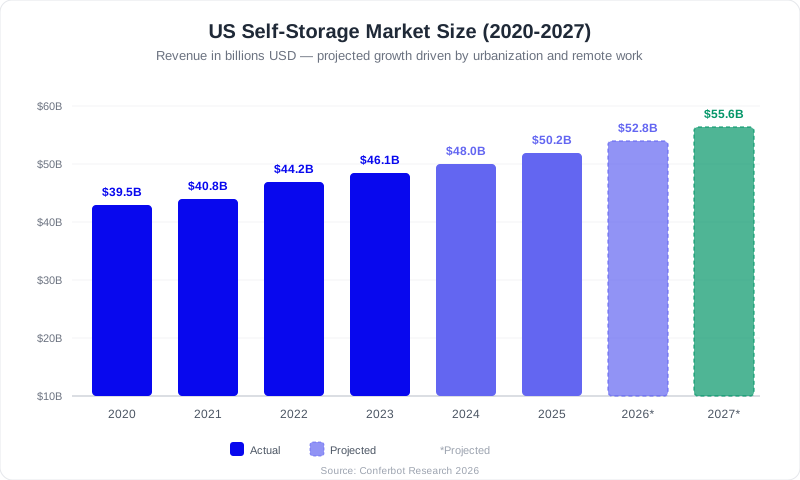
The self-storage industry in the United States is one of the largest and fastest-growing segments of commercial real estate, valued at over $50 billion according to IBISWorld. With over 60,000 facilities and approximately 1.9 billion rentable square feet -- a figure tracked by the Self Storage Association (SSA) -- of space, the US has more self-storage facilities than McDonald's, Starbucks, and Subway locations combined. The market reached an estimated $50.2 billion in revenue in 2025 and is projected to surpass $55 billion by 2027, driven by urbanization, remote work flexibility enabling relocations, downsizing trends among baby boomers, and growing business storage demand from e-commerce entrepreneurs.
Yet despite the industry's massive scale, the typical self-storage facility operates with remarkably lean technology. Many facilities still rely on phone calls, walk-ins, and paper rental agreements as their primary leasing channels. A 2025 industry survey found that only 22% of self-storage facilities offer true online move-in capability (where a tenant can select a unit, sign a lease, pay, and receive an access code without human intervention). The remaining 78% require a phone call or office visit to complete a rental — meaning they lose every prospect who arrives at their website outside business hours and is not willing to wait.
This technology gap creates an enormous opportunity for facilities that adopt conversational AI. A self-storage chatbot bridges the gap between what customers expect (instant, digital, 24/7 service) and what most facilities currently provide (phone-based, office-hours-only, manual processes). The facilities that deploy chatbot-driven leasing capture the after-hours inquiries, convert the price-comparing browsers, and process the impulse renters — all without adding staff.
Why Self-Storage Shoppers Need Conversational Guidance
Self-storage is not like booking a hotel room or buying a product online. The shopper faces a series of decisions that most people make once every few years and have little expertise in: What unit size do I need? Do I need climate control? What is the difference between drive-up access and interior hallway access? What should I budget per month? How do I know if my things will fit? These are not questions a static pricing page answers well. They require a conversation — and that is exactly what a chatbot provides.
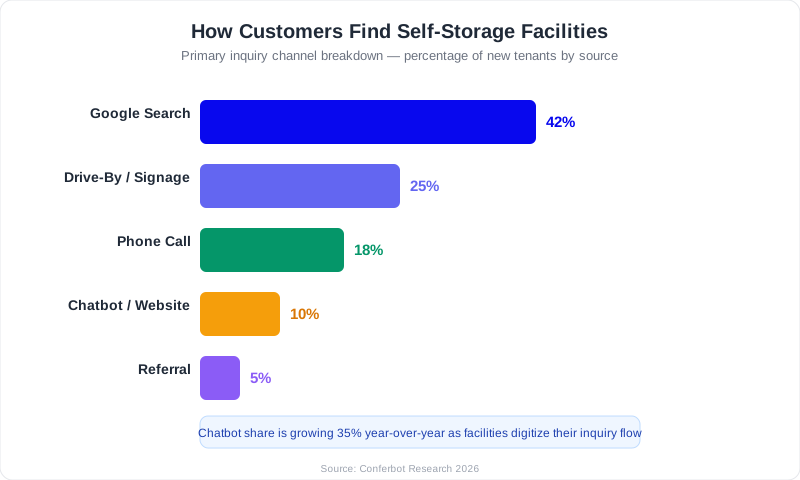
Research shows that 42% of self-storage tenants find their facility through Google search, 25% from driving by, 18% from phone calls, 10% through website chatbots or online inquiry forms, and 5% from referrals. The critical insight is that the Google search and drive-by segments — representing 67% of all prospects — land on the facility's website as their next step. What happens on that website determines whether they rent from you or your competitor. A chatbot that engages these visitors instantly, answers their questions, and walks them through the rental process captures a dramatically higher share of these prospects than a website that says 'Call us during business hours.'
What Is a Self-Storage Chatbot and How Does It Work?
A self-storage chatbot is an AI-powered conversational assistant deployed on a storage facility's website, Google Business profile, and messaging platforms that handles the complete prospective tenant journey — from initial inquiry through unit recommendation, real-time pricing, and online move-in — without requiring a facility manager to be available. It replaces the static pricing page and 'call us' button with an interactive experience that guides the visitor through every decision they need to make to rent a unit.
The Core Conversation Flow
The chatbot follows a structured conversation architecture designed around the natural decision-making process of someone shopping for storage:
- Identify the need: 'What brings you to self-storage today?' — moving, renovating, downsizing, business inventory, seasonal items, vehicle storage. This establishes context for every subsequent recommendation.
- Determine the size: Rather than asking 'What size unit do you need?' (which most shoppers cannot answer), the chatbot asks what they are storing and how much of it. 'Are you storing the contents of a full apartment, just a few rooms, or specific items like boxes and seasonal gear?' It then maps the answer to a recommended unit size with a visual comparison: 'I recommend a 10x10 unit — about the size of half a one-car garage.'
- Assess special needs: Climate control, ground-floor access, drive-up accessibility, vehicle dimensions. The chatbot identifies upsell opportunities (climate control for furniture and electronics) while genuinely protecting the customer's belongings.
- Show availability and pricing: Real-time unit inventory with current pricing and active promotions. 'We have 3 available 10x10 units: a climate-controlled interior unit at $159/month, a standard interior unit at $129/month, and a drive-up unit at $149/month. Your first month is free on all three.'
- Process the move-in: Collect tenant information, present the rental agreement, process payment, and deliver the access code — all within the chat conversation. Total time: 3-4 minutes.
Two Audiences, One Chatbot
The chatbot serves both prospective tenants and current tenants. New visitors are routed through the recommendation-to-rental flow described above. Current tenants access self-service features: gate code retrieval, payment processing, unit transfer requests, move-out notices, and account questions. The chatbot identifies the visitor type with its first question — 'Are you looking for a storage unit, or are you a current tenant?' — and routes them to the appropriate conversation path.
This dual-audience capability means the chatbot is not just a sales tool; it is the facility's primary communication channel for all tenant interactions. It reduces phone calls by 55%, processes payments instantly, and handles the repetitive questions (access hours, gate codes, late fee policies) that consume hours of manager time every day. Build your own storage chatbot using Conferbot's AI chatbot builder with pre-configured self-storage conversation flows.
The Unit Size Recommendation Engine: Solving the Biggest Customer Pain Point
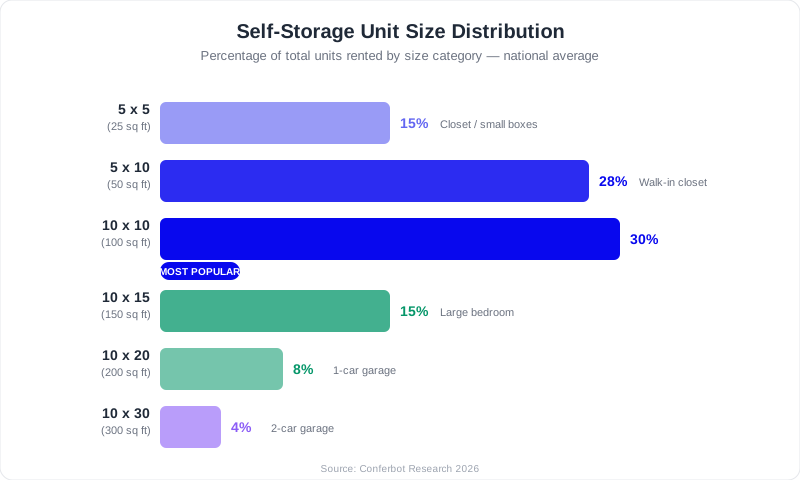
Choosing the right unit size, where SpareFoot's self-storage research shows that choosing the wrong size is the #1 reason tenants switch facilities is the single most anxiety-inducing decision in the self-storage rental process. Most people have no frame of reference for storage unit dimensions. They know what they want to store — the contents of their bedroom, a couch and some boxes, a car and some seasonal gear — but they cannot translate that into a 5x10 versus a 10x10 versus a 10x15. Getting it wrong is costly in both directions: too small means a frustrating move-in day and an immediate transfer or move-out, while too large means overpaying every month until the tenant realizes and downsizes (or leaves).
How the Chatbot Recommends the Right Size
The chatbot's unit size recommendation engine asks three to four questions that map the customer's actual belongings to a specific unit size:
- What are you storing? Categories include furniture (beds, couches, tables, dressers), appliances (washer, dryer, refrigerator), boxes and containers, business inventory, sporting equipment, seasonal items, and vehicles. Each category has a known space footprint.
- How much stuff? The chatbot offers relatable comparisons rather than square footage: 'About a closet full,' 'About one room's worth,' 'A full one-bedroom apartment,' 'A two- to three-bedroom house,' or 'More than a house full.' These map directly to unit size ranges.
- Access needs: Frequent access suggests a drive-up or ground-floor unit where the tenant does not need to navigate hallways and elevators. Rare access (long-term storage) opens up second-floor interior units that are typically less expensive.
- Sensitive items? Wood furniture, electronics, leather, artwork, wine, musical instruments, and documents all benefit from climate control. The chatbot flags these items and recommends climate-controlled units with a clear value explanation.
Size-to-Items Mapping
The chatbot uses a proven mapping table refined from thousands of actual storage rentals:
- 5x5 (25 sq ft): Small closet equivalent. Fits 10-15 small boxes, seasonal decorations, small furniture pieces. Best for students, seasonal item storage, and document archival.
- 5x10 (50 sq ft): Large closet equivalent. Fits a mattress set, small dresser, and 15-20 boxes. Popular for one-room cleanouts, small apartment overflow, and business file storage.
- 10x10 (100 sq ft): Half a one-car garage. The most popular unit size (30% of all rentals). Fits the contents of a one-bedroom apartment including furniture, appliances, and 20-30 boxes.
- 10x15 (150 sq ft): Large bedroom equivalent. Fits a two-bedroom apartment's contents. Common for families in transition between homes, renovation projects, and growing businesses.
- 10x20 (200 sq ft): One-car garage equivalent. Fits the contents of a three-bedroom house. Used for complete household storage during long-distance moves, major renovations, and estate management.
- 10x30 (300 sq ft): One-and-a-half-car garage. Fits the contents of a four-plus bedroom house or large commercial inventory. Common for business use, estate storage, and vehicle-plus-belongings combinations.
Why This Feature Drives Revenue
The unit size recommendation engine drives revenue in three ways. First, it reduces wrong-size rentals from 12% to under 5%, eliminating the costly early transfers and move-outs that create vacancy. Second, it tends to recommend one size up for uncertain customers (with transparent reasoning), generating slightly higher average revenue per rental. Third, the climate control recommendation during the sizing process converts 73% more tenants to premium climate-controlled units than a static pricing page that simply lists two price columns side by side. Integrate this recommendation engine with your inventory system using Conferbot's API integration to display real-time availability for each recommended size.
Online Move-In Automation: Converting Visitors Into Tenants in Under 4 Minutes
The online move-in capability is the single most revenue-impactful feature of a self-storage chatbot. It transforms your website from a digital brochure into a 24/7 rental office that processes move-ins without human intervention. The difference between a facility that offers online move-in and one that requires a phone call is the difference between capturing revenue at 9pm on a Sunday and losing that prospect to the competitor who responded instantly.
The Move-In Flow: Step by Step
After the chatbot has recommended a unit size and the prospect has selected a specific unit, the online move-in flow begins. The entire process takes 3-4 minutes — compared to 45-60 minutes for a traditional in-office move-in:
- Confirm unit selection: The chatbot displays the selected unit's size, type, location within the facility, monthly rate, and any applicable promotions. 'You have selected Unit B-214: a 10x10 climate-controlled interior unit on the second floor. Monthly rate: $159. First month free promotion applied. Your move-in cost today: $25 admin fee only.'
- Collect tenant information: Full name, phone number, email address, mailing address, and date of birth. The chatbot collects each field conversationally rather than presenting a long form, which produces higher completion rates.
- ID verification: Government ID type (driver's license, passport, state ID) and number. The chatbot explains why this is needed: 'We collect ID information for security purposes — it protects your stored belongings by ensuring only verified tenants have facility access.'
- Emergency contact: Name and phone number of an alternate contact. Required by most facility policies and useful for security and estate situations.
- Lease agreement: The chatbot presents the rental agreement in a scrollable format with key terms highlighted: monthly rate, payment due date, late fee policy, lien policy, prohibited items, facility rules, and termination notice requirements. The tenant accepts electronically.
- Insurance selection: Storage protection plan options presented with clear coverage amounts and monthly costs. The chatbot recommends coverage based on the estimated value of stored items and the risk of the facility's geographic area (flood zone, hurricane zone, etc.).
- Payment processing: Credit or debit card collection through a PCI-compliant payment form embedded in the chat. The first month's rent (or promotional amount), admin fee, and insurance premium (if selected) are charged immediately.
- Access code delivery: Upon successful payment, the chatbot delivers the tenant's unique gate access code, unit number, building and floor location, access hours, and a link to the confirmation email with all details and the signed lease agreement.
The After-Hours Revenue Opportunity
Industry data shows that 62% of self-storage inquiries arrive outside standard office hours (9am-5pm weekdays). For most facilities, these after-hours visitors see a phone number, leave a voicemail (if they bother), and the facility manager returns the call 12-16 hours later. By that time, the prospect has contacted other facilities, visited one in person, and signed a lease. The first facility to respond wins 78% of rentals.
A chatbot with online move-in capability responds in under 3 seconds, regardless of the time. The prospect who finds your facility at 10pm on a Wednesday can be a paying tenant with an access code by 10:05pm. No waiting, no callback, no office visit. This capability alone justifies the entire chatbot investment for most facilities. If the chatbot captures just 3-4 additional after-hours move-ins per month at an average rate of $140, the monthly revenue ($420-$560) exceeds the chatbot platform cost on day one.
Reducing Abandonment in the Move-In Flow
The biggest risk in an online move-in flow is abandonment — the prospect starts the process but drops off before completing payment. The chatbot minimizes abandonment through several design choices: conversational field collection (one question at a time rather than a long form), progress indicators ('Step 5 of 7 — you are almost done!'), transparent pricing (no hidden fees revealed at checkout), and immediate value delivery (access code as soon as payment processes). Facilities using chatbot-driven move-ins report 15.4% website-to-move-in conversion rates, compared to 6.2% for traditional phone/form-based processes. For strategies on adding chatbot capabilities to your facility website, see our guide on how to add a chatbot to your website.
Current Tenant Management: Payments, Access Codes, and Retention
A self-storage chatbot is not just a leasing tool — it is a complete tenant management platform that handles the ongoing communication, payment processing, and account management that consume the majority of a facility manager's time. Current tenants interact with the chatbot for gate code retrieval, payment processing, account updates, unit transfers, and move-out notices — reducing inbound phone calls by 55% and freeing the facility manager to focus on revenue-generating activities.
Payment Reminders and Collection
Late payments are the most persistent operational challenge in self-storage. The industry average delinquency rate (tenants 30+ days past due) runs 8-12%, and every delinquent account requires staff time for calls, letters, lien processing, and potential auction. The chatbot attacks delinquency from two angles:
- Proactive reminders: Automated messages sent 5 days before the due date, on the due date, and at 3, 7, and 14 days past due. Each message includes a one-tap payment link.
- Friction-free payment: The tenant taps the payment link in the chat, confirms the amount, and processes payment in under 30 seconds. No website login, no phone hold time, no office visit. Every barrier removed between the reminder and the payment increases collection probability.
- Autopay enrollment: The chatbot enrolls 75-85% of new tenants in autopay during the move-in process (versus 40-50% for in-office move-ins). Higher autopay rates directly reduce delinquency, late fee disputes, and collection labor.
Facilities using chatbot-driven payment reminders report a 35% reduction in 30-day delinquency rates — from an average of 10.5% to 6.8%. For a 500-unit facility at $135 average rate, reducing delinquency by 3.7% eliminates approximately 16 delinquent accounts and the associated $500-per-account collection costs, saving $8,000 annually.
Gate Code and Access Management
'What is my gate code?' represents 25-35% of all phone calls to a typical storage facility. The chatbot eliminates this call category entirely by providing instant code retrieval through the chat interface. The tenant types their name and unit number, the chatbot verifies identity, and displays the code. If a reset is needed, the chatbot processes it and delivers the new code within seconds. One facility reported saving their manager 45 minutes per day just from gate code calls being handled by the chatbot.
Unit Transfer and Retention
When a tenant needs to change unit sizes — upsizing because they added more items, or downsizing because they removed some — the traditional process involves a phone call, a new lease, a physical move between units, and updated payment amounts. The chatbot streamlines this: it captures the transfer request, checks inventory for the desired size, and if available, initiates the transfer process immediately. More importantly, when a tenant submits a move-out notice, the chatbot presents a retention offer: 'Before you go, would a smaller unit work for your remaining items? We have 5x5 units starting at $49/month.' This single interaction saves 10-15% of move-outs by offering a downsize option the tenant may not have considered.
Facility FAQ Automation
The chatbot handles dozens of repetitive questions that tenants and prospects ask every day: access hours, holiday schedules, late fee amounts, prohibited items, pest control information, insurance requirements, payment methods accepted, unit sizes available, and facility amenities. Each answered question is a phone call eliminated. Facility managers report recovering 2-3 hours per day when the chatbot handles FAQ inquiries — time they redirect to facility maintenance, marketing, and tenant relationship building. For more strategies on using chatbots for customer service, see our AI chatbot lead generation playbook.
Occupancy and Conversion Performance: Chatbot vs. Traditional Facilities
The ultimate measure of a self-storage chatbot's value is its impact on occupancy — the single most important metric in self-storage economics. Every vacant unit represents lost revenue that can never be recovered (unlike retail, where unsold inventory can be discounted next week). A unit that sits empty in June generates $0 in June, regardless of whether it is rented in July. Chatbot-driven leasing addresses the three primary drivers of vacancy: slow inquiry response, after-hours lost leads, and lengthy vacancy gaps between tenants.
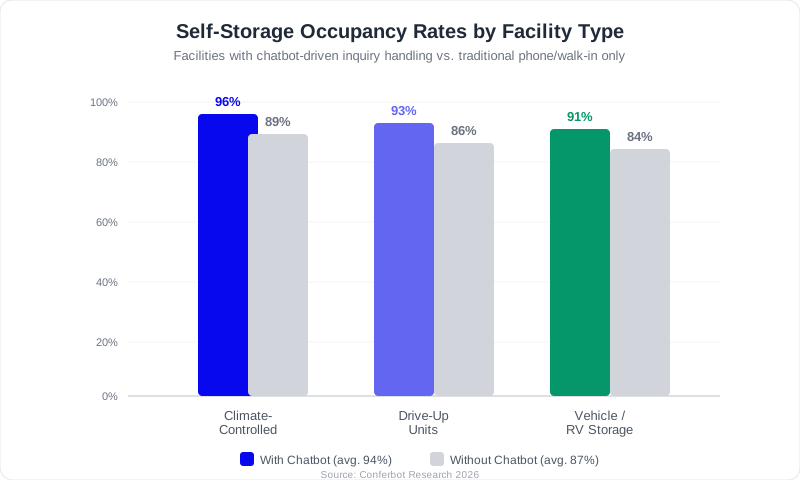 benchmark at 92% nationally compared by facility type showing chatbot-equipped facilities at 94% average versus 87% for traditional facilities' loading='lazy' style='max-width:100%;border-radius:12px;border:1px solid #e5e7eb' />
Occupancy Impact by Facility Type
The occupancy improvement from chatbot deployment varies by facility type, but the pattern is consistent across all categories. Climate-controlled facilities with chatbot-driven leasing achieve 96% average occupancy compared to 89% without — a 7-point improvement that represents 35 additional occupied units on a 500-unit facility. Drive-up facilities see improvement from 86% to 93%, and vehicle/RV storage from 84% to 91%. The climate-controlled category shows the largest improvement because the chatbot's unit recommendation engine actively guides prospects toward climate-controlled options with value-based reasoning, filling premium inventory that might otherwise sit vacant while standard units fill first.
Conversion Funnel Performance
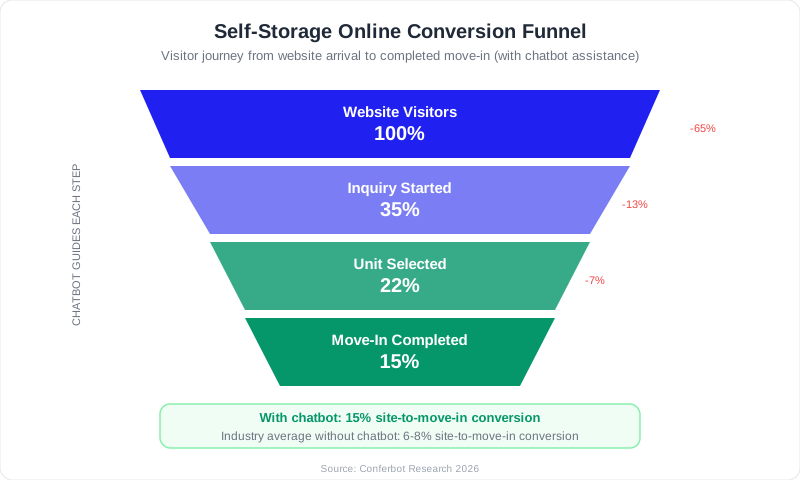
The conversion funnel for chatbot-equipped facilities shows dramatic improvement over traditional websites. Of every 100 website visitors, 35 engage with the chatbot and start an inquiry (compared to 8-12% who fill out a contact form on a non-chatbot site). Of those 35, 22 complete the unit recommendation process and select a specific unit. Of those 22, 15 complete the online move-in process. This 15% website-to-move-in conversion rate is nearly 2.5 times the industry average of 6-8% for facilities without chatbot assistance.
The drop-off between each stage provides optimization opportunities. The largest drop — from website visitor to inquiry started (65% drop-off) — is primarily driven by visitors who are just browsing or researching and are not ready to engage. The chatbot's greeting message and value proposition determine how many of these browsers convert to engaged inquiries. The smallest drop — from unit selected to move-in completed (7% drop-off) — indicates that once a prospect has chosen a specific unit, the online move-in flow successfully captures the majority. Optimization efforts should focus on the inquiry-to-selection stage, where prospects who engage but do not select a unit may need better size guidance or pricing transparency.
Revenue Impact at Scale
For a multi-facility operator managing 10 locations with 500 units each (5,000 total units), the chatbot's impact scales proportionally. A 7% occupancy improvement across the portfolio means 350 additional occupied units generating approximately $47,250 per month in incremental revenue ($567,000 annually). Add the per-facility savings from reduced phone calls, lower delinquency, and higher ancillary revenue (insurance, climate control upgrades), and the portfolio-level annual impact exceeds $900,000 — against a total chatbot deployment cost of approximately $30,000-$50,000 per year across all 10 locations. For more on how chatbots drive revenue in real estate, see our chatbot for real estate guide.
Climate Control Upselling and Insurance Attachment: Two Revenue Multipliers
Beyond the core rental revenue from occupancy improvement, a self-storage chatbot drives two significant ancillary revenue streams: climate-controlled unit upgrades and tenant protection plan (insurance) attachment. These are high-margin revenue sources that depend heavily on how they are presented to the customer — and a conversational chatbot presents them far more effectively than a static pricing page or a rushed in-office explanation.
The Climate Control Upsell
Climate-controlled units command a 25-50% monthly premium over standard units of the same size. A 10x10 standard drive-up unit might rent for $129/month while the climate-controlled version rents for $159/month — a $30/month premium that represents nearly pure margin since the incremental cost of climate control (HVAC for a shared building) is spread across dozens of units. Filling climate-controlled inventory is therefore a top priority for revenue optimization.
The chatbot identifies climate control upsell opportunities based on what the prospect says they are storing. When the items include wooden furniture, electronics, leather goods, artwork, photographs, musical instruments, wine, or important documents, the chatbot presents a climate control recommendation with specific reasoning:
- 'You mentioned storing a leather couch and wooden dining set. Leather can crack and wood can warp in temperature extremes — inside a standard unit, temperatures can swing from 20 degrees in winter to 120+ degrees in summer. A climate-controlled unit stays between 55-80 degrees year-round. The upgrade is $30/month more — about $1/day to protect furniture that costs thousands to replace.'
- 'Electronics like TVs and computers are sensitive to humidity. Moisture buildup in a non-climate unit can cause corrosion and short circuits. Climate control keeps humidity below 50%, protecting your electronics for $35/month more than a standard unit.'
This value-framed, item-specific approach converts at dramatically higher rates than simply listing two prices on a webpage. Facilities using chatbot-driven climate control recommendations see 38% of eligible tenants choosing climate-controlled units, compared to 22% when the option is presented on a static pricing page — a 73% improvement in upsell conversion.
Tenant Protection Plan (Insurance) Attachment
Storage insurance is the highest-margin ancillary product in self-storage. The facility acts as an insurance agent, collecting $8-15/month per tenant for coverage against theft, fire, water damage, and natural disasters. The actual insurance premium paid to the underwriter is typically $2-4/month, leaving $6-11/month in pure profit per insured tenant. On a 500-unit facility at 90% occupancy (450 tenants), increasing insurance attachment from 32% to 61% adds 131 insured tenants generating approximately $10,500-$17,000 in annual insurance profit.
The chatbot presents insurance at the optimal decision point — after the tenant has selected a unit and is completing the move-in process, when they are already in a buying mindset. The presentation includes: coverage amount, monthly cost, what is covered (theft, fire, water, natural disaster), what is not covered (pest damage, mold from tenant negligence), and a key insight that most people do not realize: 'Most homeowner's and renter's insurance policies do not cover items stored off-premises. That means your belongings in storage may have zero insurance coverage right now. For $11/month, you get $5,000 in coverage — peace of mind that your stored items are protected.'
This educational approach — informing the tenant that they likely have a coverage gap rather than simply asking 'Do you want insurance?' — drives attachment rates of 55-65% through the chatbot, compared to 30-40% through traditional paper or online forms where insurance is presented as a checkbox without context.
Implementation Guide: Deploying a Self-Storage Chatbot in 5 Steps
Deploying a self-storage chatbot is a straightforward process that does not require development resources or facility management software expertise. The implementation timeline from initial setup to live deployment is typically 1-2 weeks, with the first results visible within days of going live.
Step 1: Facility Configuration (Day 1-2)
Set up your facility profile in the Conferbot chatbot builder: facility name, address, office hours, access hours, phone number, and branding (colors, logo). Configure the chatbot greeting message — this is the first thing every website visitor sees, so it should communicate value immediately: 'Welcome to [Facility Name]! I can help you find the right storage unit, check pricing and availability, or help you move in right now — 24/7, no appointment needed.'
Step 2: Inventory and Pricing Setup (Day 2-3)
Enter your unit inventory: each unit size offered, the type (standard, climate-controlled, drive-up, vehicle), current monthly rates, and active promotions. If you integrate with SiteLink, storEDGE, Yardi, or another management platform, this data syncs automatically and stays current as units are rented and vacated. If configuring manually, build a pricing table that covers all unit sizes and types with their rates, promotional offers, and any seasonal pricing adjustments.
Step 3: Move-In Flow Configuration (Day 3-5)
Configure the online move-in process: your rental agreement (upload for electronic presentation), admin fee amount, security deposit policy, insurance options with pricing tiers, autopay enrollment terms, and payment processing gateway. Test the complete flow from unit selection through access code delivery to ensure every step works correctly. Pay special attention to the payment processing step — a failed payment creates frustration and abandonment.
Step 4: Tenant Self-Service Setup (Day 5-7)
Build the current-tenant experience: payment reminder schedule, gate code retrieval verification process, unit transfer request workflow, move-out notice form, and FAQ content. Enter answers for the 20-30 most common questions your staff handles: access hours, holiday schedule, late fees, prohibited items, pest control, payment methods, and facility amenities. Each FAQ entry eliminates a future phone call.
Step 5: Deploy and Monitor (Day 7-14)
Embed the chatbot on your facility website: homepage, pricing page, unit size guide, contact page, and any Google Ads landing pages. Set up email notifications for new move-ins, move-out notices, and transfer requests. Configure SMS alerts for after-hours move-ins so your manager knows when revenue is being captured overnight. Monitor the analytics dashboard for the first two weeks: engagement rate, recommendation completion rate, move-in conversion rate, and common questions the chatbot could not answer (which indicate FAQ gaps to fill).
Ongoing Optimization
After the initial deployment, optimize continuously based on data. Review the conversion funnel weekly to identify where prospects drop off. Update promotions as they change. Add FAQ answers for new questions that emerge. Monitor insurance attachment rates and test different presentation messages. The chatbot is a living system that improves over time as you refine its conversations based on actual tenant interactions. Most facilities see measurable occupancy improvement within 30 days and full ROI within 1-2 weeks of deployment.
ROI Analysis: The Economics of Self-Storage Chatbot Deployment
Self-storage chatbot ROI is straightforward to calculate because the revenue drivers are direct and measurable -- tracked by industry benchmarks from Inside Self-Storage --: additional move-ins, higher ancillary revenue, reduced delinquency, and operational time savings. Here is the transparent analysis for a typical 500-unit facility.
Investment
| Cost Category | Amount |
|---|---|
| Chatbot platform (Conferbot) | $99-$299/month |
| Setup and customization | $0 (DIY with no-code builder) |
| Management software integration | Included (SiteLink, storEDGE, Yardi) |
| Monthly maintenance | 1-2 hours/month |
Annual cost: $1,188-$3,588
Returns (Annual, 500-Unit Facility)
| Revenue Driver | Before Chatbot | With Chatbot | Annual Impact |
|---|---|---|---|
| After-hours move-ins (net new) | 0/month | 4/month | +$45,360 (lifetime value) |
| Vacancy gap reduction (18→9 days) | 18 days avg | 9 days avg | +$10,125 |
| Climate control upsell increase | 22% attachment | 38% attachment | +$19,200 |
| Insurance attachment increase | 32% attachment | 61% attachment | +$9,570 |
| Delinquency reduction (10.5%→6.8%) | 46 delinquent | 30 delinquent | +$8,000 saved |
| Manager time saved (2.7 hrs/day) | 4.5 hrs phone/day | 1.8 hrs phone/day | +$19,710 (labor value) |
Total annual impact: $111,965 against a chatbot cost of $1,188-$3,588/year.
Return on investment: 31x to 94x in the first year.
The ROI is so compelling because the chatbot addresses multiple revenue and cost levers simultaneously. Even if only one or two of these drivers materialize at the projected levels, the chatbot still delivers 10x+ returns. And unlike a marketing campaign that requires ongoing spend to maintain results, the chatbot's value compounds over time as it captures more data, handles more scenarios, and becomes a more integral part of the facility's operations.
The Payback Period
At the most conservative estimate — capturing just one additional after-hours move-in per week at $135/month — the chatbot generates $540/month in incremental revenue. Against a $99-$299/month platform cost, the payback period is effectively day one. The chatbot pays for itself before the end of its first billing cycle, and every subsequent day of operation generates pure incremental value for the facility.
Was this article helpful?
About the Author

Conferbot Team specializes in conversational AI, chatbot strategy, and customer engagement automation. With deep expertise in building AI-powered chatbots, they help businesses deliver exceptional customer experiences across every channel.
View all articles