What Are AI Chatbot Hallucinations and Why Should You Care?
An AI chatbot hallucination occurs when a language model generates a response that sounds confident and fluent but contains information that is factually incorrect, fabricated, or not grounded in any source data. The term "hallucination" is borrowed from cognitive science -- the model "perceives" information that does not exist, much like a visual hallucination in humans. Unlike simple errors or bugs, hallucinations are insidious because they are delivered with the same tone and confidence as correct answers, making them difficult for end users to detect.
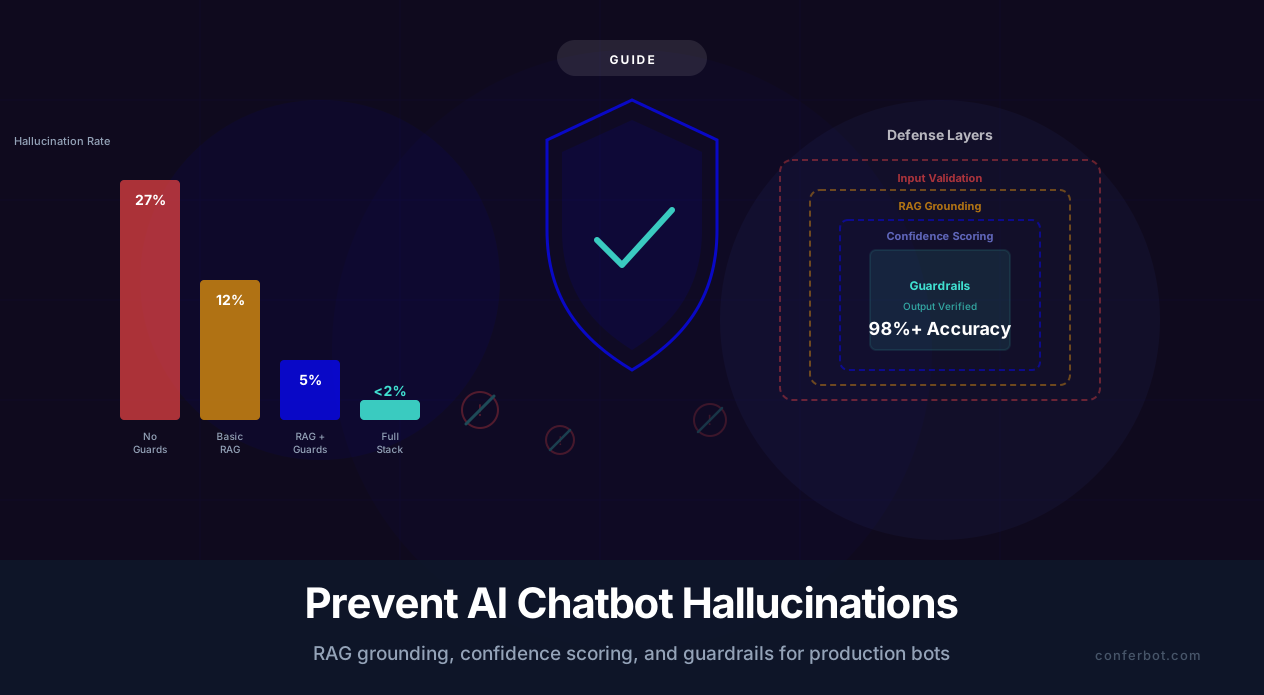
For businesses deploying customer-facing chatbots, hallucinations are not a theoretical concern -- they are a measurable operational risk. According to research from Stanford's Human-Centered AI Institute (HAI), large language models hallucinate in approximately 15-27% of their responses when operating without retrieval grounding or guardrails. A separate study published by IBM Research found that hallucination rates vary significantly by domain, with medical and financial queries producing higher rates due to the models' tendency to generate plausible-sounding but unverified claims.
The business consequences are direct and quantifiable. A hallucinating chatbot can quote incorrect pricing, fabricate product features that do not exist, provide inaccurate shipping timelines, or offer refund terms that contradict your actual policy. Each of these incidents creates a customer service escalation, a potential legal exposure, and erosion of the brand trust you have spent years building. In regulated industries like healthcare, finance, and insurance, a single hallucinated response can trigger compliance violations with substantial penalties.

The good news is that hallucination is a solved problem for production chatbots -- not by eliminating it entirely from the underlying language model, but by implementing a layered defense system that catches, prevents, and mitigates hallucinations before they reach your customers. The strategies in this guide, when implemented together, can reduce your chatbot's hallucination rate from the 15-27% baseline to below 3%. Platforms like Conferbot's AI chatbot builder bake many of these protections into the platform itself, so you do not need a machine learning team to deploy them.
Before diving into solutions, it is important to understand the different types of hallucinations, because each type requires a different mitigation strategy.
Types of Chatbot Hallucinations
| Type | Description | Example | Risk Level |
|---|---|---|---|
| Factual fabrication | The model invents facts, statistics, or details that do not exist | "Our product was rated #1 by Consumer Reports in 2025" (no such rating exists) | High |
| Source conflation | The model combines information from unrelated sources into a single answer | Mixing features from two different product tiers into one description | High |
| Temporal confusion | The model applies outdated information as if it were current | Quoting a discontinued discount or an expired promotion | Medium |
| Overconfident extrapolation | The model extends known information beyond its actual scope | Claiming a feature works on all platforms when documentation only covers web | Medium |
| Entity substitution | The model substitutes a related but incorrect entity | Attributing a competitor's feature to your product | High |
| Instruction non-compliance | The model ignores system instructions and generates unrestricted content | Providing medical advice when instructed to only discuss products | Critical |
Each subsequent section of this guide addresses specific strategies that target one or more of these hallucination types, building toward a comprehensive defense-in-depth approach.
RAG Grounding: The Foundation of Hallucination Prevention
Retrieval-Augmented Generation (RAG) is the single most impactful technique for preventing chatbot hallucinations in business applications. By requiring the language model to generate answers based on retrieved source documents rather than its pre-trained knowledge alone, RAG fundamentally changes the model's behavior from "generate plausible text" to "synthesize an answer from provided evidence." Research from Google DeepMind has demonstrated that RAG architectures reduce hallucination rates by 60-80% compared to ungrounded generation, depending on the quality of the retrieval system and the underlying knowledge base.
The principle is straightforward: when a customer asks "What is your return policy?", the chatbot does not rely on whatever the language model "remembers" from its training data. Instead, it searches your actual return policy document, retrieves the relevant paragraphs, and generates an answer grounded in that specific text. If the return policy document does not exist or does not cover the query, the chatbot can recognize the gap and respond accordingly rather than improvising.
How RAG Prevents Each Hallucination Type
- Factual fabrication: The model can only cite information present in retrieved documents. If the fact is not in your knowledge base, it cannot be fabricated (assuming proper guardrails).
- Source conflation: Retrieved chunks are tagged with their source document, allowing the model to keep information from different sources separate.
- Temporal confusion: Your knowledge base contains only current information (assuming regular maintenance). Outdated data is either removed or archived.
- Overconfident extrapolation: When the retrieved content does not support a broader claim, the model is constrained to the scope of what was actually retrieved.
If you have already followed our guide to training your chatbot on a knowledge base, you have the RAG foundation in place. The focus here is on optimizing that RAG implementation specifically for hallucination prevention.
Optimizing Your RAG Pipeline for Accuracy
Not all RAG implementations are equally effective at preventing hallucinations. The following configuration choices have the largest impact on factual accuracy:
| Configuration | Anti-Hallucination Setting | Why It Helps |
|---|---|---|
| Chunk size | 512-768 tokens (larger for technical content) | Larger chunks provide more context, reducing out-of-context interpretation |
| Retrieval count | 4-6 chunks (up from typical default of 3) | More retrieved chunks provide corroborating evidence and reduce single-source dependency |
| Similarity threshold | 0.80+ (strict) | Only highly relevant documents are used, reducing noise that can trigger hallucination |
| Re-ranking | Enable cross-encoder re-ranking | Second-stage ranking filters out topically similar but contextually irrelevant chunks |
| Metadata filtering | Filter by document type, product, or date | Narrows retrieval scope to the most appropriate documents |

The "Cite or Decline" Instruction Pattern
The single most effective prompt engineering technique for hallucination prevention is what we call the "cite or decline" pattern. In your chatbot's system prompt, include an explicit instruction like:
"Answer the user's question using ONLY the information provided in the retrieved documents below. If the retrieved documents do not contain sufficient information to answer the question, respond with: 'I don't have specific information about that in my knowledge base. Let me connect you with our team for an accurate answer.' Never fabricate information, statistics, URLs, or product details that are not explicitly stated in the retrieved documents."
This instruction pattern works because it gives the model a clear, unambiguous fallback behavior. Without it, models default to their training -- which is to always produce a helpful-sounding answer, even when they lack the information to do so. With the instruction, the model has explicit permission (and direction) to decline rather than hallucinate. Conferbot's builder includes this pattern by default in all RAG-powered chatbots.
Document Quality: The Often-Overlooked Factor
The effectiveness of RAG is only as good as the documents it retrieves. Common document-quality issues that increase hallucination risk include:
- Contradictory information across documents: If your help center says 30-day returns but your checkout page says 14 days, the model may cite either version or attempt to reconcile them by inventing a policy.
- Ambiguous language: Vague phrases like "competitive pricing" or "industry-leading support" give the model room to fill in specifics that do not exist.
- Incomplete coverage: Partial answers are worse than no answers. If your shipping policy covers domestic but not international, the model may extrapolate international terms.
The fix for all three is a rigorous content audit, as described in our knowledge base training guide. For hallucination prevention specifically, focus on eliminating contradictions and ensuring every document makes complete, unambiguous statements. Monitor your chatbot's performance through Conferbot's analytics dashboard to identify which topics generate the most escalations, as these often trace back to document quality issues.
Confidence Scoring and Dynamic Thresholds
Confidence scoring is the mechanism by which a chatbot assesses how reliable its own answer is before delivering it to the user. Think of it as an internal quality check that runs on every response. When the confidence score falls below a defined threshold, the chatbot takes a different action -- such as adding a disclaimer, requesting clarification, or escalating to a human agent -- rather than delivering a potentially hallucinated answer with full confidence.
Modern RAG-based chatbot platforms compute confidence at two levels:
- Retrieval confidence: How semantically similar are the retrieved documents to the user's query? Measured as a similarity score (typically 0.0 to 1.0). A retrieval confidence of 0.92 means the system found highly relevant documents; 0.55 means it scraped together tangentially related content.
- Generation confidence: How certain is the language model about its generated answer given the retrieved context? This can be estimated from token-level probabilities, though it is a less mature metric.
For hallucination prevention, retrieval confidence is the more reliable signal. If the system cannot find closely matching source documents, any answer it generates is at high risk of hallucination -- regardless of how confident the generation model appears.
Setting Up a Three-Tier Confidence System
Rather than a single pass/fail threshold, implement a three-tier system that provides graduated responses based on confidence levels:
| Tier | Retrieval Score | Chatbot Behavior | User Experience |
|---|---|---|---|
| High confidence | 0.85+ | Deliver answer directly with optional source citation | Seamless, fast response |
| Medium confidence | 0.65-0.84 | Deliver answer with softening language and offer human follow-up | "Based on our documentation, [answer]. Would you like me to have a team member confirm this?" |
| Low confidence | Below 0.65 | Do not attempt to answer; route to human or request clarification | "I want to make sure you get accurate information. Let me connect you with our team." |
This tiered approach balances user experience (fast answers when confident) with accuracy protection (human fallback when uncertain). The thresholds above are starting points -- you should calibrate them based on your specific domain and risk tolerance.
Calibrating Thresholds for Your Domain
Different industries and use cases require different confidence thresholds. A product recommendation chatbot can tolerate lower confidence (the cost of a slightly off suggestion is low), while a healthcare chatbot needs extremely high thresholds (the cost of an incorrect answer is significant). Here are domain-specific recommendations:
| Domain | Recommended High Threshold | Recommended Low Threshold | Rationale |
|---|---|---|---|
| E-commerce (product info) | 0.80 | 0.60 | Moderate risk; wrong product details cause returns |
| Customer support (general) | 0.82 | 0.62 | Moderate risk; wrong process instructions waste time |
| Financial services | 0.90 | 0.75 | High risk; incorrect financial info has legal implications |
| Healthcare | 0.92 | 0.80 | Critical risk; medical misinformation is dangerous |
| Legal | 0.90 | 0.78 | High risk; incorrect legal guidance creates liability |
| Internal HR/IT | 0.78 | 0.58 | Lower risk; employees can verify with IT directly |
To calibrate your specific thresholds, run a test batch of 100+ diverse queries through your chatbot and manually label each answer as correct, partially correct, or hallucinated. Then plot the retrieval confidence scores against the accuracy labels. You will see a natural breakpoint where hallucination frequency spikes -- set your low-confidence threshold just above that breakpoint. This data-driven calibration is far more effective than guessing, and Conferbot's analytics surfaces the retrieval confidence distribution automatically.
Dynamic Thresholds Based on Topic
Advanced implementations adjust confidence thresholds dynamically based on the detected topic of the query. For example, a chatbot for a bank might use a standard 0.82 threshold for general account questions but automatically raise it to 0.92 for questions about interest rates, fees, or regulatory disclosures. This is accomplished by maintaining a topic-to-threshold mapping and using intent classification to route each query to the appropriate threshold level.
This nuanced approach prevents the chatbot from being overly cautious on safe topics (which degrades user experience) while maintaining strict accuracy on high-stakes topics (which protects the business). It requires more setup, but for businesses in regulated industries, the investment pays for itself in reduced compliance incidents.
Guardrails and Output Validation Layers
Even with excellent RAG grounding and confidence scoring, hallucinations can slip through. Guardrails provide an additional defensive layer by validating the chatbot's output before it reaches the user. Think of guardrails as a quality control checkpoint on the assembly line -- they catch defects that upstream processes miss.
Effective guardrails operate at multiple levels and can be implemented without deep machine learning expertise. Research from the National Institute of Standards and Technology (NIST) on AI risk management frameworks recommends layered validation as a core component of trustworthy AI deployment.
Types of Guardrails
1. Output Consistency Checks
Compare the chatbot's generated answer against the retrieved source documents to verify that the answer does not introduce information not present in the sources. This can be implemented as a simple entailment check: does the source text entail (support) the claims in the generated answer? If the answer contains claims not supported by any retrieved document, flag it for review or suppress it.
2. Entity and Fact Validation
Extract specific entities from the chatbot's response -- prices, dates, percentages, product names, policy terms -- and verify them against your knowledge base or a structured database. For example, if the chatbot says "Our Pro plan costs $49/month," validate that figure against your actual pricing database. This catches the most dangerous class of hallucination: fabricated specifics that users are likely to act on.
3. Blocklist and Allowlist Filters
- Blocklist: Prevent the chatbot from ever mentioning competitor names, making legal promises ("we guarantee"), providing medical/financial advice, or sharing internal information. Any response containing blocklisted terms is intercepted and either rewritten or replaced with a safe fallback.
- Allowlist: For critical data like pricing, product names, and feature lists, maintain an allowlist of approved values. If the chatbot generates a value not on the allowlist, it is flagged.
4. Tone and Scope Guardrails
Ensure the chatbot stays within its defined persona and topic scope. If a customer support chatbot suddenly starts giving investment advice or discussing politics, a scope guardrail detects the off-topic drift and redirects the conversation. This prevents the instruction non-compliance type of hallucination described earlier.

Implementing Guardrails in Practice
For teams using Conferbot, many of these guardrails are built into the platform:
- Scope restriction: Configure the chatbot to only answer questions related to your knowledge base topics
- Fallback behavior: Define what happens when the chatbot is uncertain -- static message, live chat handoff, or ticket creation
- Content moderation: Automatic detection and filtering of inappropriate content in both user inputs and bot outputs
- Custom instructions: Define specific rules the chatbot must follow ("never discuss competitor pricing," "always recommend speaking to a doctor for medical questions")
For teams building custom chatbots, open-source guardrail frameworks like NeMo Guardrails (from NVIDIA) and Guardrails AI provide pre-built validation pipelines that can be integrated into your inference stack. These frameworks allow you to define guardrail rules in configuration files without writing complex validation logic from scratch.
The Performance Trade-Off
Every guardrail layer adds latency to the response. A typical three-layer guardrail system (input validation, output consistency check, entity verification) adds 200-500ms to response time. For most business chatbots, this trade-off is acceptable -- users prefer a slightly slower but accurate answer over an instant but potentially wrong one. However, if latency is critical, implement guardrails asynchronously: deliver the response immediately but flag potentially problematic answers for post-hoc review, and retroactively correct them if the user is still in the session.
Testing Frameworks and Hallucination Benchmarks
You cannot manage hallucination risk without measuring it. A structured testing framework gives you a repeatable process for quantifying your chatbot's hallucination rate, tracking improvements over time, and catching regressions before they impact users. This section provides a complete testing methodology that any business can implement, regardless of technical sophistication.
The Hallucination Testing Protocol
Build a test suite of at least 200 questions organized into five categories. Run this suite after every significant change to your knowledge base, RAG configuration, or prompt engineering:
| Category | Count | Purpose | Hallucination Risk |
|---|---|---|---|
| Direct knowledge base questions | 60 | Verify accurate retrieval and generation for well-covered topics | Low |
| Paraphrased and colloquial questions | 40 | Test robustness to natural language variation | Medium |
| Edge-of-knowledge questions | 40 | Questions where the knowledge base has partial coverage | High |
| Out-of-scope questions | 30 | Questions the chatbot should decline to answer | Critical |
| Adversarial prompts | 30 | Attempts to trigger hallucination through prompt manipulation | Critical |
Scoring Methodology
For each test question, evaluate the chatbot's response using this four-point scale:
- Fully correct (3 points): Answer is accurate, complete, and grounded in the knowledge base
- Partially correct (2 points): Core answer is correct but includes minor inaccuracies or unnecessary extrapolation
- Declined appropriately (2 points): Chatbot correctly identified it cannot answer and offered an appropriate fallback
- Hallucinated (0 points): Answer contains fabricated information, invented statistics, or claims not supported by the knowledge base
Your overall hallucination rate is: (number of hallucinated responses / total responses) x 100. Track this metric over time. Industry benchmarks for well-implemented business chatbots:
| Performance Level | Hallucination Rate | Typical Setup |
|---|---|---|
| Excellent | Below 2% | RAG + guardrails + confidence scoring + regular testing |
| Good | 2-5% | RAG + basic guardrails + periodic testing |
| Acceptable | 5-10% | RAG with minimal guardrails |
| Unacceptable for production | Above 10% | No grounding or insufficient knowledge base |
According to a 2025 benchmark study published by researchers at arXiv (Huang et al., "A Survey on Hallucination in Large Language Models"), RAG-grounded systems with proper guardrails consistently achieve hallucination rates in the 1-5% range across diverse domains, compared to 15-27% for ungrounded systems. The study analyzed over 30 commercial and open-source LLMs across question answering, summarization, and dialogue tasks.

Automated Testing with Evaluation Pipelines
Manual evaluation does not scale beyond the initial test suite. For ongoing monitoring, implement automated evaluation using one of these approaches:
- Reference-based evaluation: Compare the chatbot's answer against a known-correct reference answer using semantic similarity metrics (BERTScore, ROUGE). This works well for questions with clear, factual answers.
- Entailment-based evaluation: Use a natural language inference (NLI) model to check whether the retrieved source documents entail the chatbot's answer. If the answer is not entailed by the sources, flag it as a potential hallucination.
- LLM-as-judge: Use a separate language model to evaluate whether the chatbot's answer is faithful to the retrieved context. This approach, documented extensively in the research literature, achieves 80-90% agreement with human evaluators at a fraction of the cost.
For Conferbot users, the analytics dashboard tracks key accuracy metrics automatically, including resolution rate, escalation patterns, and user satisfaction scores that serve as proxy indicators for hallucination issues. Combine platform analytics with periodic manual test suite runs for a comprehensive quality assurance program.
Human-in-the-Loop Fallbacks: The Safety Net
No matter how sophisticated your grounding, scoring, and guardrail systems are, there will always be edge cases where the chatbot encounters a query it cannot handle accurately. The human-in-the-loop (HITL) fallback is your final safety net -- the mechanism that ensures a human expert reviews and handles conversations that exceed the chatbot's reliable capacity.
HITL is not a sign of chatbot failure; it is a design feature. The best-performing business chatbots are explicitly designed to recognize their own limitations and seamlessly transfer to humans when needed. According to IBM's research on enterprise AI deployment, organizations that implement structured human fallback mechanisms see 40% higher customer satisfaction scores compared to those that let chatbots attempt every query autonomously.
Designing Effective Escalation Triggers
The key is defining clear, measurable triggers that initiate human handoff. Use a combination of signals rather than relying on any single indicator:
- Low retrieval confidence: As discussed in the confidence scoring section, queries where retrieval confidence falls below your low threshold should route to humans
- User sentiment signals: Detecting frustration through language patterns ("this isn't helping," "let me talk to a person," repeated rephrasing of the same question) should trigger immediate escalation
- Topic-based escalation: Certain topics should always route to humans regardless of confidence -- billing disputes, complaints, legal questions, safety concerns
- Repeat query detection: If a user asks the same question three or more times (possibly rephrased), the chatbot is clearly not providing a satisfactory answer
- Multi-turn confusion: If the conversation exceeds a threshold number of turns without resolution, escalate
The Context-Preserving Handoff
The worst user experience is being transferred to a human agent and having to repeat everything from scratch. A well-designed handoff passes the full conversation context to the human agent, including:
- The complete conversation transcript
- The user's original question and any clarifications
- What the chatbot attempted to answer and what it could not
- The retrieval confidence scores and which knowledge base documents were consulted
- Any customer data the chatbot has collected (name, email, order number)
With Conferbot's live chat integration, this context transfer happens automatically. The human agent sees the full conversation history and can pick up exactly where the chatbot left off, creating a seamless experience for the customer.
The Feedback Loop: Learning From Escalations
Every human escalation is a learning opportunity. Track why conversations are escalated and use that data to improve the chatbot:
| Escalation Reason | Fix | Timeline |
|---|---|---|
| Knowledge gap (topic not in KB) | Create new knowledge base content | 1-2 days |
| Outdated information | Update the relevant knowledge base document | Same day |
| Retrieval failure (content exists but was not found) | Improve document titles, add synonyms, adjust chunking | 1-3 days |
| Complex multi-step query | Create a dedicated workflow or decision tree | 1-2 weeks |
| Emotional/sensitive situation | Add sentiment-based escalation trigger | Same day |
The most effective teams review escalation data weekly and close 3-5 knowledge gaps per week. Over time, this reduces escalation volume while simultaneously improving the chatbot's accuracy. See our detailed guide on chatbot-to-human handoff best practices for implementation specifics including message templates and SLA routing.
Prompt Engineering Techniques That Reduce Hallucination
The system prompt is the chatbot's operating manual -- the set of instructions that shape how it interprets queries and generates responses. Well-crafted prompt engineering can reduce hallucination rates by 30-50% even without changes to the RAG pipeline or guardrails, making it one of the highest-leverage interventions available.
Core Anti-Hallucination Prompt Patterns
1. Explicit Grounding Instructions
The most fundamental pattern is explicitly instructing the model to ground its answers in the provided context. Instead of a vague instruction like "be helpful and accurate," use specific, unambiguous language:
- "Answer ONLY using information from the documents provided below. Do not use your general knowledge."
- "If the provided documents do not contain the answer, say so. Do not guess or extrapolate."
- "Every factual claim in your response must be directly supported by a passage in the retrieved context."
2. The "I Don't Know" Permission Pattern
Language models are trained to be helpful, which means they default to providing an answer even when they should not. Explicitly giving the model permission to say "I don't know" significantly reduces hallucination on out-of-knowledge queries:
"It is perfectly acceptable to tell the user you don't have that information. Saying 'I'm not sure about that, but I can connect you with our team' is always better than providing an uncertain answer. Our customers trust accurate information over fast answers."
3. Step-by-Step Reasoning (Chain of Thought)
Instructing the model to reason through its answer step by step reduces hallucination on complex queries by forcing it to show its work. When the model has to articulate why it believes something is true, it is less likely to make unsupported leaps:
"Before answering, identify which retrieved documents are relevant to the question. Quote the specific passage(s) that support your answer. If no passage directly supports the answer, acknowledge the gap."
4. Output Format Constraints
Constraining the output format reduces hallucination by limiting the degrees of freedom the model has in its response. Instead of open-ended generation, require structured outputs:
- "Respond in this format: [Answer]: your answer here. [Source]: the document title the answer came from."
- For pricing queries: "Only provide prices that exactly match the figures in the retrieved pricing document. Format as: [Plan Name]: $[Exact Price]/[Period]."
Prompt Engineering Mistakes That Increase Hallucination
Certain common prompt engineering practices actually increase hallucination risk:
| Mistake | Why It Increases Hallucination | Fix |
|---|---|---|
| "Be creative and engaging" | Encourages the model to embellish and add unsupported detail | "Be accurate and clear. Use a friendly tone but never add information not in the source documents." |
| "You are an expert in [domain]" | Encourages the model to draw on general domain knowledge rather than retrieved documents | "You are a customer support assistant. Your knowledge comes exclusively from the company documents provided." |
| Providing example answers with fabricated details | Few-shot examples with made-up facts teach the model that fabrication is acceptable | Use only real, verified examples in few-shot prompts |
| No explicit fallback instruction | Without a defined fallback, the model will always attempt to answer | Always define what the chatbot should do when it doesn't know |
Remember that prompt engineering is an iterative process. Test each change against your hallucination test suite (described in the testing section) to verify it actually improves accuracy. What works for one domain may not work for another, so data-driven iteration is essential. If you are building with Conferbot, the platform provides prompt templates pre-optimized for accuracy that you can customize for your specific use case.
Monitoring and Catching Hallucinations in Production
Pre-launch testing is essential, but hallucinations in production are inevitable because real users ask questions you never anticipated, your knowledge base evolves, and the distribution of queries shifts over time. A robust monitoring system catches hallucinations quickly, minimizes their impact, and feeds insights back into your prevention pipeline.
Real-Time Monitoring Signals
Set up automated monitoring for these leading indicators of hallucination in production:
- Retrieval confidence distribution shift: If the average retrieval confidence score drops over a week, it means your knowledge base is becoming less aligned with incoming queries. This is an early warning that hallucination rates are likely increasing.
- Escalation rate spike: A sudden increase in human handoff rate signals that the chatbot is failing on more queries than usual. Investigate the specific topics being escalated.
- User satisfaction drop: A decline in CSAT or thumbs-up ratings correlates with increased hallucination. Users notice when answers feel "off" even if they cannot identify the specific error.
- Repeat query rate: If users are asking the same question multiple times in a single session, the chatbot's answer is not satisfying their information need.
- Conversation length increase: Longer conversations (more turns per session) often indicate the chatbot is providing incomplete or inaccurate answers that require follow-up clarification.
The Monitoring Dashboard
Build or configure a dashboard that tracks these metrics daily. Using Conferbot's analytics, you can set up alerts for threshold breaches:
| Metric | Alert Threshold | Action When Triggered |
|---|---|---|
| Average retrieval confidence | Drops below 0.78 | Review recent knowledge base changes; audit low-confidence queries |
| Human escalation rate | Exceeds 25% of conversations | Analyze escalation reasons; prioritize knowledge gaps |
| CSAT score | Drops below 3.8/5.0 | Review negative feedback conversations; identify hallucination patterns |
| Repeat query rate | Exceeds 15% of sessions | Audit repeated questions; improve answers or add missing content |
| Average turns per session | Increases by 20% week-over-week | Investigate whether increased turns correlate with specific topics |

Post-Hoc Hallucination Detection
In addition to real-time signals, run periodic batch analysis on conversation logs to detect hallucinations that slipped past real-time defenses:
- Random sampling: Review a random 5% sample of conversations weekly. For a chatbot handling 1,000 conversations per week, that is 50 conversations to review. Flag any responses that contain unverifiable claims.
- Automated entailment scanning: Run an NLI model over all chatbot responses to check whether they are entailed by the retrieved documents. Responses flagged as "not entailed" are hallucination candidates.
- User-reported issues: Provide a simple mechanism for users to flag incorrect answers (a thumbs-down button or "Report an issue" link). Every flag should trigger a human review.
Incident Response: When a Hallucination Gets Through
When a hallucination is discovered in production, follow this incident response process:
- Assess impact: How many users saw the hallucinated response? Was the misinformation acted upon (e.g., a user purchased based on incorrect pricing)?
- Correct the immediate issue: Update the knowledge base, adjust the prompt, or add a guardrail to prevent the specific hallucination from recurring.
- Notify affected users: If the hallucination was material (wrong pricing, incorrect policy information), proactively reach out to affected users with corrected information.
- Root cause analysis: Determine whether the hallucination was caused by a knowledge gap, a retrieval failure, a prompt issue, or a guardrail bypass. Fix the root cause, not just the symptom.
- Update your test suite: Add the hallucinated query to your test suite so it is checked in future regression testing.
This systematic approach transforms hallucination incidents from embarrassing failures into improvement opportunities, steadily hardening your chatbot against future occurrences.
Advanced Techniques: What Is Working in 2026
The field of hallucination mitigation is evolving rapidly. Beyond the foundational strategies covered above, several advanced techniques are gaining traction in 2026 for businesses that need the highest levels of factual accuracy.
1. Multi-Model Verification (Cross-Checking)
Run the same query through two different language models independently and compare their answers. If both models produce the same factual claims (grounded in the same retrieved documents), the probability of hallucination drops significantly. If they disagree, flag the response for human review. This technique is inspired by the "debate" approach described in AI safety research and is practical now that inference costs have dropped dramatically. A cross-check adds 100-200ms of latency and roughly doubles the token cost per query, making it most appropriate for high-stakes domains.
2. Fine-Tuned Hallucination Detectors
Rather than relying on general-purpose NLI models, some organizations are training dedicated hallucination detection models on their own chatbot data. These models learn the specific patterns of hallucination in your domain -- for example, the tendency to invent shipping timelines or fabricate feature availability. A fine-tuned detector trained on 1,000+ labeled examples from your own conversations can achieve 90%+ precision in identifying hallucinated responses.
3. Structured Knowledge Graphs
For domains with highly structured information (product catalogs, pricing tiers, policy rules), supplementing RAG with a structured knowledge graph dramatically reduces hallucination. Instead of retrieving paragraphs of text and letting the LLM synthesize an answer, the chatbot queries the knowledge graph for exact values (prices, dates, feature flags) and injects them into a template. The LLM only handles the natural language framing, not the factual content. This eliminates the opportunity for hallucination on structured data entirely.
4. Uncertainty Quantification Through Sampling
Generate multiple candidate answers for the same query (by sampling from the model multiple times with non-zero temperature) and measure agreement across candidates. High agreement (all samples say the same thing) correlates with high factual accuracy. Low agreement (samples contradict each other) correlates with hallucination. This technique, sometimes called "self-consistency checking," provides a model-intrinsic confidence signal that complements retrieval-based confidence scores.
5. Retrieval with Attribution
Next-generation RAG systems do not just retrieve documents -- they generate inline citations linking each claim to a specific passage in the knowledge base. The user sees the answer with clickable references (similar to academic citations), and the system can verify that every cited passage actually supports the claim it is attached to. Conferbot's platform supports source attribution, allowing users to verify the chatbot's claims against the original documents with a single click.
Choosing the Right Level of Investment
Not every business needs every technique. Here is a maturity model to guide your investment:
| Stage | Techniques | Typical Hallucination Rate | Cost and Effort |
|---|---|---|---|
| Foundation | RAG + cite-or-decline prompting + basic guardrails | 5-10% | Low (1-2 weeks) |
| Intermediate | + Confidence scoring + structured testing + HITL | 2-5% | Medium (2-4 weeks) |
| Advanced | + Cross-model verification + fine-tuned detectors + knowledge graphs | Below 2% | High (1-3 months) |
For most businesses deploying chatbots through platforms like Conferbot, the Foundation and Intermediate stages provide more than sufficient accuracy for production use. The Advanced stage is for organizations in regulated industries or those deploying chatbots in safety-critical applications where even a 2% error rate is unacceptable. Visit our pricing page to see which plan includes the accuracy and guardrail features your business needs.
Implementation Checklist: Your 30-Day Plan
Reducing hallucinations is not a one-time project but a continuous improvement cycle. This checklist provides a structured 30-day plan to implement the strategies covered in this guide, moving from quick wins to sustained excellence.
Week 1: Foundation (Days 1-7)
- Audit your knowledge base for contradictions, outdated information, and gaps (see the knowledge base training guide)
- Implement the "cite or decline" prompt pattern in your chatbot's system instructions
- Configure RAG retrieval settings: increase retrieval count to 4-6 chunks, set similarity threshold to 0.80+
- Set up a basic fallback message for low-confidence responses
- Build your initial hallucination test suite (50 questions minimum)
Week 2: Scoring and Guardrails (Days 8-14)
- Implement the three-tier confidence scoring system (high, medium, low)
- Calibrate confidence thresholds using your test suite results
- Add entity validation for critical data (prices, dates, product names)
- Set up blocklist filters for topics the chatbot should never address
- Expand your test suite to 100+ questions across all five categories
Week 3: Monitoring and Handoff (Days 15-21)
- Configure production monitoring dashboards with alert thresholds
- Implement human handoff triggers (low confidence, sentiment detection, topic escalation)
- Set up the escalation feedback loop: weekly review of escalated conversations
- Enable user feedback mechanisms (thumbs up/down, report issue)
- Run your full test suite and establish baseline hallucination rate
Week 4: Optimization and Process (Days 22-30)
- Analyze production data to identify top hallucination-prone topics
- Close the top 5 knowledge gaps identified through monitoring
- Refine confidence thresholds based on real production data
- Document your hallucination prevention procedures for the team
- Set recurring calendar reminders for weekly escalation review and monthly test suite runs
Ongoing Maintenance
| Frequency | Activity | Time |
|---|---|---|
| Weekly | Review escalation logs and close 3-5 knowledge gaps | 1-2 hours |
| Weekly | Check monitoring dashboard for metric anomalies | 15 minutes |
| Monthly | Run full hallucination test suite; track rate over time | 2-3 hours |
| Monthly | Audit and update guardrail rules | 1 hour |
| Quarterly | Full knowledge base accuracy audit | 4-8 hours |
Organizations that follow this systematic approach consistently achieve and maintain hallucination rates below 3% within 90 days, with continued improvement over time. The investment is modest -- roughly 4-6 hours per week of ongoing effort -- but the return in customer trust, reduced escalation costs, and compliance peace of mind is substantial.
If you are ready to deploy a hallucination-resistant chatbot for your business, Conferbot's AI chatbot builder provides RAG grounding, confidence scoring, and guardrails out of the box. You can explore the platform or review pricing plans to find the right fit for your team.
Was this article helpful?
How to Prevent AI Chatbot Hallucinations FAQ
Everything you need to know about chatbots for how to prevent ai chatbot hallucinations.
About the Author

Conferbot Team specializes in conversational AI, chatbot strategy, and customer engagement automation. With deep expertise in building AI-powered chatbots, they help businesses deliver exceptional customer experiences across every channel.
View all articles