
Abandoned Cart Recovery
Free Ecommerce and Retail Chatbot Template
Boost your e-commerce sales with Conferbot's Abandoned Cart Recovery Assistant. Experience increased conversion rates, personalized follow-up, and 24/7 support to reclaim lost sales and enhance customer retention.



What Is an Abandoned Cart Recovery Chatbot?
An abandoned cart recovery chatbot is an automated conversational tool that detects when a shopper has left your store with unpurchased items and re-engages them through timely, personalized messages to recover the sale. Unlike passive email reminders that sit unread in an inbox, a recovery chatbot delivers interactive prompts across the channels where shoppers are most active -- your website widget, WhatsApp, Facebook Messenger, and Instagram -- and invites them back into a live conversation.
Cart abandonment is the single largest source of recoverable revenue in e-commerce. In 2026, the average cart abandonment rate across industries sits at 69-75%, meaning roughly seven out of every ten shoppers who add a product to their cart leave without buying. For a store generating $100,000 per month in completed transactions, that figure implies nearly $230,000 in monthly revenue is walking out the door. A recovery chatbot captures a meaningful share of that lost revenue through intelligent re-engagement.
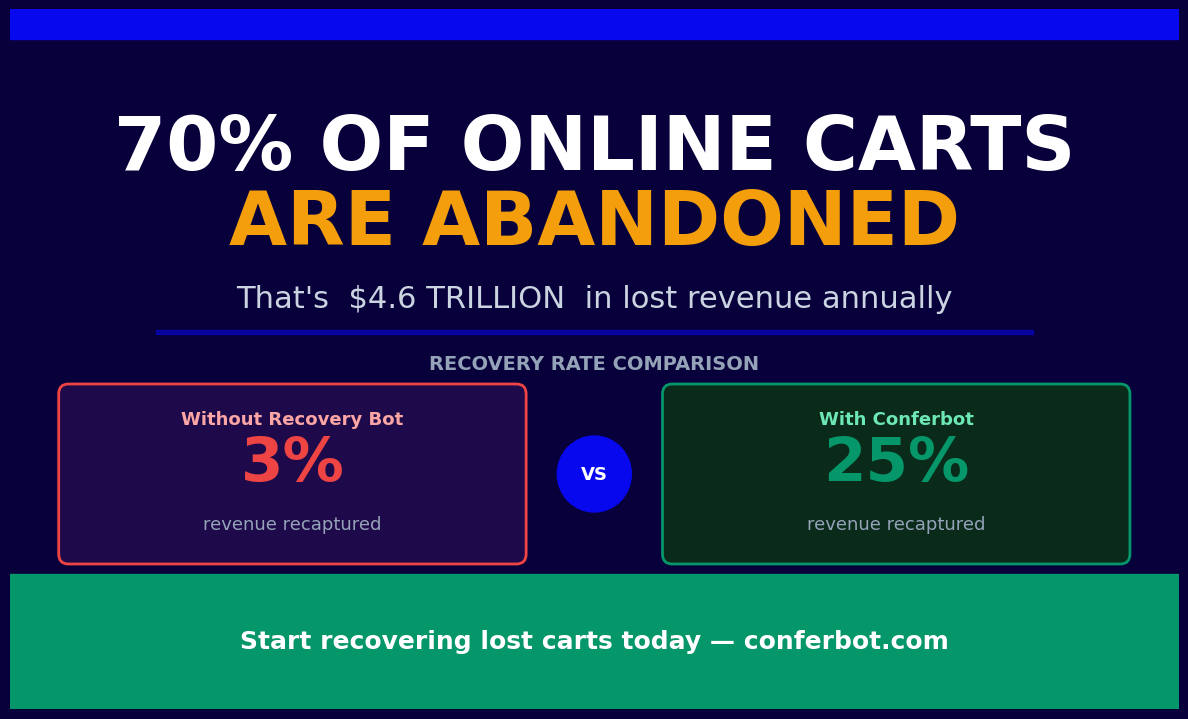
The chatbot differs from a traditional abandoned cart email sequence in three critical ways. First, it is conversational -- it asks why the shopper left, listens to the response, and tailors the recovery offer accordingly. A shopper who says "the shipping cost was too high" gets a different follow-up than one who says "I need to check my measurements first." Second, it is multi-channel, meeting shoppers where they actually engage rather than relying solely on email open rates that average 15-20%. Third, it is immediate -- the first recovery touch can fire within 60 seconds of abandonment, while purchase intent is still warm.
Conferbot's AI chatbot builder powers abandoned cart recovery flows that detect exit intent, trigger timed message sequences, apply conditional discount logic, and sync with your Shopify or WooCommerce store in real time. The result is a recovery tool that runs 24/7 without manual intervention and improves with every interaction through built-in analytics.
This page covers the mechanics of how abandoned cart recovery chatbots work, the exit-intent and timing strategies that maximize recovery rates, integration requirements, industry recovery rate benchmarks, ROI calculations, and a practical setup guide for getting your recovery bot live.
How an Abandoned Cart Recovery Chatbot Works
A well-engineered abandoned cart recovery chatbot combines behavioral detection, message sequencing, and conditional logic into a seamless recovery flow. Understanding each mechanism helps you configure the bot for maximum recovery rate.
Exit-Intent Detection
The recovery flow begins before the shopper technically abandons. Exit-intent detection monitors cursor movement, scroll velocity, and session inactivity signals to identify the moment a visitor appears ready to leave. When the bot detects exit intent on a cart or checkout page, it can trigger an immediate on-site widget message -- "Still thinking? Here is something to help you decide" -- before the shopper navigates away. This proactive touch recovers a portion of abandoners without requiring any off-site follow-up. Exit-intent triggers typically convert at 3-5% of at-risk sessions, a meaningful number given zero additional cost per impression.
Cart Abandonment Event Capture
When a session ends with items in the cart and no completed purchase, the chatbot captures the abandonment event. This requires a pixel or JavaScript snippet on your site that fires when a cart-to-session ratio exceeds a defined threshold, or when a user with cart items has been inactive for a configurable window (commonly 15-30 minutes). The event includes the shopper's contact information (if they provided it during browsing or a prior session), the cart contents, total value, and any promo codes already applied.
Recovery Sequence Timing
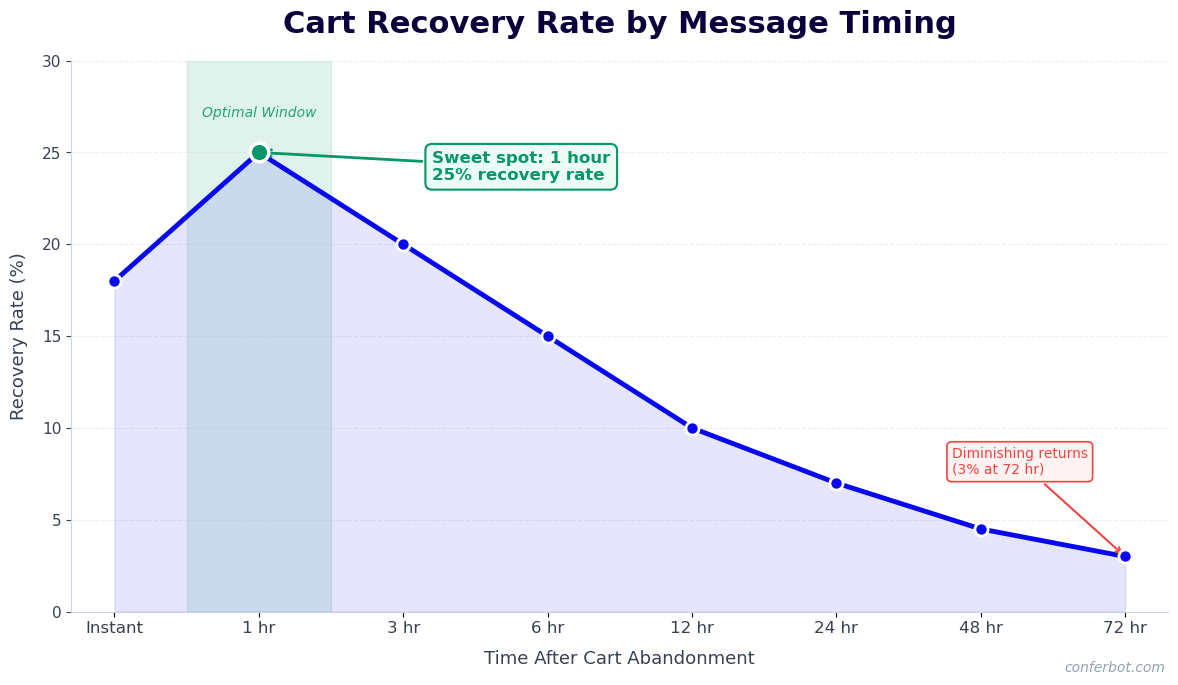
The timing of recovery messages is one of the most studied variables in cart recovery. Industry data consistently supports a three-touch sequence:
- Touch 1 (15-60 minutes post-abandonment): A gentle reminder with a direct link back to the cart. No discount -- many shoppers abandon due to distraction, not hesitation, and will return without incentive.
- Touch 2 (12-24 hours post-abandonment): A follow-up that acknowledges the cart is waiting and introduces a low-friction nudge -- social proof, a product review, or a stock-scarcity signal if applicable.
- Touch 3 (48-72 hours post-abandonment): A final recovery offer, typically including a time-limited discount or free shipping offer for carts above a threshold value.
The chatbot stops the sequence the moment a purchase is completed, preventing the embarrassing situation of sending a discount to someone who already bought at full price.
Discount Logic and Conditional Offers
A flat discount strategy leaves revenue on the table. Sophisticated abandoned cart bots apply conditional discount logic: high-value carts (above a configured threshold) receive a percentage discount, lower-value carts receive a free shipping offer, and repeat customers who have previously received discounts are excluded from the coupon sequence to protect margin. The bot can also vary the discount depth based on the cart's margin profile, configured through your store integration via API connections.
Conversational Recovery
The most effective recovery messages invite a response. Instead of a static "Here is your cart" message, the bot asks a simple question: "We noticed you left some items behind -- was something stopping you from completing your order?" When the shopper responds, the chatbot routes the conversation: shipping cost objections trigger a shipping offer, sizing questions trigger a size guide or live agent handoff via live chat, and payment issues trigger an alternative payment method suggestion. This conversational layer transforms a passive reminder into an active sales recovery interaction.
Key Features of a Cart Recovery Chatbot
Not all abandoned cart tools are equal. These are the features that distinguish a high-performing recovery chatbot from a basic email automation tool -- and the metrics that each feature moves.
| Feature | What It Does | Impact on Recovery Rate |
|---|---|---|
| Exit-intent trigger | Fires a chatbot widget before the shopper leaves the page | Recovers 3-5% of at-risk sessions on-site |
| Multi-channel delivery | Sends recovery messages via WhatsApp, Messenger, SMS, and email | Increases reach by 40-60% vs. email alone |
| Conditional discount engine | Applies discounts based on cart value, margin, and customer tier | Improves margin-adjusted recovery by 18-25% |
| Cart reconstruction | Restores the exact cart contents with a single click from the recovery message | Reduces checkout friction, lifts click-to-purchase by 30% |
| Stock urgency signals | Alerts shoppers when abandoned items are low in stock | Drives 22% faster return for high-demand products |
| Conversational objection handling | Asks why the shopper left and routes to relevant offers or support | Addresses price, shipping, and uncertainty objections in real time |
| Sequence suppression | Stops all recovery messages immediately upon purchase | Eliminates post-purchase discount sends that erode brand trust |
| A/B testing | Tests message copy, timing, and discount depth variations | Continuous optimization of recovery rate over time |
Multi-Channel Recovery Delivery
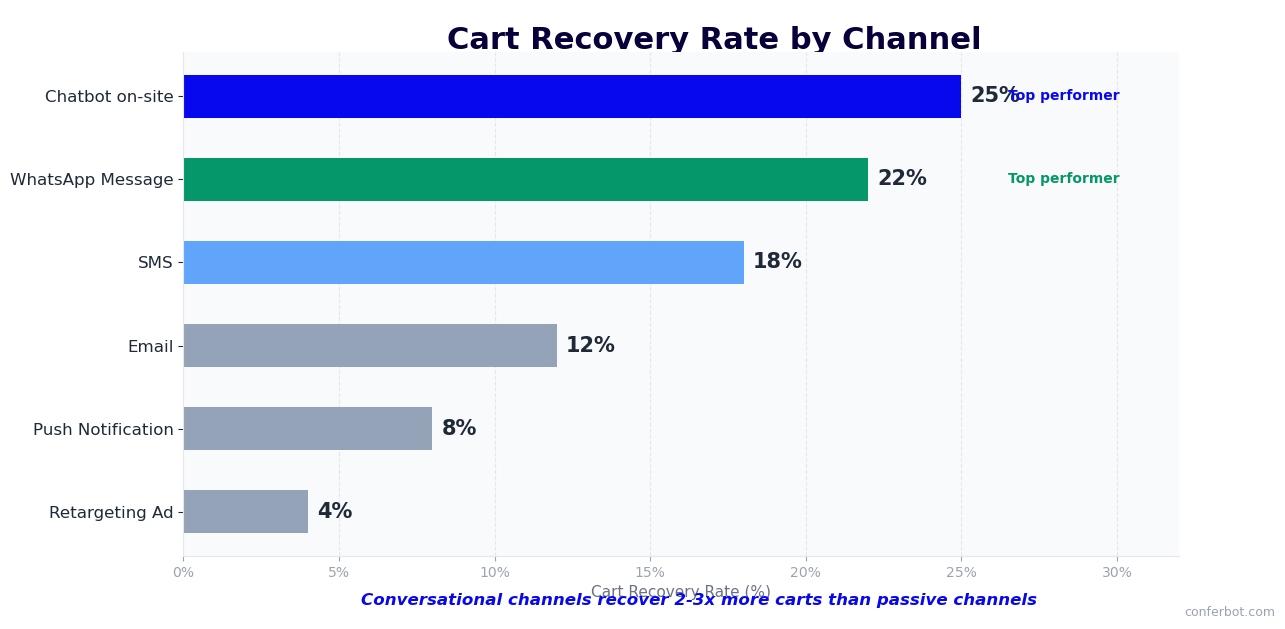
Email recovery sequences are a baseline, not a ceiling. Conferbot's omnichannel platform delivers recovery messages across WhatsApp (open rates of 85-98%), Messenger, Instagram DM, Telegram, and on-site chat widgets. The channel mix is configured per customer segment: shoppers who engaged with your Instagram account receive Instagram recovery messages; shoppers who opted into WhatsApp during checkout receive WhatsApp nudges. Multi-channel recovery sequences consistently outperform email-only sequences because they reach shoppers on the platforms they actually check.
One-Click Cart Reconstruction
Friction is the enemy of recovery. A shopper who clicks a recovery message and lands on a blank cart page will abandon again immediately. Conferbot's recovery links contain an encrypted cart token that reconstructs the shopper's exact cart -- items, quantities, variant selections, and any applied promo codes -- with a single click. The shopper picks up exactly where they left off, reducing the steps between the recovery message and checkout completion.
Real-Time Inventory Signals
Scarcity is a legitimate and effective recovery motivator when used honestly. The bot integrates with your inventory system through your platform's API and, when an abandoned item genuinely has limited stock, includes an accurate inventory signal: "Only 3 left in your size." This message is triggered only when stock data confirms the scarcity, maintaining shopper trust while creating authentic urgency.
Ready to try Abandoned Cart Recovery?
Deploy this template in under 10 minutes. No coding required.
Use This Template Free →Shopify and WooCommerce Integration
The operational foundation of an abandoned cart recovery chatbot is its integration with your e-commerce platform. A deep, reliable integration determines whether the bot fires at the right time, reconstructs carts accurately, applies discounts correctly, and stops messaging customers who have already purchased. Here is how Conferbot connects with the two dominant e-commerce platforms.
Shopify Integration
Conferbot's Shopify app installs directly from the Shopify App Store and connects to your store's Checkout, Orders, Customers, and Products APIs with a single OAuth authorization. Once connected, the integration enables:
- Automatic cart abandonment detection via Shopify's Abandoned Checkout API, which fires when a checkout has been inactive for 10+ minutes with an email address captured
- Real-time order status monitoring so the recovery sequence stops the moment a purchase is completed in Shopify, regardless of which channel or device the shopper used to complete it
- Dynamic discount code generation through Shopify's Price Rules API -- each recovery discount code is unique, single-use, and time-limited, preventing code sharing and abuse
- Product data sync for accurate cart reconstruction including images, variant titles, and current pricing
- Customer segmentation access to exclude VIP customers from discount sequences or apply higher discount tiers to high-LTV shoppers
WooCommerce Integration
For WooCommerce stores, Conferbot connects via the WooCommerce REST API and a lightweight WordPress plugin. The plugin adds the tracking JavaScript needed for exit-intent detection and session-based cart monitoring that WooCommerce's native API does not expose. Key integration capabilities include:
- Guest cart tracking using browser cookies and session identifiers, capturing abandonment data even for non-logged-in shoppers
- WooCommerce coupon integration for automatic discount code generation with configurable usage restrictions
- Order webhook subscriptions to trigger real-time purchase detection and sequence suppression
- Custom field support for stores using WooCommerce extensions that add non-standard cart attributes
Headless and Custom Platforms
Stores running headless commerce architectures or proprietary platforms connect through Conferbot's open API. You implement three endpoints: cart creation (fires when a cart is created), cart abandonment (fires when your abandonment logic triggers), and purchase completion (fires when an order is confirmed). Conferbot handles the sequencing, messaging, discount logic, and analytics from that point forward. This approach works with Magento, BigCommerce, Commercetools, and any platform that can make HTTP webhook calls.
CRM and Email Platform Sync
Recovery data is more valuable when it flows into your existing marketing stack. Conferbot's integrations hub syncs cart recovery events -- abandonment, recovery message delivery, click, purchase, and suppression -- with Klaviyo, HubSpot, Salesforce, and Mailchimp. This ensures your email automation platform does not send a competing recovery email when the chatbot is already managing the sequence, and all recovery touchpoints appear in the customer's unified history.
Cart Recovery Rate Data by Industry
Recovery rate benchmarks vary significantly across product categories, price points, and channels. Understanding where your store's recovery rate should land -- and what factors drive variation -- helps you set realistic targets and identify optimization opportunities.
Industry Recovery Rate Benchmarks
| Industry | Average Abandonment Rate | Email-Only Recovery Rate | Chatbot + Multi-Channel Recovery Rate |
|---|---|---|---|
| Fashion and Apparel | 68-72% | 8-12% | 18-24% |
| Consumer Electronics | 74-78% | 6-9% | 14-19% |
| Home and Garden | 70-74% | 9-13% | 17-22% |
| Health and Beauty | 65-70% | 10-15% | 20-27% |
| Sports and Outdoor | 71-75% | 8-11% | 16-21% |
| Food and Grocery | 55-62% | 12-17% | 22-30% |
| Luxury Goods | 78-85% | 4-7% | 10-15% |
| B2B / Wholesale | 60-68% | 11-16% | 19-26% |
Several factors explain the gap between email-only and chatbot-assisted recovery rates. First, chatbots can engage shoppers on channels with dramatically higher open and response rates -- WhatsApp messages are opened by 85-98% of recipients within 24 hours, compared to 15-25% for marketing emails. Second, the conversational format of a chatbot allows objection handling that email cannot replicate; a shopper who responds "the price was too high" can receive an immediate counter-offer, while email sequences continue on a fixed schedule regardless of shopper feedback.
Impact of Cart Value on Recovery Rate
Cart value is inversely correlated with recovery rate: lower-value carts recover at higher rates because the purchase decision carries less perceived risk and a small discount or free shipping offer is sufficient to tip the balance. Carts under $50 typically recover at 20-30% with appropriate follow-up, while carts over $500 recover at 8-15% even with significant incentives. High-value cart recovery benefits most from the conversational approach because shoppers abandoning expensive purchases often have specific, addressable concerns -- financing options, return policy questions, or product compatibility doubts -- that a chatbot can resolve in real time rather than in a 48-hour email exchange.
Timing Sensitivity
Data from Conferbot's platform across thousands of stores in 2026 shows that the first recovery touch within 60 minutes of abandonment recovers 47% of all recovered carts. The second touch at 12-24 hours recovers an additional 32%, and the third touch at 48-72 hours recovers the remaining 21%. This distribution underscores the importance of fast first-touch recovery and explains why waiting 24 hours before the first email -- a common practice in older recovery setups -- leaves significant revenue uncaptured.
Compare your current recovery rate against these benchmarks using Conferbot's ROI calculator to quantify the monthly revenue gap your recovery chatbot can close.
ROI Calculator Breakdown
Quantifying the ROI of an abandoned cart recovery chatbot is straightforward because the inputs are measurable and the attribution is clear: every order that the bot's recovery sequence directly precedes is a recoverable transaction. Here is a worked example based on median e-commerce metrics, followed by the variables you should plug in for your own store.
Example Store Baseline
- Monthly completed transactions: 500
- Average order value (AOV): $85
- Monthly revenue from completed orders: $42,500
- Current cart abandonment rate: 72%
- Monthly abandoned carts (estimated): 500 / (1 - 0.72) × 0.72 = approx. 1,286
- Current email-only recovery rate: 8%
- Current recovered carts per month: 103
- Current recovered revenue: $8,755
After Deploying Recovery Chatbot
- Multi-channel recovery rate: 20% (conservative estimate based on industry benchmarks)
- Recovered carts per month: 257
- Recovered revenue: $21,845
- Incremental revenue vs. email-only: $13,090 per month
Cost Considerations
The cost calculation must account for discount codes applied during recovery. If 40% of recovered carts required a 10% discount to convert, the discount cost is: 257 × 0.40 × $85 × 0.10 = $873 per month. Net incremental margin at a 40% product margin: ($13,090 - $873) × 0.40 = $4,887 per month in incremental gross profit. At Conferbot's standard pricing, the ROI payback period is typically under two weeks for stores with monthly revenue above $30,000.
Beyond Direct Recovery Revenue
The full ROI picture includes secondary benefits that do not appear in direct recovery attribution:
- Support deflection: Recovery conversations handle shipping and return policy questions that would otherwise generate support tickets at $5-15 each
- Customer data enrichment: Recovery conversations collect objection data that informs product pricing, shipping cost strategy, and checkout UX improvements
- Repeat purchase rate: Customers recovered through a helpful, non-aggressive chatbot experience show higher 90-day repeat purchase rates than those recovered through aggressive email discount sequences
- Checkout optimization signals: The analytics dashboard surfaces recurring abandonment reasons (high shipping costs, required account creation, missing payment methods) that, when addressed at the checkout level, reduce the abandonment rate itself
Use Conferbot's chatbot ROI calculator to input your store's actual traffic, AOV, and current abandonment rate for a personalized revenue recovery projection.
50,000+ businesses use Conferbot templates to automate conversations
Step-by-Step Setup Guide
Setting up an abandoned cart recovery chatbot with Conferbot takes less than a day for most Shopify and WooCommerce stores. Follow these steps to go from zero to a live recovery sequence.
Step 1: Install the Platform Integration
Connect your store to Conferbot through the integrations hub. For Shopify, install the Conferbot app from the Shopify App Store and authorize the required API scopes. For WooCommerce, install the Conferbot WordPress plugin and enter your WooCommerce REST API credentials in the Conferbot dashboard. Verify the connection by completing and then canceling a test checkout -- the abandonment event should appear in Conferbot within two minutes.
Step 2: Configure the Recovery Sequence
In the Conferbot no-code builder, open the abandoned cart recovery template. Configure the three-touch sequence timing: Touch 1 at 30 minutes, Touch 2 at 18 hours, Touch 3 at 48 hours are good starting defaults. Set the sequence suppression rule to fire when an order is created in your platform.
Step 3: Set Up Discount Logic
Define your discount rules: minimum cart value to qualify for a discount, discount type (percentage vs. fixed amount vs. free shipping), discount depth, and coupon expiry window. Configure the conditional logic so high-margin product categories receive percentage discounts while low-margin categories receive free shipping offers instead. Set a customer exclusion list for customers who have received a recovery discount in the past 30 days to prevent discount dependency.
Step 4: Enable Channels
Activate the recovery sequence on each channel where you have shoppers. Connect your WhatsApp Business account, Facebook Page, and Instagram Business account through Conferbot's omnichannel settings. Configure the channel priority: if a shopper has opted into WhatsApp, send Touch 1 via WhatsApp; if not, use the on-site widget or email fallback.
Step 5: Configure Exit-Intent Widget
Enable the exit-intent detection script on your cart and checkout pages. Set the trigger sensitivity (cursor movement toward browser close/back, or inactivity threshold), the delay before the widget fires (2 seconds of exit intent is a common default), and the message to display. Keep the exit-intent message brief and value-oriented: "Your cart is ready -- can we help you complete your order?"
Step 6: Test the Full Flow
Run an end-to-end test: add items to a test cart, abandon it, and verify that all three recovery messages fire at the correct times on the configured channels. Then complete a purchase on the test cart and confirm that the recovery sequence stops immediately. Check that discount codes are generated correctly, cart reconstruction links work, and all messages render properly across devices.
Step 7: Launch and Monitor
Go live and review analytics daily for the first two weeks. Track recovery rate by touch number, by channel, and by cart value tier. Identify which message copy and timing combination drives the highest recovery rate and iterate from there. Most stores see their first recovered orders within hours of launch.
Optimization Tips to Maximize Recovery Rate
Deploying the recovery chatbot is the beginning, not the end. Stores that treat abandoned cart recovery as an ongoing optimization program consistently outperform those that set it up once and forget it. Here are the highest-leverage optimization levers based on data from Conferbot's merchant base.
Test Message Copy Variants
The single highest-impact optimization variable is the first recovery message's copy. Two principles hold across most product categories: (1) personalization beats generic -- using the shopper's name and naming the specific product they abandoned consistently outperforms generic "You left something behind" messages by 15-25%; (2) question format outperforms statement format -- "Still thinking about the [Product]?" drives higher reply rates than "Your cart is waiting." Use Conferbot's built-in A/B testing to run controlled copy tests across meaningful sample sizes before drawing conclusions.
Optimize Timing by Segment
Default timing works reasonably well, but segment-specific timing delivers better results. Mobile shoppers who abandon during evening hours (7-10 PM) are more likely to respond to next-morning messages than late-night follow-ups. Shoppers in cart value tiers above $200 often need more deliberation time -- a 4-hour first touch may feel intrusive; 12 hours may feel more appropriate. Analyze recovery rate by time-of-abandonment and time-of-first-touch in your analytics dashboard to find your store's optimal timing windows.
Use Objection Data to Fix Checkout Issues
The recovery chatbot's most underused value is the objection data it collects. When shoppers tell the bot why they abandoned -- "shipping was $18, that's too much" or "I couldn't pay with PayPal" -- that is direct feedback about your checkout's weakest points. Aggregate objection responses monthly and use the data to prioritize checkout improvements: adding free shipping thresholds, introducing buy-now-pay-later options, or removing mandatory account creation. Fixing the root causes reduces your abandonment rate, which is worth more than marginal improvements to recovery rate.
Calibrate Discount Depth to Cart Value
Many stores apply a flat 10% recovery discount to all carts. A more profitable approach is to reserve discounts for carts that actually need them. Carts under $30 often recover with a free shipping offer that costs $4-6 to fulfill, not a 10% discount that costs $3 but conditions shoppers to expect discounts. Carts above $150 from new customers may justify 15% to capture the long-term LTV. Build a three-tier discount ladder based on cart value and track the margin impact of each tier separately.
Integrate with Live Chat for High-Value Carts
For carts above your defined high-value threshold, route recovery conversations to a live agent through Conferbot's live chat integration. A personalized message from a real person -- "Hi Sarah, I noticed you were looking at the Pro Bundle. I can answer any questions" -- outperforms automated messages for complex or high-consideration purchases. Reserve this white-glove approach for your top 5-10% of cart values to keep agent time cost proportional to the revenue at stake.
Consistent testing and optimization can lift recovery rates by 30-50% over baseline within six months. Track your progress against the industry benchmarks in the previous section and use Conferbot's ROI calculator to quantify each improvement in dollar terms.
Abandoned Cart Recovery FAQ
Everything you need to know about chatbots for abandoned cart recovery.
Why Use a Template vs Building from Scratch?
Templates encode years of optimization data into the conversation flow before you start.
| Factor | Conferbot Template | Build from Scratch | Hire a Developer |
|---|---|---|---|
| Time to deploy | 10 minutes | 2-8 hours | 2-6 weeks |
| Cost | Free | Your time | $5,000-$25,000 |
| Day-1 conversion | 15-22% | 5-8% | 10-15% |
| Proven flows | Yes, data-tested | No | Depends |
| Updates included | Automatic | Manual | Paid |
| Multi-channel | 8+ channels | 1 channel | Extra cost |
| Analytics | Built-in | Must build | Extra cost |
Related Ecommerce and Retail Templates
Explore more chatbot templates in this category



Ready to Deploy Abandoned Cart Recovery?
Join 50,000+ businesses. Free forever plan available. No credit card required.