
NPS Survey
Free Surveys Chatbot Template
Boost customer satisfaction insights with Conferbot's NPS Survey chatbot. Effortlessly gauge loyalty and satisfaction, and gather valuable feedback 24/7 to enhance your business offerings.



What Is an NPS Survey Chatbot?
An NPS survey chatbot is a conversational tool that collects Net Promoter Score feedback through a structured, interactive dialogue rather than a static web form or email survey link. Instead of presenting a respondent with a cold rating scale and a blank text box, the chatbot guides them through the NPS question, acknowledges their score, and asks relevant follow-up questions in natural conversation -- all within the same interface they already use to interact with your product or support team.
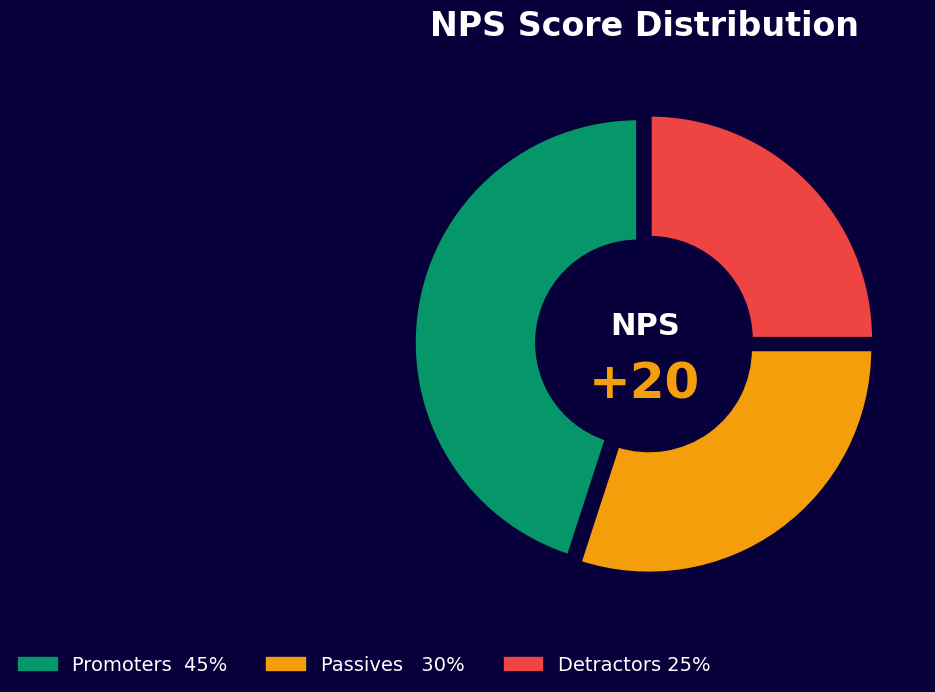
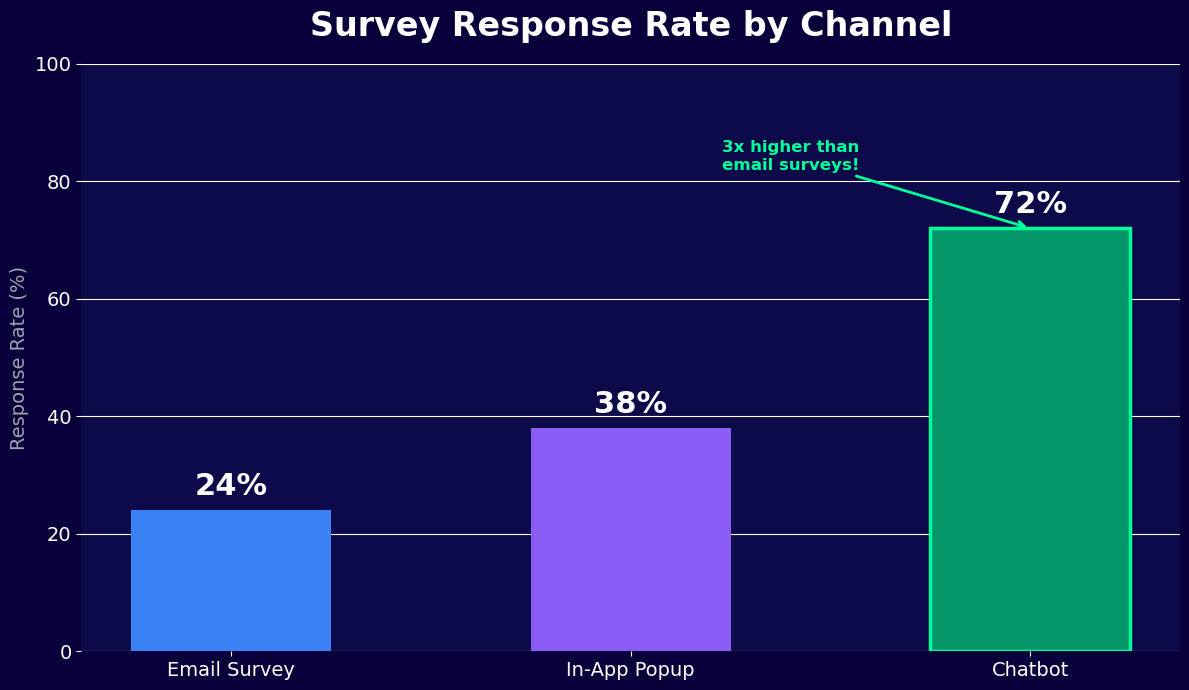
Net Promoter Score is the most widely used customer loyalty metric in 2026. A single question -- "On a scale of 0-10, how likely are you to recommend us to a friend or colleague?" -- produces a score that predicts customer churn, expansion revenue, and word-of-mouth growth with statistically significant reliability. The problem is not the question; it is delivery. Traditional email NPS surveys see response rates of 5-15%, meaning the feedback you act on represents a small, self-selected slice of your customer base. A chatbot-based NPS delivery increases response rates to 35-55% by meeting customers in context -- immediately after a support interaction, after a product milestone, or embedded in your web application.
The chatbot format also improves the quality of qualitative feedback. When a customer gives a score of 4 and the chatbot responds "Thank you -- that is helpful. What is the one thing that would have made your experience better?" they are far more likely to provide a specific, actionable answer than they would in a blank "comments" field at the bottom of a form. The conversational prompt reduces cognitive load and signals that a real response is expected and valued.
Conferbot's AI chatbot builder provides a pre-built NPS survey template that handles score collection, follow-up branching by score tier, CRM sync, and automated close-the-loop workflows. The template deploys on your website widget, WhatsApp, Facebook Messenger, and in-app embeds without writing a single line of code. This page covers the mechanics of NPS scoring, the chatbot features that drive higher response and insight quality, integration options, industry use cases, and a step-by-step setup guide.
How NPS Scoring Works: Promoters, Passives, and Detractors
Understanding the NPS calculation is essential for configuring meaningful chatbot branching logic and interpreting the scores your bot collects. The scoring system is deceptively simple, but the segment boundaries and the implications of each segment drive materially different follow-up actions.
The 0-10 Scale and Segment Definitions
Every NPS response falls into one of three segments based on the rating given:
| Score | Segment | What It Signals | Chatbot Follow-Up Priority |
|---|---|---|---|
| 9-10 | Promoter | Loyal advocates who actively recommend your product | Referral request, review ask, upsell opportunity |
| 7-8 | Passive | Satisfied but unenthusiastic -- at risk from competitor offers | Feature discovery, loyalty program, satisfaction probe |
| 0-6 | Detractor | Unhappy customers who may churn or leave negative reviews | Immediate escalation, root cause capture, recovery offer |
The NPS Formula
Your Net Promoter Score is calculated as: NPS = % Promoters - % Detractors. Passives are excluded from the calculation entirely -- they count toward the denominator (total respondents) but not toward either positive or negative weight. A company with 60% Promoters, 25% Passives, and 15% Detractors has an NPS of 45, which is considered excellent in most B2B SaaS contexts.
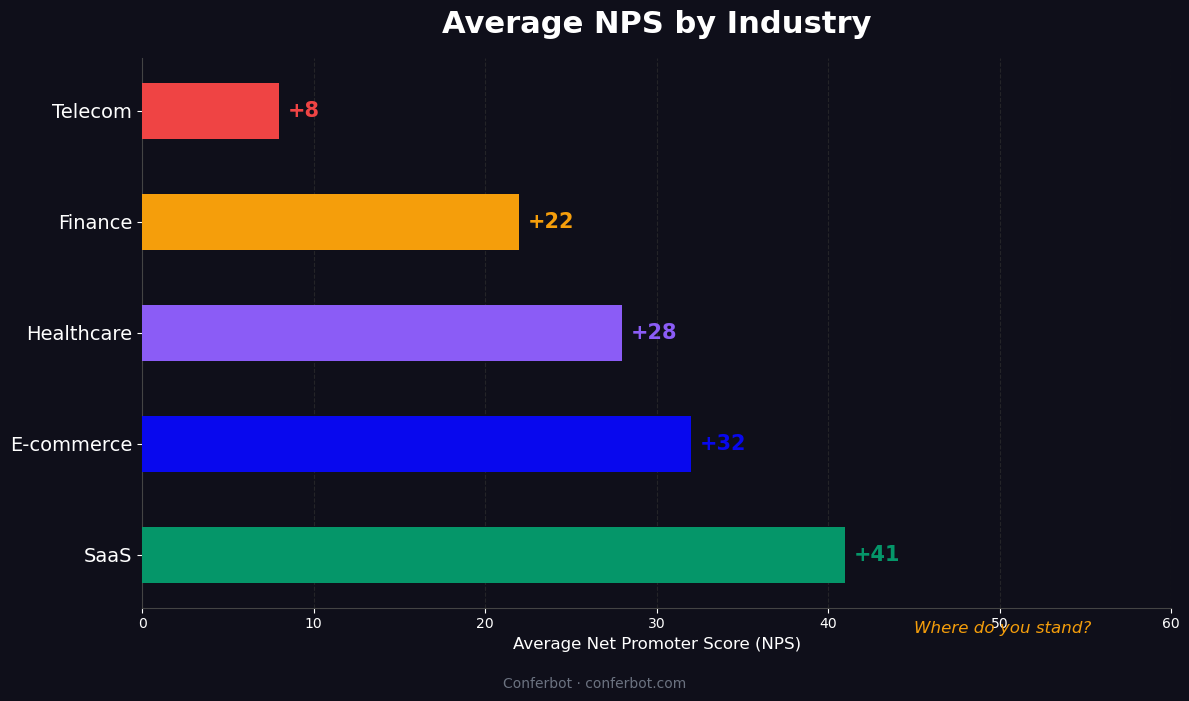
NPS scores range from -100 (all Detractors) to +100 (all Promoters). Industry benchmarks in 2026 put average NPS at 31 for SaaS, 45 for professional services, and 52 for consumer apps. Any score above 0 is acceptable; above 30 is good; above 50 is excellent; above 70 is world-class. Tracking your NPS trend over time is more actionable than fixating on any single point-in-time score.
Why Segment Boundaries Matter for Chatbot Logic
The 0-6 Detractor range is intentionally wide because it captures both mildly dissatisfied customers (score of 6) and severely dissatisfied ones (score of 0-3). Your chatbot branching logic should treat a score of 6 differently from a score of 1: a score of 6 warrants a probing follow-up question and a recovery offer; a score of 0-2 warrants an immediate escalation to a human agent via live chat and a priority support ticket creation. The chatbot can apply this nuanced routing automatically based on score thresholds you configure.
Similarly, the Promoter segment benefits from differentiated follow-up: a score of 10 from a six-month customer who has expanded their plan is a strong referral candidate, while a score of 9 from a customer who joined last week may be reacting to their initial onboarding experience. Combine NPS scores with customer attributes -- tenure, plan tier, usage frequency -- in your CRM via API integration to segment follow-up actions intelligently.
Key Features of Conferbot's NPS Survey Template
The features below distinguish a purpose-built NPS survey chatbot from a generic form builder or a basic bot that simply asks the rating question and stops. Each feature is included in Conferbot's pre-built NPS template and is configurable without code through the no-code builder.
| Feature | What It Does | Impact on Survey Quality |
|---|---|---|
| Score-based conversation branching | Routes Promoters, Passives, and Detractors into separate follow-up conversation paths | Captures segment-relevant qualitative context |
| Conditional follow-up questions | Asks different probing questions based on score sub-ranges (0-2, 3-6, 7-8, 9-10) | Increases actionability of open-text responses |
| Detractor escalation | Flags Detractor responses and routes to a live agent or creates a support ticket automatically | Enables close-the-loop recovery within hours |
| Promoter referral flow | Invites Promoters to leave a public review or refer a colleague immediately after a high score | Converts satisfaction into word-of-mouth growth |
| CRM sync | Writes NPS score, segment, and verbatim response to the customer record in HubSpot, Salesforce, or your CRM | Enables score trending and cohort analysis |
| Survey trigger logic | Fires the survey based on configurable triggers: time since signup, support ticket closure, feature usage milestone | Ensures surveys reach customers at peak relevance |
| Multi-channel delivery | Delivers NPS surveys via website widget, WhatsApp, Messenger, and in-app embed from a single template | Maximizes reach and response rate across customer segments |
| Response rate analytics | Tracks delivery, open, response, and completion rates by channel, trigger type, and customer segment | Identifies highest-performing delivery contexts |
Conversational Follow-Up Depth
The most valuable feature of the chatbot format is its ability to conduct a branched follow-up conversation rather than simply collecting a number. A Detractor who scores 3 is asked: "We are sorry to hear that -- what was the biggest frustration in your experience?" When they respond, the bot can ask one more targeted clarifying question before routing to a human agent. A Promoter who scores 10 is asked: "That is wonderful to hear -- what is the one thing you value most?" Before inviting them to share a review on G2 or Capterra. This two-layer follow-up generates far richer data than a single open-text question and takes less than 90 seconds for the respondent to complete.
Omnichannel Delivery
Conferbot's omnichannel platform delivers the NPS survey on the channel most relevant to the trigger context. A survey fired after a support ticket closes is best delivered in the same chat thread where the ticket was handled. A transactional NPS survey sent 30 days after signup is best delivered via the channel where the customer is most active -- WhatsApp for mobile-first users, the in-app widget for desktop users. Channel selection is configurable per trigger type.
Ready to try NPS Survey?
Deploy this template in under 10 minutes. No coding required.
Use This Template Free →CRM and Analytics Integration for NPS Data
An NPS score sitting in a survey tool in isolation has limited value. The score becomes actionable when it is connected to the customer record in your CRM, the usage data in your product analytics platform, and the revenue data in your billing system. Conferbot's NPS chatbot template is built for deep integration with the tools where you already manage customer relationships.
CRM Integration
Every NPS response collected by the chatbot can be written to the respondent's CRM record in real time through Conferbot's integrations hub. Supported CRMs include HubSpot, Salesforce, Pipedrive, Zoho CRM, and Intercom. For each response, the integration writes:
- NPS score as a numeric custom property
- NPS segment (Promoter, Passive, Detractor) as a contact tag or pipeline stage
- Verbatim follow-up response as a contact note with timestamp
- Survey trigger context (which trigger fired, which channel delivered it) for segmentation analysis
With score data in the CRM, your customer success team can filter their contact list by NPS segment and prioritize outreach to Detractors who have not yet been contacted. In HubSpot, a workflow can automatically enroll Detractors in a recovery sequence or assign a task to the account owner. In Salesforce, Detractor scores can update opportunity health scores and flag renewal risks in the forecast.
Product Analytics Integration
Connecting NPS scores to product usage data reveals which feature adoption patterns correlate with high and low scores. Conferbot's API integration enables bi-directional data flow: your product analytics platform (Mixpanel, Amplitude, Heap) can send usage signals to Conferbot to trigger NPS surveys at the right moments, and Conferbot can send NPS scores back to your analytics platform for cohort analysis. This connection reveals, for example, that customers who complete onboarding within 7 days score 15 NPS points higher than those who do not -- a finding that directly informs your onboarding investment priorities.
Dashboard and Trend Reporting
Conferbot's analytics dashboard provides real-time NPS trend charts, segment breakdowns by cohort, and verbatim response tagging. In 2026, teams that review NPS trends weekly and tag verbatim responses into theme categories (pricing, support quality, feature gaps, ease of use) outperform teams that review monthly by identifying and acting on issues 3-4 weeks faster. The dashboard exports raw response data to CSV for deeper analysis in business intelligence tools such as Tableau or Looker.
Slack and Email Alerts for Detractors
Speed matters most for Detractor follow-up. A customer who gives a score of 2 and receives a personalized response within two hours is far more recoverable than one who waits 48 hours for a generic email. Conferbot can send an immediate Slack notification or email alert to the responsible customer success manager or support team lead whenever a Detractor response is received, including the score, the verbatim response, and a direct link to the customer's CRM record.
NPS Survey Chatbot Use Cases by Industry
While NPS is a universal metric, the trigger moments, score benchmarks, and follow-up actions that matter most vary by industry. Here is how three major verticals use Conferbot's NPS chatbot template most effectively.
SaaS and B2B Software
SaaS companies are the heaviest users of NPS, and for good reason: NPS scores in SaaS are statistically correlated with renewal probability and expansion revenue. The most effective NPS trigger moments for SaaS products in 2026 are:
- 30/60/90 days post-signup to capture satisfaction at key onboarding milestones
- Post-support ticket closure to measure support experience quality
- Pre-renewal (60 days out) to identify renewal risk before the sales conversation
- Post-feature launch to measure new feature reception among active users
For SaaS, the Detractor escalation flow is particularly valuable: a Detractor response 45 days before renewal triggers an immediate customer success intervention that, in aggregate, recovers 15-25% of at-risk renewals according to data from Conferbot's SaaS customer base.
Retail and E-commerce
Retail NPS surveys are most effective when triggered by transactional events: post-purchase delivery confirmation, post-return completion, or post-support chat. The chatbot format is especially well-suited to post-purchase NPS because it can collect the score within the same WhatsApp order tracking thread, requiring zero additional friction from the customer. Retail Promoters who score 9-10 in a post-purchase NPS flow convert on referral discount offers at rates of 18-22%, making the Promoter follow-up flow a direct revenue generator in addition to a data collection exercise.
Hospitality and Travel
Hotels, airlines, and travel platforms use NPS surveys to capture experience quality at critical journey moments: post-check-in, post-stay, and post-support interaction. The immediacy of chatbot delivery is a significant advantage here -- a survey delivered via WhatsApp within two hours of checkout captures a guest's experience while it is fresh, compared to an email survey sent 24-48 hours later that competes with re-entry fatigue. Hospitality NPS surveys benefit from the chatbot's ability to ask property-specific follow-up questions: "What was the highlight of your stay?" for Promoters and "What could we have done differently?" for Detractors, feeding directly into property management review priorities.
Chatbot vs. Email NPS: Response Rate Comparison
The decision to deliver NPS surveys via a chatbot rather than a traditional email link is, at its core, a response rate decision. Higher response rates produce more statistically reliable scores, more representative qualitative feedback, and faster detection of experience problems. Here is a detailed comparison of the two delivery methods across every relevant dimension.
| Metric | Email NPS Survey | Chatbot NPS Survey |
|---|---|---|
| Average response rate | 5-15% | 35-55% |
| Time to first response | 24-72 hours | Under 5 minutes |
| Qualitative follow-up completion rate | 20-35% of respondents | 60-80% of respondents |
| Mobile-friendly completion rate | 45-60% (depends on email client) | 85-95% |
| Setup complexity | Low (email template + survey link) | Low (no-code chatbot builder) |
| Real-time Detractor escalation | Not possible without additional tooling | Built-in routing to live agent |
| Promoter referral conversion | 3-6% | 12-22% |
| Channel flexibility | Email only | Web, WhatsApp, Messenger, in-app |
Why Chatbots Outperform Email for NPS
The response rate gap has three primary drivers. First, context: a chatbot survey delivered within the product or in a post-support chat thread catches the customer when their experience is immediately salient. An email survey delivered to an inbox competes with hundreds of other emails and requires the customer to context-switch from whatever they are doing. Second, friction: clicking a link, loading a survey page, and submitting a form involves more steps than responding to a chatbot message in a thread that is already open. Third, channel preference: a significant and growing share of customers -- particularly those under 40 -- prefer asynchronous messaging to email for customer interactions, and a WhatsApp or in-app chatbot survey meets them on the channel they check most frequently.
When Email NPS Still Makes Sense
Email NPS remains appropriate for customer segments that are not active on messaging channels, for B2B enterprise accounts where the survey respondent is not the same person as the primary contact in your chat tool, and for annual relationship NPS surveys sent to a broad customer base. In these cases, Conferbot's hybrid approach -- delivering via chatbot where possible and falling back to email for customers who have not engaged on messaging channels -- captures the response rate benefits of chatbot delivery for the addressable population while maintaining broad coverage.
Track your NPS response rate trend in Conferbot's analytics dashboard and compare it against the benchmarks in this table to quantify the gap your current delivery method is leaving on the table.
50,000+ businesses use Conferbot templates to automate conversations
Step-by-Step Setup Guide for NPS Survey Chatbot
Setting up Conferbot's NPS survey chatbot takes under two hours for most teams. The following steps take you from installation to a live, multi-trigger NPS program with CRM integration.
Step 1: Open the NPS Survey Template
Log into Conferbot and navigate to Templates. Select the NPS Survey template from the Surveys category. The template loads a pre-built conversation flow covering the standard NPS question, score-based branching for all three segments, follow-up questions for each segment, and a closing message. You will customize this flow in the next steps using the no-code builder without writing any code.
Step 2: Customize the Conversation Flow
Edit the opening message to use your brand's voice and reference your specific product or service: "Hi [Name], you have been using [Product] for [X] days -- we would love to hear how we are doing." Configure the score input block to display a 0-10 scale with your preferred visual style (button row, slider, or numeric input). Set up the three branching paths -- Promoter (9-10), Passive (7-8), Detractor (0-6) -- and add your follow-up questions for each path. Configure a sub-branch within the Detractor path for scores of 0-3 that routes to a live agent via live chat or creates a support ticket automatically.
Step 3: Configure Survey Triggers
In the Triggers section, add the events that will fire this survey. Common configurations include: a time-delay trigger (30 days post-signup), an event-based trigger (support ticket status changes to "resolved"), and a URL-based trigger (user visits a specific in-app page indicating feature adoption). Set a survey frequency limit -- typically one NPS survey per customer per 90 days -- to prevent survey fatigue.
Step 4: Connect Your CRM
Navigate to the Integrations tab and connect your CRM through Conferbot's integrations hub. Map the NPS score field, segment field, and verbatim response field to the appropriate properties in your CRM. Enable Detractor alerts to send a Slack or email notification to your customer success team whenever a Detractor response is received. Test the integration by submitting a test response and verifying that all fields write correctly to the CRM record.
Step 5: Enable Channels
Activate the survey on each channel relevant to your triggers. For post-support NPS, enable delivery in the same chat channel where support conversations occur. For relationship NPS, enable delivery via WhatsApp and the in-app widget. Connect your Facebook Messenger or Instagram accounts if those are active support channels for your business.
Step 6: Test and Launch
Submit test responses for each score segment (a score of 2, 7, and 10) and verify that the correct follow-up path fires, the correct CRM fields are written, and Detractor alerts are sent as configured. Review the conversation flow on mobile and desktop to confirm formatting renders correctly across devices. Launch the survey and monitor Conferbot's analytics dashboard daily for the first week to catch any configuration issues and track initial response rates.
Follow-Up Automation After NPS Score Collection
Collecting NPS scores is only the beginning. The value of an NPS program is determined by what happens after a score is received -- how quickly Detractors are contacted, how effectively Promoters are converted into referrers, and how systematically Passive customers are moved up the satisfaction curve. Conferbot's follow-up automation handles all three workflows without manual intervention.
Detractor Recovery Automation
When a Detractor response is received, the chatbot triggers a parallel set of automated actions within seconds: an alert is sent to the assigned customer success manager, a high-priority task is created in the CRM with the score, verbatim response, and customer context, and -- for scores of 0-3 -- a live chat window is opened or a follow-up message is queued to appear within 15 minutes. Teams that close the Detractor loop within 24 hours recover 30-40% of those customers to Passive or Promoter status within 90 days, according to Conferbot platform data from 2026.
The chatbot's in-conversation recovery flow can also offer immediate remediation: an apology message, a discount or credit offer, a direct booking link to schedule a call with a customer success manager, or a link to a relevant help article. The appropriate offer is configured by score sub-range so that a score of 6 receives a different response than a score of 1.
Promoter Referral and Review Automation
Promoters who score 9 or 10 are in a peak satisfaction moment -- the ideal time to ask for a referral or public review. The chatbot's Promoter flow automatically presents: a referral invite with a personalized referral link, a review request linking to G2, Capterra, Trustpilot, or Google My Business (configurable by industry), or an upsell message for premium features or plans. Promoter conversion rates on in-conversation referral requests range from 12-22%, compared to 3-6% for referral request emails sent days after the survey.
Passive Re-Engagement Automation
Passives are often overlooked because they do not trigger the urgency of Detractors or the opportunity of Promoters. But converting Passives to Promoters has an outsized impact on NPS because the NPS formula excludes Passives -- moving a Passive to a Promoter adds to the Promoter percentage without changing the Detractor percentage. The chatbot's Passive follow-up flow can introduce underused features, invite the customer to a webinar or training session, or offer a one-on-one onboarding call -- all of which address the most common reason for Passive status: adequate but not transformative product engagement.
All follow-up automation workflows are configured in Conferbot's AI chatbot builder and can be connected to your CRM, email automation platform, and external APIs for a fully integrated customer experience loop. Review the performance of each follow-up flow in the analytics dashboard and use the data to continuously refine the content and timing of each automated response.
NPS Survey FAQ
Everything you need to know about chatbots for nps survey.
Why Use a Template vs Building from Scratch?
Templates encode years of optimization data into the conversation flow before you start.
| Factor | Conferbot Template | Build from Scratch | Hire a Developer |
|---|---|---|---|
| Time to deploy | 10 minutes | 2-8 hours | 2-6 weeks |
| Cost | Free | Your time | $5,000-$25,000 |
| Day-1 conversion | 15-22% | 5-8% | 10-15% |
| Proven flows | Yes, data-tested | No | Depends |
| Updates included | Automatic | Manual | Paid |
| Multi-channel | 8+ channels | 1 channel | Extra cost |
| Analytics | Built-in | Must build | Extra cost |
Related Surveys Templates
Explore more chatbot templates in this category



Ready to Deploy NPS Survey?
Join 50,000+ businesses. Free forever plan available. No credit card required.