The Patient Communication Crisis in Dental Clinics
Dental clinics across the United States are facing a patient communication bottleneck that costs the industry billions of dollars each year. According to the American Dental Association Health Policy Institute, the average dental practice generates $859,000 in annual revenue, yet loses an estimated $36,000-60,000 per year to preventable inefficiencies: missed calls, no-show appointments, manual data entry errors, and staff time consumed by repetitive patient inquiries. For multi-provider clinics, those losses scale proportionally.
The front desk of a typical dental clinic handles between 50 and 100 phone calls per day. Research published in the Journal of Dental Practice Management found that 34% of inbound calls to dental offices go unanswered during peak hours, lunch breaks, and after-hours periods. Each unanswered call represents a patient who may schedule with a competitor instead, and acquiring a new dental patient costs $150-300 in marketing spend according to industry benchmarks. Losing an existing patient to a missed phone call is among the most expensive operational failures a clinic can experience.
Meanwhile, patient expectations have fundamentally shifted. A 2025 survey by PatientPop found that 77% of patients want the ability to book, cancel, or reschedule appointments online without calling. Among patients aged 25-44 — the demographic most likely to be choosing a new dentist — 68% say they would switch providers for one that offers better digital communication. The gap between what patients expect and what most dental clinics deliver is widening every year.
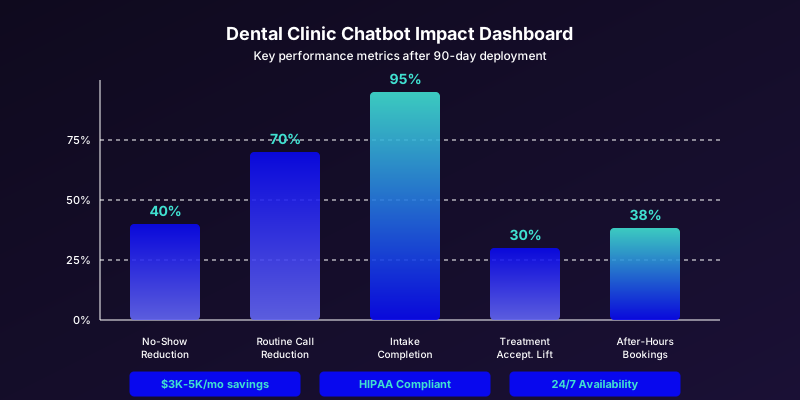
AI chatbots close this gap completely. A dental clinic chatbot operates 24 hours a day, 365 days a year, handling appointment scheduling, insurance verification questions, treatment plan FAQs, post-procedure follow-ups, and patient intake forms — all without adding a single staff member. Clinics that deploy chatbots report a 70% reduction in routine phone calls, a 40% decrease in no-show appointments, and monthly savings of $3,000-5,000 in operational costs. For a broader look at healthcare chatbot applications, see our healthcare chatbot guide.

This guide covers every aspect of deploying an AI chatbot in a dental clinic — from appointment scheduling and insurance verification to HIPAA compliance and post-procedure care — with specific ROI data, implementation timelines, and conversation design strategies that work for practices of every size.
Appointment Scheduling and No-Show Reduction: The 40% Improvement
No-shows are the single most expensive operational problem in dentistry. The American Dental Association estimates that the average dental clinic experiences a 12-18% no-show rate, with specialty practices (orthodontics, oral surgery) seeing rates as high as 25%. Each no-show costs a clinic $150-250 in lost revenue when you factor in the reserved chair time, hygienist or assistant allocation, sterilization preparation, and the opportunity cost of turning away other patients. For a clinic scheduling 30 appointments per day, even a 15% no-show rate translates to $4,500-7,500 per month in lost revenue.
AI chatbots attack no-shows through a multi-layered approach that goes far beyond simple text reminders. For detailed strategies specific to appointment reminders, see our appointment booking chatbot guide.
Interactive Confirmation Sequences
The chatbot sends a sequence of reminders at strategically timed intervals — 72 hours, 24 hours, and 2 hours before the appointment — each with interactive response options:
- 72-hour reminder: "Hi Sarah, this is a reminder that your cleaning appointment with Dr. Martinez is scheduled for Thursday at 10:00 AM. Reply CONFIRM to keep your appointment, RESCHEDULE if you need a different time, or CANCEL if you can't make it."
- 24-hour reminder: "Your appointment is tomorrow at 10:00 AM. Parking tip: the lot behind our building has free 2-hour spots. Reply CONFIRM to let us know you'll be there."
- 2-hour reminder: "See you at 10:00 AM today! Please arrive 5 minutes early. If anything has come up, reply RESCHEDULE and I'll find you a new time right now."
The critical difference between a chatbot confirmation and a passive text reminder is the frictionless rescheduling path. Patients who would otherwise simply not show up are given an instant, zero-effort way to move their appointment. When a patient replies RESCHEDULE, the chatbot immediately presents available slots and completes the rebooking in under 60 seconds. The cancelled slot is then automatically offered to patients on the waitlist, recovering revenue that would otherwise be lost entirely.
Waitlist Automation and Same-Day Fills
When a cancellation occurs, the chatbot instantly notifies patients on the waitlist:
"Great news! An opening just became available for tomorrow at 2:00 PM with Dr. Martinez. Would you like to take this slot? It's a cleaning appointment, about 45 minutes. Reply YES to book instantly."
Clinics using waitlist automation recover 60-75% of cancelled slots, compared to 10-20% when staff manually call waitlisted patients. The speed advantage is decisive: the chatbot can notify the entire waitlist within seconds, while a staff member might take 30-60 minutes to work through a phone list — by which time the patient has already made other plans.
After-Hours Scheduling Capture
According to dental industry data, 38% of appointment booking attempts happen outside of business hours — evenings after 6 PM, weekends, and early mornings before 8 AM. Without a chatbot, these patients encounter a voicemail recording. Research shows that only 20-30% of patients who reach voicemail actually leave a message or call back the next day. A chatbot captures every one of these after-hours requests and converts them into confirmed appointments in real time. Deploy across your website and WhatsApp for maximum after-hours coverage.
The Combined No-Show Impact
When you combine interactive confirmations, frictionless rescheduling, waitlist automation, and after-hours capture, the aggregate effect on no-show rates is dramatic. Dental clinics using Conferbot's AI chatbot builder report no-show rate reductions from the industry average of 15% down to 8-9% — a 40% improvement — within the first 60 days of deployment. For a 30-appointment-per-day clinic, this translates to recovering 1.5-2 additional appointments daily, or roughly $4,500-6,000 per month in recovered revenue.

Insurance Verification and Benefits Explanation
Insurance-related questions account for 25-35% of all inbound calls to a dental clinic, and each call takes an average of 6-8 minutes to resolve. The same 15-20 questions come up repeatedly: "Do you accept my insurance?" "What does my plan cover?" "How much will a crown cost with my insurance?" "What's my remaining annual maximum?" These questions are predictable, repetitive, and perfectly suited for chatbot automation.
Instant Insurance Acceptance Verification
The chatbot maintains a continuously updated database of accepted insurance plans and responds instantly:
"Yes, we accept Delta Dental PPO! Your plan typically covers preventive care (cleanings, exams, X-rays) at 100%, basic procedures (fillings, extractions) at 80%, and major procedures (crowns, bridges, root canals) at 50%, up to your annual maximum. Want me to check specific procedure coverage or help you book an appointment?"
For patients with less common plans, the chatbot provides a helpful alternative: "We don't currently accept Guardian HMO as in-network. However, you can still visit us as an out-of-network patient and submit claims for reimbursement. Many patients find their out-of-pocket costs are still competitive. Would you like a cost estimate for the treatment you're considering?"
Treatment Cost Estimation
Cost uncertainty is the number one barrier to treatment acceptance in dentistry. When a dentist recommends a crown and the patient has no idea whether it will cost $200 or $2,000 out of pocket, they delay the decision indefinitely. The chatbot bridges this gap with proactive cost estimates:
| Procedure | Typical Cost | PPO Coverage | Estimated Out-of-Pocket |
|---|---|---|---|
| Cleaning (prophylaxis) | $100-200 | 100% | $0 |
| Composite filling | $200-400 | 80% | $40-80 |
| Porcelain crown | $900-1,400 | 50% | $450-700 |
| Root canal (molar) | $800-1,200 | 50% | $400-600 |
| Dental implant | $3,000-5,000 | 50% (if covered) | $1,500-2,500 |
| Invisalign | $3,500-7,000 | Ortho benefit varies | $2,000-5,500 |
The chatbot presents these estimates with appropriate disclaimers: "These are estimates based on typical PPO coverage. Your actual costs depend on your specific plan details, remaining annual maximum, and whether you've met your deductible. We'll verify your exact benefits before your appointment so there are no surprises."
Pre-Appointment Benefits Verification Workflow
When a patient books through the chatbot, the system automatically triggers a benefits verification workflow:
- The chatbot collects insurance information (carrier, group number, subscriber ID) — or accepts a photo of the insurance card via rich media upload
- The billing team receives the information and verifies benefits before the appointment
- The chatbot follows up with the patient: "Good news! We've verified your benefits with Cigna. Your cleaning is fully covered, and the X-rays Dr. Chen recommended are covered at 80%. Your estimated out-of-pocket for today's visit is $24."
This pre-appointment verification eliminates the single most common source of billing surprises and patient dissatisfaction. Clinics that implement this workflow report 15-25% higher treatment acceptance rates because patients arrive already knowing what they owe. View our pricing page to explore the right plan for your dental clinic.
Digital Patient Intake: From Clipboards to Conversations
The traditional dental intake experience — arriving 15 minutes early to fill out six pages of forms on a clipboard — is universally disliked by patients and operationally inefficient for clinics. According to a 2025 practice management study, manual intake creates 8-12 minutes of data entry work per new patient for front desk staff, introduces an average of 3.2 errors per form from illegible handwriting and transcription mistakes, and delays the patient's actual appointment start by 10-20 minutes.
A chatbot-powered digital intake transforms this process from a clipboard ordeal into a conversational experience that patients complete before they arrive at the clinic.
The Conversational Intake Flow
When a new patient books their first appointment, the chatbot initiates a pre-visit intake sequence 48 hours before the appointment:
- Personal details: Name, date of birth, address, phone, email, and emergency contact — collected through a friendly chat conversation rather than a static form. "Welcome to Bright Smile Dental! Let's get you set up before your first visit so you can skip the paperwork. First, what's your full name?"
- Medical history: Current medications, known allergies (especially to anesthetics, latex, and antibiotics), chronic conditions (diabetes, heart conditions, blood-thinning medications), and previous surgeries. The chatbot uses conditional logic — if a patient indicates they have diabetes, it asks about their A1C level and management approach. If they report a heart condition, it asks about antibiotic premedication requirements.
- Dental history: Date of last dental visit, reason for visit, current pain or concerns, anxiety level (with sedation option information for anxious patients), and previous dental work including implants, crowns, or orthodontics.
- Insurance information: Carrier, group number, subscriber details, and the option to upload photos of insurance cards for accurate data capture.
- Consent and acknowledgments: HIPAA privacy notice acknowledgment, treatment consent, financial responsibility agreement, and cancellation policy acceptance — all completed with a digital confirmation.
Completion Rate Advantage
Paper intake forms have a completion rate of 70-80% — meaning 20-30% of fields are left blank, requiring staff to chase down missing information. Chatbot-based intake achieves 92-97% completion rates because the conversational format naturally ensures every required field is addressed. The chatbot does not move forward until each piece of information is provided, but does so in a way that feels like a helpful conversation rather than a demanding form.
Data Quality and Integration
Every response flows directly into the clinic's practice management system (Dentrix, Eaglesoft, Open Dental, CareStream) through the integrations hub, eliminating manual data entry entirely. The data is clean, structured, and immediately usable — no more deciphering handwriting or reconciling paper forms with digital records. The chatbot even validates phone numbers and email addresses in real time, catching errors before they propagate into your system.
The Patient Experience Improvement
From the patient's perspective, digital intake is dramatically better. They complete it on their own phone or computer, at their own pace, from the comfort of home. They arrive at the clinic and go straight to the chair instead of spending 20 minutes in the waiting room with a clipboard. First impressions matter enormously in patient retention, and a modern, technology-forward intake experience signals that the clinic values patients' time — a message that resonates especially strongly with younger demographics.

Treatment Plan FAQs and Patient Education
One of the most overlooked applications of dental clinic chatbots is treatment plan education. When a dentist recommends a procedure — a crown, root canal, implant, or orthodontic treatment — patients often leave the office with a vague understanding of what was recommended, why it matters, and what it will involve. This knowledge gap directly translates to lower treatment acceptance rates. According to the ADA, 38% of recommended dental treatments are declined or delayed, with the top reasons being cost concerns (addressed in the insurance section above), fear of pain, and simply not understanding why the treatment is necessary.
Automated Treatment Plan Follow-Up
After a treatment planning appointment, the chatbot sends a personalized follow-up that reinforces the dentist's recommendations:
"Hi David, Dr. Chen recommended a porcelain crown for your lower right molar (tooth #30). Here's what you should know: A crown protects a weakened tooth from cracking or breaking further. Without treatment, the crack could extend below the gumline, which would require extraction and a more expensive implant. The procedure takes two visits — about 60 minutes for preparation and 30 minutes for placement. Your estimated out-of-pocket cost with your Aetna PPO is $520. We offer 0% financing through CareCredit if you'd prefer monthly payments. Ready to schedule? I can book your first visit now."
Common Treatment FAQ Library
The chatbot maintains a comprehensive library of patient-friendly explanations for every common dental procedure. Build and manage this library through the knowledge base feature:
- "Does a root canal hurt?" "Modern root canals are no more uncomfortable than getting a filling. Your tooth and surrounding area are completely numbed with local anesthesia. Most patients describe the experience as 'pressure but no pain.' Over-the-counter pain relievers like ibuprofen are usually sufficient for any mild soreness afterward."
- "How long does Invisalign take?" "Treatment time varies based on the complexity of your case. Most adults complete Invisalign in 12-18 months, with some simpler cases finishing in as little as 6 months. Dr. Chen will provide your specific timeline during your consultation, along with a 3D preview of your results."
- "What's the difference between a filling and a crown?" "A filling repairs small to medium cavities by replacing the decayed portion of the tooth. A crown covers the entire visible part of the tooth, providing protection when the tooth is weakened by large cavities, cracks, or previous extensive dental work. Think of a filling as a patch and a crown as a helmet."
- "Is teeth whitening safe?" "Professional teeth whitening supervised by your dentist is very safe. We use carefully formulated whitening agents at concentrations that are effective but gentle on enamel. Some patients experience temporary tooth sensitivity for 1-2 days after treatment. Over-the-counter products vary widely in safety and effectiveness."
Treatment Acceptance Impact
Dental clinics that implement chatbot-based treatment plan follow-ups report a 20-30% increase in treatment acceptance rates. The improvement comes from three factors: patients have time to absorb information at their own pace (rather than processing it during a stressful dental visit), cost transparency removes financial uncertainty, and the chatbot provides a low-pressure path to schedule — no phone call required, no human to say "no" to. The chatbot simply presents information and offers a next step.
For patients who do not respond to the initial follow-up, the chatbot sends a gentle reminder after 7 days and again after 21 days, gradually increasing urgency when the treatment is time-sensitive: "David, a quick reminder about the crown Dr. Chen recommended for tooth #30. Delaying treatment could risk further cracking. Would you like to schedule this week? We have Thursday and Friday openings."

Post-Procedure Follow-Ups and Aftercare Automation
Post-procedure care is where dental clinics have the greatest opportunity to differentiate their patient experience — and where chatbots deliver the most unexpected value. Traditionally, post-procedure instructions are printed on a sheet of paper that patients immediately lose, and follow-up calls are made by staff who are already overwhelmed with incoming calls and scheduling. The result: patients with legitimate questions cannot reach the office, anxiety-driven after-hours calls go to voicemail, and potential complications are identified late.
Timed Aftercare Instruction Delivery
After a procedure, the chatbot sends tailored aftercare instructions at clinically appropriate intervals:
Post-extraction example:
- Immediately after: "Your extraction is complete! Here are your care instructions for the first 24 hours: Keep gauze in place for 30-45 minutes. Do not rinse, spit, or use a straw today. Apply ice to the outside of your cheek — 20 minutes on, 20 minutes off. Take 600mg ibuprofen every 6 hours for pain. Soft foods only for the next 48 hours."
- 4 hours later: "Checking in — how are you feeling? Some swelling and mild oozing are normal. If you're experiencing heavy bleeding that doesn't stop with pressure, call us immediately at (555) 123-4567."
- 24 hours: "Day 2 update: You can start gentle warm salt water rinses today (1/2 teaspoon salt in 8 oz warm water, 3-4 times daily). Continue soft foods and avoid the extraction site when brushing. How is your pain level on a scale of 1-10?"
- 72 hours: "Day 3: Swelling should be decreasing. If it's getting worse or you have a fever, please let us know immediately. Otherwise, you can gradually return to normal foods, avoiding very hard or crunchy items near the extraction site."
- 7 days: "One week check-in! Your extraction site should be healing well. Any lingering pain or concerns? If you have sutures, your follow-up appointment to have them checked is scheduled for [date]. Reply CONFIRM to keep it."
Symptom Monitoring and Escalation
The chatbot actively monitors patient-reported symptoms and escalates when clinical attention may be needed. If a patient reports increasing pain after day 3 (a potential sign of dry socket), fever, or excessive swelling, the chatbot immediately alerts the clinical team and provides the patient with specific guidance:
"The symptoms you're describing — increasing pain on day 4 and a bad taste — could indicate dry socket. This is treatable and not an emergency, but Dr. Chen should see you soon. I've alerted the team, and someone will call you within 30 minutes to schedule a same-day visit."
This early intervention capability is invaluable. Without it, patients with complications often wait until their next scheduled appointment or go to an emergency room — both of which result in worse outcomes and higher costs. Chatbot-enabled early detection catches complications 2-3 days sooner on average, leading to faster resolution and better patient outcomes.
Post-Visit Satisfaction and Review Collection
Seven days after a routine visit or after a procedure recovery period is complete, the chatbot collects patient satisfaction feedback:
"Hi Sarah, how was your experience at Bright Smile Dental? Rate your visit from 1-5 stars."
Patients who rate 4-5 stars receive a prompt to share their experience: "Glad to hear it! Would you mind sharing a quick Google review? It helps other patients find great dental care. [Review Link]"
Patients who rate 1-3 stars receive a private follow-up: "We're sorry your experience wasn't great. Would you like to share what happened so we can improve? Your feedback stays private and goes directly to our office manager."
This routing strategy builds your online reputation while catching and addressing negative experiences before they become public reviews. Clinics using this approach see 4x more positive reviews collected compared to passive review strategies. Track all of these metrics through chatbot analytics.
HIPAA Compliance for Dental Clinic Chatbots
Any chatbot that collects, stores, or transmits Protected Health Information (PHI) — which includes patient names linked to dental conditions, treatment plans, insurance details, and appointment information — must comply with the Health Insurance Portability and Accountability Act (HIPAA). Violations carry penalties of $100 to $50,000 per violation, with annual maximums of $1.5 million per violation category. For a dental clinic, a chatbot that mishandles patient data could result in catastrophic financial and reputational consequences. For a deeper dive into healthcare chatbot compliance, see our comprehensive HIPAA-compliant AI chatbot guide.
Technical Requirements for HIPAA-Compliant Chatbots
A HIPAA-compliant dental chatbot must meet these technical standards:
- Encryption in transit: All data transmitted between the patient's device and the chatbot server must use TLS 1.2 or higher encryption. This applies to website chat, WhatsApp, and any other communication channel.
- Encryption at rest: All stored PHI must be encrypted using AES-256 or equivalent encryption standard. This includes conversation logs, patient intake data, and any uploaded documents or images.
- Access controls: Role-based access ensures that only authorized clinic staff can view patient conversations and data. Front desk staff see scheduling information; clinical staff see health history; billing staff see insurance details.
- Audit logging: Every access to PHI must be logged with timestamps, user identification, and the nature of the access. These logs must be retained for six years per HIPAA requirements.
- Business Associate Agreement (BAA): Your chatbot vendor must sign a BAA accepting responsibility for protecting PHI in accordance with HIPAA. Conferbot provides BAAs as standard for healthcare deployments.
Conversation Design for Compliance
Beyond technical infrastructure, the chatbot's conversation design must incorporate HIPAA considerations:
- Minimum necessary principle: The chatbot should only collect the minimum PHI necessary for its function. An appointment scheduling bot does not need to ask about medical conditions; a pre-visit intake bot does.
- Patient verification: Before displaying any PHI in the chat (appointment details, treatment history, billing information), the chatbot must verify the patient's identity through at least two identifiers (name + date of birth, or policy number + date of birth).
- Session timeouts: Chat sessions that contain PHI should automatically expire after a period of inactivity (typically 15-30 minutes), requiring re-authentication to continue.
- No PHI in URLs or push notifications: Appointment reminders sent via push notification or SMS should not contain specific health information. Instead of "Reminder for your root canal tomorrow", use "Reminder for your dental appointment tomorrow."
Common HIPAA Pitfalls for Dental Chatbots
These are the mistakes dental clinics most frequently make when deploying chatbots:
- Using consumer messaging tools: Standard WhatsApp, Facebook Messenger, and SMS are not HIPAA-compliant for PHI transmission. Use WhatsApp Business API with appropriate encryption, or route patients to a secure portal for health-related conversations.
- Storing conversations on non-compliant servers: Free chatbot platforms typically store data on shared servers without the encryption and access controls HIPAA requires.
- Failing to get a BAA: Even if your chatbot vendor claims HIPAA compliance, without a signed BAA, you are solely responsible for any data breach involving their system.
- Over-collecting information: Asking for Social Security numbers, full health histories, or other sensitive data that the chatbot does not need for its specific function violates the minimum necessary principle.
Conferbot's platform is built with healthcare compliance in mind, providing end-to-end encryption, HIPAA-compliant data storage, BAAs, and configurable access controls that meet the specific needs of dental clinics. Review our AI chatbot builder to see how compliance features are integrated into the platform.

ROI Analysis: The $3,000-5,000 Monthly Savings Breakdown
The financial case for a dental clinic chatbot is straightforward and compelling. Let us walk through the specific cost savings and revenue gains for a typical single-provider dental clinic scheduling 25 patients per day, and then scale the analysis for multi-provider practices.
Cost Savings: Reduced Phone Volume
A dental clinic chatbot automates 70% of routine calls. For a clinic receiving 60 calls per day, that means 42 calls per day handled by the chatbot instead of staff. At an average call duration of 4 minutes and a front desk staff cost of $18-22/hour, each call costs the clinic approximately $1.20-1.47. Monthly savings from call automation: 42 calls x $1.33 average x 22 working days = $1,230/month.
Revenue Recovery: No-Show Reduction
A 40% reduction in no-shows from 15% to 9% means recovering approximately 24 appointments per month (based on 25 daily appointments x 22 days x 6% recovery). At an average production value of $200 per appointment, that is $4,800/month in recovered revenue. Even conservatively estimating that half of these recovered slots are filled (accounting for scheduling gaps), the revenue recovery is $2,400/month.
Revenue Growth: After-Hours Bookings
The chatbot captures appointment bookings 24/7. Clinics typically see 15-25 additional bookings per month from after-hours chatbot interactions — patients who would have gone to a competitor or simply not booked. At $200 average production value: $3,000-5,000/month in new revenue.
Efficiency Gains: Digital Intake
Eliminating manual data entry saves 10 minutes per new patient. For a clinic seeing 30 new patients per month, that is 5 hours of staff time saved, or approximately $100-110/month in direct labor savings. The indirect savings — reduced errors, faster insurance verification, improved data quality — are harder to quantify but significant.
Treatment Acceptance Uplift
A 20% improvement in treatment acceptance from chatbot-based education and follow-up translates to significant production increases. If a clinic presents $50,000 in treatment plans per month and acceptance improves from 60% to 72%, that is $6,000/month in additional accepted treatment.
Total ROI Summary
| Category | Monthly Impact |
|---|---|
| Phone volume reduction | $1,230 savings |
| No-show recovery | $2,400 revenue |
| After-hours bookings | $3,000-5,000 revenue |
| Intake efficiency | $110 savings |
| Treatment acceptance uplift | $6,000 revenue |
| Total monthly impact | $12,740-14,740 |
Against a chatbot platform cost of $99-299/month, the ROI is 40-150x. Dental clinics typically achieve positive ROI within the first week of deployment. For more on quantifying chatbot returns, see our chatbot ROI calculator framework. For reference on the dental industry's revenue data, consult the IBISWorld Dentists Industry Report, which sizes the US dental market at $162 billion in 2026.
Multi-Channel Deployment: Website, WhatsApp, Instagram, and SMS
Patients do not communicate through a single channel. A younger patient might message your clinic via Instagram, a working professional might prefer WhatsApp, and an older patient might use the website chat. Effective dental clinic chatbots must meet patients on their preferred channel while maintaining a consistent experience and unified patient record across all touchpoints.
Website Chat (Primary Channel)
Your website chatbot is the primary patient acquisition channel. It engages visitors browsing your services, captures new patient appointments, answers insurance questions, and provides treatment information. The website chatbot should be prominently displayed on every page, with proactive engagement triggers:
- Services pages: "Interested in [whitening/Invisalign/implants]? I can give you a cost estimate and book a free consultation right now."
- Contact page: "Want to skip the phone? I can help you book an appointment, answer insurance questions, or get you connected with our team."
- Homepage (after 15 seconds): "Welcome to Bright Smile Dental! Are you a new or existing patient? I can help you book an appointment in 30 seconds."
WhatsApp (Existing Patient Communication)
WhatsApp is ideal for ongoing patient communication — appointment reminders, aftercare instructions, recall sequences, and quick questions. The conversational nature of WhatsApp makes it feel personal and responsive. Patients can send photos of dental concerns (a chipped tooth, swelling after a procedure) directly through the chat for triage by the clinical team.
Instagram Direct Messages
For cosmetic-focused clinics, Instagram is a critical patient acquisition channel. When potential patients engage with before/after posts, whitening transformations, or smile makeover content, the chatbot responds to DMs with consultation booking flows: "Love that smile transformation? Want to see what's possible for you? Book a free cosmetic consultation — takes 30 seconds."
SMS for Reminders and Quick Responses
SMS remains the highest-open-rate channel at 98%, making it ideal for appointment reminders and time-sensitive communications. The chatbot sends SMS reminders with interactive reply options (CONFIRM/RESCHEDULE/CANCEL) and routes responses back to the central patient communication system.
Unified Patient Thread
Regardless of which channel a patient uses, Conferbot maintains a unified conversation thread. If a patient books via the website, receives a reminder via SMS, and asks a follow-up question via WhatsApp, all of these interactions appear in a single patient timeline visible to clinic staff. This eliminates the fragmented communication that plagues clinics using separate systems for each channel. Explore our full channel lineup at chatbot channels.
Implementation Guide: Go Live in 14 Days
Deploying a dental clinic chatbot does not require months of development or a dedicated IT team. With Conferbot's no-code chatbot builder, most dental clinics go from zero to fully operational in two weeks. Here is the implementation timeline.
Days 1-3: Foundation Setup
- Account creation and channel configuration. Set up your Conferbot account and connect your primary channels — website embed code installation and WhatsApp Business API connection. For general guidance on chatbot deployment for smaller practices, see our dental practices chatbot overview.
- Knowledge base population. Document your clinic's FAQ content: accepted insurance plans, office hours and locations, parking instructions, new patient procedures, emergency protocols, and pricing for common procedures. Upload this to the knowledge base.
- Practice management integration. Connect your chatbot to Dentrix, Eaglesoft, Open Dental, or your PMS through the integrations hub for real-time appointment availability and patient data sync.
Days 4-7: Core Flow Development
Build these flows in priority order:
- Appointment scheduling: New patient and existing patient booking flows with service selection, provider preference, and calendar integration.
- Appointment reminders: Three-touch confirmation sequence (72h, 24h, 2h) with interactive CONFIRM/RESCHEDULE/CANCEL options and waitlist automation.
- Insurance FAQ: Automated responses for accepted plans, coverage estimates, and benefits verification workflow.
- New patient intake: Pre-visit conversational intake for personal information, medical history, dental history, insurance details, and digital consent.
Days 8-10: Advanced Flows
- Treatment plan follow-ups: Post-diagnosis automated education messages with cost estimates and scheduling prompts.
- Post-procedure aftercare: Timed instruction delivery for extractions, crowns, root canals, and other common procedures.
- Review collection: Post-visit satisfaction survey with review routing for promoters and private feedback capture for detractors.
Days 11-14: Testing, Training, and Launch
- Internal testing: Have every staff member test the chatbot as if they were a patient. Test edge cases — unusual insurance plans, complex scheduling requests, emergency inquiries, multiple provider preferences.
- Staff training: Train front desk staff on monitoring chatbot conversations, handling escalations, and reviewing the analytics dashboard.
- Soft launch: Enable the chatbot for 50% of website traffic for 2-3 days, monitor conversations, and refine any responses that are not performing well.
- Full launch: Deploy to 100% of traffic across all channels.
Post-Launch Optimization (Ongoing)
Review chatbot analytics weekly for the first month, then monthly thereafter. Key metrics to track:
- Conversations initiated and completed
- Appointment bookings per channel
- No-show rate trend
- Insurance questions resolved without staff involvement
- Patient intake completion rate
- Treatment plan follow-up response rate
- Review collection volume and average rating
Most clinics see the biggest improvements in the first 30 days as the chatbot captures previously-lost after-hours bookings and immediately reduces no-shows. Optimization from that point focuses on expanding the knowledge base, refining treatment plan follow-ups, and adding new channels. Explore pricing plans to find the right fit for your clinic size.
The Future of AI in Dental Clinic Communication
The current generation of dental clinic chatbots — handling scheduling, intake, FAQs, and follow-ups — represents just the beginning of AI's transformation of dental practice operations. Emerging capabilities that are already in development or early deployment will expand the chatbot's role significantly over the next 12-24 months.
AI-Powered Symptom Assessment
Next-generation dental chatbots will incorporate symptom assessment capabilities that help patients understand the urgency of their dental concerns. A patient describing "throbbing pain in my lower right jaw that gets worse at night and I can see a dark spot on my tooth" would receive an assessment indicating a likely cavity or infection requiring prompt attention — along with an urgent appointment booking prompt. This does not replace clinical diagnosis but ensures that patients with potentially serious conditions are seen quickly rather than waiting weeks for a routine appointment.
Visual AI for Dental Concerns
Computer vision models trained on dental images will allow patients to submit photos of dental concerns — a chipped tooth, swelling, discoloration, or a concerning spot — and receive preliminary guidance on urgency and next steps. The National Institutes of Health (NIH) has published research on AI models that achieve over 90% accuracy in identifying common dental conditions from photographs, suggesting this technology will soon be practical for patient-facing applications.
Predictive Scheduling Optimization
AI will analyze historical scheduling patterns, no-show probability by patient segment, seasonal demand fluctuations, and procedure mix optimization to automatically manage the clinic's schedule for maximum production and patient satisfaction. The chatbot will offer earlier appointments to patients with high no-show risk profiles, schedule buffer time around procedures that frequently run long, and proactively fill slow periods with recall patients or new patient appointments.
Integration with Digital Dentistry
As digital impression systems, AI-powered X-ray analysis, and teledentistry become standard, the chatbot will serve as the patient-facing interface for these technologies. A patient concerned about a tooth can initiate a teledentistry consultation through the chatbot, share photos and symptoms, and receive a preliminary assessment from a dentist who reviews the case asynchronously — all without an in-office visit. This is especially valuable for follow-up checks, second opinions, and evaluating whether an in-office visit is needed.
Personalized Preventive Care
Using patient data (treatment history, risk factors, compliance patterns), the chatbot will deliver personalized preventive care recommendations from the CDC oral health guidelines: fluoride rinse reminders for cavity-prone patients, night guard usage tracking for bruxism patients, and dietary guidance for patients with enamel erosion. This proactive approach shifts the dental practice from reactive treatment to preventive wellness — improving patient outcomes while creating steady, predictable revenue from preventive services.
The dental clinics that adopt chatbot technology today will be best positioned to incorporate these emerging capabilities as they become available. The foundation — patient data, conversation history, channel integrations, and operational workflows — built during chatbot deployment creates the infrastructure needed for the next wave of AI-powered dental care. To get started with your dental clinic chatbot, explore Conferbot's AI chatbot builder and deploy your first bot in under 15 minutes.
Was this article helpful?
AI Chatbot for Dental Clinics FAQ
Everything you need to know about chatbots for ai chatbot for dental clinics.
About the Author
Conferbot Team specializes in conversational AI, chatbot strategy, and customer engagement automation. With deep expertise in building AI-powered chatbots, they help businesses deliver exceptional customer experiences across every channel.
View all articles