Why Teams Are Moving From Chatwoot to Managed Platforms: The Hidden Cost of Free
Chatwoot is one of the most popular open-source customer engagement platforms, with over 21,000 GitHub stars and a passionate community of developers who believe in self-hosted, privacy-first customer support. The appeal is genuine: own your data, control your infrastructure, avoid vendor lock-in, and pay nothing for the software itself. For developer-led teams with spare DevOps capacity, Chatwoot delivers on that promise -- at least on paper.
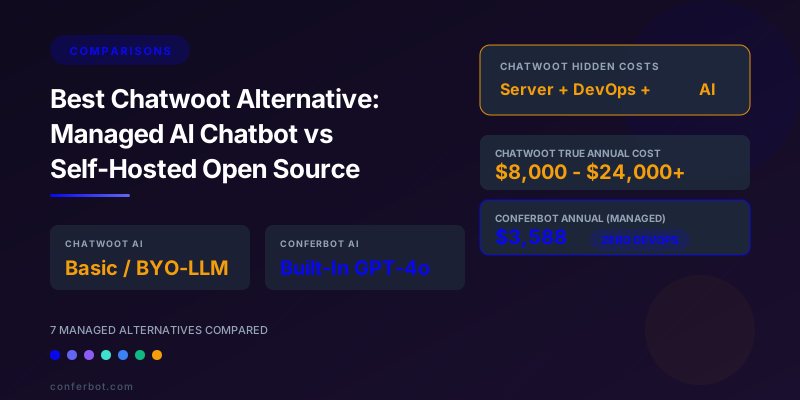
The reality is more complicated. "Free" software is never free when you account for the total cost of operating it. Self-hosting Chatwoot requires server infrastructure ($100-$500+/month for production-grade hosting), DevOps time for deployment, updates, scaling, and monitoring (4-8 hours/month minimum), security responsibility including SSL management, vulnerability patching, and data backup (your team, not Chatwoot's), and uptime accountability (your SLA, your incident response, your 3 AM alerts). When you add these costs together, the true annual cost of self-hosting Chatwoot ranges from $8,000 to $24,000 for a production deployment -- significantly more than many managed platforms that include hosting, security, updates, AI, and support for a flat monthly fee.
But cost is only half the problem. The other half is AI. Chatwoot's AI capabilities are basic: it offers a BYO-LLM integration that lets you connect OpenAI or other providers, but the implementation is rudimentary compared to purpose-built AI chatbot platforms. There is no RAG (Retrieval Augmented Generation) pipeline, no knowledge-base-trained autonomous resolution, no conversation-flow A/B testing, and no sophisticated handoff logic. Teams wanting production-grade AI on Chatwoot must build it themselves -- a significant engineering investment that defeats the "free" proposition.
According to Gartner's 2026 customer service technology report, 78 percent of businesses now prefer managed SaaS platforms over self-hosted solutions for customer engagement, citing faster AI adoption, lower total cost of ownership, and reduced operational burden. The self-hosting model that Chatwoot champions is becoming a niche choice for teams with specific compliance or data-sovereignty requirements -- not the default for teams that just want great customer support.
This guide compares seven managed alternatives that deliver what Chatwoot promises (affordable customer engagement) plus what it cannot easily deliver (production-grade AI, zero infrastructure burden, and enterprise reliability). Whether you want a flat-rate AI platform like Conferbot, a premium messenger like Intercom, or a free managed alternative like Tawk.to, this analysis provides the data for an informed decision.
For teams evaluating open-source versus proprietary across the broader market, our best AI customer service tools guide covers 15 platforms. For the technical considerations of chatbot infrastructure, see our chatbot technology stack guide.
The Chatwoot Problem: 5 Hidden Costs of Self-Hosted Open Source
Chatwoot is excellent software for what it is: an open-source, self-hosted customer engagement tool. The problems arise when teams treat "free software" as "free support platform" without accounting for the operational costs. These five hidden costs explain why teams migrate to managed alternatives.
Hidden Cost 1: Server Infrastructure ($1,200-$6,000/Year)
Chatwoot's self-hosted deployment requires server resources that grow with usage. A production-grade setup typically involves a primary server (4 vCPUs, 8GB RAM minimum) at $50-$200/month depending on provider, a PostgreSQL database with adequate storage and backup at $30-$100/month, a Redis instance for caching and real-time features at $15-$50/month, file storage for attachments and media (S3 or equivalent) at $10-$30/month, and a CDN for widget delivery at $10-$50/month. Total infrastructure ranges from $115 to $430 per month, or $1,380 to $5,160 per year. This is before any redundancy, high-availability configuration, or disaster recovery -- features that managed platforms include by default.

Hidden Cost 2: DevOps Time ($4,800-$14,400/Year)
Self-hosting means your team is responsible for everything a managed platform handles for you: initial deployment and configuration (8-16 hours), version upgrades (2-4 hours per upgrade, typically monthly), security patching (1-2 hours per patch, varies by frequency), monitoring and incident response (2-4 hours/month ongoing), scaling and performance optimization (2-4 hours/month as usage grows), and backup management and disaster recovery testing (1-2 hours/month).
At a conservative DevOps hourly rate of $80 to $120, the ongoing maintenance alone costs $4,800 to $14,400 per year. This is pure overhead -- time your engineering team could spend building product features, improving customer experience, or deploying AI capabilities that actually generate business value.
According to McKinsey's build-versus-buy analysis, companies that self-host commodity software (helpdesks, CRMs, analytics) spend 2 to 3 times more on total cost of ownership than comparable SaaS solutions while diverting engineering resources from core product development.
Hidden Cost 3: Security and Compliance Responsibility
When you self-host, security is your problem. SSL certificate management and renewal, vulnerability scanning and penetration testing, data encryption at rest and in transit, GDPR and CCPA data handling compliance, incident response planning and execution, and security audit preparation (if required by customers or regulators) all fall on your team. Managed platforms handle these by default with dedicated security teams, automated compliance frameworks, and established incident response procedures. Chatwoot's open-source nature means vulnerabilities are publicly visible in the codebase -- you must patch them before they are exploited, which requires monitoring the GitHub repository and applying updates promptly.

Hidden Cost 4: Basic AI That Requires Engineering to Be Useful
Chatwoot offers a BYO-LLM integration that connects to OpenAI's API for basic response suggestions. But this is a raw API connection, not a production AI chatbot. To build a useful AI support system on Chatwoot, you need to: implement a RAG pipeline to train the AI on your knowledge base (40-80 engineering hours), build conversation flow management with handoff logic (20-40 hours), create testing and monitoring infrastructure for AI quality (16-24 hours), implement guardrails to prevent hallucinations and off-topic responses (16-24 hours), and build analytics for AI performance tracking (16-24 hours).
Total engineering investment: 108 to 192 hours, or $8,640 to $23,040 at $80-$120/hour. And this is the initial build -- ongoing maintenance, tuning, and improvement add continuous cost. By contrast, managed AI chatbot platforms like Conferbot deliver all of these capabilities out of the box, pre-built, tested, and continuously improved by a dedicated team. See our RAG implementation guide for the technical complexity involved.
Hidden Cost 5: Opportunity Cost of Engineering Focus
The most insidious cost is not financial -- it is strategic. Every hour your engineering team spends maintaining Chatwoot infrastructure, patching security vulnerabilities, upgrading versions, and building AI capabilities is an hour not spent on your core product. For a startup or mid-market company, this opportunity cost can be the difference between shipping a competitive feature and falling behind. Managed platforms eliminate this entire category of work, freeing your engineering team to focus on what actually differentiates your business.
For a deeper analysis of when self-hosting versus managed platforms makes sense, see our ChatGPT vs chatbot platform guide which covers the build-versus-buy decision framework.
7 Best Chatwoot Alternatives Compared: Managed Platforms With Built-In AI
Every alternative on this list is fully managed -- no server setup, no DevOps maintenance, no security patching. The comparison focuses on AI capability, total cost versus Chatwoot's true TCO, and what you gain by trading self-hosting control for managed convenience.
| Platform | Starting Price | Hosting | AI Chatbot | AI Model | G2 Rating | Free Tier |
|---|---|---|---|---|---|---|
| Chatwoot | Free (self-host) | Self-hosted | Basic (BYO-LLM) | OpenAI (raw API) | 4.3 | Yes (self-host) |
| Conferbot | Free / $19/mo | Managed | Production-grade | GPT-4o, Claude, Gemini | 4.7 | Yes |
| Intercom | $39/seat/mo | Managed | Production-grade | GPT-4 (Fin) | 4.5 | Trial |
| Tidio | Free / $29/mo | Managed | Production-grade | Claude (Lyro) | 4.7 | Yes |
| Crisp | Free / $25/mo | Managed | Good | MagicReply AI | 4.5 | Yes |
| Freshchat | Free / $15/agent/mo | Managed | Basic-Good | Freddy AI | 4.1 | Yes |
| HelpCrunch | $15/member/mo | Managed | Good | AI editor | 4.7 | Trial |
| Tawk.to | Free | Managed | Basic | AI Assist | 4.5 | Yes (fully free) |
True Annual Cost: 5-Agent Team, 4,000 Monthly Conversations
| Platform | Platform Cost | Infrastructure Cost | DevOps Cost | AI Build Cost (Year 1) | True Annual Cost |
|---|---|---|---|---|---|
| Chatwoot (self-hosted, production) | $0 | $3,600 | $7,200 | $12,000 (AI build) | $22,800 (Year 1) |
| Chatwoot (self-hosted, ongoing) | $0 | $3,600 | $7,200 | $3,600 (AI maintenance) | $14,400 (Year 2+) |
| Conferbot Business | $3,588 | $0 | $0 | $0 (included) | $3,588 |
| Intercom (5 seats + Fin) | $2,340 | $0 | $0 | $0 ($0.99/resolution) | $2,340 + Fin costs |
| Tidio Growth | $3,948 | $0 | $0 | $0 (included) | $3,948 |
| Crisp Pro | $3,000 | $0 | $0 | $0 (included) | $3,000 |
| Freshchat Pro (5 agents) | $5,940 | $0 | $0 | $0 (included) | $5,940 |
| HelpCrunch (5 members) | $1,500 | $0 | $0 | $0 (included) | $1,500 |
| Tawk.to | $0 | $0 | $0 | $0 (basic AI) | $0 |

The cost comparison demolishes the "free" narrative. Chatwoot's true annual cost of $14,400 to $22,800 is 2.4x to 6.4x more expensive than Conferbot, 3.6x to 7.6x more than Crisp, and infinitely more expensive than Tawk.to's fully free managed platform. Every managed alternative is cheaper than self-hosted Chatwoot when DevOps and infrastructure costs are honestly accounted for.
For a comprehensive framework on calculating total cost of ownership for support platforms, see our chatbot ROI framework.
Detailed Alternative Reviews: Managed Platforms That Outperform Self-Hosted Chatwoot
1. Conferbot -- Best Overall Chatwoot Replacement for AI-Powered Managed Support
Conferbot is the most direct answer to Chatwoot's limitations. Where Chatwoot requires you to build AI infrastructure from scratch, Conferbot delivers production-grade GPT-4o, Claude, and Gemini-powered conversations out of the box. Where Chatwoot demands DevOps maintenance, Conferbot is fully managed with zero infrastructure burden. Where Chatwoot's true cost reaches $14,400-$22,800/year, Conferbot costs $3,588/year flat.
Why it beats Chatwoot:
- Zero infrastructure: No servers, no databases, no Redis, no CDN, no DevOps. Sign up and deploy in minutes.
- Production-grade AI: GPT-4o-powered conversations trained on your knowledge base with RAG, autonomous actions, and conversation flow management -- all pre-built, not DIY.
- 75-84 percent lower true cost: $3,588/year versus Chatwoot's $14,400-$22,800/year true TCO.
- 13-plus channels: Deploy on web, WhatsApp, Messenger, Telegram, SMS, Slack, and more. Chatwoot supports fewer channels with more configuration effort.
- Autonomous actions: Process refunds, modify orders, update CRM records within conversations using the no-code API builder. Chatwoot requires custom development for equivalent functionality.
What you give up: Source code access and full data self-hosting. If your compliance or data-sovereignty requirements mandate on-premise deployment, Chatwoot's self-hosting model is the right choice. For everyone else, Conferbot delivers more capability at lower cost with zero operational burden.
Best for: Teams currently running Chatwoot who want to eliminate DevOps overhead and upgrade to production-grade AI without building it themselves.
2. Intercom -- Best Premium Managed Alternative With AI Resolution Benchmark
Intercom's Fin AI achieves 50 to 65 percent autonomous resolution rates -- the industry benchmark for AI-powered customer support. At $39/seat/month with $0.99 per Fin resolution, it is the premium managed alternative for teams that want the highest AI quality without any infrastructure management.
Why it beats Chatwoot: Zero infrastructure, production-grade AI that resolves half of conversations autonomously, the industry's best messenger experience, and a product suite (product tours, proactive messaging, customer data platform) that Chatwoot does not offer. Intercom's 4.5 G2 rating reflects consistent delivery across enterprise and mid-market deployments.
Limitations: Per-resolution pricing makes Fin AI expensive at high volume. The $39/seat base is more than Chatwoot's managed cloud option. See our Intercom alternative analysis.
Best for: SaaS companies wanting best-in-class managed AI support with zero infrastructure management.
3. Tidio -- Best Free-to-Start Managed Alternative With Ecommerce AI
Tidio offers a genuine free tier with live chat, chatbot builder, and Shopify integration -- comparable to what Chatwoot offers for self-hosted, but fully managed with no infrastructure to maintain. The paid tiers add Lyro AI (Claude-powered) for autonomous resolution at $29 to $394/month.
Why it beats Chatwoot: Free managed tier eliminates infrastructure costs entirely. Lyro AI delivers 40 to 55 percent automation rates versus Chatwoot's DIY approach. Native Shopify and WooCommerce integration for ecommerce teams. Zero DevOps required.
Limitations: Conversation caps on lower tiers limit scalability. Less flexible than Chatwoot's open-source customization for developers. For a deeper Tidio evaluation, see our Tidio alternative guide.
Best for: Small teams and ecommerce stores that chose Chatwoot primarily for its free pricing and want a managed equivalent with real AI.
4. Crisp -- Best Developer-Friendly Managed Alternative
Crisp is the managed platform that most closely matches Chatwoot's developer-friendly ethos. It offers clean APIs, webhook support, a JavaScript SDK for custom widget behavior, and MagicReply AI for response suggestions. At $25/month for up to 4 agents (no per-seat fees), Crisp provides a modern, developer-friendly alternative without the self-hosting burden.
Why it beats Chatwoot: Developer-friendly APIs and SDKs without infrastructure management, MagicReply AI included in paid plans, flat-rate pricing that does not scale with team size, and a modern interface built for 2026 workflows. Crisp's 4.5 G2 rating reflects strong developer satisfaction.
Limitations: MagicReply AI is limited to suggestions rather than autonomous resolution. Less customizable than Chatwoot's open-source codebase for teams needing deep modifications. Higher-tier pricing increases for larger teams.
Best for: Developer-led teams that appreciate Chatwoot's technical orientation but want to stop managing infrastructure.
5. Freshchat -- Best Managed Alternative for Freshworks Ecosystem
Freshchat at $15/agent/month provides managed live chat with Freddy AI, integration across the Freshworks suite, and WhatsApp Business API support. For teams already using Freshdesk or Freshsales, Freshchat adds messaging without introducing self-hosting complexity.
Why it beats Chatwoot: Zero infrastructure, Freddy AI included in higher tiers, native Freshworks integration, and WhatsApp Business API. Production-grade hosting, security, and uptime SLA are all handled by Freshworks.
Limitations: Freddy AI automation rates (15-25 percent) are lower than Conferbot or Intercom. Per-agent pricing creates scaling costs that flat-rate alternatives avoid.
Best for: Teams using Freshworks products who chose Chatwoot for cost savings and now want managed convenience with ecosystem integration.
6. HelpCrunch -- Best Budget All-in-One Managed Alternative
HelpCrunch bundles live chat, knowledge base, email marketing, and AI in a single managed platform at $15/member/month. It delivers more functionality than Chatwoot at a lower true cost while eliminating all infrastructure and DevOps overhead.
Why it beats Chatwoot: All-in-one platform (chat + KB + email) at $15/member/month, which is cheaper than Chatwoot's true TCO even at 10 agents. AI editor and response assistance included. Zero infrastructure management. The 4.7 G2 rating exceeds Chatwoot's 4.3.
Limitations: AI capabilities are limited to response assistance rather than autonomous resolution. Smaller community and ecosystem than Chatwoot or Intercom. Less developer-friendly than Crisp or Chatwoot for custom integrations.
Best for: Budget-conscious teams wanting a complete managed support stack at the lowest possible per-agent cost.
7. Tawk.to -- Best Completely Free Managed Alternative
Tawk.to is the managed platform that most directly challenges Chatwoot's "free" positioning. It offers free managed live chat, unlimited agents, unlimited history, and basic AI assistance -- all hosted and maintained by Tawk.to at no cost. The revenue model is based on optional paid add-ons (AI chatbot, video calls, phone) and hired-agent services.
Why it beats Chatwoot: Truly free with zero infrastructure cost, zero DevOps cost, and zero maintenance burden. For teams that chose Chatwoot solely because it was free, Tawk.to is a managed equivalent that costs less (nothing) while eliminating all self-hosting overhead.
Limitations: AI capabilities are basic. The free tier includes Tawk.to branding. Customization is more limited than Chatwoot's open-source flexibility. The platform's long-term viability depends on the add-on revenue model. For teams needing production-grade AI, Conferbot is the better choice.
Best for: Teams that chose Chatwoot purely for price and want zero-cost managed live chat without self-hosting. See our free chatbot for website guide for additional free options.
Self-Hosted vs Managed: When Chatwoot's Model Makes Sense and When It Doesn't
Self-hosting is not inherently wrong -- it is a legitimate architecture choice for specific requirements. The problem is when teams choose self-hosting by default rather than by necessity, paying the hidden costs without receiving proportional benefits.
When Self-Hosting (Chatwoot) Makes Sense
- Data sovereignty requirements: If your compliance framework, customer contracts, or regulatory environment requires that customer data never leave your infrastructure, self-hosting is necessary. This applies to some government contracts, financial services, healthcare with strict data residency requirements, and EU organizations with specific GDPR interpretations about data processing.
- Air-gapped environments: If your support system must operate in a network-isolated environment (military, defense, certain government agencies), cloud SaaS platforms cannot serve you.
- Deep source-code customization: If you need to fundamentally modify the helpdesk's behavior in ways that APIs and webhooks cannot accommodate -- modifying core routing logic, building custom protocol support, or integrating with proprietary internal systems at the code level -- open source provides the access level you need.
- Engineering team with spare capacity: If you have DevOps engineers who are not fully utilized and the infrastructure cost is marginal relative to your existing cloud spend, the incremental cost of self-hosting may be lower than the list price suggests.
When Managed Platforms Are the Better Choice
- No dedicated DevOps team: If your engineering team is product-focused and does not have DevOps specialists, self-hosting adds operational burden to people who should be building features.
- AI is a priority: Building production-grade AI on Chatwoot requires 108 to 192 hours of engineering. Managed platforms deliver it out of the box.
- Time to value matters: Chatwoot deployment takes days to weeks. Managed platforms deploy in minutes to hours.
- Budget transparency: Managed platforms have fixed, predictable costs. Self-hosting costs vary with traffic, incidents, and engineering time.
- Support SLA requirements: If you need guaranteed uptime, managed platforms provide SLAs. Self-hosted uptime is your team's responsibility.

For a deeper analysis of the build-versus-buy decision in chatbot technology, our chatbot technology stack guide covers architecture considerations, and our Python chatbot vs no-code guide examines the developer-versus-managed tradeoff specifically.
AI Capability Comparison: Chatwoot's BYO-LLM vs Production-Grade Managed AI
The AI gap between Chatwoot and managed alternatives is the single most important factor driving migration. This section provides a detailed technical comparison.
Chatwoot's AI: Raw LLM Connection
Chatwoot's AI integration is a BYO-LLM connector -- you provide your OpenAI API key, and Chatwoot sends customer messages to the API for response suggestions. What this delivers: basic response suggestions based on conversation context, some intent detection for routing, and configurable LLM parameters (temperature, max tokens). What this lacks: RAG pipeline for knowledge-base-grounded responses, autonomous resolution without agent approval, conversation flow management with fallback logic, A/B testing for AI response quality, guardrails for hallucination prevention, analytics for AI performance tracking, and autonomous action execution (refunds, order modifications, CRM updates).
Managed Platform AI: Production-Grade Systems
Platforms like Conferbot, Intercom, and Tidio deliver complete AI support systems built by dedicated AI engineering teams. These systems include every capability Chatwoot lacks, pre-built and continuously improved.
| AI Capability | Chatwoot (DIY) | Conferbot | Intercom Fin | Tidio Lyro |
|---|---|---|---|---|
| LLM integration | Raw API connection | Optimized multi-model | GPT-4 (tuned) | Claude (tuned) |
| RAG pipeline | Not included (build yourself) | Built-in (auto-sync KB) | Built-in | Built-in |
| Autonomous resolution rate | 0-15% (with DIY effort) | 65-80% | 50-65% | 40-55% |
| Autonomous actions | Not included | No-code API builder | Custom actions | Limited |
| Hallucination guardrails | Not included | Built-in | Built-in | Built-in |
| A/B testing | Not included | Built-in | Built-in | Not included |
| AI analytics dashboard | Not included | Built-in | Built-in | Basic |
| Multi-language AI | Depends on LLM | 95+ languages | 45+ languages | 7 languages |
| Engineering hours to deploy | 108-192 hours | 0 hours (pre-built) | 0 hours | 0 hours |
| Ongoing AI maintenance | 4-8 hours/month | 0 hours | 0 hours | 0 hours |

The gap is not incremental -- it is categorical. Chatwoot gives you a raw LLM connection. Managed platforms give you a complete AI support system. Building the equivalent on Chatwoot requires the engineering investment of a small AI product -- 108 to 192 hours initially plus 4 to 8 hours of monthly maintenance. For teams that have done this math, managed platforms win on both cost and capability.
For the technical details of building RAG-powered chatbots, see our RAG implementation guide, and for preventing AI errors, our hallucination prevention guide.
Migration Guide: Moving From Self-Hosted Chatwoot to Managed AI in 3 Weeks
Migrating from Chatwoot to a managed platform is uniquely satisfying because you are eliminating operational burden, not just changing tools. The migration itself is straightforward.
Week 1: Data Export and Platform Setup
- Export conversation data: Use Chatwoot's API to export conversation history, contact data, and agent records. Chatwoot's API documentation is thorough for data export operations.
- Export knowledge base content: Download all help articles and canned responses. These will train your new AI chatbot.
- Export custom attributes and labels: Document any custom fields, tags, or contact attributes you have configured in Chatwoot.
- Sign up for your managed platform: Create your account, import team members, and configure basic settings.
- Upload knowledge base: Import exported content to the new platform. On AI-powered platforms, this immediately begins AI training.
Week 2: AI Configuration and Testing
- Configure AI on top conversation topics: Verify AI handles your most common inquiries accurately.
- Set up channel integrations: Connect web chat, email, WhatsApp, Messenger, and any other channels. Most managed platforms make this a one-click process versus Chatwoot's manual channel configuration.
- Configure automation rules: Translate any Chatwoot automation rules into the new platform's framework.
- Test with sample conversations: Run through your most common customer scenarios end to end.
Week 3: Deploy and Decommission
- Deploy new platform: Replace Chatwoot's widget code with your new platform's embed snippet.
- Monitor for 5-7 days: Verify everything works correctly in production.
- Decommission Chatwoot infrastructure: This is the best part. Shut down your Chatwoot servers, terminate database instances, cancel cloud infrastructure subscriptions, and reclaim your DevOps team's time. The monthly savings begin immediately.
- Redirect engineering time: Your DevOps team now has 4 to 8 hours per month freed up. Your engineering team no longer needs to build and maintain AI infrastructure. Redirect these resources to product development.
For migration strategies from other platforms, see our guides for leaving Drift, Kayako, and Ada CX.
Which Chatwoot Alternative Should You Choose? Decision Guide by Team Type
Your optimal replacement depends on why you chose Chatwoot in the first place and what you need going forward.
If You Chose Chatwoot Because: It Was Free
Consider Tawk.to (free managed live chat) or Conferbot's free tier. Both eliminate infrastructure costs while providing managed hosting. Conferbot adds AI capabilities on paid plans at $19 to $299/month -- still cheaper than Chatwoot's true TCO.
If You Chose Chatwoot Because: You Wanted Developer Control
Choose Crisp. Developer-friendly APIs, webhook support, JavaScript SDK, and a modern interface. You lose source-code access but gain production AI and zero DevOps overhead.
If You Chose Chatwoot Because: You Wanted AI
Choose Conferbot. Production-grade GPT-4o AI with RAG, autonomous actions, and A/B testing -- everything you would have had to build yourself on Chatwoot, delivered pre-built at $3,588/year.
If You Chose Chatwoot Because: Budget Constraints
Choose HelpCrunch ($15/member/month) or Tidio (free tier). Both cost less than Chatwoot's true TCO while providing more capability.
If You Chose Chatwoot Because: Data Privacy
Stay with Chatwoot if your data sovereignty requirements genuinely mandate self-hosting. If they do not, any managed platform with SOC 2 compliance (Intercom, Zendesk, Conferbot) provides enterprise-grade data protection without self-hosting burden.
| Original Reason for Chatwoot | Best Alternative | Annual Cost | Key Gain |
|---|---|---|---|
| Free pricing | Tawk.to / Conferbot free | $0 - $3,588 | Zero infrastructure cost |
| Developer control | Crisp | $3,000 | APIs + zero DevOps |
| AI capability | Conferbot | $3,588 | Production AI, no engineering |
| Budget constraints | HelpCrunch / Tidio | $0 - $1,500 | Lower true cost + AI included |
| Privacy / compliance | Stay Chatwoot or Zendesk | Varies | Self-host or SOC 2 managed |
| All-in-one simplicity | HelpCrunch | $1,500 | Chat + KB + email in one |
Verdict: Open Source Is a Philosophy, Not a Business Strategy for Customer Support
Chatwoot is excellent software built by talented developers for a community that values open source, self-hosting, and data ownership. Those are legitimate values. But for the majority of businesses -- teams that need customer support to work reliably, scale efficiently, and leverage AI effectively -- self-hosted open source is the wrong architecture choice in 2026.
The math is unambiguous:
- Cost: Chatwoot's true TCO of $14,400 to $22,800/year exceeds six of seven managed alternatives. The "free" label is misleading when infrastructure, DevOps, and AI engineering are honestly accounted for.
- AI: Chatwoot's BYO-LLM integration produces 0 to 15 percent automation. Managed platforms deliver 40 to 80 percent. Building equivalent AI on Chatwoot costs 108 to 192 engineering hours initially plus ongoing maintenance.
- Operations: Self-hosting adds 4 to 8 hours of monthly DevOps overhead, security responsibility, and uptime accountability. Managed platforms handle all of this with dedicated teams and SLAs.
- Time to value: Chatwoot deployment takes days to weeks. Managed AI deployment takes minutes to hours.
- Opportunity cost: Every hour your team spends on Chatwoot infrastructure is an hour not spent on your actual product.
For the majority of teams, Conferbot is the best Chatwoot replacement. It delivers production-grade AI (65-80 percent resolution), zero infrastructure overhead, 13-plus channel deployment, flat-rate pricing at $3,588/year, and a no-code builder that eliminates the engineering investment Chatwoot demands. The migration takes 3 weeks, and your team starts reclaiming DevOps hours immediately.
For teams that chose Chatwoot primarily because it was free, Tawk.to provides free managed live chat, and Conferbot's free tier adds AI capabilities at no cost. For developer-led teams wanting API control, Crisp is the managed platform that most respects the developer mindset. For budget-conscious teams wanting everything bundled, HelpCrunch provides chat, knowledge base, and email at $15/member/month.
The exception: if your compliance requirements genuinely mandate self-hosted, on-premise deployment, Chatwoot remains the best option in its category. For everyone else, the era of self-hosting customer support tools has passed. The operational overhead is too high, the AI gap is too wide, and the managed alternatives are too good and too affordable to justify the self-hosting tax.
Start with Conferbot's free tier to experience managed AI support without commitment. Visit our comparison hub for additional platform matchups. And when you are ready to decommission your Chatwoot servers, enjoy the most satisfying terraform destroy of your career.
Additional research: G2 Live Chat Category, Capterra Live Chat Software, and McKinsey's Build vs Buy Analysis.
Was this article helpful?
Best Chatwoot Alternative FAQ
Everything you need to know about chatbots for best chatwoot alternative.
About the Author
Conferbot Team specializes in conversational AI, chatbot strategy, and customer engagement automation. With deep expertise in building AI-powered chatbots, they help businesses deliver exceptional customer experiences across every channel.
View all articles