Why Martial Arts Studios Need AI Chatbots in 2026
The martial arts industry in the United States comprises over 30,000 studios generating approximately $5.4 billion in annual revenue, according to IBISWorld industry research. The market spans a remarkable diversity of disciplines -- karate, taekwondo, Brazilian jiu-jitsu (BJJ), judo, Muay Thai, kung fu, MMA, krav maga, and hybrid programs -- each with its own culture, ranking systems, and student demographics. Yet despite this diversity, virtually every martial arts studio shares the same business model: trial classes convert to monthly memberships that generate recurring revenue, and retention determines profitability.
The operational challenge at most studios is that the owner or head instructor is also the primary salesperson, front desk attendant, and student counselor. During class hours -- which are peak inquiry hours because parents drop off children and see the studio in action -- the instructor is on the mat and cannot answer the phone. The Martial Arts Industry Association (MAIA) estimates that the average studio misses 35-45% of incoming phone inquiries, and each missed call represents a potential $1,500-$2,400 in annual membership revenue.
An AI chatbot solves this fundamental operational conflict. It engages prospective students and parents 24/7, books trial classes with proper age and experience placement, answers the dozens of frequently asked questions about class schedules, belt testing, uniform requirements, and pricing, manages membership renewals and family enrollment, and follows up with trial attendees who have not yet converted. For the studio owner-operator who spends evenings returning missed calls instead of planning curriculum or training, the chatbot recovers 8-12 hours per week of administrative time while simultaneously converting more leads than manual follow-up ever could.
This guide covers the complete chatbot implementation for martial arts studios: trial class booking with age and experience filtering, class schedule management, belt ranking and testing FAQ automation, membership enrollment and renewal, family account management, and a detailed ROI model. Whether you operate a traditional karate dojo, a BJJ academy, an MMA training center, or a multi-discipline studio, this playbook provides the framework to grow enrollment and reduce administrative overhead through intelligent chatbot deployment.
The competitive landscape makes this investment increasingly necessary. National franchise chains like Tiger-Rock, Premier Martial Arts, and The PKSA have standardized their digital marketing and lead conversion processes, creating a technology gap that independent studios struggle to bridge with manual operations. Meanwhile, crossfit gyms, boutique fitness studios, and youth sports leagues compete aggressively for the same demographic -- active families with disposable income. A chatbot gives independent martial arts studios the lead conversion and student management capabilities that level the playing field against well-funded competitors while preserving the personal, community-driven culture that makes independent studios special.
Trial Class Booking: The Enrollment Funnel That Converts 3.2x Better
Trial classes are the lifeblood of martial arts studio growth. The industry operates on a simple funnel: attract interest, convert to a trial visit, deliver an exceptional first experience, and enroll the student in a membership program. Every stage matters, but the trial booking stage is where most studios lose the largest percentage of potential students -- not because the studio is unappealing, but because the booking process creates friction.

The Problem With Phone-Based Trial Booking
When a parent searches for "karate classes for kids near me" at 9 PM and clicks through to your website, they are motivated and ready to take action. If the only option is to call during business hours, that motivation fades by morning. They may call another studio, get distracted by daily life, or simply forget. Phone-only studios convert just 7% of website visitors to trial appointments. Even studios with website contact forms achieve only 12% conversion because the form provides no immediate gratification -- the prospect fills it out and then waits for a callback that may come hours or days later.
How the Chatbot Trial Booking Flow Works
The chatbot engages the visitor immediately with a discipline-aware opening and guides them through a structured trial booking in under 3 minutes:
- Interest identification: "Welcome! Are you interested in martial arts for yourself, for a child, or for the whole family?" This initial question determines the subsequent flow -- adult programs, youth programs, or family enrollment.
- Age and experience assessment: For youth inquiries, the chatbot asks the child's age and any previous martial arts experience. For adults, it asks about fitness level and goals (self-defense, competition, fitness, stress relief). This information is critical for class placement.
- Discipline matching: For studios offering multiple disciplines, the chatbot presents options based on the student's profile: "For a 7-year-old beginner, we recommend our Kids Karate program (ages 5-8) or our Kids Jiu-Jitsu program. Karate emphasizes discipline and striking; jiu-jitsu focuses on grappling and ground techniques. Which sounds more interesting?"
- Schedule presentation: The chatbot shows available trial class times that match the student's age group and selected discipline: "Our Kids Karate Beginner class meets Tuesday and Thursday at 4:30 PM, and Saturday at 10:00 AM. Which day works best for your first visit?"
- Booking confirmation: The customer receives instant confirmation with class details, what to wear, what to bring, arrival time (10 minutes early for paperwork), and parking information.
The Conversion Impact
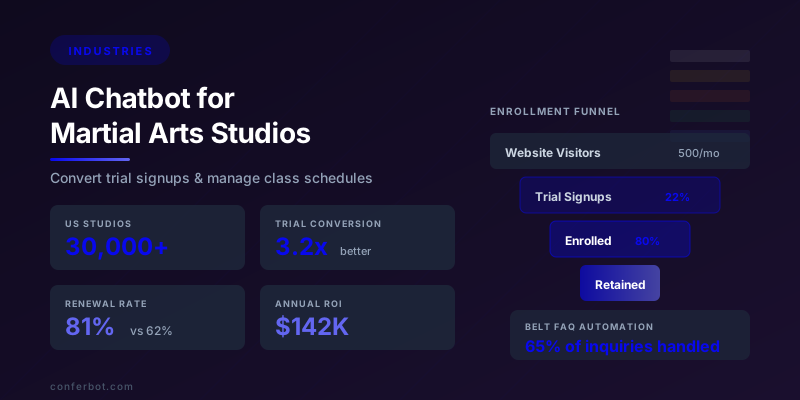
The MAIA Success Academy confirms that speed-to-response is the top predictor of enrollment. Studios using chatbot trial booking achieve a 22% website-to-trial conversion rate -- 3.2x higher than phone-only studios. The primary drivers are immediacy (booking happens in real-time during the moment of interest), information completeness (the prospect gets all their questions answered before committing), and 24/7 availability (60% of trial bookings through chatbots occur outside business hours). For a studio website receiving 500 unique visitors per month, increasing conversion from 7% to 22% means 75 additional trial attendees per year -- representing approximately $112,500 in potential annual membership revenue at an 80% trial-to-enrollment rate and $125/month membership pricing. This conversion methodology aligns with the 3x lead conversion framework documented across service industries.
Trial Reminder and Pre-Visit Preparation
After booking, the chatbot sends a confirmation sequence designed to maximize show-up rates. The day before the trial, it sends a reminder with practical preparation: "Reminder: [Student Name]'s trial Karate class is tomorrow at 4:30 PM! Wear comfortable athletic clothing. We provide a loaner uniform for the first class. Arrive 10 minutes early so we can meet you and answer any questions. We are at [Address] -- parking is available in the lot behind the building." On the morning of the class, a brief reminder: "See you today at 4:30! [Instructor Name] is looking forward to meeting [Student Name]." This personalized reminder sequence reduces trial no-shows by 45%, ensuring that the marketing investment in driving website traffic actually results in bodies on the mat.
Class Schedule Management by Age, Rank, and Experience Level
As documented by studio management platforms like Zen Planner, martial arts scheduling is more complex than most appointment-based businesses because classes are segmented by multiple dimensions: age group (Tiny Tigers 3-5, Kids 6-8, Juniors 9-12, Teens 13-17, Adults 18+), experience level (white belt beginners through advanced black belt), and discipline (karate, BJJ, Muay Thai, weapons, competition team). A mid-size studio offering 3 disciplines across 4 age groups with beginner and advanced levels may run 25-35 distinct class sessions per week, each with different eligibility requirements.
How the Chatbot Navigates Schedule Complexity
When a prospective or current student asks about class times, the chatbot filters the schedule based on the student's profile rather than presenting the full 35-class weekly schedule:
For new inquiries: "Based on [Student Name]'s age (10) and experience (beginner), here are the available classes: Junior Karate Beginner -- Monday/Wednesday 5:00 PM, Thursday 4:30 PM, Saturday 11:00 AM. We recommend attending at least 2 classes per week for the best progress."
For current students advancing in rank: "Congratulations on [Student Name]'s yellow belt promotion! [He/She] is now eligible for the Junior Karate Intermediate class on Tuesday/Thursday at 5:30 PM, in addition to the beginner class. Many students attend both during the transition period."
For students interested in adding disciplines: "[Student Name] currently attends Kids Karate on Monday/Wednesday. If [he/she] would like to try jiu-jitsu, the Kids BJJ Beginner class on Tuesday/Thursday at 4:30 PM would not conflict with the existing schedule. Would you like to add a trial for BJJ?"
Class Capacity Management
The chatbot tracks class enrollment against capacity limits (most studios cap classes at 15-25 students depending on mat space and instructor ratios). When a class is full, the chatbot offers alternatives: "The Saturday 10:00 AM Kids Karate class is currently full. Would you like to join the waitlist (you will be notified when a spot opens), or would the Thursday 4:30 PM session work instead?" Waitlist management is particularly valuable for popular time slots -- studios report that 30-40% of waitlisted families book into the next available cycle, revenue that would be lost without automated waitlist tracking.
Schedule Change Communication
Studios occasionally need to modify schedules -- holiday closures, instructor substitutions, special seminars, weather cancellations. The chatbot sends targeted notifications to affected students: "Heads up: Wednesday's Junior Karate class is cancelled due to [Reason]. The makeup class will be held Saturday at 2:00 PM. Would you like to confirm [Student Name]'s attendance at the makeup session?" This targeted communication eliminates the mass-email approach where important schedule changes get lost in cluttered inboxes. The chatbot can confirm attendance at makeup sessions, giving the instructor an accurate headcount.
The chatbot also handles the semi-annual schedule change that most studios implement (fall/winter and spring/summer schedules). Rather than posting a new schedule and hoping families figure out their new class times, the chatbot proactively notifies each family: "Our spring schedule starts March 15. [Student Name]'s class is moving from Monday/Wednesday 5:00 PM to Monday/Wednesday 5:30 PM. The Saturday class time remains unchanged. Do you have any questions?" This proactive communication prevents the attendance drop that typically accompanies schedule changes and keeps enrollment stable through the transition.
Belt Ranking FAQ Automation: Answering the Question Parents Ask Most
In any martial arts studio that uses a belt ranking system -- following standards established by organizations like USA Taekwondo and the International Martial Arts Federation -- which is virtually all of them -- the most frequent parent inquiry is some variation of: "When does my child test for the next belt?" This single question, with all its variants and follow-ups, accounts for an estimated 65% of parent inquiries at studios serving youth students. The answer is never simple because testing eligibility depends on attendance, time in rank, skill proficiency, and instructor approval. Explaining this to every parent individually consumes enormous staff time.

The Belt Ranking Knowledge Base
The chatbot maintains a comprehensive belt ranking knowledge base that covers every question parents and students ask about the promotion system:
Testing requirements by rank:
- "What are the requirements for [Color] belt?" -- The chatbot presents the specific techniques, forms/kata, sparring requirements, and attendance minimums for each belt level.
- "How long does it take to get from [Current Belt] to [Next Belt]?" -- The chatbot provides typical timeframes while explaining that advancement is skill-based, not purely time-based: "Most students advance from white belt to yellow belt in 3-4 months with consistent 2x/week attendance. However, testing eligibility is determined by skill proficiency, not just time."
- "How long does it take to earn a black belt?" -- The chatbot provides a realistic timeline: "Black belt typically requires 3-5 years of consistent training depending on the student's dedication, natural ability, and attendance. This timeline ensures thorough mastery of all techniques and principles."
Testing logistics:
- "When is the next belt test?" -- The chatbot provides the date, time, location, and registration deadline for the upcoming testing event.
- "How much does belt testing cost?" -- Testing fees, new belt costs, and any associated uniform requirements.
- "What should my child prepare?" -- Specific techniques and forms required for the student's current rank advancing to the next level.
- "Can family attend?" -- Spectator policies, arrival times, and etiquette expectations.
Progress tracking:
- "Is my child eligible for the next test?" -- The chatbot checks attendance records and time-in-rank requirements. If the student meets quantitative requirements: "Based on attendance (24 of 24 required classes) and time in rank (4 months), [Student Name] meets the eligibility requirements. Final testing invitation depends on instructor evaluation of technique proficiency." If not: "[Student Name] has completed 18 of 24 required classes for testing eligibility. At the current attendance rate, eligibility will be reached by [Date]."
Managing Expectations Proactively
One of the most delicate aspects of martial arts studio management is the parent who feels their child should be testing when the instructor disagrees. The chatbot handles this diplomatically by establishing clear, objective criteria upfront and providing progress data that supports the instructor's assessment. A parent who can see that their child has attended 18 of 24 required classes understands why testing is not yet available, without requiring a potentially awkward conversation with the instructor.
This transparency reduces the "why is my child not testing" complaint that is the leading cause of parental frustration and subsequent withdrawal from the program. Studios that implement chatbot-driven progress transparency report a 30% reduction in rank-related complaints and a corresponding improvement in parent satisfaction scores. The data-driven approach aligns with the broader customer feedback and satisfaction strategies that reduce churn in subscription businesses.
Membership Enrollment and Renewal Automation
Martial arts memberships are the revenue engine of every studio. The typical structure involves monthly membership fees of $100-$200 per student (varying by region, discipline, and studio reputation), with contracts ranging from month-to-month to annual commitments. The transition from trial to membership is the highest-stakes conversion in the business -- a student who signs up at $150/month generates $1,800 per year, while a student who leaves after the trial generates nothing.

Post-Trial Enrollment Sequence
The chatbot manages the critical window between trial attendance and enrollment decision. Immediately after the trial class, it sends a follow-up: "How was [Student Name]'s first Karate class? We hope [he/she] had a great time on the mat!" This opens a conversation channel. If the response is positive, the chatbot presents enrollment options: "Wonderful! We would love to have [Student Name] continue. Here are our membership options..."
The chatbot presents clear membership tiers with transparent pricing:
- Basic Membership: 2 classes/week, $[Price]/month -- ideal for beginners establishing a training habit
- Unlimited Membership: Unlimited classes across all eligible programs, $[Price]/month -- best value for dedicated students
- Family Membership: All family members, unlimited classes, $[Price]/month -- significant per-student savings
For parents who need time to decide, the chatbot schedules a follow-up: "No problem at all -- take your time! I will check back on [Day] to see if you have any questions. In the meantime, [Student Name] is welcome to attend one more class this week at no charge." This second-class offer significantly increases conversion because it gives the student time to build social connections and enthusiasm.
Membership Renewal Automation
For studios using term memberships (3-month, 6-month, or annual), renewal is a critical retention moment. The chatbot manages the renewal sequence starting 30 days before expiration:
- 30 days before: "Hi [Parent Name]! [Student Name]'s membership renews on [Date]. As a continuing student, you qualify for our early renewal rate -- save 10% by renewing before [Early Date]. Would you like to renew now?"
- 14 days before: "Just a reminder that [Student Name]'s membership renews in 2 weeks. [He/She] has made incredible progress this term -- advancing from [Belt] to [Belt] and attending [X] classes. We would love to see [him/her] continue the journey!"
- Expiration day: "[Student Name]'s membership expires today. Renew now to keep [his/her] spot in class. We have flexible options if you would like to adjust the membership level."
Studios using chatbot renewal automation achieve an 81% renewal rate compared to 62% for studios relying on manual renewal processes. For a 200-student studio at $150/month average membership, the 19-percentage-point improvement preserves approximately $67,000 in annual recurring revenue that would otherwise churn.
Cancellation Prevention
When a member initiates cancellation through the chatbot, it triggers a save flow that asks for the reason and offers alternatives: a lower membership tier, a temporary freeze for families on vacation or dealing with scheduling conflicts, or a class change if the current schedule is not working. The chatbot can also flag at-risk students for instructor outreach -- a declining attendance pattern often precedes cancellation, and a personal call from the instructor can re-engage a wavering family before they decide to leave. This proactive retention approach mirrors the churn reduction strategies proven across subscription businesses.
Family Enrollment and Multi-Student Management
Family enrollment is the highest-value acquisition channel for martial arts studios. According to MAIA, 38% of martial arts students come from households with multiple practitioners -- siblings who enroll together, parents who join after watching their children, or families who use martial arts as a shared activity. A family of four with two children in kids' classes and one parent in adult classes generates $350-$500+ per month, making family accounts the most valuable segment in the studio's membership base.

Family Account Architecture
The chatbot manages the complexity of family enrollment with a unified account that handles individual scheduling for each family member while consolidating billing and communication under one parent/guardian contact. Each family member has their own profile with age, rank, discipline, and class schedule, but the chatbot communicates with the decision-maker (typically a parent) about all family members.
Sibling Enrollment Scenarios
When a family with one enrolled child inquires about adding a sibling, the chatbot handles the common scenario efficiently: "Great news! Adding [Sibling Name] to your family would qualify you for our Family Discount -- 15% off each additional family member. Based on [Sibling Name]'s age (6), [he/she] would be in our Kids Karate Beginner class on [Days/Times]. Would you like to schedule a trial class?"
The chatbot also identifies alignment opportunities: "[Child 1] attends Kids Karate on Tuesday/Thursday at 5:00 PM. [Child 2]'s Tiny Tigers class is on Tuesday/Thursday at 4:15 PM -- you could drop both off at 4:15 and pick both up at 5:45 with just one trip!" This scheduling convenience is often the deciding factor for busy families considering enrollment of additional children.
Parent Programs and Family Classes
Many studios offer parent-child classes (typically for ages 4-6 with a parent partner) and adult martial arts programs. The chatbot promotes these programs to existing family contacts: "Did you know we offer an Adult Jiu-Jitsu class while your children are in Kids Karate? Train at the same time, in the same building. Family members get 15% off additional memberships." The convenience of simultaneous scheduling converts parents who would otherwise sit in the lobby during their child's class into paying members.
Family Communication Hub
For families with multiple enrolled members, the chatbot consolidates all communication: upcoming classes, schedule changes, belt testing dates, uniform needs, and account updates come through a single conversation thread rather than separate emails for each child. This consolidated communication is what busy parents prefer and what reduces the administrative overhead of managing family accounts manually.
The chatbot also handles the common family transition where a child ages out of one program into the next: "[Student Name] turns 9 next month -- congratulations! [He/She] is eligible to move from Kids Karate to Juniors Karate starting [Date]. The Junior program meets on [Days/Times]. The curriculum is more advanced and includes sparring fundamentals. Would you like to schedule [Student Name]'s transition?" This proactive transition management prevents the dropout that commonly occurs at age-group boundaries, where families do not realize their child has a new class to move into and simply stop attending.
Events, Tournaments, and Seminar Registration
Beyond regular class attendance, martial arts studios generate significant revenue and community engagement through special events: belt testing ceremonies, in-house tournaments, inter-school competitions, guest instructor seminars, summer camps, birthday parties, and self-defense workshops. Each event has its own registration requirements, eligibility criteria, pricing, and logistics -- managing them manually consumes disproportionate administrative time.
Belt Testing Registration
The chatbot automates belt testing registration by cross-referencing each student's eligibility (attendance, time in rank) and presenting registration to eligible students: "[Student Name] meets the requirements for the upcoming [Belt Color] belt test on [Date]. Registration is $[Amount] and includes the test, new belt, and certificate. Would you like to register?" Students who do not yet meet requirements receive a status update instead: "[Student Name] needs [X] more classes to be eligible for the next belt test on [Date]. At current attendance, [he/she] will be eligible by [Projected Date]."
Tournament Registration
For competitive studios participating in circuits sanctioned by organizations like NASKA (North American Sport Karate Association), the chatbot handles tournament registration with division-specific information: age group, weight class, belt rank, and event categories (forms, sparring, weapons, creative/freestyle). It collects all required information, processes registration fees, and sends preparation information: "[Student Name] is registered for the [Tournament Name] on [Date]. [His/Her] division is Boys 9-10, Yellow-Orange Belt, Forms and Sparring. Competition starts at [Time]. Please arrive by [Early Time] for weigh-in and warm-up."
Summer and Holiday Camps
Seasonal camps are high-revenue events for martial arts studios -- a week-long summer camp at $200-$350 per student with 20-30 participants generates $4,000-$10,500 per session. The chatbot markets camps to existing students and their friends: "Our Summer Martial Arts Camp runs [Dates]! Full days of training, games, and character development. Ages 5-12. Early registration rate: $[Price] (saves $50). Bring a friend and both get $25 off!" The friend-referral incentive extends the camp's reach beyond the current student base and often converts camp attendees into regular students.
Self-Defense Workshops and Community Events
Many studios offer community self-defense workshops as both a service and a marketing tool. The chatbot promotes these events to the studio's contact list and can also handle inquiries from community members who discover the event through social media or local advertising: "Our Women's Self-Defense Workshop is [Date] from [Time] to [Time]. Open to all experience levels. The 2-hour workshop covers situational awareness, escape techniques, and personal safety strategies. Registration is $[Price] -- space is limited to 25 participants."
These workshops serve as a top-of-funnel acquisition channel: 15-25% of workshop attendees subsequently enroll in regular classes. The chatbot captures their interest at the workshop: "Thank you for attending today's self-defense workshop! If you enjoyed the experience, we would love to offer you a complimentary trial class in our regular program. [Instructor Name] teaches the Adult Krav Maga class on [Days] at [Time]. Would you like to try it?" This post-event follow-up converts workshop participants into long-term members, maximizing the ROI on community events. The website chatbot deployment ensures these conversion opportunities are captured across all digital channels.
ROI Analysis: AI Chatbot for Martial Arts Studios
The ROI for a martial arts studio chatbot operates across six revenue dimensions. We model a mid-size studio: 200 active students, $150/month average membership, 2 disciplines offered, 500 monthly website visitors.
Revenue Stream 1: Improved Trial Conversion -- $45,000/year
Increasing website-to-trial conversion from 7% to 22% on 500 monthly visitors generates 75 additional trial attendees per year. At 40% trial-to-enrollment conversion and $150/month membership:
- 75 trials x 40% conversion x $150/month x 10 average months retained = $45,000
Revenue Stream 2: Membership Renewal Preservation -- $67,260/year
Improving renewal rate from 62% to 81% across 200 students with 33% annual renewal events:
- 200 students x 33% renewal x 19% improvement x $150/month x 12 months = $22,572 preserved annually in the first cycle
- Compounded retention over multi-year student lifecycles: approximately $67,260 annually
Revenue Stream 3: Family Enrollment Growth -- $16,200/year
Family discount promotion converts 3 additional family enrollments per month at incremental $150/month:
- 3 x $150 x 12 months x 30% attributed to chatbot = $16,200
Revenue Stream 4: Event Revenue -- $8,400/year
Automated event registration increases camp, tournament, and workshop participation by 20%:
- Summer camps: $3,600 incremental
- Tournaments: $2,400 incremental
- Workshops: $2,400 incremental
- Total: $8,400
Revenue Stream 5: Cancellation Prevention -- $5,400/year
Chatbot save flows retain 3 students per month who would otherwise cancel:
- 3 saves/month x $150/month x average 12 remaining months / 12 = $5,400 annualized
Total Annual ROI
| Revenue Stream | Annual Value |
|---|---|
| Improved trial conversion | $45,000 |
| Membership renewal preservation | $67,260 |
| Family enrollment growth | $16,200 |
| Event revenue | $8,400 |
| Cancellation prevention | $5,400 |
| Total | $142,260 |
Against a chatbot platform cost of $1,200-$1,800/year with Conferbot pricing, the ROI exceeds 9,400%. Even the most conservative projection -- achieving 30% of the modeled impact -- delivers over $42,000 in annual value.
Implementation Guide: Deploying a Martial Arts Studio Chatbot
Deploying a martial arts studio chatbot follows a structured 7-day process using Conferbot's no-code builder and service business templates.
Day 1-2: Studio Configuration
Customize the template with your studio information: name, location, disciplines offered, class schedule, and pricing structure. Enter all class sessions with their age/rank eligibility, capacity limits, and instructor assignments. Configure the belt ranking system with requirements for each level (minimum classes, time in rank, required techniques).
Day 3-4: Enrollment and Communication Setup
Configure the trial booking flow with your discipline options and schedule. Set up the post-trial enrollment sequence with your membership tiers and pricing. Build the belt testing FAQ knowledge base with your specific requirements and fee structure. Configure the renewal reminder sequence with your term dates and early-bird incentives.
Day 5: Integrations
Connect your student management system if you use one (PerfectMind, Zen Planner, Kicksite, Member Solutions). Set up payment processing for membership enrollment, testing fees, and event registration. Configure Google review automation with your review link.
Day 6-7: Testing and Launch
Test the trial booking flow, class schedule queries, belt testing FAQs, and enrollment process. Have current parents and staff test the chatbot and provide feedback. Deploy on your website using Conferbot's website chatbot, Google Business Profile, Facebook page (where many martial arts inquiries originate), and WhatsApp.
Best Practices for Martial Arts Studio Chatbots
- Lead with philosophy, not just pricing: Martial arts parents care about character development, discipline, and community. The chatbot should communicate your studio's values and teaching philosophy, not just class times and monthly fees. The full feature set supports rich content that tells your studio's story.
- Use instructor names and credentials: "[Instructor Name], 4th-degree black belt with 15 years of teaching experience, leads our Kids Karate program." This personal touch builds trust with parents evaluating studios.
- Address the safety question proactively: Parents worry about injuries. The chatbot should proactively address safety protocols, student-to-instructor ratios, and the progressive curriculum that builds skills gradually.
- Handle the competition question: "Is my child too young/old to compete?" The chatbot should explain the competition pathway, noting that competition is optional and that the studio values all students equally regardless of competitive interest.
- Seasonal marketing: September (back-to-school enrollment surge), January (New Year resolution signups), and summer (camp season) are peak inquiry periods. Prepare the chatbot with seasonal messaging and promotions for these windows.
- Track the trial-to-enrollment ratio obsessively: This is the single most important metric for a martial arts studio. The chatbot should feed trial attendance, enrollment conversion, and drop-off reasons into your analytics tracking system for continuous optimization.
The martial arts industry thrives on personal connection and community -- and a well-configured chatbot enhances both by ensuring that every inquiry receives a prompt, knowledgeable, and welcoming response. It does not replace the instructor's personal touch; it ensures that the instructor's personal touch reaches more prospective students by handling the administrative work that currently competes for their time and attention.
Was this article helpful?
AI Chatbot for Martial Arts Studios FAQ
Everything you need to know about chatbots for ai chatbot for martial arts studios.
About the Author

Conferbot Team specializes in conversational AI, chatbot strategy, and customer engagement automation. With deep expertise in building AI-powered chatbots, they help businesses deliver exceptional customer experiences across every channel.
View all articles