Why Traditional Lead Capture Forms Are Broken in 2026
The traditional lead capture form -- name, email, phone, company, message, submit -- was designed for a web that no longer exists. In 2026, visitors arrive on your website with shorter attention spans, higher expectations for interactivity, and an instinctive resistance to filling out forms that feel like interrogation. The data tells a stark story.

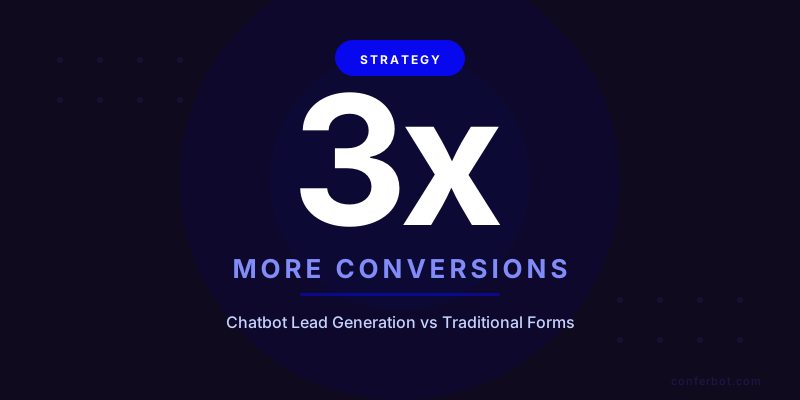
Meanwhile, conversational chatbot interfaces on the same websites convert at 12-25% depending on industry -- a a clear improvement that represents the single largest conversion rate lever most businesses have never pulled.
Why are forms failing? The reasons are structural:
- Form fatigue: The average B2B buyer encounters 50+ lead capture forms per month across vendor websites, content downloads, and webinar registrations. Each additional form field reduces completion rates
- No value exchange: Forms ask for information without giving anything back in real time. The visitor fills out 7 fields and gets a generic "We'll be in touch" confirmation page
- Mobile friction: 62% of B2B research now happens on mobile devices, where form-filling is particularly painful. Dropdown menus are difficult to navigate, typing long company names on a phone keyboard is tedious, and auto-fill frequently gets fields wrong
- The average company response time to a form submission is 42 hours. By then, the prospect has moved on -- often to a competitor who responded instantly via chatbot
- Binary qualification: Forms capture the same information from every visitor regardless of intent, buying stage, or fit. A Fortune 500 VP and a student researching a thesis both fill out the same form and receive the same follow-up sequence
The fundamental problem is that forms are transactional while buying is conversational. A chatbot bridges this gap by engaging visitors in a dialogue that qualifies their needs, delivers immediate value, and captures contact information as a natural byproduct of a helpful conversation rather than as a prerequisite gate.
This guide provides the complete playbook for replacing or supplementing your lead capture forms with conversational chatbot flows that convert more visitors into qualified leads. We cover the conversion data, progressive profiling techniques, real-time qualification frameworks, CRM integration, multi-channel deployment, lead scoring, A/B testing methodology, and implementation steps.
The Conversion Data: Chatbots vs. Forms Across Industries
The claim that chatbots outperform forms is not anecdotal -- it is backed by large-scale data across millions of sessions and dozens of industries. Here is what the numbers show.

Aggregate Conversion Data
Data compiled from Salesloft/Drift's conversational marketing benchmarks, HubSpot's conversion research, and internal Conferbot data across 10,000+ deployments:
| Metric | Traditional Form | Conversational Chatbot | Improvement |
|---|---|---|---|
| Overall conversion rate (visitor to lead) | 2.3% | 15.2% | +561% |
| Mobile conversion rate | 1.1% | 13.8% | +1,154% |
| Lead qualification rate | 18% (manual, after submission) | 72% (real-time, in conversation) | +300% |
| Average response time | 42 hours | 3 seconds | -99.99% |
| Data fields captured per lead | 4-6 (form fields) | 8-14 (progressive profiling) | +100-133% |
| Lead-to-opportunity rate | 6% | 14% | +133% |
| Cost per lead | $85-$200 | $28-$65 | -55-67% |
Industry-Specific Benchmarks
| Industry | Form Conversion Rate | Chatbot Conversion Rate | Multiplier | Key Use Case |
|---|---|---|---|---|
| B2B SaaS | 2.8% | 18.5% | 6.6x | Demo booking, trial activation |
| Real Estate | 3.2% | 22.4% | 7.0x | Property inquiry, showing schedule |
| Financial Services | 1.8% | 11.2% | 6.2x | Consultation booking, pre-qualification |
| Healthcare | 2.5% | 16.8% | 6.7x | Appointment booking, symptom triage |
| E-commerce | 3.5% | 14.2% | 4.1x | Product recommendation, discount offer |
| Education | 4.1% | 19.6% | 4.8x | Program matching, enrollment start |
| Legal | 1.5% | 12.8% | 8.5x | Case evaluation, consultation booking |
| Home Services | 3.8% | 21.5% | 5.7x | Quote request, service scheduling |
The multiplier ranges from 4x to 8.5x depending on industry, with the highest gains in industries where the buying process involves complex qualification (legal, financial services) or high-consideration purchases (real estate, SaaS). These are the exact industries where a conversational approach adds the most value because the chatbot can ask qualifying questions, provide personalized information, and guide the visitor to the right next step -- something a static form simply cannot do.
Why the Conversion Gap Is So Large
The conversion advantage comes from three compounding factors:
- Engagement timing: Chatbots engage visitors at their moment of highest intent -- when they are actively browsing your pricing page, reading a case study, or comparing features. Forms wait passively in a sidebar or at the bottom of a page
- Micro-commitment psychology: Chatbots use progressive disclosure -- asking one easy question at a time rather than presenting 6-8 fields simultaneously. Each response creates a micro-commitment that makes the next response more likely (the consistency principle from behavioral psychology)
- Immediate value delivery: The chatbot gives something back with each exchange -- an answer to a question, a product recommendation, a pricing estimate -- creating reciprocity that motivates continued engagement
For a deeper dive into form vs. chatbot conversion dynamics, see our lead generation chatbot overview.
Progressive Profiling: Capture More Data With Less Friction
Progressive profiling is the technique of collecting lead information incrementally across multiple interactions rather than demanding it all upfront. Research from Forrester's conversational marketing analysis notes that progressive data collection tends to produce more complete lead profiles than front-loaded forms. It is the single most important conversion optimization technique for chatbot lead generation, and it is impossible to replicate with a static form.
How Progressive Profiling Works in a Chatbot
Instead of a 7-field form, the chatbot conversation unfolds naturally:
- Exchange 1 (first visit): The chatbot asks what the visitor is looking for and provides a helpful answer. No personal information requested. The visitor's behavior data (pages visited, time on site, referral source) is already captured
- Exchange 2 (interest expressed): The visitor asks about pricing or a specific feature. The chatbot provides the information and asks: "Want me to send you a detailed comparison? What is the best email?" -- capturing email in exchange for value
- Exchange 3 (qualification begins): With the email captured, the chatbot asks a qualifying question: "How many team members would use this?" or "What tool are you currently using?" -- capturing firmographic data
- Exchange 4 (deeper qualification): The chatbot asks about timeline, budget, or decision-making process -- qualifying the lead against BANT or MEDDIC criteria
- Exchange 5 (conversion): The chatbot proposes the appropriate next step based on qualification: book a demo, start a free trial, or download a resource
Progressive Profiling Framework
| Stage | Data Captured | Value Delivered | Friction Level | Drop-Off Rate |
|---|---|---|---|---|
| Initial engagement | Behavioral (pages, referral, device) | Proactive greeting, navigation help | Zero | 15-20% |
| Interest signal | Email address | Personalized answer, resource delivery | Very Low | 25-30% |
| Qualification | Company size, role, industry | Tailored product recommendation | Low | 10-15% |
| Deep qualification | Budget, timeline, current solution | Custom pricing, ROI estimate | Medium | 15-20% |
| Conversion action | Phone number, calendar availability | Demo booked, trial started | Medium | 10-15% |
Cumulative capture rate: If 100 visitors engage with the chatbot, approximately 35-45 provide an email (Stage 2), 25-35 complete qualification (Stage 3-4), and 15-25 take a conversion action (Stage 5). Compare this to a form where 2-3 of 100 visitors would complete all fields.
Progressive Profiling Scripts
SaaS Demo Booking Flow:
- Bot: "Hey there! Are you exploring [Product] for your team, or just doing some initial research?"
- Visitor: "Looking for a solution for our customer support team"
- Bot: "Great choice -- our support automation handles many tickets automatically. How large is your support team currently?"
- Visitor: "About 15 agents"
- Bot: "With 15 agents, most teams like yours see about $180K in annual savings. Want me to show you exactly how that works in a quick 15-minute demo? I can grab a time that works for you."
- Visitor: "Sure, what times are available?"
- Bot: [Calendar embed] "Pick any time that works. What email should I send the calendar invite to?"
Notice that by the time the visitor provides their email, they have already received personalized value (team-size-specific savings estimate) and committed to a next step (demo). The email is captured as a functional necessity, not a gatekeeping requirement.
Multi-Visit Progressive Profiling
For visitors who do not convert on the first visit, the chatbot remembers previous interactions:
- Visit 1: Visitor browses pricing page, engages with chatbot, asks about features, leaves without providing email
- Visit 2 (3 days later): Visitor returns to case studies page. Chatbot: "Welcome back! Last time you were interested in our support automation features. We just published a case study from a team your size -- want me to share it?"
- Visit 3 (1 week later): Visitor returns to pricing page. Chatbot: "I noticed you've been evaluating our pricing. I can connect you with someone who can put together a custom quote based on your 15-agent team. Want me to set that up?"
This cross-visit continuity is impossible with forms -- a form has no memory of previous interactions. For detailed lead qualification frameworks, see our chatbot lead qualification guide.
Real-Time Lead Qualification: BANT, Lead Scoring, and Intelligent Routing
Chatbot lead generation is not just about capturing more leads -- it is about capturing better leads.

Real-time qualification during the conversation means your sales team receives pre-scored, pre-qualified leads with full context instead of a list of emails from a form download. Here is the qualification framework.
Conversational BANT Framework
BANT (Budget, Authority, Need, Timeline) is the classic qualification framework, adapted for conversational AI:
| BANT Criteria | Chatbot Question (Natural Language) | Scoring |
|---|---|---|
| Budget | "Roughly, what are you looking to invest in a solution like this?" or "What's your current spend on [problem area]?" | High: $50K+, Medium: $10-50K, Low: Under $10K |
| Authority | "Who else on your team would be involved in evaluating this?" or "What's your role in the decision?" | High: Decision maker, Medium: Influencer, Low: Researcher |
| Need | "What's the main challenge you're trying to solve?" or "What happens if you don't address this?" | High: Critical pain, Medium: Nice-to-have, Low: Just browsing |
| Timeline | "When are you looking to have something in place?" or "Is there a deadline driving this?" | High: This month, Medium: This quarter, Low: No timeline |
The chatbot asks these questions naturally within the conversation flow -- not as a rigid interrogation but as genuine interest in helping the visitor find the right solution. The AI interprets responses even when they do not fit neat categories: "We need this before our busy season in October" maps to a specific timeline without the visitor selecting from a dropdown.
AI-Powered Lead Scoring
Combine BANT responses with behavioral signals to generate a real-time lead score:
| Signal Category | Signal | Points |
|---|---|---|
| Behavioral | Visited pricing page | +15 |
| Behavioral | Visited 5+ pages in one session | +10 |
| Behavioral | Returned visitor (2+ visits) | +20 |
| Behavioral | Clicked on case study or testimonial | +10 |
| Conversational | Asked about pricing | +20 |
| Conversational | Mentioned competitor by name | +15 |
| Conversational | Expressed urgency ("ASAP", "this week") | +25 |
| Conversational | Asked about integration with specific tool | +15 |
| Firmographic | Company size 50-500 (ideal range) | +20 |
| Firmographic | Decision-maker title | +25 |
| Firmographic | Target industry | +15 |
| Negative | Student or personal email | -20 |
| Negative | "Just browsing" with no specific need | -15 |
Score thresholds:
- 80+ points (Hot): Route immediately to sales for live chat takeover or instant demo booking. Alert assigned SDR via Slack notification
- 50-79 points (Warm): Offer demo booking or free trial. Add to high-priority nurture sequence in CRM
- 25-49 points (Marketing Qualified): Offer content download, add to email nurture sequence, retarget with ads
- Under 25 points (Early Stage): Provide helpful content, invite to newsletter, track for future engagement
Intelligent Lead Routing
Once the lead is scored and qualified, the chatbot routes to the right destination:
- Hot leads (80+): Immediate handoff to live sales rep if available, or instant calendar booking. The sales rep receives the full conversation transcript, lead score breakdown, and company information in their CRM before they even join the conversation
- Warm leads (50-79): Bot offers to book a demo or start a trial. If the visitor declines, the lead is pushed to the CRM for SDR follow-up within 1 hour with personalized context
- Marketing qualified (25-49): Bot delivers a relevant content asset (case study, whitepaper, guide) and adds the lead to an automated email nurture sequence matched to their expressed interest
This real-time scoring and routing replaces the traditional process where form submissions sit in a marketing automation queue for hours or days before a human reviews and assigns them. For the complete lead qualification methodology, see our AI chatbot lead generation playbook.
CRM Integration: Syncing Leads, Enriching Data, and Closing the Loop
A lead generation chatbot that does not sync with your CRM is a data silo waiting to cause problems. Salesforce's State of Marketing report found that organizations with real-time CRM-chatbot integration see 28% higher lead-to-opportunity conversion rates than those with manual data entry. Bidirectional CRM integration ensures every chatbot interaction enriches your customer record, triggers the right sales workflows, and provides full visibility into the conversation-to-revenue pipeline.
CRM Integration Architecture
| CRM Platform | Integration Method | Chatbot Capabilities |
|---|---|---|
| HubSpot | HubSpot API v3 + Webhooks | Create/update contacts, create deals, trigger workflows, log activities, sync conversation transcripts |
| Salesforce | REST API + Streaming API | Create leads/contacts, create opportunities, log tasks, update custom fields, trigger Process Builder flows |
| Pipedrive | REST API + Webhooks | Create persons, create deals, add activities, update custom fields, move deal stages |
| Zoho CRM | REST API v5 | Create leads, convert to contacts, create deals, trigger workflows, sync notes |
| Close | REST API + Webhooks | Create leads, log calls/emails, create opportunities, custom field sync |
Data Sync: What Gets Pushed to the CRM
Every chatbot conversation should push structured data to your CRM:
- Contact record: Name, email, phone, company, job title, industry -- captured progressively during conversation
- Lead score: Numerical score with score breakdown (which signals contributed points)
- Qualification data: BANT fields mapped to custom CRM fields (budget range, authority level, pain points, timeline)
- Conversation transcript: Full transcript attached to the contact record so sales reps can review the conversation context
- Behavioral data: Pages visited, time on site, referral source, number of visits -- all synced to the CRM timeline
- Tags and segments: Auto-applied tags based on conversation content ("interested_in_enterprise", "competitor_migration", "demo_requested")
- Deal/opportunity creation: For hot leads, the chatbot creates a deal in the CRM pipeline with estimated value and close date
Bidirectional Sync: Reading from the CRM
The chatbot should also read CRM data to personalize conversations:
- Returning leads: If a visitor's email matches an existing CRM contact, the chatbot greets them by name and references their previous interactions: "Welcome back, Sarah! Last time we talked about our enterprise plan. Want to pick up where we left off?"
- Deal stage awareness: If the lead already has an open deal in the CRM, the chatbot adjusts its approach: instead of qualifying from scratch, it offers to connect them with their assigned rep or answers specific questions about their evaluation
- Existing customer detection: If the visitor is an existing customer (matched via email domain or login status), the chatbot routes them to support rather than sales, avoiding the awkward experience of being pitched a product they already own
Closed-Loop Attribution
The most valuable CRM integration feature is closed-loop attribution -- tracking leads from first chatbot conversation through to closed revenue:
- Chatbot creates lead with source attribution (chatbot, specific page, specific flow)
- Lead progresses through CRM pipeline (MQL -> SQL -> Opportunity -> Closed Won)
- Revenue attributed back to chatbot with full funnel metrics: conversion rate at each stage, average deal size, sales cycle length
This attribution data is critical for proving chatbot ROI and optimizing your lead generation strategy. When you can show that chatbot-generated leads close at 14% vs. 6% for form-generated leads (a common benchmark), the business case for expanding chatbot deployment becomes irresistible.
Conferbot's integrations hub provides native HubSpot, Salesforce, Pipedrive, and Zoho CRM connectors with field mapping UI, automatic contact deduplication, and deal creation rules -- no custom API development required.
Multi-Channel Lead Generation: Website, WhatsApp, Instagram, and Beyond
Your website is not the only place visitors discover your brand. In 2026, lead generation happens across a constellation of channels -- and your chatbot should be present on every one. Multi-channel deployment multiplies your lead capture surface area while maintaining a unified lead record in your CRM.

Channel-Specific Strategies
| Channel | Best For | Conversion Rate | Lead Quality | Deployment Method |
|---|---|---|---|---|
| Website chat widget | High-intent visitors browsing product/pricing | 15-25% | High | JavaScript embed, page-specific triggers |
| WhatsApp Business | Mobile-first audiences, emerging markets, post-click engagement | 35-45% | Very High | WhatsApp Business API, click-to-chat ads |
| Instagram DM | D2C brands, visual products, younger demographics | 20-30% | Medium-High | Instagram Messaging API, Story/Reel CTAs |
| Facebook Messenger | Local businesses, event-based lead gen, retargeting | 18-28% | Medium | Messenger Platform API, Ads CTAs |
| SMS | Appointment-based businesses, follow-up sequences | 25-35% | High | Twilio, custom SMS integration |
| Google Business Messages | Local search, map-based discovery | 22-30% | Very High (high intent) | Google Business Profile integration |
Website Chat: Page-Specific Triggers
The highest-converting website chatbot deployments use page-specific conversation starters:
- Homepage: "Hey! What brings you to [Company] today?" -- broad, open-ended to understand intent
- Pricing page: "Looking at pricing? I can help you find the right plan for your team size and needs." -- direct, acknowledges the visitor's clear buying intent
- Product/feature page: "Interested in [specific feature]? Want me to show you how it works with a quick demo?" -- feature-specific engagement
- Blog/content page: "Enjoying this article? We have a more detailed guide on [related topic] -- want me to send it to you?" -- content-to-lead conversion
- Competitor comparison page: "Comparing us to [competitor]? Here is what most teams switching from [competitor] tell us matters most." -- competitive positioning
WhatsApp Lead Generation
WhatsApp has emerged as the highest-converting lead generation channel for several reasons:
- Phone number capture is automatic: Unlike web chat where you need to ask for contact info, WhatsApp conversations inherently include the visitor's phone number
- 98% open rates: WhatsApp messages have near-universal open rates compared to 20-25% for email, making follow-up dramatically more effective
- Rich media support: Send product images, videos, catalogs, and documents within the conversation
- Click-to-WhatsApp ads: Facebook and Instagram ads with WhatsApp CTAs drive visitors directly into a chatbot conversation, bypassing the website entirely
Unified Lead Record Across Channels
The critical requirement for multi-channel deployment is a unified lead record. When a visitor engages via website chat on Monday, follows up on WhatsApp on Wednesday, and asks a question on Instagram on Friday, all three interactions should be linked to a single CRM record with the complete conversation history. This requires:
- Identity matching: Match leads across channels via email address, phone number, or browser cookie
- Conversation continuity: The chatbot on WhatsApp should know what the visitor discussed on the website: "Last time on our website, you asked about our enterprise plan. Would you like to continue that conversation?"
- Channel preference tracking: Record which channel the lead prefers and route future communications accordingly
A/B Testing Chat Flows: Methodology, Metrics, and Winning Patterns
Most chatbots launch once and never improve. Systematic A/B testing of conversation flows is how top-performing lead generation chatbots achieve and maintain their 15-25% conversion rates. According to Gartner's conversational marketing software research, organizations running monthly A/B tests on chatbot flows see 34% higher year-over-year conversion improvement than those that do not test. Without testing, you are relying on intuition -- and intuition is frequently wrong about what works in conversation design.
What to A/B Test
| Test Element | Hypothesis Example | Primary Metric | Typical Lift |
|---|---|---|---|
| Opening greeting | Question-based vs. value-statement greeting | Engagement rate | 15-40% |
| Number of questions before CTA | 3 questions vs. 5 questions before demo booking | Conversion rate | 10-25% |
| CTA wording | "Book a demo" vs. "See it in action" vs. "Get a custom walkthrough" | CTA click rate | 8-20% |
| Qualification order | Ask role first vs. ask pain point first | Qualification completion rate | 10-15% |
| Response length | 1-sentence responses vs. 2-3 sentence responses | Drop-off rate | 5-15% |
| Social proof placement | Show testimonial early vs. late in flow | Trust and conversion | 12-25% |
| Trigger timing | 3-second delay vs. 10-second delay vs. scroll-based | Engagement rate | 20-50% |
| Tone (formal vs. casual) | Professional corporate vs. friendly conversational | Engagement rate | 10-30% |
A/B Testing Methodology
Follow this rigorous testing framework:
- Identify the metric: Choose one primary metric per test. Conversion rate is the ultimate metric, but upstream metrics (engagement rate, qualification completion rate) are faster to reach significance
- Calculate sample size: Use a power analysis calculator. For a test expecting a 20% relative lift on a 15% baseline conversion rate, you need approximately 2,000 visitors per variant to reach 95% confidence
- Randomize traffic: Split visitors randomly between control (A) and variant (B). Ensure the split is cookie-based so returning visitors see the same variant
- Run to significance: Do not peek at results early and stop. Run until you reach your pre-determined sample size or statistical significance (p less than 0.05)
- Measure secondary effects: A greeting that increases engagement rate but decreases lead quality is not a win. Always check secondary metrics (lead score distribution, lead-to-opportunity rate)
- Document and iterate: Record every test, result, and learning. Build a knowledge base of what works for your audience
Winning Patterns From A/B Tests
Based on test results across thousands of Conferbot deployments, here are patterns that consistently win:
- Question greetings outperform statement greetings by 23%: "What brings you here today?" beats "Welcome to [Company]! We help businesses grow." because questions invite a response while statements do not
- Fewer questions before the CTA wins: 3 qualifying questions before offering a demo booking converts better than 5 questions. Visitors lose momentum with each additional step
- Personalized CTAs beat generic ones by 31%: "Book a 15-min walkthrough for your 50-person team" beats "Book a demo" because it reflects the information the visitor already shared
- Scroll-triggered engagement beats time-triggered by 27%: Showing the chatbot after 40% page scroll indicates genuine content interest, while a 5-second time trigger catches visitors who have not engaged yet
- Social proof early in the flow increases completion by 22%: "Teams like Acme Corp and GlobalTech use this to save 40 hours/month" builds trust before asking qualifying questions
For a comprehensive A/B testing framework, see our chatbot A/B testing optimization guide.
Conversation-to-Conversion Funnels: Templates for Every Buying Stage
Different visitors are at different stages of the buying journey, and the chatbot conversation should adapt accordingly. A visitor on your homepage researching solutions needs a different flow than a visitor on your pricing page ready to buy. Here are battle-tested funnel templates for each stage.

Top-of-Funnel: Awareness Stage (Blog Readers, Content Visitors)
Goal: Capture email, deliver value, begin nurture
- Trigger: 45% page scroll on a blog post or resource page
- Opening: "Enjoying this article? We have a more in-depth guide on [related topic] with templates you can use right away. Want me to send it?"
- Exchange: If yes -> "What email should I send it to?" -> delivers the content immediately via email
- Follow-up: "By the way, what are you working on right now? I might be able to point you to some relevant resources."
- Outcome: Email captured, content delivered, interest area identified for nurture segmentation
- Expected conversion rate: 8-15% of engaged visitors provide email
Middle-of-Funnel: Consideration Stage (Product Page Visitors, Comparison Shoppers)
Goal: Qualify the lead, provide tailored information, offer next step
- Trigger: 10 seconds on a product or comparison page
- Opening: "Hi! Looking for a [product category] solution? I can help you figure out if we are a good fit -- takes about 2 minutes."
- Qualification flow: Team size -> Current tool -> Primary challenge -> Timeline
- Personalized recommendation: Based on answers, recommend the most relevant plan, feature, or use case with supporting data
- CTA: "Based on your team size and needs, I would suggest our [Plan]. Want to see it in action with a quick demo?"
- Expected conversion rate: 15-22% of engaged visitors book a demo or start a trial
Bottom-of-Funnel: Decision Stage (Pricing Page Visitors, Returning Visitors)
Goal: Remove final objections, facilitate purchase or demo booking
- Trigger: Immediately on pricing page load for returning visitors, or after 15 seconds for new visitors
- Opening: "I see you are looking at pricing. Any questions I can help with? I can also connect you with someone who can put together a custom quote."
- Objection handling: Address common objections conversationally:
- "Is there a free trial?" -> Yes, here is how to start
- "What if it does not work for us?" -> Money-back guarantee details
- "Can I get a discount?" -> Volume pricing, annual discount, or connect to sales for custom pricing
- "How does this compare to [competitor]?" -> Key differentiators with proof points
- CTA: Contextual: demo for enterprise, free trial for SMB, checkout for self-serve
- Expected conversion rate: 25-40% of engaged pricing page visitors take a conversion action
Post-Conversion: Expansion Stage (Existing Customers)
Goal: Upsell, cross-sell, gather referrals
- Trigger: Logged-in customer visits pricing or upgrade page
- Opening: "Hey [Name]! I see you are looking at our [higher tier] plan. Based on your current usage, upgrading would unlock [specific features]. Want me to show you the ROI?"
- Value prop: Personalized upsell recommendation based on their current usage data and features they are not using
- Referral ask: "By the way, know anyone who could benefit from [Product]? We offer [referral incentive] for every referral."
Funnel Optimization Framework
For each funnel stage, track and optimize these metrics:
| Funnel Stage | Primary Metric | Target | Optimization Lever |
|---|---|---|---|
| Awareness (TOFU) | Email capture rate | 10-15% | Content offer relevance, trigger timing |
| Consideration (MOFU) | Qualification completion rate | 60-70% | Number of questions, value exchange per question |
| Decision (BOFU) | Demo/trial conversion rate | 25-35% | Objection handling, CTA personalization |
| Expansion | Upsell acceptance rate | 8-12% | Usage-based personalization, timing |
Implementation Guide: Launch Your Lead Generation Chatbot in 14 Days
You do not need months of development to launch a high-converting lead generation chatbot. This 14-day implementation plan gets you from zero to live with measurable results.
Week 1: Foundation (Days 1-7)
| Day | Task | Deliverable |
|---|---|---|
| 1 | Audit current conversion data: form completion rates, lead sources, lead-to-opportunity rates | Baseline metrics document |
| 2 | Map your buyer journey: identify top 5 landing pages by traffic, define persona for each | Page-persona mapping |
| 3 | Write conversation flows for your top 3 pages (pricing, product, homepage) | 3 conversation scripts |
| 4 | Define lead scoring model: assign point values to behavioral and conversational signals | Lead scoring matrix |
| 5 | Set up chatbot platform: create bot, configure branding, set up CRM integration | Connected chatbot platform |
| 6 | Build and test the pricing page flow (highest intent, fastest feedback loop) | Working pricing page chatbot |
| 7 | Build and test the homepage and product page flows | 3 page-specific chatbot flows ready |
Week 2: Launch and Optimize (Days 8-14)
| Day | Task | Deliverable |
|---|---|---|
| 8 | Deploy chatbot on pricing page only (controlled launch for fastest data collection) | Live chatbot on pricing page |
| 9-10 | Monitor conversations: read transcripts, identify common questions, note drop-off points | Optimization notes |
| 11 | Iterate: fix conversation gaps, improve response quality, adjust trigger timing | Optimized pricing page flow |
| 12 | Deploy on homepage and product pages | 3-page deployment live |
| 13 | Set up A/B test: test two greeting variants on the highest-traffic page | First A/B test running |
| 14 | Week 2 results report: leads captured, conversion rate vs. form baseline, lead quality assessment | Performance report with baseline comparison |
Post-Launch Optimization Cadence
After the initial 14-day launch, establish a continuous optimization rhythm:
- Weekly: Review conversation transcripts, identify top 5 unanswered questions, update chatbot responses
- Bi-weekly: Analyze A/B test results, launch new test, update lead scoring weights based on lead-to-opportunity data
- Monthly: Expand to new pages, add new conversation flows, review CRM pipeline attribution, report ROI to stakeholders
- Quarterly: Major flow redesign based on accumulated data, seasonal adjustments (holiday messaging, end-of-quarter urgency), competitive positioning updates
Platform Selection Criteria
When evaluating chatbot platforms for lead generation, prioritize these capabilities:
| Capability | Why It Matters | Must-Have |
|---|---|---|
| Visual flow builder | Marketing teams can iterate without engineering | Yes |
| AI/NLU intent recognition | Handle free-text responses, not just button clicks | Yes |
| CRM native integration | Eliminate manual data entry, enable closed-loop attribution | Yes |
| Page-specific targeting | Different flows for different pages/audiences | Yes |
| A/B testing built-in | Systematic optimization without third-party tools | Yes |
| Multi-channel deployment | WhatsApp, Instagram, SMS from same platform | Recommended |
| Lead scoring | Real-time qualification and routing | Recommended |
| Analytics dashboard | Conversion tracking, funnel visualization, revenue attribution | Yes |
Conferbot's AI chatbot builder includes all of these capabilities with a visual drag-and-drop flow builder, native CRM integrations, built-in A/B testing, and multi-channel deployment -- enabling marketing teams to launch and optimize lead generation chatbots without engineering resources. See our pricing plans for details.
Measuring Lead Generation Chatbot ROI: From Cost Per Lead to Revenue Attribution
The ultimate measure of a lead generation chatbot is not conversation volume or engagement rate -- it is revenue generated. McKinsey's personalization research shows that companies excelling at real-time conversational personalization generate 40% more revenue from those activities than average players. Here is the framework for measuring chatbot ROI from cost per lead through to closed revenue attribution.
Cost Per Lead Comparison
| Lead Source | Average Cost Per Lead | Lead Quality (Qualification Rate) | Effective Cost Per Qualified Lead |
|---|---|---|---|
| Google Ads (Search) | $65-$120 | 15-25% | $260-$800 |
| LinkedIn Ads | $75-$200 | 20-30% | $250-$1,000 |
| Content marketing + form | $40-$80 | 8-15% | $267-$1,000 |
| Trade show/event | $150-$500 | 12-20% | $750-$4,167 |
| Chatbot (website) | $15-$35 | 45-72% | $21-$78 |
| Chatbot (WhatsApp/social) | $8-$20 | 55-80% | $10-$36 |
The cost per qualified lead is where chatbots dominate. Because the chatbot qualifies leads in real time during the conversation, the qualification rate is dramatically higher than channels where leads are captured first and qualified later. A chatbot-generated lead at $30 with a 60% qualification rate produces an $50 qualified lead -- compared to $500+ for many traditional channels.
Revenue Attribution Model
Track the full funnel from chatbot conversation to revenue:
| Funnel Stage | Metric | Chatbot Benchmark | Form Benchmark |
|---|---|---|---|
| Visitor to engaged | Engagement rate | 8-15% | N/A (no engagement) |
| Engaged to lead | Conversion rate | 15-25% | 2-5% |
| Lead to MQL | Qualification rate | 60-72% | 18-25% |
| MQL to SQL | Sales acceptance rate | 55-65% | 30-40% |
| SQL to opportunity | Opportunity creation rate | 40-50% | 25-35% |
| Opportunity to closed won | Win rate | 22-30% | 18-22% |
| Average deal size | Revenue per deal | Equal or higher (better qualified) | Baseline |
Monthly ROI Calculation
Here is a worked example for a B2B SaaS company with 50,000 monthly website visitors:
| Metric | With Forms Only | With Chatbot + Forms | Improvement |
|---|---|---|---|
| Monthly visitors | 50,000 | 50,000 | Same traffic |
| Leads generated | 1,250 (2.5%) | 4,750 (9.5%) | +3,500 leads |
| Qualified leads (MQLs) | 225 (18%) | 3,135 (66%) | +2,910 MQLs |
| Sales qualified leads (SQLs) | 79 (35%) | 1,724 (55%) | +1,645 SQLs |
| Opportunities | 24 (30%) | 690 (40%) | +666 opportunities |
| Closed won deals | 5 (20%) | 173 (25%) | +168 deals |
| Revenue ($5,000 avg deal) | $25,000 | $865,000 | +$840,000/month |
| Chatbot platform cost | $0 | $2,000 | |
| Net incremental revenue | $838,000/month |
Note: These numbers represent the combined impact of chatbot + forms. Most organizations keep their forms and add chatbot as an additional conversion channel, capturing visitors who would not have filled out the form.
Executive Dashboard Metrics
Report these metrics monthly to demonstrate chatbot ROI:
- Leads generated: Total leads captured via chatbot (vs. form baseline)
- Cost per lead: Platform cost / leads generated
- Lead quality score: Average lead score of chatbot-generated leads vs. form-generated leads
- Pipeline contribution: Dollar value of opportunities created from chatbot leads
- Revenue attributed: Closed-won revenue from chatbot-sourced leads
- Conversion rate trend: Week-over-week chatbot conversion rate to track optimization impact
For a complete ROI framework with formulas and a calculator, see our how to calculate chatbot ROI guide.
Was this article helpful?
Build and deploy in 10 minutes. No coding needed.
Chatbot Lead Generation FAQ
Everything you need to know about chatbots for chatbot lead generation.
About the Author
The Conferbot team writes about building, deploying, and improving AI chatbots.
View all articles