Why Teams Are Leaving Kustomer: $89/Seat, Paid AI Add-Ons, and Meta's Uncertain Ownership
Kustomer launched with a compelling vision: a CRM-first customer service platform that treated every interaction as part of a unified customer timeline rather than isolated tickets. The idea was sound. The execution attracted major brands and led to Meta (Facebook) acquiring Kustomer for $1 billion in 2022. But what should have been a growth catalyst instead created uncertainty, and the pricing model that was always aggressive became increasingly difficult to justify as the market evolved around it.
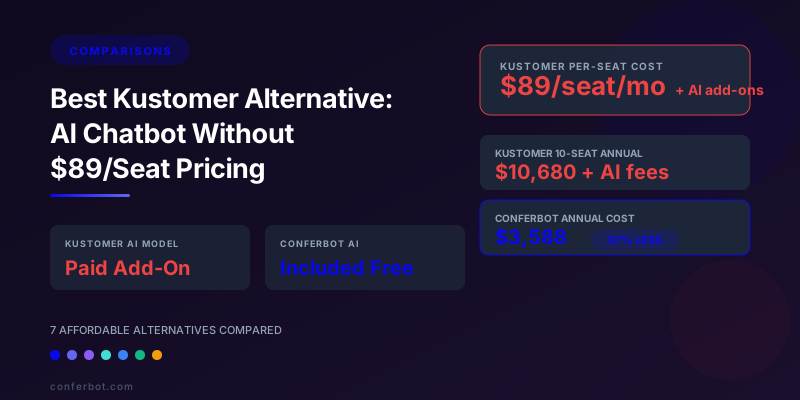
As of 2026, Kustomer charges $89 per seat per month on its Enterprise plan -- the only plan that includes meaningful functionality. AI capabilities are available only as paid add-ons on top of that per-seat cost, with pricing that is not transparently published. For a 10-agent team, the base platform cost alone is $10,680 per year before adding AI, integrations, or premium features. Add Kustomer IQ (their AI layer) and the total easily exceeds $15,000 to $20,000 annually -- for a platform that many teams report underdelivers on its AI promises.
The pricing problem is compounded by Meta's ambiguous ownership. After the FTC challenged the acquisition, Meta completed it but has not invested visibly in Kustomer's product development. The platform's roadmap is unclear, engineering velocity has slowed relative to competitors, and there is persistent market speculation about whether Meta will continue to operate Kustomer as a standalone product or integrate it into Meta Business Suite and sunset the independent platform. According to G2 reviews, customers cite this uncertainty as a growing concern when evaluating long-term commitments.
This guide is for teams currently paying Kustomer's premium pricing and not seeing proportional value, and for teams evaluating Kustomer who need to understand the true total cost before committing. We compare seven alternatives that deliver comparable or superior AI capabilities without per-seat pricing traps, mandatory add-ons, or ownership uncertainty. Whether you need an AI-first platform like Conferbot at 67 percent lower annual cost, a premium alternative like Intercom with published per-resolution pricing, or a budget option like Crisp at $25/month flat, this analysis provides the data for a confident decision.
For teams evaluating the broader helpdesk market, our best AI customer service tools guide covers 15 platforms. For specific competitor comparisons, see our analyses of Intercom alternatives, Zendesk alternatives, and Ada CX alternatives.
The Kustomer Problem: 5 Issues Making $89/Seat Hard to Justify
Kustomer's per-seat pricing was defensible when CRM-first customer service was genuinely differentiated. In 2026, every major helpdesk offers timeline views and customer context, making Kustomer's core differentiator a commodity. The problems that remain are structural.
Problem 1: $89/Seat/Month Is 2-4x More Than Comparable Platforms
At $89 per seat per month, Kustomer is among the most expensive helpdesk platforms per agent. For context: Zendesk Suite Professional costs $55 per agent per month and includes AI Agents. Intercom starts at $39 per seat per month with Fin AI available. Freshchat starts at $15 per agent per month. And platforms like Conferbot charge $299/month flat regardless of team size -- no per-seat fees at all.
The per-seat model punishes growing teams disproportionately. Adding a sixth agent to your Kustomer deployment costs $1,068 per year in platform fees alone -- before that agent handles a single conversation. On a flat-rate platform like Conferbot, adding agents costs zero additional platform spend.

Problem 2: AI Is a Paid Add-On, Not a Core Feature
While competitors build AI into their core platform, Kustomer treats it as a premium upsell. Kustomer IQ -- the platform's AI layer -- adds intent detection, automated responses, and suggested actions, but it costs extra on top of the $89/seat base price. The exact pricing for Kustomer IQ is not published, requiring a sales conversation, which means teams cannot accurately budget for AI before committing. In a market where Gartner recommends that all customer service teams adopt AI by end of 2026, making AI a paid add-on is a pricing strategy that conflicts with market direction.
Conferbot includes GPT-4o, Claude, and Gemini AI in every paid plan. Tidio includes Lyro AI in every plan. Help Scout includes AI drafts and summarization in every plan. Kustomer's approach of charging $89/seat then asking for more money for AI feels increasingly out of touch.
Problem 3: Meta Ownership Creates Strategic Uncertainty
Meta acquired Kustomer for $1 billion in 2022, but the strategic direction has been unclear since. The FTC challenged the acquisition, creating months of uncertainty. Since closing, Meta has not made significant public investments in Kustomer's standalone product. There is persistent industry speculation -- documented in TechCrunch and other outlets -- about whether Kustomer will be absorbed into Meta Business Suite, pivoted to serve only Meta advertisers, or eventually sunset.
For teams making 2 to 3-year technology decisions, platform ownership uncertainty is a material risk. If Kustomer is deprecated or fundamentally changed, migration costs and business disruption could be significant. Every alternative on this list operates as an independent company with clear, publicly stated product roadmaps.

Problem 4: CRM-First Differentiator Has Been Commoditized
Kustomer's original value proposition was a unified customer timeline that combined support interactions with CRM data. In 2022, this was genuinely differentiated. In 2026, it is table stakes. Intercom's customer data platform, Zendesk's Sunshine, Freshchat's Freshworks CRM integration, and Conferbot's customer context feature all provide comparable timeline views. The CRM-first architecture that justified Kustomer's premium pricing is no longer a competitive moat.
Problem 5: Limited Self-Serve and Transparency
Kustomer does not offer a free tier or self-serve trial. Prospects must contact sales to learn pricing details, see AI add-on costs, and understand usage limits. In a market where McKinsey research shows that 70 percent of B2B buyers prefer digital self-serve purchasing, Kustomer's sales-gated approach creates friction that many teams find incompatible with their evaluation processes.
For a broader perspective on how pricing models compare across the helpdesk industry, our chatbot pricing comparison guide analyzes transparent versus opaque approaches.
7 Best Kustomer Alternatives Compared: Pricing, AI, and Total Cost
Every alternative on this list either includes AI in the base price or publishes AI add-on costs transparently. The comparison focuses on total cost of ownership, not just sticker price, because Kustomer's add-on model obscures the real cost.
| Platform | Starting Price | AI Included | Pricing Model | G2 Rating | Free Tier | Key Strength |
|---|---|---|---|---|---|---|
| Kustomer | $89/seat/mo | No (paid add-on) | Per-seat + add-ons | 4.4 | No | CRM timeline (commoditized) |
| Conferbot | Free / $19/mo | Yes (GPT-4o, Claude) | Flat rate, published | 4.7 | Yes | AI automation + flat pricing |
| Intercom | $39/seat/mo | Yes ($0.99/resolution) | Per-seat + per-resolution | 4.5 | Trial | Fin AI resolution quality |
| Zendesk | $55/agent/mo | Yes ($1.00/resolution) | Per-agent + per-resolution | 4.3 | Trial | Enterprise compliance + voice |
| Tidio | Free / $29/mo | Yes (Lyro AI) | Flat rate, published | 4.7 | Yes | Ecommerce AI native |
| Freshchat | Free / $15/agent/mo | Partial (Freddy AI) | Per-agent + sessions | 4.1 | Yes | Freshworks ecosystem |
| HelpCrunch | $15/member/mo | Yes (AI editor) | Per-member, published | 4.7 | Trial | All-in-one at low cost |
| Crisp | Free / $25/mo | Yes (MagicReply) | Flat rate (up to 4 agents) | 4.5 | Yes | Startup-friendly flat rate |
Total Annual Cost: 10-Agent Team With 8,000 Monthly Conversations
| Platform | Base Cost | AI Cost | Total Annual | Savings vs Kustomer |
|---|---|---|---|---|
| Kustomer Enterprise + IQ | $10,680 | ~$5,000-8,000 (estimated) | $15,680-$18,680 | -- |
| Conferbot Business | $3,588 | $0 (included) | $3,588 | 77-81% |
| Intercom (10 seats + Fin) | $4,680 | ~$48,000 (Fin at scale) | $52,680 | -182% to -262% |
| Zendesk Suite Pro + AI | $6,600 | ~$48,000 (AI agents) | $54,600 | -192% to -276% |
| Tidio Growth | $3,948 | $0 (included) | $3,948 | 75-79% |
| Freshchat Pro (10 agents) | $11,940 | ~$2,400 (Freddy) | $14,340 | 9-23% |
| HelpCrunch (10 members) | $3,000 | $0 (included) | $3,000 | 81-84% |
| Crisp Business | $11,880 | $0 (included) | $11,880 | 24-36% |

The data reveals that Kustomer occupies an awkward middle ground: more expensive than AI-native platforms like Conferbot, Tidio, and HelpCrunch that include AI for free, yet less expensive than premium per-resolution platforms like Intercom and Zendesk whose AI costs scale with volume. For the majority of mid-market teams, the best value lies with flat-rate platforms that include AI natively and eliminate per-seat cost scaling.
Detailed Alternative Reviews: Why Each Platform Delivers More Value Than Kustomer
1. Conferbot -- Best Overall Kustomer Replacement for AI Without Per-Seat Pricing
Conferbot represents the polar opposite of Kustomer's pricing philosophy. Where Kustomer charges $89 per seat and treats AI as an add-on, Conferbot charges a flat $299/month for the Business tier regardless of team size and includes GPT-4o, Claude, and Gemini AI in every paid plan. For a 10-agent team, Conferbot costs $3,588 per year versus Kustomer's $15,680 to $18,680 -- a 77 to 81 percent savings with superior AI capabilities.
Why it beats Kustomer:
- No per-seat pricing: Add unlimited agents without increasing platform cost. Kustomer charges $1,068/year per additional agent.
- AI included, not add-on: GPT-4o-powered conversations resolve 65 to 80 percent of inquiries autonomously. Kustomer's AI requires an additional paid subscription.
- 13-plus channels: Deploy on web, WhatsApp, Messenger, Telegram, SMS, Slack, and more.
- Autonomous actions: Process refunds, update orders, and modify CRM records within conversations using the no-code API builder.
- Transparent pricing: Every plan, feature, and limit is published. No sales calls required, no hidden AI add-on costs.
Limitations: Conferbot is a chatbot-first platform, not a full CRM. Teams needing Kustomer's CRM timeline views may want to pair Conferbot with a dedicated CRM or use the customer context panel, which provides conversation history and key customer data.
Best for: Teams spending $15,000-plus on Kustomer who want equivalent AI at a fraction of the cost with predictable, flat-rate billing.
2. Intercom -- Best Premium Alternative With Best-in-Class AI Resolution
Intercom's Fin AI is the quality benchmark for autonomous customer support resolution. It accesses help center articles, past conversations, and custom data sources to resolve complex queries. At $39/seat/month plus $0.99 per AI resolution, Intercom is cheaper per seat than Kustomer and offers demonstrably better AI -- though high-volume AI costs can exceed Kustomer's total at scale.
Why it beats Kustomer: 56 percent lower per-seat cost, AI included in base product (resolution fees are transparent and published), superior messenger experience, and a product suite that includes product tours and proactive messaging. Intercom's customer data platform provides CRM-like timeline views comparable to Kustomer's.
Limitations: Per-resolution pricing creates unpredictable costs at high volume. For teams processing 4,000-plus AI resolutions monthly, costs can exceed Kustomer. See our Intercom alternative analysis.
Best for: SaaS companies wanting premium AI quality with lower per-seat costs than Kustomer and a modern product ecosystem.
3. Zendesk -- Best Enterprise Alternative With Compliance and Voice
Zendesk Suite Professional at $55/agent/month is 38 percent cheaper per seat than Kustomer and includes native voice, HIPAA compliance, SOC 2 certification, and a 1,200-app marketplace. The AI Agents feature provides autonomous resolution comparable to Kustomer IQ but included in the platform pricing structure with transparent per-resolution fees.
Why it beats Kustomer: Lower per-seat cost, native voice channel, mature compliance certifications, and the deepest integration ecosystem in the category. For enterprise teams, Zendesk's stability and publicly-traded company backing provides the strategic certainty that Kustomer's Meta ownership cannot match.
Limitations: Still expensive at scale due to per-agent and per-resolution pricing. Complex to configure for smaller teams. See our Zendesk alternative guide.
Best for: Enterprise teams with compliance requirements and voice support needs who want lower per-seat costs than Kustomer with more strategic certainty.
4. Tidio -- Best Budget Alternative for Ecommerce
Tidio's Lyro AI uses Claude to handle product questions, order tracking, and recommendations natively on Shopify and WooCommerce. At $29 to $394/month with a free tier, Tidio costs a fraction of Kustomer while delivering ecommerce-specific AI that Kustomer does not specialize in.
Why it beats Kustomer: 92 to 97 percent lower annual cost, native ecommerce integrations, AI included in all paid plans, and a free tier for testing. For ecommerce support specifically, Lyro AI outperforms Kustomer IQ because it understands product catalogs and shopping behavior natively.
Limitations: Conversation caps on lower tiers limit scalability. Not designed for complex enterprise workflows. Limited to primarily ecommerce use cases.
Best for: Shopify and WooCommerce stores looking for affordable AI support without Kustomer's per-seat overhead.
5. Freshchat -- Best for Teams Already Using Freshworks
Freshchat at $15 to $69 per agent per month is 22 to 83 percent cheaper per seat than Kustomer, with Freddy AI included in higher tiers. For teams already in the Freshworks ecosystem (Freshdesk, Freshsales, Freshmarketer), Freshchat provides messaging and basic AI without adding a new vendor.
Why it beats Kustomer: Dramatically lower per-seat cost, native Freshworks integration, and Freddy AI included in Pro and Enterprise tiers rather than as a paid add-on.
Limitations: Freddy AI automation rates (15-25%) are lower than Conferbot (65-80%) or Intercom Fin (50%+). Per-agent pricing still scales with team growth, though at a much lower rate than Kustomer. See our Freshdesk alternative guide for Freshworks-specific analysis.
Best for: Teams using Freshworks products who want affordable messaging and basic AI as an alternative to Kustomer's premium pricing.
6. HelpCrunch -- Best All-in-One Platform at Budget Pricing
HelpCrunch combines live chat, knowledge base, email marketing, and a chatbot builder in a single platform at $15/member/month. It is an all-in-one alternative to Kustomer that bundles capabilities Kustomer charges separately for at 83 percent lower per-seat cost.
Why it beats Kustomer: $15 versus $89 per member per month (83 percent savings), AI editor included, knowledge base included, and email marketing tools that Kustomer does not offer. The G2 rating of 4.7 exceeds Kustomer's 4.4.
Limitations: AI capabilities are limited to response suggestions and article recommendations rather than autonomous resolution. Smaller company and ecosystem than Zendesk or Intercom. Channel coverage is narrower than Conferbot's 13-plus channels.
Best for: Budget-conscious teams wanting an all-in-one platform that includes chat, knowledge base, and email at a fraction of Kustomer's per-seat cost.
7. Crisp -- Best Flat-Rate Alternative for Startups
Crisp offers flat-rate pricing with no per-agent fees: the Pro plan at $25/month includes 4 agent seats, MagicReply AI, and a shared inbox. The Business plan at $95/month adds more seats, analytics, and integrations. For startups and small teams, Crisp provides Kustomer-level functionality at 95 percent lower cost.
Why it beats Kustomer: Flat-rate pricing eliminates per-seat scaling, MagicReply AI is included (not an add-on), developer-friendly APIs enable custom workflows, and the modern UI feels contemporary versus Kustomer's increasingly dated interface.
Limitations: MagicReply AI is limited to response suggestions. The platform lacks deep enterprise features. The Business plan's per-seat costs increase at larger team sizes. See our chatbot vs live chat comparison for when AI chatbots versus live chat make more sense.
Best for: Startups and small teams (under 10 agents) wanting a modern, flat-rate platform to replace Kustomer's per-seat overhead.
Kustomer's True Cost: Per-Seat Pricing, AI Add-Ons, and Hidden Expenses
Kustomer's $89/seat/month headline figure understates the true cost of the platform. This section dissects the total cost of ownership to give teams an accurate picture of what they are paying.
Base Platform Cost: $89/Seat/Month
The Enterprise plan at $89/seat is the only plan with meaningful features. The lower-tier options (if still available) lack the CRM capabilities, automation features, and integration depth that make Kustomer worth considering in the first place. For practical purposes, $89/seat is the real starting price.
Kustomer IQ (AI Add-On): $3,000-$8,000+ Annually (Estimated)
Kustomer IQ provides intent detection, automated routing, suggested responses, and basic chatbot capabilities. It is not included in the base $89/seat price. The exact cost is not published and varies by contract, but based on G2 reviewer reports and industry analysis, teams typically pay $3,000 to $8,000 per year for the AI layer depending on conversation volume and feature tier.
Implementation and Professional Services: $5,000-$15,000
Kustomer's CRM-first architecture requires more configuration than simpler helpdesk tools. Professional services for initial setup, CRM data migration, workflow design, and integration configuration add $5,000 to $15,000 in one-time costs -- fees that platforms like Conferbot, Tidio, and Crisp do not charge because their setup processes are self-serve.

Per-Seat Scaling Tax
Every additional agent costs $1,068 per year. Teams that scale from 5 to 15 agents over two years will see platform costs increase by $10,680 annually -- pure pricing inflation with no additional capability. Flat-rate platforms like Conferbot ($299/month regardless of team size) eliminate this scaling tax entirely.
Total Cost of Ownership Comparison: 3-Year Projection for a Growing Team
| Year | Team Size | Kustomer Total | Conferbot Total | Annual Savings |
|---|---|---|---|---|
| Year 1 | 5 agents | $8,340 + $5,000 IQ + $10,000 setup = $23,340 | $3,588 | $19,752 |
| Year 2 | 10 agents | $10,680 + $6,500 IQ = $17,180 | $3,588 | $13,592 |
| Year 3 | 15 agents | $16,020 + $8,000 IQ = $24,020 | $3,588 | $20,432 |
| 3-Year Total | $64,540 | $10,764 | $53,776 (83%) |
Over three years, a growing team saves $53,776 by switching from Kustomer to Conferbot -- money that can fund additional headcount, marketing spend, or product development. The savings compound as the team grows because Conferbot's flat rate does not penalize scaling while Kustomer's per-seat model amplifies costs linearly.
For a broader analysis of chatbot and helpdesk pricing across the market, see our chatbot ROI framework.
Migration Guide: Leaving Kustomer in 5 Weeks Without Losing Customer Context
Migrating from Kustomer requires preserving the CRM data and customer timelines that are Kustomer's core value proposition. This 5-week playbook ensures a smooth transition.
Week 1: Data Audit and Export
- Export customer records: Download all customer profiles, including conversation history, CRM attributes, tags, and custom fields. Kustomer supports data export via API and CSV.
- Export knowledge base: Download all help articles and FAQ content for AI training on your new platform.
- Document workflows: Map all automation rules, routing logic, SLA configurations, and escalation paths currently active in Kustomer.
- Baseline metrics: Record CSAT, first response time, resolution time, automation rate (if using Kustomer IQ), and ticket volume by channel and category.
Week 2: Platform Selection and Setup
- Sign up for your chosen alternative: Start a free tier or trial. Import team members and configure roles matching your Kustomer agent structure.
- Import knowledge base: Upload exported help articles to the new platform. On AI-powered platforms like Conferbot, this immediately trains the AI chatbot on your content.
- Configure CRM integration: If using a standalone CRM (Salesforce, HubSpot), connect it to the new platform. This replaces Kustomer's built-in CRM functionality with your existing CRM data.
- Set up channels: Configure web chat, email, and any additional channels (WhatsApp, Messenger, Telegram) your new platform supports. This is an opportunity to expand beyond Kustomer's channel coverage.
Week 3: Workflow Replication and AI Training
- Recreate automation rules: Translate Kustomer's automation workflows into the new platform's framework. Modern platforms typically require fewer rules because AI handles what rigid automation cannot.
- Test AI responses: Send test queries for your top 20 conversation topics. Verify accuracy, adjust training data, and refine conversation flows.
- Configure human handoff: Set up escalation routing so conversations the AI cannot handle are directed to the right agent team.

Week 4: Parallel Deployment
- Route 30-50 percent of traffic to the new platform: Run both platforms simultaneously for one week, comparing metrics side by side.
- Train agents on new interface: Walk your team through the new workspace, AI collaboration features, and escalation workflows. Most agents adapt within 2 to 3 days.
- Compare performance: Track automation rate, CSAT, response time, and resolution time across both platforms.
Week 5: Full Cutover and Cost Savings
- Switch 100 percent of traffic: Remove Kustomer widgets and deploy the new platform across all channels.
- Cancel Kustomer contract: Review your contract terms and submit cancellation. Document the effective cancellation date and any final billing.
- Quantify savings: Calculate the actual cost reduction and capability improvement. Most teams see immediate savings plus the addition of AI capabilities that Kustomer charged extra for.
For migration guides from other platforms, see our playbooks for leaving Drift, Ada CX, and Intercom.
Which Kustomer Alternative Should You Choose? Decision Guide by Priority
Your optimal replacement depends on what matters most: cost reduction, AI capability, compliance, or ecosystem fit. This matrix maps your primary priority to the best alternative.
If Your Priority Is: Maximum Cost Reduction With AI
Choose Conferbot. 77 to 81 percent annual cost reduction versus Kustomer with superior AI automation (65-80 percent resolution rate) and no per-seat pricing. The no-code builder handles the autonomous actions Kustomer IQ promises but charges extra for.
If Your Priority Is: Best-in-Class AI Quality
Choose Intercom. Fin AI's resolution quality is the industry benchmark. Per-seat costs are 56 percent lower than Kustomer, and AI is part of the core platform (transparent per-resolution pricing rather than opaque add-on fees).
If Your Priority Is: Enterprise Compliance and Voice
Choose Zendesk. HIPAA, SOC 2, native voice, and the deepest marketplace -- all at 38 percent lower per-seat cost than Kustomer. The strategic certainty of a public company eliminates Meta ownership concerns.
If Your Priority Is: Ecommerce Support
Choose Tidio. Lyro AI with native Shopify integration at 92 to 97 percent lower cost than Kustomer. Purpose-built for ecommerce conversations.
If Your Priority Is: Budget All-in-One
Choose HelpCrunch. Chat, knowledge base, email marketing, and AI at $15/member/month. 83 percent cheaper than Kustomer per seat with more bundled features.
If Your Priority Is: Startup-Friendly Flat Rate
Choose Crisp. No per-agent fees, MagicReply AI included, and developer-friendly APIs at $25/month for up to 4 agents. 95 percent cheaper than Kustomer for small teams.
| Priority | Best Alternative | Annual Cost (10 agents) | Savings vs Kustomer |
|---|---|---|---|
| Best overall value | Conferbot | $3,588 | 77-81% |
| Best AI quality | Intercom | $4,680+ | 56% base (AI costs vary) |
| Best enterprise | Zendesk | $6,600+ | 38% base (AI costs vary) |
| Best ecommerce | Tidio | $3,948 | 75-79% |
| Best all-in-one | HelpCrunch | $3,000 | 81-84% |
| Best startup | Crisp | $300-$11,880 | 36-98% |
AI Capability Comparison: Kustomer IQ vs Alternatives in Autonomous Resolution
The AI comparison is where Kustomer's paid-add-on model becomes most damaging. Teams paying $89/seat plus Kustomer IQ fees are getting less AI capability than teams paying a fraction of that on platforms where AI is included.
| AI Feature | Kustomer IQ | Conferbot | Intercom Fin | Tidio Lyro |
|---|---|---|---|---|
| LLM model | Proprietary | GPT-4o, Claude, Gemini (choose) | GPT-4 | Claude |
| Autonomous resolution rate | 25-40% | 65-80% | 50-65% | 40-55% |
| Knowledge base training | Yes | Yes (auto-sync) | Yes (auto-sync) | Yes (manual upload) |
| Autonomous actions (API calls) | Limited | Yes (no-code builder) | Yes (custom actions) | No |
| Multi-language | 12 languages | 95+ languages | 45+ languages | 7 languages |
| Included in base price | No (paid add-on) | Yes | Yes ($0.99/resolution) | Yes |
| A/B testing | No | Yes | Yes | No |
| Sentiment analysis | Basic | Real-time | Yes | Basic |
Kustomer IQ's autonomous resolution rate of 25 to 40 percent falls short of Conferbot's 65 to 80 percent and Intercom Fin's 50 to 65 percent. The gap is explained by model flexibility: Kustomer uses a proprietary AI model with limited tuning options, while Conferbot lets you choose GPT-4o, Claude, or Gemini based on your use case requirements. Forrester's AI customer service analysis notes that model choice significantly impacts resolution quality, with the ability to switch models adding 10 to 20 percent to effective resolution rates.
The autonomous actions gap is equally significant. Conferbot's no-code API builder lets you configure the chatbot to process refunds, modify orders, update CRM records, and check inventory within conversations -- all without developer involvement. Kustomer IQ's action capabilities are more limited and often require professional services to configure.
For a deeper comparison of AI models in chatbot applications, see our ChatGPT vs Claude vs Gemini analysis and our chatbot technology stack guide.
Verdict: $89/Seat Is a 2022 Price for a 2022 Product in a 2026 Market
Kustomer's $89/seat pricing was defensible when CRM-first customer service was genuinely differentiated, AI was not yet commoditized, and the Meta acquisition suggested a well-funded future. None of those conditions hold in 2026. The CRM timeline view is now table stakes at every major helpdesk. AI is a baseline expectation, not a premium add-on. And Meta's ownership creates strategic uncertainty rather than confidence.
The numbers are clear:
- Cost: Kustomer's total cost (base + AI + implementation) is $15,680 to $23,340 for a 10-agent team in year one. Five of seven alternatives cost under $4,000 annually with AI included.
- AI: Kustomer IQ resolves 25 to 40 percent of conversations as a paid add-on. Conferbot resolves 65 to 80 percent as an included feature at 77 percent lower total cost.
- Pricing model: Per-seat pricing penalizes growth. Flat-rate alternatives like Conferbot and Crisp charge the same price whether you have 5 agents or 50.
- Strategic certainty: Every alternative operates as an independent company with published roadmaps. Kustomer's future under Meta remains unclear.
- Self-serve access: Every alternative offers a free tier or trial. Kustomer requires a sales process to begin evaluating.
For the majority of teams currently on Kustomer, Conferbot is the best replacement. It eliminates per-seat pricing entirely, includes AI that outperforms Kustomer IQ by 25 to 40 percentage points, deploys across 13-plus channels, and costs $3,588 per year -- saving $53,776 over three years compared to Kustomer for a growing team.
For teams needing premium AI resolution quality, Intercom provides the best autonomous AI at 56 percent lower per-seat cost than Kustomer. For enterprise compliance, Zendesk offers HIPAA and SOC 2 at 38 percent lower per-seat cost. For budget-conscious teams, HelpCrunch and Crisp deliver all-in-one functionality at 83 to 95 percent less.
The first step: stop paying $89 per seat for AI you have to buy separately. Start with Conferbot's free tier to experience what AI-included support looks like. Visit our comparison hub for additional platform matchups, or explore our conversation design masterclass to plan your ideal support experience.
Additional research: G2 Chatbot Category, Capterra Chatbot Software, and Gartner Peer Insights for CRM Customer Engagement.
Was this article helpful?
Best Kustomer Alternative FAQ
Everything you need to know about chatbots for best kustomer alternative.
About the Author

Conferbot Team specializes in conversational AI, chatbot strategy, and customer engagement automation. With deep expertise in building AI-powered chatbots, they help businesses deliver exceptional customer experiences across every channel.
View all articles