Why Teams Are Looking Beyond Freshdesk's Built-In Chatbot in 2026
Freshdesk is a reliable help desk. Over 60,000 businesses route tickets through it, and its agent workspace, SLA management, and marketplace of 1,000-plus apps have earned consistent praise on review sites. But when it comes to AI-powered customer conversations, the built-in Freddy AI chatbot is where satisfaction drops off sharply.
According to G2 reviews filtered to chatbot-specific feedback, Freddy AI averages 3.6 out of 5 stars for AI and automation -- a full point below the platform's overall 4.4 rating. Users cite rigid conversation flows, an inability to take autonomous actions beyond ticket creation, and a pricing model that penalizes growing businesses: Freddy AI charges $0.49 per AI session on top of per-agent seat costs that already run $49 to $79 per agent per month on the plans that actually include the chatbot.
The math gets painful quickly. A mid-market team with 10 agents on the Pro plan pays $490 per month just for seats. Add 3,000 Freddy AI sessions and the chatbot bill alone is another $1,470 per month. That is nearly $24,000 per year for a chatbot that, by Freshworks' own documentation, handles primarily FAQ deflection and article suggestions rather than autonomous resolution.
Meanwhile, the competitive landscape has shifted dramatically. Standalone AI chatbot platforms now offer large-language-model-powered conversations, deep integrations that let the bot process refunds, change subscriptions, and book appointments mid-conversation, and transparent flat-rate pricing with no per-session surcharges. Gartner forecasts that AI chatbots will resolve 40 percent of service interactions autonomously by 2027 -- a benchmark that requires capabilities far beyond what a help-desk add-on can deliver.
This guide compares seven alternatives across pricing, AI depth, channel coverage, integration flexibility, and real-world automation rates. We include a detailed pricing table, a head-to-head feature matrix, a migration playbook, and use-case recommendations so you can match the right platform to your team size, technical capacity, and budget. Whether you need a free starting point, an enterprise-grade platform, or an open-source solution you host yourself, there is an option here that outperforms Freddy AI on the metrics that matter.
If you have already decided to leave Freshdesk's ecosystem entirely, our full comparison hub covers dozens of platform matchups. If your frustration is specifically with Freshchat (Freshdesk's live-chat module), see our dedicated Conferbot vs Freshchat comparison. And if Freshdesk's ticket-management side still serves you well, the hybrid approach we outline in Section 8 lets you keep it as your agent workspace while upgrading only the chatbot layer.
Freshdesk Freddy AI Limitations: Per-Session Pricing, Per-Agent Seats, and Automation Ceiling
Before comparing alternatives, it helps to understand exactly where Freddy AI falls short. The limitations cluster into three categories: pricing structure, AI capability, and ecosystem lock-in.
Per-Session Pricing That Punishes Growth
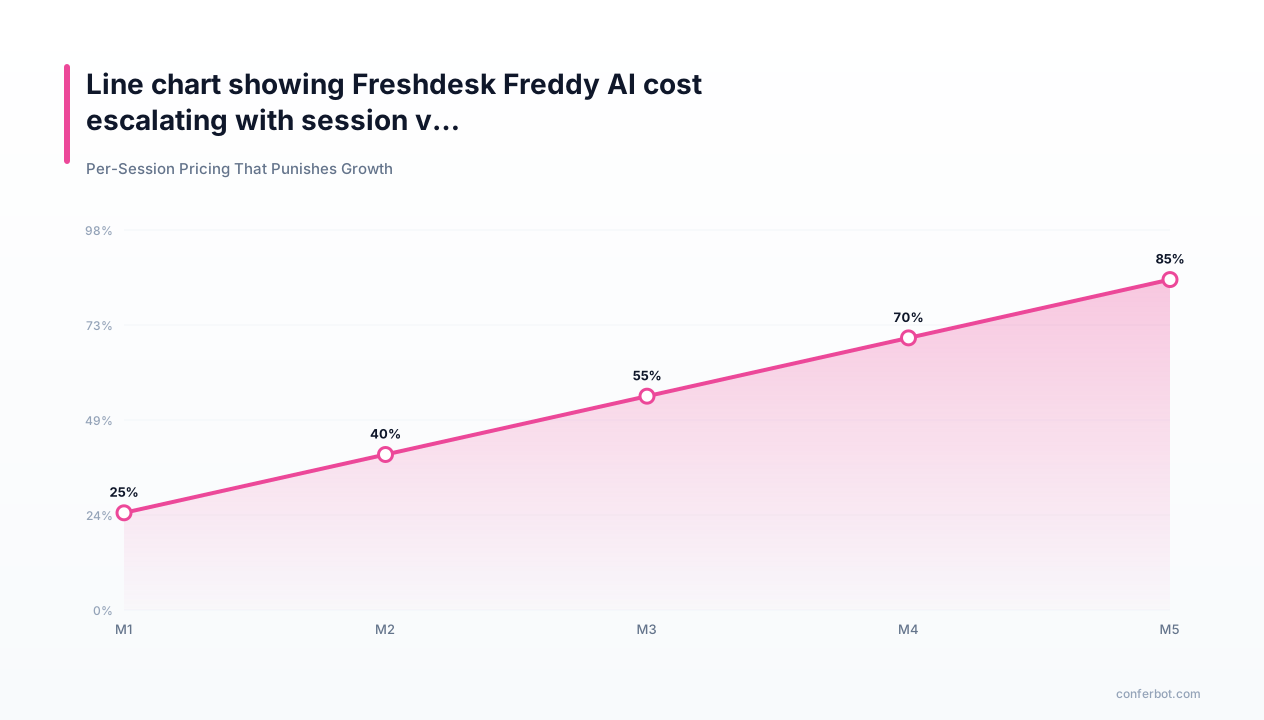
Freshdesk's official pricing page shows that Freddy AI sessions are billed at $0.49 per session on the Pro plan and included in limited quantities on Enterprise. Once you exceed the included allowance, overage charges kick in. For a business handling 5,000 chatbot sessions per month, that is up to $2,450 in session fees alone -- on top of the $49 to $79 per-agent seat cost. As your traffic scales, your chatbot bill scales linearly, destroying the unit economics that chatbot automation is supposed to improve.
Compare this to platforms like Conferbot or Crisp that charge a flat monthly rate regardless of conversation volume. At 5,000 sessions per month, the per-session model costs more than a flat-rate alternative delivering equivalent or better AI.
Per-Agent Seat Pricing on Top
Freddy AI is not a standalone product. To use it, you must subscribe to a Freshdesk agent plan -- Growth ($15/agent), Pro ($49/agent), or Enterprise ($79/agent). The chatbot functionality is gated behind the Pro tier at minimum. A 15-agent team on Pro pays $735 per month just for seats before a single AI session is consumed. This bundled model means you pay for help-desk features you may already have elsewhere just to access the chatbot.
Automation Ceiling: Built Around FAQ Deflection
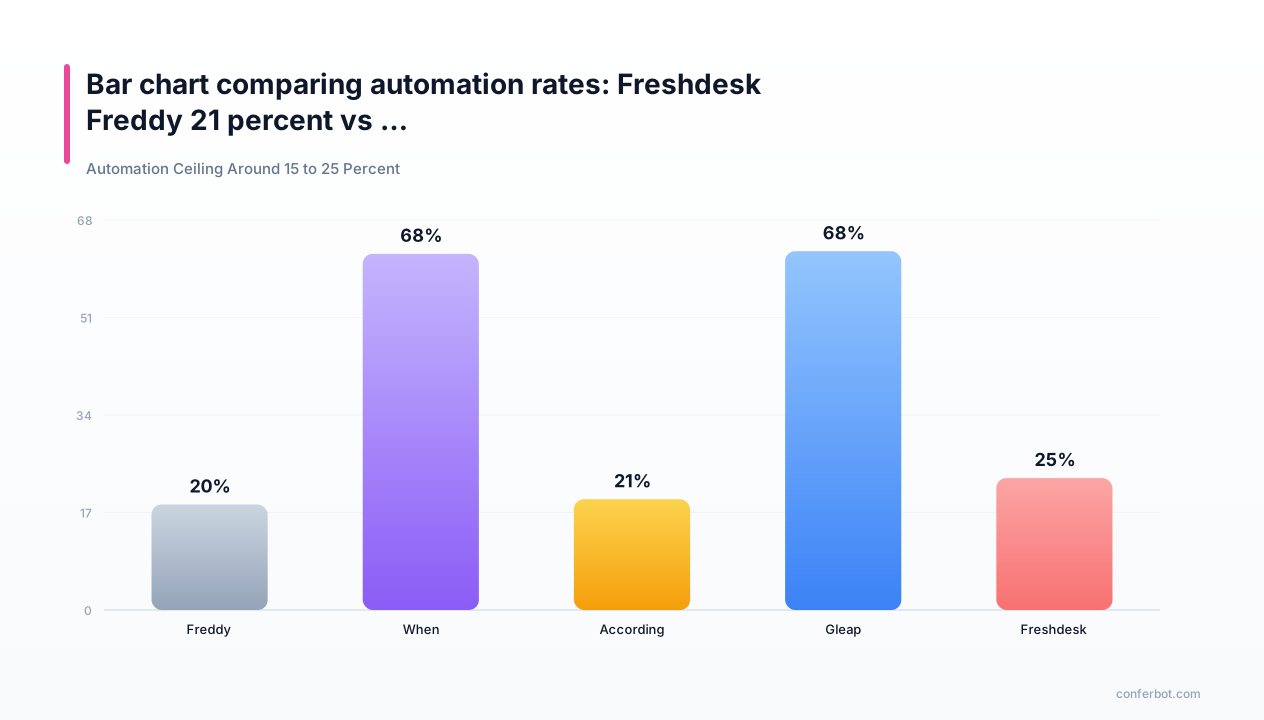
Freddy AI's architecture is ticket-centric. Its primary goal is to deflect tickets by surfacing knowledge-base articles. It cannot process a return, reschedule an appointment, modify an account, or complete a purchase inside the conversation. When customers need action rather than information, Freddy creates a ticket and hands off to a human agent. In practice, this design often limits real automation to a minority of conversations -- far below what purpose-built AI platforms achieve by integrating directly with backend systems.
Limited Multi-Channel AI
Freddy AI's conversational capabilities are strongest in the web widget. On WhatsApp, Messenger, and SMS, the experience degrades -- no carousels, no product cards, no inline forms. Customers on those channels get a text-only, stripped-down version of the chatbot that often fails to resolve their issue and generates a ticket anyway.
No Revenue Generation Features
Freddy AI is a cost-reduction tool, not a revenue tool. It cannot recommend products, upsell services, qualify leads with scoring, or recover abandoned carts. For e-commerce and SaaS businesses, this means the chatbot sits on one side of the P&L (cost savings) while ignoring the larger opportunity on the other side (revenue generation). Platforms purpose-built for customer interaction address both.
Analytics Gaps
Freddy AI reports on deflection volume and article-suggestion success rates. It does not offer A/B testing of conversation flows, funnel drop-off analysis, revenue attribution, or confidence-score tracking. Without these, optimization is guesswork. You know how many tickets the bot prevented but not why conversations fail, which flows convert, or how much revenue the chatbot influenced.
7 Best Freshdesk Chatbot Alternatives Compared: Pricing, AI, Channels
The table below compares all seven alternatives against Freshdesk Freddy AI across the dimensions that matter most when choosing a customer-support chatbot in 2026. Pricing reflects published rates as of June 2026.
| Platform | Starting Price | AI Model | Per-Session Fee | Channels | Autonomous Actions | Free Tier |
|---|---|---|---|---|---|---|
| Freshdesk Freddy AI | $49/agent/mo (Pro) | Freddy (proprietary) | $0.49/session | Web, limited WhatsApp | Ticket creation only | No AI on free plan |
| Conferbot | Free / $19/mo | GPT-4o, Claude, Gemini | None (flat rate) | 13+ (Web, WhatsApp, Messenger, Slack, Telegram, SMS, etc.) | Full CRUD via API | Yes |
| Intercom | $39/seat/mo | Fin AI (GPT-4) | $0.99/resolution | Web, WhatsApp, Messenger, email | Workflows + custom actions | Trial only |
| Tidio | Free / $29/mo | Lyro AI (Claude) | Included in Lyro plan | Web, Messenger, Instagram, email | Limited (Shopify orders) | Yes |
| Zendesk | $55/agent/mo | Zendesk AI (proprietary) | $1.00/automated resolution | Web, WhatsApp, Messenger, email, voice | Full via Sunshine | Trial only |
| Crisp | Free / $25/mo | MagicReply (LLM-based) | None (flat rate) | Web, WhatsApp, Messenger, email, Telegram | Basic via API | Yes |
| Botpress | Free / $0 self-host | Any LLM (GPT, Claude, Llama) | Pay-per-AI-token on cloud | Web, WhatsApp, Messenger, Telegram, Slack | Full via custom code | Yes (open source) |
| tawk.to | Free forever | AI Assist (basic) | None | Web, email | None (live chat focused) | Yes |
Cost Comparison for a 10-Agent Team Handling 5,000 Sessions per Month
| Platform | Monthly Cost | Annual Cost | Savings vs Freshdesk |
|---|---|---|---|
| Freshdesk Pro + Freddy AI | $2,940 | $35,280 | -- |
| Conferbot Business | $59 | $708 | 98% |
| Intercom (10 seats + Fin) | $1,390+ | $16,680+ | 53% |
| Tidio Lyro | $394 | $4,728 | 87% |
| Zendesk Suite Pro + AI | $5,550+ | $66,600+ | -89% (more expensive) |
| Crisp Unlimited | $95 | $1,140 | 97% |
| Botpress (cloud) | ~$150-400 | ~$1,800-4,800 | 86-95% |
| tawk.to | $0 | $0 | 100% |
The pricing disparity is stark. Freshdesk's bundled per-agent-plus-per-session model makes it the second most expensive option after Zendesk for this scenario. Every alternative except Zendesk delivers significant savings -- and most deliver better AI at the same time.
For a comprehensive view of pricing across even more platforms, see our chatbot pricing comparison guide.
Detailed Alternative Reviews: Strengths, Weaknesses, and Best-Fit Scenarios
1. Conferbot -- Best Overall Freshdesk Chatbot Alternative
Conferbot is purpose-built for AI-first customer interaction. Where Freshdesk bolted a chatbot onto a ticketing system, Conferbot designed every feature around autonomous conversation resolution. The platform supports GPT-4o, Claude, and Gemini models, connects to any system with an API for mid-conversation actions, and deploys across 13-plus channels from a single dashboard.
Why it beats Freddy AI:
- Flat-rate pricing: No per-session fees. The Business plan at $59/month covers 10,000 conversations -- a 98 percent cost reduction versus Freshdesk Pro plus Freddy for a 10-agent team.
- Autonomous resolution: The chatbot processes refunds, changes appointments, modifies subscriptions, checks order status, and completes purchases without creating a ticket.
- Omnichannel parity: Full rich-media support (carousels, product cards, forms, payment links) on WhatsApp, Messenger, web, Slack, Telegram, and SMS -- not just the web widget.
- Revenue generation: Product recommendations, abandoned-cart recovery, lead qualification with scoring, and conversion attribution tracking.
- No-code builder: The AI chatbot builder lets non-technical teams create complex flows with conditional logic, API calls, and AI decision points.
Limitations: Smaller marketplace of pre-built integrations compared to Freshdesk's 1,000-plus apps. Custom API integrations fill the gap but require initial setup.
Best for: SMBs and mid-market teams that want high automation rates, flat-rate pricing, and omnichannel deployment without enterprise complexity.
See the full Conferbot vs Freshchat comparison
2. Intercom -- Best Premium Alternative With Per-Resolution AI
Intercom's Fin AI agent is one of the most capable support chatbots on the market. It uses GPT-4 under the hood, accesses your help center and custom data sources, and resolves conversations end-to-end. The trade-off is a per-resolution pricing model ($0.99 per AI-resolved conversation) that can get expensive at scale.
Why it beats Freddy AI: Far superior NLU, genuine multi-turn conversation capability, custom actions via workflows, and a polished messenger experience across web, WhatsApp, and email.
Limitations: Per-resolution pricing means costs scale with volume. A team resolving 5,000 conversations per month via Fin pays $4,950 in AI fees alone -- plus $39 per seat. Total cost can approach or exceed Freshdesk for high-volume teams.
Best for: SaaS companies and tech-forward teams that value best-in-class AI and can absorb per-resolution costs.
3. Tidio -- Best for Small E-Commerce Teams
Tidio combines live chat and an AI chatbot (Lyro) in an affordable package tailored to e-commerce. Lyro uses Claude-based AI to answer product questions, check Shopify order status, and recommend products. Pricing starts free with a Lyro-specific plan at $39/month for 50 conversations.
Why it beats Freddy AI: Purpose-built Shopify and WooCommerce integrations that let the chatbot answer "Where is my order?" queries by pulling real-time tracking data -- something Freddy AI cannot do without agent involvement.
Limitations: Lyro's conversation cap (50 to 200 per month on standard plans) is restrictive for growing stores. Limited channel support compared to Conferbot. No WhatsApp integration on lower tiers.
Best for: Shopify and WooCommerce stores with under 2,000 monthly support conversations. For a deeper look, read our Tidio alternative analysis.
4. Zendesk -- Best for Enterprise Teams Already in the Zendesk Ecosystem
Zendesk's AI chatbot is mature, deeply integrated with its ticketing system, and supports autonomous resolution through the Sunshine platform. But it is the most expensive option on this list -- $55 to $115 per agent per month plus $1.00 per automated resolution.
Why it beats Freddy AI: More sophisticated AI, broader channel support (including native voice), and a richer integration ecosystem. Zendesk's reporting and analytics are also a generation ahead of Freshdesk's.
Limitations: Per-resolution pricing at $1.00 is double Freshdesk's per-session cost and triple Intercom's. Total cost for a 15-agent team easily exceeds $100,000 per year. Overkill for SMBs.
Best for: Enterprise teams with 50-plus agents, complex workflows, and budgets to match. See our Zendesk alternative comparison for details.
5. Crisp -- Best Budget Flat-Rate Option
Crisp offers live chat, chatbot, CRM, and knowledge base at a flat monthly rate with no per-agent and no per-conversation charges. MagicReply uses LLM-based AI to draft responses from your knowledge base. The Unlimited plan at $95/month covers your entire team.
Why it beats Freddy AI: Dramatically cheaper (97 percent savings for a 10-agent team), no per-session fees, and includes a built-in CRM that eliminates the need for a separate tool.
Limitations: AI capabilities are less sophisticated than Conferbot or Intercom. MagicReply drafts suggested responses for agents rather than resolving conversations autonomously. Limited autonomous action capability.
Best for: Budget-conscious teams that want live chat plus basic AI assist without paying per agent or per conversation.
6. Botpress -- Best Open-Source and Self-Hosted Option
Botpress is an open-source chatbot platform that lets you build, train, and deploy AI chatbots with any LLM. The cloud version offers a generous free tier; self-hosting is completely free. Developers have full control over conversation logic, integrations, and AI model selection.
Why it beats Freddy AI: Unlimited customization, model flexibility (GPT, Claude, Llama, Mistral), and zero vendor lock-in. You own the code and the data.
Limitations: Requires developer resources to build and maintain. No out-of-the-box customer-support workflows like Conferbot or Intercom. Cloud pricing is token-based and can be unpredictable.
Best for: Developer-led teams that want full control, custom AI pipelines, or on-premise deployment for compliance reasons.
7. tawk.to -- Best Free Live Chat With Basic AI
tawk.to is a completely free live-chat platform used by over 4 million businesses. It added AI Assist in 2026, which uses AI to suggest responses and auto-complete agent replies. The catch: tawk.to is primarily a live-chat tool, not a chatbot platform. Its AI features are agent-assist, not customer-facing autonomous conversation.
Why it beats Freddy AI: It is free. For teams that need live chat without a chatbot budget, tawk.to eliminates cost entirely.
Limitations: No autonomous AI chatbot -- AI assists agents but does not resolve conversations independently. No WhatsApp or Messenger integration. No API actions. Monetizes through optional paid agent services and branding removal.
Best for: Bootstrapped startups and micro-businesses that need live chat today and plan to add AI chatbot capabilities later.
Feature-by-Feature Matrix: What Each Platform Actually Delivers
Beyond pricing, the feature depth of each platform determines whether it can replace Freddy AI without regression. This matrix evaluates the capabilities that matter most for customer-support chatbot deployments.
| Feature | Freshdesk | Conferbot | Intercom | Tidio | Zendesk | Crisp | Botpress | tawk.to |
|---|---|---|---|---|---|---|---|---|
| LLM-powered NLU | Basic | Advanced | Advanced | Good | Advanced | Good | Advanced | Basic |
| Multi-turn conversation | 2-3 turns | Unlimited | Unlimited | 5-8 turns | Unlimited | 3-5 turns | Unlimited | N/A |
| Autonomous actions (refunds, bookings) | No | Yes | Yes | Limited | Yes | Limited | Yes (custom) | No |
| Custom AI training | KB articles only | Any data source | Help center + custom | Website + docs | Help center + custom | KB articles | Any data source | No |
| A/B testing | No | Yes | Yes | No | Limited | No | Custom | No |
| Revenue attribution | No | Yes | Yes | Basic | Limited | No | Custom | No |
| WhatsApp (full rich media) | Limited | Yes | Yes | Paid add-on | Yes | Yes | Yes | No |
| Proactive triggers | Page-based | Behavioral | Behavioral | Basic | Behavioral | Basic | Custom | Basic |
| CSAT/NPS collection | Post-ticket | In-conversation | In-conversation | Post-chat | In-conversation | Post-chat | Custom | Post-chat |
| Open-source option | No | No | No | No | No | No | Yes | No |
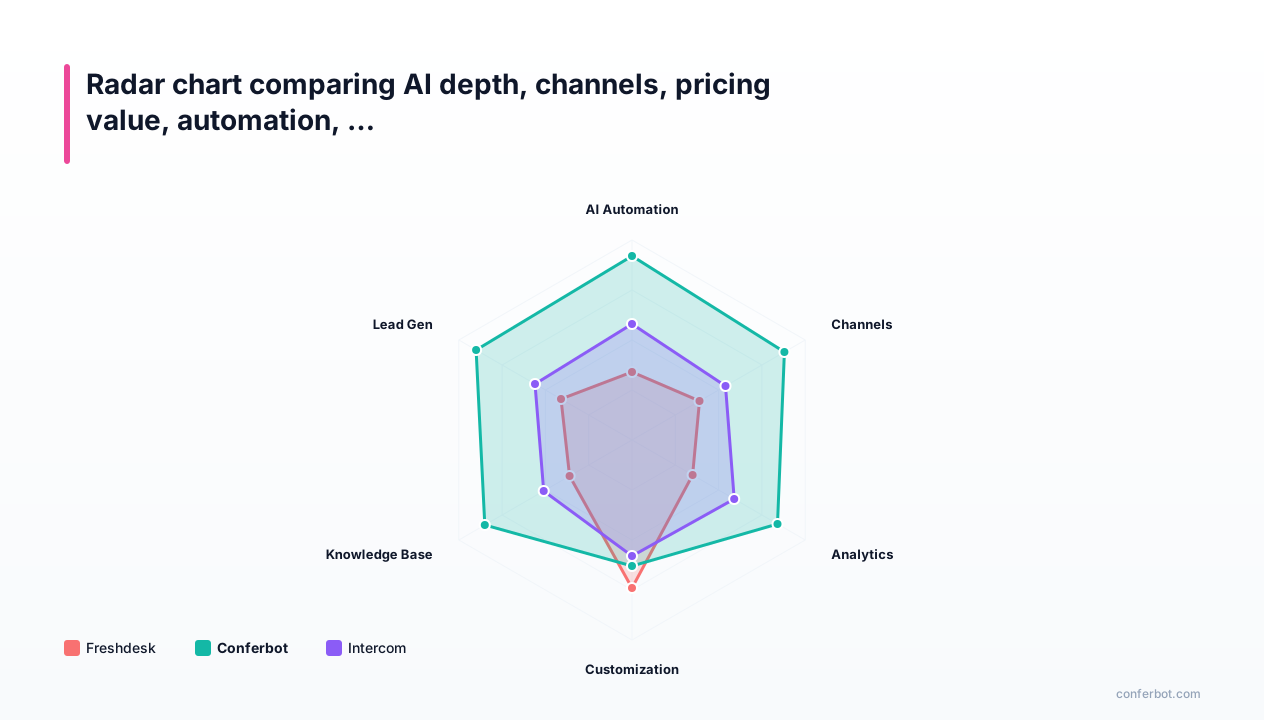
The pattern is clear: Freshdesk leads only on native ticketing integration -- the one area where being built into the help desk is an advantage. On every AI, channel, automation, and analytics dimension, at least four alternatives score higher. For teams whose primary need is an intelligent chatbot rather than a ticketing add-on, the alternatives are categorically superior.
For teams evaluating chatbot builders specifically, our best no-code chatbot builders compared guide covers the builder experience in more depth.
Which Alternative Is Right for You? Use-Case Decision Guide
Choosing the right Freshdesk alternative depends on your team size, technical capacity, primary use case, and budget. This decision guide maps common scenarios to the best-fit platform.
Scenario 1: SMB Support Team (3 to 10 Agents, Under $500/Month Budget)
Best choice: Conferbot. Flat-rate pricing keeps costs predictable as volume grows. AI automation is included with no per-session fees. The no-code builder means your support lead can build and iterate flows without waiting for engineering.
Scenario 2: E-Commerce Store on Shopify or WooCommerce (Under 2,000 Monthly Conversations)
Best choice: Tidio. Purpose-built e-commerce integrations, Lyro AI for product questions and order tracking, and affordable entry pricing. Upgrade to Conferbot when you outgrow Lyro's conversation caps or need WhatsApp and multi-channel deployment.
Scenario 3: SaaS Company With Technical Team and Per-Resolution Budget
Best choice: Intercom. Fin AI's resolution quality is best-in-class for SaaS support. Product tours and in-app messaging add onboarding value. Accept the per-resolution cost model if your resolution volume is predictable and your average ticket value justifies $0.99 per AI resolution.
Scenario 4: Enterprise With 50-Plus Agents and Existing Zendesk or Salesforce Stack
Best choice: Zendesk. Deep enterprise integrations, mature compliance features (HIPAA, SOC 2), and sophisticated workforce management justify the higher cost at enterprise scale. Migrate only if you need better AI -- not better ticketing.
Scenario 5: Developer Team Wanting Full Control and Self-Hosting
Best choice: Botpress. Open-source code base, any-LLM flexibility, and self-hosting for compliance-sensitive industries. Budget engineering time for initial build and ongoing maintenance.
Scenario 6: Zero Budget, Need Live Chat Today
Best choice: tawk.to. Completely free live chat gets you online immediately. Plan to add a dedicated AI chatbot (Conferbot's free tier is a good next step) when you are ready for automation.
Scenario 7: Budget-Conscious Team Wanting All-in-One Without Per-Seat Pricing
Best choice: Crisp. Flat $95/month for unlimited agents, built-in CRM, and LLM-assisted replies. Accept that AI is agent-assist rather than fully autonomous and plan for a future upgrade path.
No matter which platform you choose, the migration from Freshdesk follows a similar pattern. The next section provides a step-by-step playbook that applies to any of the seven alternatives.
Migration Playbook: Moving From Freshdesk Freddy AI in 4 Weeks
Switching chatbot platforms does not require switching your entire support stack. The recommended approach for most teams is hybrid: replace only the chatbot layer while keeping Freshdesk (or a lighter-weight help desk) for agent ticket management. Here is a proven four-week migration playbook.
Week 1: Audit and Baseline
- Export Freddy AI analytics: Document current deflection rate, top 20 conversation topics, average conversation length, escalation triggers, and CSAT scores. These baselines measure whether the new platform improves performance.
- Export knowledge base: Download all Freshdesk knowledge-base articles as HTML or Markdown. These become training data for the new chatbot's AI.
- Map integration requirements: List every system the chatbot should connect to: e-commerce platform, CRM, scheduling tool, payment processor, order management system. Prioritize the three integrations that will eliminate the most agent escalations.
- Choose your platform: Use the decision guide in Section 6 to select your alternative. Sign up for a free tier or trial.
Week 2: Build and Train
- Import knowledge base: Upload your exported articles to the new platform's AI training pipeline. Most platforms ingest HTML, PDF, or plain text and build vector embeddings automatically.
- Configure top 5 conversation flows: Recreate the five Freddy AI flows that handle the highest conversation volume. Simplify where possible -- Freddy's rigid decision trees often need 20 steps for what an LLM-powered bot handles in 3 conversational turns.
- Set up priority integrations: Connect your e-commerce platform (for order tracking), scheduling tool (for appointment changes), and CRM (for customer context). Test each integration with sample data.
- Configure escalation routing: Set up the handoff path to your existing help desk. When the chatbot cannot resolve, it creates a Freshdesk ticket (or equivalent) with full conversation transcript attached.
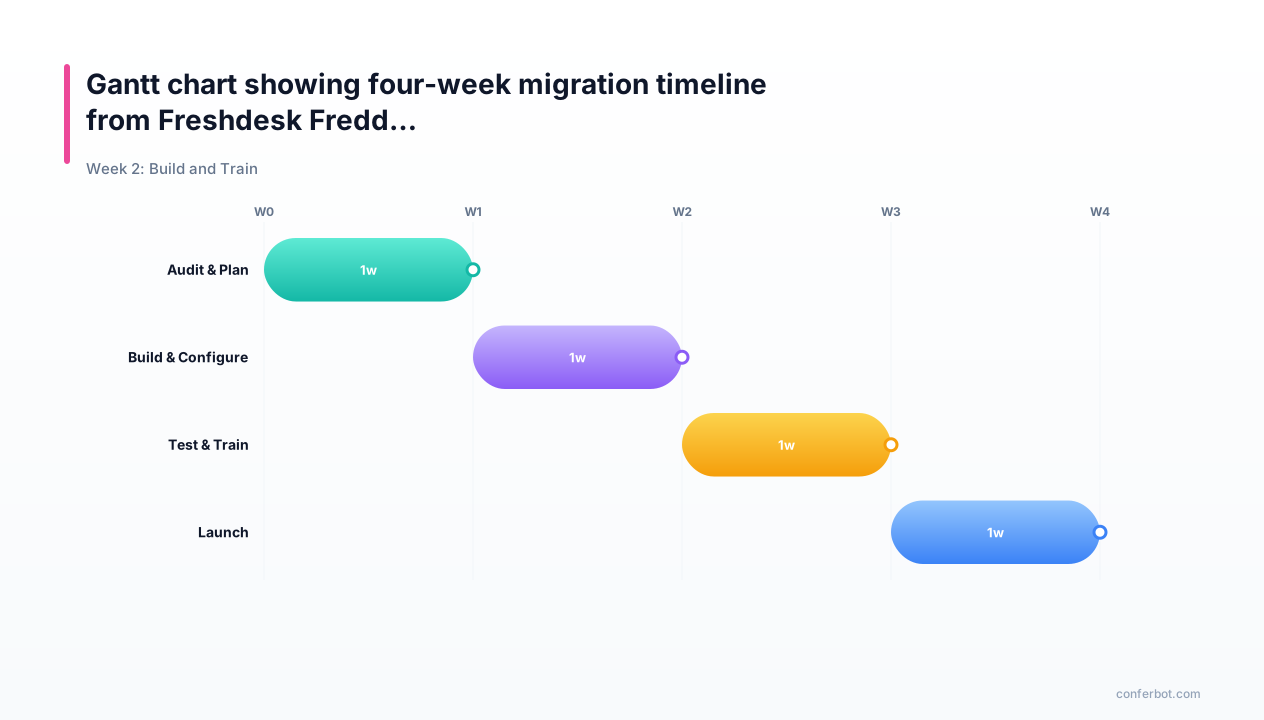
Week 3: Parallel Deployment and Testing
- Deploy to 20 percent of traffic: Use URL-based or random-split routing to send a portion of visitors to the new chatbot while Freddy AI handles the rest.
- Compare metrics side by side: Track resolution rate, escalation rate, CSAT, and average conversation length for both chatbots over the same period.
- Fix conversation gaps: Identify topics where the new chatbot underperforms Freddy AI and add training data or flow adjustments.
- Stress-test integrations: Verify that order lookups, appointment changes, and other autonomous actions work reliably under real customer input.
Week 4: Full Cutover and Optimization
- Switch 100 percent of traffic to the new chatbot. Remove the Freddy AI widget.
- Monitor for 7 days: Watch escalation volume, CSAT, and any new conversation topics the AI has not encountered before.
- Downgrade Freshdesk plan: If you are keeping Freshdesk for ticketing, switch to the Growth plan ($15/agent) since you no longer need the Pro tier for Freddy AI access. A 10-agent team saves $340/month on seat costs alone.
- Set a 30-day review: Evaluate automation rate, cost savings, and customer satisfaction against Week 1 baselines. Most teams see 2 to a clear improvement in automation rate within the first month.
For additional migration context from related platforms, see our guides on switching from Zendesk, Drift, and Tidio.
The Hybrid Approach: Keep Freshdesk for Tickets, Upgrade Only the Chatbot
The most practical migration path for many teams is not to abandon Freshdesk entirely but to separate the chatbot layer from the ticketing layer. Freshdesk remains your agent workspace for human-handled conversations; a standalone AI chatbot handles the front-line automation.
How the Hybrid Architecture Works
The standalone chatbot sits on your website, WhatsApp, Messenger, and other channels as the first point of contact. It handles routine conversations autonomously -- answering questions, processing actions, and resolving requests. For the conversations that need a human agent, the chatbot creates a Freshdesk ticket with the full conversation transcript, customer sentiment score, and a recommended action for the agent.
The agent receives a ticket that is pre-triaged, pre-categorized, and loaded with context. Instead of starting from scratch, they pick up where the chatbot left off. This eliminates the "Can you tell me your order number again?" problem that frustrates customers and wastes agent time.
Cost Comparison: Full Freshdesk vs Hybrid
| Configuration | Monthly Cost (10 Agents) | AI on the Front Line |
|---|---|---|
| Freshdesk Pro + Freddy AI (current) | $2,940 | FAQ deflection, billed per session |
| Conferbot Business + Freshdesk Growth (5 agents) | $134 | AI agent answers first, hands off to agents |
| Savings | $2,806/month ($33,672/year) | No per-session AI fees |
The hybrid approach saves over $33,000 per year while putting AI in front of every conversation. The math works because higher chatbot automation means fewer conversations reach agents, which means you need fewer agent seats. Instead of 10 agents on the expensive Pro plan, you run 5 agents on the cheaper Growth plan -- plus a standalone chatbot that handles the volume the other 5 agents used to manage.
Integration Between Chatbot and Freshdesk
Most standalone chatbot platforms offer Freshdesk integration via API or native connector. The integration typically includes: ticket creation with conversation context on escalation, customer record lookup from Freshdesk for personalization, ticket status updates that the chatbot can relay back to customers, and bi-directional sync of customer data between the chatbot and Freshdesk CRM.
For teams that want to explore this hybrid approach with Conferbot specifically, our pricing page includes a cost calculator that models the savings based on your team size and conversation volume.
Verdict: The Best Freshdesk Chatbot Alternative for Each Budget and Use Case
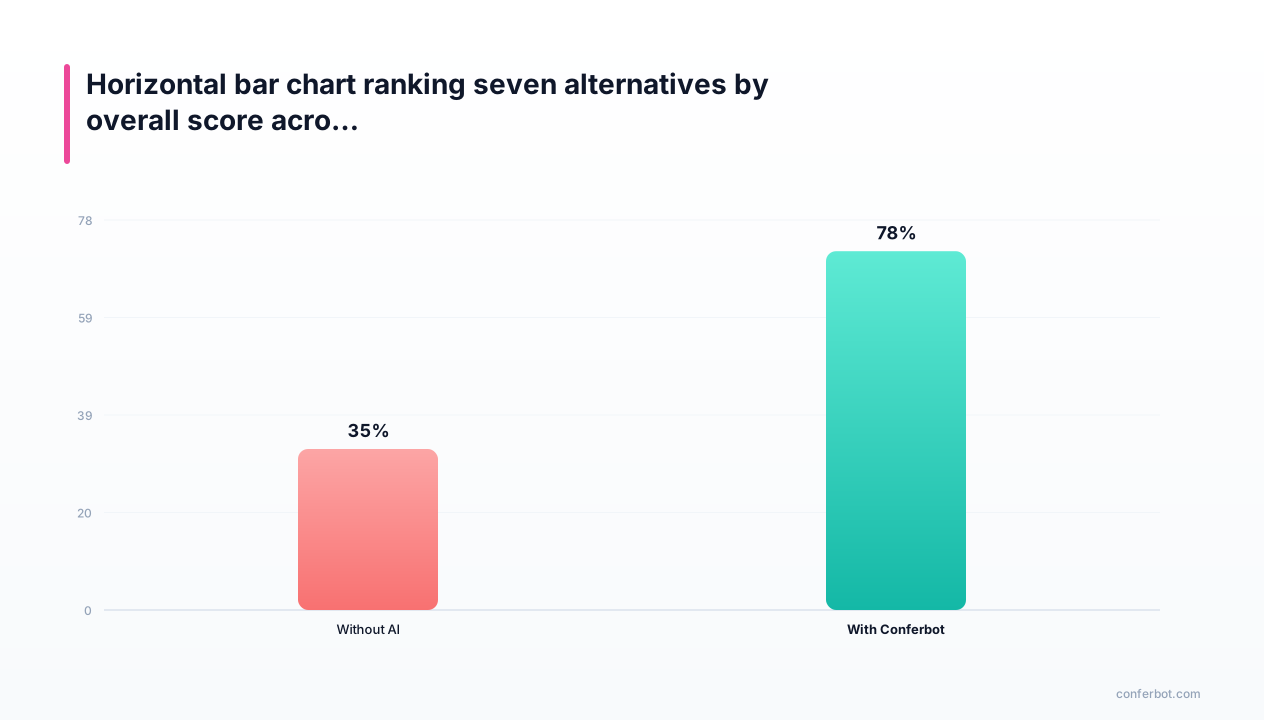
Freshdesk's Freddy AI served a purpose when AI chatbots were nascent and bolting basic FAQ deflection onto a help desk was the best available option. In 2026, that approach is outdated. Purpose-built AI chatbot platforms deliver deeper automation, cover more channels, and cost 50 to 98 percent less than the Freshdesk Pro plus Freddy AI bundle.
Here is the final recommendation matrix:
| Priority | Best Alternative | Key Reason |
|---|---|---|
| Best overall value | Conferbot | Flat-rate pricing, AI included, 10 channels, no per-session fees |
| Best AI quality | Intercom (Fin AI) | GPT-4 powered resolution, sophisticated workflows |
| Best for Shopify | Tidio (Lyro) | Native e-commerce integrations, affordable for small stores |
| Best enterprise | Zendesk | Mature compliance, workforce management, voice support |
| Best budget all-in-one | Crisp | $95/month unlimited agents, built-in CRM, no per-seat fees |
| Best open source | Botpress | Full code control, any LLM, self-hosting option |
| Best free live chat | tawk.to | Completely free, no AI chatbot but solid live chat foundation |
The evidence is consistent across G2 chatbot category reviews, Capterra chatbot software comparisons, and our own analysis: the era of help-desk add-on chatbots is ending. Businesses that switch to purpose-built AI platforms see faster ROI, higher customer satisfaction, and dramatically lower cost per conversation.
If you are ready to move forward, start with the Conferbot comparison hub to see head-to-head matchups against your current platform, or sign up for the free tier to test drive the chatbot builder with your own knowledge base. The per-session charges and automation ceiling of Freddy AI are problems you do not have to accept anymore.
Was this article helpful?
Build and deploy in 10 minutes. No coding needed.
7 Best Freshdesk Chatbot Alternatives for AI Customer Support in 2026 FAQ
Everything you need to know about chatbots for 7 best freshdesk chatbot alternatives for ai customer support in 2026.
About the Author
The Conferbot team writes about building, deploying, and improving AI chatbots.
View all articles