The After-Hours Problem: Why Home Service Companies Lose 60% of Their Best Leads
The home services industry in the United States generates over $600 billion in annual revenue across HVAC, plumbing, electrical, and related trades, according to the Bureau of Labor Statistics occupational outlook data. Behind that headline figure sits a painful operational reality: the majority of customer inquiries arrive when no one is available to answer them. Industry data from ServiceTitan's home services marketing research confirms that 60% of all home service inquiries occur outside standard business hours -- evenings, weekends, and holidays -- precisely when furnaces fail, pipes burst, and circuits overload.
The consequences are devastating for revenue. When a homeowner's air conditioning dies at 9 PM in July or a water heater ruptures at 6 AM on a Saturday, they do not submit a contact form and wait until Monday. They call the first three companies on Google, and the one that responds first books the job 78% of the time. According to HomeAdvisor's True Cost data, the average emergency HVAC repair costs $350 to $900, emergency plumbing runs $250 to $800, and emergency electrical work commands $200 to $750 -- all at premium after-hours rates. Every missed after-hours call represents $400 to $1,200 in immediate lost revenue, plus the lifetime customer value of $8,000 to $25,000 over a decade of repeat maintenance, seasonal tune-ups, and equipment upgrades.
Most home service companies attempt to solve this with answering services, costing $400 to $900 per month, that provide scripted call-taking but no lead qualification, no pricing information, no scheduling authority, and no emergency dispatch capability. The answering service takes a name and number. The customer, still panicking about the water pooling on their basement floor, hangs up and calls the next company on their list. Studies from Angi's annual home services research show that 67% of homeowners who reach an answering service still contact at least one additional provider before the original company returns their call.
AI chatbots transform this equation by providing every capability an answering service lacks: instant response at any hour, intelligent lead qualification that separates a true emergency from a routine maintenance request, real-time price estimates that build trust and pre-qualify budgets, direct calendar integration that books confirmed appointments without human intervention, emergency dispatch that alerts on-call technicians with customer details and location within 60 seconds, and post-job follow-up that converts completed work into five-star reviews. For a deeper look at how chatbots work for specific plumbing and electrical scenarios, see our dedicated plumber and electrician chatbot guide.
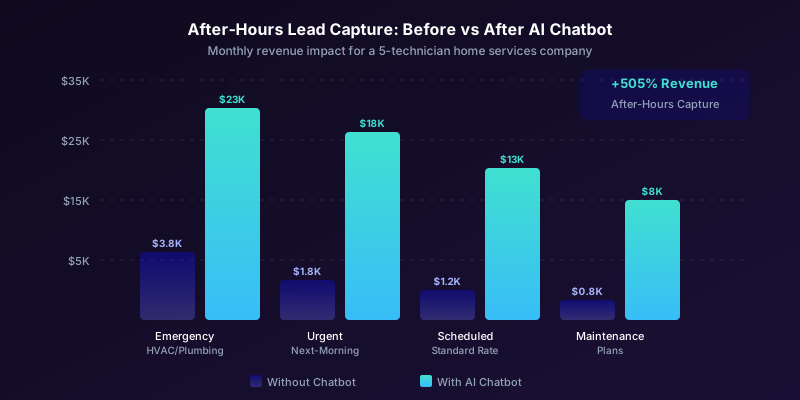
The numbers from early adopters are striking. Home service companies deploying AI chatbots report $23,000 in emergency revenue captured in the first month alone, with annual revenue increases of $180,000 to $450,000 for a typical 4 to 8 technician operation. This guide provides the complete implementation playbook: after-hours lead capture strategies, emergency triage and dispatch workflows, instant quote generation, seasonal demand handling, service scheduling optimization, review generation automation, and a detailed ROI model specific to HVAC, plumbing, and electrical businesses.
After-Hours Lead Capture: Turning Dead Hours Into Your Most Profitable Shift
The after-hours window -- roughly 6 PM to 8 AM on weekdays plus all weekend and holiday hours -- accounts for approximately 76% of the calendar but generates 60% of home service inquiries. For HVAC specifically, the after-hours share climbs to 68% during extreme weather events when systems fail under peak load. This is not a marginal revenue opportunity; it is the majority of demand arriving when virtually every competitor has gone dark.
Mapping the After-Hours Inquiry Timeline
Home service inquiries follow predictable patterns that vary by trade and season. Understanding these patterns is essential for configuring your chatbot's behavior and staffing on-call technicians effectively.
| Time Window | HVAC Inquiry Share | Plumbing Inquiry Share | Electrical Inquiry Share | Dominant Inquiry Type |
|---|---|---|---|---|
| 6 PM - 10 PM weekdays | 22% | 18% | 14% | Homeowners arrive home, discover issues |
| 10 PM - 6 AM weekdays | 8% | 12% | 6% | True emergencies (burst pipes, no heat) |
| Saturday 8 AM - 6 PM | 16% | 15% | 18% | Non-urgent projects, comparisons |
| Sunday all day | 10% | 9% | 8% | Mix of emergencies and planning |
| Business hours (M-F 8-6) | 44% | 46% | 54% | Scheduled maintenance, quotes |

The 6 PM to 10 PM weekday window is particularly valuable because these are homeowners who just arrived home, discovered that the AC is not cooling, the kitchen faucet is leaking, or a bathroom outlet stopped working. They are motivated to solve the problem before bed but still calm enough to compare options. A chatbot that engages them instantly with helpful information and clear pricing captures the booking before they move to the next search result.
The Chatbot's After-Hours Workflow
The chatbot operates differently after hours than during business hours, recognizing that customer expectations and urgency levels shift. The core after-hours workflow includes four distinct paths:
Path 1: True Emergency (Immediate Dispatch)
When the chatbot identifies keywords and context indicating a genuine emergency -- active water leak, no heat below freezing, gas smell, sparking panel, sewage backup -- it activates emergency protocol: acknowledges urgency within 5 seconds, collects address and emergency details in under 90 seconds, provides immediate safety instructions (shut off water main, leave the house for gas smell, do not touch sparking panel), dispatches an alert to the on-call technician via SMS and push notification, and relays the technician's ETA to the customer. The entire workflow from first message to confirmed dispatch takes under 3 minutes.
Path 2: Urgent but Not Emergency (Priority Morning Booking)
Issues that need attention soon but are not causing active damage -- slow drip, intermittent HVAC cycling, flickering lights -- receive priority scheduling for the first available slot the next morning. The chatbot books the appointment, provides interim guidance, and sends a confirmation summary.
Path 3: Planned Service (Standard Scheduling)
Homeowners researching seasonal tune-ups, equipment upgrades, or non-urgent repairs receive pricing information, service explanations, and standard appointment booking during regular hours.
Path 4: Information Gathering (Lead Capture for Callback)
Complex projects requiring on-site assessment -- full system replacements, major electrical upgrades, whole-house replumbing -- have their details captured completely so a sales representative can call back with full context. The chatbot sets a specific callback time: "Our comfort specialist will call you tomorrow between 9 and 10 AM to discuss your HVAC replacement options. They will have all the details you have shared with me."
For more on structuring after-hours support workflows across any industry, see our comprehensive guide to after-hours customer support chatbot setup.
After-Hours Revenue Impact: Real Numbers
Consider a 5-technician HVAC and plumbing company currently receiving 250 monthly inquiries, of which 150 (60%) arrive after hours. Without a chatbot, they capture roughly 15 of those after-hours leads (10% capture rate through voicemail callbacks). With a chatbot providing instant engagement and booking, they capture 120 (80% capture rate). At a 35% booking conversion rate and $650 average job value, the additional 105 captured leads produce 37 additional bookings worth $24,050 per month -- $288,600 annually. The first month's $23,000+ in emergency revenue that early adopters report is not an outlier; it is the expected outcome when a home service company stops hemorrhaging after-hours leads.
Instant Quote Generation: Transparent Pricing That Wins the Job Before Competitors Respond
Home service customers increasingly expect pricing transparency before committing to a service call. According to HomeAdvisor's homeowner spending survey, 73% of homeowners compare at least two quotes before booking HVAC, plumbing, or electrical work, and 61% say that receiving a fast, clear estimate is the primary factor in choosing one company over another. An AI chatbot that delivers instant price ranges while competitors are still sleeping creates a decisive competitive advantage.
Building Your Trade-Specific Pricing Engine
The chatbot generates estimates through a conversational flow that gathers the minimum information needed for an accurate range. Each trade has its own pricing logic.
HVAC Pricing Matrix
| Service | Key Variables | Chatbot Estimate Range | Estimate Approach |
|---|---|---|---|
| AC diagnostic / repair | System type, age, symptoms | $150 - $650 | Range narrows with symptoms |
| Furnace diagnostic / repair | Fuel type, symptoms, age | $150 - $700 | Range with diagnostic fee applied |
| AC unit replacement | Tonnage, SEER rating, brand | $4,500 - $12,000 | Good / Better / Best options |
| Furnace replacement | Fuel type, size, efficiency | $3,500 - $8,500 | Tiered options with rebate info |
| Seasonal tune-up (AC or heat) | System count, age | $89 - $149 | Fixed price, upsell to plan |
| Ductwork repair / install | Footage, accessibility | $1,500 - $5,000 | Requires on-site assessment |
| Mini-split installation | Zones, BTU, brand | $3,000 - $8,000 | Per-zone pricing available |
Plumbing Pricing Matrix
| Service | Key Variables | Chatbot Estimate Range | Estimate Approach |
|---|---|---|---|
| Drain cleaning | Location, severity | $99 - $350 | Fixed pricing tiers |
| Water heater replacement | Tank vs tankless, capacity | $1,200 - $4,500 | Tiered options |
| Leak repair | Location, accessibility | $175 - $800 | Range with diagnostic fee |
| Faucet / fixture install | Fixture type, complexity | $150 - $450 + parts | Labor quote + customer parts option |
| Sewer line repair | Method, length, depth | $2,500 - $15,000 | Camera inspection first |
| Garbage disposal install | New vs replacement | $250 - $550 | Fixed price with options |

The Conversational Estimate Flow
The chatbot's estimate conversation follows a funnel pattern that narrows the price range with each question. For an HVAC example:
Step 1 - Service Category: "What do you need help with?" [Air Conditioning / Heating / Water Heater / Other]
Step 2 - Issue Type: "Is your AC not working at all, not cooling well, making unusual noise, or something else?"
Step 3 - System Details: "Do you know your AC system's approximate age?" [Under 5 years / 5-10 years / 10-15 years / Over 15 years / Not sure]
Step 4 - Estimate Delivery: "Based on what you have described -- an AC system that is 10-15 years old and not cooling properly -- this typically requires a refrigerant recharge or compressor component repair. Repairs in this category range from $250 to $550. Our diagnostic fee is $89, which is applied as a credit if you approve the repair. Given the system's age, our technician will also assess whether repair or replacement provides better long-term value. Would you like to schedule a diagnostic visit?"
This flow accomplishes three critical objectives simultaneously: it provides the pricing transparency homeowners demand, it pre-qualifies the customer's budget expectations (reducing sticker shock on-site), and it builds trust through expertise demonstrated via relevant follow-up questions. Customers who receive a chatbot estimate convert to booked appointments at 42% compared to 18% for customers who receive a "we will call you back with a quote" response. For detailed guidance on building these conversational pricing flows, explore our AI chatbot builder which includes home services templates.
Financing Integration for Large Jobs
For equipment replacement quotes exceeding $3,000, the chatbot introduces financing options early: "A new 16 SEER2 AC system for your home would be in the $6,500 to $8,500 range. With our financing partners, that is as low as $89/month over 120 months with approved credit. Would you like to schedule a free in-home assessment to get an exact quote and discuss financing options?" Mentioning monthly payments alongside total cost increases booking rates for major HVAC and plumbing equipment replacements by 35 to 45%, turning price-sensitive leads into confirmed appointments.
Seasonal Demand Handling: Scaling From 50 to 500 Inquiries When Weather Extremes Hit
Home services demand is inherently seasonal, and extreme weather events create massive inquiry spikes that overwhelm traditional phone-based operations. A heat wave pushes AC repair inquiries up 400 to 800% in a single day. A cold snap triggers furnace emergencies at 5x to 10x normal volume. A heavy rainstorm drives sump pump, basement flooding, and roof leak calls simultaneously. These spikes are where revenue is made -- and where most companies fail to capture it because they simply cannot answer the phones fast enough.
The Seasonal Demand Calendar
| Season / Event | Primary Demand Spike | Inquiry Volume vs Baseline | Revenue Opportunity |
|---|---|---|---|
| First heat wave (May-June) | AC not cooling, AC won't turn on | 5x - 8x normal | Premium emergency AC repair |
| Peak summer (July-August) | AC replacements, efficiency complaints | 3x - 4x normal | Equipment replacement sales |
| First freeze (Oct-Nov) | Furnace not working, no heat | 4x - 6x normal | Emergency heating repair |
| Deep winter (Dec-Feb) | Frozen pipes, furnace failures, boiler issues | 3x - 5x normal | Emergency plumbing + HVAC |
| Spring thaw (March-April) | Flooding, sump pump, AC tune-ups | 2x - 3x normal | Seasonal maintenance plans |
| Major storms (any time) | Electrical outages, water damage, generator | 6x - 10x normal (24-48 hrs) | Emergency electrical + plumbing |

How the Chatbot Handles Volume Spikes
Unlike phone lines that queue callers and answering services that become backlogged, the chatbot handles unlimited simultaneous conversations without quality degradation. During a heat wave generating 300 inquiries in a single evening, the chatbot engages every single visitor instantly with the same qualification, pricing, and scheduling capabilities. There is no busy signal, no hold time, and no degraded service as volume increases.
During demand spikes, the chatbot automatically adjusts its behavior:
Capacity-Aware Scheduling: When the schedule fills up, the chatbot transparently communicates wait times and offers alternatives. "Due to high demand from today's heat wave, our earliest available AC diagnostic appointment is Thursday. However, we do have emergency availability today for systems that are completely non-functional -- is your AC producing any cooling at all, or is it completely dead?" This triage ensures truly urgent cases receive same-day service while less critical issues are scheduled efficiently.
Waitlist Management: When the schedule is completely booked, the chatbot captures leads with a priority waitlist: "All appointments are currently booked through Friday. I can add you to our priority waitlist -- if any cancellations open up, you will be the first to know. I also have your details ready so when we do schedule, we can get your technician out quickly. Would you like to join the waitlist?" This captures leads that would otherwise be lost entirely.
Seasonal Upselling: Demand spikes create natural upselling opportunities. A customer calling for an emergency AC repair in July is a prime candidate for a maintenance plan that prevents future emergencies: "Since your AC is 12 years old and needed emergency repair, I would recommend our Comfort Club membership at $19/month. It includes two annual tune-ups, priority scheduling during heat waves (no waiting), and 15% off all repairs. Members who had their tune-up this spring avoided exactly this type of emergency breakdown. Would you like to add that when we schedule your repair?"
Pre-Season Proactive Campaigns
Smart chatbot operators do not just react to seasonal demand -- they generate it proactively. Before each season, the chatbot reaches out to past customers through website re-engagement and email triggers: "Summer is approaching and temperatures are already hitting 90 degrees. Last year, 40% of our emergency AC calls could have been prevented by a spring tune-up. Schedule your $89 AC tune-up before the rush -- our May availability is filling fast." These proactive campaigns fill shoulder-season capacity, generate maintenance plan sign-ups, and identify aging equipment that needs replacement before it fails during peak demand. For more on leveraging seasonal strategy with chatbots, our seasonal chatbot strategy guide covers similar demand-handling frameworks.
Dispatch Coordination: From Customer Message to Technician on the Road in Under 5 Minutes
According to Jobber's home service industry trends report, businesses that reduce dispatch time below 10 minutes see 34% higher customer satisfaction scores. The gap between capturing a lead and getting a technician dispatched is where many home service companies lose the speed advantage their chatbot provides. If the chatbot captures a lead in 60 seconds but dispatch takes 3 hours, the customer experience fails. True dispatch coordination means the chatbot does not just capture and hand off -- it orchestrates the entire workflow from customer inquiry to technician arrival.
The Integrated Dispatch Workflow
When a customer completes the qualification and booking flow, the chatbot triggers a multi-step dispatch process:
Step 1: Job Creation (Automatic, 0-5 seconds)
The chatbot creates a complete work order in your field service management platform (ServiceTitan, Housecall Pro, Jobber, or similar) with all customer details: name, phone, email, address, service type, issue description, urgency level, estimated job value, property access instructions, and any photos the customer shared during the chat conversation.
Step 2: Technician Assignment (Automatic, 5-30 seconds)
The dispatch system assigns the job to the optimal technician based on: proximity to the job site (minimizing drive time), skill certification (master plumber for complex jobs, journeyman for routine work), current workload and schedule gaps, customer history (if available, assigning the same technician who previously serviced the home), and specialty equipment needs (camera for sewer inspection, recovery unit for refrigerant).
Step 3: Technician Notification (Automatic, 30-60 seconds)
The assigned technician receives a push notification and SMS with job details, customer contact information, navigation link, and a one-tap accept/decline button. For emergencies, the alert includes an audible alarm that overrides phone silent mode.
Step 4: Customer Confirmation (Automatic, 60-180 seconds)
Once the technician accepts, the chatbot immediately updates the customer: "Great news! Your technician Alex is 18 minutes away and heading to your location now. He drives a white Ford Transit van, license plate XYZ-1234. He will text you when he is 5 minutes out. Is there anything else you need while you wait?"
The entire sequence from customer's first message to confirmed technician dispatch completes in under 5 minutes for emergencies and under 2 minutes for standard bookings. Compare this to the traditional workflow: customer leaves voicemail, dispatcher checks messages the next morning, calls customer back (hope they answer), qualifies the job, checks technician availability, calls technician, calls customer back with confirmation. That multi-call, multi-hour process loses 40 to 60% of leads through attrition at each step.
Multi-Technician Optimization
For companies with 3 or more technicians, the chatbot's dispatch integration optimizes daily routing to minimize drive time and maximize billable hours. When a new job is booked, the system considers not just who is closest right now, but who will be closest at the scheduled time based on their existing route. A job in the northeast part of the service area gets assigned to the technician who already has two morning jobs in that zone, not the technician who is currently nearby but will be across town by appointment time.

Field Service Platform Integration Specifics
The chatbot connects to the dominant home services platforms through APIs and middleware. Supported integrations include ServiceTitan (full bidirectional API for job creation, dispatch board access, pricebook sync, and membership management), Housecall Pro (job scheduling, estimate generation, payment processing, and customer communication), Jobber (quote creation, scheduling, team assignment, and follow-up automation), and FieldEdge (dispatch integration, customer lookup, and work order management). For companies using simpler tools like Google Calendar or spreadsheets, the chatbot can feed bookings directly into calendar slots and send email notifications to dispatchers -- a simpler integration that still eliminates manual lead processing.
The integration setup typically takes 1 to 3 days with a platform that offers native home services connectors. For companies already using website chatbot deployment, adding dispatch integration is a configuration step, not a development project.
Service Scheduling Optimization: Filling Every Slot and Eliminating Revenue Gaps
Most home service companies operate at 65 to 75% schedule utilization, meaning 25 to 35% of available technician hours go unfilled. For a 5-technician team billing at $150/hour, that gap represents $75,000 to $131,000 in lost annual revenue. The chatbot closes this gap through intelligent scheduling that goes beyond simple calendar booking.
Dynamic Scheduling Intelligence
The chatbot does not just book the next available slot; it optimizes the entire schedule. Key scheduling behaviors include:
Gap-Filling Priority: When tomorrow's schedule has a 2-hour gap between a 10 AM and a 2 PM appointment, the chatbot proactively offers that window at a slight discount: "I have a special opening tomorrow between 11 AM and 1 PM for AC tune-ups at our early-bird rate of $79 instead of $89. Would you like to grab that slot?" This fills revenue gaps while offering customers a perceived deal.
Geographic Clustering: The chatbot considers existing appointments when offering time slots. If a technician has three appointments in the west side of town on Tuesday, the chatbot preferentially offers Tuesday slots for new west-side bookings and Wednesday slots for east-side bookings. This clustering reduces drive time by 20 to 35%, adding one to two additional billable hours per technician per day.
Job Value Optimization: When the schedule is nearly full, the chatbot prioritizes high-value jobs over low-value ones. A $6,000 AC replacement consultation takes precedence over a $89 tune-up when only one slot remains. The chatbot accomplishes this by offering premium scheduling for high-value jobs ("I have availability this week") while routing lower-value requests to future weeks ("Our next available tune-up slot is in two weeks -- would you like to book that?").
No-Show Prevention and Recovery
No-shows cost home service companies $800 to $2,000 per missed appointment when accounting for lost revenue and wasted drive time. The chatbot reduces no-shows through a multi-touch confirmation sequence:
- 48-hour reminder: "Just a reminder -- your plumbing appointment is scheduled for Wednesday at 10 AM. Technician David will arrive in a white Chevy van. Reply CONFIRM to keep your appointment or RESCHEDULE if you need a different time."
- 2-hour reminder: "Your technician David is wrapping up his current job and will be at your home within the next 2 hours. Please ensure the area around your water heater is accessible. Reply if you have any questions."
- Day-of ETA: "David is 15 minutes away from your home. He is driving a white Chevy van, license plate ABC-5678."
This sequence reduces no-shows from the industry average of 15 to 20% down to 3 to 5%. For a company completing 150 jobs per month, eliminating 15 to 25 no-shows at an average job value of $650 recovers $9,750 to $16,250 in monthly revenue.
Recurring Service Automation
The chatbot automates the scheduling of recurring maintenance services -- the foundation of predictable home services revenue. After completing any service, the chatbot offers maintenance plan enrollment: seasonal HVAC tune-ups (spring AC, fall heating), annual plumbing inspections, electrical safety checks, water heater flushes, and filter replacement reminders. Enrolled customers receive automated booking prompts at the appropriate intervals, keeping the recurring revenue pipeline full without manual outreach. Companies with strong maintenance plan programs generate 30 to 45% of annual revenue from recurring services -- the most profitable and predictable revenue stream in home services.
Automated Review Generation: Building a 5-Star Reputation That Dominates Local Search
In home services, online reviews are not just social proof. Research from Podium's review statistics study confirms that 93% of consumers read reviews before selecting a home service provider, and reviews are -- they are the primary driver of lead generation. Google's local search algorithm weights review volume, velocity, and recency heavily when determining which companies appear in the Local Pack (the map results that capture 44% of all clicks for home service searches). A plumbing company with 300 reviews averaging 4.8 stars will appear above a competitor with 50 reviews averaging 5.0 stars because the algorithm values volume and freshness. The chatbot automates the review generation process that most home service companies neglect.
The Post-Job Review Funnel
The chatbot initiates the review process 2 to 4 hours after the technician marks a job as complete in the field service management system. The timing is deliberate: the customer has had time to verify the repair works but the experience is still fresh.
Message 1 (2-4 hours post-job): "Hi! Your technician Alex completed work at your home today. How would you rate your overall experience on a scale of 1 to 5?"
If customer responds 4 or 5: "Wonderful -- thank you! Would you mind sharing a quick Google review? It helps other homeowners find reliable [plumbing/HVAC/electrical] service. Here is the direct link: [Google review URL]. Even a one-sentence review makes a huge difference!"
If customer responds 1-3: "I am sorry to hear that. Can you share what went wrong? I will have our service manager Mike reach out to you personally within the hour to make this right." This intercepts negative experiences before they become public reviews, routing dissatisfied customers to a private resolution channel.
Review Volume and Velocity Impact
Home service companies using chatbot-automated review requests generate 10 to 20 new Google reviews per month compared to 1 to 3 per month from companies relying on organic review behavior. Over 12 months, that difference compounds: 120 to 240 new reviews versus 12 to 36. The SEO impact is transformative -- moving from page two of local search results to the top three positions in the Local Pack typically increases website traffic by 200 to 400% and inbound leads by 150 to 300%.
The chatbot also distributes review requests across platforms strategically: 70% directed to Google (highest SEO value), 15% to Yelp (important for plumbing and HVAC discovery), 10% to the Better Business Bureau (trust signal for older homeowners), and 5% to Facebook (social proof for community visibility). This diversified review profile signals legitimacy to both search algorithms and potential customers.
Testimonial Collection for Marketing
Beyond star ratings, the chatbot collects specific testimonials that become marketing assets. When a customer leaves a 5-star review, the chatbot follows up: "Thank you so much for the review! Would you be comfortable with us featuring your feedback on our website and marketing materials? Your story could help other homeowners in a similar situation." These testimonials, with customer permission, become website content, social media posts, and advertising creative -- all generated automatically from the chatbot's post-job workflow.
For companies looking to track and optimize their review generation performance alongside other chatbot metrics, our chatbot analytics dashboard provides real-time visibility into review request completion rates, average ratings, and platform distribution.
ROI Model: How a Home Services Chatbot Generates $23K in Emergency Revenue in Month One
The $23,000 first-month emergency revenue figure cited by early adopters is not aspirational -- it is the natural result of capturing after-hours emergency leads that were previously lost. Here is the detailed model.
Baseline: 5-Technician HVAC and Plumbing Company
Monthly leads (all sources): 280. After-hours leads (60%): 168. Current after-hours capture rate: 12% (voicemail callbacks). Current after-hours leads captured: 20. After-hours lead-to-booking rate: 25%. After-hours bookings: 5. Average emergency job value: $750 (1.5x standard rate). Current after-hours monthly revenue: $3,750.
Month One With Chatbot
After-hours leads captured (85% rate): 143. After-hours lead-to-booking rate with chatbot (40%): 57 bookings. Emergency bookings (30% of after-hours): 17 emergency jobs at $750 average = $12,750. Urgent next-morning bookings (40%): 23 bookings at $550 average = $12,650. Planned service bookings (30%): 17 bookings at $450 average = $7,650. Total after-hours revenue: $33,050. Incremental revenue over baseline: $29,300. Conservative estimate (accounting for ramp-up in month one): $23,000+.
Annualized Revenue Impact
| Revenue Category | Before Chatbot (Annual) | After Chatbot (Annual) | Incremental Revenue |
|---|---|---|---|
| After-hours emergency jobs | $45,000 | $153,000 | $108,000 |
| After-hours urgent jobs | $18,000 | $151,800 | $133,800 |
| After-hours planned service | $12,000 | $91,800 | $79,800 |
| Business-hours conversion lift | $240,000 | $312,000 | $72,000 |
| No-show recovery | $0 | $58,500 | $58,500 |
| Maintenance plan revenue | $24,000 | $72,000 | $48,000 |
| Total Annual Revenue | $339,000 | $839,100 | $500,100 |
Investment and Return
Chatbot platform (Conferbot): $149/month = $1,788/year. Field service management integration: $500 one-time. Total first-year investment: $2,288. First-year ROI: ($500,100 - $2,288) / $2,288 = 21,758% ROI.
Even at one-quarter of projected revenue (extremely conservative), the annual revenue impact is $125,025 against a $2,288 investment. The payback period is under 48 hours of chatbot operation. Explore our pricing plans to find the tier that fits your operation size.

Comparison to Traditional Alternatives
| Solution | Annual Cost | After-Hours Coverage | Lead Qualification | Booking Capability | Instant Quotes | Emergency Dispatch |
|---|---|---|---|---|---|---|
| Answering service | $5,400 - $10,800 | Yes (phone only) | Basic scripted | No | No | No |
| Additional receptionist | $42,000 - $55,000 | No (business hours) | Good | Yes | Limited | Manual |
| Call center outsource | $18,000 - $36,000 | Yes | Moderate | Yes (limited) | No | Manual relay |
| AI Chatbot (Conferbot) | $1,788 | Yes (all channels) | Excellent | Yes (automated) | Yes | Automated |
The chatbot is not just the most capable option -- it costs 3x to 30x less than every alternative while delivering superior results across every metric that matters for home service lead conversion.
Implementation Guide: Your Home Services Chatbot Live in 7 Days
Launching a chatbot for your HVAC, plumbing, or electrical business does not require a technology team or months of development. The implementation timeline for a fully functional home services chatbot is 5 to 7 business days, with most companies seeing their first chatbot-captured booking within 48 hours of going live.
Day 1-2: Preparation
Document your services and pricing. Create a simple spreadsheet listing every service you offer, the price or price range for each, the key qualifying questions for each service type, and whether the service is emergency-eligible. Most HVAC and plumbing companies have 15 to 30 distinct service categories. For a detailed guide on building these conversation flows for your specific trade, see our HVAC contractor chatbot guide.
Define your service area. List the zip codes or cities you serve, any areas with travel surcharges, and any areas you do not service. The chatbot will use this to instantly qualify or disqualify leads by location.
Document your on-call schedule. If you provide emergency service, document which technicians are on-call on which days, their phone numbers for emergency dispatch alerts, and any limitations (residential only after hours, no gas line work after midnight, etc.).
Day 3-4: Configuration
Build your conversation flows. Using the visual builder, create flows for: emergency triage (identify urgency, collect address, dispatch alert), service qualification (identify service type, gather details, estimate delivery), appointment booking (present available slots, confirm details, collect deposit for large jobs), after-hours handling (capture leads, set callback expectations, provide interim guidance), and maintenance plan enrollment (present options, explain benefits, sign up).
Connect integrations. Link the chatbot to your field service management platform (ServiceTitan, Housecall Pro, Jobber, etc.) for automatic job creation and scheduling. Connect your payment processor if collecting booking deposits. Set up SMS/push notification channels for emergency technician dispatch.
Day 5: Testing
Test every scenario. Walk through each path: emergency plumbing call at 2 AM, routine HVAC tune-up request, out-of-area inquiry, equipment replacement quote, booking with deposit, schedule when fully booked, warranty claim, maintenance plan sign-up. Verify that estimates match your pricing, scheduling integrates correctly with your calendar, emergency alerts reach the right technicians, and confirmation messages are accurate.
Day 6-7: Launch
Deploy across channels. Install the chatbot on your website with a single line of embed code. Activate Google Business Profile messaging. Optionally enable Facebook Messenger and WhatsApp channels for customers who prefer those platforms. Configure the chat widget's appearance -- color, position, greeting text -- to match your brand.
Monitor initial conversations. Watch the first 20 to 30 conversations closely. Identify any confusion points, missing service categories, pricing inaccuracies, or places where customers drop off. Refine flows in real time -- the visual builder allows instant updates without any downtime.
Ongoing Optimization (Week 2+)
After launch, review chatbot performance weekly using the analytics dashboard. Track: total conversations, lead capture rate, booking conversion rate, most requested services, average response satisfaction, after-hours capture rate, and emergency dispatch success rate. Most companies see 25 to 40% improvement in chatbot performance over the first 60 days as they refine pricing presentation, adjust qualification questions, and add service categories they initially overlooked.
For companies concerned about compliance when deploying AI chatbots, our chatbot security and risk prevention guide covers data handling best practices that apply to home services customer data.
Scaling Across Trades: From Single-Service to Full Home Services Platform
Many home service companies start with a single trade -- HVAC, plumbing, or electrical -- and expand into adjacent services over time. The chatbot scales with this growth, handling multi-trade qualification, cross-selling between services, and unified customer management across all your offerings.
Cross-Selling Between Trades
When a customer contacts the chatbot for one service, it identifies opportunities for related services: a customer booking an HVAC replacement is a candidate for electrical panel upgrade (many new HVAC systems require 200-amp service), a plumbing customer with an older home may need a water heater replacement or whole-house repiping assessment, an electrical customer adding EV charger installation may also need a panel upgrade and potentially solar preparation wiring. These cross-sell recommendations are presented naturally within the conversation: "Since we will be working on your electrical panel for the EV charger, our technician can also assess whether your panel supports the solar preparation your HOA mentioned. Would you like a quote for both?"
Unified Customer Profiles
The chatbot maintains a unified customer profile across all trades. When Mrs. Rodriguez calls about a furnace issue, the chatbot sees that you replaced her water heater last year and installed a ceiling fan the year before. This history informs the conversation: "Welcome back, Mrs. Rodriguez! I see we have taken care of your plumbing and electrical needs before. How can our HVAC team help you today?" This personalized recognition builds loyalty and increases the lifetime value of each customer relationship.
Multi-Trade Emergency Triage
Some home emergencies involve multiple trades: a burst pipe may require both a plumber (to stop the leak and repair the pipe) and an electrician (to assess water damage to wiring and outlets). A furnace that is tripping the circuit breaker needs both an HVAC technician and potentially an electrician. The chatbot identifies these multi-trade scenarios and coordinates dispatch for both trades, managing the scheduling so the right technician arrives first.
Membership Plans Across Trades
Multi-trade companies can offer comprehensive home maintenance plans that cover all systems: "Our Total Home Plan at $39/month covers annual AC tune-up, annual furnace tune-up, annual plumbing inspection, annual electrical safety check, 15% off all repairs across all trades, and priority emergency scheduling. That is 4 professional inspections per year plus repair discounts -- compared to $356 if you booked each inspection separately." These bundled plans dramatically increase customer lifetime value and create switching costs that improve retention. The chatbot sells, enrolls, and manages these plans automatically.
Whether you are running a single-trade operation or a multi-service home services platform, the chatbot architecture supports your current business model and grows with you. Start with the services you offer today, and add new trade categories as your business expands -- no rebuild required. For businesses ready to get started, visit our website chatbot deployment page to see how the installation process works.
Was this article helpful?
AI Chatbot for Home Services FAQ
Everything you need to know about chatbots for ai chatbot for home services.
About the Author

Conferbot Team specializes in conversational AI, chatbot strategy, and customer engagement automation. With deep expertise in building AI-powered chatbots, they help businesses deliver exceptional customer experiences across every channel.
View all articles