
- Conferbot lets healthcare organizations deploy AI chatbots across 8 channels including WhatsApp, Messenger, Instagram, and your website -- all from one no-code visual builder with 30+ node types.
- Automate appointment scheduling with Google Calendar integration, patient intake forms with file uploads and condition logic, and AI-powered health FAQs using OpenAI's GPT, Claude, or Gemini.
- The free plan includes 600 conversations per month with full builder access. Paid plans start at $19/month for growing practices that need higher volume and advanced features.
- Live chat with human handover ensures complex or sensitive patient conversations are seamlessly transferred to your staff with full context, priority levels, and internal notes.
- Connect to your existing healthcare tools via Zapier (5,000+ apps) and custom webhooks for billing inquiries, prescription reminders, and patient data workflows.
Why Healthcare Providers Choose Conferbot
Conferbot helps clinics, hospitals, and medical practices improve patient communication, reduce missed appointments, and free staff for higher-value care.
Connect with Your Healthcare Stack
Link your chatbot to the tools your practice already uses. Connect calendars for scheduling, use webhooks for EHR workflows, and tap into thousands of apps via Zapier.
Everything You Need for Healthcare Automation
Purpose-built tools that help clinics and medical practices automate patient communication and streamline daily operations.
Appointment Scheduling
Let patients book, reschedule, and receive automated reminders through your chatbot. Integrates directly with Google Calendar and Outlook to keep your schedule perfectly in sync.
Patient Intake Forms
Use the no-code visual builder with 30+ node types to create dynamic intake flows. Add file uploads for insurance cards, condition logic for routing, and scoring to prioritize cases.
AI Health FAQ
Build a knowledge base with your medical content and let OpenAI's GPT, Claude, or Gemini generate accurate, context-aware answers to common patient questions about services, preparation, and office policies.
Prescription Reminders
Set up automated follow-up messages via WhatsApp, Messenger, or your website widget. Use webhook triggers to send timely medication and appointment reminders to patients.
Live Agent Handover
Seamlessly transfer complex or sensitive patient conversations to your staff via built-in live chat. Full conversation history, priority tagging, and internal notes keep handovers smooth.
Billing Inquiries
Automate common billing and insurance questions with AI-powered responses. Connect to your billing system via webhooks or Zapier to provide real-time payment status and invoice details.
Powered by leading AI models including GPT-4, Claude, and Gemini.
Get Started in Three Easy Steps
Deploy your healthcare chatbot in minutes, not months. No coding required.
Choose Your Template
Select from pre-built healthcare chatbot templates for appointment scheduling, patient intake, or FAQ automation -- or build from scratch with 30+ drag-and-drop node types.
Customize & Connect
Personalize responses, connect Google Calendar for scheduling, import your medical content into the knowledge base, and enable AI models like OpenAI's GPT, Claude, or Gemini.
Deploy & Monitor
Launch on your website, WhatsApp, Messenger, and 5 more channels. Track patient interactions with real-time analytics and refine your chatbot as you go.
Healthcare Chatbots for Every Type of Practice
From solo practitioners to multi-location hospital systems, healthcare providers can use Conferbot to deliver better patient experiences around the clock.
Why Healthcare Needs AI Chatbots
The healthcare industry faces an unprecedented challenge: rising patient expectations for instant, digital-first engagement while clinical staff remain stretched thinner than ever. In 2026, patients expect the same on-demand convenience from their healthcare provider that they get from e-commerce stores and ride-hailing apps. They want to book appointments at midnight, get prescription refill updates on their phone, and receive immediate answers to billing questions without waiting on hold for 20 minutes.
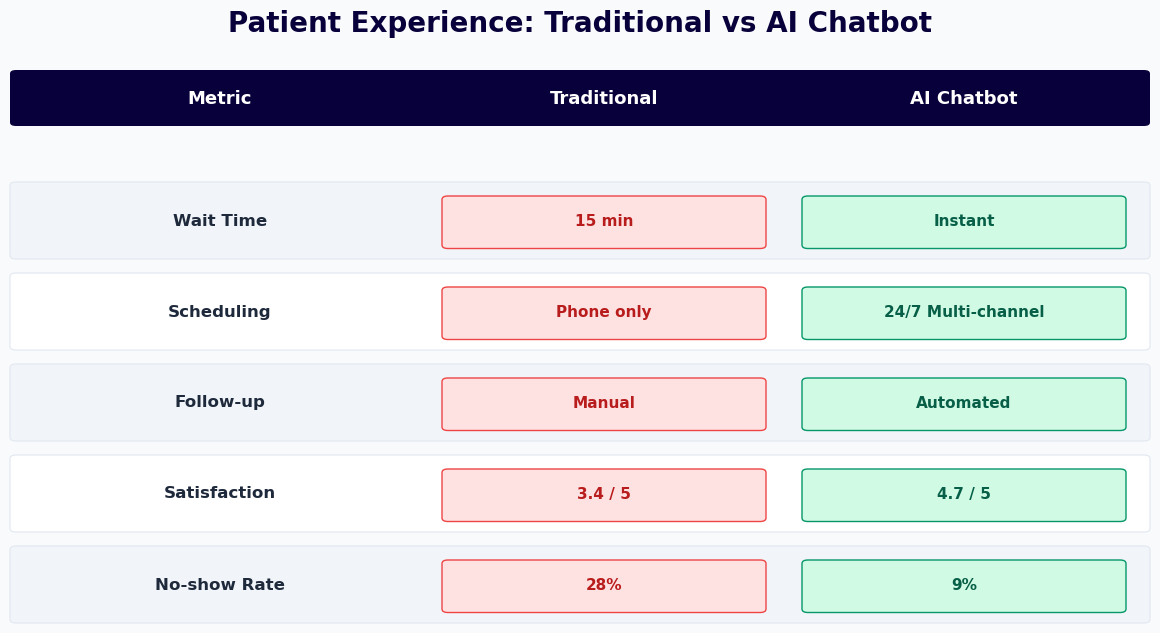
A healthcare chatbot is an AI-powered conversational agent that handles patient interactions across websites, mobile apps, and messaging platforms like WhatsApp and Messenger. Unlike a generic customer service bot, a healthcare chatbot is designed for the unique requirements of medical environments: sensitivity to patient anxiety, compliance with data protection regulations like HIPAA and GDPR, and the ability to triage conversations that require clinical judgment.
A well-designed healthcare chatbot takes pressure off your front desk by handling the repetitive, high-volume requests that fill the phone queue: appointment booking and rescheduling, after-hours symptom questions that need routing to the right level of care, and the same questions asked all day about visiting hours, insurance acceptance, directions, and lab result availability. Many practices adopt a chatbot to cut down on administrative phone volume, reduce appointment no-shows through automated reminders, and give patients faster answers outside office hours -- freeing nurses and front-desk personnel to focus on direct patient care.
With Conferbot's no-code chatbot builder, healthcare organizations can design, test, and deploy a patient-facing chatbot in a single afternoon. Our visual flow builder includes healthcare-specific templates for appointment scheduling, patient intake, symptom assessment, and billing inquiries. Combined with AI models like GPT and our NLP engine, your chatbot understands natural patient language and delivers empathetic, accurate responses around the clock.
This guide covers everything you need to know about building and deploying healthcare chatbots in 2026, from core use cases and compliance considerations to a worked illustrative example and step-by-step setup instructions.
Healthcare Chatbot Use Cases
Healthcare chatbots address real operational problems across the entire patient journey. Here are the most impactful use cases for hospitals, clinics, and private practices.
Appointment Scheduling and Management
Appointment scheduling is the single highest-volume interaction for most healthcare organizations. A chatbot lets patients browse available time slots, select a provider, choose a date and time, and confirm their appointment entirely through conversation -- on your website, WhatsApp, or any other channel. The bot syncs with your calendar system in real time, preventing double bookings and automatically sending confirmation and reminder messages. Timely reminders delivered via the patient's preferred messaging channel, combined with one-tap rescheduling, can help reduce no-shows by converting would-be missed appointments into rebooked ones.
Symptom Checking and Triage
Patients often need guidance on whether their symptoms warrant an emergency visit, an urgent care appointment, or a routine consultation. A symptom-checking chatbot walks patients through a structured series of questions about their symptoms, severity, duration, and medical history. Based on the responses, it provides triage recommendations and can directly book the appropriate type of appointment. This reduces unnecessary emergency room visits and ensures patients reach the right level of care faster.
Prescription Reminders and Refills
Medication adherence is a critical factor in patient outcomes, yet missed and delayed doses are a common, well-documented problem. A chatbot can send automated reminders at the right time each day, answer questions about dosage and side effects, and initiate prescription refill requests that are routed to the pharmacy. Patients can confirm they have taken their medication with a simple tap, creating an adherence log that providers can review.
Patient Onboarding and Intake
Collecting patient information before a visit -- insurance details, medical history, allergies, current medications, and consent forms -- traditionally requires paper forms or clunky portals. A chatbot transforms this into a conversational experience where patients provide information naturally, one question at a time. The collected data flows into your existing systems through webhooks or Zapier, reducing manual data entry and helping to shorten check-in times and waiting-room delays.
Billing and Insurance Inquiries
Billing questions account for a significant portion of inbound calls to healthcare organizations. A chatbot handles common inquiries like outstanding balance lookups, payment plan options, insurance coverage verification, and explanation of charges. For complex billing disputes, the bot collects relevant details and seamlessly transfers the conversation to a live billing specialist with full context.
Post-Visit Follow-Up
After a procedure or consultation, patients often have follow-up questions about recovery instructions, medication schedules, or warning signs to watch for. A chatbot delivers personalized post-visit care instructions, checks in on patient recovery at scheduled intervals, and escalates concerns to the clinical team when patients report troubling symptoms. This proactive outreach improves outcomes and reduces readmission rates.
Key Features for Healthcare Chatbots
A healthcare chatbot requires specialized capabilities beyond what a standard customer service bot provides. Here are the essential features that make a chatbot effective in clinical and administrative healthcare settings.
HIPAA-Conscious Design
Protecting patient health information (PHI) is non-negotiable. Conferbot encrypts conversation data in transit and at rest, and its architecture can be configured to support your compliance workflows -- for example, by using webhooks to route sensitive data straight to your own compliant systems rather than storing it on Conferbot. Conferbot does not by itself make your deployment HIPAA compliant: you should review your specific implementation with your compliance team and put a Business Associate Agreement (BAA) in place with any vendor that will handle PHI on your behalf.
Connect to Your Existing Tools
Your chatbot needs to fit into your existing healthcare IT setup. Conferbot's webhook and API integrations -- plus Zapier access to thousands of apps -- let you pass appointment data, intake responses, and patient inquiries to your EHR, practice management system, or billing platform without manual re-entry. (Conferbot connects through these generic integration points rather than shipping pre-built EHR-specific connectors.)
Multilingual Patient Support
Healthcare organizations serve diverse patient populations. Conferbot chatbots support multiple languages, allowing patients to interact in their preferred language. The bot detects the patient's language automatically and responds accordingly, ensuring equitable access to healthcare information regardless of language barriers.
24/7 Availability with Intelligent Escalation
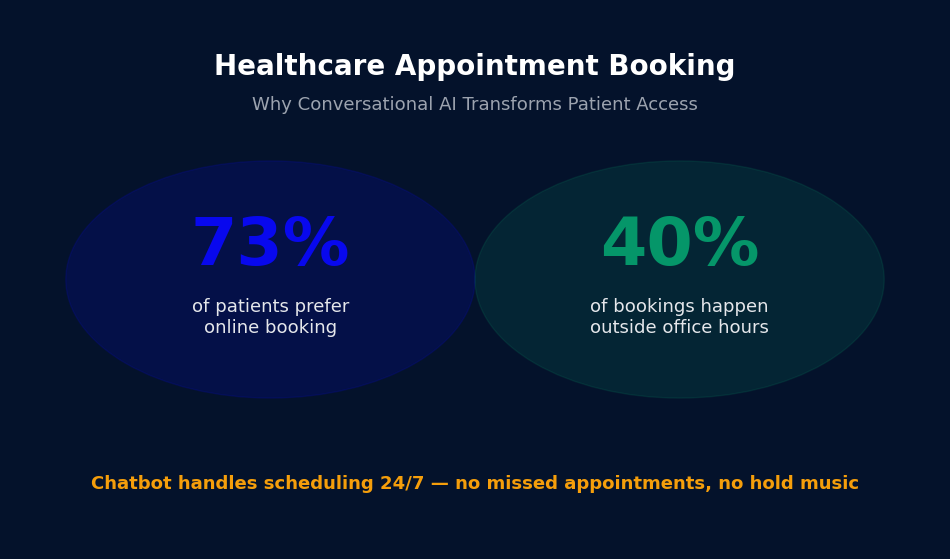
Patients do not get sick on a schedule. A healthcare chatbot provides round-the-clock support for common inquiries, appointment scheduling, and information requests. When a conversation requires clinical judgment or involves a potential emergency, the bot immediately escalates to the appropriate on-call staff or directs the patient to emergency services, using live chat handoff during business hours.
Empathetic Conversation Design
Healthcare conversations are inherently sensitive. Patients may be anxious, confused, or in pain. Conferbot's AI-powered responses are tuned for empathy and clarity, avoiding clinical jargon when speaking with patients and providing reassurance alongside factual information. The conversation tone adapts based on the context -- a billing inquiry receives a different tone than a symptom assessment.
Analytics and Reporting
Track every aspect of your healthcare chatbot's performance with Conferbot's analytics dashboard. Monitor metrics including conversation volume by category, appointment booking completion rates, patient satisfaction scores, average resolution time, and escalation frequency. Use these insights to continuously improve your bot's effectiveness and identify gaps in your patient communication.
| Feature | Benefit | Impact |
|---|---|---|
| Encrypted data handling | Protects patient health information | Regulatory compliance |
| EHR integration | Eliminates manual data entry | Staff time savings |
| Multilingual support | Serves diverse populations | Equitable access |
| 24/7 availability | Always-on patient support | Patient satisfaction |
| Smart escalation | Routes urgent cases to humans | Patient safety |
| Conversation analytics | Data-driven optimization | Continuous improvement |
How to Build a Healthcare Chatbot with Conferbot
Building a healthcare chatbot with Conferbot is straightforward, even without technical expertise. Follow these steps to go from zero to a live patient-facing chatbot.
Step 1: Define Your Primary Use Cases
Start by identifying the highest-volume patient interactions that consume your staff's time. For most healthcare organizations, appointment scheduling, billing inquiries, and general FAQs (visiting hours, location, accepted insurance) make up a large share of inbound communications. Begin with these use cases and expand over time.
Step 2: Choose Your Channels
Decide where your chatbot will be available. Most healthcare organizations start with their website and add messaging channels like WhatsApp and Messenger as patient demand grows. Conferbot's omnichannel platform lets you deploy the same bot logic across all channels from a single builder.
Step 3: Build Your Conversation Flows
Use Conferbot's visual flow builder to design conversation paths for each use case. Start with our healthcare-specific support templates and customize them for your organization. Add branching logic for different patient scenarios, configure appointment booking nodes that connect to your calendar, and set up escalation rules for situations requiring human intervention.
Step 4: Configure Integrations
Connect your chatbot to your existing systems using webhooks and API integrations. Link your appointment calendar, EHR or practice management system, and payment processing for billing inquiries. Conferbot's integration layer handles the data mapping between conversational inputs and your system's required fields.
Step 5: Train Your AI Model
If you are using AI-powered responses, upload your knowledge base -- patient handbooks, FAQ documents, care instructions, and policy information. The AI model learns from this content to answer patient questions accurately. You can also add custom training examples to improve the bot's handling of healthcare-specific terminology and patient phrasings.
Step 6: Test Thoroughly and Launch
Test every conversation path with realistic patient scenarios. Verify that appointments book correctly, escalation triggers work, and sensitive queries receive appropriate responses. Use Conferbot's preview mode to simulate conversations before going live. Once you are confident in the bot's performance, publish it to your selected channels and monitor the analytics dashboard closely during the first week.
ROI and Benefits of Healthcare Chatbots
A healthcare chatbot can pay off across operational efficiency, patient experience, and revenue protection. The exact impact depends on your patient volume, current no-show rate, and how much of your front-desk workload is repetitive -- so treat the figures below as an illustrative model to adapt with your own numbers, not a guarantee.
Operational Cost Savings
Routine questions -- visiting hours, accepted insurance, directions, balance lookups -- are expensive when a person answers each one and cheap when a chatbot does. The more of this repetitive volume you can deflect, the more time your staff get back for direct patient care. Conferbot's free plan covers 600 conversations per month, and paid plans add higher volume as your patient engagement grows.
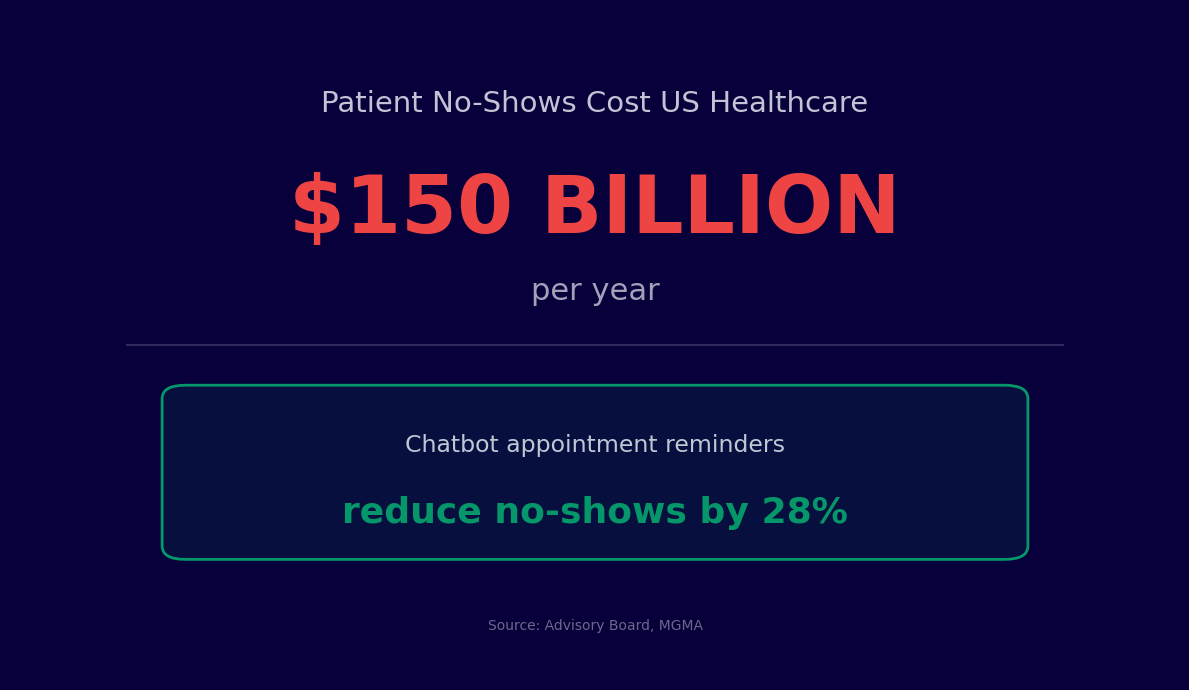
Reduced No-Show Rates
No-shows represent lost clinical time and lost revenue. Automated reminders delivered via the patient's preferred channel -- text, WhatsApp, or Messenger -- sent at sensible intervals before the appointment, together with one-tap rescheduling, can help convert would-be no-shows into rebooked visits. Measure your baseline no-show rate before launch so you can track the difference your chatbot actually makes.
Improved Patient Experience
Patients value convenience in non-clinical interactions. A chatbot that lets them book an appointment at 11 PM, ask a billing question on a Sunday, or check lab result availability without waiting on hold can meaningfully improve how patients experience your practice between visits.
Faster Patient Intake
Converting paper or portal intake forms into conversational flows lets patients complete intake before they arrive. That can mean less time in the waiting room, less manual data entry for staff, and fewer transcription errors at check-in.
Revenue Protection
Every unanswered call from a prospective patient is potential revenue walking out the door. A chatbot makes sure inquiries get a response regardless of the time of day, capturing and qualifying leads on your website and messaging channels even when your front desk is closed.
Illustrative example (your figures will differ): imagine a clinic with 1,000 booked appointments a month and a 20% no-show rate -- that is 200 missed visits. If reminders and easy rescheduling recovered even a quarter of those, that would be roughly 50 visits a month brought back onto the calendar. Plug in your own appointment volume, no-show rate, and average visit value to estimate the impact for your practice.
| Area | Where a chatbot can help | What to measure |
|---|---|---|
| Routine inquiries | Deflects repetitive FAQ and billing questions | % of conversations resolved without staff |
| No-shows | Automated reminders and one-tap rescheduling | No-show rate before vs after launch |
| Patient experience | 24/7 self-service for non-clinical tasks | Your own patient feedback / survey scores |
| Intake | Pre-visit conversational forms | Check-in time and data-entry workload |
| After-hours leads | Captures inquiries when the desk is closed | Leads captured outside office hours |
This table describes where a chatbot may help and how to measure it; it does not promise specific results.
Compliance and Data Security
Healthcare data is among the most regulated categories of personal information worldwide. Any chatbot handling patient interactions must be built with compliance as a foundational requirement, not an afterthought.
HIPAA Considerations
The Health Insurance Portability and Accountability Act (HIPAA) governs how protected health information (PHI) is collected, stored, transmitted, and accessed in the United States. When deploying a healthcare chatbot, organizations must ensure that conversation data containing PHI is encrypted both in transit (TLS 1.2+) and at rest (AES-256), access to patient data is restricted through role-based controls, audit logs track every access to PHI, and business associate agreements (BAAs) are in place with all vendors handling PHI.
Conferbot is not, by itself, a HIPAA-compliant or HIPAA-certified product, and using it does not automatically make your deployment compliant. What Conferbot offers is HIPAA-conscious building blocks -- encrypted data handling in transit and at rest, and the ability to use webhooks so PHI can be routed to your own compliant systems rather than stored on Conferbot. Healthcare organizations should review their specific implementation with their own compliance team and sign a Business Associate Agreement (BAA) with any vendor that will handle PHI before processing protected health information.
GDPR Compliance
For healthcare organizations serving patients in the European Union, GDPR adds additional requirements including explicit consent for data processing, the right to access and delete personal data, data minimization principles, and transparent privacy notices. Conferbot's platform includes consent management, data export, and data deletion capabilities to support GDPR compliance.
Data Security Best Practices
- Minimize data collection -- Only collect patient information that is necessary for the chatbot's function. Do not ask for Social Security numbers, full medical histories, or other sensitive data unless absolutely required.
- Set data retention policies -- Define how long conversation data is stored and configure automatic deletion after the retention period expires.
- Regular security audits -- Review chatbot access logs, integration security, and data handling processes on a regular schedule.
- Staff training -- Ensure that staff members who access chatbot conversation data understand their compliance obligations.
- Patient transparency -- Clearly inform patients when they are interacting with a chatbot versus a human, and explain how their data will be used.
For detailed information on how Conferbot handles data security, visit our pricing and plans page which outlines security features included at each tier.
Get Started with Healthcare Chatbots Today
Healthcare organizations of every size are using chatbots to improve patient experience, reduce administrative burden, and protect revenue. Whether you run a multi-location hospital system or a single-provider private practice, Conferbot makes it simple to get started.
Launch in 3 Steps
- Sign up for free at app.conferbot.com/signup -- no credit card required. The free plan includes website chatbot deployment and 600 monthly conversations.
- Choose a healthcare template from our template library, or build a custom flow with our visual builder. Templates for appointment scheduling, patient intake, and FAQ are ready to customize.
- Deploy across your channels -- Publish your bot on your website, WhatsApp, Messenger, and more from a single dashboard.
Why Healthcare Organizations Choose Conferbot
- No code required -- Clinical and administrative staff can build and modify chatbots without IT involvement using our drag-and-drop builder
- AI-powered understanding -- OpenAI integration and NLP enable natural patient conversations
- Omnichannel deployment -- One bot works across your website, WhatsApp, Messenger, and other channels
- Seamless human handoff -- Live chat ensures complex cases reach the right staff member
- Actionable analytics -- Built-in analytics show patient interaction patterns and bot performance
- Scalable and affordable -- Start free and scale as your patient engagement grows. See all plans
Explore how chatbots are transforming other industries too: e-commerce, real estate, education, hospitality, HR, technology, and insurance.
Create your free healthcare chatbot now and see how Conferbot can transform your patient engagement in 2026.
Healthcare FAQ
Everything you need to know about chatbots for healthcare.
Chatbots for Other Industries
Discover how businesses in other industries use AI chatbots to automate support, capture leads, and grow.
Continue Exploring
Explore features, connect third-party tools, and browse ready-made templates.
Deep-dive pillar guides, real use cases, and the chatbot & AI glossary.