Why Music Schools Need AI Chatbots in 2026
The music education industry in the United States is a $3.5 billion market serving approximately 12 million active music students, according to NAMM (National Association of Music Merchants) research data. The market spans private lesson studios, community music schools, conservatory preparatory programs, rock/pop performance schools, and online lesson platforms. Despite this scale, the typical music school operates with remarkably thin administrative infrastructure -- often a single receptionist or school owner handling enrollment, scheduling, billing, parent communication, recital coordination, and instrument rentals alongside their own teaching responsibilities.
The enrollment process at most music schools highlights the operational bottleneck. A parent interested in piano lessons for their 8-year-old calls the school during teaching hours -- when every instructor is in a lesson and the receptionist (if one exists) is managing student check-ins, processing payments, and answering questions from parents in the lobby. The call goes to voicemail. The parent, exploring multiple options, calls the next school on their list. Music Teachers Helper, a leading studio management platform, reports that the average music school responds to enrollment inquiries in 18-24 hours -- an eternity in a market where motivated parents are comparing 3-5 schools simultaneously.
An AI chatbot transforms this enrollment funnel. It engages prospective families immediately, assesses the student's instrument interest, age, experience level, and goals, matches them to the ideal instructor based on multiple compatibility factors, presents available lesson times, and books a trial lesson -- all within a single conversation that takes 3-4 minutes. For the music school owner who currently spends 10-15 hours per week on administrative tasks that do not involve teaching, the chatbot recovers time that can be redirected toward curriculum development, instructor mentorship, or simply a more sustainable work-life balance.
This guide covers the complete chatbot implementation for music schools: intelligent instructor matching, instrument-specific scheduling, enrollment conversion, practice reminders, recital coordination, instrument rental management, and a detailed ROI model. Whether you operate a single-instrument private studio, a multi-instrument community music school, or a performance-focused academy, this playbook provides the framework to grow enrollment and streamline operations through AI chatbot deployment.
The Music Teachers National Association (MTNA) emphasizes that instructor quality and student-teacher fit are the primary factors in student retention. The competitive landscape in music education is intensifying. Online lesson platforms like Lessonface, Fender Play, and Simply Piano have made music instruction accessible and convenient, setting a digital-first expectation that traditional brick-and-mortar schools must meet. Simultaneously, parents are more discerning about instructor quality and student-teacher fit, making the matching process more critical than ever. A chatbot enables music schools to compete on both convenience (instant booking) and quality (intelligent matching) -- the two factors that drive enrollment decisions in 2026.
Intelligent Instructor Matching: The Core Differentiator
The most impactful capability of a music school chatbot is intelligent instructor matching -- the process of pairing a new student with the teacher most likely to create a successful, long-term learning relationship. Poor student-teacher matching is the leading cause of early dropout in music education. A shy 6-year-old paired with a classically rigorous instructor, or an adult rock guitarist paired with a jazz specialist, creates friction that leads to disengagement within the first 1-3 months. The chatbot eliminates this mismatch by systematically assessing compatibility factors before the first lesson.
The Matching Algorithm
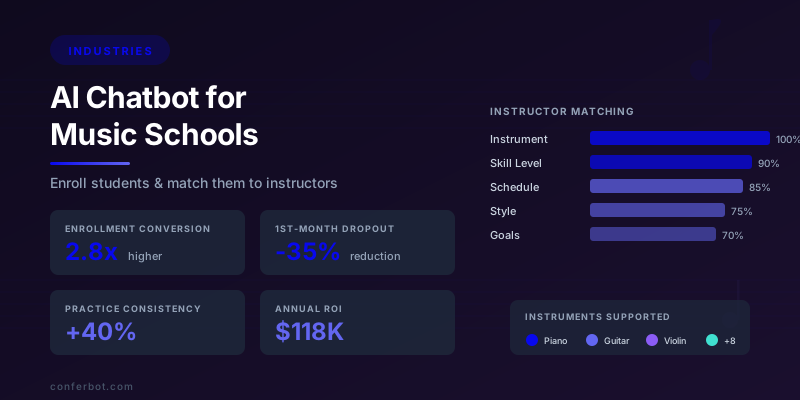
The chatbot evaluates six dimensions of student-instructor compatibility:
- Instrument expertise: The obvious starting point -- a piano student needs a piano teacher. But in multi-instrument studios, some instructors teach multiple instruments with varying proficiency. The chatbot routes students to instructors whose primary instrument matches the student's interest.
- Skill level alignment: A Suzuki-trained instructor who specializes in beginners ages 3-7 is not the right match for a high school student preparing conservatory auditions. The chatbot assesses the student's current level and matches them to instructors who specialize in that developmental stage.
- Age and teaching style: Some instructors excel with young children through patience and playfulness; others thrive with teens and adults through structured goal-setting and advanced repertoire. The chatbot considers the student's age and the instructor's teaching style strength.
- Musical goals: A student who wants to play pop songs at family gatherings has different needs than one aiming for state-level competition. The chatbot asks about goals: "What does [Student Name] want to achieve with piano? Options include: playing favorite songs for fun, building a strong classical foundation, preparing for competitions or auditions, or exploring songwriting and improvisation."
- Schedule compatibility: The best instructor match is useless if they have no availability during the student's preferred lesson times. The chatbot cross-references student scheduling preferences with instructor availability to present only viable matches.
- Personality indicators: The chatbot collects subtle preference data: "Does [Student Name] learn best with lots of encouragement and praise, or with clear structure and defined expectations?" These indicators help match personality types -- a crucial factor that traditional enrollment processes rarely assess.

The Impact on Student Retention
Music schools that implement chatbot-driven instructor matching report a 35% reduction in first-month dropout compared to random or availability-based assignment. The first month is the critical retention period -- students who pass the one-month mark have an 80% probability of continuing for at least 6 months. By improving the initial match, the chatbot dramatically impacts long-term student lifetime value.
The matching process also improves instructor satisfaction and retention. Teachers who consistently receive well-matched students experience higher teaching satisfaction, fewer difficult lessons, and better student outcomes -- all factors that reduce instructor turnover, which is one of the most disruptive and expensive events for a music school. The education chatbot methodology demonstrates how intelligent matching drives retention across learning environments.
Trial Lesson Optimization
After matching, the chatbot books a trial lesson and prepares both parties. The student/parent receives: "[Student Name]'s trial piano lesson is with [Instructor Name] on [Date] at [Time]. [Instructor Name] specializes in young beginners and uses a play-based approach that makes learning fun from the first note. Please arrive 5 minutes early. No instrument needed -- we have studio pianos available." The instructor receives the student profile: age, experience, goals, and personality indicators. This preparation ensures the trial lesson is optimized for conversion -- the instructor can tailor the first lesson to the student's interests and goals rather than spending the session figuring out what the student wants.
Instrument-Specific Scheduling and Room Management
As documented by platforms like MyMusicStaff and Fons scheduling software, music school scheduling is uniquely complex compared to other appointment-based businesses. Lesson durations vary by instrument and level (piano beginners take 30-minute lessons, advanced students take 60-minute lessons), group classes have different sizes and requirements (a guitar ensemble needs 6 chairs and stands; a choir rehearsal needs a larger room with a piano), and studios must manage room assignments to prevent acoustic conflicts (a drum lesson next to a violin lesson creates mutual disruption).

Multi-Duration Lesson Scheduling
The chatbot handles variable lesson durations based on instrument, student age, and skill level:
- Beginner children (ages 4-7): 30-minute private lessons -- optimal attention span for young learners
- Intermediate children (ages 8-12): 30 or 45-minute lessons based on parent preference and progress trajectory
- Teens and adults: 45 or 60-minute lessons -- longer sessions enable deeper technical work and repertoire coverage
- Advanced/pre-collegiate: 60 or 90-minute lessons for students preparing auditions or competitions
When a family enrolls, the chatbot recommends the appropriate lesson duration: "For a beginning 6-year-old pianist, we recommend 30-minute lessons twice per week. At this age, two shorter sessions are more effective than one longer session. As [Student Name] progresses, we can extend to 45-minute lessons." This recommendation builds trust by demonstrating pedagogical knowledge rather than simply upselling the longest (most expensive) lesson format.
Studio Room Assignment
For schools with multiple teaching studios, the chatbot manages room assignment based on instrument requirements. A piano lesson requires a room with a piano. A drum lesson requires a soundproofed room. A voice lesson needs a room with a piano for accompaniment and adequate acoustics. A violin lesson requires a quiet room away from percussion. The chatbot tracks room availability alongside instructor availability, ensuring that when a lesson time is booked, the appropriate room is also reserved.
Group Class and Ensemble Scheduling
Beyond private lessons, music schools offer group classes (music theory, ear training, early childhood music), ensembles (rock bands, jazz combos, string quartets, orchestras), and supplementary programs (recital prep workshops, summer intensives). The chatbot presents these options to students at the appropriate stage of their development: "[Student Name] has been taking private guitar lessons for 6 months and is doing great! Many students at this level enjoy joining our Rock Band Workshop on Saturdays -- it is a great way to apply skills in a group setting and learn to play with others. The next session starts [Date]. Would you like to sign up?"
Recurring Schedule Management
Music lessons are typically recurring weekly appointments -- same day, same time, same instructor, same room. The chatbot manages this recurring schedule and handles the inevitable exceptions: holiday breaks, instructor absences, and student vacation holds. When an instructor is unavailable, the chatbot can offer a substitute instructor, a makeup lesson at an alternative time, or a credit: "[Instructor Name] is unavailable for [Student Name]'s lesson on [Date]. Would you prefer: (1) a lesson with [Substitute Instructor], who also teaches [Instrument] and has an excellent reputation, (2) a makeup lesson on [Alternative Date/Time], or (3) a credit applied to your account?" This automated exception handling eliminates the hours of phone calls that studios currently spend rescheduling around instructor absences. For comprehensive scheduling automation, the chatbot manages every dimension of music school operations.
Practice Reminders That Improve Student Progress and Retention
According to research published by the National Association for Music Education (NAfME), the single greatest predictor of student retention in music education is practice consistency. Students who practice regularly make audible progress, which reinforces motivation and commitment. Students who do not practice stagnate, become frustrated, and eventually drop out. The challenge is that practice accountability traditionally falls entirely on the parent -- and busy parents, despite good intentions, frequently forget to encourage or monitor daily practice.

How Practice Reminders Work
The chatbot sends age-appropriate practice reminders to students (for teens with their own phones) or parents (for younger children) based on the instructor's practice assignment:
For young children (ages 4-8): Messages are directed to parents with encouraging, specific guidance: "Time for [Pet Name]'s piano practice! Today's focus: play 'Twinkle Twinkle Little Star' hands separately 3 times each. Try to keep a steady beat! Tip: Use a timer and make it a fun 10-minute challenge." The specificity helps parents who may not know what their child should be practicing.
For older children (ages 9-14): Messages can be directed to the student with motivational framing: "Hey [Student Name]! Your guitar practice for today: work on the chord changes in 'Blackbird' -- aim for smooth transitions between G and A minor. 15 minutes of focused practice makes a huge difference! Your next lesson is in 3 days."
For teens and adults: Messages focus on accountability and progress tracking: "Practice reminder: Work on the Chopin Nocturne measures 17-32 with the metronome at quarter note = 72. Log your practice time when you are done!"
Practice Logging
The chatbot enables students to log practice sessions: "Great work! How many minutes did you practice today?" The accumulated practice data provides the instructor with visibility into practice habits between lessons and gives parents a weekly practice summary: "[Student Name] practiced 4 times this week for a total of 85 minutes. That is above the recommended 80 minutes for [his/her] level -- great consistency!" Or, when practice is falling short: "[Student Name] practiced once this week for 15 minutes. For optimal progress at [his/her] level, we recommend 4 practice sessions of 20 minutes each. Would you like tips on building a consistent practice routine?"
The Retention Impact
Music schools implementing chatbot practice reminders report a 40% improvement in practice consistency and a corresponding 28% improvement in 12-month student retention. The mechanism is clear: more practice leads to faster progress, faster progress leads to greater enjoyment, and greater enjoyment leads to longer enrollment. For a school with 200 students at $160/month average tuition, a 28% improvement in retention translates to approximately 18 additional student-months per month, or $34,560 in annual incremental revenue.
The practice data also improves lesson quality. Instructors who know a student practiced 5 times this week can plan an ambitious lesson that builds on solid preparation. Instructors who know a student did not practice at all can adjust the lesson to review and reinforce rather than introduce new material. This data-driven lesson planning improves the student experience regardless of practice volume and demonstrates the teacher's attentiveness to the student's individual journey.
Recital and Performance Event Coordination
Recitals are the most anticipated and most administratively demanding events in a music school's calendar. A typical recital involves 30-60 performing students, each with specific performance pieces, stage time requirements, and accompanying families. The logistics include program creation, performance order scheduling, rehearsal coordination, guest seating, photography/videography, and post-event communication. Without automation, a single recital consumes 15-20 hours of administrative work over the 4-6 weeks leading up to the event.
Recital Registration Automation
The chatbot manages the entire recital registration process. Six weeks before the event, it contacts all eligible students: "Our Winter Recital is Saturday, December 14 at 3:00 PM at [Venue]. Would [Student Name] like to perform? [He/She] has been working on [Piece Name] and it would be wonderful to hear it on stage!" The personalized mention of the student's current repertoire demonstrates that the chatbot is aware of the student's progress -- a touch that builds trust with parents.
For students who register, the chatbot collects required information: performance piece(s), estimated duration, accompaniment needs (some students need a piano accompanist; others perform solo), any special requirements (music stand, specific seating for instruments), and the number of guests attending. This structured data collection eliminates the back-and-forth emails that consume admin time during recital preparation.
Program and Schedule Generation
Using the collected registration data, the chatbot assists in generating the performance order. Recital programming follows conventions: younger students typically perform first (shorter attention spans), pieces are grouped to create musical variety, and the program builds in complexity toward the end. The chatbot proposes a program order based on student age, instrument, and piece duration, which the director can review and adjust. Once finalized, it distributes the program to all participants: "The recital program is set! [Student Name] performs 7th of 32 performers, at approximately 3:25 PM. [His/Her] piece: [Title] by [Composer]. Please arrive by 2:30 PM for warm-up."
Rehearsal Coordination
For students performing with accompanists or in ensembles, the chatbot schedules rehearsals by matching student and accompanist availability. It also sends preparation reminders in the weeks leading up to the recital: "Recital in 2 weeks! Make sure [Student Name] is practicing the performance piece daily. Tip: Practice performing the piece from memory (if memorized) for family members at home -- this builds confidence for the stage."
Post-Recital Follow-Up
After the recital, the chatbot sends congratulations messages with professional photos (if available): "Congratulations to [Student Name] on a wonderful recital performance! [He/She] played beautifully. Here is a link to the recital photos and video: [Link]. We are so proud of [his/her] progress!" This celebratory communication reinforces the emotional value of music education and gives parents sharable content for social media -- organic marketing for the school. The chatbot can also prompt for Google reviews during this moment of high satisfaction, following the lead generation and review methodology that drives local business growth.
Instrument Rental Management: A Revenue Stream and Enrollment Enabler
Instrument rental is both a practical necessity for new students and a significant revenue opportunity for music schools. Many parents are reluctant to purchase a $500-$2,000 instrument for a child who might lose interest after two months. Offering rentals removes this financial barrier to enrollment and creates a recurring revenue stream that averages $35-$65 per month per rental, depending on the instrument.

Rental Integration in the Enrollment Flow
The chatbot presents rental options naturally during the enrollment conversation. When a new student enrolls for guitar lessons and the chatbot asks about instrument availability, a parent who does not yet own an instrument sees: "No guitar at home? No problem! We offer quality student guitars for rent at $45/month, which includes a gig bag, tuner, and picks. If you decide to purchase within 6 months, 50% of your rental payments apply toward a new instrument from our partner shop. Would you like to add a rental to [Student Name]'s enrollment?"
Inventory Tracking and Availability
The chatbot tracks the rental inventory in real-time: available instruments by type and size (a 1/2 size violin for a 6-year-old, a full-size violin for a teen), instruments currently rented, return dates, and maintenance status. When a specific instrument size is unavailable, the chatbot manages the waitlist: "We are currently out of 3/4-size cellos. Would you like to join the waitlist? We expect one to become available within 2-3 weeks. In the meantime, [Student Name] can use a studio cello during lessons."
Size Upgrades and Transitions
String instruments (violin, viola, cello, bass) and guitars come in multiple sizes based on the student's age and physical dimensions. As students grow, they need larger instruments. The chatbot tracks student growth milestones and proactively suggests upgrades: "[Student Name] has been playing a 1/2-size violin for 8 months. At age 9, many students are ready to move up to a 3/4-size instrument. We have 3/4-size violins available for the same monthly rental rate. Would you like to schedule a sizing with [Instructor Name]?"
Rent-to-Own Programs
The chatbot manages rent-to-own programs that incentivize long-term commitment. When a rental customer reaches the 6-month mark: "You have been renting [Student Name]'s guitar for 6 months and have paid $270 in rental fees. Our rent-to-own program applies 50% of those payments ($135) toward the purchase of a new instrument. We partner with [Music Store] to offer quality student instruments starting at $299 -- with your rental credit, you would pay just $164. Would you like more information?" This conversion from rental to purchase deepens the family's investment in music education (literally and figuratively) and frees up the rental instrument for the next new student.
Revenue Impact
For a music school with 200 students, if 25% are renting instruments at an average of $50/month, the rental program generates $30,000 in annual revenue. More importantly, the rental program removes the primary enrollment barrier for families who would otherwise delay starting lessons until they could afford an instrument purchase. Schools that add chatbot-managed rental programs report 15-20% higher enrollment conversion rates among families with no existing instrument -- a population that represents approximately 40% of all new inquiries. The Conferbot pricing makes this automation accessible to studios of any size.
Semester Enrollment Drives and Seasonal Retention Strategies
Music schools operate on a semi-annual enrollment cycle that creates predictable revenue peaks and valleys. September and January are the two primary enrollment windows, driven by back-to-school energy and New Year resolution motivation respectively. Summer presents a retention challenge as families travel and students lose practice momentum. The chatbot manages these seasonal dynamics with targeted campaigns that maximize enrollment during peak windows and minimize attrition during vulnerable periods.
Back-to-School Enrollment Campaigns
Starting in mid-August, the chatbot activates a multi-touch enrollment campaign targeting three distinct audiences: families who previously inquired but did not enroll, current students who may want to add a second instrument or group class, and new prospects discovering the school for the first time.
For previous inquiries, the chatbot sends personalized re-engagement: "Hi [Parent Name]! You inquired about piano lessons for [Child Name] last spring. Our fall semester starts September 8, and [Instructor Name] still has openings on the days you were interested in. Would you like to schedule a trial lesson before classes begin?" This targeted re-engagement converts 15-20% of dormant leads into enrolled students -- leads that would otherwise be permanently lost.
For current students, the chatbot promotes program expansion: "[Student Name] has made wonderful progress in piano this year! Many of our piano students also enjoy our Music Theory class (Saturdays at 11:00 AM) -- it deepens their understanding of what they are playing and accelerates progress. Would you like to add Theory to [his/her] fall schedule?" Cross-enrollment suggestions increase per-student revenue while improving the student experience through a more comprehensive music education.
Summer Retention Programs
Summer is the highest-risk period for student attrition. Families travel, routines are disrupted, and the momentum built during the school year can evaporate over 10-12 weeks of reduced practice. The chatbot manages summer retention through several strategies:
- Summer schedule flexibility: "We understand summer schedules are different! For June through August, we offer flexible lesson scheduling -- swap your regular weekly slot for any available time that week. Just message me to reschedule." This flexibility prevents the all-or-nothing choice between maintaining a rigid schedule and pausing entirely.
- Summer intensive programs: "Our Summer Music Intensive runs July 14-25: two weeks of daily group classes, private lessons, and a showcase performance. Perfect for students who want to accelerate their progress while having fun with peers. Registration is (current students save 20%)."
- Practice challenges: "Join our Summer Practice Challenge! Log 20 practice sessions this summer and earn a free month of lessons. Track your progress right here through our chatbot." Gamified challenges maintain engagement when external motivation (school year structure) is absent.
Music schools that implement chatbot-managed summer retention programs report 22% lower summer attrition compared to schools that simply offer a pause option. The key insight is that most summer dropouts are not intentional -- families fully intend to resume in fall but gradually disengage as the gap lengthens. The chatbot prevents this drift by maintaining regular, valuable touchpoints throughout the summer months.
January New Year Enrollment Push
January represents the second-largest enrollment window, driven by New Year resolutions and parents seeking enrichment activities for the new calendar year. The chatbot capitalizes on this window with targeted campaigns to its contact list and website visitors: "New Year, new skill! 2026 is the perfect time to start music lessons. Our spring semester begins January 13. Book a free trial lesson this week and discover the joy of making music." For adult learners specifically, the resolution framing is particularly effective: "Make 2026 the year you finally learn guitar. Our adult beginner program is designed for busy professionals -- just 30 minutes per week to start. No experience needed."
The chatbot also facilitates referral campaigns during enrollment peaks: "Love your experience at [School Name]? Refer a friend who enrolls in January and you both receive a tuition credit. Share your unique referral link: [Link]." Referral-acquired students have 30% higher retention rates than advertising-acquired students, making this the most cost-effective acquisition channel during enrollment drives. Tracking these campaigns through the analytics dashboard enables continuous optimization of enrollment messaging and timing.
ROI Analysis: AI Chatbot for Music Schools
The ROI for a music school chatbot operates across six revenue dimensions. We model a mid-size community music school: 200 active students, 15 instructors, $160/month average tuition, 400 monthly website visitors.
Revenue Stream 1: Improved Enrollment Conversion -- $38,400/year
Increasing website-to-trial conversion from 8% to 22% on 400 monthly visitors generates approximately 67 additional trial students per year. At 60% trial-to-enrollment conversion and $160/month tuition:
- 67 trials x 60% conversion x $160/month x average 6-month initial retention = $38,400
Revenue Stream 2: Practice-Driven Retention -- $34,560/year
Practice reminders improve 12-month retention by 28%, retaining approximately 18 additional student-months per month:
- 18 student-months x $160/month x 12 months = $34,560
Revenue Stream 3: Instrument Rental Revenue -- $30,000/year
50 students renting instruments at $50/month average:
- 50 rentals x $50/month x 12 months = $30,000
Revenue Stream 4: Reduced First-Month Dropout -- $8,064/year
Intelligent instructor matching reduces first-month dropout by 35%, saving approximately 4.2 students per month:
- 4.2 students x $160/month x 12 months x 35% save rate = $8,064 annualized
Revenue Stream 5: Group Program Enrollment -- $5,760/year
Chatbot promotion of group classes and ensembles to existing students generates 3 additional group enrollments per month at $80/month:
- 3 x $80/month x 12 months x 2 semesters = $5,760
Revenue Stream 6: Administrative Time Savings -- $1,500/year
Recital coordination, schedule management, and inquiry handling saves 8-12 hours per week of admin time. Valued at $18/hour:
- 10 hours x $18 x 50 weeks = $9,000 in labor value (or recovered teaching revenue if the owner reinvests time in teaching)
- Conservative attribution: $1,500 directly to chatbot
Total Annual ROI
| Revenue Stream | Annual Value |
|---|---|
| Improved enrollment conversion | $38,400 |
| Practice-driven retention | $34,560 |
| Instrument rental revenue | $30,000 |
| Reduced first-month dropout | $8,064 |
| Group program enrollment | $5,760 |
| Administrative time savings | $1,500 |
| Total | $118,284 |
Against a chatbot platform cost of $1,200-$1,800/year, the ROI exceeds 7,800%. The instrument rental revenue alone covers the chatbot cost 20x over.
Implementation Guide: Deploying a Music School Chatbot
Deploying a music school chatbot follows a structured 7-day process using Conferbot's no-code builder.
Day 1-2: School Configuration and Instructor Profiles
Start with the education template and customize it with your school information: name, location(s), instruments taught, and program structure. Build instructor profiles with their instruments, teaching specialties, student age preferences, teaching style descriptions, and weekly availability. These profiles power the intelligent matching system. Upload photos and brief bios for each instructor -- parents want to see who will be teaching their child.
Day 3-4: Scheduling and Program Setup
Enter your complete lesson schedule: private lesson availability by instructor, group class schedules, ensemble rehearsal times, and studio room assignments. Configure lesson duration options by instrument and level. Set up the instrument rental inventory with types, sizes, quantities, and monthly pricing. Build the recital registration template with your typical performance season dates.
Day 5: Practice Reminders and Automation
Configure the practice reminder system: frequency (daily or specific practice days), messaging style by age group, and practice logging prompts. Set up the enrollment follow-up sequence for trial-to-enrollment conversion. Configure automated semester-start and schedule-change communications.
Day 6-7: Testing and Launch
Test the enrollment flow for your most common scenarios: beginner child piano, intermediate teen guitar, adult voice lessons, family enrollment with multiple instruments. Verify instructor matching, schedule accuracy, and rental integration. Deploy across your website, Google Business Profile, Facebook page, and Instagram (where many music schools showcase student performances). The website chatbot serves as your primary enrollment channel.
Best Practices for Music School Chatbots
- Showcase student success stories: Include video clips or quotes from successful students in the chatbot flow. "Here is [Student Name], who started piano with us at age 7 and just won the state piano competition at age 12" is more compelling than any feature description.
- Address the practice concern upfront: Parents worry their child will not practice. The chatbot should proactively explain the practice support system: "We know practice can be challenging! Our automated practice reminders, instructor-assigned practice plans, and progress tracking help keep students motivated and on track."
- Handle the 'too old to start' objection: Adult learners frequently hesitate, believing they are too old. The chatbot should address this: "It is never too late to start! 30% of our students are adults, and our instructors specialize in making the learning process enjoyable at any age."
- Promote recitals as milestones: Frame performance opportunities as motivational milestones, not obligations: "Our twice-yearly recitals are optional but highly encouraged -- 92% of our students participate, and it is the highlight of the semester for students and families alike."
- Track the enrollment-to-6-month metric: The percentage of enrolled students who are still active at 6 months is the most predictive metric for music school health. Feed this data into your analytics dashboard for continuous optimization of instructor matching and practice support.
Music education transforms lives, and every inquiry that goes unanswered is a student who may never discover their musical potential. The chatbot ensures that no inquiry is missed, every student is matched to the right teacher, and the administrative burden that prevents school owners from focusing on education is handled automatically. The result is a school that grows enrollment, retains students longer, and delivers a better experience for students, parents, and instructors alike.
Was this article helpful?
AI Chatbot for Music Schools FAQ
Everything you need to know about chatbots for ai chatbot for music schools.
About the Author
Conferbot Team specializes in conversational AI, chatbot strategy, and customer engagement automation. With deep expertise in building AI-powered chatbots, they help businesses deliver exceptional customer experiences across every channel.
View all articles