The New Patient Pipeline Problem in Chiropractic Care
The chiropractic profession is growing, but so is the competition for new patients. According to the American Chiropractic Association (ACA), there are over 70,000 licensed chiropractors practicing in the United States, generating an estimated $19.5 billion in annual industry revenue. The Bureau of Labor Statistics (BLS) projects chiropractic employment to grow 10% through 2032, faster than the average for all occupations. Yet despite this growth, the average solo chiropractic practice faces a persistent challenge: converting website visitors and phone inquiries into new patients who actually show up for their first appointment.
The typical chiropractic office receives between 30 and 60 phone calls per day. Industry practice management data shows that 35% of inbound calls to chiropractic offices go unanswered during peak treatment hours when the chiropractor and staff are with patients. Each unanswered call from a prospective new patient represents potential revenue of $1,200-3,500 in first-year patient value when you factor in the initial exam, X-rays, treatment plan, and recurring adjustment visits. For a practice that misses just 3 new patient calls per week, that is $187,000-546,000 in lost annual revenue potential.
The challenge is amplified by the nature of chiropractic patient acquisition. Most new chiropractic patients are experiencing acute pain, back pain, neck pain, headaches, or injury symptoms, and they are searching for help right now. Research on healthcare consumer behavior shows that 62% of patients book with the first provider who responds to their inquiry. If your office does not answer the phone at 7 PM when a patient Googles "chiropractor near me" while dealing with back pain, they will call the next practice on the list.
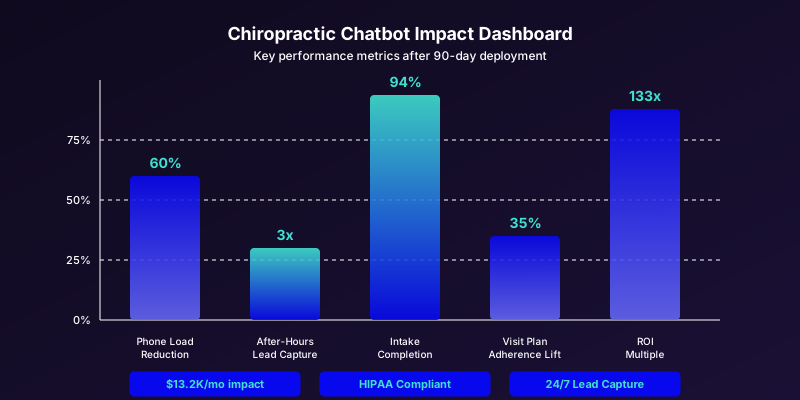
AI chatbots solve this problem completely. A chiropractic chatbot operates 24 hours a day, 365 days a year, qualifying new patient leads, collecting intake information, scheduling first appointments, answering treatment and insurance questions, and sending recurring visit reminders without adding staff or interrupting patient care. Chiropractic practices using Conferbot report a 60% reduction in phone volume, 3x more after-hours lead captures, and 35% higher recurring visit adherence. For a broader perspective on healthcare chatbot applications, see our comprehensive healthcare chatbot guide.

This guide covers every aspect of deploying an AI chatbot for a chiropractic office, from new patient qualification and intake automation to treatment plan communication and insurance verification, with specific ROI data, conversation flows, and implementation timelines for practices of every size.
New Patient Qualification: Converting Website Visitors Into Booked Appointments
Not every website visitor is a qualified chiropractic patient. Some are looking for a massage therapist, some have conditions that require medical referral first, and some are price-shopping without intent to book. A chatbot qualifies new patients through a structured conversation that determines fit, urgency, and readiness to schedule, all while providing a helpful and professional experience that reflects your practice's brand.
The Qualification Conversation Flow
When a new visitor lands on your website, the chatbot initiates engagement after a brief delay:
"Welcome to Peak Performance Chiropractic! I'm here to help you get started. Are you a new patient looking for help with pain or an injury, or are you an existing patient with a question?"
For new patients, the qualification flow proceeds through these stages:
Stage 1: Chief Complaint Assessment
"What's bringing you in? I can help with: back pain, neck pain, headaches or migraines, sciatica or leg pain, auto accident injury, work injury, sports injury, or general wellness and posture concerns. Which best describes your situation?"
Stage 2: Duration and Severity
"How long have you been experiencing this? And on a scale of 1-10, how would you rate your current pain level? This helps Dr. Martinez prioritize your care."
Stage 3: Previous Treatment
"Have you seen a chiropractor before for this issue? Have you had any imaging (X-rays or MRI) done recently? This information helps us prepare for your first visit."
Stage 4: Insurance and Scheduling
"Do you have health insurance that includes chiropractic coverage? Many plans cover chiropractic care with a copay of $20-50 per visit. We accept most major insurance plans. Would you like to schedule your initial consultation? We have openings as soon as tomorrow."
Urgency-Based Routing
The chatbot routes patients based on urgency. A patient reporting recent auto accident injury with pain level 8/10 receives an expedited response:
"I can see you're dealing with significant pain from a recent accident. Auto accident injuries should be evaluated as soon as possible for documentation and treatment. Dr. Martinez has a priority opening tomorrow morning at 9 AM for accident cases. Shall I book that for you? Your auto insurance PIP coverage typically covers chiropractic care with no out-of-pocket cost to you."
A patient seeking general wellness adjustments receives a different tone:
"Maintenance adjustments are a great way to stay aligned and prevent pain before it starts. Our wellness patients typically visit every 2-4 weeks. Would you like to start with a comprehensive evaluation so Dr. Martinez can create a personalized wellness plan? We have openings this week."
After-Hours Lead Capture: The Revenue Multiplier
This is where the chatbot delivers its most outsized value. According to chiropractic marketing data, 47% of new patient inquiries happen outside business hours, particularly in the evening when pain intensifies and patients start searching for relief. Without a chatbot, these patients hit a "Schedule an Appointment" form (5-8% conversion rate) or a voicemail greeting. With a chatbot, the conversion rate jumps to 25-35% because the patient receives immediate engagement, answers to their questions, and a confirmed appointment, all in under 3 minutes. Deploy across your website for maximum after-hours capture.
Lead Qualification Data
Every qualification conversation generates structured data that feeds into your practice management system: chief complaint, severity, duration, insurance status, previous chiropractic experience, and preferred appointment times. This data helps the chiropractor prepare for the new patient visit and segment their marketing efforts. The chatbot automatically tags leads by condition type, insurance status, and referral source, enabling targeted follow-up campaigns for specific patient populations.
Intake Form Collection: 94% Completion Rate vs. 71% With Paper
Chiropractic intake forms are among the most detailed in outpatient healthcare. A typical new patient packet includes personal information, medical history, accident or injury details, pain diagrams, informed consent for spinal manipulation, HIPAA acknowledgment, and financial responsibility agreements. On paper, this takes 15-25 minutes to complete, and research on patient intake in chiropractic settings shows that paper forms achieve only a 71% average completion rate, meaning nearly 30% of fields are left blank, incomplete, or illegible.
Incomplete intake forms create cascading problems. Staff spend 10-15 minutes per patient chasing missing information, the doctor lacks critical medical history details during the exam, and billing errors increase when insurance information is incomplete. For busy practices, incomplete intake is one of the largest hidden operational costs.
The Conversational Intake Experience
The chatbot sends the intake sequence 48 hours before the first appointment, guiding the patient through every section conversationally:
Section 1: Personal Information
"Let's get you set up before your first visit so you can skip the clipboard. First, what's your full legal name? Great. And your date of birth? Perfect. What's the best phone number and email to reach you?"
Section 2: Chief Complaint and Pain Details
"Tell me about why you're coming in. Where exactly is your pain? When did it start? Is it constant or does it come and go? What makes it better or worse? Have you tried any treatments so far (ice, heat, OTC medications, stretching)?"
The chatbot then presents an interactive body diagram where the patient can tap or click to indicate pain locations, replacing the traditional paper pain diagram that patients often fill out incorrectly.
Section 3: Medical History
"A few important health questions so Dr. Martinez can treat you safely. Have you ever been diagnosed with: osteoporosis, spinal surgery, disc herniation, cancer, stroke, or blood clotting disorders? Are you currently pregnant? Do you have a pacemaker or any metal implants?"
These questions are not just administrative; they identify contraindications to spinal manipulation that must be assessed before treatment. The chatbot flags any positive responses with clinical alerts sent directly to the chiropractor's review queue.
Section 4: Accident or Injury Information
For personal injury, auto accident, or workers' compensation cases, the chatbot collects detailed incident information:
"Since this is related to an auto accident, I need some details for your file: What was the date of the accident? Were you the driver or passenger? Were you wearing a seatbelt? Which direction was the impact (rear-end, side, head-on)? Did you go to the emergency room? Have you filed an insurance claim? What is your auto insurance carrier and claim number?"
This level of detail is essential for personal injury documentation and is rarely captured completely on paper intake forms. Practices that handle PI cases report that chatbot intake saves 20-30 minutes of staff time per PI patient in documentation collection.
Section 5: Consent and Agreements
The chatbot presents informed consent for chiropractic treatment, HIPAA privacy notice, financial responsibility agreement, and cancellation policy in plain language with digital acknowledgment.
Completion Rate Comparison
Chatbot-based intake achieves a 94% field completion rate compared to 71% for paper forms. The improvement comes from conversational guidance that explains confusing questions, mandatory field progression that does not skip sections, and the convenience of completing intake at home on the patient's own time. Build intake flows through the AI chatbot builder with conditional logic that adapts questions based on the patient's condition and case type.

Appointment Scheduling and Recurring Visit Reminders
Chiropractic care is fundamentally different from single-visit healthcare. Most treatment plans involve 12-24 visits over 6-12 weeks for acute conditions, transitioning to ongoing maintenance visits every 2-4 weeks. This recurring nature makes appointment scheduling and reminder systems critically important: if a patient misses two consecutive adjustment visits, they are 4x more likely to drop off the treatment plan entirely, according to research published in PubMed medical literature on patient appointment adherence.
Initial Appointment Booking
The chatbot books the initial consultation and first exam appointment with intelligent scheduling. For detailed strategies on appointment automation, see our appointment booking chatbot guide.
"Your initial visit with Dr. Martinez includes a comprehensive evaluation, posture analysis, and if needed, digital X-rays. It takes about 45-60 minutes. I have these openings this week: Tuesday 10 AM, Wednesday 2 PM, Thursday 9 AM, or Friday 3 PM. Which works best for you?"
Treatment Plan Scheduling
After the initial evaluation, when the chiropractor creates a treatment plan (typically 2-3 visits per week for the first phase), the chatbot helps the patient book the entire first phase in one conversation:
"Dr. Martinez has recommended 3 visits per week for the first 4 weeks to address your acute lower back pain. Let's get your schedule set so you can get started on recovery. What days and times generally work best for you? I'll find a consistent schedule that fits."
The chatbot presents available recurring time slots and books the full series with a single confirmation, dramatically reducing scheduling friction and improving treatment plan adherence.
Multi-Touch Appointment Reminders
For each scheduled visit, the chatbot sends contextual reminders:
- 24 hours before: "Reminder: Your chiropractic adjustment with Dr. Martinez is tomorrow at 3 PM. Wear comfortable clothing and avoid eating a heavy meal right before. Reply CONFIRM, RESCHEDULE, or CANCEL."
- 2 hours before: "See you at 3 PM today! Please arrive 5 minutes early. If something came up, reply RESCHEDULE and I'll find another time this week so we keep your treatment on track."
Missed Visit Recovery
When a patient misses an appointment without rescheduling, the chatbot initiates a recovery sequence:
"Hi James, we noticed you missed your adjustment today. We understand things come up! It's important to stay consistent with your treatment plan for the best results. Would you like to reschedule for later this week? I have openings on Thursday and Friday."
If the patient misses two consecutive visits:
"James, you've missed your last two adjustment appointments. Dr. Martinez wants to make sure everything is okay. Gaps in your treatment can slow your progress and potentially allow symptoms to return. Would you like to reschedule, or would it help to discuss any concerns about your treatment plan? I can connect you with our team."
Recurring Visit Adherence Impact
Chiropractic offices using chatbot appointment management report a 35% improvement in recurring visit adherence across treatment plans. The improvement comes from reducing friction (one-tap rescheduling instead of phone calls), consistent reminders tailored to the treatment context, and rapid missed-visit recovery that prevents patients from falling out of the care cycle. For a practice with 200 active treatment plan patients, this translates to approximately 280 additional kept appointments per month, worth $11,200-16,800 in additional monthly revenue at $40-60 per adjustment visit.
Treatment Plan FAQ and Patient Education
New chiropractic patients frequently have questions and concerns that, if left unanswered, lead to treatment plan abandonment. The most common reasons patients discontinue chiropractic care are: cost concerns (38%), not understanding why ongoing visits are needed (27%), fear of spinal manipulation (18%), and scheduling difficulty (17%). A chatbot addresses all four barriers through proactive patient education.
Common Treatment Plan Questions
The chatbot maintains a comprehensive FAQ library built through the knowledge base feature that covers the questions patients most often ask between visits:
- "Why do I need so many visits?" "Great question! Chiropractic adjustments work cumulatively. Think of it like orthodontic braces; one adjustment moves things a little, but sustained, consistent treatment creates lasting change. Your soft tissues (muscles, ligaments, tendons) need time to adapt to better alignment. Skipping visits can cause your body to revert to its previous misalignment patterns. Dr. Martinez designed your 3x/week initial plan based on the severity of your subluxation."
- "Is chiropractic adjustment safe?" "Chiropractic care has an excellent safety record. The risk of serious complications from cervical manipulation is estimated at 1 in 1 million, according to research published in the Spine Journal. By comparison, the risk of serious complications from taking NSAIDs like ibuprofen for the same conditions is significantly higher. Dr. Martinez uses a variety of techniques and always tailors the approach to your comfort level and health history."
- "What's the cracking or popping sound?" "That sound is gas bubbles being released from the fluid in your joints, similar to cracking your knuckles. It's called a cavitation and it's completely harmless. Some adjustment techniques produce this sound and some don't. The sound itself is not an indicator of whether the adjustment was effective."
- "Can I see a chiropractor while pregnant?" "Yes! Chiropractic care during pregnancy is considered safe and can help with lower back pain, pelvic alignment, and overall comfort. Dr. Martinez uses pregnancy-specific techniques and specialized tables with belly cutouts. Many patients find regular adjustments throughout pregnancy reduce labor time and back pain significantly."
- "How long until I feel better?" "Most patients experience some relief within the first 1-3 visits, though this varies by condition. Acute muscle spasms often respond quickly. Disc-related conditions and chronic pain may take 2-4 weeks of consistent treatment to show significant improvement. Dr. Martinez will reassess your progress at your re-evaluation appointment to make sure you're on track."
Treatment Phase Transitions
The chatbot proactively communicates when patients transition between treatment phases:
"Hi Sarah, great news! Based on your progress over the last 4 weeks, Dr. Martinez is moving you from the acute care phase (3 visits/week) to the corrective phase (2 visits/week). This means your symptoms are improving and your spine is holding adjustments longer. Let's update your schedule. Would Tuesday/Thursday or Monday/Wednesday work better?"
This proactive communication prevents the common scenario where patients feel confused when their visit frequency changes, often interpreting a reduction in visits as a signal that they are "done" when corrective and maintenance care are still important.
Home Exercise and Self-Care Delivery
Many chiropractors prescribe home exercises, stretches, and ergonomic recommendations. The chatbot delivers these as timed follow-up messages with clear instructions:
"Dr. Martinez recommended these exercises for your lower back. Do them once daily, preferably in the morning: 1) Cat-Cow stretches: 10 reps, slow and controlled. 2) Pelvic tilts: 15 reps, hold each for 3 seconds. 3) Bird-Dog: 10 reps each side, hold for 5 seconds. If any exercise causes sharp pain, stop immediately and let us know. Want me to send a reminder to do these each morning?"
Patients who receive chatbot-delivered exercise reminders demonstrate 45% higher compliance with prescribed home care programs compared to verbal instructions alone.

Insurance Verification and Personal Injury Case Management
Insurance questions account for 25-30% of all calls to chiropractic offices, and personal injury (PI) cases add a layer of complexity that consumes significant staff time. The chatbot handles both routine insurance verification and the specialized intake needs of PI cases.
Routine Insurance Verification
The chatbot responds instantly to the most common insurance questions:
"Yes, we accept Blue Cross Blue Shield! Most BCBS plans cover chiropractic care with a copay of $30-50 per visit after your deductible is met. Many plans allow 20-30 chiropractic visits per year. We'll verify your specific benefits before your first visit. Would you like to book and we'll handle the insurance verification for you?"
For patients without insurance or with limited chiropractic coverage:
"We understand not everyone has chiropractic coverage. We offer affordable self-pay rates: initial exam and evaluation is $99 (regularly $175), and follow-up adjustments are $45 per visit. We also offer treatment packages that reduce the per-visit cost further. Would you like to schedule at our self-pay rate?"
Auto Accident and Personal Injury Intake
Personal injury cases represent the highest revenue-per-patient segment for most chiropractic practices, with average case values of $3,000-8,000. However, PI intake is also the most documentation-intensive process. The chatbot streamlines PI intake by collecting all required information before the first visit:
- Date, time, and location of the accident
- Police report number (if available)
- Description of the accident (rear-end, T-bone, head-on, pedestrian)
- Seatbelt and airbag deployment information
- Emergency room visit details
- Auto insurance carrier, policy number, and claim number
- Attorney information (if represented)
- Description of all symptoms with onset timeline
- Pre-existing conditions relevant to the injury
The chatbot formats this information into a structured report that feeds directly into your PI documentation system, saving 25-35 minutes of staff time per PI case and ensuring that no critical documentation is missed.
Attorney and Med-Pay Coordination
For patients who mention they have an attorney or are considering legal representation:
"If you're working with an attorney, chiropractic care is typically covered under your auto policy's PIP (Personal Injury Protection) or Med-Pay benefits, which means no out-of-pocket cost to you while your case is being handled. We work with personal injury attorneys regularly and can coordinate care documentation. Would you like to schedule your evaluation? The sooner we document your injuries, the stronger your case."
This messaging converts hesitant PI patients by removing the cost barrier and positioning the practice as experienced in PI case management. Review pricing plans to explore features suited for chiropractic offices handling PI cases.
After-Hours Lead Capture: The $187,000 Revenue Opportunity
After-hours lead capture is where the chiropractic chatbot delivers its most dramatic ROI. The nature of chiropractic patient acquisition creates a perfect storm of after-hours demand: patients experience pain throughout the day but often do not search for help until the evening when they are home, the pain has worsened, and they have time to research providers. Data from chiropractic website analytics consistently shows that 47% of new patient website visits happen between 6 PM and 9 AM, exactly when your front desk is closed.
The After-Hours Patient Journey Without a Chatbot
At 8 PM, a patient with acute lower back pain Googles "chiropractor near me." They find your website, browse your services page, and want to schedule an appointment. Without a chatbot, they encounter:
- A static "Contact Us" form (which they may or may not fill out)
- Your office phone number (which goes to voicemail)
- An "Hours: Mon-Fri 8-6" notice
The patient, in pain and seeking immediate action, moves to the next search result. Your competitor's website has a chatbot that greets them, answers their questions, and books an appointment in 90 seconds. That patient and their $1,200-3,500 in first-year value is gone.
The After-Hours Patient Journey With a Chatbot
Same scenario, same patient, same 8 PM visit. But now your website chatbot engages immediately:
"Hi! I see you're looking into chiropractic care. Are you dealing with pain right now? I can help you get started even though our office is closed. I can answer your questions, check if we take your insurance, and book your first appointment, all right here."
The patient chats for 2-3 minutes, describes their back pain, learns you accept their insurance, and books a next-day morning appointment. They receive an immediate confirmation, an intake form link, and instructions for their visit. By 8:05 PM, what would have been a lost lead is now a confirmed new patient.
After-Hours Conversion Rate Data
| After-Hours Touchpoint | Conversion to Appointment |
|---|---|
| Contact form | 5-8% |
| Voicemail | 12-18% (callback next day) |
| AI Chatbot | 25-35% |
Revenue Impact Calculation
For a chiropractic practice receiving 80 unique new-patient website visitors per month after hours:
- Without chatbot: 80 visitors x 7% form conversion = 5.6 new patients = $6,720-19,600 in first-year revenue
- With chatbot: 80 visitors x 30% conversion = 24 new patients = $28,800-84,000 in first-year revenue
- Incremental gain: 18.4 additional new patients per month = $22,080-64,400 in additional first-year revenue
Annualized, this single automation represents a revenue opportunity of $187,000-546,000 in lifetime patient value. Even at the conservative end, this is the single highest-impact marketing investment a chiropractic practice can make.

ROI Analysis: Monthly Impact for a Solo Chiropractic Practice
The financial case for a chiropractic chatbot is straightforward and compelling. Below is the specific cost savings and revenue impact for a typical solo practitioner seeing 25-30 patients per day with one front desk staff member.
Cost Savings: Reduced Phone Volume
A chiropractic chatbot automates 60% of routine calls. For a practice receiving 45 calls per day, that means 27 calls handled by the chatbot instead of staff. At an average call duration of 4 minutes and a front desk staff cost of $16-20/hour, each call costs approximately $1.07-1.33. Monthly savings: 27 calls x $1.20 average x 22 working days = $712/month.
Revenue Growth: After-Hours New Patients
As detailed in the previous section, chatbot after-hours capture generates approximately 18 additional new patients per month. At a conservative first-visit value of $150 (exam + adjustment): $2,700/month in immediate revenue, with a trailing 12-month value of $21,600-63,000 from treatment plan continuation.
Revenue Recovery: Treatment Plan Adherence
A 35% improvement in recurring visit adherence across 200 active patients translates to approximately 280 additional kept appointments per month. At $45-60 per adjustment: $12,600-16,800/month in retained revenue. Even attributing 50% of this improvement to the chatbot specifically (versus other practice factors), the impact is $6,300-8,400/month.
Revenue Recovery: Missed Visit Reactivation
The chatbot's missed-visit recovery sequences bring back patients who would otherwise drop off. Practices typically recover 30-40% of missed visits within 48 hours of the chatbot outreach: approximately $1,800-2,400/month.
Efficiency Gains: Intake Automation
Eliminating manual intake data entry saves 12 minutes per new patient. For 25 new patients per month: 5 hours saved, approximately $80-100/month in direct labor. For PI cases (typically 5-8 per month), the additional 25-minute savings per case adds another $200-300/month.
Total ROI Summary
| Category | Monthly Impact |
|---|---|
| Phone volume reduction | $712 savings |
| After-hours new patients (immediate) | $2,700 revenue |
| Treatment plan adherence | $7,350 revenue |
| Missed visit reactivation | $2,100 revenue |
| Intake automation efficiency | $340 savings |
| Total monthly impact | $13,202 |
Against a chatbot platform cost of $99-299/month on Conferbot's pricing plans, the ROI is 44-133x. For more on quantifying chatbot returns, see our chatbot ROI calculator framework. 
Chiropractic practices typically achieve payback within the first 3-5 days of deployment. For industry revenue context, the IBISWorld Chiropractors Industry Report sizes the US chiropractic market at $19.5 billion in 2026.
Implementation Guide: Go Live in 10 Days
Deploying a chiropractic chatbot is faster than most healthcare implementations because chiropractic practices have relatively standardized workflows compared to multi-specialty clinics. With Conferbot's no-code chatbot builder, most chiropractic offices go from zero to fully operational in 10 business days.
Days 1-2: Foundation Setup
- Account creation and channel configuration. Set up your Conferbot account and install the website embed code. Connect WhatsApp Business API if you use WhatsApp for patient communication.
- Knowledge base population. Document your practice's FAQ content: accepted insurance plans, office hours, location and parking, new patient procedures, what to wear and bring, treatment philosophy, and pricing for self-pay patients. Upload to the knowledge base.
- PMS integration. Connect to your practice management system (ChiroTouch, ECLIPSE, Jane App, Platinum System, or ChiroFusion) for real-time scheduling availability and patient data sync.
Days 3-5: Core Flow Development
- New patient qualification: Build the qualification flow covering chief complaint, severity, duration, previous treatment, and insurance status, with urgency-based routing for PI and acute cases.
- Appointment scheduling: New patient and existing patient booking with appointment type selection (initial evaluation, follow-up adjustment, X-rays, massage therapy if offered) and provider preference.
- Appointment reminders: Two-touch confirmation sequence (24h and 2h) with interactive CONFIRM/RESCHEDULE/CANCEL and treatment context.
- New patient intake: Complete intake flow covering personal information, chief complaint, medical history, accident details (for PI), medications, contraindication screening, and digital consent.
Days 6-8: Advanced Flows
- Treatment plan communication: Phase transition notifications, home exercise delivery with reminders, and treatment plan FAQ library.
- Insurance FAQ: Automated responses for accepted plans, coverage estimates, self-pay pricing, and PI/auto accident billing explanation.
- Missed visit recovery: Automated outreach for missed appointments with rescheduling prompts.
- Review collection: Post-visit satisfaction survey with Google review routing for satisfied patients and private feedback for dissatisfied ones.
Days 9-10: Testing, Training, and Launch
- Internal testing: Test every flow as a new patient, existing patient, PI case, and self-pay patient. Verify PMS integration accuracy.
- Staff training: Train front desk on monitoring chatbot conversations, handling escalations, and reviewing analytics.
- Launch: Deploy to 100% of website traffic. Monitor daily for the first week, then weekly.
Key Metrics to Track Post-Launch
- New patient conversations and conversion rate
- After-hours lead captures and appointment bookings
- Intake form completion rate
- Appointment adherence rate across active treatment plans
- Phone volume reduction (compare month-over-month)
- Missed visit recovery rate
- Patient satisfaction scores and review volume
- Revenue per new patient source (chatbot vs. phone vs. form)
Most practices see the biggest improvements in the first 14 days as the chatbot captures previously lost after-hours leads and immediately reduces phone volume. The treatment plan adherence benefits compound over 60-90 days as existing patients experience consistent reminder sequences. Explore pricing options to get started with your chiropractic chatbot today.
The Future of AI in Chiropractic Practice Management
The current generation of chiropractic chatbots handles scheduling, intake, reminders, and patient education, but emerging AI capabilities will expand the chatbot's role significantly over the next 12-24 months.
AI-Powered Symptom Pre-Assessment
Next-generation chatbots will incorporate symptom assessment models that help patients describe their condition more precisely before their first visit. A patient reporting "my lower back hurts" can be guided through a differential assessment that distinguishes between muscle strain, disc-related pain, SI joint dysfunction, and sciatica-like nerve involvement. This pre-assessment will not replace clinical examination but will give the chiropractor a more detailed starting point and may identify patients who need medical referral before chiropractic treatment.
Predictive Treatment Plan Optimization
AI models trained on treatment outcomes data will predict the optimal visit frequency, duration, and modality mix for each patient based on their condition, severity, compliance history, and demographic factors. The chatbot will adjust scheduling recommendations dynamically: "Based on your progress data, Dr. Martinez suggests extending your visit interval from weekly to every 10 days. Your spine is holding adjustments well and we want to see if this improvement continues."
Posture and Movement Analysis via Phone Camera
Computer vision technology is advancing rapidly in musculoskeletal assessment. Within 12-18 months, chiropractic chatbots will offer basic posture screening through the patient's phone camera, identifying visible asymmetries, forward head posture, and postural deviations that the patient can share with their chiropractor. Research from the National Institutes of Health is advancing AI-based posture assessment that achieves clinical-grade accuracy for basic postural metrics.
Integration with Wearable Health Data
As wearable devices become more prevalent, chatbots will incorporate data from fitness trackers, smart watches, and posture sensors. A patient's daily step count, sleep quality, and movement patterns can inform treatment decisions and provide objective progress metrics. The chatbot might note: "Your sleep quality has improved from 62% to 78% since starting treatment, and your daily step count is up 23%. This correlates with the reduced pain levels you've been reporting."
Automated Outcomes Reporting
For practices participating in evidence-based outcome tracking, the chatbot will collect standardized outcome measures (Patient-Reported Outcome Measures such as the Oswestry Disability Index and Neck Disability Index) at clinically appropriate intervals and compile progress reports automatically. This data supports insurance pre-authorization requests, demonstrates treatment effectiveness, and contributes to practice-level outcomes analytics.
The chiropractic practices that adopt chatbot technology today will have the patient data infrastructure, conversation history, and workflow integration needed to incorporate these emerging capabilities as they become available. To get started, explore Conferbot's AI chatbot builder and deploy your first bot in under 15 minutes.
Was this article helpful?
AI Chatbot for Chiropractors FAQ
Everything you need to know about chatbots for ai chatbot for chiropractors.
About the Author
Conferbot Team specializes in conversational AI, chatbot strategy, and customer engagement automation. With deep expertise in building AI-powered chatbots, they help businesses deliver exceptional customer experiences across every channel.
View all articles