Why Average Order Value Is the Most Overlooked Growth Lever in E-Commerce
Every e-commerce business obsesses over two metrics: traffic and conversion rate. Entire marketing budgets are allocated to driving more visitors and optimizing the checkout funnel. But there is a third metric that often delivers faster ROI with less effort and cost: average order value (AOV). Increasing AOV means extracting more revenue from every transaction you already close, without acquiring a single new customer or improving your conversion rate by a single basis point.
The math is straightforward and compelling. If your store processes 10,000 orders per month at a $65 AOV, you generate $650,000 in monthly revenue. A 20% increase in AOV, bringing it to $78, lifts monthly revenue to $780,000. That is $130,000 per month in incremental revenue, or $1.56 million annually, without spending an additional dollar on paid acquisition.
According to McKinsey's research on personalization in commerce, businesses that deploy real-time personalized product recommendations see a 10 to 30% increase in revenue, with the majority of that lift coming from higher order values rather than higher conversion rates. The mechanism is simple: when a shopper is already in buying mode, a well-timed, relevant suggestion to add a complementary product or upgrade to a premium version encounters far less resistance than the original purchase decision.
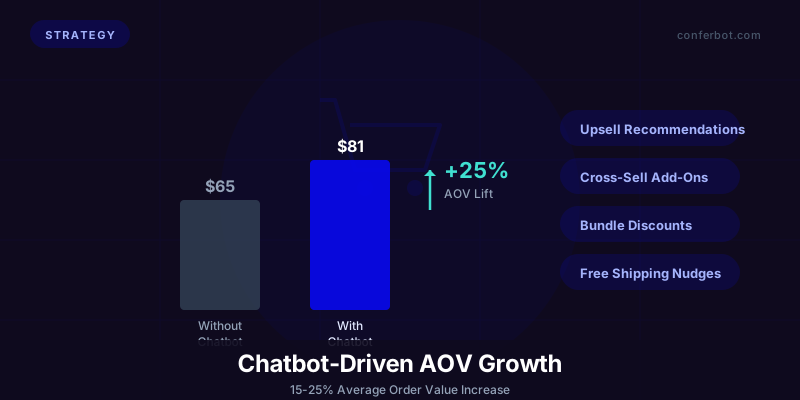
This is precisely where AI chatbots outperform every other AOV optimization tool. Static product recommendation widgets on product pages have a limited view of customer intent. They rely on collaborative filtering ("customers also bought") or rule-based logic that cannot adapt to real-time conversation signals. A chatbot, by contrast, conducts a dynamic conversation that surfaces buying intent, budget constraints, use cases, and preferences, then uses that rich context to make genuinely relevant upsell and cross-sell suggestions at the exact moment the shopper is most receptive.
The data backs this up. E-commerce stores using conversational AI for product recommendations report 15 to 25% higher AOV compared to stores relying solely on static recommendation widgets, according to Salesforce's State of the Connected Customer report. The range depends on product category, price point, and how well the chatbot is configured, but the directional result is consistent across verticals.
This guide breaks down exactly how to configure your chatbot for maximum AOV impact. We cover the four core strategies (upselling, cross-selling, bundling, and threshold nudges), the conversation scripts and timing triggers that make each strategy work, common mistakes that backfire, and a measurement framework to track your results. Whether you are running a Shopify store, a WooCommerce site, or a custom e-commerce platform, these techniques apply universally.
Upselling With Chatbots: Moving Shoppers to Premium Products Without Feeling Pushy
Upselling is the practice of encouraging a customer to purchase a higher-tier, more expensive version of the product they are already considering. It is the most direct path to increasing AOV because the customer has already expressed intent for that product category. The chatbot's role is to surface a compelling reason to upgrade.
Why Chatbot Upselling Outperforms Static Recommendations
Traditional upselling on e-commerce sites relies on "You might also like" carousels or comparison tables that appear on the product page. These approaches suffer from three limitations. First, they lack context. A static widget does not know why the shopper is considering that product, what their budget is, or what features matter most to them. Second, they lack timing. The recommendation appears at a fixed position on the page regardless of whether the shopper has scrolled past the price, read the reviews, or is about to leave. Third, they lack conversation. A widget cannot address objections, explain why the premium version is worth the extra cost, or tailor the pitch to the shopper's specific use case.
A chatbot solves all three problems. Through natural conversation, it can ask what the shopper plans to use the product for, gauge price sensitivity, and then present the upsell with a rationale that directly addresses the shopper's stated needs. Research from Harvard Business Review shows that context-aware recommendations convert at 3 to 5 times the rate of generic ones.
The Three-Step Upsell Conversation Pattern
Effective chatbot upselling follows a reliable pattern that feels helpful rather than pushy:
Step 1: Understand the use case. Before recommending anything, the chatbot asks about the shopper's intended use. "What are you planning to use this blender for?" or "Is this laptop for work, school, or personal use?" This question feels helpful (because it is) and provides the context needed to make a relevant upsell.
Step 2: Identify the upgrade trigger. Based on the response, the chatbot identifies a specific feature gap between the current product and the premium version that directly addresses the shopper's use case. If the shopper says they will use the blender for smoothies with frozen fruit, the chatbot knows the 1200-watt model handles frozen ingredients better than the 800-watt model they are viewing.
Step 3: Present the upsell with value framing. The chatbot presents the premium option with a specific benefit linked to the shopper's use case, along with a price anchor that minimizes the perceived cost difference.

Example upsell script:
Bot: "Since you mentioned you blend frozen fruit daily, I should point out that the Pro 1200 model handles ice and frozen ingredients much better than the Standard 800. It also comes with a 5-year warranty instead of 1 year. It is $40 more, which works out to about $0.11 per day over the warranty period. Want me to show you the comparison?"
This script works because it references the shopper's specific stated need (frozen fruit), provides a concrete benefit (handles frozen ingredients better), adds a secondary benefit (5-year warranty), and reframes the price difference from $40 to $0.11 per day, making it feel trivial.
Upsell Timing: When to Trigger the Conversation
Timing determines whether an upsell feels helpful or annoying. Based on A/B testing data from multiple e-commerce deployments, these are the optimal trigger points, a topic we explore further in our chatbot A/B testing guide:
| Trigger Point | Upsell Acceptance Rate | Customer Satisfaction Impact | Best For |
|---|---|---|---|
| After adding to cart | 18-23% | Neutral to positive | Complementary upgrades |
| During product browsing (30+ seconds on page) | 12-16% | Positive (feels like help) | Feature-based upgrades |
| At checkout | 8-12% | Slightly negative if aggressive | Last-minute add-ons only |
| After price comparison behavior | 20-27% | Very positive | Value-based upgrades |
The most effective trigger is after price comparison behavior, where the shopper has been toggling between product variants or visiting competitor pages. This signals active evaluation, and a chatbot that proactively helps compare options at this moment feels genuinely useful. The least effective (and most risky) trigger is at checkout, where any interruption risks cart abandonment. Limit checkout upsells to small, low-friction add-ons.
Upsell AOV Impact by Category
| Product Category | Average Upsell Price Difference | Upsell Acceptance Rate | AOV Lift From Upselling Alone |
|---|---|---|---|
| Electronics | $45-120 | 14-19% | 8-12% |
| Apparel | $15-35 | 18-24% | 5-8% |
| Home and Kitchen | $25-60 | 16-22% | 7-10% |
| Beauty and Skincare | $10-30 | 22-28% | 6-9% |
| Software/SaaS | $10-50/mo | 20-30% | 12-18% |
Cross-Selling With Chatbots: Recommending Complementary Products That Shoppers Actually Want
Cross-selling recommends products from different categories that complement the item the shopper is purchasing. Unlike upselling (which moves the shopper up within the same product line), cross-selling adds new items to the cart. When done well, cross-selling simultaneously increases AOV and improves customer satisfaction because the shopper gets everything they need in one transaction.
The Context Advantage: Why Chatbot Cross-Sells Convert 3x Better
Amazon reports that 35% of its revenue comes from cross-selling recommendations. But Amazon's recommendations are powered by massive collaborative filtering datasets ("customers who bought X also bought Y") that most e-commerce stores cannot replicate at scale. A chatbot provides an alternative path to effective cross-selling: contextual conversation.
When a shopper tells a chatbot they are buying a camping tent for a family trip next weekend, the chatbot has rich context that no algorithm-only approach can match. It knows the tent is for family use (suggest family-size sleeping bags, not solo bags), for camping (suggest a camp stove, not a backpacking stove), and the trip is next weekend (suggest in-stock items with fast shipping, not backordered items). This context makes cross-sell recommendations feel curated rather than generic.
According to Accenture's research on customer experience, 91% of consumers are more likely to shop with brands that provide relevant recommendations, and contextual relevance is the primary driver of recommendation acceptance.
Cross-Sell Conversation Patterns
Pattern 1: The "Complete the Set" approach. After the shopper adds a product to cart, the chatbot identifies what is commonly needed alongside that product and presents it as a completion.
Bot: "Great choice on the Canon EOS R50! Most photographers also grab a memory card and a protective case. I can add a 128GB SD card ($24.99) and a fitted case ($29.99) for you. That way you are ready to shoot right out of the box. Add both?"
Pattern 2: The "Based on your use case" approach. The chatbot uses information gathered earlier in the conversation to recommend products the shopper may not have considered.
Bot: "Since you mentioned you are setting up a home office, you might want to add a monitor riser ($34.99) to keep your screen at eye level. People who work from home 8+ hours a day say it makes a huge difference for neck strain. Want to take a look?"
Pattern 3: The "Frequently forgotten" approach. The chatbot proactively reminds the shopper of essential items they might forget.
Bot: "Quick heads-up: that printer requires ink cartridges that are not included in the box. The starter set is $32.99 and prints about 500 pages. I can add it so you are not stuck waiting when the printer arrives. Shall I?"

Cross-Sell Timing and Sequencing
The number and timing of cross-sell suggestions significantly affect acceptance rate and customer experience. Testing across multiple e-commerce deployments reveals clear patterns:
- One cross-sell suggestion per conversation: 22-28% acceptance rate, zero negative satisfaction impact
- Two cross-sell suggestions: 18-24% acceptance on first, 12-16% on second, minimal satisfaction impact
- Three or more suggestions: Acceptance rates drop sharply to 8-12% on the third, and satisfaction scores show measurable decline
The recommendation is to limit cross-sells to two per conversation, presenting the most relevant one first. If the shopper declines the first, the second should feel distinctly different (not another variation of the same suggestion) and should be lower in price. Never present a third cross-sell unless the shopper explicitly asks "What else do you recommend?"
Product Affinity Mapping for Cross-Sells
Effective cross-selling requires a product affinity map that pairs each product with its strongest cross-sell candidates. Build this map using three data sources:
- Purchase history data: Analyze which products are most frequently purchased together. This is the collaborative filtering approach Amazon uses.
- Product logic: Identify functional complements (camera + memory card, printer + ink, phone + case) that make sense regardless of purchase history data.
- Conversation data: Analyze chatbot transcripts to identify products shoppers ask about together, revealing associations that purchase data alone might miss.
Feed this affinity map into your chatbot's product recommendation engine so that cross-sell suggestions are data-driven rather than manually curated. For more on building product recommendation flows, see our comprehensive upselling and cross-selling guide.
Bundle Discounts: How Chatbots Create and Sell Product Bundles in Real Time
Product bundling is the strategy of combining multiple products into a single offer at a discounted total price. Bundles increase AOV by encouraging shoppers to buy more items than they originally intended, while the discount gives them a rational justification for the larger purchase. According to Bain and Company's research on product customization, bundled offers increase transaction value by 20 to 35% compared to individual product purchases.
Static Bundles vs. Dynamic Chatbot Bundles
Most e-commerce stores offer pre-configured bundles: a fixed set of products at a fixed price. These work well for obvious pairings but miss opportunities for personalized bundles based on individual shopper needs.
A chatbot creates dynamic bundles in real time based on conversation context. Instead of showing every shopper the same "Home Office Starter Kit," the chatbot assembles a custom bundle based on what the shopper has told it about their setup, preferences, and budget. This personalized approach converts at 2 to 3 times the rate of static bundles because the shopper sees products they actually want, not a generic assortment.
The Bundle Conversation Framework
Step 1: Establish the anchor product. The shopper has already expressed interest in or added a specific product. This is the bundle anchor.
Step 2: Assess bundle opportunity. Based on the product category and conversation context, the chatbot determines whether a bundle offer is appropriate. Not every purchase warrants a bundle. Good bundle candidates include products with natural complements (electronics with accessories), products used in workflows (skincare routines, cooking setups), and products purchased for specific occasions (gifts, events, projects).
Step 3: Present the bundle with savings math. The chatbot presents 2 to 3 additional items alongside the anchor product, shows the individual prices, the bundle price, and the total savings. Making the savings explicit is critical for conversion.
Bot: "I put together a bundle based on what you told me about your skincare goals:
- Vitamin C Serum (your pick): $38
- Hyaluronic Acid Moisturizer: $28
- SPF 50 Daily Sunscreen: $22
Individually that is $88. As a bundle: $69.99 (save $18.01, that is 20% off). Your morning routine is covered. Want the bundle?"
This script works because it references the shopper's specific goals ("based on what you told me"), itemizes each product with its individual price, presents the bundle with clear savings, and frames the bundle as a complete solution ("your morning routine is covered").
Bundle Pricing Psychology
How you frame bundle pricing significantly impacts acceptance rates:
| Pricing Frame | Example | Bundle Acceptance Rate |
|---|---|---|
| Percentage discount | "Save 20% when you bundle" | 18-22% |
| Dollar amount saved | "Save $18.01 with this bundle" | 22-26% |
| Free item framing | "Buy 2, get the sunscreen FREE" | 28-34% |
| Per-day cost | "$0.78/day for your complete routine" | 24-28% |
The "free item" frame consistently outperforms other approaches because it triggers loss aversion. The shopper perceives they are getting something for nothing, which is psychologically more compelling than saving a percentage. When structuring bundle pricing, always identify the lowest-priced item and position it as the free component.

Dynamic Bundle Rules Engine
To scale bundle creation, configure your chatbot with bundle rules that automatically generate appropriate offers:
- Category affinity rules: When the anchor product is in Category A, suggest products from Categories B and C. Example: Running shoes (anchor) + running socks (Category B) + shoe care kit (Category C).
- Price threshold rules: Total bundle additions should not exceed 40 to 60% of the anchor product price. Bundles that more than double the original price have sharply lower acceptance rates.
- Margin-aware rules: Prioritize cross-sell items with higher margins to ensure the bundle discount does not erode profitability. A 20% bundle discount on high-margin accessories can still generate more profit than the anchor product alone.
- Inventory-aware rules: Only suggest items that are in stock and ready to ship. Suggesting a bundle item that is backordered creates frustration and cart abandonment.
Free-Shipping Threshold Nudges: The Simplest AOV Lever With the Highest Impact
Free shipping thresholds are the simplest and often most effective AOV strategy. According to the Digital Commerce 360 shipping benchmark report, 66% of shoppers say free shipping is the most important factor in their purchase decision, and 48% of shoppers add items to their cart specifically to reach a free shipping threshold. The psychology is powerful: shoppers perceive shipping costs as a penalty rather than a cost of doing business, and they will actively spend more to avoid it.
How Chatbots Supercharge Free-Shipping Nudges
A banner that says "Free shipping on orders over $75" is effective but generic. A chatbot transforms this into a personalized, dynamic conversation:
Bot: "Your cart is at $52.40. You are just $22.60 away from free shipping (saves you $7.99). Here are three popular items that would put you over the threshold:
- Phone charging cable ($12.99)
- Screen protector 2-pack ($14.99)
- Wireless earbuds case ($19.99)
Any of these catch your eye?"
This approach converts at 3 to 4 times the rate of a static free-shipping banner because it tells the shopper exactly how much more they need, translates that into a specific savings amount ($7.99), and curates product suggestions that are both relevant and close to the threshold gap.
Optimizing the Free-Shipping Threshold
Setting the right threshold is critical. Too low and you give away free shipping to customers who would have paid it anyway, eroding margins. Too high and customers perceive it as unreachable, providing no AOV motivation.
The standard formula for optimizing your free-shipping threshold:
Optimal threshold = Current AOV x 1.2 to 1.3
If your current AOV is $62, set the threshold at $75 to $81. This means the average customer needs to add 20 to 30% more to qualify, which is achievable enough to motivate action but high enough to meaningfully lift AOV.
| Current AOV | Recommended Threshold | Average Gap to Fill | Expected AOV Lift |
|---|---|---|---|
| $35 | $45-49 | $10-14 | 12-18% |
| $65 | $79-85 | $14-20 | 14-20% |
| $100 | $120-130 | $20-30 | 10-15% |
| $200 | $240-260 | $40-60 | 8-12% |
Chatbot Free-Shipping Conversation Triggers
The chatbot should trigger the free-shipping nudge at specific moments for maximum impact:
- After adding to cart: Immediately calculate the gap and present it. "You added the blue scarf. Your cart is $38.50 and free shipping starts at $49. Just $10.50 to go!"
- At cart review: When the shopper opens the cart or starts checkout, remind them of the gap with specific product suggestions.
- After declining an upsell: If the shopper declines a premium product, pivot to the free-shipping angle. "No problem! By the way, you are only $15 from free shipping. Want me to suggest a few small additions?"
For stores managing seasonal campaigns, these threshold nudges pair well with the promotional strategies covered in our seasonal e-commerce chatbot strategy guide.
The "Add One More" Nudge Variation
When the gap to free shipping is small (under $15), the most effective approach is the "add one more" nudge that suggests a single low-priced item rather than multiple options:
Bot: "You are $8.50 from free shipping. A travel-size hand cream ($9.99) would put you over and save you $6.95 in shipping. It is one of our top sellers. Add it?"
This single-item approach works because it removes decision fatigue. The shopper does not have to choose from multiple options. The item is inexpensive, the savings math is clear, and the action is a simple yes/no. Testing shows the single-item nudge converts at 32 to 38% when the gap is under $15, compared to 22 to 26% for multi-option presentations at the same gap size.
Conversation Timing and Triggers: When to Recommend What for Maximum Acceptance
The effectiveness of any AOV strategy, whether upsell, cross-sell, bundle, or free-shipping nudge, depends heavily on when the chatbot delivers the recommendation. The same offer presented at the right moment converts 3 to 5 times better than the same offer presented at the wrong moment.
The Shopper Psychology Timeline
Understanding where the shopper is in their decision process determines which AOV strategy to deploy:
| Shopper Stage | Behavioral Signal | Best AOV Strategy | Acceptance Rate |
|---|---|---|---|
| Browsing (exploring) | Viewing multiple categories, short page dwell time | Product discovery, no AOV push yet | N/A (too early) |
| Evaluating (comparing) | Toggling between product variants, reading reviews | Upsell to premium version | 20-27% |
| Decided (adding to cart) | Add to cart action | Cross-sell complementary items | 22-28% |
| Committing (cart review) | Viewing cart, starting checkout | Free-shipping nudge, bundle offer | 18-25% |
| Post-purchase | Order confirmation page | "Add to this order" before shipping | 12-16% |
Each stage has a primary AOV lever. Deploying the wrong lever at the wrong stage hurts rather than helps. An upsell at checkout creates friction. A free-shipping nudge during early browsing is irrelevant (no cart yet). Match strategy to stage for maximum impact.
Behavioral Triggers That Signal AOV Opportunity
Beyond stage-based timing, specific behavioral triggers indicate heightened receptivity to AOV-increasing offers:
Price comparison trigger: The shopper has viewed the same product on a competitor's site (detected via referral URL) or has been toggling between price tiers on your site. This signals active evaluation and high receptivity to value-based upsells that justify the price difference.
Cart stall trigger: The shopper has items in the cart but has not progressed to checkout for 3+ minutes. A chatbot intervention at this point ("I noticed you have items in your cart. Can I help with anything?") often reveals price hesitation that a bundle discount can resolve.
High-intent browsing trigger: The shopper has visited 4+ product pages in the same category. This signals serious purchase intent and high receptivity to curated recommendations. The chatbot can consolidate their browsing into a personalized bundle.
Repeat visitor trigger: The shopper has visited before without purchasing. On their return, the chatbot can reference their previous browsing and present a tailored offer that addresses whatever prevented the first purchase. This approach is covered in depth in our customer retention chatbot guide.
Trigger Sequencing Rules
When multiple triggers fire simultaneously, follow this priority order to avoid overwhelming the shopper:
- Free-shipping nudge (highest acceptance, lowest friction)
- Cross-sell complementary item (medium friction, high relevance)
- Bundle offer (medium friction, requires more consideration)
- Upsell to premium (highest friction, most persuasion needed)
Never stack more than two AOV strategies in a single conversation. Data consistently shows that a third recommendation attempt reduces the acceptance rate of all offers and negatively impacts overall satisfaction. Two well-timed suggestions is the optimal maximum.
Proven Conversation Scripts: Copy-Paste Templates for Every AOV Strategy
Here are field-tested conversation scripts for each AOV strategy, ready to configure in your chatbot platform. Each script includes the trigger condition, the message template, and the expected conversion range. For more on writing effective chatbot messages, see our chatbot copywriting guide.
Upsell Scripts
Script 1: Feature-Based Upsell
Trigger: Shopper viewing mid-tier product for 45+ seconds
Bot: "I see you are looking at the [Product Name]. Just so you know, the [Premium Product Name] includes [specific feature the mid-tier lacks] and [second feature], which a lot of our customers find essential for [use case]. It is [price difference] more. Want me to pull up a side-by-side comparison?"
Expected acceptance: 14-19%
Script 2: Social Proof Upsell
Trigger: Shopper added mid-tier product to cart
Bot: "Nice pick! Quick note: 68% of customers who started with the [Current Product] ended up upgrading to the [Premium Product] within 30 days because of [key reason]. The upgrade is [price difference] and I can swap it in your cart right now. Interested?"
Expected acceptance: 16-22%
Cross-Sell Scripts
Script 3: The Essential Add-On
Trigger: Product added to cart that requires accessories
Bot: "Heads-up: the [Product] does not include [essential accessory]. Most customers grab the [Accessory Name] ($XX.XX) so they can start using it right away. Want me to add it?"
Expected acceptance: 26-32%
Script 4: The Occasion-Based Cross-Sell
Trigger: Shopper mentioned gift, event, or specific occasion in conversation
Bot: "Since this is for [occasion], you might want to add [complementary product] ($XX.XX). It pairs perfectly and makes the gift feel more complete. I can also add gift wrapping for $4.99. Would you like either?"
Expected acceptance: 20-26%
Bundle Scripts
Script 5: The Custom Bundle Builder
Trigger: Shopper has 2+ items in cart from related categories
Bot: "I noticed you have [Item 1] and [Item 2] in your cart. If you add [Item 3], I can apply a bundle discount: [total individual price] becomes [bundle price]. That saves you [savings amount]. Should I apply it?"
Expected acceptance: 24-30%
Script 6: The Starter Kit Bundle
Trigger: New customer (first visit) browsing a product category
Bot: "Looks like you are new to [category]. We have a [Category] Starter Kit that includes everything you need to get going: [Item 1], [Item 2], and [Item 3]. Individually $XXX, the kit is $XX.XX (save XX%). Perfect for beginners. Take a look?"
Expected acceptance: 18-24%
Free-Shipping Nudge Scripts
Script 7: The Gap Calculator
Trigger: Cart total is within 30% of free-shipping threshold
Bot: "Your cart is $[amount]. You are just $[gap] from free shipping, which saves you $[shipping cost]. Here is a popular add-on that fits: [Product] ($[price]). Add it and get free shipping?"
Expected acceptance: 30-36%
Script 8: The Post-Decline Pivot
Trigger: Shopper declined an upsell or cross-sell
Bot: "No worries! By the way, you are only $[gap] from free shipping. The [low-price item] ($[price]) would get you there and it is one of our most-loved products. Want to add it?"
Expected acceptance: 28-34%

Common Mistakes That Kill AOV Instead of Growing It
Not all AOV strategies work. Poorly executed upselling and cross-selling can actively reduce conversion rates, damage brand perception, and increase cart abandonment. These are the most common mistakes to avoid, with data on their negative impact.
Mistake 1: Recommending Irrelevant Products
The single biggest AOV killer is suggesting products that have no logical connection to what the shopper is buying. A shopper purchasing a laptop case does not want a recommendation for kitchen towels, even if the algorithm says other customers bought both. Irrelevant recommendations are not just ineffective; they actively damage trust in the chatbot and reduce engagement with future suggestions.
Impact: Irrelevant cross-sell recommendations reduce overall chatbot engagement by 15 to 20% because shoppers learn to ignore or dismiss the chatbot's suggestions. Always validate that your product affinity map reflects genuine complementary relationships, not spurious correlations.
Mistake 2: Too Many Recommendations Per Conversation
Enthusiasm for AOV growth leads many stores to stack 4, 5, or 6 recommendations into a single conversation. This creates recommendation fatigue and decision paralysis. The shopper feels bombarded rather than helped, and the overall acceptance rate plummets.
Impact: Research from Sheena Iyengar's paradox of choice research at Columbia University shows that excessive options reduce purchase likelihood. In chatbot contexts, more than 2 AOV suggestions per conversation reduces total acceptance by 35 to 45% compared to 1 to 2 focused suggestions.
Mistake 3: Upselling at Checkout Without Context
Adding upsell pop-ups or chatbot messages at the checkout step is tempting because the shopper is at peak purchase intent. But checkout is also the moment of maximum price sensitivity and friction awareness. A poorly timed upsell at checkout increases cart abandonment by 8 to 12%.
The rule: upsell before checkout, not during it. If the shopper has reached checkout without accepting an upsell, they have made their decision. Respect it. The only exception is small, low-friction additions (gift wrapping, extended warranty, shipping insurance) that do not require re-evaluating the purchase decision.
Mistake 4: Ignoring the Discount-AOV Paradox
Offering discounts to increase AOV can backfire. If a shopper's cart is $70 and you offer 10% off orders over $100, the shopper might add $30+ of products. But the 10% discount means they save $10 on that $100+ order, so the net AOV increase is only $20 despite the shopper spending $30 more. Worse, you have trained the shopper to expect discounts, reducing full-price purchases in the future.
Better alternative: Use value-add incentives instead of percentage discounts. Free shipping, a free sample, or a free accessory with qualifying purchases provides AOV incentive without percentage-based margin erosion or discount expectation training. This is especially important for customer retention, as we discuss in our conversational commerce guide.
Mistake 5: Not Testing and Iterating
Many stores deploy AOV chatbot scripts once and never revisit them. Product catalogs change, customer preferences shift, and what worked 6 months ago may underperform today. Without regular testing and updating, AOV strategies degrade over time.
Recommendation: Review and refresh your AOV scripts monthly. Run A/B tests on script variations quarterly. Monitor acceptance rates weekly to catch declining performance early. The stores that treat AOV optimization as an ongoing process rather than a one-time setup consistently outperform those that set it and forget it.
Measuring AOV Impact: Metrics, Attribution, and ROI Calculation
Deploying AOV strategies without rigorous measurement is flying blind. You need a clear framework to attribute revenue lift to chatbot recommendations, calculate ROI, and identify which strategies are working and which need adjustment. For a complete metrics framework, see our chatbot analytics and metrics guide.
Core AOV Metrics to Track
| Metric | Definition | Benchmark | How to Calculate |
|---|---|---|---|
| Chatbot-influenced AOV | Average order value for orders where the chatbot was engaged | 15-25% higher than non-chatbot AOV | Sum of chatbot-engaged order revenue / count of chatbot-engaged orders |
| Upsell acceptance rate | Percentage of upsell offers accepted | 14-22% | Upsells accepted / upsells presented |
| Cross-sell acceptance rate | Percentage of cross-sell offers accepted | 20-28% | Cross-sells accepted / cross-sells presented |
| Bundle acceptance rate | Percentage of bundle offers accepted | 18-30% | Bundles accepted / bundles presented |
| Free-shipping nudge conversion | Percentage of nudges that result in threshold achieved | 28-36% | Thresholds achieved / nudges delivered |
| Revenue per chatbot conversation | Average revenue attributed to each chatbot conversation | $2.50-8.00 | Total chatbot-attributed revenue / total conversations |
Attribution Methodology
Chatbot AOV attribution must distinguish between correlation and causation. Not every order from a chatbot-engaged visitor was influenced by the chatbot. Use this attribution framework:
Direct attribution: The shopper accepted a specific chatbot recommendation (clicked the upsell, added the cross-sell, accepted the bundle). This is unambiguous and should be your primary attribution method.
Influenced attribution: The shopper engaged with the chatbot, received recommendations, but added the suggested products manually (browsing the product page after the chatbot suggested it). Track this by comparing the shopper's cart after chatbot engagement vs. before, and flag items that match chatbot suggestions even if not directly clicked.
Incremental attribution: Compare the AOV of chatbot-engaged shoppers vs. a control group of non-engaged shoppers with similar profiles. The difference represents the chatbot's incremental AOV lift. This is the most rigorous method but requires a holdout group.
ROI Calculation Framework
Calculate the ROI of your chatbot AOV strategies using this formula:
Monthly incremental revenue = (Chatbot-engaged orders x AOV lift from chatbot) - chatbot cost
Example calculation:
- Monthly orders: 10,000
- Chatbot engagement rate: 15% (1,500 chatbot-engaged orders)
- Chatbot-influenced AOV lift: 20% on a $65 baseline = $13.00 per order
- Monthly incremental revenue: 1,500 x $13.00 = $19,500
- Monthly chatbot cost: $299 (platform subscription)
- Monthly ROI: ($19,500 - $299) / $299 = 6,421% ROI
Even conservative assumptions (10% engagement, 15% AOV lift) produce compelling ROI because the chatbot cost is fixed while the revenue scales with order volume. For a comprehensive ROI calculation framework, refer to our chatbot ROI calculator guide.
How Conferbot Drives AOV Growth for E-Commerce Stores
Conferbot includes purpose-built features for AOV optimization that make it easy to deploy upselling, cross-selling, bundling, and free-shipping nudges without custom development.
Product Catalog Integration
Conferbot syncs with your product catalog (Shopify, WooCommerce, BigCommerce, or custom API) to automatically access product data, pricing, inventory levels, and category relationships. This means the chatbot always recommends in-stock products at current prices and can dynamically assemble bundles based on real catalog data.
AI-Powered Recommendation Engine
The built-in recommendation engine uses conversation context, browsing behavior, and purchase history to rank product suggestions by relevance. It learns from acceptance and rejection patterns to improve recommendations over time, achieving progressively higher acceptance rates as it accumulates data about your customer base.
Visual Product Cards
Product recommendations are presented as rich visual cards within the chat interface, showing the product image, name, price, and a one-click "Add to Cart" button. Visual presentation increases recommendation acceptance by 35 to 45% compared to text-only recommendations because shoppers can see what they are adding.
Dynamic Free-Shipping Calculator
Conferbot automatically detects your free-shipping threshold and calculates the gap for each shopper in real time. It triggers the nudge at the optimal moment (when the cart is within 30% of the threshold) and suggests products that close the gap precisely. No manual configuration of shipping rules is needed.
Bundle Builder
The drag-and-drop bundle builder lets you define bundle rules (anchor product, complementary categories, maximum discount percentage) and the chatbot assembles custom bundles in real time during conversations. You set the rules; the chatbot handles the personalization.
A/B Testing for AOV Scripts
Every AOV script can be A/B tested natively within Conferbot. Test different upsell approaches, cross-sell timing, bundle presentations, and free-shipping nudge formats to continuously optimize acceptance rates. The platform calculates statistical significance automatically and deploys winners with one click.
AOV Analytics Dashboard
A dedicated AOV analytics dashboard tracks all core metrics: chatbot-influenced AOV vs. baseline, acceptance rates by strategy, revenue per conversation, and monthly trend data. You can filter by product category, traffic source, and device type to identify where your AOV strategies perform best and where they need refinement.
If you are ready to increase your store's average order value with conversational AI, start with our Shopify chatbot setup guide or explore the WooCommerce integration walkthrough to get your product catalog connected in minutes.
Was this article helpful?
How Chatbots Increase Average Order Value FAQ
Everything you need to know about chatbots for how chatbots increase average order value.
About the Author

Conferbot Team specializes in conversational AI, chatbot strategy, and customer engagement automation. With deep expertise in building AI-powered chatbots, they help businesses deliver exceptional customer experiences across every channel.
View all articles