Why Solar Companies Need a Calculator Chatbot in 2026
The residential solar market in the United States has never been larger or more competitive, as SEIA's solar market research confirms. With the federal Investment Tax Credit locked at 30% through 2032 and utility rates climbing 3-5% annually, homeowner interest in solar is at an all-time high. But interest alone does not pay the bills. Solar companies face a brutal reality: lead costs are among the highest in any home services industry, sales cycles stretch 45 to 90 days, and the majority of inquiries come from people who will never qualify or convert. The companies that thrive are the ones that solve the qualification problem before it drains their budget.
A solar panel calculator chatbot is the answer. It sits on your website, WhatsApp, or social media pages and does what your best sales rep does on a first call -- but it does it 24 hours a day, 7 days a week, with zero salary, zero sick days, and zero missed follow-ups. It asks the right questions in the right order: Do you own your home? What is your average electric bill? How old is your roof? What is your zip code? Then it runs those answers through a savings calculation engine and delivers a personalized estimate in under 60 seconds: "Based on your $310 monthly electric bill in Phoenix, you could save approximately $265 per month with an 8.2 kW solar system. Your estimated payback period is 5.5 years."
That single interaction -- which takes less than three minutes -- accomplishes what used to require a phone call, a scheduling back-and-forth, and 30 minutes of a sales rep's time. And it happens at 11 PM on a Sunday when no one on your team is available. The homeowner gets the information they want instantly, and your company gets a pre-qualified lead with detailed data points that make the follow-up consultation dramatically more productive.
This guide covers everything solar companies need to know about building and deploying a calculator chatbot: the qualification logic that separates serious buyers from tire-kickers, the savings calculation methodology that builds credibility, the CRM and design tool integrations that streamline your pipeline, the ROI analysis that justifies the investment, and the best practices that turn chatbot conversations into signed contracts. Whether you are a regional installer with 10 reps or a national company managing thousands of leads monthly, this is the playbook for turning your website into a qualification machine.

The Solar Lead Cost Crisis: Why Traditional Channels Are Failing
Before we dive into solutions, let us confront the problem. Solar lead acquisition costs are rising faster than panel efficiency. According to EnergySage market research, the average cost per solar lead through paid digital channels has increased 35% since 2023. Google Ads keywords like "solar panels for my home" now cost $45 to $90 per click. With typical landing page conversion rates of 3-5%, that translates to $900 to $3,000 per raw lead. But raw leads are not qualified leads. Only 15-25% of people who fill out a form actually own their home, have a suitable roof, live in your service area, and have an electric bill high enough to make solar financially viable.
The math gets worse. Lead marketplace providers like SolarReviews, EnergySage, and LeadGenius charge $30 to $120 per lead, but these leads are shared with 3 to 7 competing installers. Your close rate on shared leads typically falls between 3% and 8%, and the homeowner is overwhelmed by the barrage of calls and emails from multiple companies. The experience leaves a bad taste and drives many prospects out of the market entirely.
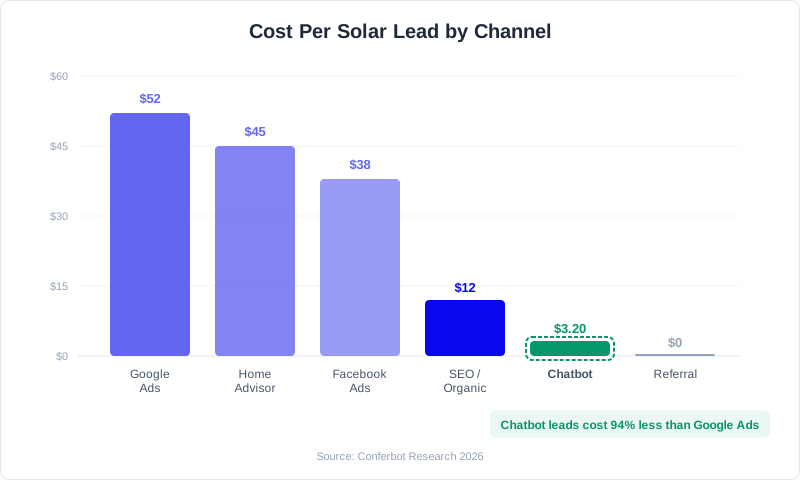
Door-to-door canvassing, once the backbone of solar sales, costs $200 to $500 per qualified appointment when you factor in labor, transportation, training, and the high turnover rate among canvassers. And it is increasingly unwelcome -- homeowners are more likely to close the door than open their wallets when a stranger knocks unannounced. Referral programs deliver the best close rates (25-40%) but cannot scale reliably and typically cost $500 to $1,500 per closed deal in referral bonuses.
Here is the core issue: solar companies are spending the majority of their marketing budget generating leads they can never convert. The qualification step happens too late -- after the money is already spent on clicks, after the lead is already shared with competitors, after the sales rep has already invested 30 minutes in a phone call with someone who rents their apartment. A calculator chatbot moves the qualification step to the very first interaction, before any human time is invested and while the cost per engagement is minimal.
What the Numbers Look Like
- Google Ads: $45-$90 CPC, 3-5% conversion, 20% qualification rate = $4,500-$15,000 per qualified lead
- Lead marketplaces: $30-$120 per shared lead, 3-8% close rate on shared leads
- Door-to-door: $200-$500 per qualified appointment, high turnover overhead
- Referral programs: Best ROI but limited scale, $500-$1,500 per closed deal
- Chatbot-qualified leads: $15-$50 per qualified lead from existing website traffic
The chatbot does not replace your marketing channels -- it makes every channel dramatically more efficient by ensuring that no visitor leaves your website without being engaged, qualified, and either converted to a consultation or identified as unqualified before your team spends a minute on them.
The Qualification Logic: How a Solar Calculator Chatbot Screens Homeowners
The power of a solar calculator chatbot lies in its qualification logic, incorporating technical factors documented by the DOE Solar Energy Technologies Office -- the structured sequence of questions that determines whether a homeowner is a viable solar prospect and, if so, how hot that lead is. This is not a generic form with five fields. It is a guided conversation engineered to gather maximum information with minimum friction, using branching logic that adapts based on each answer.
Question 1: Homeownership Verification
"Do you own your home?" This single yes-or-no question eliminates 25-35% of unqualified traffic immediately. Renters cannot install solar panels on a property they do not own. But the chatbot handles this gracefully: rather than a dead end, it offers community solar program information or a referral option. "Solar installation requires homeownership, but community solar programs in your area may let you benefit from solar energy. Would you like information about that?" This preserves goodwill and occasionally generates leads for community solar partners.
Question 2: Monthly Electric Bill
"What is your average monthly electric bill?" This is the single most important financial data point. A homeowner paying $75 per month will have a payback period exceeding 15 years in most markets, making solar a poor financial proposition. A homeowner paying $350 per month is a highly motivated buyer. The chatbot uses this data to segment leads into tiers:
- Hot lead: $250+/month electric bill -- fast payback, high motivation
- Warm lead: $150-$249/month -- good candidate with solid ROI
- Cool lead: $100-$149/month -- viable in high-incentive markets
- Unlikely candidate: Under $100/month -- long payback, may not pencil financially
Question 3: Roof Age and Condition
"Approximately how old is your roof?" Installing solar on a roof that needs replacement within 5 years creates a costly problem -- the panels must be removed, the roof replaced, and the panels reinstalled. The chatbot flags roofs older than 15 years: "Since your roof is 18 years old, our solar specialist may recommend a roof assessment before installation. Some of our customers bundle a new roof with their solar system to maximize long-term value." This transforms a potential disqualifier into a cross-selling opportunity for companies with roofing partnerships.
Question 4: Zip Code and Service Area
"What is your zip code?" This serves triple duty: it confirms the homeowner is in your service area, it determines the local sun hours and electricity rates for the savings calculation, and it identifies which utility company serves the property (which dictates net metering policies). The chatbot can reference utility-specific data: "Great, you're in the APS service territory. APS offers net metering that credits you for excess energy at a rate of $0.08 per kWh."
Question 5: Roof Orientation and Shading
"Does your main roof face south, east, west, or north? Are there large trees or buildings shading your roof?" South-facing roofs are ideal, but east and west-facing roofs still produce 75-85% of maximum output. North-facing roofs in northern latitudes are generally unsuitable. Heavy shading is a deal-breaker in most cases. These questions help set accurate expectations before the consultation.
Question 6: Timeline and Motivation
"When are you hoping to have solar installed?" Answers like "as soon as possible" or "within 3 months" indicate a hot buyer ready to move. "Just researching" or "within a year" suggests a prospect who needs nurturing. The chatbot adjusts its approach accordingly -- hot leads go straight to consultation booking, while researchers receive educational content and are enrolled in a follow-up sequence.
Question 7: Financing Preference
"Are you interested in purchasing a system outright, or would you prefer financing options?" This question helps your sales team prepare the right proposal. Cash buyers prioritize total savings and payback period. Financing buyers focus on monthly payment relative to their current electric bill. The chatbot tailors the savings presentation based on this preference.
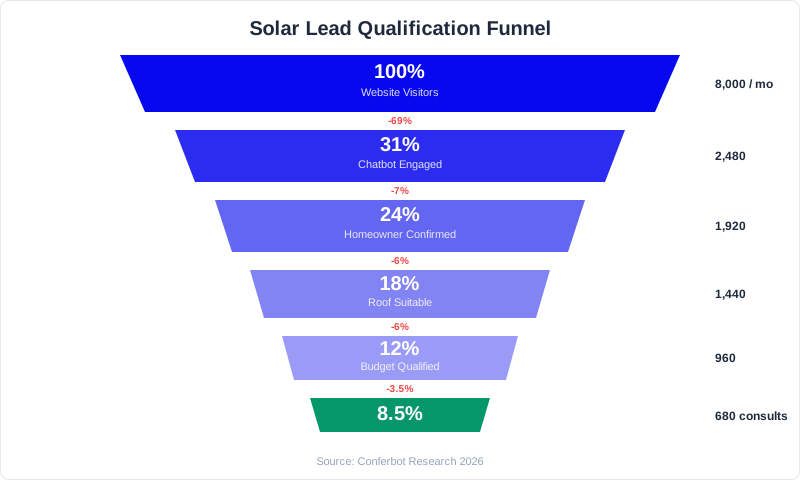
The qualification flow typically takes 2 to 4 minutes to complete -- fast enough that homeowners stay engaged but thorough enough to deliver genuinely qualified leads. Every answer is captured and passed to your CRM, giving your sales team a complete prospect profile before the first human interaction.
The Savings Calculation Engine: Building Credibility Through Personalized Estimates
The question every solar prospect wants answered is deceptively simple: "How much will I save?" A chatbot that answers this question with a credible, personalized number within the conversation converts at 3x the rate of one that simply collects contact information and promises "a specialist will call you." The savings calculation is not just a feature -- it is the moment that transforms curiosity into commitment.
The Input Variables
A reliable savings estimate requires three primary inputs from the homeowner: monthly electric bill (collected during qualification), zip code (which determines solar irradiance, local electricity rates, and available incentives), and an optional fourth input of home square footage or roof area if available. From these inputs, the calculation engine derives:
- Annual energy consumption: Monthly bill divided by local electricity rate, multiplied by 12
- Required system size: Annual consumption divided by local solar production factor (kWh per kW of installed capacity, typically 1,200-1,800 depending on location)
- Estimated system cost: System size multiplied by local cost per watt ($2.50-$3.50 in most markets)
- Federal ITC value: 30% of system cost
- State and local incentives: Based on zip code lookup (SRECs, state tax credits, utility rebates)
- Net system cost: Total cost minus all incentives
- Monthly savings: Current electric bill minus the minimal grid connection fee ($10-$20/month in most markets)
- Payback period: Net system cost divided by annual savings
- 25-year savings: Cumulative savings over the system lifespan, factoring in 3-4% annual utility rate increases
Presenting the Results Conversationally
The chatbot presents results in a way that is easy to understand and emotionally compelling: "Here is what solar could look like for your home in 85281. Based on your $310 monthly electric bill, you would need approximately an 8.2 kW system. Estimated system cost is $24,600. After the $7,380 federal tax credit and Arizona state incentives, your net cost would be around $16,200. Your estimated monthly savings would be $265, with a payback period of approximately 5.1 years. Over 25 years, you would save an estimated $89,400 -- and that factors in utility rate increases of 3% per year."
The chatbot then adds crucial context: "These are preliminary estimates based on average data for your area. A site assessment will provide exact numbers based on your specific roof orientation, shading, and energy usage patterns. Would you like to schedule a free consultation to get your detailed proposal?"
Handling Estimate Objections
Homeowners sometimes challenge the estimates, and the chatbot is prepared for every scenario. When someone says the payback period seems too long, the chatbot responds: "Your 5.1-year payback means 19.9 years of essentially free electricity after that. And since utility rates have been rising 3-4% per year, your savings actually increase over time. In year 10, you will be saving even more than the estimate suggests." When someone questions accuracy, the chatbot reassures: "This estimate is based on NREL PVWatts data for your specific zip code. A detailed engineering assessment during your consultation will refine these numbers to within 5% accuracy."
Calculator Credibility Factors
What separates a credible calculator from a marketing gimmick? Several factors that your chatbot should incorporate:
- Source attribution: Reference where the data comes from (NREL, EIA, local utility rate sheets)
- Honest ranges: Present savings as a range rather than a single number to account for variability
- Caveats included: Acknowledge that final numbers depend on site assessment, roof condition, and panel placement
- Conservative assumptions: Use conservative efficiency and degradation estimates rather than best-case scenarios
- Updated data: Refresh electricity rate data and incentive values quarterly to maintain accuracy
A calculator that overpromises will hurt your credibility during the consultation when the real numbers come in lower. A calculator that delivers conservative estimates and is then exceeded by the detailed proposal creates a positive surprise that builds trust and accelerates the close.
CRM and Solar Design Tool Integration
A chatbot that qualifies leads and calculates savings is valuable. A chatbot that feeds that data directly into your CRM, triggers automated workflows, and pre-populates your design tools is transformative. Integration is what turns a chatbot from a standalone tool into the front door of your entire sales operation.
CRM Integration: Zero-Leakage Lead Capture
The moment a homeowner completes the chatbot qualification, their data flows into your CRM -- HubSpot, Salesforce, GoHighLevel, Zoho, or whatever platform your sales team uses. The CRM record includes every data point collected: name, email, phone, address, homeownership status, electric bill amount, roof age, utility company, financing preference, savings estimate, timeline, and the full conversation transcript. No manual data entry. No leads lost between systems. No rep forgetting to log a call.
The CRM integration also triggers automated workflows. A qualified lead with a $350 electric bill and an "as soon as possible" timeline gets flagged as a hot lead with an instant notification to your sales manager. A researcher with a $150 bill and a "within a year" timeline enters a nurture sequence with educational emails about solar incentives, customer success stories, and seasonal promotions. Each lead is handled appropriately based on the data the chatbot collected.
Solar Design Software Integration
Tools like Aurora Solar, Helioscope, OpenSolar, and Enphase Design automate system layout, production modeling, and proposal generation. When your chatbot passes the homeowner's address and electric bill data to these platforms, your design team can generate a preliminary system layout before the consultation. The homeowner walks into the meeting and sees a satellite image of their actual roof with panels placed on it -- a powerful visual that makes solar feel real and specific rather than abstract and generic.
Some forward-thinking solar companies are pushing this further. The chatbot collects the address, the design tool generates a preliminary layout automatically, and the chatbot presents a rendered image of panels on the homeowner's roof within the conversation. "Here is what a solar system on your roof at 4521 Oak Street might look like." This level of personalization within a chatbot conversation is a significant competitive differentiator.
Calendar and Scheduling Integration
The chatbot connects to your scheduling system -- Calendly, HubSpot Meetings, Acuity, or your CRM's built-in scheduler -- and presents available consultation slots. The homeowner books directly within the chat without leaving the conversation. Automated confirmation emails and SMS reminders are triggered immediately. This seamless flow reduces friction between interest and appointment to nearly zero.
Marketing Attribution Integration
By connecting the chatbot to Google Analytics, Google Ads, and Facebook Ads, you gain visibility into which campaigns, keywords, and ad creatives drive chatbot-qualified leads versus unqualified traffic. This data is gold for marketing optimization. If the keyword "solar savings calculator" generates chatbot leads at $22 each while "solar panels for home" costs $95 per lead, you can reallocate budget accordingly. Conferbot's built-in analytics provides conversion funnels, qualification rates, drop-off analysis, and engagement metrics that complement your marketing platform data.
Financing Platform Integration
Since 70-80% of residential solar installations are financed, integration with lending platforms like GoodLeap, Mosaic, Sunlight Financial, or Dividend Finance allows the chatbot to provide preliminary financing information: "Based on a $24,600 system and the $7,380 tax credit, your estimated monthly loan payment would be $128-$155 per month -- less than your current $310 electric bill. You would save from day one." This immediate comparison of monthly payment versus current bill is one of the most effective closing arguments in solar sales, and the chatbot delivers it before the prospect even meets your sales team.
Step-by-Step: Building a Solar Calculator Chatbot with Conferbot
Building a solar calculator chatbot that qualifies homeowners, estimates savings, and books consultations does not require a development team or months of implementation. Here is the complete process using Conferbot's no-code chatbot builder.
Step 1: Map Your Qualification Criteria (15 Minutes)
Sit down with your top sales rep and document exactly what they ask during the first 5 minutes of a new homeowner call. For most solar companies, this includes: homeownership, property type, electric bill range, roof age, zip code, timeline, and financing interest. Also document the disqualification criteria -- what answers indicate a lead is not worth pursuing (renter, extremely low bill, out of service area, roof older than 20 years with no budget for replacement).
Step 2: Configure the Conversation Flow (25 Minutes)
Using Conferbot's visual flow builder, create the conversation sequence. Start with a warm, benefit-focused greeting: "Curious about solar for your home? I can estimate your savings in under 3 minutes. Let's start with a few quick questions." Then build each qualification question as a node with branching logic. For homeownership, "Yes" continues the flow while "No" branches to a community solar information path. For electric bill, the answer determines the savings estimate calculation and the lead priority score.
Step 3: Build the Savings Calculator Logic (20 Minutes)
Configure the calculator to use the homeowner's electric bill and zip code to generate estimates. Conferbot supports custom calculations within the flow. Set up formulas that reference regional solar irradiance data (available from NREL's PVWatts), local electricity rates (from EIA data), and current incentive values (federal ITC plus state-specific credits and rebates). The result is presented as a formatted savings summary within the chat.
Step 4: Load Your Knowledge Base (20 Minutes)
Homeowners will ask questions outside the structured flow: "What happens during a power outage?" "How does net metering work in my state?" "Do solar panels work on cloudy days?" "What about hail damage?" Load answers to the 30-50 most common solar questions into Conferbot's knowledge base. The NLP engine matches homeowner questions to the right answer, keeping the conversation flowing naturally even when prospects go off-script.
Step 5: Set Up Integrations (15 Minutes)
Connect the chatbot to your CRM using Conferbot's native integrations or Zapier. Configure lead routing rules: hot leads (high bill, homeowner, good roof, ready timeline) trigger instant notifications; warm leads enter a nurture sequence; disqualified visitors receive helpful alternative resources. Connect your calendar tool for consultation scheduling and your email/SMS platform for automated confirmations.
Step 6: Deploy and Test (15 Minutes)
Deploy the chatbot on your website -- targeting your homepage, service area pages, and especially your paid advertising landing pages where every visitor represents $45-$90 in ad spend. Test every conversation path thoroughly: the fully qualified homeowner who books a consultation, the renter who gets redirected, the homeowner with an old roof who gets flagged, the low-bill prospect who may not be viable, and the researcher who asks a dozen knowledge-base questions before engaging with qualification.
Step 7: Optimize Based on Data (Ongoing)
After the first week of deployment, review the analytics. Where do homeowners drop off? Which questions cause hesitation? What knowledge-base questions are missing? If 15% of visitors abandon at the electric bill question, consider offering a "not sure" option with a follow-up: "No worries! You can check your latest bill and come back, or our specialist can look this up during your consultation." Continuous optimization based on real interaction data is what separates good chatbots from great ones.
ROI Analysis: How a Calculator Chatbot Transforms Solar Unit Economics
Solar company owners and marketing directors need hard numbers. Let us build a detailed ROI model for a mid-size solar installer spending $15,000 per month on digital marketing.
Baseline: Without a Calculator Chatbot
- Monthly ad spend: $15,000
- Average CPC: $60
- Monthly clicks: 250
- Landing page conversion rate: 4%
- Monthly form submissions: 10
- Qualification rate (form leads): 20%
- Monthly qualified leads: 2
- Consultation-to-close rate: 25%
- Monthly closed deals: 0.5
- Average contract value: $28,000
- Monthly revenue from digital leads: $14,000
- Cost per qualified lead: $7,500
- Customer acquisition cost: $30,000
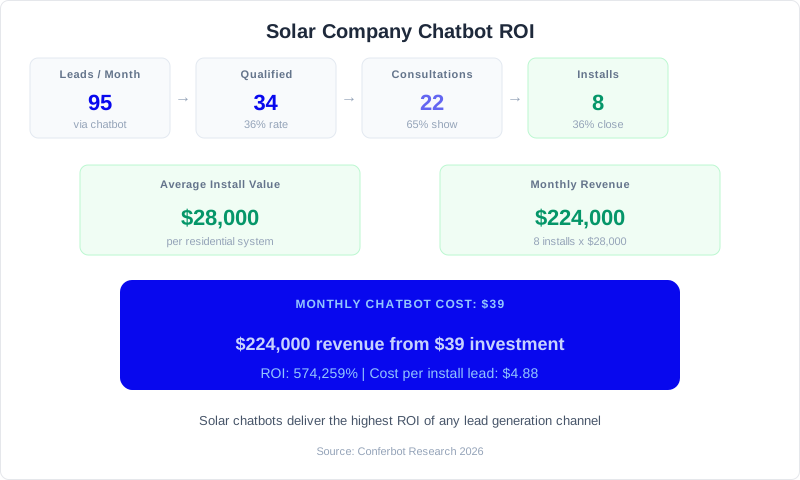
With a Calculator Chatbot
- Monthly ad spend: $15,000 (unchanged)
- Monthly clicks: 250 (unchanged)
- Chatbot engagement rate: 35% of visitors interact
- Monthly chatbot conversations: 87
- Chatbot completion rate: 55%
- Monthly completed qualifications: 48
- Of those, qualified leads: 60% (the chatbot pre-filters)
- Monthly qualified leads: 29
- Consultation-to-close rate: 30% (higher because leads are educated)
- Monthly closed deals: 8.7
- Monthly revenue from digital leads: $243,600
- Cost per qualified lead: $517
- Customer acquisition cost: $1,724
The Impact
- Qualified leads: 2 per month becomes 29 per month (14.5x increase)
- Cost per qualified lead: $7,500 becomes $517 (93% reduction)
- Monthly closed deals: 0.5 becomes 8.7 (17x increase)
- Monthly revenue: $14,000 becomes $243,600
- Customer acquisition cost: $30,000 becomes $1,724 (94% reduction)
Even if you cut these projections in half for conservatism, the chatbot is still delivering 7-8x more revenue from the same ad spend. The chatbot platform cost ($100-$200 per month) is negligible relative to the revenue impact. This is not marginal optimization -- it is a fundamental restructuring of your lead economics.
Secondary ROI Factors
Beyond the direct lead generation impact, the calculator chatbot delivers additional financial benefits that compound over time:
- Sales rep efficiency: Reps spend time only with pre-qualified, pre-educated prospects. This reduces wasted consultation time by 60-70% and allows each rep to handle 2-3x more qualified appointments per week.
- Reduced no-shows: Chatbot-scheduled appointments with automated SMS and email reminders experience 30-40% fewer no-shows than manually scheduled appointments.
- Faster sales cycle: Educated leads who have already seen a savings estimate and understand the financing options close 20-30% faster than cold leads, improving cash flow.
- Data-driven marketing: The chatbot's qualification data reveals which marketing channels, keywords, and campaigns generate the highest-quality leads, enabling smarter budget allocation.
- 24/7 lead capture: 65-70% of homeowners research solar outside business hours. Without a chatbot, these visitors bounce. With one, they engage, qualify, and book consultations while your office is closed.
How the Chatbot Handles Financing and Incentive Questions
Financing is where solar deals are won or lost. Most homeowners cannot or prefer not to pay $20,000 to $40,000 upfront for a solar system, and the complexity of solar financing options -- loans, leases, PPAs, cash purchases, tax credits, SRECs, net metering -- creates confusion that stalls decisions. A calculator chatbot that navigates financing questions confidently and clearly becomes your most effective pre-sales educator.
Explaining the Four Financing Options
When a homeowner asks about financing, the chatbot presents options conversationally rather than dumping a wall of text. It starts with the most popular option:
Solar loan (most popular, 60% of residential installations): "With a solar loan, you own the system from day one. There is usually no money down. Your monthly loan payment replaces your electric bill and is typically lower. For your estimated $24,600 system, monthly payments would be approximately $130-$160 over 20 years. Since your current electric bill is $310, you save from day one. Plus, you keep the $7,380 federal tax credit."
Cash purchase: "Paying cash gives you the highest total savings because there are no interest charges. For your system, you would invest approximately $24,600 upfront, receive $7,380 back from the federal tax credit, and save an estimated $89,000 over 25 years. Payback period is about 5 years."
Solar lease: "With a lease, you pay a fixed monthly amount and the solar company owns the panels. No upfront cost, no maintenance responsibility. Monthly payment is typically 20-30% less than your current electric bill. The trade-off is lower total savings since you do not own the system or receive the tax credit."
PPA (Power Purchase Agreement): "With a PPA, you pay only for the electricity the panels produce, at a rate lower than your utility charges. No upfront cost. You do not own the system. This option works well if you want simplicity with guaranteed savings."
Tax Credit Education
The federal Investment Tax Credit (ITC) is one of the most powerful financial incentives in solar, but homeowners frequently misunderstand it. The chatbot explains clearly: "The federal government offers a 30% tax credit on solar installations. For your $24,600 system, that is $7,380 you deduct directly from your federal taxes -- not from your taxable income, from your actual tax bill. If you owe $10,000 in federal taxes, you would only pay $2,620 after the solar tax credit. This credit is available through 2032 and then begins to phase down."
Addressing the "Too Good to Be True" Skepticism
Many homeowners are wary of solar sales claims, and rightfully so. The chatbot acknowledges this directly: "We understand the skepticism. Here is why the economics work: the federal government subsidizes 30% of the cost through the tax credit. Your utility company pays you for excess energy through net metering. And solar panel costs have dropped over 70% in the last decade, according to the Solar Energy Industries Association. These factors combined make solar financially viable for most homeowners. Your consultation will include a detailed, transparent financial analysis."
Net Metering Explained
Net metering confuses nearly every homeowner. The chatbot simplifies it: "Net metering means your utility credits you for the excess solar energy your panels produce. During the day, your panels often produce more electricity than your home uses. That excess goes to the grid, and your meter essentially runs backward. At night or on cloudy days, you draw from the grid. At the end of the billing period, you only pay for the net energy used. In most cases, your annual electric bill drops to just the minimum connection fee of $10-$20 per month."
Energy Calculation Logic: The Science Behind the Savings Estimate
A credible savings estimate requires more than simple arithmetic. The chatbot's calculation engine must account for geographic solar irradiance, local electricity rates, system degradation, utility rate escalation, and incentive stacking. Here is the methodology that powers an accurate solar calculator chatbot.
Solar Irradiance by Location
The United States varies dramatically in solar potential. Phoenix, Arizona receives approximately 6.5 peak sun hours per day, while Seattle, Washington gets about 3.8. The chatbot uses zip-code-level solar irradiance data from the National Renewable Energy Laboratory (NREL) PVWatts Calculator to determine the production factor for each location. This production factor -- measured in kWh produced per kW of installed capacity per year -- ranges from approximately 1,100 in the Pacific Northwest to 1,800+ in the Desert Southwest.
System Sizing Formula
The system size calculation works backward from energy consumption. The chatbot collects the monthly electric bill and divides by the local retail electricity rate (obtained from EIA data by zip code) to estimate monthly kWh consumption. It then multiplies by 12 for annual consumption and divides by the local production factor to determine the required system size in kW. A worked example: $310 monthly bill divided by $0.14/kWh local rate equals 2,214 kWh monthly consumption. Times 12 equals 26,571 kWh annually. Divided by 1,550 kWh/kW production factor for the Phoenix area equals a 17.1 kW system. In practice, system size is often constrained by available roof area, so the chatbot presents this as an upper bound.
System Cost Estimation
The chatbot uses regional average cost-per-watt data, which varies from $2.40 to $3.60 per watt depending on market, installer size, and equipment quality. For the Phoenix example: 17.1 kW times $2.80 per watt equals $47,880 gross system cost. After the 30% ITC ($14,364) and any state incentives, the net cost might be $32,000 to $35,000. The chatbot presents both gross and net costs transparently.
Savings Projection Methodology
Annual savings are calculated as current annual electricity cost minus the post-solar annual cost (typically just the utility minimum charge of $120-$240 per year). But 25-year projections must account for two factors: panel degradation (0.5-0.7% per year, meaning panels produce about 87% of original capacity in year 25) and utility rate escalation (historically 3-4% annually). These factors work in opposite directions -- degradation slightly reduces savings over time while rate escalation significantly increases them. The net effect is that savings grow over the system's lifespan.
Payback Period Calculation
The payback period is the number of years until cumulative savings equal the net system cost. For a net cost of $33,500 and first-year savings of $6,400 (growing at 3% annually due to rate escalation), the payback period is approximately 4.8 years. After payback, the homeowner enjoys essentially free electricity for the remaining 20+ years of the system's warranted lifespan. The chatbot presents payback period as one of the headline numbers because it directly answers the homeowner's key question: "How long until this pays for itself?"
Keeping Data Current
Electricity rates, incentive values, and solar equipment costs change regularly. The chatbot's calculation data should be refreshed quarterly at minimum. Federal ITC values and expiration dates should be updated whenever legislation changes. State-specific incentive databases like the DSIRE database are useful references for keeping state incentive data accurate.
Best Practices for Maximizing Solar Chatbot Performance
Deploying a solar calculator chatbot is the beginning, not the end, and continuous optimization should follow the data-driven approach endorsed by ENERGY STAR's energy efficiency programs. These best practices, drawn from high-performing solar companies, separate chatbots that generate a handful of leads from those that transform entire sales operations.
1. Lead Speed Is Everything
Solar leads have a half-life measured in hours. A homeowner who completes the chatbot qualification at 8 PM is browsing competitor websites by 9 PM. Configure instant push notifications and SMS alerts for qualified leads. Your sales team should respond within 15 minutes during business hours and within 2 hours outside business hours. Companies that respond within 5 minutes are 100x more likely to connect with the lead than those who wait 30 minutes, according to research from Lead Response Management.
2. Personalize Everything
Generic chatbot messages feel robotic. Personalized messages build trust. Use the homeowner's zip code to reference their specific city: "Great, solar is booming in Scottsdale right now." Reference their electric bill in the savings estimate. Mention their specific utility company's net metering policy. Every personalized detail signals that the chatbot is providing information specific to their situation, not a canned pitch.
3. Optimize for Mobile
Over 65% of solar research happens on mobile devices. Test your chatbot thoroughly on mobile: Are the buttons large enough to tap? Do the savings results display correctly on a small screen? Is the consultation booking calendar easy to navigate on a phone? A chatbot that works beautifully on desktop but is frustrating on mobile is losing the majority of its potential leads.
4. A/B Test Relentlessly
Test different greeting messages, qualification question orders, savings presentation formats, and call-to-action language. Does "Schedule your free consultation" convert better than "Get your detailed solar proposal"? Does asking about roof age before electric bill reduce drop-off? Does presenting monthly savings before total savings increase consultation bookings? Only data answers these questions. Run A/B tests continuously and let the results guide your optimization.
5. Handle Objections Within the Flow
Do not wait for homeowners to raise objections -- address them proactively at the points in the flow where they typically arise:
- After the savings estimate: "Your payback period of 5.5 years means 19.5 years of free electricity after that. And since utility rates rise 3-4% annually, your savings actually increase every year."
- After the system cost: "The 30% federal tax credit reduces your upfront cost by $7,380. With a solar loan, your monthly payment would be less than your current electric bill, so you save from day one."
- After the consultation booking: "This is a no-obligation consultation. Our specialist will provide a detailed proposal based on your specific roof and energy needs. There is no pressure to commit."
6. Implement Post-Qualification Nurture
Not every qualified lead books a consultation immediately. Some need time to discuss with a spouse, review finances, or simply think. The chatbot captures their contact information and enrolls them in a nurture sequence: a follow-up email with their personalized savings estimate, a customer testimonial from a neighbor in their area, a seasonal promotion ("Book before June 30 and lock in current pricing before our summer schedule fills up"), and a re-engagement chatbot message if they return to the website.
7. Track and Attribute Everything
Use UTM parameters to track which marketing channels, campaigns, and keywords drive chatbot engagements, completions, and qualified leads. This data feeds your marketing optimization loop. If Facebook ads drive high chatbot engagement but low qualification rates (lots of renters clicking), you can adjust targeting. If a specific Google Ads keyword drives low volume but extremely high qualification rates, you can increase the bid. The chatbot is not just a lead generation tool -- it is a marketing intelligence tool.
8. Update Messaging Seasonally
Solar demand is seasonal, and your chatbot messaging should reflect this. In spring: "Spring is the best time to install solar -- your system will be generating savings through the peak summer months." In late fall: "Install now to claim the tax credit on this year's tax return." When utility rate hikes are announced: "Your utility just announced a 6% rate increase effective January 1. Lock in your solar savings now and protect yourself from rising rates."
Advanced Features: AI-Powered Solar Sales Automation
The basic calculator chatbot handles qualification and estimation. Advanced implementations push further into AI-powered sales automation that can multiply your results.
Satellite Imagery Integration
The most impressive advanced feature is satellite-based roof analysis. When a homeowner provides their address, the chatbot triggers an API call to a mapping service and overlays potential panel placement on an actual image of their roof. "Here is your roof at 1234 Elm Street with a potential 24-panel layout on the south-facing section." Seeing their actual home with solar panels on it creates an emotional connection that abstract numbers alone cannot achieve. Services like Google Solar API and Project Sunroof provide the data foundation for this feature.
Predictive Lead Scoring
Machine learning models trained on your historical sales data can predict which chatbot leads are most likely to close. The model considers variables like electric bill amount, zip code demographics, roof age, response speed during the chat, questions asked, time of day, and device type. A lead score from 1-100 prioritizes your sales team's follow-up queue automatically. High-scoring leads (80+) get a same-day call. Mid-range leads (50-79) get an email with their savings estimate and a scheduling link. Low-scoring leads enter a long-term nurture sequence.
Multi-Channel Deployment
Your calculator chatbot should not live only on your website. Deploy it on WhatsApp for markets where WhatsApp is a primary communication channel, on Facebook Messenger for leads from social media ads, and via SMS for re-engagement campaigns. The same qualification logic and savings calculation works across all channels, meeting homeowners wherever they prefer to communicate.
Automated Follow-Up Sequences
After the initial chatbot conversation, AI-powered follow-up sequences can nurture leads through the decision process. A homeowner who completed qualification but did not book a consultation receives a sequence: Day 1 -- personalized savings estimate email with a booking link. Day 3 -- customer success story from their neighborhood. Day 7 -- educational content about the federal tax credit expiring. Day 14 -- time-sensitive offer (free panel upgrade, waived permit fees, etc.). These sequences are personalized based on the chatbot data and can be managed through Conferbot's AI platform.
Voice AI for Inbound Calls
Some homeowners still prefer to call. Voice AI can serve as the first point of contact for inbound calls, running the same qualification logic and savings calculation verbally. "Thank you for calling SunPower Solar. I can help you estimate your solar savings right now. Do you own your home?" Qualified callers are warm-transferred to a live sales rep with all the data already captured. This ensures that even phone leads are pre-qualified before consuming rep time.
Competitive Intelligence
The chatbot can identify when a homeowner is comparing multiple installers by recognizing questions like "How do your prices compare to [competitor]?" or "I got a quote from another company." The chatbot responds with competitive differentiators rather than price matching: "We would be happy to review your other quote during the consultation. Our customers often find that our equipment warranty, installation quality, and post-installation support offer better long-term value. Your specialist will provide a transparent comparison."
The Future of Solar Chatbot Technology
Solar chatbot technology is evolving rapidly, driven by advances in AI, computer vision, and energy modeling. Here is what the next 2-3 years hold for solar companies that invest in chatbot infrastructure today.
Instant AI-Generated Proposals
By 2027, the chatbot will generate a complete, branded solar proposal within the conversation. The homeowner provides their address and electric bill. The chatbot accesses satellite imagery, performs automated shading analysis, designs optimal panel placement, calculates production estimates, applies current incentive values, generates financing scenarios, and presents a multi-page proposal -- all within 90 seconds. This collapses the current 3-5 day proposal generation timeline to near-instant and gives your company a massive speed advantage over competitors still relying on manual design processes.
Conversational AI Sales Agents
Current chatbots follow structured flows with some NLP flexibility. Future AI agents will conduct genuinely conversational sales interactions, adapting their approach based on the homeowner's communication style, technical sophistication, and emotional state. They will detect hesitation and proactively address unstated concerns. They will identify buying signals and accelerate the path to commitment. The human sales rep will focus exclusively on the high-value consultation and close while AI handles every other touchpoint.
Integration with Smart Utility Data
With homeowner permission, chatbots will access real-time utility account data to provide hyper-accurate savings estimates based on actual hourly consumption patterns rather than monthly averages. A homeowner who consumes heavily during afternoon peak hours will see different (and often better) solar economics than one who consumes primarily at night. This granularity increases estimate accuracy to within 5% and dramatically boosts homeowner confidence in the numbers.
Community and Social Proof at Scale
Future chatbots will integrate neighborhood-level social proof: "Seven homes on your street already have solar installations. Your neighbor at 4523 Elm Street installed last March and is saving $285 per month." (With appropriate privacy controls and opt-in sharing from existing customers.) This hyper-local social proof is among the most powerful persuasion factors in solar adoption and will be seamlessly woven into chatbot conversations.
Starting Today
Solar companies that deploy calculator chatbots now are building the data foundation and organizational capabilities that will power these advanced features. Every chatbot conversation generates training data. Every qualification flow refinement improves conversion rates. Every integration makes the system more powerful. The cost of waiting is not just missed leads today -- it is falling behind competitors who are accumulating AI advantages that compound over time.
Build your solar calculator chatbot on Conferbot today. Deploy it on your website this week. Within 30 days, you will have hard data on how many qualified leads your website has been letting slip away -- and a system that captures them around the clock. Every day without a chatbot is a day of paying $45-$90 per click for traffic that bounces without converting. That era ends when your calculator chatbot goes live.
Was this article helpful?
About the Author

The Conferbot team specializes in conversational AI, chatbot strategy, and customer engagement automation. With deep expertise in building AI-powered chatbots, they help businesses deliver exceptional customer experiences across every channel.
View all articles