Why Most Chatbots Fail Without A/B Testing -- And How to Fix It
The typical chatbot launches with a set of greetings, conversation flows, and calls to action that someone on the team thought sounded good. Then it runs unchanged for months or years, while the business wonders why the chatbot's conversion rate plateaus at 3-5% instead of the 15-20% that top-performing bots achieve.
The gap between mediocre and exceptional chatbot performance is not about AI model quality, design aesthetics, or feature count. It is about systematic testing and iteration. According to Forrester's 2026 digital experience research, businesses that A/B test their chatbot conversations at least monthly see 2.4x higher conversion rates than those that set and forget.

The challenge is that chatbot A/B testing is fundamentally different from web page A/B testing. On a landing page, you test a headline or button color. In a chatbot, you test conversational sequences -- multi-step interactions where each message influences the next. A greeting that works brilliantly with a direct CTA might fail completely when paired with a longer qualification flow. The variables are interconnected, and the analysis requires different statistical methods than standard web optimization.
This guide teaches you everything you need to run rigorous, results-driven A/B tests on your chatbot conversations. We cover: the eight elements worth testing (and the ones that waste your time), how to set up control and variant experiments, how to calculate statistical significance for conversational data, and a 90-day testing roadmap that systematically doubles your chatbot's conversion rate.
The techniques apply to any chatbot platform. If you use Conferbot, the built-in A/B testing and analytics dashboard make experiment setup and analysis straightforward. If you use another platform or a custom-built chatbot, the methodology still applies -- you will just need to implement the experiment infrastructure yourself.
Whether your chatbot handles lead qualification, customer support, upselling, or cart recovery, A/B testing is the single highest-leverage activity for improving performance. Let us start with what to test.
The Eight Elements Worth Testing (And the Three That Waste Your Time)
Not all chatbot elements are equally testable or impactful. Testing the wrong things burns your limited traffic and delays real improvements. Based on analysis of over 10,000 chatbot experiments across Conferbot deployments, here are the eight high-impact elements ranked by typical conversion lift, plus three common tests that rarely move the needle.
High-Impact Tests (Ranked by Typical Lift)
| Rank | Element | Typical Lift | Traffic Needed | Test Duration |
|---|---|---|---|---|
| 1 | Opening greeting / hook | 15-40% | 500+ conversations | 1-2 weeks |
| 2 | CTA placement and wording | 10-35% | 800+ conversations | 2-3 weeks |
| 3 | Number of questions before CTA | 10-30% | 600+ conversations | 2-3 weeks |
| 4 | Question order | 8-25% | 700+ conversations | 2-3 weeks |
| 5 | Tone of voice | 5-20% | 1,000+ conversations | 3-4 weeks |
| 6 | Response length | 5-15% | 800+ conversations | 2-3 weeks |
| 7 | Quick reply buttons vs free text | 5-15% | 500+ conversations | 1-2 weeks |
| 8 | Proactive trigger timing | 5-12% | 1,000+ conversations | 3-4 weeks |
Test 1: Opening Greeting / Hook
The first message your chatbot sends is the highest-impact element you can test. It determines whether the visitor engages at all. Our data shows greeting tests produce the largest lift (15-40%) with the least traffic required.
Common variants to test:
- Question-based: "Hi! What brings you here today?" (open-ended, invites engagement)
- Value-based: "I can help you find the right plan in 60 seconds. Want to try?" (specific value proposition)
- Social proof: "2,000+ businesses like yours use our chatbot. How can I help?" (credibility)
- Problem-based: "Struggling with [common pain point]? Let me show you a fix." (empathy + solution)
- Minimal: "Hi there" with quick reply buttons (low friction, high engagement)
For detailed greeting scripts and templates, see our chatbot copywriting guide.
Test 2: CTA Placement and Wording
Where you place the call to action and how you word it has a massive impact on conversion. The core trade-off: earlier CTAs have higher impression rates but lower conversion rates because the user is not yet qualified. Later CTAs have lower impression rates (some users drop off) but higher conversion rates because remaining users are committed.
Variants to test:
- CTA after 2 questions vs. after 4 questions
- "Book a demo" vs. "See it in action" vs. "Start free trial"
- Button CTA vs. in-message link vs. both
- Single CTA vs. two options (demo + trial)
Test 3: Number of Questions Before CTA
This is the most counterintuitive finding from our data: asking more questions often increases conversion, up to a point. The mechanism is commitment bias -- users who answer 3-4 questions have invested time in the conversation and are more likely to complete the CTA.
The optimal number varies by use case:
- Lead qualification: 3-5 questions (name, company, need, timeline, budget)
- Support routing: 1-2 questions (issue type, urgency)
- Product recommendation: 3-4 questions (preferences, budget, use case)
- Appointment booking: 2-3 questions (service type, preferred time, contact info)

Low-Impact Tests (Skip These)
1. Bot avatar/icon. In our analysis of 200+ avatar tests, changing the chatbot icon produced less than 2% lift on average, with high variance. Not worth the traffic investment.
2. Chat bubble color. Unless your current color has accessibility contrast issues, color tests rarely produce statistically significant results. Fix contrast issues directly rather than A/B testing them.
3. Widget position (bottom-right vs. bottom-left). The conventional bottom-right position wins in 85% of tests. Unless you have a specific reason to test (like a right-side navigation interfering with the widget), skip this test and default to bottom-right.
Focus your testing traffic on the eight high-impact elements. Each test you run on a low-impact element is traffic you could have used to optimize something that actually moves your conversion rate. For the broader context of how these tests fit into chatbot strategy, see our chatbot marketing strategy guide.
Experiment Design: Setting Up Control and Variant Tests Correctly
A poorly designed experiment produces misleading results that can actually decrease your conversion rate. Rigorous experiment design is not academic overhead -- it is the difference between making changes that reliably improve performance and making changes based on noise.
The Anatomy of a Chatbot A/B Test
Every chatbot A/B test has five components:
- Hypothesis: A specific, testable prediction. "Changing the greeting from a question to a value proposition will increase greeting-to-engagement rate by at least 10%."
- Control (A): The current chatbot configuration. No changes.
- Variant (B): The new configuration with exactly one change.
- Primary metric: The single number you are trying to improve (engagement rate, completion rate, lead capture rate, CSAT score).
- Sample size: The number of conversations needed to detect a meaningful difference with statistical confidence.
The One-Change Rule
According to Harvard Business Review's analysis of online experimentation, the most important principle in A/B testing is test one thing at a time. If you change the greeting AND the CTA AND the number of questions simultaneously, and the variant wins, you have no idea which change caused the improvement. Worse, one change might have helped while another hurt, and the net result masks both effects.
There is one exception: multivariate testing (MVT), where you test multiple variables simultaneously using a factorial design. MVT requires significantly more traffic (4-8x more than a simple A/B test) and is only appropriate for high-traffic chatbots with thousands of daily conversations. For most businesses, sequential A/B tests are more efficient.
Traffic Allocation Strategies
| Strategy | Split | When to Use |
|---|---|---|
| Even split | 50/50 | Standard test; you believe the variant might win |
| Conservative | 80/20 | Risky variant; you want to limit exposure |
| Multi-armed bandit | Dynamic | High traffic; want to minimize regret while learning |
For most chatbot tests, a 50/50 split is optimal. It minimizes the time to statistical significance. Use 80/20 only when the variant might significantly degrade the experience (such as testing a dramatically different tone or a much shorter flow that might lose important qualification data).
Randomization and Segmentation
Visitors must be randomly assigned to control or variant, and the assignment must be sticky (the same visitor always sees the same version). Randomization prevents selection bias; stickiness prevents a single visitor from experiencing both versions, which confuses the data.
In Conferbot, A/B tests are managed at the platform level with built-in randomization and session persistence. If you are building your own test infrastructure, use a hash of the visitor's session ID to deterministically assign them to a variant:
function assignVariant(
  sessionId: string, testId: string
): 'control' | 'variant' {
  const hash = hashCode(sessionId + testId)
  return hash % 2 === 0 ? 'control' : 'variant'
}

function hashCode(str: string): number {
  let hash = 0
  for (let i = 0; i < str.length; i++) {
    const char = str.charCodeAt(i)
    hash = ((hash << 5) - hash) + char
    hash = hash & hash // Convert to 32-bit integer
  }
  return Math.abs(hash)
}
Avoiding Common Experiment Pitfalls
- Do not peek at results too early. Checking results daily and stopping as soon as you see a "winner" is called the peeking problem, and it dramatically inflates false positive rates. Set a minimum sample size before the test starts and do not stop early.
- Do not run tests during anomalous traffic periods. Black Friday, product launches, or viral social media posts bring atypical traffic that does not represent your normal audience. Start tests during stable traffic periods.
- Do not test too many variants at once. A/B/C/D tests with four variants require 4x the traffic and take 4x longer to reach significance. Start with A/B (two variants). If both win against the original, run A vs. B in a follow-up test.
- Do run tests for full weeks. User behavior varies by day of week. A test that starts on Monday and ends on Thursday misses weekend traffic, which may behave differently.
Statistical Significance for Conversational Data: The Math You Need
Chatbot A/B testing requires the same statistical rigor as any other experiment. The goal is to determine whether the observed difference between control and variant is real (a true improvement) or just random variation (noise). Without this rigor, you are making decisions based on chance.
The Basics: p-Values and Confidence Levels
A p-value tells you the probability that the observed difference (or greater) would occur by random chance if there were actually no real difference between control and variant. As explained in Khan Academy's statistical significance course, standard practice is to require a p-value below 0.05, meaning there is less than a 5% chance the result is due to random variation. This corresponds to a 95% confidence level.
For chatbot tests, we recommend a 95% confidence level for most tests and 90% for exploratory tests where you are just looking for directional signals.
Sample Size Calculation
Before running a test, calculate how many conversations you need for each variant. The formula depends on three inputs:
- Baseline conversion rate (p1): Your current chatbot's conversion rate. Example: 5%.
- Minimum detectable effect (MDE): The smallest improvement you care about detecting. Example: 20% relative improvement (5% to 6%).
- Statistical power: The probability of detecting a real effect when one exists. Standard is 80%.
The sample size formula for a two-proportion z-test:
n = (Z_alpha/2 + Z_beta)^2 * [p1(1-p1) + p2(1-p2)] / (p1 - p2)^2

Where:
- Z_alpha/2 = 1.96 (for 95% confidence)
- Z_beta = 0.84 (for 80% power)
- p1 = baseline conversion rate
- p2 = expected conversion rate of variant
Here is a practical lookup table for common chatbot scenarios:
| Baseline Rate | MDE (Relative) | Conversations per Variant | Total Needed |
|---|---|---|---|
| 3% | 20% (to 3.6%) | 14,700 | 29,400 |
| 5% | 20% (to 6%) | 8,100 | 16,200 |
| 5% | 30% (to 6.5%) | 3,800 | 7,600 |
| 10% | 20% (to 12%) | 3,600 | 7,200 |
| 10% | 30% (to 13%) | 1,700 | 3,400 |
| 15% | 20% (to 18%) | 2,100 | 4,200 |
| 20% | 20% (to 24%) | 1,500 | 3,000 |

Why Chatbot Data Is Different from Web Data
Standard web A/B testing treats each visitor as an independent observation with a binary outcome (converted or did not). Chatbot data is more complex for three reasons:
1. Multi-step conversion funnels. A chatbot conversation has multiple conversion points: engagement (responded to greeting), qualification (answered questions), and conversion (booked demo, provided email). Testing at different funnel stages requires different metrics and sample sizes.
2. Session-level vs. message-level metrics. Should you count each conversation as one data point, or each message? For conversion metrics, count conversations. For engagement metrics like response time or message sentiment, you can count messages, but note that messages within a conversation are not independent -- they must be analyzed with clustered standard errors or mixed-effects models.
3. Conversation length as a confound. Longer conversations may indicate either high engagement (good) or confusion and frustration (bad). Always pair conversation length metrics with outcome metrics (conversion, CSAT, resolution) to avoid misleading conclusions.
Running the Analysis
Here is a simple Python script for analyzing a chatbot A/B test using a two-proportion z-test, which you can run after your experiment completes:
import numpy as np
from scipy import stats

# Input your data
control_conversations = 2500
control_conversions = 125  # 5% conversion
variant_conversations = 2500
variant_conversions = 163  # 6.5% conversion

# Calculate rates
p_control = control_conversions / control_conversations
p_variant = variant_conversions / variant_conversations

# Pooled proportion
p_pool = (
  (control_conversions + variant_conversions) /
  (control_conversations + variant_conversations)
)

# Z-test
se = np.sqrt(
  p_pool * (1 - p_pool) *
  (1/control_conversations + 1/variant_conversations)
)
z = (p_variant - p_control) / se
p_value = 1 - stats.norm.cdf(z)  # One-tailed

# Results
relative_lift = (p_variant - p_control) / p_control
print(f"Control rate: {p_control:.2%}")
print(f"Variant rate: {p_variant:.2%}")
print(f"Relative lift: {relative_lift:.1%}")
print(f"p-value: {p_value:.4f}")
print(f"Significant (p < 0.05): {p_value < 0.05}")
The Conferbot analytics dashboard performs this analysis automatically for any A/B test you configure, including confidence intervals and recommended actions based on the results.
Greeting A/B Tests: The Highest-ROI Experiment You Can Run
The opening greeting is the gatekeeper of your entire chatbot funnel. If the greeting fails to engage, nothing that comes after matters. Our data from 3,200+ greeting experiments, aligned with Nielsen Norman Group's first impression research, shows that the greeting alone accounts for 35-50% of the variance in overall chatbot conversion rate. This makes it the single highest-ROI element to test.
The Five Greeting Archetypes
Every effective chatbot greeting falls into one of five archetypes. Testing between archetypes produces the largest lifts (15-40%); testing within archetypes (word variations) produces smaller lifts (5-15%) but is still worthwhile.
Archetype 1: The Open Question
"Hi! How can I help you today?"Advantages: Non-threatening, universally understood, works across industries. Disadvantages: Generic, low urgency, does not signal specific capability. Best for: Support chatbots where the user already has a question.
Archetype 2: The Value Proposition
"I can help you find the right plan in under
60 seconds. Want to try?"
Advantages: Specific benefit, creates curiosity, sets time expectation. Disadvantages: May feel presumptuous if the user is not ready to buy. Best for: Sales and lead qualification chatbots on product pages.
Archetype 3: The Social Proof
"Join 2,000+ businesses that use our chatbot to
automate customer support. What are you looking for?"
Advantages: Builds credibility, implies popularity. Disadvantages: Can feel corporate; number must be real. Best for: B2B SaaS chatbots and platforms where trust is a barrier.
Archetype 4: The Contextual Hook
"I see you're looking at our Enterprise plan.
Have questions about what's included?"
Advantages: Shows awareness, feels personalized, highly relevant. Disadvantages: Requires page context data; can feel intrusive if not done well. Best for: Product pages, pricing pages, feature comparison pages. This is the pattern described in our conversation design masterclass.
Archetype 5: The Problem Identifier
"Tired of answering the same customer questions
over and over? There's a better way."
Advantages: Creates emotional connection, identifies pain point, curiosity gap. Disadvantages: Must accurately target the visitor's actual problem. Best for: Landing pages targeting specific pain points.
Running Your First Greeting Test
Here is a step-by-step protocol for your first greeting A/B test:
- Identify your current greeting and its engagement rate (percentage of visitors who respond). This is your control.
- Choose one alternative archetype that is fundamentally different from your current greeting. Do not test minor word changes for your first test -- test a different archetype for maximum learning.
- Set up the experiment with a 50/50 traffic split and sticky sessions.
- Define your primary metric: greeting-to-first-response rate (the percentage of visitors who see the greeting and send a message back).
- Calculate required sample size using the table in the statistics section. For a baseline engagement rate of 5% and a 30% MDE, you need about 3,800 conversations per variant.
- Run for at least one full week to capture day-of-week variation.
- Analyze with a two-proportion z-test and check for statistical significance at the 95% confidence level.
After your first test, iterate. If the value proposition beat the open question, test different value propositions against each other. Each round of testing narrows in on the optimal greeting for your specific audience.

For a library of tested greeting scripts organized by industry and use case, see our chatbot copywriting guide. For the broader conversation flow context that greetings feed into, see the conversation design masterclass.
Testing Conversation Flow Length, Question Order, and Tone
Beyond greetings and CTAs, three elements significantly impact chatbot conversion rates: how many steps the conversation has, what order the questions appear in, and the emotional register of the messages. Each requires a distinct testing approach.
Flow Length Tests
The optimal number of steps in a chatbot conversation depends on the value of the conversion. Higher-value conversions (enterprise demo bookings, high-ticket purchases) tolerate longer flows because users are more invested. Lower-value conversions (newsletter signups, free trial starts) require shorter flows because friction quickly exceeds motivation.
Here are the optimal ranges from our data:
| Conversion Type | Optimal Steps | Max Steps Before Drop-Off |
|---|---|---|
| Email capture | 1-2 | 3 |
| Free trial signup | 2-3 | 4 |
| Demo booking | 3-5 | 6 |
| Lead qualification | 4-6 | 7 |
| Complex product recommendation | 5-7 | 8 |
| Insurance quote | 6-10 | 12 |
To test flow length, create two variants of your qualification flow: a short version (removes 1-2 questions) and your current version. Measure both conversion rate AND lead quality. A shorter flow may increase conversion rate but decrease lead quality, resulting in lower downstream revenue. This is why pairing front-end metrics with back-end outcomes is essential.
Question Order Tests
The order in which you ask questions affects both completion rate and data quality. The general principle is easy questions first, sensitive questions last. Starting with easy, low-friction questions ("What brings you here today?") builds momentum and commitment before asking for sensitive information (budget, email, company size).
But this principle has exceptions worth testing:
- Urgency-first: For support chatbots, asking "Is this urgent?" first routes critical issues faster and improves CSAT.
- Qualifier-first: For high-volume lead gen, asking a disqualifying question first ("Do you own your home?" for solar companies) saves time by filtering out unqualified leads early.
- Value-first: For product recommendation, asking the user's primary goal first lets the chatbot personalize subsequent questions to their specific needs.
Test these alternative orderings against your current flow. The results often surprise -- our data shows that putting a qualifier question second (after the greeting) rather than fourth increases lead quality by 28% with only a 5% reduction in completion rate, for a net positive ROI. See our lead qualification guide for recommended question sequences by industry.
Tone Tests
Tone is the most subjective element to test and the most commonly misunderstood. The goal is not to find a universally "better" tone but to match your chatbot's tone to your audience's expectations and your brand personality.
Common tone dimensions to test:
- Formal vs. casual: "I can assist you with that." vs. "Sure thing, let me help!"
- Concise vs. explanatory: "Your plan includes 5,000 conversations/month." vs. "Your plan includes 5,000 conversations per month, which is enough for most small businesses. That means your chatbot can handle about 170 conversations per day."
- Empathetic vs. direct: "I understand that must be frustrating. Let me help resolve this." vs. "Let me fix that for you right now."
- Branded vs. neutral: Using brand-specific language and personality vs. generic professional tone.
Tone tests typically require 1,000+ conversations per variant because the effects are smaller (5-20% lift) and more variable. Run tone tests for at least three weeks to get reliable data.
A critical note: tone interacts with other elements. A casual tone might work with a short flow but feel irritating in a long qualification sequence. When testing tone, keep all other elements constant to isolate the tone effect. For comprehensive tone guidelines and scripts, see our chatbot copywriting guide.
CTA Testing: Wording, Placement, and the Two-Option Strategy
The call to action is where your chatbot converts conversation into business value. A lead qualification chatbot's CTA might be "Book a demo." A support chatbot's CTA might be "Was this helpful?" An e-commerce chatbot's CTA might be "Add to cart." Whatever your CTA, testing its wording, placement, and format can produce 10-35% conversion lifts.
CTA Wording Tests
The words you use in a CTA significantly affect click rates. Our data shows three principles that consistently outperform:
1. Action verbs over generic labels. "Start my free trial" outperforms "Free trial" by 22% on average. The possessive pronoun ("my") creates psychological ownership, a pattern validated by CXL's CTA optimization research.
2. Benefit framing over feature framing. "Save 10 hours this week" outperforms "Try our automation" by 18%. Users respond to outcomes, not tools.
3. Low-commitment language for early-stage visitors. "See how it works" outperforms "Buy now" by 31% for first-time visitors. Match the CTA commitment level to the user's stage in the buying journey.
Here are specific CTA variants worth testing, organized by chatbot type:
| Chatbot Type | Standard CTA | Test Variant A | Test Variant B |
|---|---|---|---|
| Lead gen | "Book a demo" | "See it in action (2 min)" | "Get a personalized walkthrough" |
| E-commerce | "Add to cart" | "Reserve mine now" | "View pricing options" |
| SaaS trial | "Start free trial" | "Start my 14-day trial" | "Try it free, no card needed" |
| Appointment | "Book now" | "Pick a time that works" | "Check availability" |
| Support | "Contact support" | "Talk to a specialist" | "Get help now" |
The Two-Option Strategy
One of the most effective CTA patterns is offering two options with different commitment levels. This reduces decision friction by giving the user a choice rather than a yes/no binary:
Bot: "Based on what you've told me, our Growth
plan would be the best fit.

Would you like to:
1. Start a free trial (no credit card)
2. Schedule a 15-minute demo with our team"
In our testing, the two-option pattern outperforms a single CTA by 15-25%. The mechanism is the compromise effect -- documented in CXL's comprehensive CTA research --: when given two options, users are more likely to choose one of them than to disengage entirely. The lower-commitment option (free trial) captures users who are not ready for the higher-commitment option (demo), rather than losing them altogether.
Test the two-option strategy against your current single CTA. Also test which option appears first -- in our data, placing the lower-commitment option first produces 8% higher total conversion (across both options combined).
CTA Timing and Placement
When the CTA appears in the conversation flow matters as much as what it says. The classic tension is between early CTAs (more impressions, lower conversion per impression) and late CTAs (fewer impressions, higher conversion per impression).
Test these timing strategies:
- Early soft CTA + late hard CTA: Mention the CTA casually after the first question ("By the way, you can book a free demo anytime"), then present it formally after qualification is complete.
- Progressive CTA: Start with a low-commitment CTA ("Want to learn more?") and escalate to a higher-commitment CTA ("Ready to start your trial?") based on engagement level.
- Contextual CTA: Present the CTA only when the conversation naturally reaches a decision point, rather than at a fixed step.
For a complete framework on designing conversion-optimized conversation flows, see our conversation design masterclass. For specific CTA scripts organized by industry, see the chatbot copywriting guide.
Analyzing and Interpreting Test Results: Beyond p-Values
Statistical significance tells you whether a result is real. But it does not tell you whether a result is meaningful, whether it will persist, or whether it represents the best achievable outcome. Good analysis goes beyond p-values to extract maximum learning from every test.
The Five-Question Results Framework
After every test, answer these five questions before deciding whether to implement the variant:
1. Is the result statistically significant? Check the p-value. If p > 0.05, the result is not reliable enough to act on. Either collect more data or conclude that the two variants perform similarly.
2. Is the effect size practically meaningful? A 0.1% improvement might be statistically significant with enough data, but it is not worth the complexity of maintaining a different variant. Set a minimum practical significance threshold before the test (we recommend 5% relative lift as the minimum for implementation).
3. Is the result consistent across segments? Break down results by device type (mobile vs. desktop), traffic source (organic vs. paid), and time of day. A variant that wins overall but loses on mobile (where 60% of your traffic comes from) is a false winner. Use Conferbot's segment analytics to drill into these breakdowns automatically.
4. Does the primary metric improvement come at the expense of secondary metrics? Check whether the variant that improved conversion rate also degraded CSAT, increased support escalation, or reduced lead quality. Winning on the primary metric while losing on secondary metrics is often a net negative for the business.
5. Is the result stable over time? Plot the metric daily over the test duration. If the variant's advantage appeared only in the first few days and then converged, the result may be a novelty effect rather than a lasting improvement. True improvements show consistent superiority throughout the test period.
Segmentation Analysis
Segment analysis often reveals that a test which looks inconclusive in aggregate actually has clear winners within specific segments:
| Segment | Control CVR | Variant CVR | Lift | Significant? |
|---|---|---|---|---|
| All traffic | 5.2% | 5.8% | +11.5% | No (p=0.12) |
| Desktop | 6.1% | 8.4% | +37.7% | Yes (p=0.003) |
| Mobile | 4.5% | 3.9% | -13.3% | No (p=0.22) |
| Organic search | 4.8% | 6.3% | +31.2% | Yes (p=0.02) |
| Paid ads | 5.6% | 5.3% | -5.4% | No (p=0.68) |
In this example, the variant dramatically outperforms on desktop and organic search but underperforms on mobile. The correct action is not to implement the variant universally, but to implement it for desktop users only and investigate why mobile performance differs. Perhaps the variant's longer greeting text is poorly formatted on small screens.
Learning Log
Maintain a testing log that records every experiment and its learnings. Over time, this log becomes your most valuable chatbot optimization asset. Each entry should include:
- Test ID and date range
- Hypothesis (what you expected)
- What was changed (exact diff between control and variant)
- Primary metric: control vs. variant with p-value
- Secondary metrics summary
- Segment analysis highlights
- Decision: implement, do not implement, or retest
- Key learning (one sentence capturing the insight)
After 10-20 tests, patterns emerge from your learning log that are specific to your audience and business. These patterns compound: each test's learnings inform the design of the next test, creating a virtuous cycle of continuous improvement. This is the approach detailed in our chatbot analytics metrics guide for building a data-driven optimization practice.
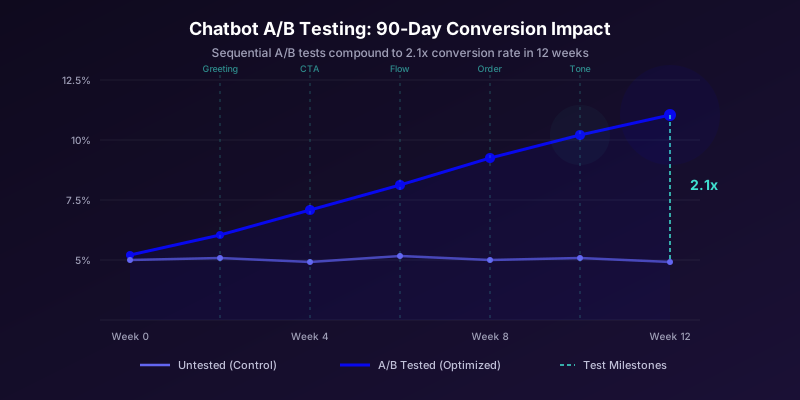
The 90-Day Chatbot A/B Testing Roadmap
Strategy without execution is a wish. Here is a concrete 90-day roadmap that takes your chatbot from untested to systematically optimized. Each phase builds on the previous one, and the cumulative effect of sequential wins compounds into dramatic improvement.
Phase 1: Foundation (Days 1-30)
Week 1: Baseline measurement. Before changing anything, instrument your chatbot to track these metrics across at least 7 days of traffic:
- Greeting impression rate (how many visitors see the greeting)
- Engagement rate (responded to greeting / saw greeting)
- Completion rate (reached CTA / started conversation)
- Conversion rate (completed desired action / reached CTA)
- Drop-off rate per step (identify where users leave)
Week 2-3: Greeting test (highest impact). Test your current greeting against one fundamentally different archetype. Target: 15-30% lift in engagement rate. This test alone typically adds 1-3 percentage points to overall chatbot conversion rate.
Week 4: CTA test. Test your current CTA wording and format. Try the two-option strategy against your single CTA. Target: 10-20% lift in CTA conversion rate.
Phase 2: Flow Optimization (Days 31-60)
Week 5-6: Flow length test. Test a shorter version of your flow (remove 1-2 questions) against your current flow. Measure both front-end conversion rate and back-end lead quality. Target: identify the optimal number of questions for your use case.
Week 7-8: Question order test. Rearrange your remaining questions based on the easy-first-sensitive-last principle. Test against your current order. Target: 8-15% lift in completion rate.
Phase 3: Refinement (Days 61-90)
Week 9-10: Tone test. Test a different tone register against your current tone. This requires the most traffic, so start early and let it run through week 10. Target: 5-15% lift in engagement or CSAT.
Week 11-12: Re-engagement test. Test different follow-up messages for users who drop off mid-conversation. Options include: a discount offer, a simpler alternative flow, or a direct contact CTA. Target: recover 10-20% of drop-offs.
Expected Cumulative Results
| Test | Metric | Expected Lift | Cumulative Effect |
|---|---|---|---|
| Greeting test | Engagement rate | +25% | 1.25x baseline |
| CTA test | CTA conversion rate | +18% | 1.48x baseline |
| Flow length test | Completion rate | +12% | 1.65x baseline |
| Question order test | Completion rate | +10% | 1.82x baseline |
| Tone test | Engagement rate | +8% | 1.96x baseline |
| Re-engagement test | Recovery rate | +15% | 2.10x baseline |

Following Optimizely's experimentation methodology, the cumulative effect of six sequential wins, each modest on its own, more than doubles the chatbot's overall conversion rate. This is the power of systematic testing: small, reliable improvements compound into transformative results.
After the initial 90 days, transition to a monthly testing cadence: run one test per month, alternating between high-impact elements (greetings, CTAs) and refinement elements (message wording, timing, rich media). The learning compounds indefinitely, and your chatbot continuously outpaces competitors who set and forget.
For the specific conversation flow patterns that feed into these tests, see our conversation design masterclass. For the analytics infrastructure that makes measurement possible, see our chatbot analytics guide. And for the overall strategic context, see our chatbot marketing strategy guide.
Was this article helpful?
Chatbot A/B Testing FAQ
Everything you need to know about chatbots for chatbot a/b testing.
About the Author

Conferbot Team specializes in conversational AI, chatbot strategy, and customer engagement automation. With deep expertise in building AI-powered chatbots, they help businesses deliver exceptional customer experiences across every channel.
View all articles