The Retention Crisis: Why Keeping Customers Is the New Growth Strategy
Customer acquisition costs have increased by 222% over the past decade, according to data from ProfitWell's SaaS benchmarking research. Meanwhile, the probability of selling to an existing customer is 60 to 70 percent, compared to just 5 to 20 percent for new prospects. The math is clear: in 2026, sustainable growth increasingly depends on keeping the customers you already have rather than continuously filling a leaky bucket with expensive new acquisitions.
Yet most businesses still allocate 80% of their marketing budget to acquisition and only 20% to retention—a ratio that is economically backwards for any company past the early growth stage. The reason is not ignorance of retention's value; it is the perceived difficulty of executing retention at scale. How do you proactively engage thousands of customers before they churn? How do you identify at-risk customers before they leave? How do you personalize win-back efforts across diverse customer segments?
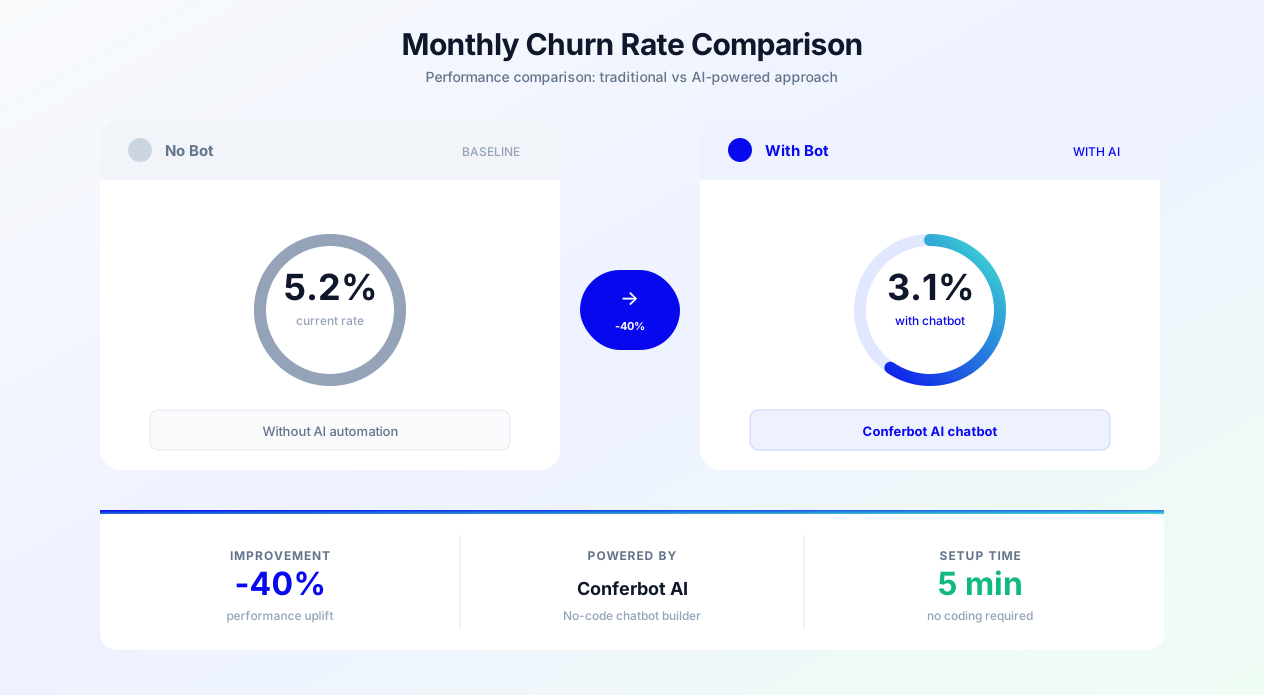
The answer is AI chatbots purpose-built for retention. Unlike reactive support chatbots that wait for customers to reach out with problems, retention chatbots proactively engage customers based on behavioral signals, predicted churn risk, and lifecycle stage. They deliver personalized interventions—loyalty rewards, usage tips, feedback collection, re-engagement offers—at scale, 24 hours a day, across every channel where your customers live.
The results are compelling. Businesses implementing proactive retention chatbots report 25 to 35 percent reductions in churn rate, 15 to 20 percent improvements in NPS, and customer lifetime value increases of 40% or more. A 5% improvement in customer retention increases profits by 25 to 95 percent, according to research published in Harvard Business Review. When you apply chatbot automation to retention, you are compounding this profit multiplier across your entire customer base.
This guide covers the complete retention chatbot strategy: churn indicators and prediction models, proactive engagement frameworks, win-back campaign automation, loyalty program integration, customer health scoring, NPS improvement tactics, industry-specific retention playbooks, ROI analysis, and a practical implementation timeline. Whether you run a SaaS business, an e-commerce store, or a subscription service, you will find actionable strategies to deploy immediately.
Churn Indicators and Prediction: How AI Identifies At-Risk Customers
The most effective retention strategy is preventing churn before it happens. AI chatbots integrated with customer data platforms can identify at-risk customers weeks or months before they actually leave, giving you time to intervene. Here are the key churn indicators by business model:
SaaS and Subscription Churn Signals
| Churn Signal | Risk Level | Typical Lead Time Before Churn | Chatbot Intervention |
|---|---|---|---|
| Login frequency drops by 50% or more | High | 30 to 60 days | Proactive check-in with usage tips and feature highlights |
| Key features unused for 14+ days | Medium | 45 to 90 days | Feature education and guided walkthrough |
| Support ticket spike (3+ in 2 weeks) | High | 15 to 30 days | Priority resolution plus satisfaction check |
| Billing page visited without upgrade | Medium | 30 to 45 days | Offer value reinforcement or plan adjustment |
| Admin user inactive for 7+ days | High | 20 to 40 days | Direct outreach to decision-maker |
| Data export initiated | Critical | 7 to 14 days | Immediate high-touch intervention |
| Cancel button clicked but not completed | Critical | 1 to 7 days | Real-time save offer with reason inquiry |
E-Commerce Churn Signals
| Churn Signal | Risk Level | Detection Method | Chatbot Intervention |
|---|---|---|---|
| No purchase in 2x average purchase cycle | High | RFM analysis | Re-engagement offer with personalized recommendations |
| Email open rate drops below 5% | Medium | Email analytics | Switch to chatbot channel with fresh content |
| Cart abandonment rate increases | Medium | Session analytics | Proactive assistance and friction removal |
| Negative review or low NPS response | High | Feedback system | Immediate follow-up with resolution and recovery offer |
| Website visits without purchase (3+ sessions) | Medium | Behavioral tracking | Personalized offer or loyalty reward reminder |
How AI Churn Prediction Works
Modern churn prediction models use machine learning trained on historical churn data. The model learns which combinations of signals (not just individual signals) predict churn with high accuracy. For example, a single missed login is low risk. But a missed login PLUS a recent support complaint PLUS no feature adoption in 14 days creates a compound risk score that is highly predictive.
The chatbot system ingests these risk scores from your data platform and triggers appropriate interventions based on the score level and the specific signals driving it. A customer at risk due to low feature adoption gets educational content. A customer at risk due to support frustration gets priority resolution and a satisfaction check. A customer at risk due to disengagement gets a re-engagement offer. The intervention matches the cause, not just the symptom.
Research from Forrester's customer retention analytics shows that leading platforms achieve churn prediction accuracy of 70 to 85 percent when combining behavioral, transactional, and engagement signals. This means your chatbot can reach out to 100 at-risk customers, knowing that 70 to 85 of them would have actually churned without intervention—making the outreach relevant rather than random.
Proactive Engagement via Chatbot: Intervening Before Customers Decide to Leave
Traditional customer service is reactive, a model that Gartner's customer service research identifies as increasingly obsolete—you wait for the customer to reach out with a problem. Proactive engagement flips this model: the chatbot reaches out to the customer based on signals that suggest they need attention, support, or a reason to stay. This proactive approach is the core mechanism through which retention chatbots reduce churn.
Types of Proactive Engagement
1. Value Reinforcement Outreach: When usage declines, the chatbot reminds customers of the value they are (or could be) getting. "Hi Sarah! I noticed you have not used our analytics dashboard recently. Did you know we added three new report templates last month? Here is a quick tour of what is new." This re-engages without being pushy and addresses the common churn cause of perceived value decline.
2. Feature Education: Many customers churn because they never discover features that would make the product indispensable. The chatbot identifies unused features relevant to the customer's use case and introduces them proactively. "You have been creating reports manually each week. Did you know you can schedule automated reports that deliver to your inbox every Monday? Let me show you how—it takes 30 seconds to set up."
3. Milestone Celebrations: Recognizing customer achievements builds emotional connection. "Congratulations! You have processed your 1,000th order through our platform this month. That is a 23% increase over last month. Keep it up!" These moments of recognition make customers feel valued and noticed, which builds switching costs.
4. Friction Detection and Resolution: When the chatbot detects repeated errors, abandoned workflows, or confusion signals (visiting help docs repeatedly for the same topic), it proactively offers assistance. "I noticed you have been working on the integration setup. Is there anything I can help with? Many users find step 3 tricky—here is a quick walkthrough."
5. Feedback Collection at Key Moments: Rather than sending annual surveys, the chatbot collects feedback at moments of high engagement or potential friction. "You just completed your first month with us! On a scale of 1 to 10, how likely are you to recommend us to a colleague? Your feedback helps us improve." Learn more about effective chatbot-driven NPS and feedback collection.
Engagement Timing and Frequency
Proactive engagement must be carefully calibrated. Too frequent and it becomes annoying; too sparse and it has no impact. Here are evidence-based guidelines:
- Maximum proactive outreach frequency: No more than 2 proactive messages per week per customer across all channels combined
- Optimal timing: Send messages during the customer's typical active hours (learned from usage patterns), not at fixed times
- Cool-down after interaction: After any customer-initiated interaction (support ticket, purchase, login), wait at least 48 hours before proactive outreach
- Escalating cadence for at-risk: For high-risk customers, increase cadence slightly—but shift to higher-value interventions (offers, executive outreach) rather than just more messages
Channel Selection for Proactive Engagement
The chatbot should reach customers on the channel where they are most responsive:
- In-app/on-site chatbot: Best for active users currently in the product. Highest engagement rate (35 to 45% response rate).
- WhatsApp or SMS: Best for lapsed users who are no longer visiting the product. Higher open rates (85%+) than email. Use for critical retention moments.
- Email: Best for educational content and milestone celebrations. Lower urgency but acceptable for value reinforcement.
- Push notification: Best for mobile-first products. Use sparingly—only for time-sensitive offers or critical engagement nudges.
The chatbot should learn each customer's preferred channel based on historical response rates and automatically route proactive messages to the channel most likely to generate engagement. This channel intelligence alone can improve retention outreach effectiveness by 40 to 60 percent versus single-channel approaches.
Win-Back Campaigns: Automated Re-Engagement for Churned and At-Risk Customers
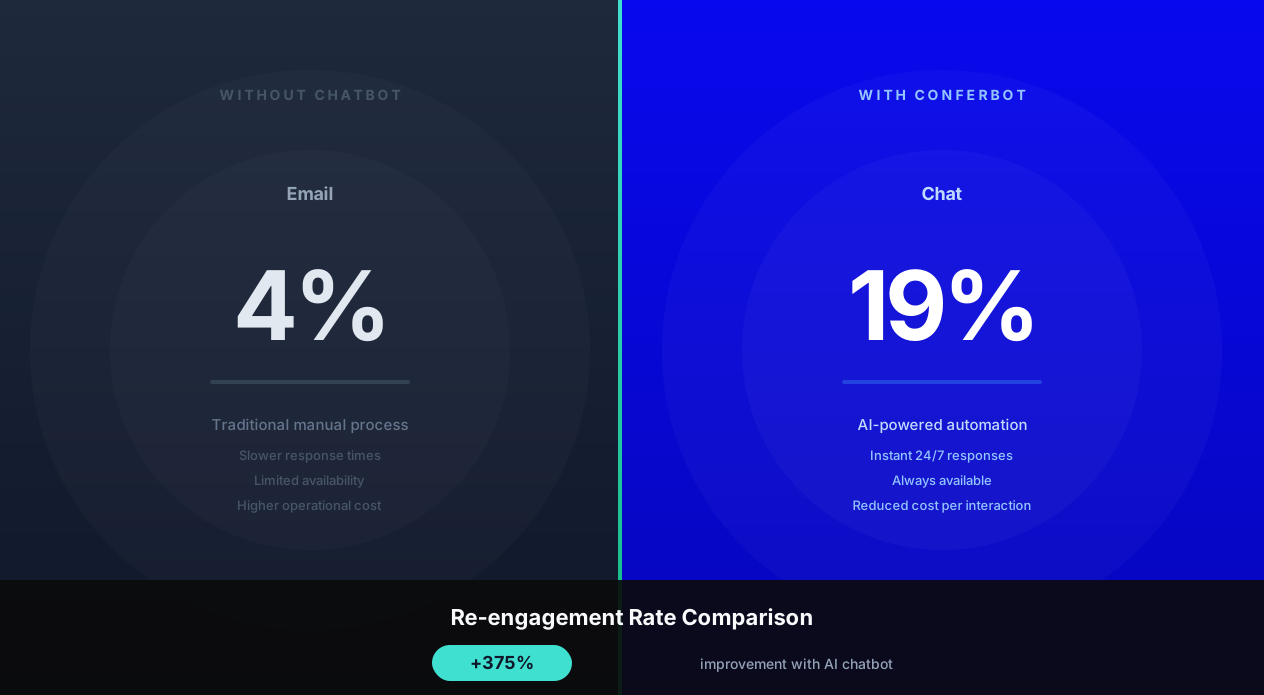
Win-back campaigns target two groups, a segmentation approach validated by McKinsey's growth and retention insights: customers who have already churned (lapsed) and customers who are actively churning (showing late-stage churn signals like cancellation attempts or extended inactivity). Chatbot-driven win-back campaigns outperform email-only campaigns by 3 to 5x on reactivation rates because they enable two-way conversation, objection handling, and real-time personalized offers.
Save Offers for Active Cancellation Attempts
When a customer clicks the cancel button or explicitly states intent to leave, the chatbot triggers an immediate save flow. This is the highest-stakes moment—you have seconds to change their mind:
Step 1: Understand the reason. "I am sorry to see you go. Before I process the cancellation, would you mind sharing what is driving this decision? It helps us improve, and I might be able to help."
Step 2: Address the specific reason with a tailored offer:
- "Too expensive" → Offer a discounted rate, downgrade option, or pause instead of cancel: "What if I could offer you 3 months at 40% off while you evaluate whether the value is there? No commitment after that."
- "Not using it enough" → Offer a personalized onboarding session or feature walkthrough: "Many customers find that once they discover feature X, their usage doubles. Can I spend 5 minutes showing you a shortcut that might change your experience?"
- "Switching to competitor" → Offer a comparison walkthrough highlighting unique advantages: "I understand you are evaluating options. Before you switch, can I show you two capabilities we have that competitor X does not offer? It might change the comparison."
- "Missing a key feature" → Check if the feature is on the roadmap: "That feature is actually launching next month! Would you like early access? I can keep your account active at a reduced rate until it is available."
Step 3: If the save fails, exit gracefully. "I understand. I have processed your cancellation effective on your next billing date. Your data will be available for 30 days if you change your mind. We would love to have you back anytime—just reach out and I can reactivate your account instantly."
Win-Back Sequences for Lapsed Customers
For customers who have already churned, the chatbot executes a multi-touch win-back sequence over 30 to 60 days:
Day 3 post-churn: Soft check-in. "Hi [Name], we noticed you are no longer with us. We hope everything is going well. If there is anything we could have done differently, we would love to hear your feedback." (Goal: gather intelligence on churn reason)
Day 14 post-churn: Value reminder with updates. "Since you left, we have shipped 3 new features including [relevant feature based on their usage history]. Here is a quick summary of what is new." (Goal: show continued improvement)
Day 30 post-churn: Win-back offer. "We miss you, [Name]! As a returning customer, we would like to offer you [specific offer: 50% off for 2 months, free upgrade to Pro for 1 month, etc.]. No long-term commitment—just give us another try." (Goal: reduce friction of return)
Day 60 post-churn: Final attempt with escalated offer. "Last chance—our best offer for returning customers: [strongest offer]. After today, this offer expires. We genuinely believe we can deliver value for you and would love another chance." (Goal: urgency plus maximum value)
Win-Back Performance Benchmarks
| Win-Back Approach | Reactivation Rate | Average Retention of Reactivated | Revenue per Reactivation |
|---|---|---|---|
| Email-only campaign | 3 to 5% | 4 months average | $180 average LTV post-return |
| Chatbot conversational campaign | 12 to 18% | 7 months average | $420 average LTV post-return |
| Chatbot plus personalized offer | 18 to 25% | 9 months average | $560 average LTV post-return |
| Human outreach (phone/video) | 20 to 30% | 11 months average | $680 average LTV post-return |
Chatbot-driven win-back campaigns achieve 70 to 85 percent of human outreach effectiveness at 5% of the cost—making them the optimal choice for all but the highest-value churned customers. For comprehensive strategies on personalized engagement, see our chatbot personalization guide.
Loyalty Program Automation: Chatbot as Your Always-On Loyalty Manager
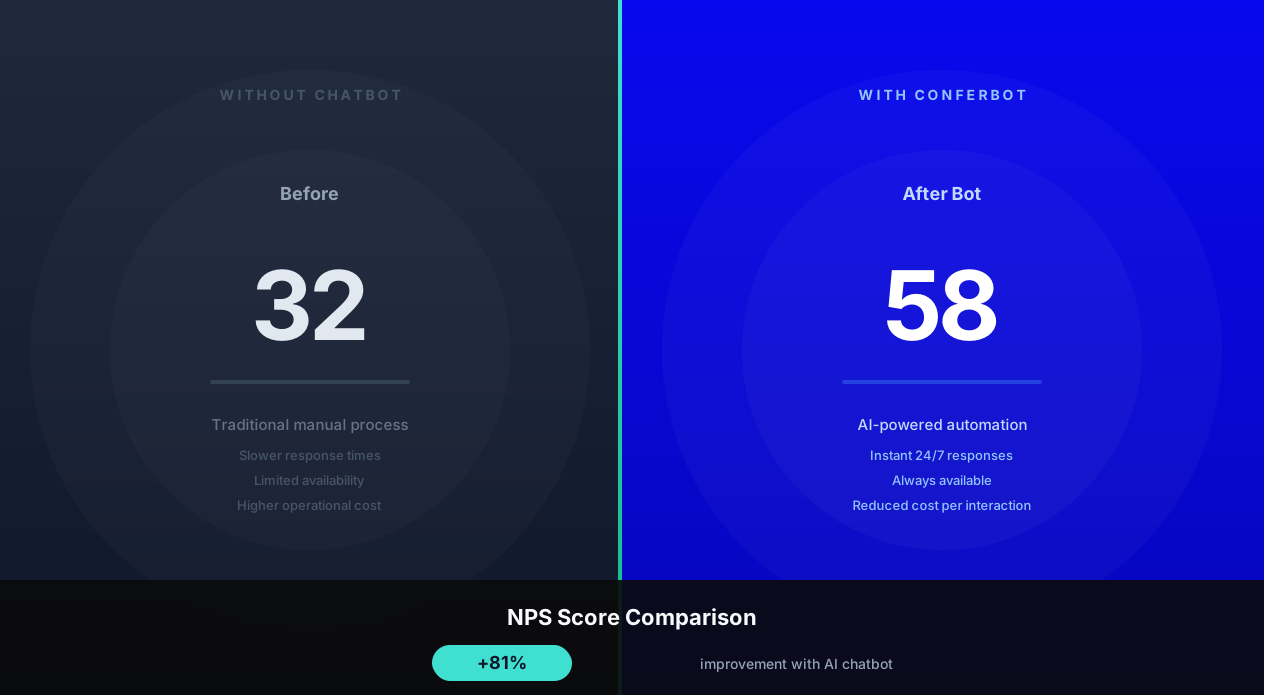
Loyalty programs are one of the most effective retention tools—members of loyalty programs are 59% more likely to choose a brand over competitors and spend 12 to 18% more per transaction, according to Bond Brand Loyalty's research. But traditional loyalty programs suffer from low awareness (members often forget they have points), low engagement (only 44% of loyalty members are active), and high operational cost (managing tiers, points, rewards manually).
AI chatbots solve all three problems simultaneously by serving as an always-on loyalty program manager that proactively engages members, educates them about rewards, and automates the entire points-to-rewards lifecycle.
Chatbot Loyalty Functions
1. Points Balance and Progress Updates: The chatbot proactively notifies members when they are close to earning a reward. "You have 850 points—just 150 more until your next $20 reward! Your next purchase will likely push you over." This nudge combines retention (the customer feels invested in reaching the threshold) with revenue (it motivates a purchase).
2. Reward Redemption Assistance: Many loyalty programs have complex redemption processes that frustrate members. The chatbot simplifies this: "You have enough points for a free product! Would you like to redeem them now? I can apply $25 in rewards to your current cart automatically."
3. Tier Progression Communication: For tiered programs, the chatbot explains what the next tier offers and how close the member is: "You are a Silver member and just $200 in purchases away from Gold status. Gold members get free shipping on every order plus early access to sales. Would you like to see what is new this week?"
4. Birthday and Anniversary Rewards: Automated delivery of special occasion rewards with personalized messaging: "Happy birthday, [Name]! Here is a special gift from us—double points on any purchase this week. Treat yourself!"
5. Expiration Warnings: Prevent frustration from expired points by notifying members before expiration: "Heads up—you have 500 points expiring in 7 days. That is worth $10 in rewards. Want to use them now?" This also drives purchases (to use or earn more points before expiration).
6. Referral Program Integration: The chatbot promotes referral programs to satisfied customers (high NPS responders): "Since you love our product, would you like to share it with friends? For each friend who joins, you both get $15 in rewards."
Loyalty Automation Impact on Retention
| Loyalty Metric | Without Chatbot Automation | With Chatbot Automation | Improvement |
|---|---|---|---|
| Active loyalty members (monthly engagement) | 44% | 72% | +28 percentage points |
| Points redemption rate | 34% | 61% | +27 percentage points |
| Time to first reward redemption | 67 days | 38 days | 43% faster |
| Loyalty member retention rate (annual) | 71% | 86% | +15 percentage points |
| Loyalty member AOV vs. non-members | +12% | +22% | +10 percentage points additional |
The 15 percentage point improvement in loyalty member retention rate is the headline metric—it means that for every 1,000 loyalty members, you retain 150 additional customers per year who would otherwise have churned. At an average customer lifetime value of $500, that is $75,000 in preserved revenue per 1,000 loyalty members, driven entirely by chatbot-automated loyalty engagement that costs pennies per interaction.
Customer Health Scoring: Quantifying Relationship Strength
Customer health scores aggregate multiple signals into a single metric, a methodology championed by Gainsight's customer success framework that represents the strength of each customer relationship. The chatbot uses health scores to prioritize outreach—reaching the most at-risk customers first and tailoring the intervention to the specific health dimensions that are declining.
Building a Customer Health Score Model
An effective health score combines four dimensions, each weighted by their predictive importance for your specific business:
1. Engagement Score (30% weight): How frequently and deeply the customer interacts with your product or brand. Metrics include login frequency, feature usage breadth, session duration, email open rates, and chatbot interaction frequency. A declining engagement score is often the first early warning of future churn.
2. Support Sentiment Score (25% weight): The quality of support interactions and overall satisfaction. Metrics include CSAT scores on recent tickets, NPS responses, complaint frequency, escalation history, and chatbot conversation sentiment. Negative support experiences are a leading churn driver.
3. Commercial Score (25% weight): The financial health of the relationship. Metrics include payment timeliness, plan tier, expansion history (upgrades vs. downgrades), purchase frequency, and average order value trends. Declining commercial metrics signal disengagement or dissatisfaction.
4. Relationship Score (20% weight): The depth and breadth of the customer relationship. Metrics include number of users or seats (for SaaS), integration depth, referrals made, community participation, and tenure. Deeper relationships have higher switching costs and lower churn probability.
Health Score Ranges and Chatbot Actions
| Health Score Range | Classification | Chatbot Action | Outreach Frequency |
|---|---|---|---|
| 80 to 100 | Healthy (advocate) | Request referrals, gather testimonials, offer loyalty rewards, beta access | Monthly (light touch) |
| 60 to 79 | Stable (satisfied) | Feature education, value reinforcement, milestone celebrations | Bi-weekly |
| 40 to 59 | At-risk (declining) | Proactive support, usage tips, feedback collection, special offers | Weekly |
| 20 to 39 | Danger (likely to churn) | Escalated outreach, save offers, executive attention, urgent resolution | Multiple per week |
| 0 to 19 | Critical (imminent churn) | Immediate human escalation with chatbot-gathered context, best save offer | Daily until resolved |
Dynamic Health Score Updates
Health scores are not static—they update in real time based on customer actions. When a customer logs in after a period of inactivity, their engagement score improves immediately. When a customer submits a negative NPS response, their sentiment score drops. The chatbot responds to these changes dynamically, adjusting outreach strategy within hours rather than waiting for a weekly or monthly review cycle.
For a complete framework on which metrics to track and how to build dashboards, see our chatbot analytics and metrics guide. This real-time responsiveness is what makes chatbot-driven health scoring superior to manual customer success processes. A human team reviewing accounts monthly will miss the window between a customer's first frustration signal and their cancellation decision. A chatbot monitoring health scores in real time catches the signal within hours and intervenes before frustration compounds into churn.
Improving NPS Through Chatbot Engagement: From Detractors to Promoters
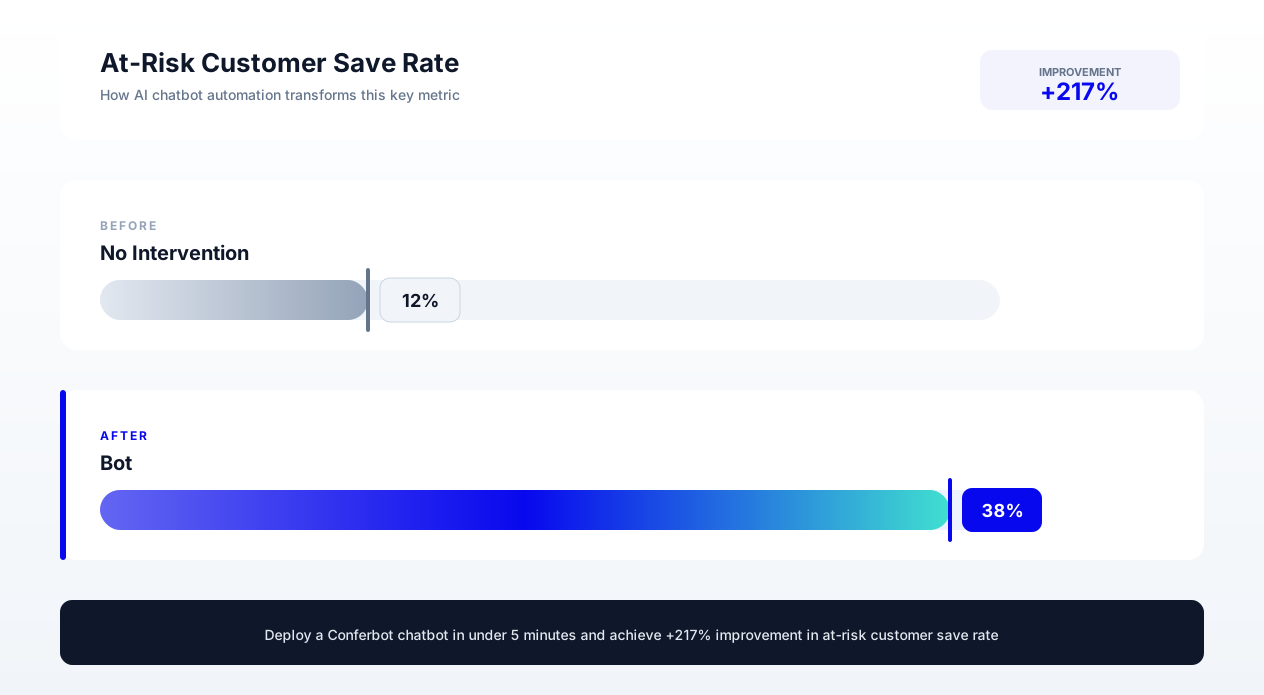
Net Promoter Score is both a lagging indicator of customer satisfaction and a leading indicator of retention. As documented by Bain & Company's customer loyalty research, customers who are promoters (NPS 9 to 10) have retention rates 2 to 3x higher than detractors (NPS 0 to 6). Moving customers from detractor to passive, or passive to promoter, directly improves retention metrics. Here is how chatbots drive NPS improvement.
Closed-Loop Feedback via Chatbot
Traditional NPS programs collect scores but rarely act on them in real time. Chatbots enable closed-loop feedback where the response to a score is immediate and actionable:
Detractor response (score 0 to 6): "Thank you for your honest feedback. I am sorry we have not met your expectations. Can you share what we could do better? I would like to connect you with someone who can help address your concerns today." The chatbot then routes to a priority support queue with the specific feedback attached, ensuring fast resolution.
Passive response (score 7 to 8): "Thank you! We appreciate your feedback. What would it take to make your experience a 9 or 10? We are always looking to improve, and your input directly shapes our roadmap." The chatbot collects actionable suggestions that product teams can act on.
Promoter response (score 9 to 10): "That is wonderful to hear! Thank you for the high score. Since you are enjoying our product, would you be open to sharing your experience? [Options: write a review, refer a friend, join our case study program]." The chatbot converts positive sentiment into tangible business assets.
Chatbot-Driven NPS Improvement Strategies
1. Proactive issue resolution: The chatbot identifies and resolves issues before they affect NPS. Customers who never have to contact support rate their experience 15 to 20 points higher on NPS than customers who had to resolve issues (even if the resolution was satisfactory).
2. Feature adoption guidance: Customers who use 3 or more core features rate NPS 25 points higher than those who use only one feature. The chatbot drives feature adoption through education and guided walkthroughs.
3. Response time optimization: Every hour of delay in responding to a customer inquiry reduces NPS by 1 to 2 points. Chatbot instant responses eliminate this decay entirely for the 80% of queries they can resolve.
4. Personalized check-ins: Monthly check-in messages from the chatbot ("How is everything going? Anything we can help with?") increase NPS by 8 to 12 points among responsive customers because they feel proactively cared for.
NPS Impact Metrics
| Intervention | NPS Impact | Retention Impact | Revenue Impact per Customer |
|---|---|---|---|
| Closed-loop detractor recovery | +20 to 30 points for recovered detractors | 60% of recovered detractors retained vs. 20% without intervention | +$340 average saved LTV |
| Feature adoption nudges | +10 to 15 points | +12% retention rate for adopters | +$180 LTV from extended retention |
| Proactive issue detection | +8 to 12 points | +8% retention rate | +$120 LTV from prevented complaints |
| Monthly personalized check-ins | +5 to 8 points | +6% retention rate | +$95 LTV from engagement |
The compound effect of implementing all four strategies simultaneously is an NPS improvement of 15 to 25 points at the portfolio level. For a company with a starting NPS of 35, this brings you to 50 to 60—a transformative improvement that compounds into retention gains, referral growth, and organic acquisition. For detailed tactics on feedback collection, see our comprehensive guide to chatbot customer feedback and NPS strategies.
Retention Playbooks by Industry: Tailored Strategies for Maximum Impact
Retention dynamics differ significantly across industries, as Statista's customer retention data confirms. Customer expectations, churn triggers, and effective interventions vary based on the business model, purchase frequency, and relationship depth. Here are industry-specific retention playbooks for chatbot implementation.
SaaS and B2B Software
Primary churn drivers: Low feature adoption, ROI not visible, key user departure, budget cuts, competitor switch
Chatbot retention playbook:
- Day 1 to 14: Onboarding chatbot ensures core feature activation (target: 3+ features used in first week)
- Day 30: First value check-in: "You have saved X hours this month using [feature]. Here is your ROI summary."
- Monthly: Usage insights with benchmarks: "Your team processed 340 tickets this month—15% more than last month. You are in the top 20% of similar companies."
- Trigger-based: If key user stops logging in, immediate outreach to admin: "[User name] has not logged in for 7 days. Would you like to reassign their tasks or should I check in with them?"
- Renewal minus 60 days: Proactive health check and success summary to support renewal decision
Expected impact: 25 to 35% churn reduction, 20% improvement in net revenue retention
E-Commerce and D2C
Primary churn drivers: Poor product experience, price sensitivity, lack of engagement, competitor promotions, delivery issues
Chatbot retention playbook:
- Post-purchase day 3: Delivery satisfaction check and usage tips for the product purchased
- Post-purchase day 14: Review request plus cross-sell of complementary items
- Lapse detection (2x purchase cycle): Re-engagement with personalized recommendations and exclusive offer
- Birthday and anniversary: Special rewards that drive return visits
- Post-return: Follow up with exchange suggestions and satisfaction recovery
Expected impact: 20 to 30% improvement in repeat purchase rate, 15% higher customer lifetime value
Subscription Boxes and Recurring Commerce
Primary churn drivers: Product fatigue, accumulated unused products, price sensitivity over time, skip habit forming
Chatbot retention playbook:
- Pre-shipment: Customization prompts ("Your next box ships in 3 days. Want to swap any items?") increase satisfaction and reduce returns
- Post-delivery: Unboxing engagement ("How do you like this month's selections? Rate each item to improve next month's picks.")
- Skip detection: If customer skips, immediately offer alternatives ("Instead of skipping, would you like a smaller box this month at half price?")
- Accumulation prevention: "I noticed you have 4 unused items from recent boxes. Would you like to pause for a month, or should we adjust your preferences so future boxes better match what you love?"
Expected impact: 30 to 40% reduction in cancellations, 50% reduction in skips, 12% higher average box value through upsells
Financial Services and Fintech
Primary churn drivers: Better rates elsewhere, poor customer service, lack of product awareness, life events (moving, job change)
Chatbot retention playbook:
- Account anniversary: Annual relationship review with benefit summary and loyalty rewards
- Rate change detection: Proactive notification when competitor rate advantages appear, with retention offers
- Life event triggers: Job change, address change, or family change triggers product suitability review
- Low engagement: Monthly spending insights and savings tips that demonstrate ongoing value
Expected impact: 15 to 25% churn reduction, 30% increase in products per customer through cross-sell
Each playbook should be adapted to your specific customer base, product offering, and competitive landscape. The common thread across all industries is the principle of proactive, personalized, value-demonstrating engagement that makes customers feel noticed and served before they decide to leave.
ROI of Retention vs. Acquisition: The Economics That Drive the Strategy
The economics of retention versus acquisition are well-documented but worth quantifying for your specific business case. Here is a framework for calculating the ROI of chatbot-driven retention investment.
The Retention Multiplier Effect
A 5% improvement in customer retention rate increases profits by 25 to 95%, depending on industry. This outsized impact occurs because retained customers:
- Cost nothing to re-acquire (no CAC)
- Spend more over time (average 67% more in months 31 to 36 than in months 1 to 6)
- Refer others (5x more likely to refer than new customers)
- Accept premium pricing (willing to pay 10 to 25% more due to trust and switching costs)
- Require less support (experienced users generate 60% fewer tickets than new customers)
Retention Chatbot ROI Calculation
Here is a concrete calculation for a subscription business:
Baseline metrics:
- Active customers: 5,000
- Monthly churn rate: 6% (300 customers lost per month)
- Average monthly revenue per customer: $75
- Customer acquisition cost: $250
- Average customer lifetime: 16.7 months (1 / 6% churn)
- Customer lifetime value: $1,250 (16.7 months multiplied by $75)
After implementing retention chatbot (30% churn reduction):
- New monthly churn rate: 4.2% (210 customers lost per month)
- Customers saved per month: 90
- Revenue preserved per month: 90 multiplied by $75 = $6,750 immediately, compounding over customer lifetime
- New average customer lifetime: 23.8 months (1 / 4.2% churn)
- New customer lifetime value: $1,785
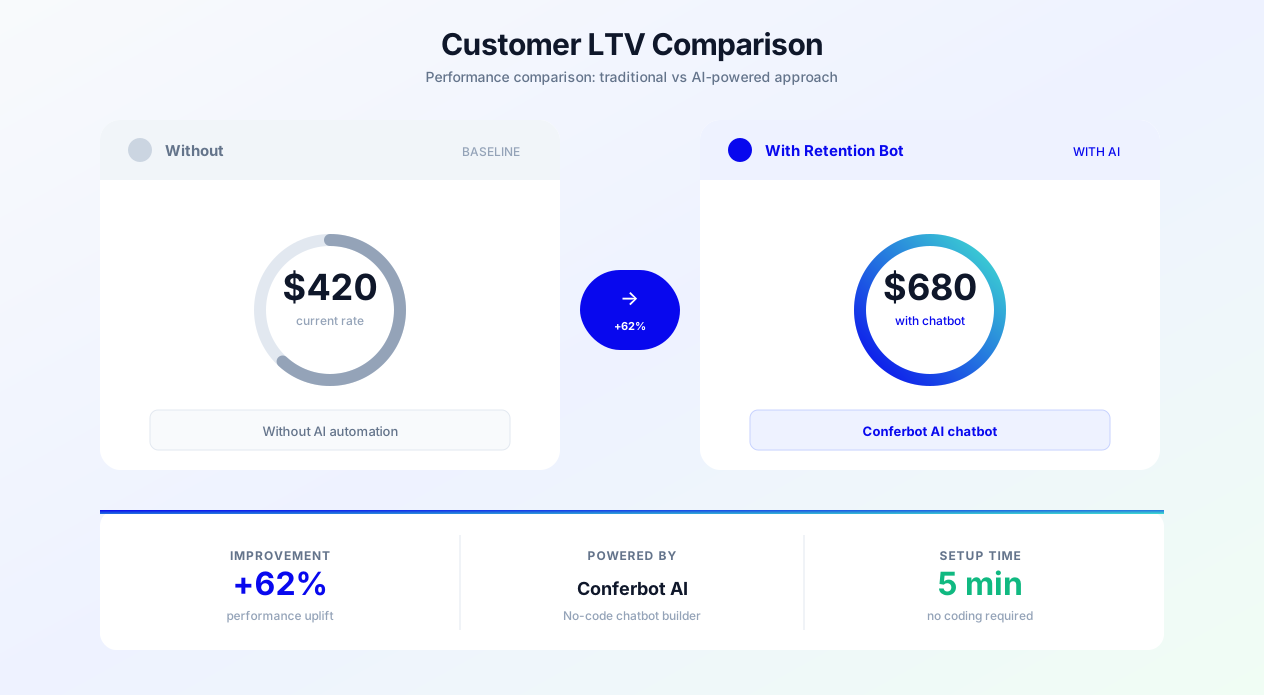
- LTV improvement: $535 per customer (a 43% increase)
Annual financial impact:
- Customers saved annually: 1,080
- Revenue preserved in year 1: $972,000 (1,080 customers multiplied by 12 months average remaining life multiplied by $75)
- Equivalent acquisition cost avoided: $270,000 (1,080 multiplied by $250 CAC to replace them)
- Chatbot platform and setup cost: $6,000 annually
- Net annual benefit: $1,236,000
- ROI: 20,500%
Comparative Investment Analysis
| Investment | Annual Cost | Annual Revenue Impact | ROI | Time to Impact |
|---|---|---|---|---|
| Retention chatbot | $6,000 | $972,000 preserved | 16,100% | 30 to 60 days |
| Additional paid acquisition | $270,000 | $972,000 new revenue | 260% | Immediate but recurring cost |
| Human customer success team (3 FTEs) | $300,000 | $750,000 preserved | 150% | 60 to 90 days |
| Product improvement for retention | $200,000 | $500,000 preserved | 150% | 3 to 6 months |
The chatbot's ROI is dramatically higher than alternatives because it operates at near-zero marginal cost per customer interaction. Whether your chatbot engages 100 at-risk customers or 10,000, the platform cost remains essentially the same. This scalability is the fundamental advantage—human customer success teams cannot scale to proactively engage thousands of customers, but a chatbot can. For a broader view of chatbot ROI across use cases, see our chatbot case studies and ROI analysis.
Implementation Timeline: Launching a Retention Chatbot in 6 Weeks
Here is a practical timeline for implementing a retention chatbot that delivers measurable churn reduction within 6 weeks of launch.
Weeks 1 and 2: Foundation
Week 1: Data and Strategy
- Audit current churn data: rates, reasons, timing, customer segments most affected
- Identify top 5 churn signals for your business (see churn indicators section above)
- Define health score model dimensions and weights based on historical correlation with churn
- Map customer lifecycle stages and appropriate engagement for each
- Set baseline metrics: current churn rate, NPS, engagement metrics, LTV
Week 2: Design and Planning
- Design 3 to 5 proactive engagement flows targeting top churn signals
- Write conversation scripts for each intervention type (value reinforcement, feature education, save offer)
- Design win-back sequence for recently churned customers (3 to 5 touchpoints over 60 days)
- Define trigger conditions and frequency limits to prevent over-communication
- Plan integration requirements (data platform, CRM, billing system)
Weeks 3 and 4: Build and Integrate
Week 3: Platform Setup
- Deploy Conferbot with retention-specific configuration
- Build conversation flows in the visual editor
- Connect customer data platform for health scores and churn signals
- Integrate with billing system for plan change and cancellation detection
- Set up proactive messaging channels (in-app, email, WhatsApp/SMS)
Week 4: Testing
- Test all conversation paths with realistic customer scenarios
- Verify trigger accuracy (right signals fire right interventions)
- Test frequency limits (ensure no customer receives excessive outreach)
- QA save flow on actual cancellation process
- Test escalation handoff to human customer success team
Weeks 5 and 6: Launch and Optimize
Week 5: Phased Launch
- Launch proactive engagement for highest-risk segment first (bottom 20% health scores)
- Monitor response rates, intervention acceptance, and early retention signals
- Launch win-back sequence for customers who churned in the past 30 days
- Gather agent feedback on escalation quality and context completeness
Week 6: Optimize and Expand
- Analyze initial results and optimize messaging based on response data
- Expand proactive engagement to medium-risk segment
- Activate loyalty automation features
- Set up A/B tests for key intervention messages
- Establish reporting cadence (weekly health score distribution, monthly churn impact)
Expected Results Timeline
- Week 6 (launch): First retention impacts visible in high-risk segment
- Month 2: 10 to 15% churn reduction measurable across targeted segments
- Month 3: 20 to 25% churn reduction as win-back and loyalty programs mature
- Month 4 and beyond: 25 to 35% steady-state churn reduction with ongoing optimization
The time to measurable impact is 6 to 8 weeks from project start—significantly faster than hiring additional customer success staff (3 to 6 months to recruit, train, and ramp) and more scalable than any human-driven approach. For more on the broader conversational marketing ecosystem, explore our guide on conversational marketing chatbot strategies.
How Conferbot Drives Retention at Scale
Conferbot's retention capabilities are designed to work proactively, intelligently, and at the scale required to engage your entire customer base—not just the handful of accounts a human team can manage.
Predictive Churn Engine
Conferbot integrates with your customer data platform and applies machine learning to predict churn risk for every customer in real time. The system continuously updates health scores and triggers appropriate interventions without manual configuration for each customer.
Multi-Channel Proactive Outreach
Reach customers where they are most responsive: in-app chat, website widget, WhatsApp, SMS, email, or push notifications. Conferbot learns each customer's preferred channel and optimal timing through interaction history, maximizing engagement rates on every outreach.
Automated Save Flows
When a customer initiates cancellation, Conferbot's save flow activates immediately with reason-specific offers and objection handling. The system adapts offers based on the customer's LTV, tenure, and stated reason—high-value customers get stronger retention offers automatically.
Loyalty Program Engine
Built-in loyalty features handle points tracking, reward delivery, tier management, and engagement campaigns. No need for a separate loyalty platform—Conferbot manages the entire loyalty lifecycle conversationally.
Success Measurement
The retention dashboard shows real-time churn rate trends, intervention success rates, health score distributions, and ROI calculations. Track which interventions are working and which need optimization—all in one view.
Conferbot transforms retention from a reactive, labor-intensive process into a proactive, automated system that scales to your entire customer base. Start reducing churn today with intelligent, personalized engagement that keeps customers before they decide to leave.
Was this article helpful?
AI Chatbot for Customer Retention FAQ
Everything you need to know about chatbots for ai chatbot for customer retention.
About the Author

Conferbot Team specializes in conversational AI, chatbot strategy, and customer engagement automation. With deep expertise in building AI-powered chatbots, they help businesses deliver exceptional customer experiences across every channel.
View all articles