Why Cybersecurity Firms Need Assessment Chatbots in 2026
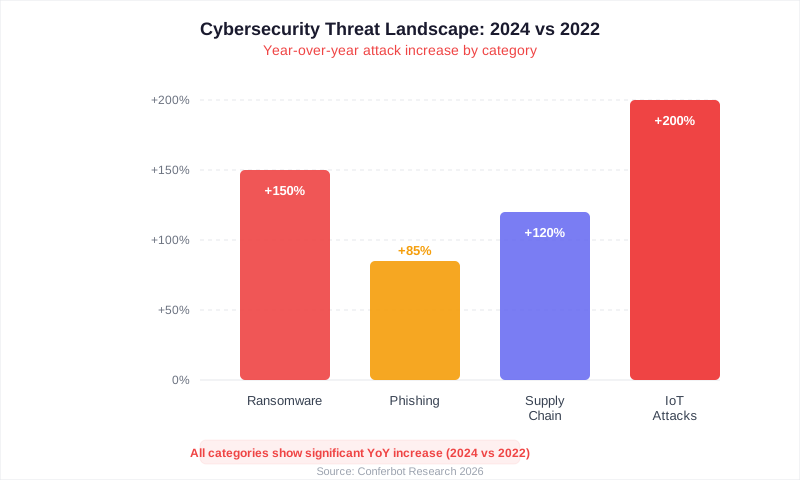
The cybersecurity landscape has never been more dangerous or more complex. In 2025 alone, global cybercrime damages exceeded $10.5 trillion annually, and the average cost of a data breach climbed to $4.88 million according to IBM's Cost of a Data Breach Report. Small and medium-sized businesses bear a disproportionate share of the burden: 43% of all cyberattacks target SMBs, yet only 14% of small businesses consider their ability to mitigate cyber risks as highly effective. The result is an enormous, growing market for cybersecurity services, managed security providers (MSPs), and compliance consulting firms that help organizations assess, understand, and reduce their risk exposure.
The challenge for cybersecurity firms, however, is not a lack of demand. It is the bottleneck of skilled human analysts required to conduct initial security assessments, risk evaluations, compliance questionnaires, and vulnerability intake processes. A typical cybersecurity assessment begins with dozens of preliminary questions about the prospect's infrastructure, current security posture, regulatory requirements, number of endpoints, cloud usage, and data handling practices. These initial conversations are repetitive, time-consuming, and do not require the deep expertise of a senior security analyst. They are, in other words, a perfect candidate for intelligent automation through AI chatbots.
A cybersecurity assessment chatbot transforms the front end of the security evaluation pipeline. Instead of scheduling a 45-minute discovery call with a human consultant to ask the same 30 preliminary questions for the hundredth time, the chatbot conducts an interactive, guided assessment on the prospect's website visit, at any hour, in a fraction of the time. It collects infrastructure details, identifies immediate risk factors, generates a preliminary risk score, and qualifies the lead for a deeper human-led assessment. The prospect gets instant value in the form of a risk snapshot, and the cybersecurity firm gets a qualified, pre-assessed lead with all the data needed to prepare a targeted proposal.
This guide explores how cybersecurity firms, MSPs, vCISO practices, and IT service providers can deploy AI chatbots to automate risk assessments, compliance screening, vulnerability intake, and lead qualification. We will cover the architecture of an effective cybersecurity assessment chatbot, the specific question flows that produce actionable risk scores, integration with security tools and CRMs, compliance considerations including HIPAA, PCI-DSS, and SOC 2, and the measurable ROI these chatbots deliver. Whether you are a solo cybersecurity consultant or a large managed security services provider, an assessment chatbot can dramatically increase your capacity to evaluate prospects while reducing the cost per assessment by 60 to 80 percent.
The Growing Cybersecurity Market and the Assessment Bottleneck
The global cybersecurity market is projected to reach $376 billion by 2029 according to MarketsandMarkets research, growing at a compound annual growth rate of 13.4%. This growth is driven by several converging forces: increasing sophistication of cyber threats, expanding regulatory requirements, the shift to remote and hybrid work models, accelerating cloud adoption, and heightened awareness among business leaders that cybersecurity is no longer optional. For MSPs and cybersecurity consultancies, this translates to a massive pipeline of prospects seeking security assessments, compliance audits, and risk evaluations.
However, the cybersecurity talent shortage creates a severe bottleneck. The global cybersecurity workforce gap stands at approximately 4 million unfilled positions. Even well-staffed security firms find that their senior analysts spend 30 to 40 percent of their billable time on initial intake conversations, preliminary questionnaires, and first-stage risk assessments that follow predictable, repeatable patterns. This is time that could be spent on deep-dive penetration testing, incident response, or architecture review, which are the high-value activities clients actually pay premium rates for.
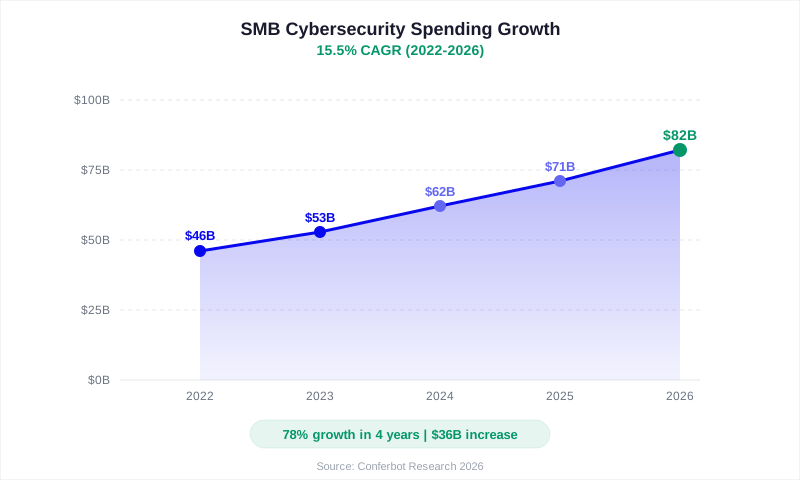
The assessment bottleneck manifests in several costly ways. First, slow response times to prospect inquiries. When a business owner visits a cybersecurity firm's website and fills out a contact form, the average response time is 24 to 48 hours. Research shows that 78% of B2B deals go to the vendor that responds first. Every hour of delay costs potential contracts. Second, inconsistent assessment quality. When different analysts conduct initial assessments, the depth, structure, and scoring vary significantly. A chatbot delivers a standardized, repeatable assessment every time. Third, inability to scale during demand spikes. After a high-profile breach makes headlines, cybersecurity firms see a 200 to 400 percent spike in inquiry volume. Without automation, most of these leads go unserved.
An AI-powered assessment chatbot addresses all three bottlenecks simultaneously. It responds instantly, 24 hours a day. It delivers a consistent, standardized assessment framework. And it scales infinitely, handling 10 or 10,000 assessments concurrently without additional staffing. For firms using platforms like Conferbot's AI chatbot builder, deployment takes hours rather than months, and the chatbot can be customized to reflect the firm's specific assessment methodology, scoring rubric, and brand voice.
How a Cybersecurity Assessment Chatbot Works: Architecture and Flow
A well-designed cybersecurity assessment chatbot follows a structured conversation flow that mirrors the initial stages of a professional security audit, aligning with the NIST Cybersecurity Framework that mirrors the initial stages of a human-led security assessment. The chatbot guides the prospect through a series of question categories, collects structured data, applies scoring logic, and produces an actionable risk summary. Here is the architecture of an effective assessment chatbot from start to finish.
Stage 1: Visitor Identification and Context Setting
The chatbot begins by establishing who the visitor is and why they need a security assessment. This stage collects basic firmographic data: company name, industry vertical, number of employees, and the visitor's role (IT director, business owner, compliance officer). It also asks what triggered the assessment interest, whether that is a regulatory requirement, recent security incident, insurance application, vendor due diligence, or proactive risk management. This context shapes the rest of the assessment by determining which question branches are most relevant.
Stage 2: Infrastructure and Technology Assessment
The chatbot maps the prospect's technology environment by asking about operating systems in use, cloud providers (AWS, Azure, Google Cloud, or on-premises), email platforms, number of endpoints (desktops, laptops, mobile devices), remote access methods, network architecture (single site versus multi-site versus fully remote), and critical business applications. Each answer feeds into the risk scoring engine. For example, a company running end-of-life operating systems scores higher on vulnerability risk, while a company with multi-factor authentication on all remote access points receives a lower access control risk score.
Stage 3: Current Security Controls Assessment
This stage evaluates what security measures are already in place. The chatbot asks about antivirus and endpoint protection solutions, firewall configurations, backup procedures and frequency, employee security awareness training, incident response plans, password policies, encryption usage for data at rest and in transit, and vulnerability scanning practices. The presence or absence of each control adjusts the cumulative risk score. This stage often reveals critical gaps that the prospect was not aware of, creating immediate value and urgency for the chatbot interaction.
Stage 4: Compliance and Regulatory Requirements
Based on the industry identified in Stage 1, the chatbot asks targeted compliance questions. A healthcare organization receives HIPAA-specific questions about protected health information handling, business associate agreements, and breach notification procedures. A retail business receives PCI-DSS questions about cardholder data environment segmentation and encryption. A financial services firm receives SOX and GLBA questions. This stage determines whether the prospect has compliance obligations they may not be fully addressing, which is a powerful selling point for the cybersecurity firm's services.
Stage 5: Risk Score Generation and Report Delivery
After completing the assessment questions, the chatbot calculates a composite risk score based on weighted factors across all stages. The scoring algorithm assigns different weights to different risk categories: critical infrastructure vulnerabilities might carry a weight of 3x while documentation gaps carry 1x. The chatbot presents the risk score visually, typically as a color-coded score out of 100 with category breakdowns. It explains what the score means in plain language: high risk areas, immediate action items, and where the prospect stands relative to industry benchmarks. The chatbot then offers to email a detailed PDF report and schedule a consultation with a human analyst to discuss remediation strategies.
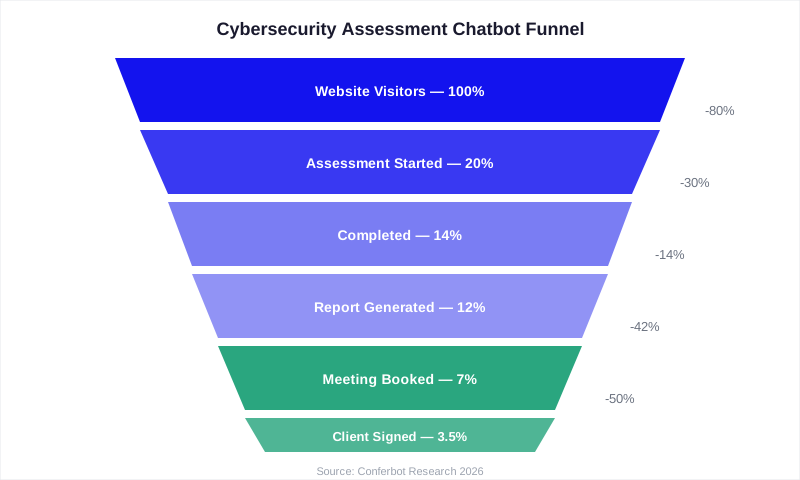
This five-stage architecture is modular. Firms can add, remove, or reorder stages based on their assessment methodology. The key principle is progressive disclosure: each stage builds on the previous one, and the prospect sees increasing value as the assessment deepens. By the time the chatbot asks for contact information to deliver the full report, the prospect has already invested significant time and received genuine value, making lead capture natural rather than intrusive. Building this type of multi-stage flow is straightforward using a no-code chatbot builder that supports conditional logic and branching.
Building an Effective Risk Scoring Engine for Your Chatbot
The risk scoring engine is the intellectual core of your cybersecurity assessment chatbot. It transforms raw questionnaire responses into a quantified risk profile that prospects find valuable and that your sales team can use to prioritize outreach and tailor proposals. A well-designed scoring engine must be rigorous enough to produce meaningful results yet simple enough to operate within a conversational chatbot interaction.
Weighted Category Scoring
The most effective approach uses weighted categories that reflect the relative importance of different security domains. A typical cybersecurity assessment chatbot scores across six to eight categories, each with a predefined weight. For example: Access Control and Authentication (weight: 20%), Endpoint Protection (weight: 15%), Network Security (weight: 15%), Data Protection and Encryption (weight: 15%), Backup and Recovery (weight: 10%), Compliance Posture (weight: 10%), Employee Training and Awareness (weight: 10%), and Incident Response Readiness (weight: 5%). Within each category, individual questions contribute positive or negative points. Having multi-factor authentication enabled on all accounts might add 8 points to the Access Control category, while lacking any form of multi-factor authentication subtracts 12 points from the same category. The asymmetric scoring reflects that the absence of a critical control is more damaging than its presence is protective.
Industry-Adjusted Benchmarks
Raw scores become meaningful only in context. A score of 62 out of 100 means something different for a 5-person marketing agency than for a 200-person healthcare provider with HIPAA obligations. The scoring engine should apply industry-specific multipliers that account for the threat landscape, regulatory environment, and data sensitivity of each vertical. Healthcare, financial services, and government organizations face higher baseline risk due to regulatory requirements and the value of the data they handle, so their benchmark thresholds are higher. A marketing agency might be considered adequately protected at a score of 60, while a healthcare provider needs a score above 80 to meet the same relative standard.
Actionable Risk Tiers
Present the final score within clear risk tiers that communicate urgency and recommended action. A common four-tier system works well: Critical Risk (score 0 to 40) indicates severe vulnerabilities that require immediate remediation and the prospect should schedule an emergency consultation. High Risk (score 41 to 60) indicates significant gaps that expose the organization to likely breach and the prospect should schedule a comprehensive assessment within 2 weeks. Moderate Risk (score 61 to 80) indicates a reasonable security posture with identifiable improvement areas and a quarterly review engagement would be beneficial. Low Risk (score 81 to 100) indicates strong security controls with minor optimization opportunities and an annual review is recommended to maintain the posture. Each tier maps directly to a service offering, making the risk score a natural lead qualification tool.
Transparency and Trust
Unlike opaque scoring systems that feel like a sales gimmick, an effective cybersecurity chatbot scoring engine should explain its reasoning. After presenting the score, the chatbot should highlight the two or three factors that had the greatest impact on the score, both positive and negative. For example: Your strongest areas were endpoint protection and backup procedures. Your greatest risk factors were the absence of multi-factor authentication and the lack of an incident response plan. This transparency builds trust and demonstrates genuine expertise rather than a sales trick, which is essential in the cybersecurity industry where credibility is everything.
Tracking how prospects engage with their risk scores provides valuable business intelligence. Using chatbot analytics, cybersecurity firms can identify which risk categories generate the most concern, which score ranges convert best to paid engagements, and which assessment questions cause the most drop-off so they can optimize the flow over time.
Automating Compliance Questionnaires: HIPAA, PCI-DSS, SOC 2, and NIST
One of the highest-value applications of a cybersecurity assessment chatbot is automating the initial stages of compliance, covering standards like those from ISO/IEC 27001 questionnaires. Compliance assessments are inherently structured, rule-based, and repetitive, making them ideal for chatbot automation. Organizations seeking compliance certification or evaluating their compliance posture must answer hundreds of specific questions, and the preliminary self-assessment stage can be conducted entirely by a well-configured chatbot.
HIPAA Compliance Self-Assessment
For healthcare organizations and their business associates, HIPAA compliance involves the Privacy Rule, Security Rule, and Breach Notification Rule. A HIPAA-focused chatbot assessment covers administrative safeguards (risk analysis completion, workforce training, access management policies), physical safeguards (facility access controls, workstation security, device and media controls), and technical safeguards (access controls, audit controls, integrity controls, transmission security). The chatbot asks specific questions such as: Do you conduct an annual HIPAA risk assessment? Do all workforce members receive HIPAA training within 30 days of hiring? Do you maintain a current inventory of all systems that create, receive, maintain, or transmit electronic protected health information? Do you have a documented breach notification procedure? Each answer maps to a specific HIPAA requirement, and the chatbot can identify gaps that the cybersecurity firm can then address through a paid remediation engagement.
PCI-DSS Compliance Assessment
For businesses that process credit card payments, PCI-DSS compliance is mandatory. The PCI Self-Assessment Questionnaire (SAQ) is a structured document that maps well to chatbot interaction. The chatbot determines which SAQ type applies based on the prospect's payment processing method (SAQ A for e-commerce with fully outsourced payment, SAQ A-EP for e-commerce with partial outsourcing, SAQ B for imprint-only merchants, SAQ C for payment application merchants, and SAQ D for all others). Based on the applicable SAQ, the chatbot walks through the relevant requirements: network segmentation, cardholder data environment scope, encryption standards, access controls, and monitoring procedures. The output is a gap analysis that identifies non-compliant areas requiring remediation.
SOC 2 Readiness Assessment
SOC 2 compliance is increasingly required for SaaS companies and technology service providers. The five Trust Services Criteria (security, availability, processing integrity, confidentiality, and privacy) provide a natural framework for chatbot-guided assessment. The chatbot evaluates each criterion by asking about specific controls: security policies, access management, change management, risk assessment processes, monitoring and logging, incident response, business continuity, data classification, and privacy practices. Because SOC 2 is principles-based rather than prescriptive, the chatbot assessment focuses on whether controls exist and are documented rather than whether they meet specific technical specifications.
NIST Cybersecurity Framework Assessment
The NIST CSF provides a comprehensive, voluntary framework that many organizations adopt as their security baseline. Its five core functions, which are Identify, Protect, Detect, Respond, and Recover, contain 23 categories and 108 subcategories. A chatbot can assess the prospect's maturity across each function by asking questions that map to the framework's implementation tiers: Partial (Tier 1), Risk Informed (Tier 2), Repeatable (Tier 3), and Adaptive (Tier 4). This tiered approach is especially useful because it provides a maturity roadmap showing where the organization currently stands and what the next level of maturity looks like, creating a natural consulting engagement pathway.
Across all compliance frameworks, the chatbot's role is not to replace the formal audit or certification process. Rather, it accelerates the preliminary assessment, identifies the most significant gaps, and generates a scope of work for the human-led engagement. This pre-qualification saves 10 to 15 hours per prospect that analysts would otherwise spend on initial questionnaire administration, freeing them to focus on the technical analysis and remediation planning that requires genuine expertise. For firms that handle sensitive compliance data, ensuring the chatbot interaction itself is secure is paramount. Using a platform with enterprise-grade security and a robust knowledge base that can be configured to handle regulatory frameworks is essential.
Lead Qualification and Sales Pipeline Integration for Cybersecurity Services
Beyond risk assessment, a cybersecurity chatbot is a powerful lead qualification engine, leveraging the security awareness gap that CISA (Cybersecurity and Infrastructure Security Agency) identifies as a top organizational vulnerability. Every question in the assessment simultaneously serves two purposes: it provides value to the prospect through risk identification and it provides intelligence to the sales team for lead scoring and proposal preparation. This dual-purpose design makes the cybersecurity assessment chatbot one of the highest-ROI tools in a security firm's marketing stack.
Firmographic Qualification
The early-stage questions about company size, industry, and number of endpoints directly qualify the lead from a revenue potential perspective. A 200-employee healthcare organization with multiple locations represents a significantly different opportunity than a 5-person startup. The chatbot captures this data naturally within the assessment flow, and the CRM integration pushes it to the sales pipeline with appropriate lead scores. Many cybersecurity firms define ideal customer profiles (ICPs) based on employee count, industry vertical, regulatory exposure, and current security maturity. The chatbot data allows automatic ICP matching and lead prioritization.
Budget and Timeline Signals
The chatbot can incorporate subtle qualification questions that reveal budget readiness and timeline urgency. Asking whether the assessment is driven by an upcoming compliance deadline, insurance renewal requirement, board mandate, or recent security incident provides critical context. A company with a PCI-DSS audit in 60 days has a fundamentally different urgency level than one conducting a general security review. Similarly, asking whether the prospect has allocated a budget for security improvements or whether they are in the research and budgeting phase helps the sales team calibrate their approach and prioritize their time accordingly.
CRM and Pipeline Integration
The assessment chatbot should push all collected data directly into the firm's CRM (Salesforce, HubSpot, Zoho, or ConnectWise for MSPs). The integration should create a new contact record, attach the assessment report as a document, set the lead score based on risk level and firmographic fit, assign the lead to the appropriate sales representative based on territory or specialization, and trigger an automated follow-up sequence. For ConnectWise users, the chatbot can create a new opportunity with the assessment data pre-populated, including the prospect's infrastructure details, identified gaps, and recommended service packages. This eliminates the hours of data entry that typically follow an initial assessment call.
Automated Follow-Up Sequences
Based on the assessment results, the chatbot can trigger different automated email sequences through the CRM. A Critical Risk prospect receives an urgent outreach from a senior consultant within 30 minutes, followed by case studies of similar organizations that suffered breaches. A Moderate Risk prospect receives a summary report, industry benchmark comparison, and an invitation to schedule a deeper assessment at their convenience. A Low Risk prospect receives maintenance and monitoring package information and a quarterly newsletter. This segmented follow-up dramatically improves conversion rates compared to generic follow-up for all leads. The chatbot effectively does the work of a sales development representative (SDR), and many MSPs report that their chatbot replaces the need for one or two full-time SDRs while producing higher-quality qualified leads.
For cybersecurity firms looking to maximize lead conversion, combining the assessment chatbot with live chat capabilities enables seamless escalation from automated assessment to human consultant when a high-value prospect indicates readiness to proceed immediately.
Security Awareness Training, Phishing Simulation, and Vulnerability Reporting
Beyond prospect-facing assessments, cybersecurity chatbots serve a valuable internal function: employee security awareness training and phishing readiness evaluation. This represents an additional revenue stream for MSPs that offer security awareness training as a managed service, and it provides ongoing client engagement that goes beyond one-time assessments.
Interactive Security Training via Chatbot
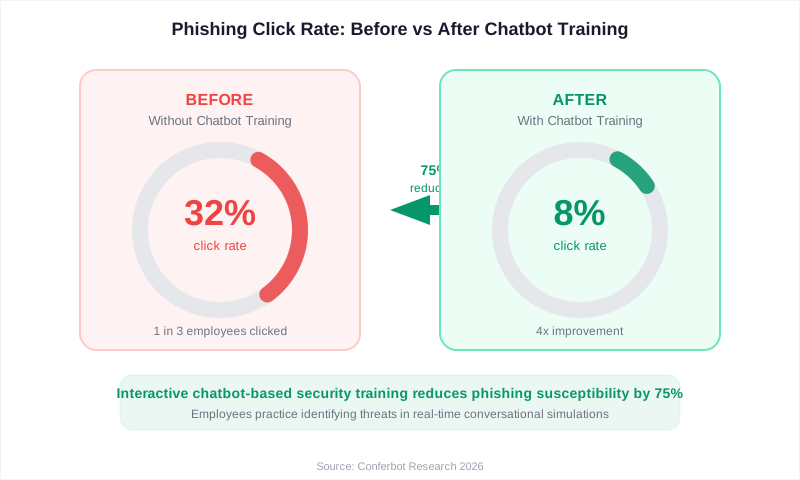
Traditional security awareness training consists of annual slide presentations or video courses that employees passively consume and immediately forget. Research from KnowBe4's security training data shows that passive training reduces phishing susceptibility by only 2 to 4 percent, while interactive, scenario-based training reduces susceptibility by 60 percent or more. A chatbot-based training program delivers interactive, scenario-based security education that is more engaging, more effective, and easier to deploy than traditional methods.
The training chatbot presents realistic scenarios and asks employees to make decisions. For example: You receive an email from your CEO asking you to wire $50,000 to a new vendor immediately. The email comes from ceo@company.com and looks legitimate. What do you do? The employee selects from options like verify by phone, forward to IT, comply with the request, or reply asking for more details. Based on their choice, the chatbot explains why each option is correct or dangerous, providing memorable, context-rich education that sticks far better than abstract policy documents.
Phishing Simulation and Readiness Scoring
The chatbot can deliver simulated phishing scenarios that test employee readiness in a low-stakes environment. Rather than sending actual phishing emails that create anxiety and resentment, the chatbot presents phishing scenarios within the training conversation and asks the employee to identify the red flags. This approach trains pattern recognition without the negative psychological impact of being tricked by a simulated phishing email from their own IT department. The chatbot tracks individual and departmental scores over time, identifying which employees need additional training and which departments represent the highest human-factor risk.
Policy Compliance Verification
After training, the chatbot can quiz employees on specific security policies: password requirements, data handling procedures, incident reporting protocols, acceptable use policies, and remote work security guidelines. This replaces the annual policy acknowledgment form (which nobody reads) with an interactive verification that actually tests comprehension. The chatbot can also serve as an on-demand policy reference, allowing employees to ask security policy questions at any time rather than searching through lengthy policy documents that they will never actually read.
Continuous Micro-Training
Instead of annual training events, the chatbot can deliver weekly or monthly micro-training sessions of 3 to 5 minutes each. These short, focused sessions cover a single topic: recognizing business email compromise, safe USB practices, social engineering tactics, or secure password creation. The spaced repetition approach is proven to improve long-term retention compared to annual cramming sessions. For MSPs, this continuous training model creates recurring revenue through monthly training subscriptions rather than one-time training engagements. Each micro-training session can be tracked and reported to the client's management, demonstrating ongoing value and justifying the monthly investment.
Another high-impact application of cybersecurity chatbots is streamlining vulnerability reporting and security incident intake. Both internal employees discovering potential vulnerabilities and external security researchers reporting bugs benefit from a structured, automated intake process that ensures no report falls through the cracks.
Vulnerability Disclosure Programs
Organizations that maintain vulnerability disclosure programs (VDPs) or bug bounty programs need an efficient way to receive, categorize, and triage reports from external researchers. A chatbot on the organization's security page guides reporters through a structured submission process: vulnerability type (SQL injection, XSS, authentication bypass, IDOR, etc.), affected system or URL, reproduction steps, proof of concept, and severity assessment. The structured data format ensures that security teams receive actionable reports rather than vague emails that require multiple rounds of clarification.
Internal Incident Reporting
When employees suspect a security incident, whether that is a suspicious email, unexpected system behavior, potential data exposure, or lost device, the speed and quality of the initial report directly impacts the incident response team's ability to contain the threat. A chatbot provides a standardized incident intake form that captures critical details: what happened, when it was discovered, which systems or data may be affected, who else is aware, and whether any immediate actions have been taken. The chatbot triages the incident severity based on the responses and routes it to the appropriate responder, whether that is the help desk for low-severity reports or the incident response team lead for critical alerts.
Automated Triage and Escalation
The chatbot applies predefined triage logic to incoming reports. A report involving potential ransomware triggers an immediate high-priority alert to the incident response team. A report of a suspicious email that the employee did not click is logged for analysis but does not trigger emergency escalation. A report of a lost personal mobile device with company email access triggers a moderate-priority response that includes remote wipe verification. This automated triage ensures that critical incidents receive immediate attention while routine reports are handled through normal channels, preventing alert fatigue among the security team while ensuring nothing critical is missed.
Report Tracking and Communication
After initial submission, the chatbot provides reporters with a tracking number and status updates. For external vulnerability researchers, this communication is especially important for maintaining positive relationships with the security research community. The chatbot can send automated updates when the report is received, when analysis begins, when remediation is complete, and when a bounty or acknowledgment is issued. For internal employees, the chatbot provides confirmation that their report was received and explains what happens next, encouraging continued reporting rather than the see something, stay quiet culture that develops when employees feel their reports disappear into a black hole.
Cybersecurity firms that implement vulnerability reporting chatbots for their clients can offer this as a managed service, handling triage, analysis, and remediation tracking on behalf of organizations that lack dedicated security operations centers. This creates another revenue stream while providing genuine security value to clients, and it pairs well with a broader NLP-powered chatbot that understands the nuanced language of technical vulnerability descriptions.
Step-by-Step Implementation: Building Your Cybersecurity Assessment Chatbot
Implementing a cybersecurity assessment chatbot does not require building from scratch. Modern no-code chatbot platforms provide the conditional logic, scoring capabilities, and integration options needed to deploy a sophisticated assessment chatbot in days rather than months. Here is a practical step-by-step implementation guide.
Step 1: Define Your Assessment Framework
Before configuring any technology, document your assessment methodology on paper. Define the question categories you will assess, the specific questions within each category, the scoring weight of each category, the point values for each answer option, the risk tier thresholds, and the output format for the assessment report. This framework document becomes the blueprint for your chatbot configuration. Most cybersecurity firms already have an informal assessment methodology they use in discovery calls. The task is to formalize it into a structured, scored questionnaire that a chatbot can administer.
Step 2: Map the Conversation Flow
Translate your assessment framework into a conversation flow diagram. Each question becomes a chatbot message with multiple-choice or short-answer response options. Branch logic determines which questions follow based on previous answers. For example, if the prospect indicates they are in healthcare, the flow branches to HIPAA-specific questions. If they indicate fewer than 10 employees, certain enterprise-scale questions are skipped. The flow should feel natural and conversational despite its structured nature. Use transitional messages between sections: Great, I have a good picture of your infrastructure. Now let me ask about your current security controls.
Step 3: Configure the Chatbot Platform
Using your chosen chatbot platform, build the conversation flow. Set up each question as a chatbot message with the appropriate response type: multiple choice for categorical questions, number input for counts like endpoints and employees, and short text for open-ended responses. Configure the conditional branching logic that routes the conversation based on answers. Set up variables that accumulate scores as the assessment progresses. Most platforms support calculated variables that sum weighted scores across categories to produce the final risk score. Using a platform like Conferbot's AI chatbot builder, you can set up complex branching logic and scoring without writing any code.
Step 4: Build the Risk Score Output
Design the risk score presentation that the chatbot delivers at the end of the assessment. This should include the overall risk score with a color-coded visual indicator, category-by-category breakdowns showing strongest and weakest areas, two to three specific high-impact findings in plain language, recommended immediate actions, and a clear call to action offering a deeper assessment with a human consultant. The presentation should be valuable enough to stand on its own while clearly communicating that a comprehensive professional assessment would provide much deeper insights and actionable remediation planning.
Step 5: Integrate with Your CRM and Email
Connect the chatbot to your CRM via native integration or Zapier. Configure the data mapping so that each assessment field populates the correct CRM field. Set up lead scoring rules that reflect your qualification criteria. Configure email notifications for your sales team when high-priority leads complete assessments. Set up the automated email sequence that sends the prospect their detailed PDF report. Test the entire flow from chatbot interaction through CRM population to email delivery to ensure data integrity at each handoff point.
Step 6: Deploy and Test
Deploy the chatbot on your website and run comprehensive testing. Complete the assessment multiple times with different answer combinations to verify that scoring is accurate, branching logic works correctly, CRM integration captures all data, email notifications fire appropriately, and the risk score output is clear and accurate. Have colleagues from both technical and non-technical backgrounds complete the assessment to identify confusing questions or unclear response options. Refine based on feedback before promoting the chatbot to prospects.
Step 7: Promote the Assessment
Once deployed, actively promote the free security assessment chatbot through your marketing channels. Add prominent calls to action on your website: Get Your Free Cybersecurity Risk Score in 5 Minutes. Include the assessment link in email signatures, social media profiles, content marketing, and paid advertising. Position it as a valuable free resource rather than a sales tool, because that is genuinely what it is. The prospect receives real value in the form of a risk assessment, and you receive a qualified, data-rich lead. Both parties benefit.
Real-World Use Cases and Measuring ROI
Cybersecurity assessment chatbots are already delivering measurable results for managed service providers and security consultancies across different specializations and firm sizes. These real-world use cases demonstrate the versatility and ROI of automated security assessments.
MSP Targeting SMBs for Managed Security Services
A managed service provider serving small businesses with 10 to 100 employees deployed a chatbot on their website that conducts a 15-question security assessment covering endpoint protection, email security, backup, and access controls. The assessment takes prospects approximately 7 minutes to complete. Upon completion, the prospect receives a risk score and a comparison against similar-sized businesses in their industry. The MSP reported that 34% of website visitors who started the assessment completed it, 62% of those who completed it provided their email address to receive the full report, and 28% of those who received the report scheduled a consultation call. The chatbot generated an average of 47 qualified leads per month, replacing a part-time SDR position and reducing the cost per qualified lead from $185 to $23.
vCISO Practice Using Assessment for Client Acquisition
A virtual CISO (vCISO) practice embedded a comprehensive 25-question assessment chatbot that evaluates security program maturity across the NIST Cybersecurity Framework's five functions. The chatbot produces a maturity score for each function and an overall security program maturity rating from Tier 1 (Partial) to Tier 4 (Adaptive). The vCISO uses the assessment results as the basis for an initial strategy session, arriving at the consultation already informed about the prospect's security posture rather than spending the first hour asking discovery questions. This approach reduced the average sales cycle from 6 weeks to 3 weeks because the assessment pre-educates the prospect about their gaps, creating urgency and informed demand before the first human conversation occurs.
Compliance Consulting Firm Streamlining HIPAA Assessments
A compliance consulting firm specializing in HIPAA assessments for medical practices deployed a chatbot that conducts a preliminary HIPAA readiness evaluation. The 20-question chatbot covers the most common HIPAA compliance gaps: risk analysis completion, workforce training, business associate agreements, access controls, and breach notification procedures. The firm found that 71% of medical practices that completed the chatbot assessment had significant gaps in at least three of the five areas assessed. By presenting these gaps immediately in the chatbot output, the firm converts 41% of assessment completions into paid compliance remediation engagements, compared to the 12% conversion rate from their previous contact-form-based lead generation approach.
Penetration Testing Firm Using Pre-Engagement Scoping
A penetration testing firm uses a chatbot to handle the pre-engagement scoping process. Before a penetration test can be quoted, the firm needs detailed information about the target environment: IP ranges, application types, authentication methods, testing windows, excluded systems, and rules of engagement. Previously, this scoping process required a 60-minute scoping call for every prospect, including those who ultimately did not engage. The chatbot collects this information upfront, allowing the firm to prepare an accurate quote before the first human conversation. This reduced the scoping time per engagement from 60 minutes to 10 minutes of analyst review time, enabling the firm to process three times as many quote requests with the same team size.
Demonstrating ROI is critical for justifying chatbot investment and optimizing performance over time. Cybersecurity assessment chatbots produce clear, measurable business outcomes across multiple dimensions. Here are the key metrics to track and the benchmarks you should target.
Assessment Completion Rate
Track the percentage of visitors who start the assessment and complete all stages through to the risk score delivery. The industry benchmark for well-designed assessment chatbots is 30 to 45% completion. If your completion rate is below 25%, examine where in the flow prospects are dropping off. Common causes include too many questions in a single section, confusing or overly technical language, assessment that feels longer than the 5 to 7 minutes advertised, and questions that prospects cannot answer without research. Optimize by shortening sections, simplifying language, adding progress indicators, and providing an option to skip questions the prospect cannot answer immediately with a note to address them in the follow-up consultation.
Lead Capture Rate
Of those who complete the assessment, what percentage provide contact information? The benchmark is 55 to 70% for cybersecurity assessments because the value exchange is clear: the prospect receives a detailed risk report in exchange for their email address. If your capture rate is below 50%, the assessment may not be delivering enough perceived value to justify the email exchange. Enhance the value proposition by offering a more detailed PDF report, industry benchmark comparisons, and specific remediation recommendations that are only available via email delivery.
Lead-to-Consultation Conversion Rate
What percentage of captured leads schedule a consultation call? The benchmark is 20 to 35% for cybersecurity services. Critical Risk prospects should convert at 40 to 60%, while Low Risk prospects may convert at only 5 to 10%, which is expected. Track conversion by risk tier to understand which segments drive the most revenue.
Cost Per Qualified Lead
Calculate the total monthly cost of the chatbot platform, any integration tools, and a proportional share of the website traffic acquisition cost, divided by the number of qualified leads generated. Cybersecurity firms typically see cost per qualified lead drop from $150 to $250 (traditional methods including events, cold outreach, and content marketing) to $15 to $40 (chatbot assessment) representing a 75 to 90% reduction in lead acquisition costs.
Analyst Time Saved
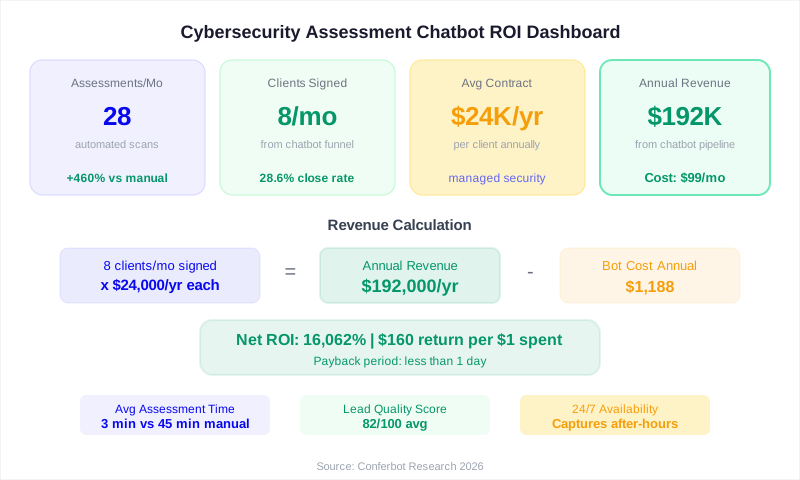
Measure the number of hours per month that analysts no longer spend on initial discovery calls and preliminary assessments. At analyst billing rates of $150 to $300 per hour, this time savings directly translates to either cost reduction or increased revenue capacity. A chatbot that saves 40 hours per month of analyst time at $200 per hour represents $8,000 per month in recaptured capacity, far exceeding the typical chatbot platform cost of $50 to $200 per month.
Pipeline Value Generated
Track the total dollar value of opportunities in the sales pipeline that originated from chatbot assessments. This is the ultimate ROI metric: if the chatbot generates $50,000 per month in pipeline value at a cost of $100 per month, the ROI is undeniable. Most cybersecurity firms find that chatbot-generated leads close at equal or higher rates than leads from other sources because the assessment pre-qualifies and pre-educates the prospect, shortening the sales cycle and reducing objections.
Tracking these metrics requires proper analytics instrumentation. Ensure your chatbot platform provides detailed conversation analytics showing completion rates, drop-off points, and time-per-stage data. Integrating these metrics into a unified dashboard alongside CRM pipeline data gives you a complete picture of chatbot performance and its contribution to revenue.
Best Practices for Cybersecurity Assessment Chatbots
After analyzing hundreds of cybersecurity chatbot deployments, several best practices consistently separate high-performing assessment chatbots from those that underperform. Follow these guidelines to maximize the effectiveness of your cybersecurity assessment chatbot.
Keep the Initial Assessment Under 7 Minutes
The sweet spot for initial assessments is 15 to 20 questions that can be completed in 5 to 7 minutes. Longer assessments see steep drop-off rates. If your full assessment methodology requires 40 or more questions, split it into a quick initial assessment (15 questions, 5 minutes) that delivers a high-level risk score and a comprehensive deep-dive assessment (40 or more questions, 20 minutes) offered as a follow-up to prospects who want more detail. The initial assessment serves as a lead generation tool, while the comprehensive assessment serves as a pre-consultation data gathering tool.
Use Plain Language, Not Security Jargon
Remember that many prospects completing your assessment are business owners and executives, not IT professionals. They may not know what multi-factor authentication means by that name but would understand additional login verification beyond a password. Provide brief explanations or examples alongside technical terms. Frame questions around business outcomes rather than technical controls. Instead of asking Do you have network segmentation? ask Are your payment systems separated from your general business network? The substance is identical, but the language is accessible to a non-technical audience.
Provide Immediate Value at Every Stage
Do not save all the value for the end. Throughout the assessment, the chatbot should provide mini-insights: That is great that you have automatic backups. About 40 percent of businesses your size do not, which is a leading cause of permanent data loss after ransomware attacks. These micro-validations and warnings keep the prospect engaged by delivering continuous value and demonstrating expertise throughout the conversation rather than asking 20 questions with no feedback and then delivering a score at the end.
Secure the Assessment Data
You are collecting sensitive information about an organization's security vulnerabilities. The irony of a cybersecurity assessment chatbot that handles this data insecurely would destroy your credibility. Ensure the chatbot platform uses encryption in transit and at rest, does not store conversation data in plaintext, complies with relevant data protection regulations, has a data retention policy aligned with your privacy commitments, and can provide documentation of its security practices for prospects who ask. This is a non-negotiable requirement for cybersecurity-focused chatbots.
Follow Up Fast and with Context
When the chatbot generates a qualified lead, the follow-up must be fast, personalized, and demonstrably informed by the assessment results. A generic sales email that does not reference the prospect's specific risk score, top vulnerabilities, or industry vertical wastes the intelligence the chatbot gathered. The follow-up should reference specific assessment findings, propose targeted solutions for the identified gaps, include the prospect's risk score relative to their industry benchmark, and offer a specific next step (a 30-minute consultation focused on their top three risk areas). This contextualized follow-up converts at three to five times the rate of generic outreach because it demonstrates that you already understand the prospect's situation and have relevant solutions.
Continuously Optimize Based on Data
Review chatbot analytics monthly to identify optimization opportunities. Questions where prospects consistently select I do not know should be reworded or supplemented with explanations. Stages with above-average drop-off should be shortened or split. Risk score tiers that produce low conversion rates may need threshold adjustment. New threat categories like AI-powered attacks or supply chain risks should be added to keep the assessment current. The chatbot is a living tool that should evolve with the threat landscape and your assessment methodology, not a static form that you deploy and forget. Leveraging insights from tools like the Conferbot ROI calculators can help you quantify the impact of each optimization you make.
The Future of AI in Cybersecurity Assessment and Risk Management
The cybersecurity assessment chatbot space is evolving rapidly, driven by advances in AI, machine learning, and the increasing sophistication of both cyber threats and regulatory requirements. Here is where the technology is headed and what early adopters should prepare for.
AI-Powered Threat Intelligence Integration
Future assessment chatbots will integrate real-time threat intelligence feeds to provide context-aware assessments. Rather than asking generic questions about ransomware preparedness, the chatbot will reference specific active threats targeting the prospect's industry: We are currently tracking a ransomware campaign targeting medical practices using a specific EHR software. Do you use that software? This real-time relevance dramatically increases the perceived value of the assessment and the urgency of remediation.
Automated External Attack Surface Assessment
With the prospect's permission, future chatbots will combine questionnaire-based assessment with automated technical scanning. The chatbot could perform a non-intrusive external scan of the prospect's domain, identifying exposed services, SSL certificate issues, DNS configuration problems, and publicly available information that attackers could exploit. This combines self-reported assessment data with objective technical findings for a more comprehensive and credible risk picture.
Predictive Risk Modeling
As assessment chatbots accumulate data from thousands of assessments, machine learning models will identify patterns that predict breach likelihood based on specific combinations of risk factors. A chatbot might report: Organizations with your combination of risk factors, specifically no MFA, outdated endpoint protection, and no incident response plan, experience a security incident within 18 months 73 percent of the time based on our analysis of 5,000 similar organizations. This predictive capability makes the assessment output more compelling and actionable than a simple risk score.
Continuous Assessment and Monitoring
The assessment chatbot will evolve from a one-time evaluation into a continuous monitoring tool. After the initial assessment, the chatbot periodically checks in with the client: Has your organization implemented MFA since our last assessment three months ago? Have there been changes to your cloud infrastructure? Did you complete the security awareness training program we recommended? This continuous reassessment updates the risk score over time and demonstrates the cybersecurity firm's ongoing value, supporting managed service retention and recurring revenue models.
Multi-Modal Assessment
Future chatbots will accept document uploads (security policies, network diagrams, compliance certificates) and analyze them using AI to supplement the questionnaire-based assessment. A prospect could upload their existing security policy document and the chatbot would identify gaps, outdated provisions, and missing elements rather than asking dozens of questions about policy content. This multi-modal capability will dramatically reduce assessment time while increasing assessment depth and accuracy.
The cybersecurity assessment chatbot is not just a lead generation tool. It is the beginning of a fundamental shift in how cybersecurity services are discovered, evaluated, and delivered. Firms that adopt this technology early establish themselves as innovators in a market that values technical sophistication, building a competitive moat that grows deeper with every assessment completed and every data pattern learned. As the Gartner forecast on cybersecurity spending continues to show double-digit growth, the opportunity for firms that can efficiently scale their assessment capacity is enormous.
Was this article helpful?
About the Author
The Conferbot team specializes in conversational AI, chatbot strategy, and customer engagement automation. With deep expertise in building AI-powered chatbots, they help businesses deliver exceptional customer experiences across every channel.
View all articles