The Chatbot vs Live Chat Debate in 2026
According to Gartner's customer service research, the hybrid model combining chatbots and humans will dominate by 2027. Every business investing in customer communication faces the same question: should we deploy chatbots, hire live chat agents, or both? The answer in 2026 is more nuanced than it was even two years ago, because AI chatbots have gotten dramatically better — and customer expectations have risen to match.
Here's the state of play:
- 73% of consumers now expect instant responses when they contact a business online (Salesforce State of Service, 2025)
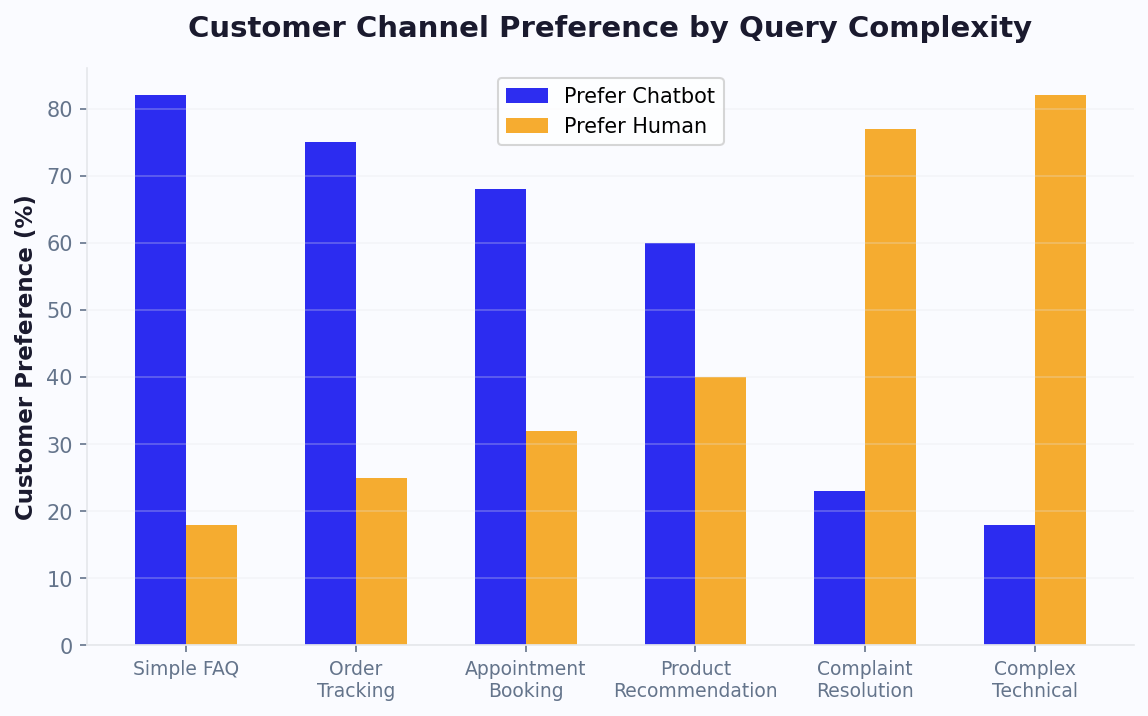
- 62% of consumers prefer chatbots for simple queries but switch to preferring human agents for complex or emotional issues (Gartner, 2025)
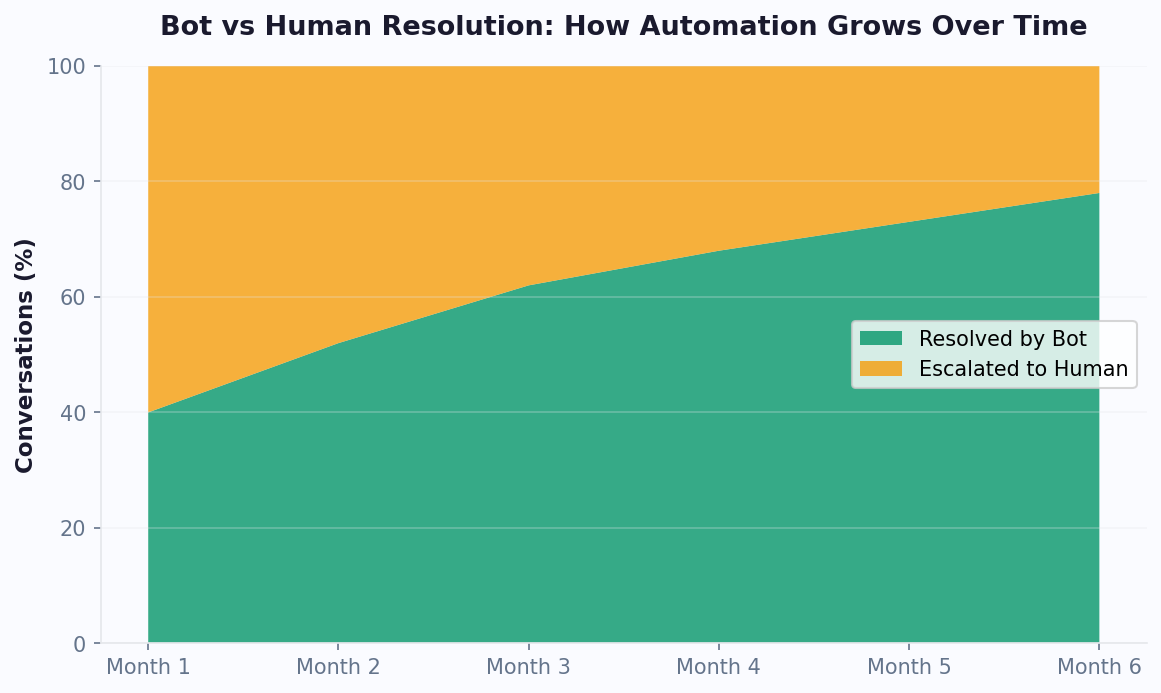
- AI chatbots can now handle up to 80% of routine customer queries without human intervention, up from 40% in 2022
- Meanwhile, live chat agent salaries have risen 15-20% since 2023 due to labor market tightening
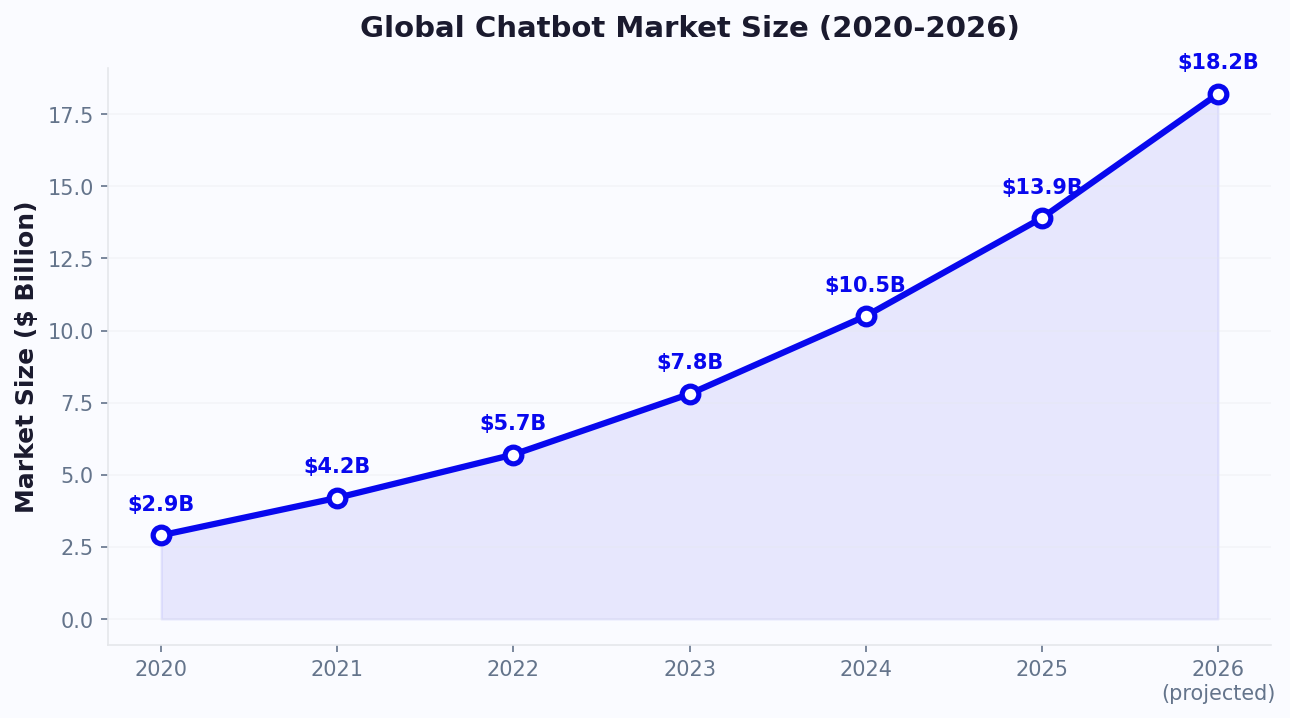
According to Statista's market projections, businesses worldwide are investing heavily in chatbot technology specifically because of this cost gap. The cost gap between the two approaches has widened significantly. But cost isn't the only factor. Customer satisfaction, resolution quality, brand perception, and scalability all play into the decision.
Research from Forrester's Customer Experience Index and HubSpot's State of Service confirms the shifting economics. In this guide, we'll lay out the real numbers — not vendor marketing claims, but verifiable data from published industry reports. By the end, you'll know exactly when to use a chatbot, when to use live chat, and why most businesses in 2026 are choosing a hybrid approach that combines the best of both.
Whether you're a startup evaluating your first support channel or an enterprise looking to optimize an existing operation, this comparison will give you the data you need to make the right call. For a three-way comparison that includes contact forms, see our chatbot vs live chat vs form analysis.
Feature-by-Feature Comparison
Let's compare chatbots and live chat across every dimension that matters for business operations:
| Feature | AI Chatbot | Live Chat (Human Agents) |
|---|---|---|
| Availability | 24/7/365, no downtime | Limited to agent shifts (typically 8-16 hrs) |
| Response Time | Instant (<2 seconds) | 30 sec - 5 min average (varies by queue) |
| Concurrent Chats | Unlimited simultaneous | 3-5 chats per agent maximum |
| Consistency | 100% consistent responses | Varies by agent knowledge & mood |
| Empathy | Improving but limited | High — humans detect emotion naturally |
| Complex Problem Solving | Good for structured issues | Excellent for unstructured, novel issues |
| Personalization | Data-driven, scales infinitely | Relationship-based, doesn't scale well |
| Languages | 95+ languages instantly | Limited by agent language skills |
| Training Time | Hours to days | 2-6 weeks per agent |
| Scalability | Instant — handles traffic spikes | Requires hiring, training, scheduling |
| Data Collection | Automatic, structured | Depends on agent discipline |
| Cost per Conversation | $0.10 - $0.50 | $5 - $15 |
The takeaway from this comparison is clear: chatbots dominate on speed, scalability, consistency, and cost. Live chat wins on empathy, complex reasoning, and handling emotionally charged situations.
Neither is universally better. The key is understanding which queries belong to which channel. Routine questions like "What are your hours?" or "Where's my order?" should never reach a human agent in 2026. But a customer who's been charged incorrectly and is frustrated deserves a real person who can listen, apologize, and resolve the issue with judgment and care.
The Real Cost Analysis: Chatbot vs Live Chat
Cost is usually the deciding factor. Let's break down the true all-in costs for both approaches, using a mid-size business handling 5,000 support conversations per month as our baseline.
Live Chat Cost Breakdown
| Cost Component | Monthly Cost | Notes |
|---|---|---|
| Agent salaries (3 agents) | $9,000 - $15,000 | $3,000-5,000/agent depending on location |
| Benefits & overhead (30%) | $2,700 - $4,500 | Healthcare, PTO, equipment, office space |
| Live chat software | $150 - $500 | Per-agent pricing from Intercom, Zendesk, etc. |
| Training & QA | $500 - $1,000 | Ongoing coaching, call reviews |
| Management overhead | $1,000 - $2,000 | Team lead / supervisor time |
| Total | $13,350 - $23,000 | |
| Cost per conversation | $2.67 - $4.60 |
AI Chatbot Cost Breakdown
| Cost Component | Monthly Cost | Notes |
|---|---|---|
| Chatbot platform (Conferbot Business) | $99 | Includes 5,000 conversations |
| AI/NLP add-on | $50 | For GPT-powered responses |
| Initial setup (amortized) | $100 | One-time $500 spread over 5 months |
| Ongoing optimization | $200 | 2-3 hours/month of flow updates |
| Total | $449 | |
| Cost per conversation | $0.09 |
The Cost Difference
The chatbot approach costs 96-98% less than a fully-staffed live chat operation. For our 5,000-conversation baseline:
- Live chat: $13,350 - $23,000/month
- AI chatbot: $449/month
- Annual savings: $154,800 - $270,600
Even if we account for the 15-20% of conversations that still need human intervention, the math is overwhelming. A hybrid model (chatbot handles 80%, humans handle 20%) costs roughly $3,500-5,500/month — still a 70-80% savings versus pure live chat.
For a full pricing breakdown across all features, visit our pricing page. To model your specific cost savings, use the framework in our chatbot ROI calculator guide.
Response Time: What the Data Shows
Response time is the single biggest predictor of customer satisfaction in chat-based support. And the data is unambiguous:
Average Response Times (2026 Benchmarks)
| Channel | First Response Time | Resolution Time |
|---|---|---|
| AI Chatbot | 1-3 seconds | 45 seconds - 3 minutes |
| Live Chat | 45 seconds - 3 minutes | 8-15 minutes |
| 4-24 hours | 24-48 hours | |
| Phone | 2-8 minutes (hold time) | 10-20 minutes |
The Impact of Wait Time on Satisfaction
Research from Forrester (2025) quantified the relationship between wait time and customer satisfaction:
- 0-10 seconds: 95% satisfaction rate
- 10-30 seconds: 90% satisfaction rate
- 30-60 seconds: 82% satisfaction rate
- 1-3 minutes: 65% satisfaction rate
- 3+ minutes: 45% satisfaction rate (and 35% abandon the chat entirely)
Chatbots win this metric decisively. They respond in under 3 seconds, every time, regardless of volume. During peak hours — Black Friday, product launches, outages — chatbot response times remain constant. Live chat response times spike as queues grow.
But Resolution Quality Matters Too
Speed without resolution is worse than a slow correct answer. Here's where nuance matters:
- For simple queries (60-70% of all support requests), chatbot resolution is instant and accurate
- For medium-complexity queries (20-25%), chatbots resolve correctly about 75% of the time; the rest need escalation
- For complex or emotional queries (10-15%), human agents resolve at significantly higher quality
The optimal approach: let the chatbot handle the first response instantly, attempt resolution, and seamlessly hand off to a human via AI agent handover if the issue requires it. The customer gets instant acknowledgment (satisfying the speed expectation) plus expert help when needed. This is exactly the model that Conferbot's live chat integration enables — a smooth transition from bot to human without making the customer repeat themselves.
Customer Satisfaction: What Customers Actually Prefer
The narrative that "customers hate chatbots" is outdated. Modern AI chatbots have fundamentally changed the satisfaction equation. Here's what recent research tells us:
Global Customer Preference Data (2025-2026)
- 71% of consumers prefer self-service options for simple tasks (Microsoft Global State of Service)
- 55% of consumers would rather interact with a well-designed chatbot than wait for a human agent (HubSpot Consumer Trends)
- 68% of consumers appreciate that chatbots provide instant answers (Drift State of Conversational AI)
- 89% of consumers get frustrated when they need to repeat their issue to multiple agents (Salesforce)
CSAT Scores by Channel
| Channel | Average CSAT | Key Driver |
|---|---|---|
| AI Chatbot (well-designed) | 82-88% | Speed, availability, consistency |
| Live Chat (well-staffed) | 85-92% | Empathy, flexibility, problem-solving |
| Hybrid (bot + human) | 90-95% | Speed + empathy when needed |
| Email Support | 60-70% | Asynchronous convenience |
| Phone Support | 70-78% | Personal connection (offset by hold times) |
The hybrid model consistently scores highest across industries. Customers get the speed of a chatbot for straightforward needs and the empathy of a human when things get complicated.
When Customers Prefer a Chatbot
- Checking order status or account balance
- Getting business hours, locations, or policies
- Booking or rescheduling appointments
- Making simple returns or exchanges
- Getting quick product information
When Customers Prefer a Human
- Billing disputes or incorrect charges (managed through a ticket system)
- Complex technical troubleshooting
- Complaints that require empathy and acknowledgment
- High-value purchasing decisions
- Situations where they've already tried self-service and failed
A Zendesk CX Trends 2026 study found that well-designed chatbots can match human agent satisfaction scores for routine queries. The critical insight: customer satisfaction with chatbots depends almost entirely on design quality. A poorly designed chatbot that loops users through irrelevant menus earns a CSAT of 30-40%. A well-designed chatbot that resolves issues quickly and escalates gracefully earns 85%+. The technology isn't the variable — the implementation is. Tools like Conferbot's analytics help you continuously identify and fix the pain points that drag down satisfaction.
When to Use Chatbot vs Live Chat
Based on the data above, here's a clear decision framework for choosing between chatbot and live chat for different scenarios:
Use a Chatbot When:
- Volume is high and queries are repetitive: If 50%+ of your support requests are the same 20-30 questions, a chatbot handles them at a fraction of the cost
- You need 24/7 coverage: Hiring agents for night shifts and weekends is prohibitively expensive for most businesses. A chatbot covers off-hours instantly.
- Speed is the priority: For transactional queries (order tracking, booking confirmations, account lookups), every second of wait time hurts satisfaction
- You're scaling rapidly: Going from 1,000 to 10,000 conversations/month with live chat means hiring 5-10 new agents. With a chatbot, it means upgrading your plan.
- You operate in multiple languages: A chatbot can switch between 95+ languages instantly; multilingual agents are expensive and hard to find
Use Live Chat When:
- High-value sales conversations: A customer evaluating a $10,000 enterprise contract deserves a human who can negotiate, customize, and build rapport
- Emotionally charged issues: Billing errors, service failures, or product defects require human empathy and judgment
- Complex multi-step troubleshooting: Issues that require screen sharing, log analysis, or creative problem-solving
- Regulated industries with compliance requirements: Healthcare, legal, and financial services may require human oversight for certain interactions
- VIP customer segments: Your top 5% of customers by revenue may warrant dedicated human attention
Decision Matrix
| Scenario | Recommended | Why |
|---|---|---|
| FAQ answering | Chatbot | Instant, consistent, scales infinitely |
| Order tracking | Chatbot | API-connected, real-time data |
| Lead qualification | Chatbot | 24/7 capture, structured data collection |
| Appointment booking | Chatbot | Calendar integration, instant confirmation |
| Sales negotiation | Live Chat | Requires flexibility and rapport |
| Complaint resolution | Live Chat | Requires empathy and authority |
| Technical support (basic) | Chatbot | Step-by-step guided troubleshooting |
| Technical support (advanced) | Live Chat | Creative problem-solving needed |
The Hybrid Model: Why It Wins in 2026
The chatbot vs live chat debate has a clear winner in 2026: the hybrid model. It's not a compromise — it's an optimization that delivers better outcomes than either approach alone.
How the Hybrid Model Works
- Chatbot handles first contact: Every conversation starts with the AI chatbot. It greets the user, identifies their intent, and attempts resolution.
- Instant resolution for routine queries: 60-80% of conversations are resolved entirely by the chatbot (FAQs, order tracking, bookings, account info).
- Smart escalation for complex issues: When the chatbot detects a query it can't handle confidently, it transfers to a human agent with full context. The customer doesn't repeat anything.
- Agent handles high-value interactions: Human agents focus exclusively on conversations that require empathy, judgment, or creative problem-solving — the work they're actually good at.
- Chatbot assists the agent: Even during human conversations, the chatbot suggests responses, pulls up customer history, and handles post-conversation tasks (surveys, follow-ups).
Hybrid Model Results
Organizations that adopted the hybrid model in 2025 reported:
- 40-60% reduction in agent workload (agents handle fewer but more meaningful conversations)
- 90-95% CSAT scores (the highest across all support models)
- 70% cost reduction compared to pure live chat
- 35% improvement in agent job satisfaction (less burnout from repetitive tasks, supported by team management tools)
- 24/7 coverage without night-shift staffing costs
The Agent Experience Matters Too
Support agent turnover averages 30-40% annually in the industry, largely driven by burnout from repetitive, low-value interactions. The hybrid model transforms the agent role: instead of answering "What are your hours?" for the hundredth time, agents handle interesting, challenging problems that require their expertise. This leads to higher job satisfaction, lower turnover, and better service quality for the customers who do reach a human.
The technology has matured to the point where seamless handoff is genuinely seamless. Platforms like Conferbot maintain conversation context through the transition — the agent sees everything the customer told the bot, so there's no repetition and no friction. Our chatbot-to-human handoff guide covers the technical implementation in detail.
Future of Chat Support: Where AI and Human Support Converge in 2026-2027
The chatbot versus live chat debate is rapidly becoming obsolete. By late 2026 and into 2027, the distinction between AI-handled and human-handled conversations is blurring to the point where customers often cannot tell the difference, and businesses increasingly do not need to choose one over the other. Here is where the convergence is heading and what it means for your support strategy.
Five Trends Reshaping Chat Support
1. AI copilots for human agents are becoming standard. Rather than replacing agents, the next wave of AI assists them in real time. When a human agent handles a complex conversation, the AI suggests responses, pulls up relevant knowledge base articles, auto-fills customer data, and drafts follow-up emails. Early adopters report 35-45% reduction in average handle time and 20% improvement in first-contact resolution when agents use AI copilots. Platforms like Conferbot are building these copilot features directly into the live chat interface, so the AI works alongside the agent rather than as a separate system.
2. Sentiment-aware routing is replacing rule-based escalation. Instead of escalating based on keywords or fallback counts, advanced chatbots now detect customer frustration, confusion, or urgency through sentiment analysis and route accordingly. A customer typing short, clipped responses with negative language gets transferred to a human agent proactively, before they ask. This preemptive routing improves CSAT by 12-18% compared to reactive escalation, because the customer feels heard before reaching a breaking point.
3. Voice and chat are merging. The next frontier is seamless transitions between text chat and voice. A customer starts with a chatbot text conversation, hits a complex issue, and with one tap switches to a voice call with a human agent who already has the full chat transcript. No repetition, no context loss. By 2027, an estimated 30% of enterprise support interactions will involve at least one channel switch within the same conversation, and platforms that handle these transitions gracefully will have a significant advantage.
4. Proactive support is overtaking reactive support. The most sophisticated chat support systems in 2026 do not wait for customers to ask for help. They use behavioral signals (repeated page visits, cart hesitation, error page hits) to trigger proactive chatbot outreach. A visitor who has viewed the pricing page three times in a week receives a targeted message: "I notice you have been exploring our plans. Can I answer any questions?" Proactive chatbot engagement converts at 3-5x the rate of passive chat widgets, and it is a capability that human agents simply cannot replicate at scale.
5. Autonomous AI agents are handling end-to-end resolution. The biggest shift is AI agents that do not just answer questions but take actions: process refunds, update account settings, reschedule appointments, and apply promotional codes. These autonomous agents resolve issues that previously required human intervention, pushing bot resolution rates from 70% toward 85-90%. The key enabler is secure API integration with backend systems, available through platforms with robust integration hubs.
Projected Support Model Evolution
| Metric | 2024 | 2026 | 2027 (Projected) |
|---|---|---|---|
| Bot resolution rate | 55-65% | 70-80% | 82-90% |
| Avg. human handle time | 12 min | 8 min | 5-6 min (AI-assisted) |
| Cost per resolution (bot) | $0.40-0.80 | $0.15-0.40 | $0.08-0.20 |
| Cost per resolution (human) | $8-15 | $6-12 | $4-8 (copilot-assisted) |
| Customer preference for AI | 35% | 52% | 60-65% |
| Hybrid model adoption | 30% | 55% | 75% |
What This Means for Your 2026-2027 Strategy
The data points in one direction: invest in AI-first support with human escalation, not human-first support with AI assistance. Businesses that build their support stack around an AI chatbot as the primary channel, supported by human agents for complex cases, will achieve the lowest cost-per-resolution and highest customer satisfaction. The customer support chatbot guide covers implementation details.
Practically, this means: deploy a chatbot with strong knowledge base training and analytics to handle 80%+ of volume. Train human agents as specialists rather than generalists. Use AI copilots to make those specialists faster and more effective. And choose a platform that supports seamless bot-to-human transitions so the customer experience remains fluid regardless of who, or what, is handling the conversation.
ROI Comparison: Chatbot vs Live Chat by Business Size
The return on investment from choosing the right chat model varies significantly by business size. Here is how the economics play out across different scales of operation, with real numbers businesses can use for planning.
Startup / Small Business (Under 500 Conversations/Month)
| Metric | Live Chat | Chatbot | Hybrid |
|---|---|---|---|
| Monthly cost | $3,500-5,000 (1 agent) | $49-149 | $2,500-3,500 |
| Conversations handled | 500 | 500 | 500 |
| Hours of coverage | 8-10/day | 24/day | 24/day |
| Missed leads (after-hours) | 35-40% | 0% | 0% |
| Annual cost | $42,000-60,000 | $588-1,788 | $30,000-42,000 |
For startups, the chatbot-only approach is often the right first step. The cost difference is so dramatic that investing $149/month in a chatbot versus $4,000+/month in a live chat agent is an obvious choice. The chatbot covers after-hours gaps that would otherwise lose 35-40% of potential leads.
Mid-Market (2,000-10,000 Conversations/Month)
At this scale, the hybrid model becomes optimal. You have enough conversation volume to justify human agents for complex issues while the chatbot handles routine queries. Most mid-market companies that switch to hybrid see annual savings of $120,000-$250,000 compared to live-chat-only, while maintaining or improving customer satisfaction.
Enterprise (50,000+ Conversations/Month)
Enterprise-scale operations see the most dramatic absolute savings. Reducing even 20% of live chat volume through chatbot automation saves millions annually. Large enterprises typically achieve $1M-$5M in annual savings from chatbot deployment while simultaneously improving response times and consistency across all customer interactions.
Regardless of business size, the ROI timeline is remarkably consistent: most businesses recoup their chatbot investment within the first 7-14 days of deployment. For a detailed calculation framework, see our chatbot ROI calculator guide. If you are evaluating platforms, our chatbot pricing comparison breaks down costs across providers.
How to Implement the Hybrid Model With Conferbot
Implementing a hybrid chatbot + live chat system with Conferbot takes about an hour. Here's the step-by-step process:
Step 1: Set Up Your Chatbot
Use Conferbot's no-code builder to design your automated flows. Start with the top 20 questions your support team handles most frequently. These typically cover:
- Business hours and location
- Shipping and return policies
- Order status and tracking
- Account management (password resets, profile updates)
- Basic product/pricing information
Step 2: Configure Live Chat Integration
Enable Conferbot's built-in live chat module:
- Go to Settings > Live Chat
- Set your business hours (when agents are available)
- Configure routing rules (round-robin, skill-based, or load-balanced)
- Set up agent roles and permissions
- Customize the transfer message (e.g., "I'm connecting you with a support specialist who can help further.")
Step 3: Define Escalation Triggers
Configure when the chatbot should hand off to a human:
- Intent-based: Specific intents always go to humans (billing disputes, cancellation requests)
- Confidence-based: If the AI confidence score drops below 70%, escalate
- Sentiment-based: Negative sentiment detection triggers immediate handoff
- Explicit request: User clicks "Talk to a Person" button (always available)
- Fallback count: After 2 consecutive unrecognized inputs, offer human help
Step 4: Connect Your Website Channel
Add the Conferbot widget to your website with a single line of code. The widget handles both chatbot and live chat in a unified interface — users never know they've switched from bot to human unless you want them to.
Step 5: Set Up Analytics
Use Conferbot's analytics dashboard to track hybrid performance:
- Bot resolution rate: Target 70-80% in the first month, optimizing toward 85%+
- Escalation rate: Monitor which intents trigger the most handoffs and improve bot responses
- Agent handle time: Should decrease as the bot handles more pre-qualification
- Overall CSAT: Track both bot-only and bot-to-human conversation satisfaction separately
Step 6: Optimize Continuously
The hybrid model gets better over time. Every week, review the conversations that escalated to humans and ask: could the bot have handled this? If yes, update the bot's training. Conferbot's OpenAI integration makes this easier — the AI learns from agent responses and gradually handles more edge cases automatically.
Within 90 days, most businesses using this approach see their chatbot resolution rate climb from 65% to 85%, meaning agents handle only the truly complex 15% of conversations — and they handle those better because they're not burned out from routine work.
Measuring Hybrid Success: Key Performance Indicators
After deploying the hybrid model, track these KPIs weekly to ensure optimal performance:
- Bot containment rate: Percentage of conversations resolved without human intervention. Target 70-80% by month 3.
- Escalation quality: Of the conversations that escalate to humans, what percentage genuinely required a human? Target 85%+ appropriate escalations.
- CSAT by resolution type: Compare satisfaction scores for bot-only resolutions vs bot-to-human resolutions. Both should be above 80%.
- Agent handle time: Should decrease as bot pre-qualifies and provides context. Target 20-30% reduction vs pre-chatbot baseline.
- After-hours lead capture: Track the percentage of total leads generated outside business hours. This represents pure incremental value the chatbot provides.
For a complete guide to chatbot metrics and how to use them for optimization, see our chatbot analytics metrics guide.
The Transition Path: Starting Hybrid
For businesses currently running live-chat-only operations, transitioning to a hybrid model should be gradual. Start by deploying the chatbot to handle after-hours inquiries only, then expand to handling tier-one questions during business hours while agents focus on complex cases. Within 60 days, most teams find the chatbot handling 60-70% of total volume with equal or higher satisfaction scores, proving the model before fully committing resources.
Was this article helpful?
Build and deploy in 10 minutes. No coding needed.
Chatbot vs Live Chat in 2026 FAQ
Everything you need to know about chatbots for chatbot vs live chat in 2026.
About the Author
Deepak is the founder of Conferbot and writes about building, deploying, and improving AI chatbots.
View all articles