Why Towing Companies Need AI Chatbots: Capturing Every Call in a $12 Billion Industry
The U.S. towing and roadside assistance industry generates over $12 billion in annual revenue, serving approximately 69 million motorists who need emergency assistance each year. According to IBISWorld industry analysis, the market includes over 55,000 towing companies ranging from single-truck owner-operators to multi-state fleet operations. The fundamental economics of towing are straightforward: every call answered is revenue; every call missed is revenue that goes to a competitor.
Yet the operational reality is brutal. Towing calls arrive unpredictably, cluster during peak hours (rush hour accidents, winter storms, holiday weekends), and carry extreme urgency -- a stranded motorist on a highway shoulder at night needs help immediately, not a callback in 20 minutes. The average towing company misses 25 to 40% of incoming calls during peak periods because dispatchers are already on the line with other callers. At an average tow charge of $109 to $275 depending on type and distance, each missed call represents $100 to $300 in lost revenue. A company missing 5 calls per day during peak periods loses $500 to $1,500 daily -- $180,000 to $540,000 annually.
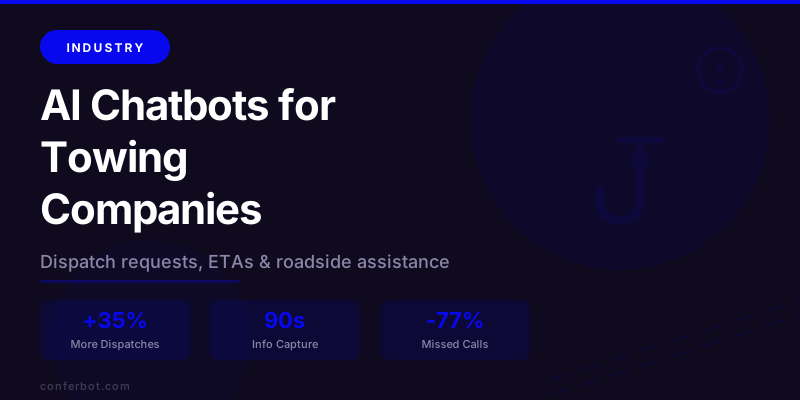
AI chatbots provide the always-available, instant-response capability that towing companies need. Deployed on the company's website, Google Business Profile, and SMS, the chatbot captures essential dispatch information (vehicle location, vehicle type, service needed, insurance details) in 60 to 90 seconds, provides real-time ETA estimates, handles insurance pre-authorization workflows, and absorbs peak-hour overflow that would otherwise go to voicemail or a competitor. The chatbot works at 2 AM during a blizzard as effectively as at 2 PM on a sunny Tuesday.
The financial impact is substantial. A mid-size towing company running 6 trucks that averages 18 dispatched jobs per day generates approximately $1.4 million annually. Adding 6 more daily dispatches through reduced missed calls and after-hours capture adds $480,000 in annual revenue -- a 34% growth rate from a single technology implementation. Combined with faster dispatch processing (freeing dispatchers for complex calls) and improved insurance capture (reducing unpaid jobs), the total revenue impact often exceeds 40%.
This guide covers everything towing company owners need to implement an AI chatbot: dispatch request capture with vehicle location and type, service type classification (tow, jump start, lockout, tire change, fuel delivery), ETA communication, insurance information collection, peak hour call overflow management, motor club and fleet account handling, ROI modeling, and a complete implementation roadmap. Whether you run a single truck or a 50-truck fleet, this guide provides the specific strategies for your operation.
Towing Industry Challenges That AI Chatbots Solve
The towing industry faces unique operational challenges driven by the emergency nature of the service, the unpredictability of demand, and the razor-thin margins between answered and missed calls. Understanding these challenges reveals why chatbot adoption delivers outsized returns for towing operations.
The Missed Call Revenue Hemorrhage
Towing is the most time-sensitive service industry that exists. A stranded motorist does not leave a voicemail and wait -- they call the next company on Google. According to industry data, 78% of motorists who reach voicemail at one towing company immediately call a competitor. Every unanswered call is essentially a guaranteed lost job. During peak periods (accidents on major highways, severe weather, holiday travel surges), call volume can spike 3 to 5x normal levels in minutes, overwhelming even well-staffed dispatch centers.
Peak Hour Call Stacking
Towing demand concentrates in predictable surge windows: morning and evening rush hours (5-8 AM and 4-7 PM), during and after severe weather events, holiday travel weekends (Memorial Day, July 4th, Labor Day, Thanksgiving), and late Friday and Saturday nights (lockouts and breakdowns). A company with 2 dispatch lines and 1 dispatcher cannot handle 6 simultaneous incoming calls. The chatbot provides unlimited concurrent capacity, ensuring that no caller waits in a queue while the dispatcher handles higher-priority calls by phone.

Information Gathering Inefficiency
Every dispatch requires collecting specific information: exact vehicle location (address or GPS coordinates), vehicle year/make/model/color, service needed (tow, jump, lockout, tire, fuel), vehicle condition (driveable, accident-damaged, in traffic lane), insurance or motor club information, and customer contact details. On the phone, this takes 3 to 5 minutes per call -- time the dispatcher cannot spend on other incoming calls. The chatbot collects this information in a structured format in 60 to 90 seconds, with GPS-verified location data that eliminates the "where exactly are you?" confusion that plagues phone dispatching.
After-Hours Coverage
Towing is inherently a 24/7 business, but staffing a dispatch center around the clock is expensive. Many small to mid-size companies rely on answering services ($500 to $2,000 per month) that add a communication layer between the motorist and the tow truck driver, slowing response times and frequently recording inaccurate information. The chatbot replaces or supplements answering services with instant, accurate information capture that feeds directly into the dispatch system.
Insurance and Motor Club Complexity
A significant portion of towing revenue comes from motor club contracts (AAA, Agero, Allstate Motor Club) and insurance company roadside assistance programs. Each has different authorization procedures, coverage limits, and payment processes. Dispatchers must verify coverage, obtain authorization numbers, and document services within specific parameters. The chatbot handles preliminary insurance information collection, reducing the authorization time from 5 to 8 minutes to 2 to 3 minutes per call. According to the Tow Industry Analytics database, companies that streamline insurance processing capture 20% more motor club referrals due to faster response times.
Competition from Roadside Assistance Apps
Digital-first roadside assistance services like Honk, URGENTLY, and Agero's digital platform are capturing an increasing share of the towing market. These platforms offer instant digital dispatch, GPS-tracked ETAs, and cashless payment -- features that traditional towing companies cannot match with phone-only operations. A chatbot brings these digital capabilities to independent towing companies, allowing them to compete with app-based services while maintaining direct customer relationships.
Dispatch Request Capture: From Phone Calls to Structured Digital Intake
Dispatch request capture is the highest-impact chatbot capability for towing companies. Every structured request that enters the system is a dispatchable job; every missed or incomplete request is revenue lost. Here is how to implement a dispatch intake system that captures and qualifies requests in 90 seconds or less.
The Dispatch Conversation Flow
An effective towing dispatch chatbot guides motorists through a structured intake process that mirrors the dispatcher's information needs:
Step 1: Service type identification. "Need roadside help? What do you need? [Tow truck / Jump start / Locked out / Flat tire / Fuel delivery / Accident recovery / Winch out (stuck vehicle) / Other]." Identifying service type first determines which truck and equipment to dispatch.
Step 2: Vehicle location. "Where is your vehicle? [Share GPS location / Enter address / Describe location]." The GPS share option is critical -- it provides exact coordinates that eliminate the location confusion that plagues phone dispatching. For motorists who cannot share GPS, the chatbot asks progressively specific questions: "What highway or road are you on? In which direction were you traveling? What is the nearest cross street, exit number, or landmark?"

Step 3: Vehicle identification. "Tell me about your vehicle: Year? Make? Model? Color? [optional: license plate]." Vehicle identification determines tow truck requirements (flatbed for AWD vehicles, wheel-lift for standard, heavy-duty for trucks and SUVs) and helps the driver locate the vehicle on arrival.
Step 4: Situation assessment. "Is your vehicle in a safe location? [Yes, pulled over safely / On the road shoulder / In a travel lane / In a parking lot / Other]." Vehicles in travel lanes are automatically flagged as priority dispatches. The chatbot can also ask: "Are there any injuries? If yes, please call 911 first, then return to this chat for towing."
Step 5: Tow destination (if applicable). "Where would you like your vehicle towed? [My home / A specific repair shop / The nearest repair shop / I need a recommendation / Insurance will determine]." For customers who need a shop recommendation, the chatbot can suggest partner shops that provide referral revenue.
Step 6: Contact and confirmation. "Your name and phone number so our driver can reach you? We will dispatch a truck to your location and text you an ETA within 2 minutes. A [flatbed/wheel-lift] truck is best for your [vehicle]. Estimated cost for this service: $125-$175 plus $4/mile after the first 5 miles."
Dispatch System Integration
| Platform | Integration Capabilities |
|---|---|
| Towbook | Dispatch creation, truck assignment, GPS tracking, invoicing |
| TOPS (Towing Operations and Procedure System) | Call management, dispatch, motor club integration |
| Beacon Software | Full dispatch, fleet management, customer database |
| ProTow | Dispatch, impound management, motor club billing |
| Clearplan | Digital dispatch, driver app, real-time tracking |
| Custom / Phone-based | API or SMS-based dispatch notification to drivers |
For companies using GPS fleet management solutions like Samsara or GPS Trackit, the chatbot can also display real-time truck locations for more accurate ETA calculations. These integrations allow the chatbot to feed structured dispatch requests directly into the company's existing workflow, eliminating manual data entry and ensuring no information is lost in translation from customer to dispatcher to driver.
Priority Routing and Triage
Not all tow requests are equal. The chatbot applies intelligent routing based on urgency: vehicles in travel lanes receive immediate priority dispatch, highway shoulder situations are escalated, parking lot requests are queued normally, and lockouts in hot weather with children or pets mentioned are flagged as emergencies. This triage ensures the most urgent situations receive the fastest response -- improving safety outcomes and customer satisfaction.
For strategies on capturing leads through digital channels across service industries, see our AI chatbot lead generation playbook.
ETA Estimates and Real-Time Tracking: Reducing Anxiety for Stranded Motorists
For a stranded motorist, the most important piece of information after "help is on the way" is "when will they get here?" Uncertainty about arrival time is the #1 source of customer anxiety and the #1 driver of negative reviews in the towing industry. AI chatbots with GPS integration provide accurate, real-time ETA communication that transforms the waiting experience.
Initial ETA Estimation
Within 60 seconds of dispatch, the chatbot provides an estimated arrival time: "Your tow truck has been dispatched! Driver: Mike, Truck #7 (white Peterbilt flatbed). Estimated arrival: 22 minutes based on current traffic. I will update you as Mike gets closer." This immediate ETA communication reduces anxiety, prevents duplicate calls ("where is my tow truck?"), and sets realistic expectations.
The ETA calculation factors in: distance from nearest available truck to the customer's location, current traffic conditions (Google Maps or Waze API integration), time of day and road conditions, and type of service required (which determines which specific truck must respond). For companies without GPS fleet tracking, the chatbot uses distance-based estimates with time-of-day adjustments: "Based on your location, estimated arrival is 25-35 minutes. We will update you once the driver confirms departure."
Real-Time Tracking Updates
The chatbot sends proactive updates as the truck approaches:
Driver departure: "Mike has departed and is heading your way. Updated ETA: 20 minutes."
Halfway point: "Mike is about 10 minutes away. He is traveling on Route 9 heading south toward your location."
Approaching: "Mike is 3 minutes away. He will be arriving from the northbound direction. Please stay safely away from traffic if possible."
Arrived: "Mike has arrived at your location. Look for Truck #7, a white flatbed. He is pulling up now."

Delay Communication
When delays occur (traffic, prior job running long, mechanical issue), the chatbot communicates proactively: "Update: Mike is running about 10 minutes behind the original estimate due to heavy traffic on I-95. New estimated arrival: 32 minutes. We apologize for the delay and appreciate your patience. Your request remains our priority." Proactive delay communication prevents the angry "where is my truck?" callbacks that consume dispatcher time and generate negative reviews. Customers are far more tolerant of delays when communicated proactively versus discovering them through silence. According to J.D. Power's 2025 Roadside Assistance Satisfaction Study, proactive communication is the single highest-weighted factor in customer satisfaction with roadside assistance -- outranking even speed of arrival. A towing company that communicates well during a 40-minute wait scores higher than one that arrives in 25 minutes but provides no updates.
Post-Arrival Communication
After the service is complete, the chatbot handles post-service communication: payment confirmation and receipt delivery, satisfaction check ("How was your experience with Mike today?"), review request for satisfied customers, and follow-up resources ("Need a trusted mechanic? Here are our recommended partners in your area."). This post-service communication captures reviews (critical for local SEO), identifies service issues early, and generates referral revenue from partner shop recommendations.
For more on real-time communication strategies that enhance customer experience, see our chatbot customer experience guide.
Service Type Handling: Tows, Jump Starts, Lockouts, and More
Towing companies offer a range of services beyond traditional towing, and each service type has unique information requirements, pricing structures, and equipment needs. The chatbot handles each service type with tailored conversation flows.
Standard Towing
The chatbot determines the appropriate tow method based on vehicle characteristics: flatbed required for all-wheel drive, four-wheel drive, luxury vehicles, and accident-damaged vehicles. Wheel-lift suitable for front-wheel drive and rear-wheel drive vehicles without damage. Heavy-duty towing for trucks over 10,000 lbs, RVs, commercial vehicles, and equipment. The chatbot communicates pricing clearly: "Standard tow for your 2022 Honda CR-V (flatbed recommended for AWD): $125 hookup fee plus $4 per mile. Distance to your preferred shop: 8 miles. Estimated total: $157. Does that work for you?"
Jump Starts
Jump start requests follow a simpler flow: verify vehicle location, confirm the issue is a dead battery (versus a no-start condition that might indicate another problem), and dispatch. The chatbot can also troubleshoot: "Has your car been sitting for more than a week? Are your headlights dim or completely off? Does the engine crank at all when you turn the key?" This troubleshooting helps ensure a jump start service will actually resolve the issue, preventing wasted trips for non-battery problems.
Lockout Service
Vehicle lockout requests require specific details: vehicle year/make/model (determines lock technology), are keys visible inside the vehicle, is the vehicle running, and are there children or pets inside (emergency escalation). The chatbot handles these situations with appropriate urgency: "I see you are locked out of a 2023 Toyota Camry with the keys inside. Good news -- our technician can open this without damage. Is anyone inside the vehicle who might be in distress? [Yes - this is an emergency / No - vehicle is empty]."

Flat Tire Service
For tire-related requests, the chatbot determines the best approach: "Do you have a spare tire in your vehicle? [Yes / No / Not sure]." If yes, the chatbot dispatches a tire change service. If no, it offers towing to the nearest tire shop or a mobile tire service if available. This pre-qualification prevents dispatching a tire-change truck to a vehicle with no spare -- a common source of wasted trips and customer frustration.
Fuel Delivery
Running out of fuel is embarrassing for customers, so the chatbot handles these requests with zero judgment: "Need fuel? No worries, it happens more than you think! What type of fuel does your vehicle use? [Regular unleaded / Premium / Diesel]. We will bring enough to get you to the nearest gas station safely. Fuel delivery service: $65 including 2 gallons of fuel." The chatbot also confirms that fuel is actually the issue (versus a mechanical problem) by asking if the fuel gauge was at or near empty.
Accident and Recovery Services
Accident situations require the most careful handling. The chatbot begins with safety: "If there are injuries, please call 911 first. Is everyone safe? [Yes / There are injuries - calling 911]." For non-injury accidents, the chatbot collects: number of vehicles involved, extent of damage, whether the vehicle is driveable, police report number (if available), and insurance information. Accident tows command premium pricing ($175 to $350+) and often lead to additional services (storage fees, secondary towing to body shops), making them high-value jobs that justify priority dispatch.
For strategies on handling urgent service requests across industries, see our chatbot for emergency service businesses.
Insurance and Motor Club Integration: Streamlining Authorization and Payment
Insurance companies and motor clubs (AAA, Agero, Allstate Motor Club, Nationwide, USAA) are major revenue sources for towing companies, representing 30 to 50% of total dispatch volume. However, insurance-related calls require additional verification and authorization steps that extend call times significantly. The chatbot streamlines this process.
Insurance Information Pre-Collection
The chatbot collects insurance details during the initial intake: "Do you have roadside assistance coverage? [Yes, through my insurance / Yes, through AAA or another motor club / No, I will pay out of pocket / Not sure]." For insured motorists, the chatbot gathers: insurance company or motor club name, member or policy number, and policyholder name. This pre-collection allows the dispatcher to begin the authorization process immediately upon receiving the chatbot-captured request, rather than spending the first 3 to 5 minutes of a phone call collecting information.
Motor Club Workflow Optimization
For motor club calls (AAA, Agero), the chatbot can inform the motorist about what to expect: "Your AAA membership covers towing up to 5 miles (Classic) or 100 miles (Plus) from the breakdown location. We will verify your coverage with AAA and dispatch a truck. If your tow distance exceeds your coverage, we will let you know the additional cost before proceeding. Any additional mileage is billed at $4/mile."
This transparent communication reduces the billing disputes that arise when motorists are surprised by charges exceeding their coverage limits. According to towing industry data, billing disputes cost the average company $8,000 to $15,000 annually in unpaid invoices and administrative time. Pre-communicating coverage limits through the chatbot reduces disputes by 60 to 75%.
Direct Insurance Company Communication
For motorists with insurance-based roadside assistance (Progressive, GEICO, State Farm, Allstate), the chatbot provides clear guidance: "Your insurance roadside coverage typically works like this: We provide the service, your insurance reimburses us directly, and you pay nothing out of pocket (or just a small deductible). I will collect your policy information and our team will handle the authorization. You may also want to have your insurance company's roadside number handy in case they need to authorize directly."

Cash Customer Conversion
For the 40 to 50% of callers who do not have roadside coverage, the chatbot provides transparent pricing and payment options: "No roadside coverage? No problem. Here is our pricing for your tow: Hookup fee: $125. Mileage (12 miles): $48. Total estimate: $173. We accept cash, all major credit cards, Venmo, and Zelle. Payment is due at time of service. Would you like me to dispatch a truck?" Transparent upfront pricing for cash customers reduces payment disputes and no-pays, which are estimated to cost the industry $1.2 billion annually according to Towing and Storage industry data.
Fleet Account Management
Commercial fleet accounts (trucking companies, dealerships, property management companies, municipalities) represent high-volume recurring revenue. The chatbot recognizes fleet account callers by phone number or account number and applies pre-negotiated rates: "Welcome back! I see you are calling from ABC Trucking, account #4712. Your pre-negotiated rate applies. What vehicle needs service today?" Fleet account identification reduces per-call processing time from 5 minutes to 90 seconds and ensures correct billing -- eliminating the rate-lookup delays that frustrate fleet managers.
Peak Hour Call Overflow: Never Miss a Dispatch During Surge Periods
Peak hour call overflow is where the chatbot delivers its single highest financial impact for towing companies. During surge events -- rush hour accidents, severe weather, holiday weekends -- call volume can spike 300 to 500% within minutes, overwhelming even well-staffed dispatch centers. The chatbot provides unlimited concurrent capacity to absorb this surge.
Simultaneous Request Handling
While a human dispatcher handles one call at a time (or two with extreme multitasking), the chatbot handles 50, 100, or 500 simultaneous requests with zero degradation in response quality or speed. During a major highway accident that generates a dozen tow requests in 10 minutes, the chatbot captures every one -- vehicle location, type, service needed, and contact information -- while the dispatcher focuses on the highest-priority calls that require human judgment.
Smart Triage During Overload
When demand exceeds truck availability, the chatbot manages customer expectations: "We are experiencing high demand due to the weather. All our trucks are currently dispatched. Your request is confirmed and you are #3 in our queue. Estimated wait time: 45-60 minutes. I will update you when a truck is assigned and provide an ETA at that time. If you prefer not to wait, I can provide the number for other service options." This transparent communication retains customers who would otherwise call a competitor, while the honest wait-time estimate (versus a promise you cannot keep) builds trust and reduces complaints.
Weather Event Surge Management
Severe weather events (ice storms, heavy snow, flooding, extreme heat) generate predictable towing surges. The chatbot can be pre-configured for weather events: "Due to today's ice storm, our response times are running 30-45 minutes longer than usual. We are dispatching trucks as quickly and safely as possible. If your vehicle is in a safe location, please remain inside with your hazard lights on. If you are in danger, please call 911." This mass communication capability during weather events -- reaching all active requestors simultaneously -- is impossible with phone-based dispatching.

After-Hours Intelligent Dispatch
Between 10 PM and 6 AM, many towing companies reduce to on-call driver coverage. The chatbot serves as the overnight dispatch system: capturing all incoming requests, qualifying urgency, providing ETAs based on driver availability, and sending structured dispatch notifications to on-call drivers via SMS or push notification. This eliminates the need for overnight answering services ($500 to $2,000/month) while providing faster, more accurate dispatch than a third-party service can deliver.
Prioritizing Revenue-Maximizing Calls
Not all tow calls are equally profitable. Accident tows ($175 to $350), long-distance tows ($200+), and heavy-duty tows ($300+) generate 2 to 3x the revenue of basic roadside services ($65 to $85). During peak periods when truck availability is limited, the chatbot can flag high-value requests for priority dispatcher attention while handling routine roadside calls autonomously. This intelligent triage maximizes revenue per truck-hour during the periods when it matters most.
For strategies on managing high-volume customer inquiries during surge periods, see our appointment and scheduling automation guide.
ROI Model: Single-Truck Operations and Multi-Truck Fleets
Let us build ROI models for both a single-truck owner-operator and a mid-size fleet to demonstrate the chatbot's financial impact at different scales.
Single-Truck Owner-Operator ROI
| Metric | Before Chatbot | After Chatbot | Impact |
|---|---|---|---|
| Daily dispatched jobs | 6 | 8 (+33%) | +2 jobs/day |
| Average revenue per job | $145 | $155 (better service mix) | +$10/job |
| Missed calls during active tow | 35% of calls | 5% (chatbot captures) | -86% missed rate |
| After-hours jobs captured | 1/day | 2.5/day | +1.5 jobs/day |
| Answering service cost | $800/month | $0 (chatbot replaces) | $9,600/year saved |
| Insurance pre-collection rate | Manual each call | 85% pre-collected | 3 min saved/insured call |
Revenue impact: Additional daily jobs: 2 jobs x $155 x 365 = $113,150. Answering service elimination: $9,600. Reduced no-pays from upfront pricing: $4,800. Total annual impact: $127,550.
Investment: Conferbot platform: $149/month. Dispatch integration: $500 one-time. Total first-year: $2,288.
First-year ROI: $127,550 / $2,288 = 5,573%
Mid-Size Fleet ROI (8 Trucks, 2 Dispatchers)
| Metric | Before Chatbot | After Chatbot | Impact |
|---|---|---|---|
| Daily dispatched jobs (fleet) | 36 | 48 (+33%) | +12 jobs/day |
| Average revenue per job | $165 | $180 (improved mix + reduced no-pays) | +$15/job |
| Peak hour capture rate | 65% | 92% | +27 percentage points |
| Dispatcher overtime hours/week | 12 hours | 4 hours | 8 hours saved/week |
| Monthly Google reviews | 3 | 22 | +228 reviews/year |
Revenue impact: Additional daily jobs: 12 x $180 x 365 = $788,400. Dispatcher overtime savings: 8 hrs x $35/hr x 52 weeks = $14,560. Answering service elimination: $18,000. Reduced billing disputes: $12,000. Total annual impact: $832,960.
Investment: Conferbot platform: $249/month. Dispatch system integration: $2,000 one-time. Total first-year: $4,988.
First-year ROI: $832,960 / $4,988 = 16,699%
These ROI figures are particularly compelling because towing revenue is directly tied to call capture -- there is no equivalent of "walk-in traffic" or "organic discovery" for emergency towing. Every additional captured request translates directly to dispatched revenue.
For a comprehensive ROI calculation framework applicable to any service business, see our chatbot ROI calculator and framework guide.
Review Generation and Local SEO for Towing Companies
For towing companies, local SEO dominance is a direct revenue driver. When a motorist searches "tow truck near me" or "roadside assistance [city]", the top 3 Google results capture 75% of the clicks -- and in an emergency, the motorist calls the first company with good reviews and a phone number. According to BrightLocal's 2025 survey, 88% of consumers trust online reviews as much as personal recommendations for service businesses.
Post-Service Review Automation
Within 1 to 2 hours of service completion, the chatbot sends a follow-up: "Hi! Mike from FastTow just helped you with your Honda CR-V. How did everything go? Rate 1-5." Responses of 4 or 5 get a Google review request with a direct link. Responses of 1 to 3 trigger private feedback collection and service recovery. This systematic approach generates 15 to 25 reviews per month for an active towing company, compared to 1 to 3 organic reviews.
Review Content Coaching
The chatbot can guide review content: "Thanks for the 5-star rating! If you have 30 seconds, mentioning the fast response time and Mike's professionalism in a Google review helps other stranded drivers find us. Here is the link: [Google review URL]." Reviews that mention specific attributes (response time, professionalism, fair pricing) carry more weight in Google's local algorithm and are more persuasive to future searchers.
Google Business Profile Optimization
The chatbot deployed on Google Business Profile captures customers at peak intent -- when they are actively searching for a tow truck. Immediate response, transparent pricing, and one-click dispatch initiation convert Google searchers at 2 to 3x the rate of a phone number alone. Combined with accumulated positive reviews, GBP chatbot deployment creates a self-reinforcing growth loop: more reviews improve visibility, which drives more traffic, which generates more reviews.
Repeat Customer and Referral Building
While towing seems like a one-time service, the chatbot builds a customer database for remarketing: annual roadside safety reminders ("Winter is coming -- is your battery ready? Schedule a free battery test at our partner shop"), referral incentives ("Know someone who needs a tow? Give them our number and mention your name for priority dispatch"), and fleet and commercial prospecting based on individual encounters with company vehicles. A single commercial relationship generated from a cash tow can be worth $10,000 to $50,000 in annual recurring revenue.
For more strategies on using chatbot-generated reviews to dominate local search, see our chatbot feedback and NPS guide.
Implementation Guide: Launching Your Towing Company Chatbot
Here is a practical implementation plan for towing companies, designed to get your chatbot capturing dispatch requests within 10 days.
Phase 1: Data Preparation (Days 1-3)
Service and pricing documentation: Document every service type with pricing: standard tow (hookup fee + per-mile rate by vehicle class), jump start, lockout, tire change, fuel delivery, winch-out, accident recovery, heavy-duty tow, and motorcycle tow. Include after-hours surcharges, holiday rates, and mileage calculations.
Service area mapping: Define your service area boundaries and response time estimates by zone. A customer 5 miles away gets a different ETA than one 25 miles away. Document typical response times by time of day and day of week.
Insurance and motor club details: List all motor clubs and insurance companies you work with, their authorization procedures, coverage limits, and billing processes. This information enables the chatbot to communicate accurately about insurance-covered services.
Phase 2: Configuration and Integration (Days 4-7)
Conversation flow design: Configure the dispatch intake flow (service type, location, vehicle info, insurance, confirmation), ETA communication sequences, and post-service follow-up using Conferbot's visual builder. Prioritize speed -- every second matters for stranded motorists.
Dispatch system integration: Connect the chatbot to your dispatch software (Towbook, TOPS, Beacon, ProTow, Clearplan) for automated job creation. For companies without dispatch software, configure SMS or push notification dispatch to drivers with structured request details.
GPS and tracking setup: Integrate Google Maps API for distance and ETA calculations. If using fleet GPS (Fleetio, GPS Trackit, Samsara), connect for real-time truck location and ETA accuracy.
Phase 3: Testing and Launch (Days 8-10)
Dispatcher and driver training: Train dispatchers on how chatbot-captured requests appear in their workflow, how to verify and dispatch chatbot requests, and when the chatbot escalates to them. Train drivers on the chatbot's customer communication (so they know customers have been given ETAs and pricing).
Soft launch: Deploy to your website alongside your phone number. Position as "Text us for instant dispatch" to capture customers who prefer texting. Monitor the first 20 to 30 chatbot-initiated dispatches for accuracy and customer satisfaction.
Full deployment: After confirming accuracy, deploy to Google Business Profile (critical for "tow truck near me" searches), Facebook, and SMS. Activate post-service review requests and insurance pre-collection workflows.
Ongoing Optimization
Review chatbot analytics daily during the first month, then weekly: dispatch request capture rate (target: 90%+), average information capture time (target: under 90 seconds), ETA accuracy, customer satisfaction scores, and review generation volume. Refine location capture flows based on common failure points (customers who cannot describe their location) and adjust pricing communication based on customer feedback.
For more guidance on building chatbots that handle urgent service requests, see our no-code chatbot builder guide and our conversation design masterclass.
Was this article helpful?
AI Chatbot for Towing Companies FAQ
Everything you need to know about chatbots for ai chatbot for towing companies.
About the Author

Conferbot Team specializes in conversational AI, chatbot strategy, and customer engagement automation. With deep expertise in building AI-powered chatbots, they help businesses deliver exceptional customer experiences across every channel.
View all articles