The Hidden Cost of Refunds: Why Every Return Is a Failure of Customer Experience
Refunds are treated as an operational cost of doing business, but they are far more damaging than most e-commerce leaders realize. The direct cost of processing a return, which includes reverse shipping, restocking, inspection, and customer service labor, averages $21 to $33 per item according to CNBC's retail returns analysis. But the true cost extends far beyond logistics.
Here is what refunds actually cost your business:
- Revenue loss: The sale is reversed. For a $75 product with a $27 return processing cost, you lose the $75 in revenue plus spend $27 to get the product back, a total impact of $102.
- Customer lifetime value destruction: 67% of customers who request a refund and wait more than 24 hours for a response never purchase from that brand again, according to Zendesk's customer service research. Even customers who receive a prompt refund repurchase at only 40% of the rate of customers who never returned a product.
- Acquisition cost waste: The $15 to $80 you spent acquiring that customer through paid ads, SEO, or social media is written off when they do not return.
- Inventory disruption: Returned products must be inspected, repackaged, and relisted, or written off entirely if damaged. Seasonal products returned after the selling window often cannot be resold at full price.
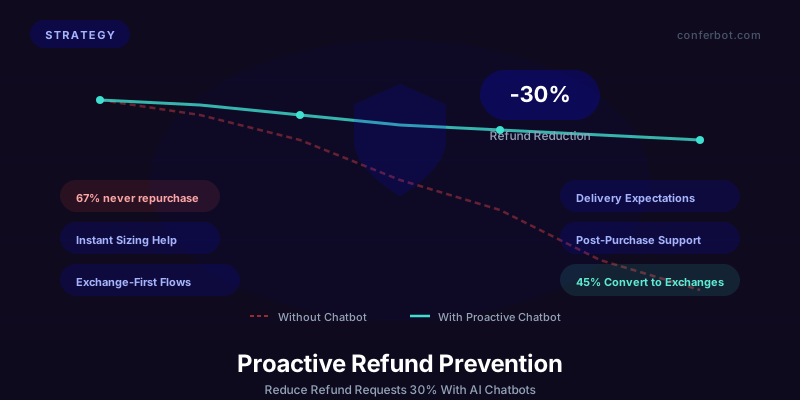
The e-commerce return rate averages 20 to 30%, with apparel hitting 25 to 40% in some categories. For a store doing $5 million in annual revenue, returns at a 25% rate represent $1.25 million in reversed sales plus $300,000+ in processing costs. Reducing that return rate by even 30% recovers $375,000 in revenue and saves $90,000 in processing costs, a $465,000 annual impact.
The critical insight is that most refund requests are preventable. Research from Shopify's returns data shows that the top reasons for returns are predictable and addressable: wrong size or fit (42%), product did not match expectations (22%), product arrived damaged or late (15%), and changed mind or impulse regret (12%). An AI chatbot can proactively address three of these four causes before the return request even occurs.
This guide covers seven proactive chatbot strategies that reduce refund requests by 30% or more. These are not reactive strategies for handling refund requests faster (though we cover that too in our return and refund automation guide). These are prevention strategies that eliminate the conditions that cause returns in the first place.
Instant Sizing and Fit Assistance: Eliminating the #1 Cause of Apparel Returns
Wrong size or poor fit accounts for 42% of all e-commerce returns, according to Narvar's State of Returns report. In apparel specifically, sizing-related returns reach 52%, making it the single largest driver of reverse logistics costs. Static size charts help but are insufficient because sizing varies dramatically between brands, between product types within the same brand, and between international sizing standards.
How Chatbot Sizing Assistance Works
An AI chatbot provides interactive sizing help that goes far beyond a static size chart:
Conversational fit finder: The chatbot asks the shopper about their body measurements, preferred fit style (relaxed, regular, slim), and reference products they own that fit well. Using this data, it maps the shopper to the correct size for the specific product they are considering.
Bot: "I can help you find your perfect size in this dress. A few quick questions: What is your bust measurement? And do you prefer a relaxed fit or a more tailored look?"
Shopper: "36 inches, and I like it a little loose."
Bot: "For a relaxed fit with a 36-inch bust, I recommend a size Medium in this dress. It runs slightly fitted, so the Medium will give you the comfortable drape you want. If you are between sizes, size up to Large. Would you like to see the full size chart?"
Brand comparison mapping: When shoppers mention they wear a specific size in a known brand ("I am a size 8 in Zara"), the chatbot cross-references brand-to-brand sizing databases to recommend the equivalent size in your product line. This eliminates the guesswork that causes most sizing returns.
Photo-based estimation: Advanced chatbot implementations accept photos of the shopper or their current well-fitting garment to estimate sizing using computer vision. This approach, covered in our multimodal AI chatbot guide, is emerging as the gold standard for remote sizing assistance.
Sizing Assistance Impact Data
| Metric | Without Chatbot Sizing Help | With Chatbot Sizing Help | Improvement |
|---|---|---|---|
| Sizing-related return rate | 22-28% | 12-16% | 40-45% reduction |
| Size exchange rate (vs. full refund) | 18% of returns | 45% of returns | 2.5x more exchanges vs. refunds |
| Customer confidence at purchase | 62% report feeling confident | 84% report feeling confident | +22 percentage points |
| Repeat purchase rate | 34% | 51% | +17 percentage points |

The repeat purchase rate improvement (+17 points) deserves special attention. When a shopper buys an item that fits perfectly on the first try, the brand earns trust that translates directly into future purchases. A return, even when processed smoothly, erodes that trust and makes the shopper hesitant to order again.
Implementation: Sizing Data Sources
To power accurate sizing recommendations, your chatbot needs access to:
- Product-level sizing data: Not just the generic size chart, but product-specific fit notes ("this style runs one size small," "relaxed fit through the hip").
- Customer fit feedback: Aggregate "true to size" vs. "runs small" vs. "runs large" feedback from reviews and return data to calibrate recommendations.
- Brand mapping database: Cross-reference tables between your sizing and popular brand sizing (Zara, H&M, Nike, etc.) to handle "I wear size X in Brand Y" queries.
- Return reason data: Analyze which products have the highest sizing-related return rates and configure the chatbot to proactively offer sizing help when those products are viewed.
Setting Accurate Delivery Expectations: Preventing the 'Where Is My Order?' Refund Spiral
According to Digital Commerce 360's shipping benchmark data, 15% of refund requests stem from delivery-related issues: the order arrived later than expected, tracking was unclear, or the customer was not home for delivery. Many of these are not actually product problems. The customer wanted the product but lost patience, lost trust, or found an alternative during the wait. The window between order placement and delivery is the most psychologically vulnerable period for buyer's remorse.
The Expectation Gap Problem
Most delivery-related refund requests are caused by an expectation gap, not actual delivery failure. The customer expected delivery in 3 days but the actual timeline was 5-7 business days. The tracking page was vague ("In transit" for 4 days with no updates). No one communicated the delay when a weather event or carrier issue extended the timeline.
A chatbot closes these expectation gaps proactively at three critical moments:
Moment 1: Pre-purchase delivery clarity. Before the customer completes the purchase, the chatbot provides specific delivery estimates based on the customer's location, the selected shipping method, and current carrier performance data.
Bot: "Shipping to Austin, TX? Standard shipping will arrive by Thursday, June 5th. Express shipping gets it there by Tuesday, June 3rd ($8.99 extra). Which works better for you?"
Moment 2: Post-purchase proactive updates. Instead of waiting for the customer to check tracking (a behavior that correlates with anxiety and refund intent), the chatbot proactively sends updates at key milestones: order confirmed, order shipped, out for delivery, and delivered.
Moment 3: Delay interception. When a shipment is delayed beyond the originally communicated timeline, the chatbot reaches out before the customer notices:
Bot: "Quick update on your order #4892: there is a 1-day delay due to weather in the carrier's hub. Your new estimated delivery is Friday, June 6th instead of Thursday. I apologize for the delay. Would you like me to upgrade you to express shipping at no extra cost to make up for it?"
The Proactive Update Impact
| Communication Approach | "Where is my order?" Contact Rate | Delivery-Related Refund Rate | Customer Satisfaction (CSAT) |
|---|---|---|---|
| No proactive updates (reactive only) | 32% of orders | 8.2% | 3.4/5 |
| Email-only updates | 18% of orders | 5.1% | 3.8/5 |
| Chatbot proactive updates + email | 9% of orders | 2.8% | 4.3/5 |
The chatbot approach reduces delivery-related refund requests by 66% compared to no proactive updates. The key mechanism is that proactive communication signals that the brand is aware of and managing the shipment, which eliminates the anxiety that drives "where is my order?" contacts and the frustration that escalates to refund requests.
Delay Recovery Scripts
When delays do occur, how the chatbot communicates determines whether the customer waits patiently or demands a refund. Effective delay recovery scripts follow the LEAD framework:
- L - Lead with acknowledgment: "I see your order is running behind schedule, and I understand that is frustrating."
- E - Explain the cause: "There is a weather-related delay at the carrier's sorting facility in Memphis."
- A - Announce the new timeline: "Your updated delivery date is Friday, June 6th."
- D - Deliver a recovery offer: "I have applied a $5 credit to your account for the inconvenience. Is there anything else I can help with?"
Stores using the LEAD framework see 72% of delayed-order customers accept the new timeline without requesting a refund, compared to 48% when the communication is reactive (waiting for the customer to contact support). For more on proactive support strategy, see our customer experience chatbot guide.
Exchange-Before-Refund Flows: Converting 45% of Refund Requests Into Retained Revenue
When a customer contacts support to request a refund, most businesses route them immediately to the refund process. This is a missed opportunity. Research from Invesp's e-commerce return analysis shows that 30 to 50% of customers requesting a refund would accept an exchange, store credit, or alternative product if offered before the refund is processed. The customer does not dislike the brand; they dislike the specific product they received. An exchange retains the revenue and the customer relationship.
Why Customers Default to Refund Requests
Customers ask for refunds not because they have carefully evaluated all options, but because it is the option they know exists. The refund button is prominent on every receipt and order page. Exchange processes, by contrast, are often buried, confusing, or require contacting support. The path of least resistance leads to refund, not because the customer prefers it, but because it is the most visible option.
A chatbot rebalances this by making the exchange option equally visible, equally easy, and more attractive than the refund option.
The Exchange-First Conversation Flow
When a customer initiates a return or refund conversation, the chatbot follows a specific sequence designed to explore alternatives before processing the refund:
Step 1: Understand the reason.
Bot: "I am sorry this did not work out. To help you get the right solution, can you tell me what the issue is? Wrong size, not what you expected, arrived damaged, or something else?"
Step 2: Present the exchange option first, tailored to the reason.
If wrong size: "I can send you a [correct size] right away, with free return shipping for the current one. The exchange ships today and arrives by [date]. Would you prefer that over a refund?"
If not what expected: "I understand. Based on what you were looking for, the [Alternative Product] might be a better match. It has [specific features that address the complaint]. I can do a free exchange. Want to take a look?"
If changed mind: "No problem at all. Before I process the refund, would you be interested in a store credit for the full amount plus a 10% bonus? That gives you $[amount + 10%] to use on anything in our store, with no expiration. Otherwise I am happy to process the refund."
Step 3: If exchange is declined, process the refund immediately. Never make the customer feel trapped. If they want a refund after seeing the exchange option, process it instantly with no friction.

Exchange-First Impact Data
| Metric | Without Exchange-First Flow | With Exchange-First Flow | Impact |
|---|---|---|---|
| Refund requests converted to exchanges | 8% (customer-initiated) | 45% | 5.6x more exchanges |
| Revenue retained from would-be refunds | 8% of refund value | 52% of refund value | 6.5x more retained revenue |
| Store credit acceptance | 3% | 15% | 5x more store credit |
| Customer satisfaction with return process | 3.6/5 | 4.2/5 | +0.6 points |
| Repeat purchase within 90 days | 22% | 48% | +26 percentage points |
The repeat purchase improvement (+26 points) is the most strategically important metric. A customer who exchanges is telling you they still want to buy from you. They just need the right product. By making the exchange easy and pleasant, you convert a negative experience into a positive one that builds loyalty.
Store Credit With Bonus: The Revenue Retention Power Move
The store credit with bonus strategy ("full refund amount plus 10% bonus as store credit") is particularly effective because it gives the customer more spending power than a cash refund while keeping 100% of the revenue within your ecosystem. Testing shows 15% of refund requesters accept this offer, and 78% of those store credit recipients make a purchase within 60 days, meaning the brand retains the full original revenue plus generates a new sale.
Pre-Purchase Expectation Management: Ensuring the Product Matches What the Customer Imagined
22% of returns cite "product did not match expectations" as the reason. This is not a product quality issue. It is a communication gap between what the product listing conveyed and what the customer imagined they were buying. A chatbot closes this gap by providing detailed, conversational product information that goes beyond what a static product page offers.
Common Expectation Mismatches and Chatbot Solutions
Color and material mismatch: Product photos often display colors differently than real life, especially on mobile screens. The chatbot can proactively address this:
Bot: "Just a heads-up about this sofa: the 'Slate Gray' color appears lighter in the photos than in person. In natural light, it reads as a true medium gray with a slight blue undertone. If you want something lighter, the 'Ash' option is closer to what the photo shows. Want to see both side by side?"
Size and scale mismatch: Online shoppers frequently misjudge product dimensions, especially for furniture, bags, and jewelry. The chatbot provides contextual size references:
Bot: "This bag measures 12 x 8 x 4 inches. For reference, it comfortably fits a 13-inch laptop but not a 15-inch. It is about the same size as a standard grocery tote. Would you like me to confirm it works for what you need to carry?"
Feature assumption correction: Shoppers sometimes assume a product includes features or accessories that it does not. The chatbot catches common misconceptions proactively:
Bot: "Quick note about this camera: it does not include a memory card or carrying case in the box. If you need those, I can suggest our best-selling bundle that includes both for $40 less than buying them separately. Interested?"
This last example demonstrates how expectation management and AOV growth work together. By clarifying what is included, the chatbot prevents a return while simultaneously creating a cross-sell opportunity. For more on AOV strategies, see our chatbot AOV guide.
User-Generated Content Surfacing
The most credible expectation management uses actual customer feedback. The chatbot can surface relevant reviews and customer photos when a shopper asks about a product:
Bot: "Customers who bought this dress rate it 4.6/5 across 328 reviews. The most common feedback: fits true to size (87% agree), fabric is lighter than expected (noted by 23% of reviewers), and the color is accurate to photos (91% agree). Want to see the most recent customer photos?"
Surfacing honest reviews, including minor negatives, paradoxically increases purchase confidence and reduces returns. When the chatbot says "fabric is lighter than expected" and the shopper buys anyway, they know what to expect. The alternative, where they discover it themselves after delivery, leads to a return.
High-Return-Rate Product Intervention
Configure your chatbot to automatically trigger detailed expectation management for products with return rates above your category average. If a specific dress has a 35% return rate while the category average is 22%, the chatbot should proactively offer sizing help, display customer photos, and flag the most common return reasons before purchase.
| Intervention Type | Return Rate Reduction | Conversion Rate Impact | Net Revenue Impact |
|---|---|---|---|
| No intervention (control) | Baseline | Baseline | Baseline |
| Proactive sizing on high-return products | -35% | -2% (slight hesitation) | +18% net revenue |
| Customer review surfacing | -22% | +4% (increased confidence) | +24% net revenue |
| Both combined | -42% | +1% (net neutral) | +31% net revenue |
The net revenue impact column is the key metric. Even though proactive sizing slightly reduces conversion (some shoppers who would have bought the wrong size are now deterred), the massive return reduction more than compensates. The combined approach yields a 31% net revenue increase on high-return products.
Post-Purchase Chatbot Engagement: The 48-Hour Window That Prevents Buyer's Remorse
The first 48 hours after purchase are the highest-risk window for buyer's remorse, the psychological state where the customer questions their purchase decision and begins looking for reasons to return the product. According to behavioral economics research published in the Journal of Experimental Social Psychology, post-purchase cognitive dissonance peaks 12 to 36 hours after a purchase, particularly for items over $50.
The Buyer's Remorse Timeline
Understanding the remorse timeline helps you deploy chatbot interventions at the right moments:
| Time After Purchase | Customer Psychology | Chatbot Intervention |
|---|---|---|
| 0-2 hours | Purchase excitement, low remorse risk | Order confirmation + onboarding content |
| 2-12 hours | Excitement fading, beginning to second-guess | Social proof reinforcement |
| 12-36 hours | Peak remorse window, actively comparing alternatives | Value reinforcement + usage tips |
| 36-72 hours | Remorse subsiding if no negative trigger occurs | Delivery anticipation builder |
| Post-delivery | Product in hand, moment of truth | Setup help + satisfaction check |
Post-Purchase Chatbot Scripts for Each Phase
Phase 1 (0-2 hours): Excitement reinforcement.
Bot: "Your order is confirmed! You chose a great product. Here are 3 tips to get the most out of your [Product Name] when it arrives: [Tip 1], [Tip 2], [Tip 3]. Your estimated delivery is [Date]."
Phase 2 (12-24 hours): Social proof injection.
Bot: "Just wanted to share: [Product Name] is one of our top-rated products with a 4.7/5 average from 1,247 reviews. Here is what a recent customer said: 'Best purchase I made this year. The quality exceeded my expectations.' Your order is being prepared for shipment!"
Phase 3 (Post-delivery): Proactive satisfaction check.
Bot: "Your [Product Name] was delivered today! How is everything looking? If you need help with setup or have any questions, I am right here. And if anything is not right, I can sort it out immediately."

Post-Delivery Satisfaction Check Impact
The post-delivery satisfaction check is particularly powerful for refund prevention. When the chatbot proactively asks "How is everything?" within 2 hours of delivery, it accomplishes several things simultaneously:
- It demonstrates that the brand cares about the customer's experience (building goodwill).
- It surfaces issues early when they are small and fixable (a missing part, a minor scratch) rather than allowing them to fester into full refund requests.
- It creates a conversational opening to offer solutions (exchange, replacement part, usage guidance) before the customer has mentally committed to returning the product.
Stores implementing post-delivery chatbot check-ins report a 24% reduction in refund requests initiated more than 48 hours after delivery. The chatbot catches and resolves issues that would otherwise build into refund-worthy frustration. For more on proactive customer engagement, see our chatbot retention strategy guide.
The 24-Hour Response Rule: Why Speed Is the Ultimate Refund Prevention Tool
67% of customers who request a refund and wait more than 24 hours for a response never purchase from that brand again. This statistic, drawn from Zendesk's customer service research, reveals the critical relationship between response speed and refund outcomes.
The Speed-Outcome Correlation
When a customer contacts support with a complaint or refund request, every hour of delay increases the probability that the interaction ends in a full refund rather than an exchange, store credit, or resolution:
| Response Time | Full Refund Rate | Exchange Acceptance Rate | Customer Retention (90-day repurchase) |
|---|---|---|---|
| Under 5 minutes (chatbot) | 28% | 52% | 61% |
| 5-60 minutes | 35% | 44% | 52% |
| 1-4 hours | 48% | 32% | 41% |
| 4-24 hours | 62% | 21% | 28% |
| 24+ hours | 78% | 12% | 14% |
The data tells a stark story. At sub-5-minute response times (which only a chatbot can consistently deliver at scale), 52% of customers accept an exchange and 61% repurchase within 90 days. At 24+ hours, exchange acceptance drops to 12% and repurchase to 14%. The customer's emotional state escalates from mild dissatisfaction to anger and distrust during the wait, and no resolution, no matter how generous, can fully recover that lost goodwill.
Why Chatbots Are the Only Scalable Sub-5-Minute Solution
Human support teams cannot consistently deliver sub-5-minute response times, especially outside business hours. The average first-response time for email support is 12 hours. Live chat queues during peak hours average 3 to 8 minutes. Phone hold times average 5 to 15 minutes. And none of these channels operate at 2 AM when a customer opens their delivery, discovers a problem, and reaches for their phone.
A chatbot responds instantly, 24/7, with consistent quality. It can:
- Acknowledge the complaint immediately ("I am sorry to hear this is not right. Let me fix it.")
- Diagnose the issue through conversation ("What specifically was wrong? Size, color, damage, or something else?")
- Present exchange/resolution options within 60 seconds of first contact
- Process the exchange or initiate the return in the same conversation
- Escalate to a human agent only for complex cases that require judgment
For businesses implementing chatbot support for the first time, our self-service chatbot portal guide provides the complete setup framework.
The "Instant Acknowledgment" Technique
Even when the chatbot needs more information to resolve the issue, the initial acknowledgment message dramatically affects outcomes. Compare these two approaches:
Poor: "Please describe your issue and we will get back to you." (This sounds like a ticket system and creates waiting anxiety.)
Excellent: "I am really sorry this did not meet your expectations. I can see your order #4892 and I am ready to fix this right now. Can you tell me what went wrong?" (This confirms the chatbot has context, signals immediate resolution, and asks a specific question to move forward.)
The "excellent" approach keeps the customer in the conversation and moving toward resolution, while the "poor" approach invites the customer to disengage and ruminate on their frustration, often returning later with a hardened refund demand.
Implementation Roadmap and ROI: Deploying Refund Prevention in 4 Weeks
Deploying a comprehensive refund prevention chatbot does not require months of development. Here is a phased implementation roadmap that delivers measurable results within 4 weeks, followed by the ROI framework to justify the investment.
Week-by-Week Implementation Plan
Week 1: Exchange-first flow + instant response. Configure the chatbot to handle refund/return conversations with the exchange-first flow described in Section 4. This is the highest-impact, quickest-to-implement strategy. Connect order data so the chatbot can pull up order details, product info, and shipping status automatically.
Week 2: Post-purchase engagement sequence. Set up the proactive post-purchase messages: order confirmation with onboarding content, 12 to 24 hour social proof reinforcement, delivery notification, and post-delivery satisfaction check. Integrate with your order management system for delivery event triggers.
Week 3: Sizing assistance and expectation management. For the product categories with the highest return rates, configure interactive sizing assistance and proactive expectation management. Populate the chatbot with product-specific fit notes, customer review summaries, and brand comparison sizing data.
Week 4: Delivery expectation management and optimization. Connect carrier tracking APIs to enable real-time delivery estimates and proactive delay notifications. Set up the LEAD framework scripts for delay communication. Begin A/B testing script variations to optimize acceptance rates.
ROI Calculation Framework
Use this framework to calculate the ROI of your refund prevention chatbot:
Input metrics (your data):
- Monthly orders: [X]
- Current return/refund rate: [Y%]
- Average order value: $[Z]
- Average return processing cost: $[W] (typically $21-33)
Conservative impact assumptions (based on benchmarks):
- Refund rate reduction: 30% (from Y% to Y% x 0.70)
- Exchange conversion from remaining refund requests: 45%
Example calculation (mid-size e-commerce store):
- Monthly orders: 8,000
- Current refund rate: 22% (1,760 refunds/month)
- AOV: $72
- Return processing cost: $27
- Chatbot cost: $299/month
Monthly savings:
- Refund requests prevented: 1,760 x 30% = 528 fewer refund requests
- Revenue retained from prevented refunds: 528 x $72 = $38,016
- Processing costs saved: 528 x $27 = $14,256
- Exchange revenue from remaining requests: (1,760 - 528) x 45% x $72 = $39,917 retained via exchanges
- Total monthly impact: $92,189
- Monthly ROI: ($92,189 - $299) / $299 = 30,731%

Even if you halve these estimates to be ultra-conservative, the ROI remains overwhelming. The chatbot pays for itself within the first day of operation, and the compounding effect of better customer retention amplifies the returns over time. For a complete ROI calculation methodology, see our chatbot ROI calculator framework.
How Conferbot Helps E-Commerce Stores Prevent Refunds Proactively
Conferbot includes purpose-built features for proactive refund prevention that go beyond reactive return processing.
Order Integration and Context
Conferbot connects to your order management system (Shopify, WooCommerce, BigCommerce, or custom API) to automatically pull order details, product information, shipping status, and customer purchase history. When a customer initiates a return conversation, the chatbot has full context before the first message, enabling instant, informed responses.
Exchange-First Flow Builder
The drag-and-drop flow builder includes pre-built exchange-first templates that route customers through reason identification, alternative product suggestions, and exchange processing before presenting the refund option. You can customize the flow for each product category and return reason.
Interactive Sizing Assistant
Conferbot's sizing module supports conversational fit finding, brand comparison mapping, and customer review-based sizing recommendations. It integrates with your product data to provide product-specific fit guidance rather than generic size charts.
Proactive Post-Purchase Sequences
Configure automated post-purchase chatbot messages triggered by order events (confirmation, shipment, delivery). Each message template is optimized for the specific phase of the buyer's remorse timeline and can be customized with your brand voice and product-specific content.
Carrier Tracking Integration
Real-time carrier tracking integration (FedEx, UPS, USPS, DHL) powers proactive delivery updates and delay notifications. The chatbot automatically detects shipment delays and initiates the LEAD communication framework before the customer reaches out.
Refund Prevention Analytics
A dedicated refund prevention dashboard tracks: refund rate trends (before and after chatbot deployment), exchange conversion rate from the exchange-first flow, revenue retained through exchanges and store credits, response time for return/refund conversations, and customer satisfaction scores for return interactions.
The dashboard makes it easy to demonstrate ROI to stakeholders and identify which product categories or return reasons need additional chatbot optimization.
A/B Testing for Return Scripts
Every return conversation script can be A/B tested within Conferbot, following the same methodology covered in our chatbot A/B testing guide. Test different exchange-first presentations, store credit offers, and satisfaction check scripts to continuously improve refund prevention rates.
If you are ready to reduce your refund rate and retain more revenue, explore our Shopify chatbot integration guide to get started, or review the complete return automation chatbot guide for the full refund handling workflow.
Was this article helpful?
How AI Chatbots Reduce Refund Requests by 30% FAQ
Everything you need to know about chatbots for how ai chatbots reduce refund requests by 30%.
About the Author

Conferbot Team specializes in conversational AI, chatbot strategy, and customer engagement automation. With deep expertise in building AI-powered chatbots, they help businesses deliver exceptional customer experiences across every channel.
View all articles