The $370 Billion Training Problem That LMS Platforms Cannot Solve
Organizations worldwide spend an estimated $370 billion annually on employee training and development, according to Training Industry research. The average company allocates between $1,200 and $1,800 per employee per year on formal training programs, with enterprise organizations spending significantly more. Yet the return on this enormous investment is alarmingly low.
The root problem is not a lack of spending but a fundamental mismatch between how training is delivered and how adults actually learn. Traditional Learning Management Systems demand that employees block out hours for scheduled courses, consume content in rigid sequences, and pass assessments that test short-term memorization rather than on-the-job application. Research from ATD (Association for Talent Development) shows that employees forget 70% of what they learn in formal training within 24 hours, and 90% within a month, a phenomenon cognitive scientists call the Eberlinghaus forgetting curve.
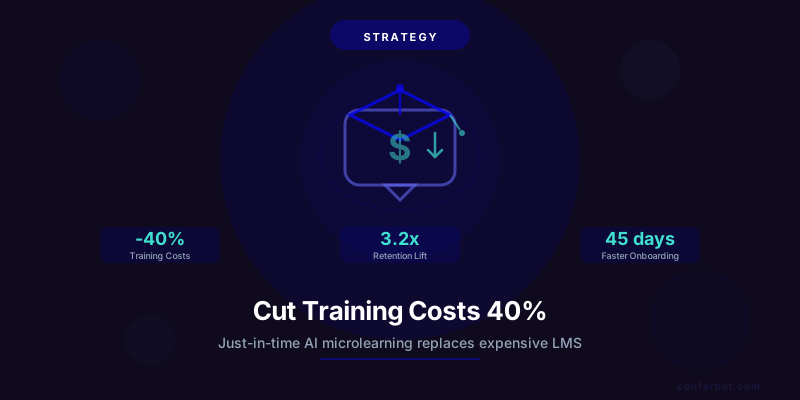
AI chatbots solve this problem by replacing the scheduled-course model with just-in-time microlearning -- delivering the exact knowledge an employee needs at the precise moment they need it. Instead of a two-hour compliance module completed once a year, a training chatbot delivers 90-second refreshers spaced across the year, triggered by role context, calendar events, or employee-initiated queries. Instead of a static product knowledge PDF, a training chatbot answers specific product questions in seconds, quizzes understanding conversationally, and adapts difficulty based on the employee's demonstrated knowledge level.
The cost impact is dramatic. Organizations that replace traditional LMS-centric training with AI chatbot-delivered microlearning report 35 to 45 percent reductions in total training cost per employee while simultaneously improving knowledge retention by 3.2 times. This guide breaks down exactly how those savings materialize, presents a per-employee cost model you can adapt to your organization, and provides a practical implementation roadmap for deploying a training chatbot that delivers measurable results.
Whether you manage a 50-person team or a 50,000-person enterprise, the economics of chatbot-delivered training are compelling. The question is no longer whether to augment your training programs with conversational AI, but how quickly you can capture the savings your competitors are already realizing.
The True Cost of Traditional LMS Training: Where Your Budget Actually Goes
Before quantifying chatbot savings, it is essential to understand the full cost structure of traditional training programs. Most organizations dramatically underestimate their actual training costs because indirect expenses dwarf the visible line items.
Direct Costs: The Visible Spending
Traditional LMS platforms charge $15 to $40 per user per month, with enterprise platforms like Cornerstone, SAP SuccessFactors, and Docebo commanding premium pricing for advanced features. For a 500-employee organization, platform licensing alone costs $90,000 to $240,000 annually. Content development is the next major expense. Custom e-learning course development costs $10,000 to $35,000 per hour of finished content, according to industry benchmarks from instructional design research. Even using templated course builders, organizations spend $3,000 to $8,000 per course module. A typical training library of 40 to 60 modules represents a $200,000 to $480,000 investment in content creation.
Administration costs include LMS system administrators ($65,000 to $95,000 salary), training coordinators ($50,000 to $75,000), and instructional designers ($70,000 to $100,000). Many organizations employ two to five full-time training staff depending on size.
Indirect Costs: The Hidden Majority
The largest training cost is nearly invisible on balance sheets: employee time away from productive work. When a sales representative spends four hours in a training session, the company loses four hours of selling time. At average fully loaded costs of $45 to $80 per hour, a single full-day training session for 50 employees costs $18,000 to $32,000 in lost productivity alone, before counting the trainer's time, room rental, or materials.

Travel costs for instructor-led training add $800 to $2,500 per employee per event for dispersed workforces. Scheduling overhead -- the administrative time required to coordinate calendars, book rooms, send reminders, handle cancellations, and reschedule no-shows -- consumes 15 to 25 percent of a training coordinator's time.
The Comprehensive Cost Model
| Cost Category | Per Employee Per Year (500 employees) | Percent of Total |
|---|---|---|
| LMS licensing | $180 - $480 | 12 - 18% |
| Content development (amortized) | $400 - $960 | 15 - 22% |
| Training staff (allocated) | $260 - $540 | 10 - 15% |
| Employee time in training | $720 - $1,920 | 40 - 55% |
| Facilities and materials | $80 - $200 | 3 - 6% |
| Travel (if applicable) | $200 - $800 | 5 - 15% |
| Total per employee | $1,840 - $4,900 | 100% |
The critical insight from this cost model is that employee productivity loss during training represents the single largest cost component, typically 40 to 55 percent of total spend. Any solution that reduces time away from work while maintaining or improving learning outcomes will produce substantial savings regardless of its own direct costs. This is precisely where AI chatbots excel: they deliver training in 60 to 120-second micro-interactions throughout the workday rather than demanding multi-hour blocks of dedicated training time. For a deeper analysis of chatbot ROI calculations, see our chatbot ROI calculator framework.
Just-in-Time Learning: How AI Chatbots Deliver Knowledge at the Moment of Need
Just-in-time learning is a training methodology where knowledge is delivered at the precise moment an employee needs it to perform a task, rather than weeks or months in advance of potential application. The concept draws from lean manufacturing principles and is supported by extensive cognitive science research on contextual learning and retrieval practice.
The Five Moments of Need Framework
Training researcher Bob Mosher identified five moments when employees need learning support: learning something new, learning more about a topic, applying what they have learned, solving a problem, and adapting to change. Traditional LMS platforms address only the first two moments effectively. AI chatbots address all five because they are available in the workflow, not in a separate learning platform.
Consider a new sales representative who completed product training two weeks ago. They are now on a call with a prospect who asks about integration capabilities with a specific CRM system. The representative cannot pause the call to open the LMS, navigate to the product module, and search for integration details. But they can type a quick question to a training chatbot running on their desktop: "Does our product integrate with HubSpot CRM?" Within three seconds, the chatbot returns the answer with key talking points, feature specifics, and a link to the integration documentation.
On-Demand Knowledge Delivery Architecture
An AI training chatbot functions as a conversational knowledge base with pedagogical intelligence. The architecture includes three layers. The knowledge layer ingests and indexes training materials, product documentation, policy documents, process guides, and frequently asked questions. Using retrieval-augmented generation (RAG), the chatbot can answer specific questions by retrieving relevant passages from the training corpus and generating contextual responses.

The personalization layer tracks each employee's role, department, tenure, prior interactions, quiz results, and identified knowledge gaps. This enables the chatbot to calibrate response depth (concise for experienced employees, detailed for newcomers), recommend proactive learning opportunities, and adjust quiz difficulty. The pedagogy layer applies evidence-based learning science: spaced repetition schedules reviews of previously learned material at increasing intervals, interleaving mixes topics to improve long-term retention, and retrieval practice uses questioning rather than re-reading to strengthen memory.
Practical Delivery Patterns
AI training chatbots deliver learning through several interaction patterns. Query-response handles employee-initiated questions and provides immediate, contextual answers. Proactive nudges deliver scheduled microlearning based on role requirements, upcoming deadlines, or identified gaps. Scenario simulations present realistic workplace scenarios and ask the employee to select the best response, providing immediate feedback. Post-event reinforcement follows up after formal training sessions with spaced reviews that cement key concepts. Compliance reminders deliver regulation updates and require acknowledgment or quiz completion before deadlines.
Each interaction takes 60 to 180 seconds, meaning employees can engage with 3 to 5 learning moments per day without meaningfully impacting their productive time. Over a month, this accumulates to 60 to 100 microlearning interactions covering the same material that a traditional LMS would pack into a four-hour course, but with dramatically better retention because the learning is distributed, contextual, and actively practiced rather than passively consumed. For examples of how internal chatbots deliver employee self-service beyond training, see our employee FAQ bot guide.
Conversational Quizzes and Adaptive Assessment: Testing That Actually Improves Learning
Traditional LMS assessments are universally dreaded by employees and largely ineffective as learning tools. End-of-module quizzes test short-term memory, encourage cramming, and provide no long-term retention benefit. AI chatbot-delivered conversational quizzes fundamentally reimagine assessment by making it an active part of the learning process rather than a gate at the end.
The Science of Retrieval Practice
Cognitive psychology research, particularly work published by Roediger and Karpicke in the Journal of Experimental Psychology, demonstrates that the act of retrieving information from memory significantly strengthens that memory far more than re-reading or re-watching content. This is called the testing effect or retrieval practice effect. When a chatbot asks an employee a question and the employee must recall the answer, the neural pathways associated with that knowledge are strengthened regardless of whether the answer is correct. Getting the question wrong is actually valuable because the subsequent correction creates a strong memory trace through surprise and error correction.
How Conversational Quizzes Work
Unlike traditional multiple-choice quizzes, conversational quizzes feel like natural dialogue. The chatbot might say: "Quick scenario -- a customer calls saying their order arrived damaged. Walk me through the first three steps you would take." The employee responds in natural language, and the chatbot evaluates the response against the correct procedure, providing specific feedback: "Good start with empathy and apology. You correctly mentioned creating a replacement order. One thing to add: always capture photos of the damage before initiating the return, as our claims department requires visual documentation."
This conversational format has several advantages over traditional quizzes. Employees practice articulating knowledge in their own words rather than recognizing correct answers from a list, which maps directly to how they will need to use the knowledge on the job. The chatbot can probe deeper when answers are partially correct, asking follow-up questions that expose specific knowledge gaps. The experience feels like coaching rather than testing, which reduces anxiety and increases engagement.
Adaptive Difficulty and Personalized Paths
AI training chatbots adjust quiz difficulty based on demonstrated mastery. The system tracks accuracy rates by topic, response latency (faster correct responses indicate stronger knowledge), and longitudinal patterns (improving versus deteriorating performance). An employee who consistently answers customer service protocol questions correctly receives fewer basic questions on that topic and more advanced scenario-based challenges. An employee who struggles with product specification questions receives more frequent, simpler retrieval practice on that topic with progressive complexity increases as accuracy improves.

Completion Tracking and Compliance Reporting
For regulated industries where training completion must be documented, AI chatbots provide granular tracking that exceeds LMS capabilities. Rather than recording a binary "completed/not completed" status, chatbot-delivered training tracks: number of interactions per topic, accuracy trends over time, specific knowledge gaps identified and remediated, time to competency for new hires, and engagement patterns (frequency, duration, self-initiated versus prompted). This data supports compliance audits with richer documentation than traditional LMS records provide, showing not just that an employee completed a course but that they demonstrated sustained competency through repeated successful retrieval practice over time.
Managers receive dashboard views showing team-level knowledge strengths and gaps, enabling targeted coaching interventions. HR and compliance teams receive automated certification reports confirming that required training has been completed and competency demonstrated. The chatbot can automatically escalate employees who fail to reach competency thresholds after multiple attempts, triggering additional support resources or live coaching sessions. For more on how to measure the impact of these learning interactions, see our chatbot analytics and metrics guide.
Per-Employee Cost Savings: The Complete ROI Model
The business case for AI chatbot-delivered training rests on quantifiable cost reductions across every component of the traditional training cost model. Here is the detailed savings analysis by category.
LMS Licensing Savings: 50 to 70 Percent Reduction
Many organizations can downgrade or eliminate their LMS subscription after deploying a training chatbot for day-to-day learning delivery. The LMS may be retained for formal certification programs or instructor-led course management, but the number of active users decreases dramatically when routine training moves to the chatbot. Organizations report reducing LMS seats from full-workforce to 20 to 30 percent of employees (those in formal certification programs), saving $90 to $336 per employee annually on licensing.
Content Development Savings: 60 to 75 Percent Reduction
Traditional e-learning courses require professional instructional design, multimedia production, and platform-specific formatting. AI training chatbots ingest existing documents -- policy PDFs, product spec sheets, process guides, FAQ databases -- and make them conversationally accessible without expensive course development. When new content is needed, creating a chatbot knowledge article takes 30 to 60 minutes versus 40 to 100 hours for a comparable e-learning module. Annual content development costs drop from $400 to $960 per employee to $100 to $240 per employee.
Productivity Loss Savings: 65 to 80 Percent Reduction
This is the largest savings category. Traditional training pulls employees away from work for multi-hour sessions. Chatbot microlearning integrates into the workday in 60 to 120-second interactions. A realistic comparison: an employee who previously spent 40 hours per year in formal training sessions now spends 8 to 12 hours on chatbot microlearning spread across the year, with no single interaction exceeding three minutes. At $55 per hour fully loaded cost, this reduces productivity loss from $2,200 per employee to $440 to $660, a savings of $1,540 to $1,760 per employee.
| Cost Category | Traditional LMS (per employee/year) | AI Chatbot Training (per employee/year) | Savings |
|---|---|---|---|
| Platform licensing | $180 - $480 | $36 - $144 | $144 - $336 (70%) |
| Content development | $400 - $960 | $100 - $240 | $300 - $720 (68%) |
| Training staff | $260 - $540 | $130 - $270 | $130 - $270 (50%) |
| Employee productivity loss | $720 - $1,920 | $180 - $480 | $540 - $1,440 (72%) |
| Facilities and materials | $80 - $200 | $0 - $20 | $80 - $180 (90%) |
| Total per employee | $1,640 - $4,100 | $446 - $1,154 | $1,194 - $2,946 (40-55%) |
Scaling the Savings
For a 500-employee organization, the annual savings range is $597,000 to $1,473,000. For a 5,000-employee enterprise, savings scale to $5.97 million to $14.73 million annually. These figures are conservative because they do not account for secondary benefits: faster time-to-productivity for new hires (30 to 45 percent reduction in onboarding duration), lower error rates from better-retained knowledge (15 to 25 percent reduction in process errors), reduced compliance violation risk (60 to 80 percent fewer training-related compliance gaps), and higher employee satisfaction (employees strongly prefer self-paced microlearning over scheduled courses).

The payback period for deploying an AI training chatbot is typically three to six months, after which the organization realizes net savings for the remainder of the year and every year thereafter. For an internal IT use case that follows similar cost dynamics, see our AI chatbot for internal IT helpdesk guide.
Accelerating Employee Onboarding: From 90 Days to 45 Days
New hire onboarding is the most expensive training period for any organization. The average time-to-productivity for new employees ranges from 60 to 120 days depending on role complexity, during which the employee is generating cost without proportional output. Reducing this window even modestly produces significant financial impact.
The Onboarding Cost Problem
According to SHRM (Society for Human Resource Management), the average cost-per-hire is $4,700 but the total cost of bringing a new employee to full productivity ranges from $15,000 to $50,000 when you factor in reduced output during the ramp period, manager time spent coaching, and mistakes made during the learning curve. For sales roles, where quota attainment ramp can stretch six months or longer, the total onboarding investment often exceeds $100,000.
How Chatbots Accelerate Onboarding
AI training chatbots compress the onboarding timeline through several mechanisms. First, they provide instant answers to the thousands of small questions new hires have during their first weeks: Where do I submit expense reports? What is our return policy for enterprise customers? How do I escalate a technical support ticket? Each of these questions traditionally requires interrupting a colleague or manager, creating friction and delay. A training chatbot provides immediate, consistent answers 24/7.
Second, chatbots deliver structured onboarding curricula in digestible daily doses rather than overwhelming information dumps. A new hire receives five to eight microlearning interactions per day during their first two weeks, covering company policies, product knowledge, tools and systems, and role-specific processes. Each interaction builds on previous ones, with the chatbot referencing prior conversations: "Yesterday you learned about our tier-1 support process. Today let us cover how to escalate to tier-2 -- remember the three criteria we discussed for escalation?"
Measurable Onboarding Improvements
| Onboarding Metric | Traditional (LMS plus classroom) | AI Chatbot Augmented | Improvement |
|---|---|---|---|
| Time to first independent task | 15 - 20 days | 7 - 10 days | 45 - 50% faster |
| Time to full productivity | 75 - 120 days | 40 - 65 days | 40 - 46% faster |
| Manager coaching hours (first 90 days) | 60 - 100 hours | 25 - 45 hours | 55 - 58% reduction |
| New hire information-seeking interruptions per day | 8 - 15 | 2 - 4 | 73 - 75% reduction |
| Onboarding satisfaction score | 3.2 / 5.0 | 4.3 / 5.0 | 34% higher |
| 90-day retention rate | 82% | 91% | 11% improvement |
The 90-day retention improvement is particularly valuable. Each avoided early departure saves the organization $15,000 to $50,000 in rehiring and re-onboarding costs. For a company hiring 100 people per year, improving 90-day retention from 82 to 91 percent saves 9 early departures, representing $135,000 to $450,000 in avoided rehiring costs annually, before even counting the productivity benefits of faster ramp time.
Third, chatbots provide a psychologically safe learning environment. New hires often hesitate to ask "basic" questions because they do not want to appear uninformed. A chatbot carries no social judgment. Employees ask more questions, ask them sooner, and report feeling more confident in their role understanding. This psychological safety accelerates learning velocity because employees are not spending cognitive energy managing impression management alongside actual learning. For another perspective on internal support automation, see our employee self-service chatbot guide.
Implementation Roadmap: Deploying a Training Chatbot in 30 Days
Deploying an AI training chatbot does not require a year-long enterprise transformation project. Organizations can launch a functional training chatbot in 30 days and iterate from there. Here is a practical four-week implementation roadmap.
Week 1: Knowledge Base Preparation
Audit your existing training materials and select the highest-value content for initial chatbot deployment. Prioritize materials that address the most frequently asked questions by employees, cover compliance or regulatory requirements with imminent deadlines, support the most common onboarding knowledge needs, and experience the highest forgetting rates in current training assessments.
Prepare documents for ingestion by ensuring they are in machine-readable formats (PDF, DOCX, HTML rather than image-only scans), organized by topic and role relevance, and free of outdated information that could confuse the chatbot. Most organizations can prepare 50 to 100 source documents in a week, which is sufficient for an initial deployment covering core training needs.
Week 2: Chatbot Configuration and Training
Configure the chatbot platform with your knowledge base, organizational structure, and role definitions. Using a platform like Conferbot, this involves uploading your knowledge documents to the RAG system, defining role-based access so employees see content relevant to their function, creating conversational quiz templates for key topics, setting up spaced repetition schedules for compliance-critical material, and configuring integration with your existing communication tools such as Slack, Microsoft Teams, or your company intranet.
Test the chatbot with a sample of 20 to 30 common employee questions to verify accuracy, tone, and response quality. Adjust prompts and knowledge base organization based on testing results.
Week 3: Pilot Launch
Deploy the chatbot to a pilot group of 25 to 50 employees across two to three departments. Provide a brief introduction explaining what the chatbot can help with, how to access it, and that feedback is actively sought. Monitor daily during the pilot for accuracy issues (incorrect or incomplete answers that need knowledge base updates), engagement patterns (which topics generate the most queries), user experience friction (confusing responses, dead ends, or unclear instructions), and feedback from pilot participants on usefulness and ease of use.
Week 4: Refinement and Full Launch
Based on pilot data, refine the knowledge base (add missing content, correct inaccuracies), improve conversation flows that showed high abandonment, and address any integration issues. Then launch to the full organization with a communication plan that includes leadership endorsement, a launch email or video introducing the chatbot, quick-start guides, and ongoing support channels for questions or feedback.
Post-Launch Optimization Timeline
| Timeframe | Focus Area | Key Actions |
|---|---|---|
| Month 1 - 2 | Content coverage expansion | Add 20 to 30 new knowledge documents based on unanswered queries |
| Month 2 - 3 | Quiz and assessment deployment | Launch conversational quizzes for top 10 compliance topics |
| Month 3 - 4 | Onboarding integration | Create structured 30-day onboarding learning paths by role |
| Month 4 - 6 | Analytics and optimization | Use engagement data to refine content, identify gaps, measure retention improvement |
| Month 6 - 12 | Advanced features | Multilingual support, manager dashboards, certification tracking, LMS integration |
The phased approach allows organizations to realize value quickly while continuously improving. Most organizations see measurable training cost reductions within 60 to 90 days of initial deployment, with full 40 percent cost savings realized by month six as usage matures and content coverage expands. For organizations evaluating the internal ROI of employee-facing chatbot deployments, see our internal chatbot ROI calculator.
Industry-Specific Training Chatbot Applications
The training chatbot model applies across industries, with specific high-value use cases emerging in each sector.
Retail and Hospitality
Retail chains and hospitality groups face unique training challenges: high employee turnover (60 to 100 percent annually), geographically dispersed locations, seasonal hiring surges, and a young workforce that prefers mobile-first learning. AI training chatbots deliver product knowledge updates instantly when new merchandise arrives, seasonal procedure training during hiring surges without overwhelming managers, customer service scenario practice through conversational role-play, and compliance training for food safety, alcohol service, or workplace safety delivered in micro-doses.
A 200-location retail chain deploying a training chatbot reported 42 percent reduction in new hire onboarding time, 67 percent reduction in training-related manager time per location, and $1.2 million annual savings in training costs.
Healthcare and Pharmaceuticals
Healthcare organizations must maintain rigorous continuing education, regulatory compliance, and clinical protocol adherence. Training chatbots deliver drug interaction reference lookups in seconds rather than manual searches, procedure protocol refreshers available at the point of care, HIPAA and safety compliance microlearning with documented completion tracking, and new treatment protocol onboarding distributed across the care team.
Financial Services
Banks, insurance companies, and investment firms operate in heavily regulated environments where compliance training failures carry significant financial and legal risk. AI training chatbots provide real-time regulatory guidance when employees encounter unfamiliar compliance scenarios, anti-money laundering and know-your-customer procedure refreshers, product knowledge updates when offerings change (rate adjustments, new products, policy modifications), and sales process training with conversational practice for client interactions.
Manufacturing and Logistics
Manufacturing environments require safety training, equipment operation procedures, and quality control knowledge that must be accessible on the factory floor. Training chatbots can be deployed on tablets or mobile devices to provide equipment-specific procedure lookup using serial numbers or QR codes, safety protocol reminders triggered by shift start times or equipment changes, quality control checkpoint guidance with visual reference images, and incident reporting procedures available immediately when an event occurs.

Across all industries, the pattern is consistent: AI training chatbots reduce costs most dramatically in organizations with high employee counts, frequent turnover, distributed workforces, and regulatory compliance requirements, precisely the scenarios where traditional training is most expensive and least effective. For more on deploying chatbots across customer-facing channels alongside internal training, see our chatbot channel overview.
Measuring Training Chatbot Effectiveness: KPIs and Analytics
Deploying a training chatbot without measuring its impact is like running a business without financial statements. Rigorous measurement ensures the chatbot delivers promised value and identifies optimization opportunities.
Learning Effectiveness Metrics
Knowledge retention rate measures what percentage of trained material employees can correctly recall after 7, 30, and 90 days. Compare chatbot-trained employees against a control group using traditional methods. Target: 60 to 75 percent retention at 30 days versus the traditional 10 to 15 percent baseline. Quiz accuracy trends track how employee quiz scores change over time. Improving accuracy with decreasing prompt frequency indicates genuine learning rather than short-term memorization. Time-to-competency measures how quickly new hires reach defined performance thresholds. Track days from start date to first independent task completion, first unassisted customer interaction, or full quota attainment.
Engagement Metrics
Daily active users as a percentage of total employees indicates adoption health. Target: 30 to 50 percent daily active usage in the first month, stabilizing at 20 to 35 percent ongoing. Self-initiated queries versus prompted interactions reveals whether employees find the chatbot valuable enough to seek out independently. A high self-initiated ratio (above 60 percent) indicates strong perceived value. Average interaction duration should be 60 to 180 seconds for microlearning interactions and 30 to 60 seconds for knowledge lookups. Significantly longer durations may indicate confusion; significantly shorter may indicate disengagement.
Business Impact Metrics
| Metric | Measurement Method | Target Improvement |
|---|---|---|
| Training cost per employee | Total training spend divided by headcount, compared year-over-year | 35 - 45% reduction |
| Time-to-productivity (new hires) | Days from start to defined performance milestone | 30 - 50% reduction |
| Compliance completion rate | Percentage of required training completed on time | 95%+ (from typical 78%) |
| Support ticket volume from knowledge gaps | Internal helpdesk tickets categorized as training-related | 40 - 60% reduction |
| Error rates in trained processes | Quality control data for processes covered by chatbot training | 15 - 25% reduction |
| Employee training satisfaction (NPS) | Post-training survey scores | +25 to +40 point improvement |
Continuous Improvement Loop
Use analytics to identify the most frequently asked unanswered questions (content gaps), topics with lowest quiz accuracy (content or delivery issues), departments or roles with lowest engagement (adoption challenges), and time periods with highest usage (optimal delivery timing). Feed these insights back into content development, chatbot configuration, and organizational communication to continuously improve training effectiveness and cost efficiency. Review metrics monthly for the first six months, then quarterly once patterns stabilize. For broader analytics strategies applicable to all chatbot deployments, see our comprehensive chatbot analytics and metrics guide.
Building Your Training Chatbot With Conferbot: Features and Getting Started
Conferbot provides the infrastructure to deploy an AI training chatbot without custom development, making the 40 percent cost reduction accessible to organizations of all sizes.
Knowledge Base Management
Upload training documents in any format -- PDF, Word, PowerPoint, HTML, or plain text -- and Conferbot's RAG system indexes them for conversational retrieval. When an employee asks a question, the chatbot searches across all uploaded materials, synthesizes relevant information, and delivers a clear, contextual answer with source attribution so the employee can verify and explore further.
Conversational Quiz Builder
Create adaptive quizzes using the visual flow builder. Define questions, acceptable answer ranges, branching logic for follow-up questions, and feedback messages. The platform handles spaced repetition scheduling automatically, resurfacing questions at optimal intervals based on each employee's demonstrated retention patterns.
Role-Based Learning Paths
Define structured learning curricula by role, department, or seniority level. A new sales hire receives a different onboarding sequence than a new engineer, with content calibrated to their specific knowledge requirements. Learning paths can include timed milestones, manager checkpoints, and certification gates for compliance-required topics.
Deployment Flexibility
Deploy the training chatbot wherever your employees work: embedded in Slack or Microsoft Teams for seamless workflow integration, as a web widget on your intranet or internal portal, as a standalone mobile-accessible web application, or integrated with your existing LMS as a supplementary learning channel. This multi-channel availability ensures employees can access training support regardless of their preferred communication tool.
Analytics Dashboard
Monitor training effectiveness through Conferbot's built-in analytics: employee engagement rates by department and role, knowledge retention scores with trend analysis, content gap identification from unanswered queries, compliance completion tracking with automated reporting, and individual and team-level progress dashboards for managers.
Getting Started
Organizations can launch their first training chatbot on Conferbot in under a week. Start with a focused use case -- onboarding for one department, compliance training for one regulation, or product knowledge for one product line -- measure the impact over 30 days, and expand from there. The modular approach lets you prove value quickly and build organizational buy-in before broader deployment.
Visit our pricing page to explore plans that include knowledge base management, conversational quizzes, and employee analytics. For questions about enterprise training deployments, our team provides personalized guidance on knowledge base preparation, integration architecture, and change management strategies.
Was this article helpful?
How AI Chatbots Cut Employee Training Costs by 40% FAQ
Everything you need to know about chatbots for how ai chatbots cut employee training costs by 40%.
About the Author
Conferbot Team specializes in conversational AI, chatbot strategy, and customer engagement automation. With deep expertise in building AI-powered chatbots, they help businesses deliver exceptional customer experiences across every channel.
View all articles