98% of Morgan Stanley Advisors Use AI: The Wealth Management Tipping Point
The financial advisory industry has crossed a definitive AI adoption threshold. In late 2025, Morgan Stanley reported that 98% of its 15,000+ financial advisors actively use its AI assistant for client preparation, meeting notes, and follow-up automation. This is not a pilot program or a niche experiment. It represents a wholesale transformation of how the largest wealth management firm in the world operates daily. For independent RIAs, hybrid advisors, and smaller wirehouses, the message is clear: AI-powered client communication is no longer a competitive differentiator but a baseline expectation.
Research from Kitces Research confirms the trend across the broader advisory landscape. Their 2025 Advisor Technology Study found that 73% of financial advisors now use at least one AI tool in their practice, up from 28% in 2023. The advisors reporting the highest satisfaction and growth rates are those using AI for three specific functions: client communication automation, prospect qualification, and compliance documentation.
According to Cerulli Associates, the wealth management industry manages $42.4 trillion in US investable assets across approximately 310,000 financial advisors. The average advisor manages 100-150 client relationships while spending 40-50% of their time on administrative tasks rather than client-facing activities. This administrative burden creates a ceiling on practice growth and client service quality that only technology can break through.
The economics are straightforward. A financial advisor's time is worth $200-500 per hour in revenue-generating capacity. Every hour spent on tasks a chatbot can handle, such as scheduling meetings, answering routine portfolio questions, collecting new client information, and sending reminders, represents $200-500 of opportunity cost. For a solo RIA spending 2 hours per day on these tasks, that is $100,000-250,000 in annual lost revenue capacity.
An AI chatbot deployed on the advisor's website, client portal, and communication channels automates these interactions while maintaining the personal, professional tone that high-net-worth clients expect. Unlike generic customer service chatbots, a financial advisor chatbot must operate within strict regulatory guardrails set by the SEC and FINRA, making platform selection and configuration critical.
This guide provides a complete implementation blueprint for financial advisors across all practice models, from solo RIAs to large wirehouse teams, covering client onboarding automation, portfolio Q&A, meeting scheduling, compliance, risk profiling, and client retention strategies. For related financial industry chatbot strategies, see our banking and finance chatbot guide.
Client Onboarding Automation: From 3 Weeks to 3 Days
Client onboarding is the most labor-intensive, document-heavy process in a financial advisory practice. The typical onboarding for a new wealth management client involves 15-25 forms, 3-5 meetings, and a 2-4 week timeline. According to Kitces Research, advisors spend an average of 8-12 hours per new client on onboarding activities: collecting personal data, gathering financial documents, completing custodian paperwork, establishing account permissions, and building the initial financial profile. An AI chatbot compresses this process dramatically.
Pre-Meeting Data Collection
Before the first meeting, the chatbot guides the prospect through comprehensive data collection via a conversational interface that feels less burdensome than form-filling:
- Personal information: "Welcome to [Firm Name]. I will help us prepare for your first meeting with [Advisor Name]. Let us start with some basics. What is your full legal name and date of birth?"
- Employment and income: "What is your current employment status? Employed, self-employed, retired, or other?" followed by employer details, compensation structure (salary, bonus, equity), and income range.
- Family situation: Marital status, dependents, ages of children, aging parent responsibilities. Each of these factors affects financial planning recommendations.
- Financial accounts inventory: "Let us get a picture of your current financial accounts. Do you have a 401(k) or 403(b) through your employer? What about IRAs, brokerage accounts, or other investment accounts?" The chatbot builds a complete account inventory with approximate balances.
- Insurance coverage: Life insurance, disability, long-term care, umbrella liability. Coverage amounts, carriers, and premium costs.
- Estate planning status: Will, trust, power of attorney, beneficiary designations. Dates of last review.
- Goals and priorities: "What are the top 3 financial priorities on your mind right now? For example: retirement planning, college funding, reducing taxes, estate planning, or growing investments."
Document Collection and Verification
The chatbot facilitates secure document upload through the conversation:
- Recent tax returns (last 2 years)
- Investment account statements
- Employer benefit summaries
- Insurance policy declarations
- Estate planning documents
- Social Security statements
"To give you the most accurate advice, we will need a few documents. You can upload them securely right here in our chat, or email them to [secure upload address]. Let us start with your most recent tax return."
Custodian Account Opening
For advisors using custodians like Schwab, Fidelity, or Pershing, the chatbot pre-populates new account applications with information already collected, reducing redundant data entry:
| Onboarding Step | Traditional Process | Chatbot-Assisted |
|---|---|---|
| Personal data collection | 45-minute questionnaire meeting | 15-minute chat at client's pace |
| Document gathering | 5-10 email exchanges over 1-2 weeks | Guided upload in 1-2 sessions |
| Account application | Redundant form filling (20 min) | Auto-populated from intake (5 min review) |
| Total onboarding time | 2-4 weeks | 3-5 days |
| Advisor hours per client | 8-12 hours | 3-4 hours |
The time savings are substantial. For an advisor onboarding 3-5 new clients per month, chatbot-assisted onboarding frees 20-40 hours monthly, roughly an extra week of capacity redirected to client meetings, prospecting, and financial plan development. Build your onboarding flows with Conferbot's AI chatbot builder, which supports conditional logic, secure document uploads, and CRM integration through the integrations hub.

Portfolio FAQ Automation: Answering the Questions Clients Ask at 10 PM
Financial advisory clients have questions around the clock, not just during office hours. Market volatility, tax deadlines, and life events trigger urgent concerns that clients want addressed immediately. According to Cerulli Associates' 2025 US Advisor Metrics report, 62% of high-net-worth clients expect same-day responses to their inquiries, and 38% expect responses within one hour. Advisors who consistently meet these expectations retain clients at rates 25% higher than those who do not.
A portfolio FAQ chatbot provides instant, accurate answers to the questions that dominate advisor inboxes and voicemails, letting clients self-serve for routine inquiries while reserving advisor time for complex conversations.
Common Portfolio Questions the Chatbot Handles
- Performance inquiries: "How did my portfolio perform last quarter?" The chatbot retrieves performance data from the portfolio management system and presents it with context: "Your portfolio returned 3.2% last quarter, compared to 2.8% for your benchmark (60/40 S&P 500/Agg Bond). Year-to-date, you are up 7.4% net of fees."
- Market commentary: "What happened in the market today?" The chatbot delivers the firm's market commentary, sourced from the advisor's approved content library. "The S&P 500 declined 1.3% today on concerns about [factor]. Your portfolio is designed for long-term growth and has weathered similar pullbacks historically. Would you like to schedule a call with [Advisor] to discuss your concerns?"
- Account balance and holdings: "What is my current account value?" After authentication, the chatbot provides current values across all accounts.
- Distribution and income: "When is my next RMD due?" or "How much income has my portfolio generated this year?" The chatbot pulls distribution schedules and income data from the portfolio system.
- Fee transparency: "How much am I paying in fees?" The chatbot provides a clear breakdown: advisory fee, fund expense ratios, and any transaction costs.
Market Volatility Response
During market downturns, advisory practices are overwhelmed with client calls. A chatbot serves as the first line of response, reducing panic-driven calls by 40-60%:
"I understand market days like today can feel unsettling. Here are a few things to keep in mind: Your portfolio is diversified across [X] asset classes. Your allocation was specifically designed to weather market volatility. Historically, markets have recovered from similar declines within [timeframe]. [Advisor Name] is monitoring the situation closely and will reach out if any changes to your portfolio are warranted. Would you like to schedule a call to discuss your specific concerns?"
The key is that the chatbot provides reassurance grounded in the client's actual situation while offering an easy path to the advisor for those who need more support.
Tax Season FAQ
Tax season generates a predictable surge in client inquiries. The chatbot handles the most common ones:
- Tax document availability: "Your 1099-R will be available by February 15. Your consolidated 1099 (dividends, interest, and capital gains) will be available by March 15. I will send you a notification when each is ready."
- Capital gains/losses: "Your portfolio realized $12,450 in long-term capital gains and $3,200 in short-term gains this year. You also have $1,800 in harvested losses. Your CPA will need the detailed 1099 for your return."
- Contribution deadlines: "The deadline for 2026 IRA contributions is April 15, 2027. You can contribute up to $7,000 ($8,000 if age 50 or older). You have contributed $4,000 so far this year. Would you like to make an additional contribution?"
Upload your firm's FAQ content, market commentary templates, and approved responses to the AI knowledge base. The chatbot draws exclusively from this approved content, ensuring every response is accurate and compliant. For strategies on training your chatbot with custom content, see our RAG training guide.

Meeting Scheduling: Eliminating the 5-Email Booking Chain
Meeting scheduling is a deceptively expensive time drain for financial advisory practices. The average meeting booking requires 4-7 email exchanges to find a mutually available time, confirm the meeting type, and send calendar invitations. For an advisor scheduling 15-20 meetings per week, this represents 3-5 hours of weekly administrative time consumed by a task that creates zero client value. A chatbot integrated with calendar booking eliminates this friction entirely.
Intelligent Meeting Type Routing
The chatbot determines the appropriate meeting type based on context and routes accordingly:
- Annual review: "It is time for your annual portfolio review. [Advisor] has prepared your performance summary and updated financial plan. Shall I book a 60-minute meeting? I have availability on [dates]."
- Quick question: "For a quick question about your account, I can schedule a 15-minute phone call. When works best for you this week?"
- Financial plan presentation: "Your updated financial plan is ready. [Advisor] would like to walk you through it in a 45-minute Zoom meeting. Here are the available times."
- Life event consultation: When the chatbot detects a life event (marriage, new baby, job change, inheritance, retirement), it proactively suggests: "Congratulations on the new role! Job changes often affect retirement plan rollovers, benefits elections, and tax planning. Would you like to schedule a planning session with [Advisor]?"
Prospect Meeting Booking
For prospective clients visiting the advisor's website, the chatbot qualifies interest and books discovery meetings:
- Interest qualification: "Welcome to [Firm Name]. Are you looking for help with investment management, financial planning, retirement planning, or another financial concern?"
- Fit assessment: Collect basic information to determine if the prospect meets the firm's minimums and service model: investable assets, current advisor status, timeline for making changes.
- Meeting booking: If qualified, offer immediate booking: "Based on what you have shared, a 30-minute introductory call with [Advisor] would be a great next step. I have openings on [dates]. Which works best?"
- Pre-meeting preparation: After booking, the chatbot sends a brief questionnaire to gather additional context so the advisor arrives prepared: "To make the most of your meeting, could you share a bit more about your current financial situation and what prompted you to reach out?"
Scheduling Metrics
| Metric | Manual Scheduling | Chatbot + Calendar |
|---|---|---|
| Emails to book one meeting | 4-7 exchanges | 0 (booked in chat) |
| Time from request to confirmed | 24-72 hours | Under 2 minutes |
| No-show rate | 15-20% | 5-8% (with reminders) |
| After-hours bookings captured | 0% | 35% of all bookings |
| Weekly admin time for scheduling | 3-5 hours | 15 minutes (oversight only) |
The chatbot also sends automated meeting reminders at 48 hours, 24 hours, and 1 hour before the appointment, with a link to reschedule or cancel. This reduces no-shows by 60-70% and eliminates the awkward staff follow-up calls. For a deeper look at appointment scheduling automation, see our appointment booking chatbot guide.
SEC and FINRA Compliance: Non-Negotiable Guardrails for Advisor Chatbots
Financial advisors operate under the most prescriptive regulatory framework of any professional service. Every client communication, whether delivered by a human or an AI chatbot, must comply with SEC and FINRA rules governing investment advice, advertising, recordkeeping, and client privacy. A chatbot that violates these rules exposes the advisor to enforcement actions, fines, and license revocation.
SEC Regulatory Requirements for AI Communications
The SEC's 2024 guidance on AI in investment advisory specifically addresses chatbot communications:
| Regulation | Requirement | Chatbot Implementation |
|---|---|---|
| Investment Advisers Act, Section 206 | Fiduciary duty; no misleading statements | AI responses grounded in approved content only; no hallucinated advice |
| SEC Marketing Rule (206(4)-1) | Advertisements must be fair, balanced, and not misleading | Performance claims include benchmarks and disclosures; no guarantees |
| Reg S-P (Privacy Rule) | Protect customer NPI (nonpublic personal information) | Encryption, access controls, data minimization in chat logs |
| Books and Records Rules (204-2) | Retain all client communications | Complete conversation logging with 5-year retention |
| Form CRS disclosure | Deliver relationship summary to prospects | Chatbot delivers CRS link at beginning of advisory conversation |
FINRA Rules for Broker-Dealer Chatbots
Advisors operating under a broker-dealer must also comply with FINRA rules:
- FINRA Rule 2210 (Communications with the Public): All chatbot content is considered "correspondence" or "retail communication" depending on audience size. Retail communications (to 25+ people within 30 days) must be pre-approved by a registered principal. This means chatbot scripts used broadly require supervisory review.
- FINRA Rule 3110 (Supervision): The firm must supervise chatbot communications as it would any other form of client communication. Implement quarterly review of chatbot conversation samples.
- FINRA Rule 4511 (Books and Records): All chatbot conversations must be retained for the required period (typically 3-6 years depending on record type) in a format that is readily accessible for regulatory examination.
- Suitability (Rule 2111) / Reg BI: The chatbot must not make investment recommendations without proper suitability analysis. Route any conversation involving specific investment recommendations to a registered representative.
Practical Compliance Architecture
The safest approach treats the chatbot as an information and logistics tool rather than an advice-giving tool:
- Information boundary: The chatbot provides factual information (account values, document status, market data, scheduling) but does not make investment recommendations or provide personalized financial advice.
- Escalation triggers: Any conversation that approaches advice territory ("Should I sell my stocks?" or "What should I invest in?") triggers an immediate warm handoff to the advisor with full conversation context via live chat.
- Approved content only: The chatbot draws responses exclusively from compliance-reviewed content in the knowledge base. No generative responses for anything related to investment products, performance, or recommendations.
- Disclosure automation: The chatbot automatically includes required disclosures: AI identity, Form CRS delivery, privacy notice, and the distinction between information and advice.
- Audit trail: Every conversation is logged with timestamps, user identification, content delivered, and any escalation events. These logs must be exportable in formats compatible with compliance review tools and regulatory examination requests.
For a broader view of chatbot compliance in regulated industries, see our HIPAA-compliant chatbot guide, which covers similar principles applied to healthcare. The compliance architecture patterns are transferable across regulated industries.
Automated Risk Profiling and Investment Questionnaires
Risk profiling is foundational to investment advisory. Every financial plan begins with understanding the client's risk tolerance, risk capacity, and investment time horizon. Traditionally, this involves a paper or PDF questionnaire completed during the first meeting, often rushed through in 10 minutes with inadequate explanation. A chatbot transforms this into a thoughtful, educational conversation that produces better data and a more engaged client.
Conversational Risk Assessment
Instead of a dry multiple-choice form, the chatbot presents risk scenarios conversationally:
- Loss tolerance: "Imagine your portfolio dropped 20% in a single month, meaning a $500,000 portfolio would temporarily be worth $400,000. How would you most likely react? (A) Sell everything to prevent further losses, (B) Sell some investments to reduce risk, (C) Hold steady and wait for recovery, (D) Invest more to take advantage of lower prices."
- Time horizon context: "When do you expect to start drawing from these investments? In the next 1-3 years, 3-10 years, 10-20 years, or 20+ years? Keep in mind that longer time horizons generally allow for more growth-oriented strategies."
- Income stability: "How stable is your income? Very stable (tenured position, government job), moderately stable (corporate employment, established business), somewhat variable (commission-based, contract work), or highly variable (startup, gig economy)?"
- Experience level: "How would you describe your investment experience? I'm new to investing, I understand the basics, I'm an experienced investor, or I have professional investment knowledge."
Behavioral Finance Integration
Advanced chatbot risk profiling goes beyond traditional questionnaires by incorporating behavioral finance insights. Research from Kitces Research on advisor technology shows that behavioral risk assessments produce 35% fewer risk tolerance mismatches than traditional questionnaires:
- Recency bias check: If markets recently dropped, the chatbot contextualizes: "I am asking these questions about a general scenario, not about what is happening in today's market. Try to answer based on how you would feel in any market environment."
- Consistency verification: If answers suggest conflicting risk preferences (wanting high returns but unable to tolerate any loss), the chatbot flags the inconsistency: "I notice you mentioned wanting aggressive growth but also said you would sell if your portfolio dropped 10%. Let me ask a few more questions to better understand your preferences."
- Spouse/partner alignment: For joint accounts, the chatbot can administer separate risk assessments and highlight differences: "Interesting. You scored as a moderate-aggressive investor while your spouse scored as moderate-conservative. This is very common and something [Advisor] will help you navigate together."
Risk Profile Output
The chatbot generates a structured risk profile document that feeds directly into the advisor's financial planning software:
| Profile Component | Assessment Method | Output |
|---|---|---|
| Risk tolerance (willingness) | Scenario-based questions | Score 1-100 with category label |
| Risk capacity (ability) | Financial data analysis | High/Medium/Low with factors |
| Time horizon | Goal-based timeline | Years per goal with priority |
| Behavioral tendencies | Behavioral finance questions | Loss aversion and anchoring flags |
| Recommended allocation | Combined profile analysis | Target equity/fixed income range |
This automated risk profiling ensures consistency across all clients, eliminates the variability of different advisors administering questionnaires differently, and creates a documented baseline that satisfies regulatory requirements for suitability documentation.
RIA vs. Wirehouse Use Cases: Tailoring the Chatbot to Your Practice Model
The financial advisory industry spans a wide spectrum of practice models, each with distinct chatbot requirements. A solo RIA managing 75 clients needs fundamentally different automation than a wirehouse team managing 500 households with dedicated support staff. Understanding these differences is critical for effective chatbot deployment.
Solo and Small RIA (1-3 Advisors, 50-200 Clients)
For small RIAs, the chatbot serves as a virtual team member replacing the administrative support they often cannot afford to hire:
- Primary value: Time recovery. The advisor is doing everything: meetings, planning, portfolio management, scheduling, client inquiries, compliance, and marketing. The chatbot absorbs the scheduling, FAQ, and onboarding tasks that consume 30-40% of the advisor's week.
- Key flows: Prospect qualification and meeting booking, new client onboarding, portfolio FAQ, meeting scheduling, and review reminders.
- Compliance approach: The advisor personally reviews and approves all chatbot content, with quarterly compliance audits conducted by the RIA's Chief Compliance Officer or outsourced compliance firm.
- Channel priority: Website chatbot (primary) and WhatsApp (for existing clients who prefer messaging).
- Expected impact: 10-15 hours per week of recovered time, equivalent to hiring a part-time administrative assistant at a fraction of the cost.
Mid-Size RIA (4-15 Advisors, 500-2,000 Clients)
At this scale, the chatbot coordinates across multiple advisors and supports a client service team:
- Primary value: Scalable service consistency. With multiple advisors, maintaining consistent client communication quality is challenging. The chatbot delivers the same professional experience regardless of which advisor's client it is serving.
- Key flows: All small RIA flows plus: team-based scheduling (routing to correct advisor), multi-advisor CRM integration, service team workflow management, and segmented client communication campaigns.
- Compliance approach: Dedicated CCO reviews chatbot content. The firm establishes a chatbot content governance process with quarterly reviews and annual compliance audits.
- Channel priority: Website, client portal integration, WhatsApp, and email-triggered chat (links in emails that open chat with pre-loaded context).
- Expected impact: 25-40% reduction in inbound client calls, 50% faster onboarding, and measurable improvement in client satisfaction scores.
Wirehouse and Large Institutional Team (50+ Advisors)
Wirehouses like Morgan Stanley, Merrill Lynch, UBS, and Wells Fargo Advisors operate under firm-level technology and compliance oversight:
- Primary value: Enterprise-scale client engagement with centralized compliance control. The chatbot operates within the firm's existing technology ecosystem and compliance framework.
- Key flows: Firm-approved FAQ, advisor-specific scheduling, event registration, market commentary delivery, firm-wide campaigns with advisor personalization, and compliance-monitored client interactions.
- Compliance approach: Firm compliance department pre-approves all chatbot content. Real-time monitoring and sampling of conversations. Integration with firm's existing communication archiving systems.
- Integration requirements: Deep integration with firm CRM (Salesforce), portfolio management systems, and compliance monitoring tools. Single sign-on authentication for client-facing features.
- Expected impact: 30-50% reduction in routine administrative workload per advisor, enabling each advisor to serve 20-30% more clients without degrading service quality.
Hybrid RIA/BD Model
Advisors operating under both an RIA and a broker-dealer face the most complex compliance requirements. The chatbot must distinguish between advisory and brokerage interactions and apply appropriate rules to each. Advisory conversations follow SEC/Investment Advisers Act rules, while brokerage conversations follow FINRA rules. The chatbot routes each interaction type to the appropriate compliance framework automatically.
Regardless of practice model, start building with Conferbot's AI chatbot builder. The platform supports all practice sizes from solo RIAs to enterprise teams, with role-based access, multi-advisor scheduling, and configurable compliance guardrails.

Client Retention: Proactive Engagement That Prevents Attrition
Client retention is the most important financial metric in wealth management. According to Cerulli Associates, the average advisory firm loses 5-8% of clients annually, with each departed client representing $40,000-100,000+ in lifetime revenue. The primary reasons clients leave their advisor, cited in industry surveys year after year, are lack of communication (42%), feeling unimportant (28%), and dissatisfaction with service responsiveness (18%). All three causes are directly addressable with chatbot-powered proactive engagement.
Automated Touchpoint Calendar
High-retention advisory practices maintain 12-24 meaningful touchpoints per client per year. Without automation, this is impossible at scale. The chatbot executes a structured engagement calendar:
- Monthly: Portfolio summary with performance context and market commentary. "Here is your May portfolio update: your total portfolio is valued at $1.24M, up 1.8% this month. Your year-to-date return is 6.2% versus 5.8% for your benchmark."
- Quarterly: Review meeting scheduling with pre-populated agenda. "It is time for your Q2 review. [Advisor] has prepared your performance report and wants to discuss your progress toward your retirement goal. Shall I book your 30-minute review?"
- Annually: Comprehensive financial plan review invitation. Birthday and holiday greetings. Tax planning check-in before year-end.
- Event-triggered: Market events (significant market moves trigger reassurance messages), life events (detected from conversation signals), regulatory changes (new tax laws, contribution limit changes).
At-Risk Client Detection
The chatbot monitors engagement patterns to identify clients at risk of departure:
- Declining engagement: Clients who stop opening monthly summaries, skip review meetings, or reduce chatbot interactions are flagged for personal advisor outreach.
- Increased questions about fees: A sudden interest in fee transparency often precedes a move to a competitor. The chatbot alerts the advisor to proactively schedule a value conversation.
- Life event signals: Divorce, job loss, inheritance, or relocation create vulnerability points where clients may reevaluate their advisor relationship. Early detection enables proactive support.
- Competitor mentions: If a client asks about services the advisor does not offer ("Do you offer crypto trading?"), the chatbot captures this interest and alerts the advisor to address the unmet need before the client looks elsewhere.
Retention Impact Data
Advisory practices using chatbot-powered proactive engagement report significant retention improvements:
| Metric | Without Chatbot | With Chatbot Engagement |
|---|---|---|
| Annual client attrition | 5-8% | 2-4% |
| Client touchpoints per year | 6-8 | 18-24 |
| Client satisfaction (NPS) | 35-50 | 60-75 |
| Referral rate | 15-20% of clients refer | 30-40% of clients refer |
| Asset consolidation (wallet share) | 55-65% | 70-85% |
For an advisory firm managing $200M AUM with a 1% advisory fee, reducing attrition from 6% to 3% protects $60,000 in annual revenue, while the increase in referrals and asset consolidation can add $100,000-200,000 in annual revenue growth. These numbers compound year over year, making retention automation one of the highest-ROI technology investments an advisory firm can make.
ROI Analysis and Implementation Roadmap for Financial Advisors
The financial case for deploying a chatbot in a financial advisory practice is among the clearest in any professional service. Here is the complete ROI analysis for a representative mid-size RIA: 3 advisors, 400 client households, $300M AUM, with a 1% blended advisory fee generating $3M in annual revenue.
Cost Savings
- Administrative time recovery: Each advisor saves 10-15 hours/week on scheduling, FAQs, and onboarding. At $300/hour revenue capacity, that is $156,000-234,000/year across 3 advisors redirected to revenue-generating activities.
- Reduced support staff need: The chatbot handles 60-70% of inbound client communications, reducing the need for one full-time client service associate ($50,000-70,000/year in salary and benefits).
Revenue Growth
- Retention improvement: Reducing attrition from 6% to 3% on $300M AUM = $900,000 in protected AUM = $9,000/year in protected fees. Over 5 years, the compounding effect protects $4.5M+ in AUM.
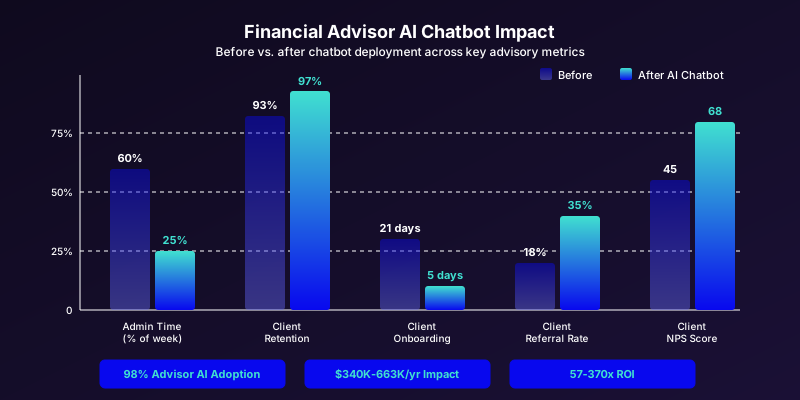
- Increased referrals: Proactive engagement increases referral rate from 18% to 35%. On 400 clients, that is 68 additional referrals/year, leading to approximately 15-20 new clients, each bringing $500K-1M average AUM = $7.5M-20M in new AUM = $75,000-200,000 in new annual fees.
- Faster onboarding: Reducing onboarding from 3 weeks to 5 days means new clients are fee-generating sooner. For 30-40 new clients per year, this accelerates approximately $15,000-25,000 in fee collection.
- Prospect capture: The chatbot captures and qualifies website visitors 24/7. Most advisory websites have zero lead capture mechanism beyond a phone number or contact form. A chatbot typically generates 5-15 qualified prospect meetings per month.
Total Annual Impact
| Category | Annual Impact |
|---|---|
| Time recovery (redirected capacity) | $156,000-234,000 |
| Support staff savings | $50,000-70,000 |
| Retention protection | $9,000 (Year 1, compounding) |
| New client revenue from referrals | $75,000-200,000 |
| Prospect conversion | $50,000-150,000 |
| Total annual impact | $340,000-663,000 |
Against a chatbot platform cost of $149-499/month ($1,788-5,988/year), the ROI ranges from 57x to 370x. Even the most conservative estimates (using only time recovery and support staff savings) produce ROI exceeding 34x.
30-Day Implementation Roadmap
- Week 1: Account setup, compliance framework definition, knowledge base creation with approved content. Upload firm FAQs, market commentary templates, and onboarding workflows to the AI knowledge base.
- Week 2: Build core flows: prospect qualification, meeting scheduling with calendar integration, new client onboarding, and portfolio FAQ. Configure SEC/FINRA compliance guardrails.
- Week 3: Build engagement flows: automated review scheduling, monthly portfolio summaries, and life event triggers. Set up CRM integration for client data synchronization.
- Week 4: Compliance review (all flows reviewed by CCO), staff training, pilot with 25% of website traffic, then full launch. Enable analytics monitoring from day one.
Get started with Conferbot's AI chatbot builder and see pricing plans designed for financial advisory practices of every size. For a broader framework on measuring chatbot returns, consult our chatbot ROI calculator framework.

The Future of AI in Financial Advisory: From Chatbot to Digital Associate
The current generation of financial advisor chatbots handles communication, scheduling, and information delivery. The next generation, already taking shape at firms like Morgan Stanley and through advisor-focused fintech innovation, will function as digital associates capable of executing increasingly complex tasks autonomously.
AI-Powered Meeting Preparation
Before each client meeting, the AI will prepare a comprehensive briefing: portfolio performance with attribution analysis, progress toward each financial plan goal, relevant life events or changes detected from client interactions, tax optimization opportunities, and suggested agenda items. The advisor walks into every meeting fully prepared without spending any prep time, a capability Morgan Stanley's AI assistant already delivers at scale.
Automated Financial Plan Monitoring
Financial plans are living documents that should be continuously monitored, not reviewed once a year. AI will track plan assumptions against reality in real time: actual spending versus projected, actual returns versus assumed, life event impacts, and tax law changes. When plan assumptions deviate materially, the chatbot alerts both the client and advisor with specific recommended adjustments.
Natural Language Account Management
Clients will be able to execute routine account actions through conversation: "Rebalance my portfolio to target allocation," "Increase my monthly contribution by $500," or "Transfer $10,000 from my savings to my IRA." These actions will be executed with appropriate authentication and compliance checks, reducing the operational burden on both clients and advisors.
Intergenerational Wealth Transfer
As Cerulli estimates $84 trillion in intergenerational wealth transfer over the next two decades, chatbots will play a crucial role in engaging the next generation of clients who expect digital-first communication. Advisors who build AI-powered relationships with heirs before the wealth transfer occurs will retain a dramatically higher share of inherited assets than those who rely on traditional outreach.
Predictive Client Intelligence
AI will analyze patterns across the entire client base to predict needs before clients express them. An advisor will receive notifications like: "3 clients are approaching age 73 and will need RMD planning conversations in Q4," or "Client X's stock option vesting schedule suggests a tax planning opportunity in October." This predictive capability transforms the advisor from reactive to proactive at scale.
The advisors who deploy chatbot technology today are building the foundation, the client interaction data, the approved content library, the compliance framework, and the digital communication habits, that these next-generation capabilities will require. Starting now positions your practice for compounding AI advantages over the coming decade. Build your foundation today with Conferbot's AI chatbot builder and join the growing community of advisors transforming their practices with conversational AI.
Was this article helpful?
AI Chatbot for Financial Advisors FAQ
Everything you need to know about chatbots for ai chatbot for financial advisors.
About the Author

Conferbot Team specializes in conversational AI, chatbot strategy, and customer engagement automation. With deep expertise in building AI-powered chatbots, they help businesses deliver exceptional customer experiences across every channel.
View all articles