Why Property Management Companies Need AI Chatbots: The $100 Billion Opportunity
The property management industry in the United States is a $100 billion market overseeing more than 44 million rental units, according to National Apartment Association (NAA) data. Yet the industry is drowning in communication volume. The average property management company handles 40 to 60 tenant interactions per property per month, spanning maintenance requests, lease questions, rent payment inquiries, noise complaints, package notifications, and move-in/move-out coordination. For a company managing 500 units, that is 20,000 to 30,000 annual interactions, most of them repetitive, time-sensitive, and perfectly suited for AI automation.
The economics tell the story. According to National Multifamily Housing Council (NMHC) research, on-site staff at apartment communities spend 45 to 55% of their workday answering phones, responding to emails, and handling walk-in inquiries from residents and prospects. That means a community manager earning $55,000 per year spends roughly $28,000 worth of their time on communication tasks that an AI chatbot can handle in seconds. Multiply that across a portfolio of 20 properties and the annual cost of manual communication exceeds $560,000 before accounting for the opportunity cost of what that staff could accomplish if freed from repetitive inquiries.
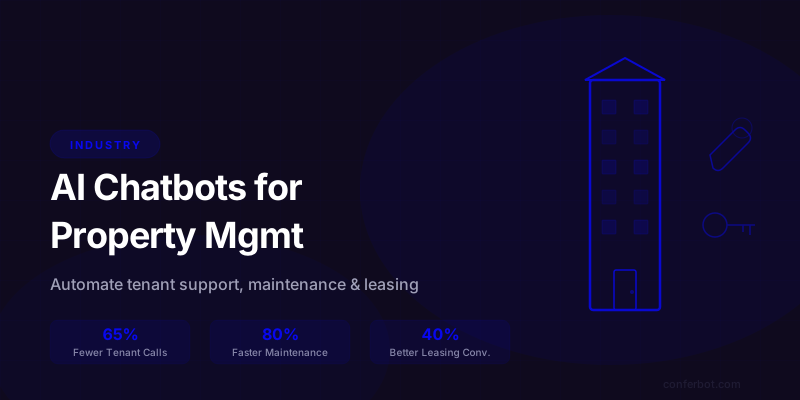
The market has validated this need. Stan AI, a property management chatbot company, demonstrated that property managers adopting conversational AI see a 65% reduction in routine phone calls, 80% faster maintenance request processing, and a 40% improvement in leasing conversion rates from website visitors. These are not incremental improvements; they represent a fundamental transformation in how property management companies operate.

An AI chatbot deployed on a property management company's website, tenant portal, WhatsApp, and SMS channels can instantly respond to tenant questions, triage maintenance requests by urgency, handle lease renewal inquiries, send rent reminders and accept payment confirmations, schedule property tours for prospective tenants, coordinate move-in and move-out logistics, and maintain Fair Housing Act compliance in every interaction. It operates 24 hours a day, 7 days a week, ensuring that a tenant reporting a water leak at 2 AM receives the same immediate response as one calling during business hours.
This comprehensive guide covers every aspect of AI chatbot implementation for property management: tenant communication, maintenance triage, leasing automation, rent collection support, move-in/move-out coordination, property tours, Fair Housing Act compliance, tenant screening intake, and a complete ROI model. Whether you manage a single 50-unit apartment community or a portfolio of 10,000 units across multiple markets, you will find actionable strategies tailored to property management workflows. For a broader look at how chatbots handle real estate communication, see our real estate chatbot guide.
Property Management Challenges That AI Chatbots Solve
Property management is defined by volume, urgency, and regulatory complexity. Every property generates a constant stream of tenant needs, prospect inquiries, and operational tasks that overwhelm even the most organized teams. Here are the specific pain points that make AI chatbots transformational for property managers.
The 24/7 Communication Expectation
Tenants expect immediate responses regardless of the time of day. A maintenance emergency at midnight, a lockout at 6 AM on a Sunday, a noise complaint at 11 PM -- these situations demand instant acknowledgment and action. Yet most property management offices operate Monday through Friday, 9 AM to 5 PM. After-hours answering services are expensive ($1.50 to $3.00 per call), often provide poor experiences (unfamiliar operators reading scripts), and create information handoff gaps that lead to dropped requests.
An AI chatbot provides true 24/7 coverage that handles routine inquiries completely and triages urgent issues to on-call staff with full context. A tenant texting at midnight about a non-emergency maintenance issue (a running toilet that is not causing flooding) receives an immediate acknowledgment, a work order creation confirmation, and an expected timeline -- without waking up the maintenance team. A tenant reporting a gas smell or flooding receives immediate emergency instructions and an instant notification to the on-call maintenance technician with the unit number, tenant contact, and issue description.
Maintenance Request Chaos
Maintenance is the number one source of tenant communication and the number one driver of tenant satisfaction (or dissatisfaction). According to SatisFacts research, maintenance responsiveness is the single strongest predictor of lease renewal, outweighing rent price, location, and amenities. Yet the maintenance request process at most properties is fundamentally broken: tenants call the office, leave voicemails, send emails, stop staff in the hallway, or submit requests through outdated tenant portals. Each channel produces requests in different formats with varying levels of detail, making it impossible to triage and prioritize effectively.
The chatbot standardizes maintenance intake into a single, structured flow that captures every detail the maintenance team needs: unit number, issue category, urgency level, description, photos, access instructions, pet information, and preferred scheduling. This structured data enables intelligent triage that routes emergencies immediately, schedules urgent issues within 24 hours, and batches routine requests for efficient scheduling.
Leasing Lead Loss
Prospective tenants research apartments in the evening and on weekends, precisely when leasing offices are closed. According to apartment industry benchmarks, 68% of apartment searches happen between 6 PM and 10 PM, and 42% of initial inquiries arrive on weekends. A prospect who visits your listing on Apartments.com at 8 PM and does not receive a response will contact the next property on their list within minutes. Without after-hours engagement, property management companies lose 30 to 45% of leasing leads to competitors who simply responded faster.
The chatbot captures every leasing lead instantly, regardless of time. It answers questions about availability, pricing, amenities, pet policies, and lease terms. It schedules property tours and self-guided viewing appointments. It collects prospect contact information and preferences. By the time the leasing office opens the next morning, the chatbot has qualified and scheduled tours with prospects who would otherwise have been lost overnight.

Rent Collection and Payment Communication
Late rent payments create cash flow problems, awkward confrontations, and administrative overhead. The average property management company spends 8 to 12 hours per month per 100 units on rent-related communication: payment reminders, late notices, payment plan negotiations, and payment confirmation follow-ups. A chatbot automates this entire communication cycle while maintaining a professional, consistent tone that avoids the emotional friction of human-to-human payment conversations.
Regulatory Compliance Complexity
Property management operates under a complex web of federal, state, and local regulations: the Fair Housing Act, state landlord-tenant laws, local rent control ordinances, accessibility requirements (ADA and Section 504), lead paint disclosure, security deposit regulations, and eviction procedures. Every tenant interaction must comply with these regulations. A single Fair Housing violation can result in penalties exceeding $100,000 and devastating reputational damage. The chatbot ensures consistent compliance by following approved scripts that have been reviewed for regulatory adherence, eliminating the risk of staff members making off-the-cuff statements that could constitute violations.
Maintenance Request Triage: From Chaos to Structured, Priority-Based Resolution
Maintenance request management is the single highest-impact chatbot function for property management companies. Every maintenance interaction directly affects tenant satisfaction, retention, and ultimately revenue. A well-designed maintenance chatbot transforms the fragmented, manual process into a structured system that ensures no request falls through the cracks and urgent issues receive immediate attention.
The Maintenance Intake Conversation Flow
An effective property management maintenance chatbot guides tenants through a structured intake process:
Step 1: Identity Verification. "What is your unit number and name on the lease?" The chatbot verifies the tenant against the property management system, ensuring the request is legitimate and associated with the correct unit record.
Step 2: Issue Categorization. "What type of maintenance issue are you reporting?" [Plumbing / Electrical / HVAC/Heating/Cooling / Appliance / Pest control / Lock/door/window / Flooring/walls/ceiling / Common area / Other]. Category selection routes the request to the appropriate maintenance technician or vendor and helps with parts and scheduling planning.
Step 3: Urgency Assessment. This is the most critical step. The chatbot asks targeted questions to determine urgency:
- Emergency (immediate response): Is water actively flooding? Do you smell gas? Is there an electrical fire risk? Has the unit lost all heat when temperatures are below 40 degrees F? Is there a security breach (broken lock, broken window)?
- Urgent (24-hour response): Is the only toilet in the unit non-functional? Is the refrigerator not cooling? Is the AC not working when temperatures exceed 90 degrees F? Is there a water leak that is contained but ongoing?
- Routine (3-5 business day response): Is a non-essential appliance malfunctioning? Is there cosmetic damage? Is there a minor plumbing drip? Are there pest sightings without infestation?
Step 4: Detailed Description and Photos. "Please describe the issue in detail. Where exactly in your unit is the problem? When did you first notice it?" "Can you upload a photo of the issue? This helps our maintenance team prepare the right tools and parts before arriving." Photo uploads dramatically reduce repeat visits (technician arrives with wrong parts) and help maintenance managers assess urgency from a distance.
Step 5: Access and Scheduling. "Do you authorize entry to your unit if you are not home?" "Do you have any pets that our maintenance team should be aware of?" "What are the best times for our team to access your unit?" [Morning 8-12 / Afternoon 12-5 / Evening 5-8 / Any time / Emergency - now]. These questions prevent the access coordination delays that cause 25 to 30% of maintenance visits to fail on the first attempt.

Step 6: Confirmation and Tracking. "Your maintenance request has been submitted. Here is your confirmation: Work Order #2847 -- Plumbing, Leaky faucet in kitchen -- Priority: Routine -- Expected response: Within 3 business days. You can check the status of this request anytime by messaging me with your work order number."
Emergency Routing and Escalation
When the chatbot identifies an emergency based on the tenant's responses, it triggers an immediate escalation: sends an SMS and push notification to the on-call maintenance technician with the unit number, tenant name, phone number, issue description, and photos; provides the tenant with emergency instructions ("If you smell gas, leave the unit immediately and call 911. Do not use light switches or electrical appliances. Our emergency maintenance team has been notified and will call you within 10 minutes."); and notifies the property manager for awareness. This dual-track response (tenant safety instructions plus maintenance team notification) happens within seconds of the tenant's report.
Vendor Dispatch Integration
For maintenance categories handled by external vendors (pest control, elevator repair, HVAC service), the chatbot can dispatch directly to the vendor's scheduling system or send a formatted work order via email. The chatbot tracks vendor response and follows up with both the vendor and the tenant until the issue is resolved, closing the loop that property managers often struggle to manage across multiple vendor relationships.
Status Updates and Satisfaction Follow-Up
After a maintenance request is submitted, the chatbot provides proactive status updates: "Work Order #2847 has been assigned to our plumbing technician, Mike. He is scheduled to visit your unit on Thursday between 10 AM and 12 PM. Will someone be home during that window?" After the work is completed: "Our records show that Work Order #2847 (kitchen faucet leak) was completed today. Was the issue resolved to your satisfaction? Please rate the service from 1 to 5." This closed-loop process ensures accountability and generates tenant satisfaction data that property managers can use to evaluate maintenance quality. The feedback collection approach is similar to strategies covered in our customer feedback chatbot guide.
Leasing Automation: Convert Website Visitors Into Signed Leases
Leasing is the revenue engine of property management. Every vacant unit costs the owner an average of $50 to $100 per day in lost rent, and the average apartment vacancy takes 30 to 45 days to fill. Reducing vacancy time by even 5 days across a 200-unit portfolio saves $50,000 to $100,000 annually. AI chatbots accelerate every stage of the leasing funnel: inquiry response, qualification, tour scheduling, application assistance, and lease signing.
Prospect Qualification and Engagement
When a prospective tenant visits the property's website or listing page, the chatbot engages immediately: "Welcome! Are you looking for an apartment at Riverside Commons? I can help you find available units, answer questions about pricing and amenities, and schedule a tour. What size apartment are you looking for?"
The chatbot qualifies prospects through conversational questions:
- Unit size and type: "Are you looking for a studio, 1-bedroom, 2-bedroom, or 3-bedroom?"
- Move-in timeline: "When are you hoping to move in?" (Prospects moving within 30 days are high priority; those 3+ months out are nurture candidates.)
- Budget alignment: "Our 1-bedrooms range from $1,450 to $1,750. Does that fit within your budget?"
- Pet requirements: "Do you have any pets? We are pet-friendly with some breed and size restrictions."
- Occupant count: "How many people will be living in the apartment?"
Based on these responses, the chatbot presents matching available units with photos, floor plans, pricing, and key features. It highlights what makes each unit special: "Unit 4B is our largest 1-bedroom at 780 sq ft with a private balcony overlooking the courtyard. It is available for August 1 move-in at $1,650/month."
Property Tour Scheduling
Once a prospect is interested, the chatbot schedules a tour without leasing agent involvement: "Would you like to schedule a tour of our available units? Here are the available tour times this week:" It presents slots aligned with the leasing agent's calendar for guided tours or available self-guided tour windows for properties offering that option.
For self-guided tours, the chatbot manages the entire process: verifies the prospect's identity, sends access codes or smart lock credentials for the tour window, provides parking and entry instructions, and follows up afterward: "How was your tour of Riverside Commons? Did you have a chance to see Unit 4B? Would you like to begin the application process?"
FAQ Handling for Leasing Questions
| Question Category | Example Questions | Query Volume |
|---|---|---|
| Pricing and Availability | What are your current rents? Are there any move-in specials? What is the security deposit? | 30-35% of queries |
| Pet Policy | Do you allow dogs? What are the weight limits? Is there a pet fee? | 15-20% of queries |
| Amenities | Is there in-unit laundry? Do you have a gym? Is parking included? | 15-18% of queries |
| Lease Terms | What is the minimum lease length? Can I go month-to-month? What about early termination? | 10-15% of queries |
| Application Process | What credit score do you require? How long does approval take? What documents do I need? | 10-12% of queries |
| Neighborhood | Is the area safe? What schools are nearby? How far to downtown? | 5-8% of queries |
Each answer is configured to comply with Fair Housing Act requirements (more on this in the compliance section). The chatbot never makes statements that could be construed as steering, discrimination, or selective marketing. It provides the same information to every prospect regardless of protected class characteristics. For more on how chatbots handle high-volume FAQ scenarios, see our website chatbot deployment page.
Application Assistance
The lease application process involves document collection, background and credit check authorization, and personal information that many prospects find tedious to complete. The chatbot streamlines this by walking applicants through each section conversationally, answering questions in real time, and collecting required documents (pay stubs, ID photos, employer verification letters) through file upload within the chat. Completion rates for chatbot-assisted applications are 35 to 40% higher than self-service online application portals, because the chatbot answers questions and resolves confusion in real time rather than requiring the applicant to call the office or email with questions.
Rent Collection and Payment Communication: Reduce Late Payments by 40%
Late rent payments are a persistent challenge for property management companies. According to NAA data, approximately 8 to 12% of rent payments are received after the due date in a typical month, and the cost of pursuing late payments (staff time, late notices, legal filings) averages $75 to $150 per late payment incident. An AI chatbot automates the entire rent communication cycle, from pre-due-date reminders through late payment resolution, maintaining consistent professionalism while eliminating the emotional friction that makes rent collection uncomfortable for both staff and tenants.
Automated Rent Reminder Sequence
The chatbot sends a structured sequence of payment communications:

5 days before due date: "Friendly reminder: Your rent of $1,650 for Unit 4B is due on June 1. You can pay online through your tenant portal at [link], by check at the office, or by setting up autopay. Let me know if you have any questions about your payment options."
Due date: "Your rent payment of $1,650 is due today, June 1. If you have already paid, thank you! If not, you can pay online here: [link]. Payments received after June 5 will incur a $75 late fee per your lease terms."
3 days after due date (grace period ending): "Your rent payment has not yet been received. Your lease includes a 5-day grace period ending June 5. After that date, a $75 late fee applies. If you are experiencing a temporary financial difficulty, please let me know and I can connect you with our property manager to discuss options."
After grace period: "A late fee of $75 has been applied to your account. Your total balance due is $1,725. To avoid further fees or action, please submit payment as soon as possible. If you need to arrange a payment plan, respond 'payment plan' and I will connect you with our property manager."
This automated sequence replaces the manual phone calls and door-knocking that property managers dread. The chatbot delivers the message consistently and professionally, without the variation in tone or timing that occurs when different staff members handle rent reminders differently. Properties using chatbot rent reminders report 35 to 45% reductions in late payments, primarily because tenants who simply forgot receive timely reminders before the grace period expires.
Payment Plan Negotiation Support
When a tenant indicates financial difficulty, the chatbot collects initial information before connecting them with a human: "I understand. Can you share a bit about your situation so I can help our property manager prepare options for you? (1) Are you expecting a delay of days or weeks? (2) Is this a one-time situation or ongoing? (3) What amount could you pay now versus later?" This pre-screening helps the property manager arrive at the conversation prepared with appropriate options rather than starting cold.
Rent Ledger and Balance Inquiries
Tenants frequently need to check their account balance, confirm a payment was received, or understand charges on their ledger. The chatbot provides self-service access: "Your current account summary for Unit 4B: Rent for June: $1,650 (paid June 1). Water/sewer charge: $45.00 (due June 15). Account balance: $45.00. Would you like to make a payment or see detailed transaction history?"
This self-service capability eliminates one of the most common reasons tenants call the office. According to property management industry benchmarks, balance inquiries and payment confirmations account for 15 to 20% of all tenant calls, and each call takes the office staff 3 to 5 minutes to look up the account and communicate the information. The chatbot delivers the same information in seconds.
Security Deposit Communication
Security deposit handling is one of the most disputed aspects of the landlord-tenant relationship. The chatbot provides transparent communication throughout the deposit lifecycle: initial deposit receipt confirmation, move-out inspection scheduling, itemized deduction notices, and refund processing status. This documentation trail protects the property management company in disputes and demonstrates the professionalism that builds tenant trust. For more detail on how chatbots handle financial communication workflows, see our AI chatbot builder page.
Move-In and Move-Out Coordination: Streamline the Transition Process
Move-in and move-out are the most operationally complex events in property management. Each transition involves dozens of tasks: utility transfers, key exchanges, inspection scheduling, cleaning coordination, repair assessment, deposit calculations, and new tenant preparation. Missing any step creates problems that echo for months: a forgotten utility transfer creates billing disputes, an incomplete move-out inspection leads to deposit disagreements, and a poorly coordinated move-in creates a terrible first impression that colors the entire tenancy.
Move-In Checklist Automation
The chatbot guides new tenants through the move-in process with a structured checklist that begins 2 weeks before the move-in date:
14 days before: "Your move-in date is June 15. Here is what you need to prepare: (1) Set up renter's insurance (required by your lease, minimum $100K liability). (2) Schedule utility transfers for electric and gas to start June 15. (3) Confirm your payment for first month's rent and security deposit. Would you like links to recommended insurance providers and utility setup pages?"
7 days before: "Move-in is 1 week away! Checklist update: Renter's insurance -- Please upload your policy declaration page. Utilities -- Have you contacted [local electric] and [local gas]? Keys -- You can pick up your keys at the leasing office on June 15 between 9 AM and 5 PM, or we can arrange early access starting at 8 AM for a $50 fee."
1 day before: "Your move-in is tomorrow! Final reminders: Key pickup at the leasing office, 123 Main Street, Suite 100. Bring your photo ID. Your assigned parking spot is P-47. Building entry code is 4521 (please keep confidential). Elevator reservation for moving is from 8 AM to 12 PM. Please contact me if you need anything during your move."
Move-in day: "Welcome to Riverside Commons! Your move-in inspection form is available here: [link]. Please complete it within 48 hours, noting any existing damage or issues in your unit. This protects your security deposit at move-out. Report any issues that need immediate attention and I will create a maintenance work order."
Move-Out Process Management
Move-out is even more complex and consequential. The chatbot manages the process from notice to deposit refund:
Notice receipt: "We have received your notice to vacate Unit 4B with a move-out date of August 31. Here is what happens next: (1) Move-out inspection will be scheduled for August 31 or September 1. (2) All personal property must be removed by August 31 at 5 PM. (3) Unit should be cleaned (broom-swept minimum). (4) All keys, fobs, and parking passes must be returned. (5) Security deposit refund will be processed within [state-specific timeframe] days of move-out."
Inspection scheduling: "Would you like to be present for your move-out inspection? Available times: August 31 at 2 PM, August 31 at 4 PM, September 1 at 10 AM. Being present allows you to address any concerns in real time."
Post-move-out: "Your move-out inspection has been completed. A detailed report with any deductions from your security deposit will be mailed to your forwarding address within [state timeframe] days. Your forwarding address on file is [address]. Is this correct?"
Unit Turnover Coordination
Between tenants, the chatbot coordinates the unit turnover process internally: scheduling cleaning crews, ordering paint touch-ups, coordinating appliance repairs, scheduling carpet cleaning or replacement, and tracking completion of each turnover task. The chatbot notifies the leasing team when the unit is ready to show, reducing the vacancy gap between tenants.
For property management companies handling frequent turnovers, the coordination principles mirror those in our appointment scheduling chatbot guide, adapted for multi-step operational workflows rather than single-event scheduling.
Fair Housing Act Compliance: Consistent, Lawful Communication at Scale
The Fair Housing Act (FHA) prohibits discrimination in housing based on race, color, national origin, religion, sex (including gender identity and sexual orientation), familial status, and disability. Many state and local laws add additional protected classes (source of income, marital status, age, veteran status). Violations can result in penalties up to $100,000+ per incident, plus damages, attorney fees, and devastating publicity. For property management companies, AI chatbots are both an opportunity and a risk: an opportunity because they ensure consistent compliance, and a risk if they are not properly configured.
How Chatbots Improve Fair Housing Compliance
Consistent treatment. The most common source of Fair Housing complaints is inconsistent treatment: telling some prospects about available units while not telling others, offering concessions to some applicants but not all, or applying qualification criteria differently based on protected characteristics. The chatbot eliminates inconsistency by delivering the same information, the same way, to every prospect. Every inquiry about a 2-bedroom apartment receives the same availability information, the same pricing, and the same qualification requirements regardless of who is asking.
Documentation. Every chatbot conversation is logged, creating a complete record of what information was provided to each prospect. If a Fair Housing complaint is filed alleging that the property provided different information to different prospects, the chatbot logs provide contemporaneous, uneditable evidence of exactly what was communicated. This documentation is far more reliable than relying on leasing agents to remember or document what they said in phone calls or in-person interactions months ago.
No steering. Steering, the practice of directing prospects toward or away from certain properties, buildings, or units based on protected characteristics, is one of the most common Fair Housing violations. The chatbot cannot steer because it does not make subjective judgments about where a prospect "would be comfortable" or which building is "more suitable" for them. It presents all available options that match the prospect's stated criteria (size, price, move-in date) without regard to any other factors.
Fair Housing Compliance Configuration
Configuring a chatbot for Fair Housing compliance requires specific guardrails:
- Occupancy standards: The chatbot applies the property's occupancy standards (typically 2 persons per bedroom, based on HUD guidance) uniformly. It never asks about marital status, family composition, ages of children, or whether the applicant is pregnant.
- Disability accommodations: The chatbot proactively offers information about accessibility features and reasonable accommodations: "Our community complies with all accessibility requirements. If you need a reasonable accommodation or modification during the application process or during your tenancy, please let us know and we will work with you."
- Prohibited questions: The chatbot is configured to never ask or respond to questions about the racial, ethnic, or religious composition of the community or neighborhood. If a prospect asks "What kind of people live there?", the chatbot redirects: "I can share information about our community amenities, unit features, and local services. What specific information would be most helpful for your decision?"
- Consistent qualification criteria: The chatbot states qualification requirements (income minimums, credit score thresholds, rental history requirements) identically to every prospect. It never modifies criteria based on the prospect's perceived demographic characteristics.
- Source of income compliance: In jurisdictions where source of income is a protected class (including New York, California, and many other states and cities), the chatbot does not discriminate based on payment source (Section 8 vouchers, disability payments, child support, etc.).
Audit Trail and Compliance Reporting
The chatbot generates compliance reports that property managers and legal teams can review: a summary of all prospect interactions by protected class indicators (where voluntarily provided), consistency checks confirming identical treatment of similar inquiries, and flagged conversations where a prospect raised a topic requiring human follow-up (accommodation requests, complaints about discriminatory treatment). These reports serve as proactive compliance documentation that demonstrates the company's commitment to fair housing practices.
For property management companies that want to ensure their chatbot meets all regulatory requirements, the Conferbot AI chatbot builder includes compliance configuration options specifically designed for housing providers.
ROI Model: Property Management Chatbot Financial Impact by Portfolio Size
The financial impact of an AI chatbot varies based on portfolio size, property type (multifamily, single-family, commercial), and current operational efficiency. Here are detailed ROI models for three common portfolio profiles.
Small Portfolio (50-150 Units)
A property manager or small management company overseeing 1 to 3 apartment communities with a lean office staff.
| Metric | Before Chatbot | After Chatbot | Impact |
|---|---|---|---|
| Monthly tenant inquiries handled manually | 320 | 96 (chatbot handles 70%) | 224 inquiries automated |
| Maintenance requests with complete info | 35% | 92% | Fewer repeat visits, faster resolution |
| After-hours leasing leads captured | 0 | 18/month | +18 qualified prospects |
| Average vacancy duration (days) | 38 | 26 | 12 days shorter |
| Late rent payments per month | 14% | 8% | 43% reduction |
| Office staff hours on phone/email | 25 hours/week | 10 hours/week | 15 hours freed/week |
Annual revenue impact: Reduced vacancy (12 days x 8 turnovers/year x $55/day avg rent) = $5,280. Late payment reduction (6% fewer late x 100 units x $1,600 avg rent) = improved cash flow of $115,200/year in on-time payments. Additional leasing leads converting at 25% = 54 additional tours, 4.5 additional leases per year at $19,200 annual rent = $86,400 in secured annual rent. Staff time savings valued at $39,000/year. Total first-year impact: $130,000+ in combined savings and revenue.
Annual investment: Conferbot platform at $79/month = $948/year. ROI: 13,700%

Mid-Size Portfolio (500-2,000 Units)
A property management company with multiple communities, a centralized office, and dedicated leasing and maintenance teams.
| Metric | Before Chatbot | After Chatbot | Impact |
|---|---|---|---|
| Monthly tenant interactions | 4,500 | 1,350 manual (chatbot handles 70%) | 3,150 interactions automated |
| Leasing conversion (inquiry to tour) | 22% | 41% | 86% improvement |
| Average vacancy duration | 35 days | 22 days | 13 days shorter |
| Maintenance satisfaction (CSAT) | 3.2/5 | 4.4/5 | +1.2 points |
| Lease renewal rate | 52% | 64% | +12 percentage points |
| FTE hours saved per month | -- | 320 hours | Equivalent to 2 FTEs |
Annual revenue impact: Reduced vacancy across 1,000 units (13 days x 80 turnovers/year x $60/day) = $62,400. Improved renewal rates (12% more renewals x 120 expiring leases/year x $4,500 turnover cost avoided) = $64,800 in avoided turnover costs. Additional leasing revenue from improved conversion: $180,000/year. FTE cost savings: $120,000/year. Reduced after-hours answering service costs: $24,000/year. Total first-year impact: $451,200+
Annual investment: Conferbot platform at $199/month + integrations = $4,000/year. ROI: 11,280%
Large Portfolio (5,000+ Units)
For large property management companies, the chatbot becomes centralized infrastructure serving all communities. Each property gets its own configuration (pricing, amenities, policies, maintenance contacts) while sharing the core platform. At this scale, the chatbot enables operational standardization that is impossible to achieve through human staff alone, and the data generated drives portfolio-wide strategic decisions.
Large portfolio annual impact: $2 to $5 million in combined vacancy reduction, operational savings, and revenue improvement.
To explore which Conferbot plan fits your portfolio size, visit our pricing page.
Implementation Roadmap: From Zero to Live in 28 Days
Deploying an AI chatbot for property management follows a structured process that accounts for the regulatory complexity and multi-stakeholder nature of the industry. Here is a four-week implementation plan.
Week 1: Foundation, Content, and Compliance
Days 1-2: Platform setup and branding. Create your Conferbot account, configure brand colors and logo for each property (or a unified company brand), and select deployment channels (website, tenant portal, WhatsApp, SMS).
Days 3-4: Knowledge base creation. Upload property information for each community: unit types, pricing, amenities, pet policies, lease terms, application requirements, and FAQs. Upload maintenance category definitions, emergency escalation procedures, and vendor contact information. Import rent collection policies, late fee structures, and payment methods.
Days 5-7: Fair Housing compliance configuration. Work with your legal team or compliance officer to review all chatbot responses for Fair Housing Act compliance. Configure prohibited topic guardrails, consistent qualification criteria, accessibility accommodation language, and source-of-income neutrality. Document the compliance review for your records. Use the Conferbot AI chatbot builder to set up compliance-safe response templates.
Week 2: Conversation Flow Development
Days 8-10: Maintenance request flow. Build the complete maintenance intake flow with urgency assessment, photo upload, access authorization, and emergency routing. Configure integration with your maintenance management system (AppFolio, Buildium, Yardi, RentManager, or others) for automatic work order creation.
Days 11-12: Leasing flow. Build the prospect engagement flow: unit matching, tour scheduling, FAQ handling, and application assistance. Connect to your PMS (Property Management Software) for real-time availability and pricing.
Days 13-14: Rent communication flow. Configure the automated rent reminder sequence, balance inquiry responses, and payment plan escalation triggers. Integrate with your accounting system for real-time balance lookups.
Week 3: Integration and Testing
Days 15-17: PMS integration validation. Test data flow between the chatbot and your PMS: tenant lookup, work order creation, lease application initiation, balance inquiries, and payment confirmation. Key PMS integrations:
| Platform | Integration Capabilities |
|---|---|
| AppFolio | Tenants, units, maintenance, leasing, accounting |
| Yardi Voyager | Resident services, maintenance, leasing, rent ledger |
| Buildium | Tenant portal, maintenance, accounting, leasing |
| RentManager | Tenants, work orders, charges, applications |
| Entrata | Resident portal, leasing, maintenance, payments |
Days 18-19: Internal testing. Have property managers, leasing agents, and maintenance staff test all flows. Identify gaps in knowledge base content, incorrect routing, or awkward conversation transitions.
Days 20-21: Resident beta testing. Invite 15 to 20 cooperative residents to test the chatbot for maintenance requests and general inquiries. Collect feedback and refine.
Week 4: Launch and Optimization
Days 22-24: Production deployment. Deploy on property websites, tenant portals, and messaging channels. Announce to residents: "We have launched a new 24/7 digital assistant to help you with maintenance requests, account questions, and more. Text [number] or visit [link] anytime."
Days 25-28: Monitoring and refinement. Monitor every conversation during the first week. Add missing FAQ content, refine maintenance triage accuracy, and adjust leasing conversation flows based on prospect behavior. Configure analytics dashboards tracking inquiries handled, response times, satisfaction scores, and leasing conversion rates.
For properties already using a chatbot on their website and looking to expand to additional channels, our rental property inquiry chatbot guide covers multi-channel deployment strategies specific to rental properties.
Competitive Advantage: AI-First Property Management Is the Future
The property management industry is at an inflection point. Tenants increasingly expect digital-first experiences: they want to submit maintenance requests from their phone at midnight, tour apartments on their own schedule, and get instant answers to questions without waiting on hold. Property management companies that meet these expectations retain more tenants, fill vacancies faster, and operate more efficiently. Those that do not will watch their best tenants leave for properties that offer a modern experience.
The Tenant Experience Gap
According to J Turner Research apartment resident satisfaction data, the gap between the best-rated and worst-rated apartment communities centers on communication quality. Top-rated communities respond to maintenance requests within hours, provide proactive updates, and make it easy to communicate about any issue. Bottom-rated communities take days to respond, provide no status updates, and force tenants to call repeatedly about the same issue. The chatbot brings every property to top-tier communication standards regardless of staff size or skill level.
Owner and Investor Expectations
Property owners and investors are increasingly evaluating management companies on their technology capabilities. A management company that can demonstrate AI-powered tenant communication, automated maintenance workflows, and data-driven leasing optimization wins new management contracts over competitors still relying on phone-and-email operations. For third-party management companies, the chatbot is a competitive differentiator in winning and retaining management agreements.
Operational Scalability
The traditional property management model requires adding staff as the portfolio grows: more units means more phones ringing, more maintenance requests to process, and more prospects to tour. This linear scaling of headcount against unit count compresses margins as portfolios grow. The chatbot breaks this linear relationship. It can handle 500 or 5,000 or 50,000 interactions per month with the same platform cost, enabling property management companies to grow their portfolios without proportionally growing their staff. This operational leverage is the key to building a property management company that scales profitably.
Future-Proofing with AI
The chatbot is the conversational AI layer on which more advanced property management automation will be built. In the near future, chatbots will integrate with smart building systems (automatically creating maintenance tickets when IoT sensors detect HVAC anomalies or water leaks), predictive maintenance algorithms (scheduling preventive repairs before equipment fails), and AI-powered rent optimization (adjusting pricing based on market conditions, vacancy patterns, and demand signals). Property management companies that deploy chatbots now are building the AI infrastructure that will power the next generation of property management technology.
For property management companies ready to begin their AI transformation, Conferbot's AI chatbot builder offers a no-code platform designed for industry-specific deployments. Start with the highest-impact use case -- maintenance triage or leasing automation -- and expand capabilities as your team gains confidence with the technology.
Was this article helpful?
AI Chatbot for Property Management FAQ
Everything you need to know about chatbots for ai chatbot for property management.
About the Author

Conferbot Team specializes in conversational AI, chatbot strategy, and customer engagement automation. With deep expertise in building AI-powered chatbots, they help businesses deliver exceptional customer experiences across every channel.
View all articles