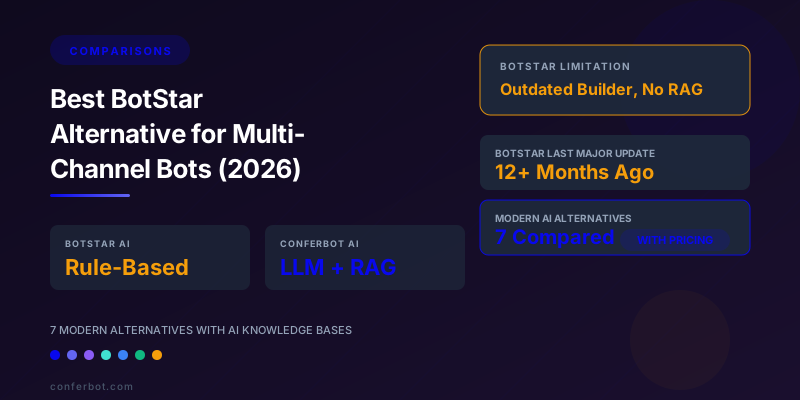
Why BotStar's Visual Builder Has Fallen Behind the AI-Powered Chatbot Market
BotStar launched as a promising visual chatbot builder that let non-technical users create conversational flows through a drag-and-drop canvas. In 2022 and 2023, it was a viable mid-market option for businesses that wanted chatbots on their website and Facebook Messenger without writing code. But the chatbot industry has undergone a fundamental architectural shift since then -- from rule-based decision trees to AI-powered knowledge bases with RAG (Retrieval-Augmented Generation) -- and BotStar has not made the transition.
The platform's last significant feature update was over 12 months ago. While competitors have integrated GPT-4o, Claude, Gemini, and sophisticated RAG pipelines that let chatbots answer questions from uploaded documents, help articles, and product catalogs, BotStar remains a rule-based visual builder that requires users to manually map every possible conversation path. There is no AI knowledge base, no document ingestion, no LLM integration, and no mechanism for the chatbot to answer questions it was not explicitly programmed to handle.
According to Gartner's analysis of the chatbot market, 78 percent of new chatbot deployments in 2026 use some form of AI knowledge base or RAG pipeline -- making purely rule-based builders like BotStar an increasingly niche choice. The market has moved, and BotStar has not moved with it.
This matters for multi-channel deployment especially. BotStar's channel support was once competitive -- website, Facebook Messenger, and basic API access. But modern businesses need chatbots on WhatsApp, Instagram, Telegram, SMS, Slack, Microsoft Teams, and embedded within mobile apps. BotStar's channel list has not expanded, while alternatives now offer 10 to 15 channels with unified conversation management.

This guide is for teams currently on BotStar who are hitting the platform's ceiling, and for teams evaluating chatbot builders who want to understand what modern AI-powered alternatives offer versus a traditional visual builder. We compare seven platforms that combine visual building convenience with AI knowledge bases, RAG-powered responses, and genuine multi-channel deployment. For broader platform comparisons, see our comparison hub with head-to-head matchups across dozens of chatbot tools.
Every alternative on this list supports AI-powered responses from uploaded knowledge bases, offers broader channel coverage than BotStar, and provides transparent pricing. The goal is not just to find a BotStar replacement -- it is to upgrade to a chatbot architecture that can handle the questions your customers actually ask, across the channels they actually use, without requiring you to manually build a decision tree for every possible conversation.
5 Critical Gaps in BotStar's Platform That Are Costing You Customers
BotStar's limitations are not minor feature gaps -- they are fundamental architectural shortcomings that prevent the platform from meeting modern chatbot requirements.
Gap 1: No AI Knowledge Base or RAG Capability
This is BotStar's most critical deficiency. Modern chatbot platforms let you upload documents (PDFs, help articles, product manuals, FAQs, website content) and the AI automatically answers questions from this knowledge base using RAG. If a customer asks "What is your return policy for items over $100?" the AI retrieves the relevant section from your return policy document and generates an accurate, conversational response.
BotStar has no such capability. To handle a return policy question on BotStar, you must: identify that the question might be asked, create a specific conversation node for it, write the exact response, and connect it to the appropriate trigger keywords. You must repeat this process for every single question your customers might ask. For businesses with extensive product catalogs, help documentation, or policy libraries, manually programming every possible question is both impractical and incomplete -- resulting in chatbots that can only answer a fraction of what customers actually ask.
According to Forrester's research on AI chatbot effectiveness, RAG-powered chatbots resolve 65 to 85 percent of customer inquiries autonomously, compared to 15 to 30 percent for rule-based chatbots. The resolution gap directly translates to customer satisfaction, support cost savings, and chatbot ROI.
Gap 2: Outdated Visual Builder With No Modern AI Nodes
BotStar's visual builder was competitive in 2022. In 2026, it lacks the AI-specific building blocks that modern platforms provide: LLM response nodes (generate AI-powered answers mid-flow), knowledge search nodes (query a document base during conversation), sentiment detection nodes (change flow based on customer emotion), intent classification nodes (route conversations based on AI-understood intent), and API-powered AI nodes (call external AI services). Without these building blocks, BotStar's visual builder creates static, predetermined conversation paths that feel robotic to customers accustomed to ChatGPT-quality interactions.

Gap 3: Limited Multi-Channel Support
BotStar supports website deployment and Facebook Messenger, with basic API access for custom integrations. In 2026, this channel coverage is inadequate for businesses that need to meet customers where they are. Missing channels include WhatsApp Business (the dominant messaging channel globally with 2.7 billion users), Instagram DMs (critical for D2C brands), Telegram (growing rapidly in Europe, Middle East, and South Asia), SMS and RCS messaging, Slack and Microsoft Teams (for internal chatbots), and native mobile app SDKs. Each missing channel represents customers you cannot reach with your chatbot investment. Alternatives like Conferbot deploy across 13-plus channels from a single chatbot configuration.
Gap 4: Stagnant Development Velocity
Software platforms that stop shipping new features are signaling a business trajectory that should concern paying customers. BotStar's feature changelog shows no major updates in over 12 months. Compare this to the breakneck pace of the AI chatbot market: GPT-4o launched, Claude 3.5 Sonnet shipped, Gemini 1.5 Pro became available, RAG architectures matured, multi-modal AI arrived, and voice-to-text chatbots reached production quality -- all within the period BotStar remained static. Investing time and resources in building chatbots on a stagnant platform creates technical debt that grows with every month of industry advancement.
Gap 5: No Analytics for AI Performance Optimization
Modern chatbot analytics go beyond conversation counts and completion rates. They include: AI confidence scores per response, knowledge-base coverage analysis (identifying topics where the AI lacks information), intent clustering (discovering patterns in what customers ask), conversation quality metrics, and A/B testing of AI model performance. BotStar's analytics are limited to basic conversation metrics that tell you how many conversations happened but not how to improve them. Without AI-specific analytics, optimization is guesswork rather than data-driven iteration. For more on chatbot analytics best practices, see our chatbot analytics guide.
7 Best BotStar Alternatives Compared: AI Knowledge Base, Channels, and Pricing
Every alternative on this list offers AI knowledge base capabilities that BotStar lacks, broader channel support, and active development velocity. The comparison prioritizes the features most relevant to multi-channel deployment.
| Platform | Starting Price | AI Knowledge Base | Channels | LLM Support | G2 Rating | Free Tier |
|---|---|---|---|---|---|---|
| BotStar | Free / $15/mo | None | Web, Messenger | None | 4.4 | Yes |
| Conferbot | Free / $19/mo | Full RAG | 13+ channels | GPT-4o, Claude, Gemini | 4.7 | Yes |
| Botpress | Free / self-host | Full RAG | Web, WA, Messenger, Slack, Teams | Any LLM | 4.6 | Yes |
| Voiceflow | Free / $50/mo | Full RAG | Web, API, WhatsApp (via API) | GPT-4, Claude | 4.6 | Yes |
| Tidio | Free / $29/mo | Product catalog AI | Web, Messenger, Instagram, Email | Claude (Lyro) | 4.7 | Yes |
| Manychat | Free / $15/mo | Basic (FAQ) | Instagram, Messenger, WhatsApp, SMS | OpenAI (basic) | 4.6 | Yes |
| Chatfuel | $15/mo | Basic AI | Messenger, Instagram, WhatsApp, Web | GPT (basic) | 4.4 | Trial |
| Intercom | $39/seat/mo | Full RAG | Web, WhatsApp, Messenger, Email, SMS | GPT-4 (Fin AI) | 4.5 | Trial |
Annual Cost Comparison for a Mid-Market Business (10,000 Monthly Conversations, 5 Channels)
| Platform | Annual Cost | AI Knowledge Base Included | Channels Supported |
|---|---|---|---|
| BotStar Pro | $468 | No (rule-based only) | 2 (Web + Messenger) |
| Conferbot Business | $3,588 | Yes (full RAG) | 13+ |
| Botpress Cloud | ~$3,600 | Yes (full RAG) | 6+ |
| Voiceflow Pro | $1,800 | Yes (full RAG) | 3+ (API-extended) |
| Tidio Lyro | $4,728 | Yes (product-focused) | 4 |
| Manychat Pro | $780 | Basic | 4 |
| Chatfuel Business | $420 | Basic | 4 |
| Intercom (3 seats + Fin) | $14,040+ | Yes (full RAG) | 5+ |
BotStar's low price point reflects its limited capability. The $468 annual cost buys a rule-based chatbot on 2 channels with no AI. For $3,588 annually, Conferbot delivers AI-powered RAG responses across 13-plus channels -- a fundamentally different product category despite being the same line item in your software budget. The question is not which costs less, but which delivers more value per dollar. For a framework to measure chatbot value, see our chatbot ROI calculator guide.

Detailed Alternative Reviews: From Rule-Based Flows to AI Knowledge Bases
1. Conferbot -- Best Overall BotStar Replacement With AI Knowledge Base and 13+ Channels
Conferbot is the most complete BotStar upgrade path. It combines a visual builder (familiar to BotStar users) with full RAG-powered AI knowledge base capabilities and the broadest channel coverage in the market. Upload your documents, help articles, product manuals, and website content -- the AI handles customer questions automatically, even topics you did not explicitly program.
Why it beats BotStar:
- AI knowledge base with RAG: Upload PDFs, URLs, help docs, and product catalogs. The AI retrieves relevant information and generates accurate, conversational responses. BotStar requires you to manually program every answer.
- 13-plus channels: Deploy on web, WhatsApp, Messenger, Instagram, Telegram, SMS, Slack, Microsoft Teams, and more -- all from a single chatbot configuration. BotStar is limited to web and Messenger.
- LLM flexibility: Choose GPT-4o for speed, Claude for nuanced responses, or Gemini for multilingual support. BotStar has no LLM integration.
- Visual builder plus AI: The no-code builder lets you create structured flows where needed and AI-powered responses where flexibility matters. It is not either/or -- it is both.
- Active development: New features ship monthly, keeping pace with AI advancements. BotStar's changelog has been dormant for over a year.
Limitations: Conferbot's AI features require more initial setup than BotStar's simple drag-and-drop builder. Teams with very basic chatbot needs may find the capabilities beyond what they currently require.
Best for: Any team outgrowing BotStar's rule-based limitations and needing AI-powered responses across multiple channels.
2. Botpress -- Best Open-Source Alternative for Developer-Led Teams
Botpress is the developer-first alternative that offers maximum control over AI chatbot architecture. Self-hostable, compatible with any LLM, and built on an open-source foundation, it provides the flexibility that BotStar's closed platform cannot match.
Why it beats BotStar: Full RAG pipeline control (choose your vector database, embedding model, and retrieval strategy), any-LLM support, self-hosting option for data sovereignty, and an active open-source community contributing templates and integrations.
Limitations: Requires developer resources to build, deploy, and maintain. The cloud platform simplifies this but loses some self-hosting advantages. Not recommended for non-technical teams.
Best for: Engineering-led teams that need full control over their chatbot's AI pipeline and want to avoid vendor lock-in.
3. Voiceflow -- Best Visual Builder With AI for Design-Focused Teams
Voiceflow bridges the gap between BotStar's visual approach and AI-powered capabilities. It offers a canvas-based conversation designer with built-in AI blocks for knowledge base queries, LLM responses, and intent classification. For teams that loved BotStar's visual building experience but need AI capabilities, Voiceflow is the most natural transition.
Why it beats BotStar: AI knowledge base blocks within the visual canvas, GPT-4 and Claude integration, export to multiple channels via API, and a collaborative design environment for teams. Voiceflow's builder is more sophisticated than BotStar's while maintaining visual simplicity.
Limitations: Channel deployment is primarily through API rather than native integrations (except web). WhatsApp and Messenger deployment requires custom API work or third-party connectors. Pricing scales with AI usage. For related platform evaluations, see our chatbot technology stack guide.
Best for: Design and product teams that want a visual conversation builder with AI capabilities and are comfortable with API-based channel deployment.
4. Tidio -- Best for E-Commerce Multi-Channel Bots
Tidio's Lyro AI is purpose-built for e-commerce: it understands product catalogs, tracks orders, recommends products, and handles customer support across website, Messenger, Instagram, and email. For e-commerce businesses using BotStar for product-related chatbots, Tidio is a targeted upgrade.
Why it beats BotStar: Native Shopify and WooCommerce integration, product-aware AI that understands inventory and pricing, Instagram DM support (missing from BotStar), and e-commerce-specific analytics. For a more detailed analysis, see our Tidio alternative guide.
Limitations: Conversation caps on lower tiers. AI capabilities are optimized for e-commerce and less flexible for general use cases. Limited to 4 channels versus Conferbot's 13-plus.
Best for: Shopify and WooCommerce stores that need product-aware chatbots across web and social channels.
5. Manychat -- Best for Instagram and Social Media-First Deployment
Manychat dominates the social media chatbot space, with native integrations for Instagram DMs, Facebook Messenger, WhatsApp, and SMS. For businesses whose multi-channel strategy is primarily social media, Manychat's depth in these channels exceeds what BotStar offers.
Why it beats BotStar: Native Instagram DM automation (BotStar does not support Instagram), WhatsApp Business integration, SMS campaigns, and the most mature Messenger automation in the market. Basic OpenAI integration adds AI capability to flows.
Limitations: AI capabilities are basic compared to Conferbot, Botpress, or Voiceflow. No RAG or knowledge base. Website chatbot is secondary to social channels. Best thought of as a social media automation tool with chatbot features rather than a full chatbot platform.
Best for: D2C brands and creators whose primary customer engagement happens on Instagram and Facebook.
6. Chatfuel -- Best Budget Multi-Channel Bot for Messenger and Instagram
Chatfuel offers affordable chatbot deployment across Messenger, Instagram, WhatsApp, and web. It is simpler than Botpress or Voiceflow but more capable than BotStar for social channel deployment, with basic GPT integration for AI-assisted responses.
Why it beats BotStar: Four-channel deployment versus BotStar's two, basic GPT integration for AI-assisted responses, and an established track record with Messenger bots. Pricing is competitive with BotStar while offering more channels.
Limitations: AI capabilities are shallow -- basic GPT integration, no RAG, no knowledge base upload. Visual builder is functional but not as polished as Voiceflow or Botpress.
Best for: Small businesses that need budget-friendly chatbots on Messenger and Instagram with basic AI enhancement.
7. Intercom -- Best Premium Multi-Channel AI for Support-Focused Teams
Intercom's Fin AI agent is the premium benchmark for AI-powered multi-channel chatbots. Full RAG from help center and custom sources, GPT-4-powered responses, and deployment across web, WhatsApp, Messenger, email, and SMS make it the most capable option for customer support use cases. For a comprehensive evaluation, see our Intercom alternative guide.
Why it beats BotStar: Enterprise-grade AI resolution with proven 50-plus percent autonomous resolution rates, the most mature messenger platform in the market, deep CRM and helpdesk integration, and analytics that measure AI performance down to individual resolution quality.
Limitations: Per-seat pricing ($39/seat/month) plus per-AI-resolution fees ($0.99 each) creates the highest total cost on this list. Overkill for simple chatbot use cases. Complex setup compared to BotStar's simplicity.
Best for: Support-focused teams with 3-plus agents needing the highest AI resolution quality and mature multi-channel capabilities.
Understanding RAG: Why AI Knowledge Bases Change Everything BotStar Cannot Do
RAG (Retrieval-Augmented Generation) is the technology that fundamentally separates modern AI chatbots from rule-based builders like BotStar. Understanding RAG clarifies why the alternatives on this list can do things BotStar architecturally cannot.
How RAG Works in Plain Language
RAG combines two capabilities: retrieval (finding relevant information from your documents) and generation (creating a natural, conversational response using that information). When a customer asks your chatbot a question, three things happen in sequence: first, the AI searches your uploaded knowledge base (help articles, product docs, FAQs, policy documents) for information relevant to the question. Second, it retrieves the most relevant passages. Third, it generates a conversational response that accurately answers the question using the retrieved information as its source of truth.
The result is a chatbot that can answer thousands of different questions from your knowledge base without you programming a single conversation flow for any of them. Upload your documentation, and the chatbot handles the rest.
Why BotStar Cannot Implement RAG
RAG requires three architectural components that BotStar lacks: a vector database for storing document embeddings (semantic representations of your content), an embedding model for converting questions and documents into comparable vectors, and an LLM for generating responses from retrieved context. BotStar's architecture is built around decision trees and keyword matching -- there is no vector storage, no embedding pipeline, and no LLM integration. Adding RAG to BotStar would require rebuilding the platform from the ground up.

Real-World Impact: Rule-Based vs RAG-Powered
Consider a mid-size SaaS company with 200 help articles, 50 product documentation pages, and 30 policy documents. On BotStar, supporting this content requires manually creating conversation nodes for every anticipated question -- realistically covering 50 to 100 topics at best, with months of building time. On a RAG-powered platform like Conferbot, you upload all 280 documents, and the AI can answer questions about any of them within minutes. The coverage is complete, the setup time is hours not months, and the chatbot improves automatically as you add more documents.
According to McKinsey's analysis of AI in customer service, RAG-powered chatbots reduce the time from deployment to full topic coverage by 85 to 95 percent compared to manually programmed chatbots. For businesses with extensive knowledge bases, this is the single most compelling reason to move beyond BotStar.
RAG Accuracy and Hallucination Prevention
A common concern is whether RAG-powered chatbots will "hallucinate" -- generate incorrect information. Modern RAG implementations include guardrails: confidence scoring (the AI declines to answer when confidence is low), source attribution (responses cite the specific document used), and fallback escalation (uncertain responses route to human agents). These guardrails produce accuracy rates of 92 to 97 percent for well-configured RAG chatbots, compared to 100 percent accuracy for rule-based responses that actually get triggered -- but only 15 to 30 percent topic coverage. For teams concerned about AI accuracy, our hallucination prevention guide provides a comprehensive framework.
Migrating From BotStar: 4-Week Multi-Channel Transition Plan
BotStar's rule-based architecture means your current chatbot is a set of conversation flows, not a trained AI model. Migration involves recreating these flows (often simplified, since AI handles much of what required manual branching) and expanding to new channels.
Week 1: Audit, Export, and Select
- Document BotStar flows: Map every conversation flow in your BotStar workspace -- the triggers, branches, responses, and integrations. Take screenshots of complex flows for reference.
- Export conversation data: Download all conversation logs from BotStar for analysis. Identify the top 20 topics customers ask about and the top 10 points where conversations drop off or fail.
- Identify knowledge base content: Gather all documents, help articles, product pages, and FAQs that your chatbot should know about. This content feeds your new platform's RAG knowledge base.
- Select your platform: Use the comparison table in Section 3 and detailed reviews in Section 4. Sign up for a free tier and evaluate the builder interface.
Week 2: Build the AI Foundation
- Upload knowledge base: Import your documents, help articles, and product documentation into the new platform's knowledge base. This single step often covers 70 to 80 percent of what you spent weeks building manually on BotStar.
- Configure AI behavior: Set the chatbot's tone, language, escalation rules, and response boundaries. Define what topics the AI should handle and which should escalate to humans.
- Recreate structured flows: For conversations that need specific structure (lead capture, appointment booking, payment processing), recreate these as structured flows using the new platform's builder. AI handles unstructured questions; structured flows handle processes.
- Configure integrations: Connect your CRM, helpdesk, scheduling tool, and e-commerce platform. Test bidirectional data flow.
Week 3: Multi-Channel Deployment
- Deploy to primary channel: Start with your highest-traffic channel (usually website). Test thoroughly with real traffic for 2 to 3 days.
- Add WhatsApp: Connect WhatsApp Business API and deploy the same chatbot to WhatsApp. Test message formatting, media handling, and quick-reply buttons.
- Add additional channels: Deploy to Messenger, Instagram, Telegram, SMS, or Slack based on where your customers are. Each channel activation takes 15 to 30 minutes on platforms with native support.
- Configure channel-specific behavior: Adjust greetings, response formatting, and quick-reply options for each channel's unique UI conventions.
Week 4: Optimize and Scale
- Monitor AI performance: Review AI confidence scores, identify low-confidence responses, and add knowledge base content for gaps. Track resolution rates per channel.
- A/B test conversations: Test greeting messages, AI temperature settings, and escalation thresholds. Use the new platform's A/B testing to find optimal configurations. See our A/B testing guide for methodology.
- Retire BotStar: Once performance on the new platform meets or exceeds BotStar baselines across all channels, cancel your BotStar subscription.
- Set up ongoing optimization: Schedule monthly reviews of knowledge-base coverage, AI confidence scores, and channel performance metrics.
For conversation flow design principles that apply to multi-channel deployment, see our conversation design masterclass.
Multi-Channel Chatbot Strategy: Deploying One AI Across All Customer Touchpoints
One of BotStar's fundamental limitations is its two-channel ceiling (website and Messenger). Modern businesses interact with customers across 5 to 8 digital channels, and the chatbot experience should be consistent and context-aware across all of them. Here is how to think about multi-channel chatbot deployment strategically.
The Unified Brain Model
The right architecture uses a single AI brain (knowledge base + conversation logic) deployed across multiple channel interfaces. Your chatbot knows the same information whether a customer reaches it on your website, WhatsApp, Instagram, or Slack. Only the presentation layer adapts to each channel's UI conventions (quick replies on WhatsApp, rich cards on Messenger, threaded responses on Slack).
This unified approach eliminates the BotStar problem of building and maintaining separate chatbot flows for each channel. One knowledge base update, one flow change, one training data addition -- reflected instantly across every channel. According to HubSpot's customer engagement research, businesses that provide consistent chatbot experiences across 3-plus channels see 23 percent higher customer satisfaction and 31 percent higher resolution rates compared to single-channel deployment.
Channel Selection Strategy
Website (mandatory): Your website is the hub. Every business should have a chatbot on their website to capture leads, answer questions, and support customers 24/7. This is the channel BotStar supports adequately -- and the baseline for any replacement.
WhatsApp (high priority for global businesses): With 2.7 billion users, WhatsApp is the dominant messaging channel outside North America. For businesses with international customers, WhatsApp chatbot deployment is essential. BotStar does not support WhatsApp.
Instagram DMs (high priority for D2C and lifestyle brands): Instagram is where product discovery happens for consumers. An Instagram chatbot that handles product questions, sizes, and ordering directly in DMs converts browsers into buyers.
Messenger (standard): Facebook Messenger remains relevant for businesses with active Facebook pages. BotStar supports this channel, so migration is straightforward.
Telegram (regional priority): Growing rapidly in Europe, Middle East, and South Asia. For businesses in these regions, Telegram chatbot deployment reaches audiences that other channels miss.
SMS (high intent): SMS chatbot interactions have 98 percent open rates and are ideal for appointment reminders, delivery notifications, and time-sensitive communications.
Slack/Teams (internal use): For internal chatbots (IT helpdesk, HR FAQ, onboarding), Slack and Teams deployment puts the chatbot where employees already work. BotStar has no workplace chat integration.

Cross-Channel Conversation Continuity
The most sophisticated multi-channel implementations maintain conversation continuity across channels. A customer who starts a conversation on your website can continue it on WhatsApp without repeating information. This requires a unified customer identity system and conversation storage that spans channels -- features available on platforms like Conferbot and Intercom but absent from BotStar's architecture.
For businesses building their first multi-channel chatbot strategy, start with 2 to 3 channels, establish performance baselines, then add channels quarterly based on customer demand and channel-specific engagement data. Our chatbot marketing strategy guide provides a framework for channel selection and performance measurement.
Which BotStar Alternative Should You Choose? Decision Framework
Your optimal BotStar replacement depends on your team's technical capabilities, primary channels, and budget. This framework maps common BotStar user profiles to the best alternative.
If You Need: Maximum AI + Maximum Channels (Non-Technical Team)
Choose Conferbot. Full RAG knowledge base, GPT-4o/Claude/Gemini support, 13-plus channels, no-code builder, and flat-rate pricing. The most complete BotStar upgrade for teams that want AI power without developer resources.
If You Need: Full Control + Self-Hosting (Developer Team)
Choose Botpress. Open source, self-hostable, any-LLM compatible, and fully customizable. The opposite of BotStar's closed platform. Requires developer resources but provides unlimited flexibility.
If You Need: Visual Builder + AI (Design-Focused Team)
Choose Voiceflow. The closest builder experience to BotStar but with AI knowledge base blocks, LLM integration, and a collaborative design environment. Best transition for teams that valued BotStar's visual approach.
If You Need: E-Commerce Multi-Channel Bots
Choose Tidio. Product-aware AI, native Shopify/WooCommerce integration, and deployment across web, Messenger, Instagram, and email. Purpose-built for e-commerce chatbot scenarios.
If You Need: Social Media-First Automation
Choose Manychat. The deepest Instagram DM and Messenger automation in the market, with WhatsApp and SMS support. Best for D2C brands and creators whose audience is primarily on social platforms.
If You Need: Budget Multi-Channel (Simple Flows)
Choose Chatfuel. Affordable four-channel deployment with basic GPT integration. The most BotStar-like option with additional channels and basic AI enhancement.
If You Need: Premium AI for Customer Support
Choose Intercom. The highest AI resolution quality, deepest CRM integration, and most mature multi-channel messenger platform. Premium pricing reflects premium capabilities for support-intensive businesses.
| Your Priority | Best Alternative | Annual Cost | Key Advantage Over BotStar |
|---|---|---|---|
| Best overall upgrade | Conferbot | $3,588 | Full RAG + 13+ channels + no-code |
| Best for developers | Botpress | $0-3,600 | Open source, any LLM, self-host |
| Best visual builder | Voiceflow | $1,800 | Visual canvas + AI knowledge blocks |
| Best for e-commerce | Tidio | $4,728 | Product-aware AI + Instagram |
| Best for social media | Manychat | $780 | Instagram DMs + WhatsApp + SMS |
| Best budget option | Chatfuel | $420 | 4 channels + basic GPT at low cost |
| Best premium AI | Intercom | $14,040+ | Highest AI resolution quality |
Verdict: The Rule-Based Builder Era Is Over -- Choose AI-Powered Multi-Channel
BotStar's visual chatbot builder was a reasonable choice in 2022. In 2026, it is a platform frozen in time while the industry has fundamentally transformed around it. The absence of AI knowledge bases, RAG capabilities, LLM integration, and modern channel support makes BotStar a tool from the previous era of chatbot technology -- an era defined by decision trees, keyword matching, and manually programmed responses.
The case for switching is overwhelming:
- AI knowledge base: RAG-powered alternatives answer questions from your documents automatically. BotStar requires manual programming for every response. The difference is 65 to 85 percent autonomous resolution (RAG) versus 15 to 30 percent (rule-based).
- Channel coverage: Alternatives offer 4 to 13-plus channels. BotStar is limited to 2 (website and Messenger). Every missing channel is an unreachable customer segment.
- Development velocity: Alternatives ship AI features monthly. BotStar has not shipped a major update in over 12 months. Building on a stagnant platform creates growing technical debt.
- LLM support: Alternatives integrate GPT-4o, Claude, Gemini, and other frontier models. BotStar has no LLM integration. In 2026, a chatbot without LLM capability feels like a website without mobile responsiveness -- technically functional but missing the baseline expectation.
- Setup efficiency: Uploading documents to a RAG knowledge base takes hours. Manually programming equivalent coverage on BotStar takes weeks to months -- and still results in incomplete coverage.
For the majority of BotStar users, Conferbot is the best replacement. It combines a no-code builder (familiar transition from BotStar) with full RAG knowledge base, LLM flexibility (GPT-4o, Claude, Gemini), and 13-plus channel deployment -- all at a flat $299/month Business tier with no per-conversation charges. The migration takes 2 to 4 weeks, and most teams see immediate improvement in chatbot resolution rates and customer satisfaction.
For developer teams wanting full control, Botpress offers the open-source path. For teams that prioritize the visual builder experience, Voiceflow provides the most natural transition. For social-media-first brands, Manychat's Instagram and Messenger depth is unmatched. For e-commerce, Tidio's product-aware AI is purpose-built. And for teams needing premium AI resolution quality, Intercom's Fin AI sets the benchmark.
The common thread: every viable BotStar alternative in 2026 is AI-powered. The rule-based chatbot builder era has ended. It is time to move to a platform built for the AI knowledge base era. Visit our comparison hub for additional platform matchups, or start with Conferbot's free tier to test RAG-powered chatbot responses against your own documents before committing.
Further reading: G2 Chatbot Category Reviews, Capterra Chatbot Software Directory, Gartner's Conversational AI Market Analysis, HubSpot Customer Engagement Statistics, and McKinsey's Generative AI Economic Impact Study.
Was this article helpful?
Best BotStar Alternative for Multi-Channel Chatbot Deployment (2026) FAQ
Everything you need to know about chatbots for best botstar alternative for multi-channel chatbot deployment (2026).
About the Author
Conferbot Team specializes in conversational AI, chatbot strategy, and customer engagement automation. With deep expertise in building AI-powered chatbots, they help businesses deliver exceptional customer experiences across every channel.
View all articles