Why Construction Companies Need AI Chatbots: The $2.1 Trillion Opportunity
The construction industry is a $2.1 trillion sector in the United States alone, employing over 8 million workers and encompassing everything from single-family residential builds to billion-dollar infrastructure projects. Yet it remains one of the least digitized industries on the planet. According to McKinsey's landmark construction productivity research, the construction sector has experienced only a 1% annual productivity gain over the past two decades, compared to 3.6% across the broader economy. Much of that stagnation traces back to manual administrative processes, fragmented communication, and missed opportunities that a simple AI chatbot can solve.
Consider what happens when a potential client visits a general contractor's website at 8 PM on a Thursday evening. They have a remodeling project in mind, they want a ballpark estimate, and they want to know if the contractor is available to start in the next quarter. On a typical construction company website, they find a static contact form or a phone number that goes to voicemail. By Friday morning, they have already contacted two competitors who responded faster. According to the Associated General Contractors of America (AGC), 67% of construction firms report difficulty winning new contracts, yet the same firms take an average of 26 hours to respond to initial inquiries. That gap between demand and responsiveness is where AI chatbots deliver transformational value.
An AI chatbot deployed on a construction company's website, WhatsApp, or Facebook page can instantly qualify bid requests, answer safety compliance questions, provide project status updates to existing clients, coordinate with subcontractors, and streamline material ordering inquiries. It operates 24 hours a day, 7 days a week, 365 days a year, capturing leads that would otherwise vanish to competitors and freeing project managers from the relentless cycle of phone calls and emails that consume 30 to 40% of their workday.

The financial case is compelling. A mid-size general contractor processing 50 bid requests per month and winning 15% of them at an average project value of $285,000 generates roughly $25.6 million annually. If an AI chatbot increases qualified bid volume by 40% (by capturing after-hours inquiries, qualifying faster, and reducing drop-off) and improves win rates by just 3 percentage points (through faster response times and more complete initial qualification), the annual revenue impact exceeds $5.8 million, achieved with a technology investment of under $3,000 per year. That ROI makes construction one of the highest-impact verticals for chatbot deployment.
This comprehensive guide covers every aspect of AI chatbot implementation for construction companies: bid request automation, safety compliance FAQ systems, project status communication, subcontractor coordination, material ordering, equipment scheduling, multi-site deployment, and a complete ROI model. Whether you operate a five-person specialty trade business or a 500-employee general contracting firm, you will find actionable strategies specific to the construction workflow. For a broader look at how chatbots automate scheduling across industries, see our appointment booking chatbot guide.
Construction Industry Challenges That AI Chatbots Solve
Construction is defined by complexity. Every project involves dozens of stakeholders, tight timelines, strict regulatory requirements, and a constant stream of communication that overwhelms even the most organized teams. Here are the specific pain points that make AI chatbots uniquely valuable for construction companies.
The Bid Request Bottleneck
For most construction companies, new business starts with a bid request. A property owner, developer, or general contractor reaches out describing a project and asking for a proposal. The problem is that bid requests arrive through every possible channel: phone calls, emails, website forms, walk-ins, referrals, and increasingly social media messages. According to Engineering News-Record (ENR) survey data, the average general contractor receives 30 to 80 bid inquiries per month, but only 40 to 60% of those contain enough information for estimators to begin pricing. The remaining 40 to 60% require back-and-forth communication to collect project scope, timeline, budget range, site details, and specification requirements, a process that takes 3 to 7 business days through traditional email and phone exchanges.
An AI chatbot compresses this intake process to a single conversation. It asks structured questions, collects project details in a standardized format, attaches photos or documents the prospect uploads, and delivers a complete bid request package to the estimating team within minutes instead of days. The estimating team receives every bid request in the same format, with the same data fields completed, eliminating the scavenger hunt for missing information that currently delays 60% of bids.
Safety Compliance Communication
Construction is among the most dangerous industries in the United States. OSHA reports that construction accounts for the highest number of fatal workplace injuries of any industry sector, with the "Fatal Four" (falls, struck-by, electrocution, and caught-in/between) responsible for over 60% of construction worker deaths annually. Every construction company must maintain extensive safety programs, conduct regular toolbox talks, document safety training, and ensure workers can access safety information instantly on the job site.
An AI chatbot serves as a 24/7 safety information system. Workers can ask questions about PPE requirements for specific tasks, fall protection standards, chemical handling procedures, emergency protocols, and equipment operation guidelines. The chatbot delivers instant, accurate answers from your company's safety manual and OSHA regulations, reducing the risk of workers proceeding with unsafe practices because they could not quickly find the right information. It also documents every safety query, creating an audit trail that demonstrates proactive safety communication during OSHA inspections.
Project Status Communication Overload
Clients want to know how their project is progressing. Subcontractors need schedule updates. Suppliers need delivery windows. Inspectors need access coordination. The volume of status-related communication on a typical commercial construction project is staggering. According to FMI Corporation research, project managers report spending 35 to 45% of their workday on communication tasks: answering phone calls, writing emails, attending meetings, and providing status updates. A chatbot that provides self-service project status access reduces inbound communication by 50 to 65%, freeing project managers to focus on the decision-making and problem-solving that actually advances the project.
Subcontractor Coordination Chaos
A typical commercial construction project involves 20 to 50 subcontractors, each with their own schedule, workforce, and material requirements. Coordinating this network through phone calls and emails is inherently fragile. Missed messages, scheduling conflicts, and communication delays cascade into project delays and cost overruns that McKinsey estimates add 20% to project timelines and 80% of projects running over budget. AI chatbots enable structured, documented, real-time communication with subcontractors that eliminates the chaos of fragmented communication channels.
After-Hours Lead Loss
Construction company offices typically operate Monday through Friday, 7 AM to 5 PM. But property owners research contractors in the evening. Developers review proposals on weekends. Facility managers deal with emergencies at all hours. Without 24/7 responsiveness, construction companies lose an estimated 30 to 40% of potential leads to competitors who happen to respond faster, even if their capabilities and pricing are inferior. The chatbot ensures every inquiry receives an immediate, professional response regardless of when it arrives.
Automated Bid Request Intake: From Days of Back-and-Forth to Minutes
Bid request intake is the single highest-value chatbot function for construction companies. Every qualified bid request represents a potential project worth tens of thousands to millions of dollars. Automating the intake process captures more bids, qualifies them faster, and delivers them to estimators in a standardized format that accelerates proposal turnaround.
The Bid Intake Conversation Flow
An effective construction bid intake chatbot guides prospects through a structured qualification process that collects all the information your estimating team needs:
Step 1: Project Type Classification. "What type of construction project are you planning?" [New construction / Renovation / Addition / Tenant improvement / Repair / Emergency repair]. This classification determines which subsequent questions to ask and which estimator or division to route the bid to.
Step 2: Building Type and Scope. "What type of building is this project for?" [Residential single-family / Residential multi-family / Commercial office / Commercial retail / Industrial / Healthcare / Educational / Government / Religious / Mixed-use]. For each building type, the chatbot asks scope-specific follow-ups. For residential: square footage, number of stories, garage, basement. For commercial: gross square footage, number of floors, parking requirements.
Step 3: Project Location. "Where is the project located? Please provide the address or nearest cross streets." Location determines permit jurisdiction, travel costs, local code requirements, and geographic desirability for the contractor.

Step 4: Timeline and Budget. "When do you need the project to start?" [ASAP / Within 30 days / 1-3 months / 3-6 months / 6+ months / Flexible]. "Do you have a budget range in mind?" [Under $50K / $50K-$150K / $150K-$500K / $500K-$1M / $1M-$5M / $5M+ / Not sure yet]. Budget questions are optional but dramatically improve estimator efficiency by setting expectations before proposal preparation begins.
Step 5: Plans and Specifications. "Do you have architectural plans or specifications?" [Yes, complete plans / Partial plans / Concept drawings only / No plans yet]. If yes: "You can upload your plans here (PDF, DWG, or image files accepted)." The ability to accept file uploads during the chatbot conversation is critical for construction, where project scope cannot be accurately estimated without drawings.
Step 6: Contact Information and Preferences. Name, company (if applicable), phone, email, preferred contact method, and best time to reach them. The chatbot confirms: "Thank you for your detailed project information. Our estimating team will review your submission and contact you within [SLA timeframe] with next steps. In the meantime, would you like to see examples of similar projects we have completed?"
Intelligent Routing by Project Type
Construction companies often have specialized divisions or estimators for different project types. The chatbot routes bid requests automatically: residential projects go to the residential estimating team, commercial to commercial, and emergency repairs to the service department with an urgent flag. This routing eliminates the manual triage step that delays bid response and ensures each request reaches the right person immediately.
Lead Scoring for Bid Prioritization
Not all bid requests deserve equal attention. The chatbot scores each lead based on configurable criteria: project size (higher value equals higher priority), timeline (sooner starts may indicate urgency), completeness of information provided (prospects with plans are more serious), budget disclosure (prospects who share budget are further along), and geographic fit. High-scoring bids trigger immediate notifications to estimators, while lower-scoring inquiries enter a nurture sequence. This approach is similar to the qualification frameworks described in our chatbot lead qualification guide, adapted for the construction sales cycle.
Bid Follow-Up Automation
After the initial intake, the chatbot manages follow-up communication. If the estimating team has not responded within the SLA window, the chatbot sends the prospect a status update: "Your bid request is being reviewed by our estimating team. You can expect a detailed response by [date]. Is there any additional information you would like to provide in the meantime?" This proactive communication prevents the prospect from assuming they have been ignored and reaching out to competitors.
For prospects who submitted incomplete information, the chatbot follows up with specific requests: "To provide an accurate estimate for your retail build-out, our team needs the floor plan and lease requirements. Would you be able to upload those?" This automated gap-filling replaces the email chains that typically delay bid preparation by days.
Safety Compliance FAQ System: OSHA Standards at Every Worker's Fingertips
Construction safety is not optional, it is federal law. OSHA's construction standards (29 CFR 1926) encompass thousands of pages of regulations covering fall protection, scaffolding, excavation, electrical safety, crane operation, hazardous materials, and dozens of other topics. Workers need instant access to this information on the job site, and safety managers need documentation that proves their team has access to and engages with safety content. An AI chatbot transforms your safety program from a binder on a shelf to an interactive, always-available resource.
Core Safety FAQ Categories
The chatbot's safety knowledge base should be organized around the most common on-site questions:
| Category | Example Questions | Query Volume |
|---|---|---|
| Fall Protection | When is a harness required? What is the maximum free-fall distance? What anchors are approved? | 25-30% of queries |
| PPE Requirements | What PPE do I need for grinding? When is a face shield required vs safety glasses? | 20-25% of queries |
| Scaffolding | What is the maximum platform height without tie-ins? Can I use a ladder on scaffolding? | 10-15% of queries |
| Excavation | At what depth do I need shoring? What soil classification requires sloping? | 8-12% of queries |
| Electrical Safety | What is the minimum clearance from power lines? When is GFCI required? | 8-10% of queries |
| Hazcom / Chemical | Where is the SDS for this product? What respirator do I need for spray foam? | 5-8% of queries |
| Emergency Procedures | Who is the site safety officer? Where is the nearest hospital? What do I do if someone falls? | 5-8% of queries |
Site-Specific Safety Information
Beyond general OSHA regulations, the chatbot should deliver site-specific safety information for each active project. When a worker identifies which job site they are on (through location detection, QR code scan, or manual selection), the chatbot provides information specific to that project: site-specific hazards ("Overhead crane operations active in Bay 3 through Friday"), emergency assembly points for that location, site safety officer contact information, active permits (hot work, confined space entry), and daily safety briefing topics.

This site-specific capability means a worker who just arrived at a new job site can instantly access all relevant safety information without waiting for a superintendent to brief them, reducing the safety risk during the critical first hours on a new site when workers are most vulnerable to unfamiliar hazards.
Toolbox Talk Delivery and Documentation
Toolbox talks are brief, focused safety meetings conducted at the start of each workday. OSHA does not mandate them specifically, but they are considered industry best practice and are often required by company safety programs and project specifications. The chatbot can deliver daily toolbox talk content to foremen and superintendents, collect digital sign-off from attendees, and maintain a complete audit trail. This replaces the paper sign-in sheets that are frequently lost, incomplete, or illegible during OSHA audits.
Incident Reporting and Near-Miss Capture
When an incident or near-miss occurs, timely reporting is critical for both regulatory compliance and prevention of future incidents. The chatbot provides a structured incident reporting flow: "What type of incident occurred?" [Injury / Property damage / Near-miss / Environmental release]. It then collects details (location, time, description, photos, witness names) and immediately notifies the safety manager. For injuries, it provides first-aid guidance and emergency contact information simultaneously.
Near-miss reporting is particularly valuable because most companies capture only 5 to 10% of near-misses through traditional reporting methods. Workers are more willing to report a near-miss through a quick chatbot conversation than by filling out a paper form or calling the safety office. Increasing near-miss capture provides early warning of hazards before they cause actual injuries. This proactive safety communication approach complements the strategies outlined in our AI chatbot builder documentation, which covers creating custom knowledge base chatbots for specialized domains like safety compliance.
Project Status Updates: Keep Clients, Subs, and Inspectors Informed Automatically
Communication is the lifeblood of construction project management. Clients want progress photos. Subcontractors need schedule confirmations. Inspectors need coordination for site visits. Architects need RFI responses. The sheer volume of status-related communication on a commercial project can overwhelm even experienced project managers. AI chatbots provide a self-service status portal that reduces inbound communication by 50 to 65% while actually improving information access for all stakeholders.
Client-Facing Project Dashboard via Chatbot
Property owners and developers can message the chatbot at any time to get current project status: "What is the status of the Elm Street renovation?" The chatbot responds with a structured update pulling from your project management system:
Project: Elm Street Commercial Renovation
Overall Progress: 62% complete (on schedule)
Current Phase: Interior rough-in (electrical and plumbing)
Completed This Week: HVAC ductwork installation, electrical panel upgrade
Scheduled Next Week: Plumbing rough-in inspection, drywall delivery
Milestone Ahead: Framing inspection scheduled June 12
Budget Status: Within approved budget, no change orders pending
Photos: [Link to latest progress photos]
This self-service approach eliminates the "How is my project going?" phone calls that interrupt project managers multiple times daily. Clients get more detailed, more consistent, and more timely information than they would receive through periodic phone calls, and the chatbot tracks every interaction for documentation purposes.
Subcontractor Schedule Communication
Subcontractors need to know when they are scheduled, what work needs to be completed before they arrive, and whether any changes have occurred since their last update. The chatbot serves as a real-time schedule communication tool:
"Hi ABC Plumbing, confirming your schedule for next week at Elm Street: Monday through Wednesday, 7 AM start. Please note: electrical rough-in will be completing Friday this week. Drywall is not scheduled until the week of June 15, so you will have full access to wall cavities. Please confirm your crew size so we can coordinate parking."
When schedule changes occur (weather delays, inspection failures, material delivery issues), the chatbot proactively notifies affected subcontractors: "Schedule update for Elm Street: Framing inspection was pushed to Wednesday due to inspector availability. This shifts your start date from Monday to Thursday. Please confirm you can accommodate this change or let us know if we need to reschedule."
Inspector and Permit Coordination
Building inspections require precise coordination. The chatbot manages inspection scheduling, sends reminders to the project team before scheduled inspections, confirms that prerequisite work is complete, and communicates results. When an inspection is passed, the chatbot notifies the next trade that they are cleared to proceed. When an inspection fails, it documents the required corrections and notifies the responsible subcontractor with specific items to address.
Integration with Construction Project Management Software
The chatbot's effectiveness depends on its connection to your existing project management tools. Key integrations include:
| Platform | Integration Capabilities |
|---|---|
| Procore | Project schedule, RFIs, submittals, daily logs, change orders |
| Buildertrend | Schedule, budgets, time clock, customer portal, selections |
| PlanGrid (Autodesk Build) | Plans, field reports, punch lists, photos, RFIs |
| CoConstruct | Selections, budgets, schedules, communication logs |
| Contractor Foreman | Scheduling, time tracking, estimates, invoicing |
| Monday.com / Asana | Task management, timelines, resource allocation |
With these integrations, the chatbot provides real-time, accurate information instead of requiring manual updates. For construction companies exploring API-based integrations with their project management tools, our chatbot API integration guide covers the technical details of connecting external systems to chatbot workflows.
Subcontractor Coordination: Eliminate Phone Tag and Scheduling Conflicts
Subcontractor management is arguably the most complex communication challenge in construction. A typical commercial project has 20 to 50 subcontractors, each with their own schedule, workforce, and requirements. The general contractor must coordinate this network so that each trade arrives at the right time, finds the site ready for their work, has the materials they need, and completes their scope before the next trade needs access. When this coordination breaks down, the results are expensive: idle crews waiting for another trade to finish, work installed out of sequence requiring rework, and schedule delays that cascade through the entire project timeline.
Automated Schedule Notifications
The chatbot sends proactive schedule notifications to subcontractors at defined intervals: 7-day lookahead, 3-day confirmation, and day-of reminders. Each notification includes the specific information subcontractors need: start date and time, expected duration, areas of the site where they will work, any prerequisite work that must be complete (and its current status), materials they need to bring versus what is on-site, site access instructions and parking, and weather forecast (relevant for exterior trades).
Subcontractors confirm through the chatbot with a simple response, and confirmations (or lack thereof) are visible to the project manager in a dashboard view. Unconfirmed subcontractors receive escalated notifications, and persistent non-responders trigger alerts to the project manager for manual follow-up.
Change Order and Scope Communication
When project changes affect subcontractor scope, the chatbot communicates the change, explains the impact, and requests updated pricing or schedule adjustments: "Change Order #7 has been approved for the Elm Street project. This adds 400 sq ft of tile to the second-floor bathroom area. Updated plans are attached. Please provide an updated price for the additional tile work and confirm whether this affects your schedule. Respond through this chat or call the project manager at [number]."
This structured communication creates a documented trail of change order notifications, acknowledgments, and pricing responses. This documentation is invaluable during disputes about whether a subcontractor was notified of a change, which are among the most common causes of construction litigation.
Daily Log and Progress Reporting
The chatbot collects daily progress reports from subcontractors through a quick conversational flow: "Good afternoon, ABC Electric. Quick daily report for Elm Street: (1) How many workers on site today? (2) What work was completed? (3) Any issues or delays to report? (4) Are you on track for your scheduled completion date?" These responses feed into the project daily log, providing the superintendent with automated documentation that used to require manual collection from each trade at the end of every day.
RFI (Request for Information) Routing
RFIs are a constant in construction. Subcontractors encounter ambiguities in plans, unexpected site conditions, or conflicts between specifications and field conditions. The chatbot can intake RFIs: "Describe the issue you have encountered, reference the plan sheet number if applicable, and upload any photos." It routes the RFI to the project manager and architect, tracks response time, and notifies the subcontractor when the answer is available. This structured RFI process replaces the verbal questions that often go undocumented and the email chains that get buried in overflowing inboxes.
For companies managing complex multi-party communication workflows, the principles are similar to those covered in our HR and recruiting chatbot guide, where structured intake and routing across multiple stakeholders is also critical.
Material Ordering and Equipment Scheduling: Reduce Waste and Downtime
Material costs represent 40 to 50% of total construction project costs. Equipment rental and management represent another 8 to 15%. Inefficiencies in material ordering (over-ordering, under-ordering, wrong specifications) and equipment scheduling (idle equipment on-site, equipment not available when needed) directly impact project profitability. AI chatbots streamline both processes.
Material Request Automation
Foremen and superintendents in the field need to order materials constantly: lumber, concrete, rebar, drywall, electrical components, plumbing fittings, and hundreds of other items. The traditional process involves a phone call to the office, a handwritten list, and manual entry into the purchasing system. This multi-step process introduces errors, delays, and frustration on both ends.
The chatbot enables field-to-office material requests through a structured conversation: "What material do you need?" [Category selection or free text]. "What quantity?" "Which project and delivery location?" "When do you need it?" [Today / Tomorrow / This week / Specific date]. "Any special specifications?" (grade of lumber, PSI of concrete, brand preference). The completed request is formatted and sent to the purchasing department with all necessary details, and the requestor receives confirmation and expected delivery information.

For recurring material orders (e.g., weekly concrete pours), the chatbot can set up automated reorders with quantity adjustments: "Your weekly concrete order for the Oak Park project is scheduled for Tuesday delivery. Last week's order was 24 cubic yards. Would you like the same quantity this week, or do you need to adjust?"
Equipment Scheduling and Utilization
Construction equipment (excavators, cranes, lifts, compactors, generators) must be scheduled across multiple job sites to maximize utilization and minimize rental costs. The chatbot manages equipment requests from project managers: "I need a 40-ton crane at the Elm Street site from June 10 to June 14 for steel erection." The chatbot checks equipment availability across all active projects, confirms the reservation or suggests alternatives if the requested equipment is already committed, and coordinates delivery logistics.
When equipment is no longer needed at a site, the chatbot facilitates rapid redeployment: "The mini-excavator at Oak Park is no longer needed as of Wednesday. Any projects that need it this week?" This cross-project equipment sharing reduces rental costs and downtime significantly.
Supplier Communication and Price Tracking
Material prices in construction fluctuate constantly. Lumber, steel, and concrete prices can change weekly based on supply and demand conditions. The chatbot can track pricing from preferred suppliers, alert purchasing managers to significant price changes, and even facilitate competitive quotes: "Rebar prices from your primary supplier increased 8% this week. Would you like me to request quotes from your alternate suppliers for the Oak Park rebar order?"
This proactive price monitoring capability has become increasingly important since the material price volatility that began in 2020 and has continued to impact construction budgets. According to AGC data, material cost fluctuations caused budget overruns on 72% of projects in 2025, making real-time pricing intelligence a competitive advantage for contractors who can react quickly to market changes.
Client Communication and Pre-Sales: Convert More Prospects Into Signed Contracts
Construction is a relationship-driven industry, but the sales cycle is long and complex. A commercial project may take 3 to 12 months from initial inquiry to signed contract. During that period, the prospect evaluates multiple contractors, reviews proposals, checks references, and negotiates terms. The construction company that maintains the most responsive, professional, and informative communication throughout this process wins the contract. An AI chatbot provides this communication advantage.
Website Visitor Engagement
Most construction company websites are digital brochures: some project photos, a list of services, an about page, and a contact form. The chatbot transforms this passive experience into an interactive conversation. When a visitor arrives, the chatbot engages contextually based on the page they are viewing: on the commercial construction page, it asks about commercial projects; on the remodeling page, it focuses on residential renovation. This page-aware engagement increases lead capture rates by 2.5x compared to static contact forms.
The chatbot also serves as an intelligent portfolio guide. When a prospect describes their project, the chatbot can present relevant case studies: "We recently completed a similar 15,000 sq ft retail build-out in the downtown area. Would you like to see photos and details of that project?" This personalized portfolio presentation is far more effective than asking prospects to browse a generic gallery.
Pre-Qualification for the Contractor
Just as the prospect evaluates the contractor, the contractor needs to evaluate the prospect. The chatbot qualifies prospects based on criteria your team defines: project budget alignment with your typical project size, geographic location within your service area, timeline feasibility, project type match with your capabilities, and decision-making authority of the contact. Leads that pass qualification are routed to sales with a complete profile. Leads that do not fit (too small, too far, wrong project type) receive a polite redirect to more appropriate resources.
FAQ Handling for Common Pre-Sales Questions
Prospects ask predictable questions before engaging with a contractor:
- "Are you licensed and insured?" The chatbot provides license numbers, insurance certificates, and bonding information instantly.
- "How long have you been in business?" Company history, project count, and team size.
- "Do you handle permits?" Explanation of the permitting process and the company's role.
- "What is your warranty?" Warranty terms for different project types.
- "Can I see references?" Curated reference list or testimonial quotes.
- "What is your typical timeline for a project like mine?" General timeline ranges by project type.
- "Do you offer financing?" Financing options, payment schedules, and deposit requirements.
Each of these questions, when answered instantly and thoroughly, builds confidence and moves the prospect closer to requesting a formal bid. The chatbot's ability to handle these FAQ-style interactions is described in more detail in our website chatbot deployment guide, which covers how to configure knowledge base responses for industry-specific questions.
Proposal Follow-Up Automation
After a bid is submitted, follow-up is critical but often neglected as project managers get pulled into active project demands. The chatbot automates proposal follow-up sequences: a check-in 3 days after submission ("Did you have a chance to review our proposal? I am happy to answer any questions."), a value reminder at 7 days ("Just a reminder that our proposal includes [key differentiator]. Would you like to schedule a call to discuss?"), and a final follow-up at 14 days ("Our proposal for the Oak Park project is still available. Shall I connect you with our project manager to discuss next steps?"). These automated follow-ups recover 15 to 20% of proposals that would otherwise go cold due to lack of follow-through.
ROI Model: Construction Chatbot Financial Impact by Company Size
The financial impact of an AI chatbot varies significantly based on construction company size, project type, and current operational efficiency. Here are detailed ROI models for three common company profiles.
Small Specialty Contractor (5-15 employees)
A specialty trade contractor (electrician, plumber, HVAC, concrete) with $1.5 to $3 million in annual revenue and a small office staff where the owner or office manager handles all incoming inquiries.
| Metric | Before Chatbot | After Chatbot | Impact |
|---|---|---|---|
| Monthly bid inquiries captured | 12 | 19 (+58%) | +7 qualified leads/month |
| Average project value | $28,000 | $28,000 | No change |
| Win rate | 22% | 26% (faster response) | +4 percentage points |
| Admin hours on inquiries/week | 8 hours | 3 hours | 5 hours freed/week |
| After-hours leads captured | 0 | 6/month | +6 leads previously lost |
| Safety documentation | Paper-based, incomplete | Digital, 100% documented | Audit-ready |
Annual revenue impact: 7 additional monthly leads x 26% win rate x $28,000 = $610,000 in additional annual pipeline, generating approximately $152,000 in new revenue. Admin time savings valued at $18,000/year. Total first-year impact: $170,000+
Annual investment: Conferbot platform at $49/month = $588/year. ROI: 28,800%

Mid-Size General Contractor (30-80 employees)
A general contractor with $15 to $40 million in annual revenue, a dedicated estimating team, and multiple active projects.
| Metric | Before Chatbot | After Chatbot | Impact |
|---|---|---|---|
| Monthly bid inquiries | 45 | 68 (+51%) | +23 qualified leads/month |
| Average project value | $285,000 | $285,000 | No change |
| Win rate | 15% | 18% | +3 percentage points |
| PM communication hours/week | 18 hours | 8 hours | 10 hours freed/week per PM |
| Subcontractor scheduling conflicts/month | 8 | 2 | 75% reduction |
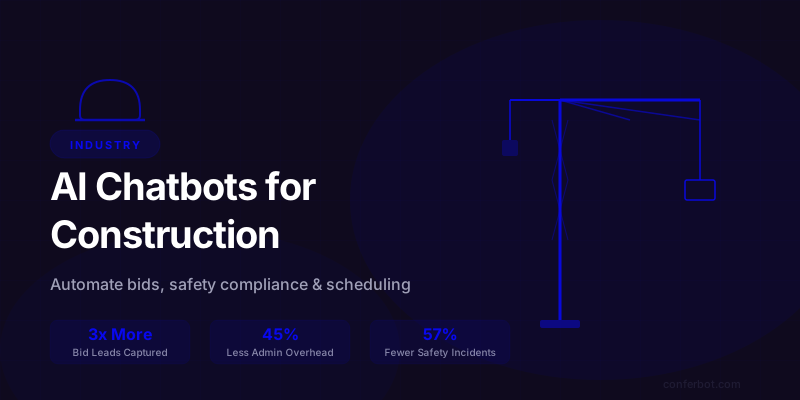
| Safety incidents/quarter | 14 | 6 | 57% reduction |
Annual revenue impact: 23 additional monthly leads x 18% win rate x $285,000 = $14.2 million in additional pipeline, generating approximately $2.8 million in new revenue. PM time savings across 4 PMs: $208,000/year. Reduced scheduling conflicts preventing an estimated $180,000 in delay costs. Safety incident reduction saving approximately $120,000 in direct and indirect costs. Total first-year impact: $3.3 million+
Annual investment: Conferbot platform at $149/month + integrations = $3,000/year. ROI: 110,000%
Large Contractor / Multi-Division (200+ employees)
For large contractors with multiple divisions, the chatbot scales across the entire organization. Each division (residential, commercial, industrial, service) gets its own chatbot configuration with shared infrastructure. The chatbot handles bid intake across all divisions, routes leads to the correct division based on project type, manages subcontractor communication across dozens of active projects, and provides executive dashboards on lead flow, response times, and conversion rates.
Large contractor annual impact: $8 to $15 million in combined revenue growth, operational savings, and risk reduction.
For a broader look at calculating chatbot ROI across different business models, see our complete chatbot ROI calculation guide.
Implementation Roadmap: From Zero to Live in 30 Days
Deploying an AI chatbot for a construction company follows a structured implementation process that can be completed in 30 days or less. Here is a week-by-week roadmap.
Week 1: Foundation and Content
Days 1-2: Platform setup and branding. Create your Conferbot account, configure brand colors and logo, set up the chat widget appearance to match your website design. Select the deployment channels (website, WhatsApp, Facebook, SMS).
Days 3-5: Knowledge base creation. Upload your company's core content: services offered (with descriptions and typical pricing for estimable services), project portfolio (photos, descriptions, outcomes), safety manual and OSHA reference materials, company information (licenses, insurance, history, team bios), FAQ content covering the 30 to 50 most common questions from prospects and clients. Use the Conferbot AI chatbot builder to create your knowledge base from existing documents, PDFs, and website content.
Days 6-7: Conversation flow design. Build the bid request intake flow with all qualification questions and routing logic. Build the safety FAQ flow with category navigation. Build the project status inquiry flow (initially with manual status updates; integrate with PM software in Phase 2).
Week 2: Integration and Testing
Days 8-10: CRM and notification integration. Connect the chatbot to your CRM (HubSpot, Salesforce, or Conferbot's built-in CRM) so bid requests create deal records automatically. Set up email and SMS notifications to estimators when high-priority bids arrive. Configure routing rules by project type, size, and location.
Days 11-12: Internal testing. Have your team test every conversation flow. Estimators test the bid intake process. Safety managers test the safety FAQ system. Project managers test the status update flows. Document any gaps or incorrect responses for correction.
Days 13-14: External beta testing. Invite 5 to 10 trusted subcontractors and past clients to interact with the chatbot and provide feedback. This real-world testing reveals conversation gaps that internal testing misses.
Week 3: Deployment and Optimization
Days 15-17: Production deployment. Install the chatbot on your website, Google Business Profile, Facebook page, and any other channels. Enable after-hours mode with appropriate messaging. Launch with your team briefed on how the chatbot will route leads and notifications to them.
Days 18-21: Monitoring and refinement. Monitor every conversation for the first week. Identify questions the chatbot cannot answer (knowledge gaps) and add content. Refine conversation flows based on how real users interact (they never follow the expected path exactly). Adjust lead scoring based on actual lead quality.
Week 4: Advanced Features
Days 22-25: Project management integration. Connect to Procore, Buildertrend, or your PM platform for real-time project status access. Configure subcontractor notification automations. Set up equipment and material request workflows.
Days 26-30: Analytics and reporting. Configure dashboards tracking lead volume, qualification rates, response times, and conversion rates. Set up weekly report delivery to management. Establish KPIs and targets for ongoing optimization.
For detailed guidance on chatbot deployment across multiple channels including website and messaging apps, see the Conferbot pricing and plans page to understand which features are available at each tier.
First-Mover Advantage: Why Construction Chatbot Adoption Is a Competitive Moat
Construction is one of the last major industries to adopt conversational AI. While e-commerce, healthcare, finance, and hospitality have widely deployed chatbots, construction companies are still overwhelmingly reliant on phone calls, emails, and manual processes. This creates an extraordinary first-mover advantage for construction firms that adopt chatbot technology now.
The Competitive Landscape in 2026
Based on industry surveys and our analysis of the top 1,000 US construction company websites, fewer than 3% currently have any form of chatbot or live chat on their website. Compare this to 42% of e-commerce sites and 38% of healthcare provider sites. The construction industry is not just behind, it is an entire technology generation behind in customer communication capabilities.
For the construction company that deploys a chatbot today (and according to Dodge Construction Network analytics, 82% of project owners rank contractor responsiveness as a top-3 selection criterion), this means being the only contractor in their market that responds instantly to every inquiry, 24 hours a day. When a prospect sends the same inquiry to three contractors at 9 PM on a Tuesday, one of them responds within 30 seconds with intelligent qualification questions while the other two respond 12 to 24 hours later with a generic "Thanks for your inquiry, someone will be in touch." The company with the chatbot wins the first-mover advantage in that prospect's decision process.
Compounding Benefits Over Time
Chatbot advantages compound over time. As your chatbot collects data from thousands of conversations, it becomes better at qualifying leads, predicting project types from initial descriptions, recommending relevant portfolio items, and identifying common objections. A competitor deploying a chatbot two years later starts from zero, while your chatbot has been learning and optimizing for 24 months.
Additionally, the operational efficiency gains, reduced admin overhead, improved safety documentation, and streamlined subcontractor communication, create sustainable competitive advantages in pricing. A contractor with 20% lower administrative overhead can bid more competitively on projects while maintaining margins, a structural advantage that is difficult for less efficient competitors to overcome.
Industry Transformation Ahead
The construction industry is approaching a technology inflection point. The convergence of AI chatbots, BIM (Building Information Modeling), drone site surveys, IoT sensors, and project management SaaS is creating a digital construction ecosystem where information flows automatically between systems and stakeholders. Companies that build the chatbot communication layer now will be positioned to integrate with these emerging technologies as they mature, while companies that wait will face the compounding cost of catching up across multiple technology fronts simultaneously.
For construction companies ready to build their first chatbot, the Conferbot AI chatbot builder provides a no-code platform specifically designed for industry-specific deployments. You can start with bid request automation, the highest-impact use case, and expand to safety, project status, and subcontractor coordination as your team gains confidence with the technology.
Was this article helpful?
AI Chatbot for Construction Companies FAQ
Everything you need to know about chatbots for ai chatbot for construction companies.
About the Author

Conferbot Team specializes in conversational AI, chatbot strategy, and customer engagement automation. With deep expertise in building AI-powered chatbots, they help businesses deliver exceptional customer experiences across every channel.
View all articles