The HR Chatbot Revolution in 2026
Human Resources departments are caught in a persistent squeeze: strategic demands are growing (talent strategy, culture building, DEI initiatives, workforce planning) while administrative workload continues to consume the majority of HR professionals' time. A 2025 SHRM survey found that HR teams spend an average of 60% of their time on administrative and transactional tasks — answering policy questions, processing paperwork, coordinating schedules, and managing routine employee requests.
AI chatbots are the most effective tool available to flip this ratio. By automating the repetitive, transactional work that dominates HR teams' days, chatbots free HR professionals to focus on the strategic, human-centered work that actually drives organizational success. The business case is compelling: organizations using HR chatbots report 40-50% reductions in routine HR inquiry volume, 30-40% faster time-to-hire, and measurable improvements in employee satisfaction with HR services.
The applications span the entire employee lifecycle. HR chatbots screen candidates and schedule interviews during recruiting, guide new hires through onboarding, answer policy questions and process requests during employment, and even assist with offboarding and exit processes. Deployed through Microsoft Teams, Slack, or company intranets — with team management for assigning conversations to the right HR specialist — they meet employees on the platforms they already use every day.
The candidate experience impact is equally significant. In a competitive labor market where top candidates receive multiple offers within days, the speed and quality of the recruiting experience directly impacts hiring outcomes. Gartner's HR research shows that companies with strong candidate experience hire quality talent 2.5x faster than those with poor processes. A chatbot that screens candidates instantly, schedules interviews within minutes, and keeps applicants informed throughout the process creates a decisive competitive advantage in talent acquisition.
This guide covers every major HR chatbot use case — from candidate screening through employee offboarding — with practical implementation strategies, ROI data, and best practices drawn from organizations that have successfully deployed HR chatbots at scale. You can get started quickly with a no-code chatbot builder that requires no technical expertise to configure for your HR workflows.
The competition for top talent has never been more intense. HR teams that rely on manual processes for candidate screening, interview scheduling, and onboarding face a structural disadvantage against organizations using AI-powered automation. The speed, consistency, and scalability of HR chatbots directly impact an organization's ability to attract, evaluate, and hire the best candidates before competitors do.
Automated Candidate Screening and Initial Qualification
The recruiting funnel is inherently inefficient: for every hire, recruiters typically review 75-250 applications, conduct 15-30 phone screens, and hold 5-10 interviews. The phone screening stage alone consumes 20-30 minutes per candidate — and the majority of screened candidates do not advance. A screening chatbot automates this initial qualification, processing hundreds of candidates simultaneously while delivering a consistent, bias-reduced evaluation.
How Screening Chatbots Work
When a candidate applies for a position, the chatbot initiates a screening conversation — either immediately after application or via a scheduled message. The screening covers:
- Minimum qualifications: Years of experience, required certifications, education level, specific technical skills. These are non-negotiable criteria that immediately qualify or disqualify candidates.
- Work authorization: Legal right to work in the relevant jurisdiction, visa sponsorship requirements.
- Availability: Start date, work schedule preferences (full-time, part-time, shifts), willingness to relocate if applicable.
- Compensation expectations: Salary range expectations compared to the budgeted range for the role.
- Key competency questions: 2-3 open-ended questions about relevant experience that help assess depth of qualification beyond checkbox criteria.
Scoring and Routing
Based on screening responses, the chatbot assigns a qualification score and routes candidates accordingly:
- Highly qualified (80-100%): Immediate notification to the recruiter with a recommendation to fast-track. The chatbot offers to schedule an interview right away.
- Qualified (60-79%): Added to the review queue with a summary of strengths and any concerns.
- Not qualified (below 60%): Receives a respectful decline message with encouragement to apply for other suitable positions.
Reducing Bias in Screening
One of the most valuable aspects of chatbot screening is consistency. Every candidate is asked the same questions in the same order, evaluated against the same criteria, and scored by the same algorithm. This eliminates the unconscious biases that inevitably creep into human screening — mood effects, affinity bias, halo effects, and inconsistent questioning. Organizations using standardized chatbot screening report more diverse candidate shortlists and fewer bias-related complaints, a finding consistent with McKinsey's research on diversity and organizational performance.
Integrate your screening chatbot with your Applicant Tracking System (ATS) through API integrations to ensure candidate data flows seamlessly into your existing workflow. Deploy through Microsoft Teams or Slack for internal recruiter notifications, and through your careers website chatbot and messaging platforms for candidate-facing interactions.
Interview Scheduling and Candidate Communication
Interview scheduling is one of the most time-consuming tasks in recruiting — a single interview involving multiple interviewers can require 5-10 back-and-forth emails or messages to coordinate calendars. Multiply this by dozens of candidates per open role, and scheduling becomes a full-time job in itself. A scheduling chatbot eliminates this coordination nightmare.
Automated Interview Scheduling
After a candidate passes screening, the chatbot handles the entire scheduling process:
- Calendar integration: The chatbot accesses interviewer calendars (Google Calendar, Outlook, or ATS-integrated calendars) to identify available time slots.
- Candidate selection: Presents available slots to the candidate in a conversational format, accommodating timezone differences for remote candidates.
- Confirmation: Once the candidate selects a slot, the chatbot uses calendar booking to create calendar events for all parties, sends confirmation emails with meeting details (location, video link, parking info), and provides preparation guidance.
- Reminders: Automated reminders at 24 hours and 1 hour before the interview, with easy options to reschedule if needed.
Panel Interview Coordination
For interviews requiring multiple panelists, the chatbot finds time slots where all required interviewers are available — a task that is exponentially more complex with each additional participant. It also handles the logistics:
- Distributing candidate resumes and interview scorecards to panelists
- Assigning specific competency areas to each interviewer to avoid redundant questions
- Collecting interviewer feedback through a structured post-interview form
- Consolidating feedback for the hiring manager's review
Candidate Communication Throughout the Process
One of the biggest complaints candidates have about the hiring process is lack of communication. They apply, screen, interview — and then hear nothing for weeks. A chatbot ensures consistent communication at every stage:
- Application acknowledgment: Immediate confirmation that the application was received, with expected timeline for next steps.
- Status updates: Proactive updates as the application moves through each stage. "Your application has been reviewed by the hiring team and moved to the interview stage. I'll reach out shortly to schedule a time."
- Post-interview follow-up: Thank-you message after each interview with updated timeline expectations.
- Decision communication: Whether the news is positive (offer) or negative (rejection), timely communication shows respect for the candidate's time and preserves your employer brand.
Organizations using chatbot-managed candidate communication report 35-50% improvements in candidate experience scores and 25% reduction in offer declines — because candidates who feel respected and informed throughout the process are more likely to accept. Deploy your recruiting chatbot through Teams and Slack for internal coordination, and through your careers website for candidate-facing interactions.
Employee Onboarding Automation
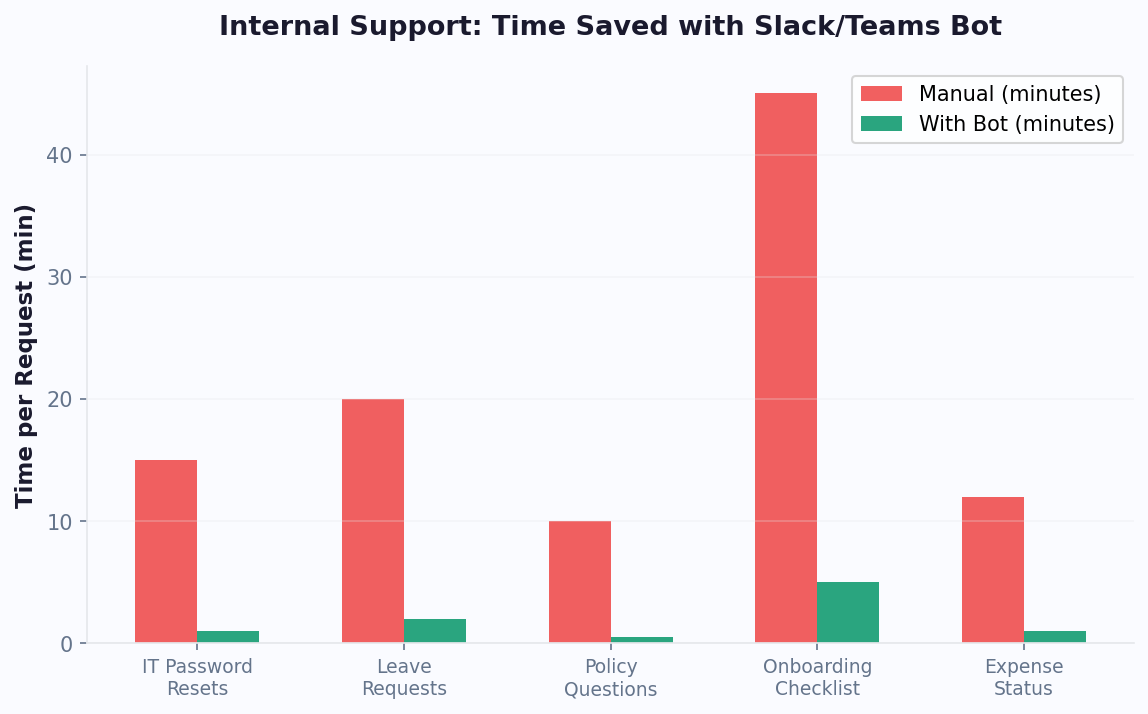
The first 90 days of employment are the most critical period for new hire retention and productivity. Yet most organizations acknowledge that their onboarding process is inconsistent, incomplete, and overly reliant on busy managers and HR staff to manually guide new hires through forms, systems, policies, and introductions. A well-designed onboarding chatbot reduces new hire time-to-productivity by 30-50% while ensuring every employee receives a consistent, comprehensive onboarding experience.
Pre-Day-One Preparation
The onboarding chatbot begins working before the new hire's first day:
- Document collection: Tax forms, direct deposit information, emergency contacts, I-9 documentation — the chatbot guides new hires through each required form with clear explanations and submission instructions.
- Equipment and access requests: Laptop preferences, software needs, building access badge requests — collected through the chatbot and routed to IT and facilities teams for preparation.
- First day logistics: Where to park, which entrance to use, what to bring, what to wear, who to ask for upon arrival — all the practical information that reduces first-day anxiety.
- Welcome and culture: Company mission, values, team introductions, and a preview of the first week's schedule to help the new hire feel welcomed and prepared.
First Week and Beyond
During the onboarding period, the chatbot delivers a structured program:
- Day-by-day guidance: Each day, the chatbot shares that day's onboarding tasks, training modules, meetings, and objectives. This creates a clear roadmap that prevents the "what should I be doing?" uncertainty common in poorly structured onboarding.
- System setup support: Step-by-step guidance for setting up email, VPN, project management tools, communication platforms, and other workplace technology.
- Policy acknowledgment: Present key policies (code of conduct, information security, harassment prevention) with comprehension checks and electronic acknowledgment collection.
- Check-in questions: Periodic prompts that ask how the new hire is settling in, whether they have questions, and if they need any support — with escalation via the ticket system to HR or their manager when issues arise.
Buddy and Mentor Matching
The chatbot can facilitate social integration by:
- Matching new hires with onboarding buddies based on department, interests, or location
- Facilitating introductions through the chatbot platform
- Scheduling coffee chats or lunch meetings
- Prompting buddy check-ins at regular intervals (day 3, week 1, week 2, month 1)
Onboarding Metrics
Track onboarding effectiveness through the chatbot's analytics:
- Task completion rates: What percentage of onboarding tasks are completed on time?
- Time-to-productivity: How quickly do new hires reach defined productivity milestones?
- New hire satisfaction: Regular pulse surveys through the chatbot during the first 90 days
- 90-day retention: Retention rate for chatbot-onboarded employees vs. historical baseline
Integrate your onboarding chatbot with your HRIS and internal systems to automate document routing, access provisioning, and training enrollment. Deploy through Microsoft Teams or Slack so new hires interact with the chatbot in the same platform they will use daily.
Employee Self-Service: HR FAQs and Policy Inquiries
HR teams spend a disproportionate amount of time answering the same questions over and over: "How many vacation days do I have left?" "What is the parental leave policy?" "How do I change my tax withholding?" "When is open enrollment?" These questions are important to employees but routine for HR — and every minute spent answering them is a minute not spent on strategic work. An HR FAQ chatbot powered by a comprehensive knowledge base resolves this permanently.
Common HR Queries Chatbots Handle
A comprehensive HR chatbot addresses questions across every functional area:
Benefits and compensation:
- Health, dental, and vision plan details and coverage summaries
- HSA/FSA balance checks and contribution changes
- Open enrollment dates, deadlines, and plan comparison tools
- 401(k) contribution rates, matching policies, and vesting schedules
- Bonus and incentive program details
Time off and leave:
- PTO balance and accrual rates
- Leave request submission and approval status
- Holiday schedules
- Parental leave, medical leave, and bereavement leave policies
- Sabbatical eligibility and application process
Payroll and tax:
- Pay schedule and next pay date
- Pay stub access and year-to-date earnings
- W-2 and tax form availability
- Direct deposit setup and changes
- Tax withholding adjustments (W-4 updates)
Policies and procedures:
- Remote work and hybrid policies
- Dress code guidelines
- Expense reimbursement process and limits
- Travel policies and booking procedures
- Performance review timeline and process
Personalized Responses
When integrated with your HRIS (Workday, BambooHR, ADP, etc.) through API integrations, the chatbot provides personalized answers rather than generic policy citations. Instead of "PTO accrual rates vary by tenure", the chatbot responds: "You currently have 12.5 PTO days remaining. You accrue 1.25 days per month, so you'll have 15 days available by the end of March." This level of personalization dramatically reduces follow-up questions and gives employees confidence in the information they receive.
Multi-Language and Global Support
For organizations with global workforces, the chatbot provides HR support in employees' preferred languages and adapts answers based on the employee's location — showing the correct benefits, holidays, and policies for their country or region. This eliminates the need for separate HR knowledge bases by geography and ensures every employee has equal access to HR information regardless of time zone or language. Deploy across Microsoft Teams and Slack for seamless access within employees' daily workflows. For guidance on training the chatbot on internal documentation, read our knowledge base training guide.
HR Chatbot Use Cases: Impact Comparison
Different HR chatbot applications deliver different levels of impact based on volume, time savings, and strategic value. The following comparison helps HR teams prioritize which use cases to automate first based on their specific pain points and organizational goals.
| Use Case | Avg. Time Saved per Interaction | Monthly Volume (500-person org) | Automation Rate | Implementation Complexity |
|---|---|---|---|---|
| Policy & Benefits FAQs | 5-8 min | 200-400 inquiries | 80-90% | Low |
| Candidate Screening | 20-30 min | 50-200 candidates | 70-85% | Medium |
| Interview Scheduling | 15-25 min | 30-100 interviews | 90-95% | Low |
| Employee Onboarding | 2-4 hours total | 5-20 new hires | 60-75% | Medium-High |
| Leave & PTO Requests | 5-10 min | 100-250 requests | 85-95% | Medium |
| Pulse Surveys & Feedback | 10-15 min (collection) | 500+ responses | 95-100% | Low |
Most organizations should start with Policy and Benefits FAQs and Interview Scheduling — they offer the highest automation rates with the lowest implementation complexity. Candidate Screening and Employee Onboarding deliver the most strategic value but require more integration work with existing HR systems.
Performance Management and Employee Engagement
Beyond transactional HR tasks, chatbots are increasingly being used to support the more strategic aspects of people management — performance reviews, pulse surveys, recognition, and engagement monitoring. These applications transform the chatbot from a simple FAQ tool into a strategic asset for organizational health.
Performance Review Support
Performance reviews are universally dreaded by both managers and employees, largely because they are infrequent, poorly structured, and disconnected from day-to-day work. A chatbot improves the process by:
- Continuous feedback collection: Instead of annual reviews, the chatbot prompts brief feedback exchanges (manager-to-employee and peer-to-peer) on a regular cadence — weekly or bi-weekly. Each exchange takes 2-3 minutes and builds a rich performance record over time.
- Goal tracking: Employees set quarterly goals through the chatbot, and the bot checks in periodically on progress, helping maintain accountability without manager micromanagement.
- Review preparation: When formal review periods arrive, the chatbot compiles the quarter's feedback, goal progress, achievements, and development areas into a summary that makes review conversations more substantive and evidence-based.
- Self-assessment guidance: Walk employees through the self-assessment form with prompts and examples that help them articulate their contributions effectively.
Employee Pulse Surveys
Traditional annual engagement surveys are expensive, time-consuming, and provide stale data by the time results are analyzed. Chatbot-based pulse surveys transform engagement measurement:
- Frequency: Short (3-5 question) surveys delivered weekly or bi-weekly through the chatbot, providing real-time engagement data rather than an annual snapshot.
- Participation rates: Chatbot-delivered surveys achieve 70-85% response rates vs. 40-60% for email-based surveys, because they take 30 seconds and are delivered in the platforms employees already use.
- Anonymity and trust: Responses are aggregated and anonymized, with clear communication about data handling to build employee trust.
- Trend analysis: With frequent data points, HR can identify engagement trends by team, department, or location and intervene early when scores decline.
Recognition and Rewards
Employee recognition is one of the strongest drivers of engagement, but many organizations struggle to make recognition consistent and timely. A chatbot-based recognition system makes it easy:
- "I want to recognize Maria for her amazing work on the product launch." — The chatbot captures the recognition, notifies Maria, posts to a recognition feed (if configured), and awards points in the rewards program.
- Managers receive periodic nudges: "You haven't recognized anyone on your team in 2 weeks. Anyone doing great work you'd like to call out?"
- Milestone celebrations: work anniversaries, project completions, and personal achievements are automatically recognized through the chatbot.
These engagement features transform the HR chatbot from a cost-reduction tool into a strategic platform that actively improves organizational culture, manager effectiveness, and employee satisfaction — driving retention and productivity improvements that far exceed the chatbot's cost.
HR Chatbot Implementation: Strategy, Rollout, and Measurement
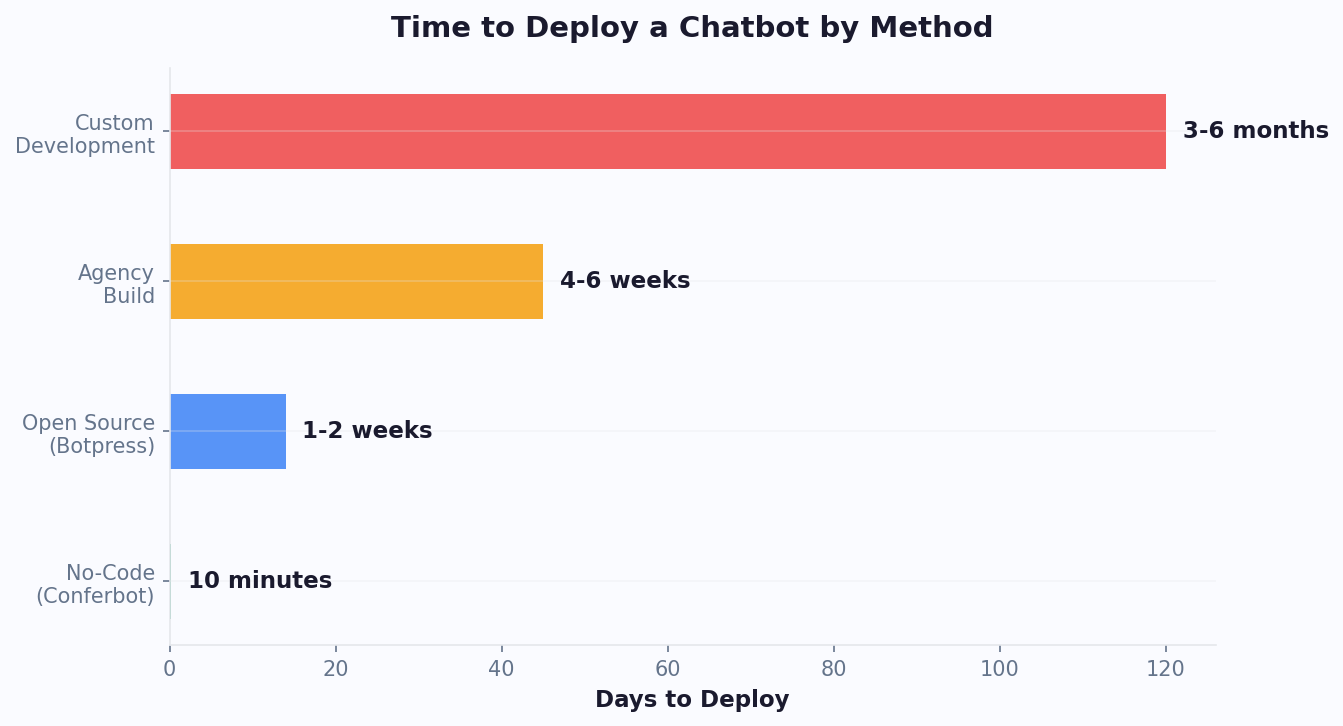
Successfully implementing an HR chatbot requires careful attention to organizational change management, data privacy, and phased deployment. Here is a comprehensive implementation guide for HR teams of any size.
Phase 1: Strategy and Planning (Weeks 1-3)
- Quantify the opportunity. Audit your HR team's time allocation. How many hours per week are spent on routine inquiries? What is the cost of that time? What strategic work is being deferred? This analysis builds the business case and defines success metrics.
- Select priority use cases. Rank potential chatbot functions by volume, time savings, and employee impact. Most organizations start with: (1) Policy and benefits FAQs, (2) PTO balance and leave requests, (3) Onboarding automation, then expand to recruiting and performance management.
- Address data privacy. HR data is highly sensitive. Define which employee data the chatbot can access, establish authentication requirements for personalized queries, and ensure compliance with data protection regulations (GDPR, state privacy laws, etc.).
- Secure leadership buy-in. Present the business case to senior leadership, emphasizing time savings, cost reduction, employee experience improvement, and strategic HR capacity recovery.
Phase 2: Build and Integrate (Weeks 4-6)
- Build your HR knowledge base. Compile all HR policies, benefits summaries, procedures, and FAQs into a structured knowledge base format the chatbot can use. Ensure accuracy — incorrect policy information from a chatbot can create legal and trust issues.
- Integrate with HR systems. Connect the chatbot to your HRIS, ATS, payroll system, and benefits platform through API integrations. Start with read-only integrations and add write capabilities (submitting requests, updating information) in a subsequent phase.
- Design conversation flows. Create natural, empathetic conversation flows for each use case using the no-code chatbot builder. HR interactions often involve sensitive topics (leave, compensation, performance), so tone matters more here than in most chatbot applications.
- Configure deployment channels. Deploy through Microsoft Teams and Slack for maximum adoption, as these are the platforms employees already use daily. Add web-based access for employees who prefer browser interaction.
Phase 3: Launch and Optimize (Weeks 7-10)
- Pilot with a friendly audience. Launch to a single department or location first. Choose a team that is receptive to new technology and can provide constructive feedback.
- Employee communication. Announce the chatbot with clear messaging about what it does, what it does not do, and how it complements (not replaces) the HR team. Address common concerns proactively.
- Monitor and iterate. Review conversation logs weekly using chatbot analytics to identify gaps in content, misunderstood questions, and escalation patterns. Add new content and refine existing flows based on real usage data.
- Expand gradually. Roll out to additional departments and locations, adding new use cases as each previous phase stabilizes.
Measuring HR Chatbot ROI
- HR inquiry volume reduction: Target 40-50% fewer routine inquiries to HR staff within 3 months
- Time-to-hire: For recruiting chatbots, target 30-40% reduction in time from application to offer
- Onboarding completion: Target 90%+ completion rate for onboarding tasks within the defined timeline
- Employee satisfaction: Pulse survey scores for HR services (target: measurable improvement within 6 months)
- HR team strategic time: Percentage of HR team time spent on strategic vs. administrative work (target: shift from 40/60 to 60/40)
For a dedicated deep-dive on the onboarding phase, see our AI Chatbot for Employee Onboarding guide. To understand broader chatbot ROI, use our chatbot ROI calculator and formula guide. The organizations that see the greatest ROI from HR chatbots are those that treat the chatbot as a strategic HR transformation tool rather than just a cost-cutting measure. When the chatbot frees HR professionals from administrative work, the question becomes: what strategic initiatives can the team now pursue with that recovered capacity? The answer to that question is where the real value lies. Common high-impact strategic initiatives enabled by chatbot-freed capacity include building comprehensive manager coaching programs, designing succession plans, launching employee development frameworks, improving diversity sourcing, and creating data-driven workforce planning models that position the organization for sustainable future growth. These high-value activities deliver strategic returns that far exceed the direct cost savings of the chatbot itself, making the investment case compelling for any organization with more than 100 employees.
Building an Employer Brand Through Chatbot Experience
The candidate experience during recruitment directly shapes employer brand perception — and in a competitive talent market, employer brand determines who applies. An HR chatbot that provides instant, personalized, and transparent communication throughout the hiring process signals that the organization values efficiency, technology, and respect for candidates' time. This impression carries forward into the employment relationship and influences Glassdoor reviews, employee referrals, and the organization's ability to attract top talent in future hiring cycles.
Conversely, a slow and opaque hiring process — where candidates submit applications into a black hole and wait weeks for any response — damages employer brand and discourages top performers from applying. Research from LinkedIn's Talent Solutions indicates that 83% of candidates say a negative interview experience can change their mind about a company they previously liked. An HR chatbot eliminates the most common sources of negative candidate experience: delayed responses, lack of status updates, and inability to get answers to basic questions about the role, team, or process.
Organizations that invest in chatbot-powered candidate communication report 40-60% improvements in candidate experience scores, 25-35% increases in offer acceptance rates, and measurably stronger employer brand metrics on platforms like Glassdoor and Indeed. These improvements compound over time as stronger employer brands attract larger, more qualified applicant pools, reducing cost-per-hire and time-to-fill for subsequent roles.
Was this article helpful?
AI Chatbots for HR and Recruiting FAQ
Everything you need to know about chatbots for ai chatbots for hr and recruiting.
About the Author
Conferbot Team specializes in conversational AI, chatbot strategy, and customer engagement automation. With deep expertise in building AI-powered chatbots, they help businesses deliver exceptional customer experiences across every channel.
View all articles