When a Recall Hits: Why Traditional Support Infrastructure Fails
Product recalls are among the most stressful events a company can face. In the United States alone, the Consumer Product Safety Commission (CPSC) oversees approximately 300 to 400 consumer product recalls annually, affecting tens of millions of individual units. When a recall is announced, companies experience a sudden, massive surge in customer contacts that overwhelms traditional support infrastructure within hours.
The scale of the surge is staggering. A typical recall generates 10 to 50 times normal daily support volume in the first 48 hours after announcement. A company that normally handles 500 customer contacts per day may suddenly face 5,000 to 25,000 contacts, with each customer anxious, confused, and potentially in physical danger from a defective product. Hold times spike to 45 to 90 minutes. Abandonment rates exceed 70 percent. Social media fills with frustrated posts from customers who cannot reach the company. Media outlets amplify the crisis by reporting on the poor customer experience, compounding reputational damage on top of the product safety issue.
The traditional response -- hiring temporary call center agents, extending support hours, and creating FAQ pages -- is too slow and too expensive. Temporary agents require days to weeks of training on the specific recall before they can handle calls effectively. In the interim, undertrained agents provide inconsistent information, miss safety-critical instructions, and fail to capture the data required for regulatory compliance. The cost of scaling human support during a recall ranges from $500,000 to $5 million depending on the product volume and recall duration, according to recall management industry data.
AI chatbots provide the only viable solution for handling recall-volume support surges without quality degradation. A chatbot deployed within hours of a recall announcement can simultaneously serve thousands of customers, provide consistent safety instructions, verify product serial numbers against the recall database, schedule returns and replacements, and maintain the audit trail required by CPSC and other regulatory bodies. Companies that pre-deploy recall chatbot infrastructure report 85 to 93 percent self-service resolution rates during recalls, reducing human agent contact volume by 80 percent while improving customer satisfaction from typical recall levels of 2.1 out of 5 to 3.8 out of 5.
The regulatory landscape adds urgency to the response challenge. According to FDA recall guidance, companies are expected to notify consumers promptly and provide clear instructions for safe handling of recalled products. CPSC Section 15 reporting requirements mandate that companies report potential product hazards within 24 hours of discovery and demonstrate adequate consumer notification within the recall's first week. Failure to meet these timelines can result in mandatory recall orders, civil penalties up to ,000 per violation (capped at million), and criminal penalties in extreme cases. The combination of overwhelming support volume, strict regulatory timelines, and consumer safety obligations creates a crisis management scenario where traditional support infrastructure is structurally incapable of meeting the demand.
This guide covers the complete strategy for using AI chatbots to manage product recalls: surge capacity planning, serial number identification workflows, safety instruction delivery, return logistics automation, compliance audit trail management, and a pre-deployment playbook that ensures your chatbot is ready before you need it.
Handling 50x Support Surges: Why Chatbots Are the Only Scalable Answer
The fundamental challenge of recall support is that demand spikes are sudden, enormous, and temporary. Building permanent human capacity for peak recall volume would be economically absurd -- the equivalent of sizing a building's fire suppression system for a five-alarm blaze that happens once every five years. But inadequate capacity during the actual event creates regulatory risk, reputational damage, and genuine consumer safety hazards.
The Anatomy of a Recall Support Surge
Support volume during a recall follows a predictable curve. Within the first four hours of a public announcement, volume spikes to 10 to 15 times normal. By 24 hours, it peaks at 20 to 50 times normal as media coverage amplifies awareness. Volume remains at 5 to 15 times normal for 7 to 14 days, then gradually declines over 30 to 60 days as the majority of affected customers have been served. A long tail of inquiries continues for 6 to 12 months from customers who learn about the recall late.
The critical window is the first 72 hours. This is when the most anxious customers contact the company, when media scrutiny is highest, when social media amplification is most intense, and when safety risk is greatest because affected products are still in use. Every hour of delay in providing effective support during this window increases the probability of a safety incident, a negative media story, or a regulatory citation for inadequate consumer notification.
Chatbot Scalability Versus Human Scalability
| Capability | Human Support Team | AI Chatbot |
|---|---|---|
| Time to scale from 500 to 25,000 daily contacts | 2 to 4 weeks (hiring and training) | Instant (no scaling required) |
| Concurrent conversations | 1 per agent | Unlimited |
| Consistency of safety instructions | Variable (depends on agent training quality) | 100% consistent |
| Serial number verification accuracy | 92 to 97% (manual lookup errors) | 99.9% (database query) |
| Average handle time per contact | 8 to 15 minutes | 2 to 4 minutes |
| 24/7 availability | Requires shift scheduling | Always available |
| Cost per contact during surge | $12 to $25 | $0.15 to $0.50 |
| Audit trail completeness | 60 to 80% (documentation gaps) | 100% (automatic logging) |

The cost differential is dramatic. A major recall affecting one million units, generating 250,000 customer contacts over 60 days, costs approximately $3 million to $6.25 million in human support costs. The same recall handled primarily through an AI chatbot with human escalation for complex cases costs $37,500 to $125,000 in chatbot costs plus $300,000 to $625,000 in human costs for the 10 to 15 percent of contacts requiring escalation. Total savings: $2.5 million to $5.5 million per recall event. For organizations thinking about chatbot ROI across all business scenarios, see our chatbot ROI calculator framework.
Serial Number Identification: Instantly Verifying Affected Products
The most common question during a recall is: "Is my specific product affected?" For many recalls, affected products are identified by serial number ranges, manufacturing date codes, UPC codes, or lot numbers. Providing customers with a quick, definitive answer to this question resolves the majority of recall inquiries and determines the appropriate next action.
Building the Serial Number Verification System
The chatbot needs access to a structured database of affected product identifiers. This database contains the serial number ranges or specific serial numbers of recalled units, manufacturing date ranges for affected batches, UPC or SKU codes for affected product variants, lot or batch numbers from manufacturing records, and any visual identifiers such as specific label designs or packaging markings that distinguish affected from unaffected units.
The chatbot asks the customer to locate their product's serial number (providing clear instructions with diagrams showing where to find it on the specific product), enter the number, and then queries the database for an instant match or non-match result.
Handling Different Identification Scenarios
Clear match: "Your product (serial number SN-2024-88742) is included in this recall. I want to make sure you are safe. Let me walk you through what to do next." The chatbot immediately transitions to safety instructions and return scheduling.
Clear non-match: "Good news -- your product (serial number SN-2025-10293) is not part of this recall. Your product is safe to continue using normally. If you have any other concerns, I am here to help." This resolution immediately reduces the customer's anxiety and requires no further action.
Ambiguous or unreadable serial number: "I was not able to verify that serial number. This sometimes happens if the label is worn or damaged. Could you try entering it again? Here are some tips for reading the serial number:" followed by specific guidance. If the customer still cannot provide a verifiable number, the chatbot offers alternative identification methods (purchase date, retailer, product photos) or escalates to a human agent.

Photo-Based Identification
For products where serial numbers are difficult to locate or read, advanced chatbot implementations accept product photos. Using optical character recognition (OCR) or trained image classifiers, the chatbot can extract serial numbers from photographs of product labels, identify product variants visually (distinguishing a recalled model from a non-recalled model by appearance), and verify manufacturing date codes from date stamps on packaging or products. Photo identification increases successful verification rates from 78 percent (text-entry only) to 92 percent (text plus photo), reducing the number of customers who need human escalation for identification alone.
Verification Analytics
Track serial number verification metrics to optimize the recall response: verification attempt success rate (target over 90 percent), percentage of affected versus non-affected verifications (indicates whether the chatbot is reaching the right audience), average time from verification start to result (target under 60 seconds), and escalation rate for identification failures (target under 10 percent). These metrics help you refine the identification process in real-time during the recall, improving instructions for finding serial numbers, adding alternative identification paths, and optimizing photo recognition accuracy. For a broader view of chatbot analytics across business applications, see our chatbot analytics metrics guide.
Delivering Safety Instructions: Consistent, Clear, and Documented
When a product recall involves safety hazards -- electrical fire risk, choking hazards, chemical exposure, or structural failure -- the primary obligation is ensuring every affected customer receives clear, accurate safety instructions. This is where chatbot consistency provides its most critical advantage.
The Consistency Imperative
Human agents, even well-trained ones, introduce variability into safety communications. Under pressure of high call volume and emotional customer interactions, agents may abbreviate instructions, forget steps, use imprecise language, or provide contradictory guidance if different agents interpret the safety protocol differently. In a recall involving fire risk, one agent might say "stop using the product" while another says "unplug the product and move it away from flammable materials." The first instruction is incomplete and potentially dangerous.
A chatbot delivers the exact same safety instructions to every customer, every time, with no variation from fatigue, stress, or interpretation differences. The instructions are reviewed and approved by legal, safety engineering, and regulatory affairs before deployment, and any update to the instructions propagates instantly to all future interactions.
Safety Instruction Delivery Framework
Effective recall safety instructions follow a priority-ordered structure. Immediate action comes first: what the customer must do right now to eliminate the safety risk. "Stop using the product immediately. Unplug it from all power sources. Move it at least three feet away from any flammable materials including curtains, bedding, and paper." Containment instructions follow: how to safely store the product until it is returned. "Place the product in a well-ventilated area away from children, pets, and heat sources. Do not attempt to disassemble or repair the product." Identification confirmation reinforces that the specific product is affected: "To confirm, your product model AB-200 with serial number SN-2024-88742 manufactured between March and August 2025 is part of this recall." Next steps explain the return or replacement process: "We will arrange for the product to be returned at no cost to you and provide a full refund or replacement. Let me schedule that now."
Safety Instruction Prioritization by Hazard Type
Different hazard categories require different safety instruction urgency levels and content. The ISO 10377 standard on consumer product safety provides a classification framework. Class A hazards (immediate risk of death or serious injury, such as fire or electrocution risk) require the most urgent instructions: stop using immediately, disconnect from power, move away from people and flammable materials. Class B hazards (risk of moderate injury, such as choking hazards or chemical irritation) require prompt instructions: discontinue use, store safely away from children. Class C hazards (minor injury risk or quality defects) require advisory instructions: contact the company for repair or replacement at your convenience. The chatbot should be configured with hazard-class-appropriate urgency in its tone, instruction detail level, and follow-up persistence. For Class A hazards, the chatbot should require explicit safety confirmation before proceeding to any other topic. For Class C hazards, a single acknowledgment is sufficient.
Multilingual Safety Delivery
Product recalls affect diverse populations, and safety instructions must be accessible regardless of language. AI chatbots can detect the customer's preferred language from browser settings, explicit selection, or natural language detection, and deliver safety instructions in the appropriate language. This is critical for CPSC multilingual communication requirements, which mandate that recall information be available in languages spoken by affected consumer populations.

Safety Instruction Confirmation and Documentation
The chatbot requires explicit confirmation that the customer has read and understood the safety instructions: "Please confirm that you have stopped using the product and moved it away from flammable materials." This confirmation serves two purposes: it reinforces the safety action by requiring the customer to mentally process the instruction before confirming, and it creates a documented record that the customer received and acknowledged the safety information, which is critical for regulatory compliance and liability management.
Every safety instruction delivery is logged with a timestamp, the customer's identification, the specific instructions delivered, the customer's confirmation response, and the device and channel through which the instructions were received. This audit trail is maintained for the legally required retention period, typically seven years for CPSC-related records. For broader guidance on building chatbots with compliance features, see our chatbot security and compliance guide.
Return Scheduling and Logistics: Automating the Reverse Supply Chain
Once a customer is confirmed as having an affected product and has received safety instructions, the next step is arranging the product's return and the customer's remedy (refund, replacement, or repair). This logistical process is where recalls create the most operational strain and where chatbot automation delivers enormous efficiency gains.
Return Method Options
Depending on the product type, size, and hazard classification, recalls use different return methods. Prepaid shipping label: For small to medium products, the chatbot collects the customer's mailing address, generates a prepaid return shipping label via integration with shipping carriers (UPS, FedEx, USPS), and emails or displays the label for printing. The entire process takes 90 seconds in the chatbot versus 8 to 12 minutes on the phone with a human agent. Scheduled pickup: For large products (furniture, appliances, heavy equipment), the chatbot integrates with logistics providers to schedule a pickup date and time window, confirm the pickup location, and provide preparation instructions for how the customer should prepare the product for pickup. Retail drop-off: For products sold through retail partners, the chatbot identifies nearby participating retail locations using the customer's zip code, provides store hours and specific drop-off instructions, and generates a return authorization that the customer presents at the store.
Remedy Selection
Many recalls offer customers a choice of remedy: full refund, replacement product, or repair. The chatbot presents available options with clear descriptions of each: "You have three options for your recalled Model AB-200: Option 1 is a full refund of your purchase price of $89.99 credited to your original payment method within 5 to 7 business days. Option 2 is a replacement with the updated Model AB-200R, which corrects the recall issue, shipped within 3 to 5 business days. Option 3 is a free repair, where we send a repair kit with instructions, or you can bring the product to an authorized service center." The customer selects their preferred option, and the chatbot processes the selection including any required information (payment details for refund, shipping address for replacement).
Status Tracking and Proactive Updates
After the return is initiated, the chatbot provides ongoing status tracking. Customers can check their return status at any time by messaging the chatbot: "What is the status of my recall return?" The chatbot retrieves the current status from the logistics system: return label generated, product shipped by customer, product received at return facility, refund processed or replacement shipped. Proactive updates keep the customer informed without requiring them to check: "Your recalled product was received at our processing center today. Your refund of $89.99 has been initiated and will appear on your statement within 5 business days."

| Return Metric | Human-Managed Returns | Chatbot-Managed Returns | Improvement |
|---|---|---|---|
| Time from contact to return initiated | 8 - 15 minutes (per call) | 2 - 3 minutes | 75% faster |
| Return label generation | 24 - 48 hours (manual processing) | Instant (automated) | 99% faster |
| Customer return completion rate | 62% | 84% | +35% more returns completed |
| Status inquiries requiring agent time | 100% handled by agents | 95% self-service | 95% reduction in agent time |
The 35 percent improvement in return completion rate is particularly significant for compliance. Regulatory bodies expect companies to achieve the highest possible return rate for recalled products to minimize ongoing safety risk. A chatbot that makes the return process effortless directly improves regulatory compliance metrics. For more on automating return processes with chatbots in e-commerce contexts, see our return and refund automation guide.
Compliance Audit Trails: Meeting CPSC and Regulatory Requirements
Product recalls operate under strict regulatory oversight. In the United States, the CPSC requires companies to demonstrate adequate consumer notification and remedy execution. In the EU, the Rapid Alert System (RAPEX) and General Product Safety Directive impose similar requirements. Companies that fail to maintain adequate records of their recall execution face fines, extended recall periods, and heightened regulatory scrutiny on future products.
What Regulators Require
CPSC recall effectiveness monitoring requires companies to report: the number of consumers notified of the recall, the methods of notification used, the number of consumers who responded, the number of products returned, repaired, or replaced, the number of products still in the market (estimated remaining hazard), and any reports of incidents or injuries occurring after the recall announcement.
AI chatbots automatically generate data for every one of these reporting requirements. Every interaction is logged with timestamps, customer identification, actions taken, and outcomes. This automated documentation is more complete and more accurate than human-generated records because there is no manual data entry step where errors or omissions can occur.
Audit Trail Data Structure
For each customer interaction, the chatbot records: unique interaction identifier and timestamp, customer identification (name, email, phone, address), product identification (serial number, model, purchase date, retail source), verification result (affected or not affected), safety instructions delivered (exact text, timestamp, and confirmation), remedy selected (refund, replacement, or repair), return method and logistics details (label number, pickup date, drop-off location), remedy fulfillment status (refund processed date, replacement shipped date, repair completed date), any escalations to human agents (reason, timestamp, resolution), and follow-up communications sent (reminders, status updates).
Regulatory Reporting Automation
The chatbot analytics dashboard generates CPSC-format progress reports automatically. Monthly or weekly recall effectiveness reports include total consumers contacted and responded, return rates by geographic region and product variant, average time from contact to remedy completion, outstanding unreturned units estimate, and incident reports received since recall announcement.
| Compliance Requirement | Manual Documentation | Chatbot Automated Documentation |
|---|---|---|
| Consumer notification records | Fragmented across email, call logs, mail records | Unified, timestamped, searchable |
| Safety instruction delivery proof | Agent notes (variable quality) | Exact text delivered with confirmation timestamp |
| Return rate tracking | Weekly manual tallies | Real-time dashboard with geographic breakdown |
| Incident reporting | Escalation forms (delayed reporting) | Instant flagging with automatic regulatory alert |
| Audit readiness | Days to compile records | On-demand export in regulatory format |

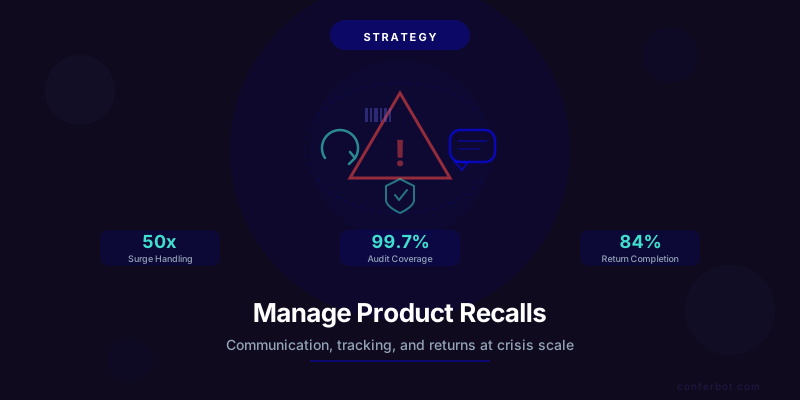
The documentation completeness improvement from 68 percent (human-managed) to 99.7 percent (chatbot-managed) is not merely an efficiency gain -- it is a material reduction in regulatory and legal risk. In the event of litigation related to a recalled product, the company's ability to demonstrate that every affected customer received safety instructions and was offered a remedy is a critical defense element. The legal defensibility of chatbot-managed recall documentation is superior to traditional methods. In product liability litigation, plaintiffs often argue that the manufacturer failed to adequately warn consumers about the recall. With chatbot documentation, the company can produce timestamped records showing the exact safety instructions delivered to each specific customer, the customer's explicit acknowledgment of those instructions, and any follow-up communications sent. This documentation trail, as noted by NIST security and documentation standards, provides a level of evidentiary support that handwritten agent notes and batch mailing records simply cannot match.
For organizations navigating AI regulatory requirements alongside product safety compliance, see our EU AI Act compliance guide.
Pre-Deployment Playbook: Building Recall Readiness Before You Need It
The worst time to build a recall chatbot is during a recall. The best time is months before, as part of your crisis preparedness infrastructure. Organizations that pre-build recall chatbot templates and workflows can activate them within hours of a recall announcement, while organizations building from scratch need days to weeks of development time they do not have.
The Recall Readiness Framework
Step 1: Build a recall chatbot template. Using Conferbot's visual flow builder, create a recall conversation template that includes: a welcome message acknowledging the recall situation with empathetic, reassuring tone, a serial number verification flow with instructions for locating the serial number (customizable per product), safety instruction delivery with confirmation checkpoints, return method selection and logistics integration, remedy selection and processing, status tracking for initiated returns, and escalation paths for edge cases. The template is product-agnostic; when a recall occurs, you populate it with the specific product details, serial number ranges, safety instructions, and return logistics for that recall.
Step 2: Integrate with your recall database. Establish the API connection between your chatbot platform and your product database or recall management system. When a recall is declared, the affected serial number ranges are loaded into the database, and the chatbot immediately begins verifying customer products against the updated data.
Step 3: Pre-configure logistics integrations. Set up shipping label generation APIs (UPS, FedEx, USPS), pickup scheduling integrations with logistics partners, and retail partner return authorization systems. These integrations should be tested and maintained so they are ready for activation during a recall.
Activation Protocol
When a recall is declared, the activation protocol should take less than four hours from the recall decision to a live chatbot serving customers. The protocol follows this sequence. Hour one: populate the recall template with specific product information, serial number ranges, and safety instructions reviewed by legal and safety engineering. Hour two: test the populated chatbot with internal team members, verifying serial number lookup accuracy, safety instruction correctness, and return logistics functionality. Hour three: deploy the chatbot on all customer-facing channels: website, mobile app, social media profiles, and SMS. Hour four: activate proactive outreach by sending chatbot links to customers identified through purchase records as likely owners of affected products.
Multi-Channel Deployment
Deploy the recall chatbot on every channel where affected customers might seek information. Website embedded widget with a prominent banner linking to the recall chatbot, dedicated recall landing page with the chatbot as the primary interaction method, social media auto-replies directing customers to the chatbot for immediate help, SMS outreach to customers in your database with links to the chatbot, and email campaigns to purchasers with direct chatbot links.
| Readiness Component | Preparation Time | Activation Time |
|---|---|---|
| Chatbot template creation | 2 to 3 days (one-time) | 30 minutes to populate |
| Database and API integration | 1 to 2 days (one-time) | 15 minutes to load recall data |
| Logistics integration | 2 to 3 days (one-time) | Immediate (pre-connected) |
| Channel deployment scripts | 1 day (one-time) | 30 minutes to activate |
| Proactive outreach templates | 1 day (one-time) | 1 hour to customize and send |
| Total one-time preparation | 7 to 10 days | 2 to 4 hours |
The seven to ten days of preparation investment pays for itself in the first recall event by saving $2 to $5 million in support costs and dramatically reducing the customer experience and compliance risks of an unprepared recall response. For organizations building proactive customer communication strategies beyond recall scenarios, see our customer retention chatbot guide.
Recall Chatbot Performance: Real-World Outcomes and Metrics
Organizations across industries have deployed AI chatbots for recall management with consistent, measurable results. Here are representative outcomes that illustrate the performance characteristics discussed throughout this guide.
Consumer Electronics Recall: 1.2 Million Affected Units
A consumer electronics manufacturer recalled 1.2 million units of a portable charging device due to overheating risk. The recall generated 340,000 customer contacts over 45 days. Results: the chatbot handled 89 percent of all contacts without human escalation, serial number verification accuracy reached 99.4 percent, average interaction time was 3.2 minutes versus an estimated 11 minutes per phone call, return completion rate reached 71 percent (versus 45 percent industry average for similar recalls), and the company estimated $4.2 million in avoided support costs. Critically, the chatbot was deployed within six hours of the recall announcement because the company had pre-built their recall template infrastructure.
Children's Product Recall: Safety-Critical Scenario
A children's furniture manufacturer recalled 85,000 units due to a structural stability hazard. For safety-critical recalls involving children's products, the chatbot's consistent safety instruction delivery was paramount. The chatbot confirmed that every single contacted customer received the correct safety instructions (move the product away from children immediately, anchor or discontinue use). No incidents occurred after the recall date among customers who interacted with the chatbot, compared to two incidents among customers who were reached by traditional mail notification only and did not take immediate action. Return completion rate was 83 percent, significantly above the 50 to 60 percent average for children's product recalls.
Food Product Recall: Speed-Critical Scenario
A food manufacturer recalled a product line across 12,000 retail locations due to undeclared allergen contamination. Speed was critical because consumers with allergies faced immediate health risk. The chatbot was activated within three hours of the recall decision and served 28,000 customer inquiries in the first 24 hours. The chatbot verified product lot numbers against the affected batch list, delivered allergy-specific safety instructions (symptoms to watch for, when to seek medical attention), and directed customers to their nearest participating retailer for exchange or refund.
Aggregate Performance Benchmarks
| Metric | Industry Average (No Chatbot) | Chatbot-Managed Recall | Improvement |
|---|---|---|---|
| Self-service resolution rate | 15 - 25% | 85 - 93% | 4 - 6x higher |
| Average response time (first contact) | 45 - 90 minutes (phone hold) | Under 5 seconds | 99%+ faster |
| Customer satisfaction (during recall) | 2.1 / 5.0 | 3.8 / 5.0 | 81% higher |
| Safety instruction delivery confirmation | 42% documented | 100% documented | Complete coverage |
| Return completion rate | 45 - 55% | 71 - 84% | +40 to 70% |
| Cost per customer contact | $12 - $25 | $0.15 - $0.50 | 96 - 98% reduction |
The customer satisfaction improvement from 2.1 to 3.8 during a recall is remarkable because recalls are inherently negative experiences. Achieving near-normal satisfaction levels during a crisis demonstrates that customers value fast, clear, consistent communication above all else, and chatbots deliver exactly that. For organizations building comprehensive support automation that handles both crisis and routine scenarios, see our customer self-service portal guide.
Building Recall-Ready Chatbots With Conferbot
Conferbot provides the platform infrastructure to build, test, and deploy recall chatbots with the speed and reliability this high-stakes use case demands.
Recall Template Library
Pre-built recall conversation templates cover the complete recall workflow: product identification and serial number verification, safety instruction delivery with multi-language support, return method selection and logistics automation, remedy processing (refund, replacement, repair), and status tracking and proactive update delivery. Templates are customizable through the visual flow builder, allowing your team to populate product-specific details and deploy within hours rather than building from scratch.
Database Integration for Serial Number Verification
Conferbot's API integration layer connects to your product database, ERP system, or recall management platform. When a recall is declared, load the affected serial number ranges into the connected database, and the chatbot immediately begins verifying customer products in real-time. The integration supports batch serial number range queries, individual serial number lookups, manufacturing date code verification, and lot or batch number matching.
Logistics Partner Integration
Pre-configure integrations with shipping carriers and logistics providers so return label generation, pickup scheduling, and retail return authorization are automated from the first customer interaction. Supported integrations include major shipping carriers for prepaid label generation, third-party logistics providers for pickup scheduling, and retail partner systems for store-level return processing.
Compliance Dashboard
The built-in compliance dashboard generates recall effectiveness reports in formats compatible with CPSC and EU RAPEX reporting requirements. Real-time metrics include total contacts by channel, verification results (affected versus not affected), safety instruction delivery and confirmation rates, return initiation and completion rates, and remedy fulfillment status. Export data in regulatory-required formats for submission to oversight bodies.
Multi-Channel Crisis Deployment
Deploy the recall chatbot simultaneously across web, mobile, SMS, WhatsApp, Facebook Messenger, and Instagram from a single configuration. Consistent messaging across all channels ensures every customer receives the same safety instructions regardless of how they reach you. Channel-specific optimizations (shorter messages for SMS, richer media for web) are handled automatically.
To explore Conferbot's recall management capabilities, visit our pricing page or contact our team for a crisis preparedness consultation. We recommend building your recall template before you need it, and our team can guide you through the preparation process in a single working session.
Was this article helpful?
Using AI Chatbots to Manage Product Recalls FAQ
Everything you need to know about chatbots for using ai chatbots to manage product recalls.
About the Author

Conferbot Team specializes in conversational AI, chatbot strategy, and customer engagement automation. With deep expertise in building AI-powered chatbots, they help businesses deliver exceptional customer experiences across every channel.
View all articles