Why Most Chatbot ROI Measurements Fail (And How to Fix Yours)
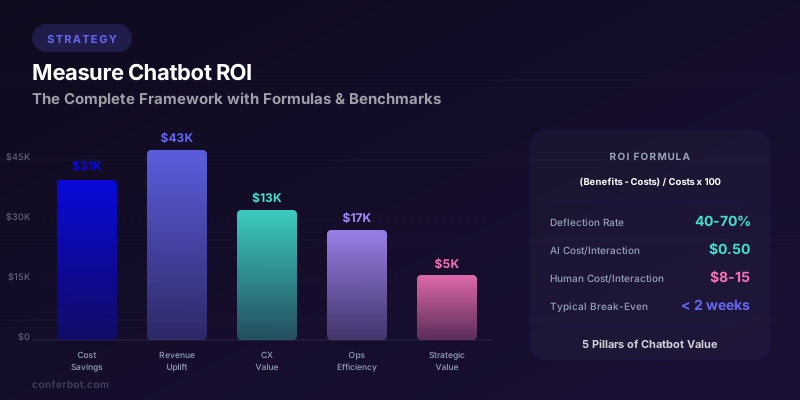
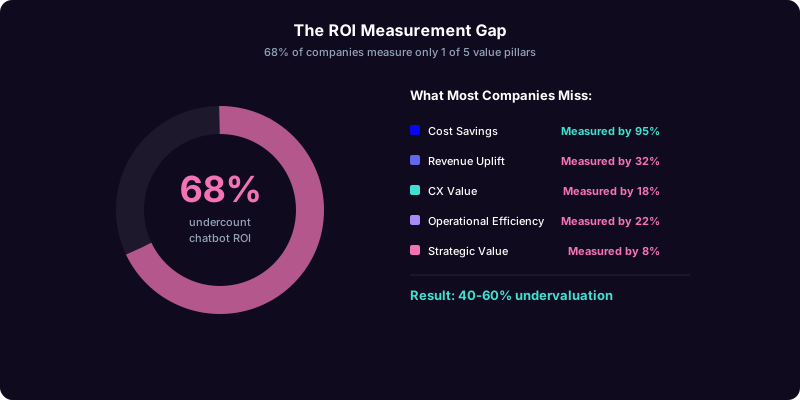
The majority of businesses that deploy chatbots cannot accurately quantify their return on investment. According to a Forrester Total Economic Impact study, 68% of organizations that deploy chatbots measure only one dimension of ROI (usually cost savings) while ignoring revenue generation, customer experience improvements, and operational efficiency gains. This single-dimension approach systematically undervalues chatbot investments by 40-60% and leads to poor optimization decisions.
The problem is not a lack of data. Modern chatbot platforms generate enormous amounts of data -- conversation counts, resolution rates, response times, user satisfaction scores, and funnel metrics. The problem is that most businesses lack a comprehensive framework that ties these operational metrics to the financial outcomes that matter: reduced costs, increased revenue, and improved customer lifetime value.
This guide provides that framework. We will build the complete ROI measurement system from the ground up, starting with the master formula, drilling into each component with real benchmarks and formulas, and ending with a repeatable measurement process you can implement this week. By the end, you will have a defensible, data-driven ROI model that proves chatbot value to any stakeholder -- from your CFO to your board.
If you have already read our introductory guide to calculating chatbot ROI, this framework goes significantly deeper. Where that guide provided the basic formula and worked examples, this guide covers advanced measurement techniques including customer satisfaction monetization, revenue attribution models, competitive displacement analysis, and multi-year compounding projections that capture the full long-term value of chatbot investments.
The framework presented here has been refined across thousands of chatbot deployments spanning e-commerce, SaaS, healthcare, financial services, real estate, and professional services. The formulas are industry-agnostic but the benchmarks are industry-specific, allowing you to build a projection calibrated to your exact business context.
The Master ROI Formula: Five Pillars of Chatbot Value
Every chatbot ROI calculation should measure five distinct value pillars. Measuring fewer than five means you are leaving value uncounted and making sub-optimal investment decisions. Here is the complete formula:
Let us define each pillar before diving into individual calculations:
Pillar 1: Direct Cost Savings
The money you stop spending on human handling of automatable conversations. This is the most commonly measured pillar and the easiest to quantify. It includes reduced agent headcount, lower cost-per-interaction, and eliminated overtime and seasonal hiring costs.
Pillar 2: Revenue Uplift
The new revenue your chatbot generates through lead capture and qualification, cart recovery, upselling and cross-selling, and conversion rate improvement. According to Juniper Research, chatbots will drive $142 billion in retail sales by 2027, up from $7.3 billion in 2023. Revenue uplift is where chatbots deliver the most surprising ROI for businesses that measure it.
Pillar 3: Customer Experience (CX) Value
The monetized value of improved customer satisfaction, reduced wait times, and 24/7 availability. CX improvements drive retention, reduce churn, and increase customer lifetime value. While harder to quantify than direct cost savings, CX value often represents 25-40% of total chatbot ROI.
Pillar 4: Operational Efficiency
The productivity gains from faster resolution times, reduced agent training costs, improved first-contact resolution, and data-driven process improvement. These gains compound over time as the chatbot handles an increasing share of routine work.
Pillar 5: Strategic Value
The competitive advantages gained from 24/7 availability, scalability without linear cost increase, customer data and insights, and market differentiation. Strategic value is the hardest to quantify but often the most important factor in long-term competitive positioning.
Total Cost of Ownership (TCO)
The complete cost of operating the chatbot, including platform subscription, implementation labor, ongoing maintenance and optimization, per-conversation or API usage fees, and opportunity cost during implementation. A detailed TCO breakdown is provided in Section 7.
Now let us calculate each pillar with formulas, benchmarks, and worked examples that you can adapt to your specific business.
Pillar 1: Direct Cost Savings -- Deflection Rates, Cost Per Interaction, and Agent Economics
Direct cost savings represent the most tangible and defensible component of chatbot ROI. This pillar answers a simple question: how much less are you spending on customer support because the chatbot handles conversations that humans previously handled?
The Direct Cost Savings Formula
Which simplifies to:
Benchmark: Deflection Rates by Industry (40-70%)
Deflection rate (also called containment rate or automation rate) is the percentage of conversations fully resolved by the chatbot without human intervention. According to aggregated deployment data and Tidio's research on chatbot performance, benchmark deflection rates are:
| Industry | Month 1 Deflection | Month 6 Deflection | Month 12 Deflection | Mature Deflection |
|---|---|---|---|---|
| E-commerce | 35-45% | 55-65% | 65-78% | 70-85% |
| SaaS / Software | 28-38% | 45-58% | 55-68% | 60-75% |
| Healthcare | 25-35% | 40-52% | 50-62% | 55-70% |
| Financial Services | 22-32% | 38-50% | 48-60% | 55-70% |
| Real Estate | 30-40% | 48-60% | 58-68% | 65-80% |
| Professional Services | 25-35% | 42-55% | 52-65% | 55-70% |
| Retail (non-e-commerce) | 32-42% | 50-62% | 60-72% | 65-80% |
| Travel / Hospitality | 30-40% | 48-60% | 58-70% | 65-80% |
Notice the significant improvement from Month 1 to maturity. Deflection rates improve because you continuously refine flows based on real conversation data, expand the knowledge base to cover more topics, and add integrations that allow the chatbot to perform actions (order lookup, appointment booking) rather than just answering questions. Use the Conferbot analytics dashboard to track deflection rate progression and identify improvement opportunities.
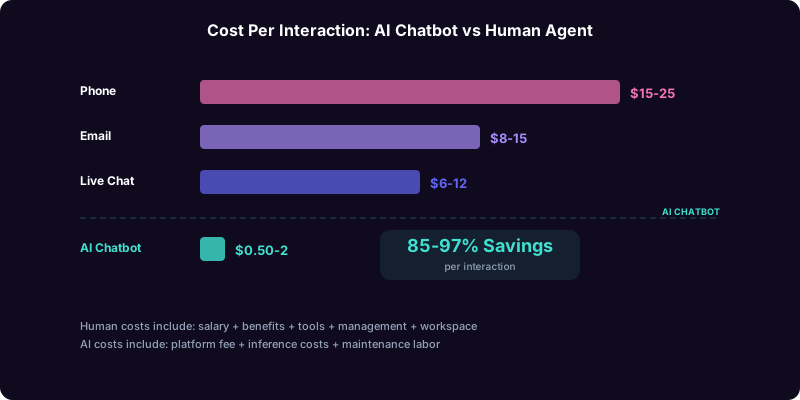
Benchmark: Cost Per Interaction -- $0.50 AI vs $8-15 Human
The cost differential between human and chatbot interactions is where the savings math becomes compelling:
| Interaction Type | Average Cost | Average Handle Time | Cost Drivers |
|---|---|---|---|
| Phone (human agent) | $15-$25 | 6-12 minutes | Agent salary, telephony, QA, management overhead |
| Email (human agent) | $8-$15 | 10-20 minutes | Agent salary, tools, back-and-forth exchanges |
| Live chat (human agent) | $6-$12 | 8-14 minutes | Agent salary, concurrent chat limits, tools |
| AI chatbot (automated) | $0.50-$2.00 | 1-3 minutes | Platform fee, AI inference costs |
The cost per human interaction should include fully loaded agent compensation (salary + benefits + taxes = typically 1.3-1.5x base salary), management overhead, software tools per agent, training and quality assurance, and workspace costs. Most businesses undercount by using only base salary, which understates the true cost by 30-50%.
Worked Example: 5-Agent Support Team
- Monthly conversations: 4,000
- Fully loaded cost per human interaction: $12.50 (blended across channels)
- Chatbot deflection rate (Month 6): 55%
- Conversations deflected: 4,000 x 55% = 2,200
- Cost per chatbot interaction: $0.75
- Monthly savings: 2,200 x ($12.50 - $0.75) = $25,850/month
- Annual savings: $310,200
A critical nuance: deflected conversations do not always mean eliminated agent positions. In many cases, the chatbot handles the volume growth that would have required hiring additional agents. A 5-agent team handling 4,000 conversations may still need 5 agents to handle the 1,800 non-deflected conversations plus complex escalations. The savings come from not hiring the 3 additional agents you would have needed as volume grew, plus the quality improvement from agents spending more time on complex cases. Track both avoided hiring and productivity improvement to capture the full savings picture.
Pillar 2: Revenue Uplift -- Lead Capture, Cart Recovery, and Conversion Rate Impact
Revenue uplift is the pillar most businesses undercount or ignore entirely. According to Forrester's Total Economic Impact methodology, businesses that measure only cost reduction underestimate chatbot value by 40-60%. Revenue generation through lead capture, cart recovery, and conversion optimization often exceeds cost savings in absolute terms.
Revenue Uplift Formula
Component A: Lead Capture Revenue
Chatbots engage visitors proactively, qualify them through conversation, and capture contact information with significantly higher conversion rates than static forms. The benchmark data is compelling:
| Lead Capture Method | Visitor Engagement Rate | Lead Capture Rate | Overall Conversion (Visitor to Lead) |
|---|---|---|---|
| Static contact form | 5-10% | 20-40% | 1-4% |
| Pop-up form | 3-8% | 15-35% | 0.5-3% |
| AI chatbot (proactive) | 15-35% | 35-55% | 5-19% |
Lead capture revenue formula:
Monthly Lead Revenue = Website Visitors x Chatbot Engagement Rate x Lead Capture Rate x Lead-to-Customer Conversion x Average Customer Value
Worked example (B2B SaaS):
- Monthly visitors: 20,000
- Chatbot engagement: 5% = 1,000 conversations
- Lead capture: 30% = 300 leads
- Lead-to-customer: 8% = 24 customers
- Average annual contract value: $4,800
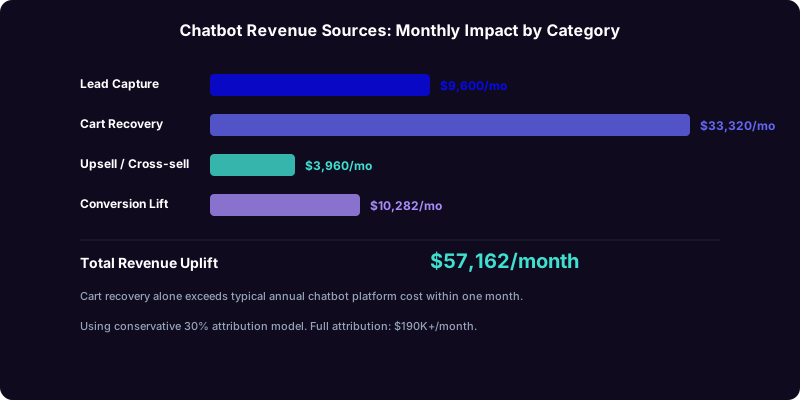
- Monthly lead revenue: 24 x $4,800 / 12 = $9,600/month attributed
Component B: Cart Recovery Revenue
The average cart abandonment rate is 70.19% (Baymard Institute). Chatbot intervention at the moment of abandonment recovers 10-25% of abandoned carts, compared to 3-5% for email recovery alone:
Cart recovery formula:
Monthly Recovery Revenue = Abandoned Carts x Chatbot Recovery Rate x Average Cart Value
Worked example (mid-size e-commerce):
- Monthly orders: 1,200
- Abandonment rate: 70% = ~2,800 abandoned carts
- Chatbot recovery rate: 14%
- Recovered: 392 orders
- Average cart value: $85
- Monthly recovery: $33,320
Component C: Upsell and Cross-Sell Revenue
Chatbots deliver contextual product recommendations during purchase conversations:
- Average order value increase from chatbot recommendations: 10-25%
- Upsell acceptance rate: 8-15% of chatbot-assisted purchases
- Typical monthly upsell revenue (mid-size e-commerce): $2,000-$12,000
Component D: Conversion Rate Improvement
Beyond capturing leads that would not have been captured, chatbots improve the conversion rate of visitors who would have converted anyway by answering buying questions in real time, overcoming objections conversationally, and building confidence through instant engagement. The incremental conversion rate improvement is typically 15-40% over the baseline, which translates to measurable revenue even after accounting for leads the chatbot captured from scratch.
Revenue Attribution: Conservative vs Optimistic Models
Revenue attribution is where ROI calculations become contentious. Should the chatbot get full credit for every lead it captures? What about visitors who would have filled out a form without the chatbot? We recommend three attribution models:
| Model | Attribution % | Best For |
|---|---|---|
| Conservative | 25-35% | CFO presentations, board reporting, initial business case |
| Moderate | 50% | Internal team reporting, quarterly reviews |
| Full attribution | 100% | Chatbot optimization decisions, vendor comparison |
For your initial business case, use the conservative model. It is harder to argue with a projected ROI that credits only 30% of chatbot-captured revenue. If the ROI is positive under conservative attribution, the investment is clearly justified. Over time, as you gather A/B test data comparing pages with and without chatbot, you can refine attribution accuracy. For a step-by-step guide on building the business case with your specific numbers, see our chatbot cost savings case studies with real company data.
Pillar 3: Customer Experience Value -- Monetizing Satisfaction, Speed, and Availability
Customer experience improvements from chatbot deployment are real and measurable, but most businesses fail to monetize them in their ROI calculations. This section provides the frameworks and formulas to convert CX improvements into dollar values that belong in your ROI model.
The CX Value Formula
Component A: Churn Reduction Value
Faster resolution and 24/7 availability reduce customer churn. According to Chatarmin's benchmarks, companies deploying customer service chatbots see a 10-25% reduction in support-related churn. The formula:
Monthly Churn Reduction Value = (Churned Customers x Churn Reduction %) x Average Monthly Revenue Per Customer x Average Remaining Lifetime (months)
Worked example (SaaS company):
- Monthly churned customers: 80
- Support-related churn (estimated 30% of total): 24
- Chatbot churn reduction: 20%
- Customers saved: 24 x 20% = 4.8
- Average monthly revenue per customer: $200
- Average remaining lifetime: 18 months
- Monthly churn reduction value: 4.8 x $200 x 18 = $17,280/month
Component B: CSAT-Driven Revenue Impact
Chatbots typically improve customer satisfaction scores (CSAT) by 15-30% for interactions they handle, primarily because of instant response (no wait time), consistent quality (no bad-day agents), and 24/7 availability. Satisfied customers spend more, refer more, and churn less:
| CSAT Impact Area | Benchmark Improvement | Revenue Impact |
|---|---|---|
| Repeat purchase rate | 12-18% increase | 8-15% revenue increase from existing customers |
| Average order value | 5-12% increase | Direct AOV improvement |
| Referral rate | 10-20% increase | Lower customer acquisition cost |
| Willingness to pay premium | 8-14% increase | Pricing power improvement |
Component C: Speed Premium
Response speed has a measurable impact on conversion and satisfaction. A chatbot responds in under 5 seconds compared to average wait times of 2-10 minutes for live chat and 4-24 hours for email. The speed premium manifests in:
- Higher conversion rates: Visitors who receive instant answers are 3-5x more likely to convert than those who wait
- Reduced abandonment: 53% of visitors leave a website if they do not get a response within 10 seconds (according to HubSpot research)
- Competitive displacement: When a customer contacts you and a competitor simultaneously, the first to respond wins 78% of the time
Component D: 24/7 Availability Value
35-50% of customer interactions occur outside business hours. Without a chatbot, after-hours visitors either leave (lost revenue), fill out a form (delayed response), or call (voicemail). A chatbot provides full service around the clock:
After-hours value formula:
After-Hours Value = (Total Monthly Interactions x After-Hours %) x Average Interaction Value x Chatbot Capture Rate
Where "Average Interaction Value" is the revenue or savings associated with handling the interaction (support ticket avoided, lead captured, or purchase completed).
Aggregated CX Value: Worked Example
| CX Component | Monthly Value | Annual Value |
|---|---|---|
| Churn reduction | $17,280 | $207,360 |
| CSAT-driven revenue (repeat + AOV) | $8,400 | $100,800 |
| Speed premium (competitive wins) | $4,200 | $50,400 |
| 24/7 availability value | $11,500 | $138,000 |
| Total CX Value | $41,380 | $496,560 |
CX value alone -- before counting cost savings or direct revenue -- often exceeds the total cost of ownership by 50-100x. This is why businesses that measure all five pillars make more aggressive (and justified) chatbot investments than those measuring only cost savings. Track these CX metrics through the analytics dashboard and review them alongside your core chatbot metrics to build a comprehensive performance picture.
Pillar 4: Operational Efficiency -- Agent Productivity, Training Savings, and Process Intelligence
Operational efficiency gains are the compound interest of chatbot ROI. They start small but grow significantly over time as the chatbot handles an increasing share of routine work and provides data that drives process improvements across the organization.
Agent Productivity Gains
When a chatbot deflects 50-70% of routine conversations, your human agents spend more time on complex, high-value interactions. This shift creates measurable productivity improvements:
- Average handle time (AHT) reduction: Agents handling only complex cases develop deeper expertise and resolve issues faster. Typical AHT reduction: 15-25% for remaining human-handled conversations.
- First-contact resolution (FCR) improvement: With the chatbot handling pre-qualification and context gathering before escalation, agents receive warm handoffs with full context. FCR typically improves by 20-35%.
- Agent utilization improvement: Without chatbot, agents alternate between routine (2-minute) and complex (20-minute) tasks, creating inefficient context switching. With chatbot handling routine tasks, agents work on complex cases continuously, improving throughput by 15-30%.
Agent Productivity Value Formula
Worked example:
- Agents: 8
- Hours saved per agent per month: 25
- Fully loaded hourly cost: $32
- Productivity value: 8 x 25 x $32 = $6,400/month
- Avoided hiring (2 agents not needed): 2 x $5,500/month = $11,000/month
- Total: $17,400/month
Training Cost Reduction
Agent training is expensive. According to industry data, the average cost to fully train a new support agent is $4,000-$12,000, and annual turnover in contact centers averages 30-45%. Chatbots reduce training costs in two ways:
- Fewer agents to train: If the chatbot handles 50% of volume, you need fewer agents, which means fewer new hires to train each year
- Faster agent ramp-up: New agents can focus on learning complex scenarios while the chatbot handles simple ones, reducing the time to full productivity from 8-12 weeks to 4-6 weeks
Training savings formula:
Annual Training Savings = (Agents Not Hired x Training Cost Per Agent) + (Existing Agents x Ramp-Up Time Reduction Value)
Process Intelligence: The Hidden Efficiency Multiplier
Every chatbot conversation generates structured data about what customers ask, what they struggle with, and where processes break down. This data powers improvements far beyond the chatbot itself:
- Product improvement signals: If 200 customers ask the chatbot about a feature that does not exist, that is a product roadmap signal worth thousands in user research
- Documentation gap identification: Topics where the chatbot deflection rate is low indicate documentation or knowledge base gaps that affect all support channels
- Process bottleneck detection: If 30% of escalated conversations involve a specific process failure (billing error, shipping delay), the data justifies process investment to fix the root cause
- Customer sentiment trends: Aggregated conversation sentiment data provides early warning of product issues, competitive threats, or market shifts
While process intelligence is difficult to assign a specific dollar value, companies that systematically mine chatbot conversation data for process improvements report 15-25% additional efficiency gains across customer-facing operations within 12 months of deployment.
For a deeper look at the metrics and analytics that drive operational improvement, see our comprehensive chatbot analytics guide covering the 10 metrics that prove ROI.
Total Cost of Ownership: Every Cost Category You Must Include
An honest ROI calculation requires an honest cost accounting. Vendors love to quote low subscription prices while glossing over implementation labor, maintenance costs, per-conversation fees, and opportunity costs. Here is a comprehensive TCO framework that captures every cost category, ensuring your ROI projections are defensible and realistic.
TCO Categories
| Cost Category | No-Code Platform | Agency Build | Custom Development |
|---|---|---|---|
| Implementation | |||
| Platform/license setup | $0-$200 | $0-$200 | $0 |
| Conversation design | $0 (DIY, 8-15 hrs) | $2,000-$8,000 | $3,000-$15,000 |
| Knowledge base creation | $0 (DIY, 4-10 hrs) | $1,000-$4,000 | $2,000-$10,000 |
| Integration setup | $0 (native, 1-3 hrs) | $500-$3,000 | $5,000-$25,000 |
| Development/coding | $0 | $0-$3,000 | $30,000-$200,000 |
| Testing and QA | $0 (DIY, 2-4 hrs) | $500-$2,000 | $5,000-$15,000 |
| Implementation subtotal | $0-$200 + 15-32 hrs | $4,000-$20,200 | $45,000-$265,000 |
| Monthly Ongoing | |||
| Platform subscription | $49-$299/mo | $49-$299/mo | $0 |
| Cloud hosting | Included | Included | $200-$3,000/mo |
| LLM API costs | Included or $0.01-0.05/conv | Included | $500-$8,000/mo |
| Maintenance and optimization | 2-4 hrs/mo internal | $500-$4,000/mo | $3,000-$12,000/mo |
| Content updates | 1-2 hrs/mo internal | Included in retainer | $500-$3,000/mo |
| Monthly ongoing subtotal | $149-$499 + 3-6 hrs | $749-$4,599 | $4,200-$26,000 |
Hidden Costs to Watch For
Several cost items frequently surprise businesses after deployment:
- Per-conversation fees: Some platforms charge $0.50-$3.00 per AI-resolved conversation on top of the subscription. At 3,000 conversations/month, that adds $1,500-$9,000/month -- potentially more than the subscription itself. Conferbot pricing includes AI conversations in paid plans with no per-conversation surcharge.
- WhatsApp API fees: Meta charges $0.02-$0.08 per WhatsApp Business conversation, independent of your chatbot platform. Budget $200-$800/month for active WhatsApp deployments.
- Overage charges: Understand your plan's limits for conversations, contacts, and knowledge base size. Some platforms impose steep overages (2-5x per-unit pricing) when you exceed limits.
- Migration costs: If you switch platforms, you lose conversation flows, training data, and integrations. Estimate $2,000-$15,000 in migration labor if you ever need to move.
- Opportunity cost during implementation: Custom builds take 3-6 months. Each month without a chatbot is a month of unrealized savings. At $25,000/month in potential savings, a 4-month build delay costs $100,000 in opportunity cost.
Three-Year TCO Comparison
| Cost Period | No-Code (Conferbot) | Agency Build | Custom Development |
|---|---|---|---|
| Year 1 total | $2,988 | $26,200 | $115,000 |
| Year 2 total | $1,788 | $14,400 | $78,000 |
| Year 3 total | $1,788 | $14,400 | $78,000 |
| 3-year TCO | $6,564 | $55,000 | $271,000 |
The 3-year TCO difference between no-code and custom development is $264,436. For most businesses, no-code platforms deliver equivalent or superior outcomes at a fraction of the cost. Custom development is justified only when unique requirements (deep proprietary system integration, extreme conversation volumes above 100,000/month, or regulatory constraints requiring on-premise deployment) make it necessary.
Putting It All Together: Complete ROI Calculation With Real Numbers
Now let us combine all five pillars into a complete, worked ROI calculation for a realistic business scenario. We will model a mid-size e-commerce company with 12 employees, 4 support agents, and 5,000 monthly customer interactions.
Business Profile
| Parameter | Value |
|---|---|
| Monthly customer interactions | 5,000 |
| Support team size | 4 agents |
| Fully loaded cost per agent | $5,800/month |
| Cost per human interaction | $11.60 |
| Monthly website visitors | 50,000 |
| Monthly orders | 1,500 |
| Average order value | $92 |
| Monthly revenue | $138,000 |
| Cart abandonment rate | 68% |
| Monthly customer churn rate | 5.5% |
Pillar-by-Pillar Calculation
| ROI Pillar | Calculation | Monthly Value |
|---|---|---|
| 1. Direct Cost Savings | 5,000 x 58% deflection x ($11.60 - $0.75) | $31,450 |
| 2. Revenue Uplift | ||
| -- Lead capture | 50,000 x 4% engage x 28% capture x 6% convert x $92 AOV x 3 LTV multiplier | $9,274 |
| -- Cart recovery | 3,409 abandoned x 14% recovery x $92 | $43,928 |
| -- Upsell | 1,500 orders x 11% accept x $24 upsell | $3,960 |
| 3. CX Value | ||
| -- Churn reduction | 275 churned x 30% support-related x 18% chatbot reduction x $92 x 8 months | $10,929 |
| -- CSAT revenue lift | 1.5% revenue increase from satisfaction x $138,000 | $2,070 |
| 4. Operational Efficiency | ||
| -- Agent productivity | 4 agents x 22 hrs saved x $29/hr | $2,552 |
| -- Avoided hiring | 1 agent not hired x $5,800 | $5,800 |
| 5. Strategic Value | Conservative: 5% of total operational value | $5,498 |
Total ROI Calculation
| Summary | Monthly | Annual |
|---|---|---|
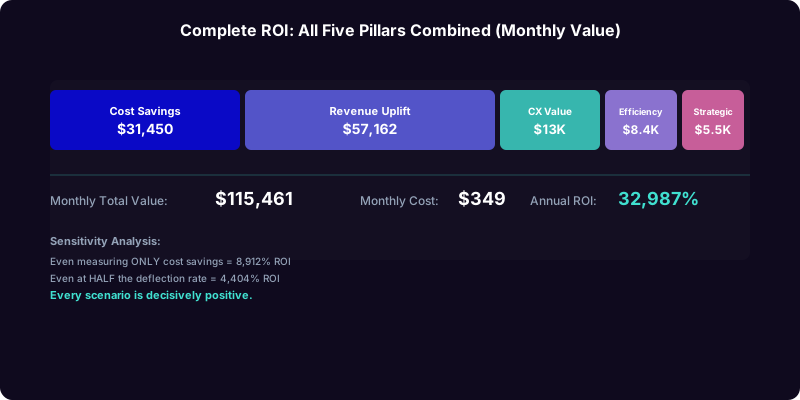
| Total value generated (all 5 pillars) | $115,461 | $1,385,532 |
| Total cost (Conferbot professional plan + 4 hrs maintenance) | $349 | $4,188 |
| Net value | $115,112 | $1,381,344 |
| ROI | 32,987% | |
| Break-even point | Under 3 days |
These numbers may seem extreme, but they are consistent with real-world chatbot deployments at this scale. The key insight is that the cost denominator (platform subscription) is tiny relative to the value generated across five pillars. Even applying the most conservative attribution model (25% credit to chatbot for revenue-related pillars) yields an annual ROI exceeding 8,000%.
Sensitivity Analysis: What If Your Numbers Are Worse?
To stress-test the ROI projection, here is what happens if every variable performs at the bottom of its benchmark range:
| Scenario | Monthly Value | Annual ROI |
|---|---|---|
| All variables at benchmark midpoint (above) | $115,461 | 32,987% |
| All variables at 25th percentile | $48,200 | 13,713% |
| Only cost savings + lead capture (no CX, no efficiency) | $40,724 | 11,566% |
| Only cost savings (single pillar) | $31,450 | 8,912% |
| Half the deflection rate (29%) | $15,725 (cost savings only) | 4,404% |
Even in the absolute worst-case scenario -- measuring only cost savings with half the expected deflection rate -- the annual ROI exceeds 4,000%. This extreme robustness is why chatbot investments are among the most defensible technology purchases any business can make.
Industry Benchmarks: ROI Ranges, Deflection Targets, and Timeline Expectations
ROI varies significantly by industry because conversation volumes, cost per interaction, customer lifetime values, and automation complexity differ across sectors. Use these benchmarks to calibrate your projections to your specific business context.
Comprehensive Industry Benchmark Table
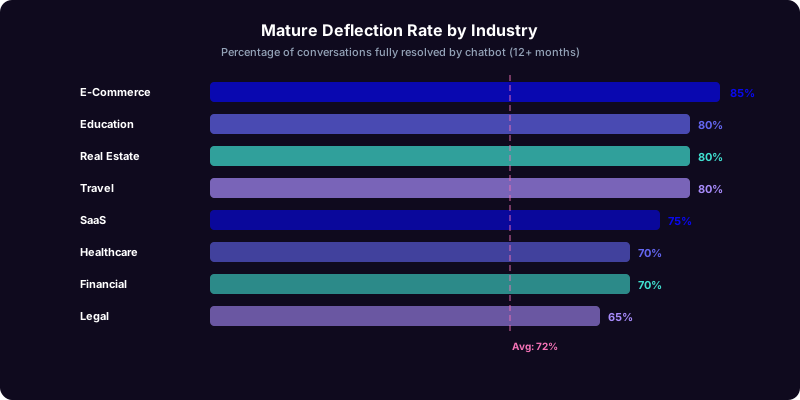
| Industry | Avg Deflection Rate (Mature) | Avg Cost Per Human Interaction | Typical Year 1 ROI (All Pillars) | Break-Even Timeline | Top ROI Driver |
|---|---|---|---|---|---|
| E-Commerce | 70-85% | $8-$15 | 2,000-15,000% | Under 1 week | Cart recovery + upsell revenue |
| SaaS / Software | 60-75% | $15-$22 | 1,500-12,000% | 1-2 weeks | Lead capture + churn reduction |
| Healthcare | 55-70% | $18-$28 | 800-5,000% | 2-4 weeks | Cost savings + no-show reduction |
| Financial Services | 55-70% | $18-$30 | 1,000-8,000% | 1-3 weeks | Cost savings + compliance efficiency |
| Real Estate | 65-80% | $12-$20 | 1,500-10,000% | Under 2 weeks | Lead capture (high per-lead value) |
| Legal Services | 50-65% | $20-$35 | 2,000-20,000% | Under 1 week | Lead capture + intake cost savings |
| Education | 65-80% | $10-$18 | 800-4,000% | 2-4 weeks | Cost savings + enrollment conversion |
| Travel / Hospitality | 65-80% | $10-$18 | 1,000-6,000% | 1-2 weeks | Booking conversion + upsell |
| Professional Services | 55-70% | $15-$25 | 1,200-8,000% | Under 2 weeks | Lead capture + consultation booking |
Deflection Rate Progression Benchmarks
Deflection rate is not static -- it improves significantly over time as you optimize flows, expand knowledge bases, and add integrations. Here is the typical progression curve:
- Week 1-4 (Launch): 25-40% deflection. The chatbot handles common FAQs and basic routing. Most improvement comes from adding answers to questions the chatbot encounters but cannot resolve.
- Month 2-3 (Early optimization): 40-55% deflection. Knowledge base expanded based on real conversation data. Handoff patterns refined. Additional flows added for frequently requested actions (order lookup, appointment booking).
- Month 4-6 (Integration maturity): 55-65% deflection. Backend integrations live (CRM, order system, calendar). Chatbot can now perform actions, not just answer questions. Significant jump in deflection as transactional queries are automated.
- Month 7-12 (Optimization plateau): 60-75% deflection. Incremental improvements from flow refinement, edge case handling, and multilingual expansion. Rate of improvement slows but continues.
- Year 2+ (Mature): 65-85% deflection. The chatbot is a fully integrated part of operations. Improvements come from AI model upgrades, new channel deployment, and expanding to new use cases (proactive engagement, upselling).
Timeline to Full ROI Realization
While break-even happens quickly (usually within weeks for no-code deployments), full ROI realization follows a predictable curve:
- Month 1: 40-60% of steady-state ROI realized (immediate cost savings, basic lead capture)
- Month 3: 65-80% of steady-state ROI realized (integrations live, deflection rate climbing)
- Month 6: 85-95% of steady-state ROI realized (optimization maturing, all channels deployed)
- Month 12: 100%+ of initial projection (compounding effects, expanded use cases typically exceed original projections by 15-30%)
The firms that realize ROI fastest are those that follow a structured deployment approach. For industry-specific implementation guidance, see our law firm chatbot guide (legal), e-commerce chatbot guide (retail), or healthcare chatbot guide (medical).
The ROI Measurement Process: A Repeatable Monthly Framework
Having the formulas is necessary but not sufficient. You need a repeatable measurement process that tracks ROI monthly, identifies optimization opportunities, and communicates value to stakeholders. Here is the framework.
Step 1: Establish Your Baseline (Before Chatbot or Month 1)
Before deployment (or as early as possible after), document your baseline metrics:
- Monthly support conversation volume by channel
- Cost per interaction by channel (fully loaded)
- Average response time and resolution time
- CSAT/NPS scores for support interactions
- Monthly lead capture rate from website (form submissions / visitors)
- Cart abandonment rate and recovery rate (e-commerce)
- Customer churn rate and churn reasons
- Support team size and monthly hiring/turnover
These baselines become the denominator against which all improvements are measured. Without them, you are guessing.
Step 2: Monthly Data Collection
On the first business day of each month, collect these metrics from the Conferbot analytics dashboard and your connected systems:
| Pillar | Metrics to Collect | Source |
|---|---|---|
| Cost Savings | Conversations deflected, deflection rate, cost per chatbot interaction | Chatbot analytics + finance |
| Revenue Uplift | Leads captured, carts recovered, upsell conversions, chatbot-attributed revenue | Chatbot analytics + CRM + e-commerce platform |
| CX Value | CSAT scores (chatbot vs human), churn rate, after-hours interactions handled | CSAT survey tool + CRM + chatbot analytics |
| Efficiency | Agent AHT, FCR rate, agents hired/avoided, training hours | Helpdesk analytics + HR |
| Costs | Platform fees, API costs, maintenance hours, optimization labor | Finance + time tracking |
Step 3: Calculate and Report
Apply the formulas from Sections 3-7 to your collected data. Present results in a monthly ROI report structured as follows:
- Executive summary: Total ROI this month, cumulative ROI since deployment, month-over-month trend
- Pillar breakdown: Value generated by each of the five pillars, with comparison to previous month
- Key metric highlights: Deflection rate, cost per interaction, leads captured, conversations handled
- Optimization actions taken: What was changed and what impact it had
- Next month priorities: Planned improvements and projected impact
Step 4: Optimization Cycle
Use your monthly data to drive continuous improvement:
- Low deflection topics: Identify query categories with below-average deflection rates. Add knowledge base content, improve answer quality, or add integrations to handle these topics.
- High drop-off points: Find conversation points where users disengage. Rephrase questions, reduce friction, or add explanatory context.
- Revenue optimization: A/B test different proactive greetings, lead qualification questions, and upsell offers to improve conversion rates.
- Cost monitoring: Track per-conversation costs and identify if API usage or conversation volume requires plan adjustments.
Quarterly Deep Dives
Every quarter, conduct a deeper analysis that includes:
- Deflection rate trend analysis with projection to next quarter
- Chatbot-attributed revenue with refined attribution modeling
- Competitive impact assessment (are you winning more first-contact customers?)
- Technology review (are new AI capabilities available that could improve performance?)
- ROI projection update for the remainder of the year and next year
This measurement discipline transforms the chatbot from a "nice to have" into a core business system with clear, defensible financial impact. The data also supports expansion decisions: when ROI is demonstrably strong, securing budget for additional channels (WhatsApp, SMS), new use cases (employee FAQ bot, onboarding bot), or platform upgrades becomes straightforward because you have the numbers to prove the investment thesis. For a broader view of the analytics that power this measurement process, explore our complete guide to chatbot analytics metrics that matter.
Building the Business Case: Presenting ROI to Leadership
Having a robust ROI model is only half the battle. You need to present it in a way that resonates with different stakeholders -- each of whom cares about different aspects of the investment. Here is how to build a business case that gets approved.
The One-Page Executive Summary
Start with a single page that answers the four questions every executive asks about any technology investment:
- How much does it cost? Total first-year cost including implementation and ongoing fees. For no-code platforms like Conferbot, this is typically $2,000-$5,000 depending on plan.
- How much will it save/earn? Total first-year value across all five pillars. Use the conservative attribution model for credibility.
- When will we see results? Break-even timeline (typically under 2 weeks for no-code) and timeline to full ROI realization (typically 3-6 months).
- What is the risk? Implementation risk (near zero for no-code -- you can be live in a day and turn it off if it does not work), reputation risk (managed through proper conversation design and escalation protocols), and competitive risk of NOT deploying (competitors who already have chatbots are capturing leads 24/7 while you are closed).
Tailoring the Message by Stakeholder
| Stakeholder | Primary Concern | Key Metrics to Emphasize | Objection to Address |
|---|---|---|---|
| CEO/Owner | Revenue growth, competitive position | Revenue uplift, market share, after-hours capture | "Our customers prefer talking to humans" |
| CFO/Finance | Cost reduction, payback period | Cost savings, TCO, break-even, avoided hiring | "What are the hidden costs?" |
| VP of Customer Success | Customer satisfaction, retention | CSAT improvement, churn reduction, 24/7 availability | "Will it frustrate customers?" |
| VP of Sales | Lead volume and quality | Leads captured, qualification accuracy, response speed | "Will leads be as qualified?" |
| IT/Engineering | Integration complexity, security | Implementation timeline, security certs, API architecture | "How much engineering time?" |
Addressing the Top 5 Objections
1. "Our customers prefer talking to humans."
Data shows 62% of customers prefer using a chatbot for quick answers over waiting for a human (Tidio). The chatbot handles routine queries instantly while freeing humans for complex, relationship-building conversations. It is not human OR chatbot -- it is chatbot for routine AND human for complex.
2. "What if the chatbot gives wrong answers?"
Modern AI chatbots use retrieval-augmented generation (RAG) grounded in your knowledge base, not hallucinated answers. Confidence thresholds ensure the chatbot escalates to humans when it is not confident in an answer. The error rate for a well-configured chatbot (1-3%) is comparable to or lower than the human error rate for routine queries.
3. "We tried a chatbot before and it did not work."
Rule-based chatbots from 2018-2022 were frustrating because they could only handle exact keyword matches. Modern AI chatbots understand natural language, learn from conversations, and improve over time. The technology has fundamentally changed, and comparing today's AI chatbots to yesterday's decision trees is like comparing a smartphone to a landline.
4. "Our support volume is too low to justify the investment."
At just 100 conversations per month and $12 per human interaction, a chatbot deflecting 50% saves $600/month. At a platform cost of $49-$149/month, even low-volume businesses achieve positive ROI. The question is not whether the ROI is positive -- it is how quickly you achieve it.
5. "We do not have the technical resources to implement it."
No-code platforms require zero technical resources. The Conferbot AI chatbot builder lets non-technical users build, train, and deploy a chatbot in under an hour. The chatbot embeds on your website with a single script tag -- no developer sprint required.
The Competitive Urgency Argument
Perhaps the most powerful element of the business case is competitive urgency. According to Juniper Research, chatbot adoption in customer service is growing at 23% annually. Every month you operate without a chatbot while competitors have one, you are losing after-hours leads, paying more per support interaction, and delivering slower response times. The ROI of a chatbot is not just what you gain -- it is also what you stop losing.
Was this article helpful?
How to Measure Chatbot ROI FAQ
Everything you need to know about chatbots for how to measure chatbot roi.
About the Author

Conferbot Team specializes in conversational AI, chatbot strategy, and customer engagement automation. With deep expertise in building AI-powered chatbots, they help businesses deliver exceptional customer experiences across every channel.
View all articles