Why HOAs and Community Associations Need Chatbots in 2026
The homeowners association industry in the United States is enormous and largely invisible to the broader technology market. More than 370,000 community associations — including HOAs, condominium associations, and housing cooperatives — govern housing for 74.2 million Americans, approximately 30% of the US housing stock. These associations collectively manage $106 billion in annual assessments and oversee everything from landscaping and pool maintenance to architectural review and dispute resolution.
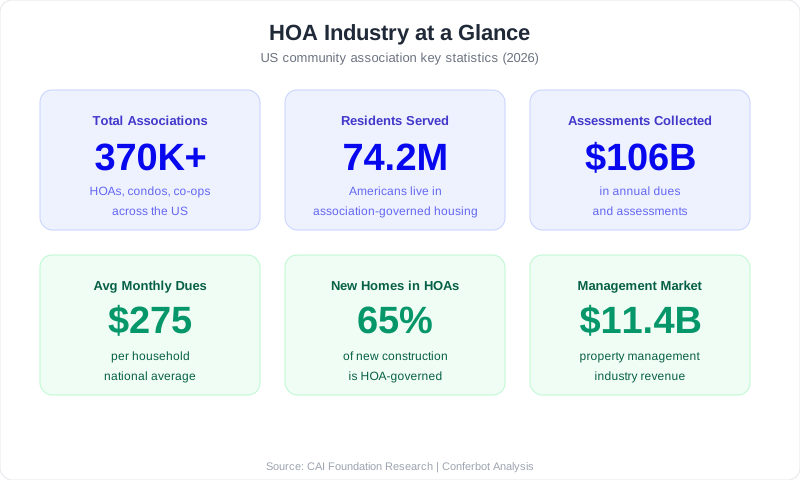
Yet the communication infrastructure at most HOAs has not evolved past email and phone calls. A resident with a question about their dues balance calls the management office, waits on hold, and hopes someone is available. A homeowner wondering whether they can paint their front door calls and waits 2-3 business days for a CC&R interpretation. A resident reporting a broken sprinkler head emails the property manager and has no visibility into whether the request was received, assigned, or scheduled for repair. The result is a pervasive dissatisfaction problem: according to the Community Associations Institute, resident satisfaction with HOA management averages just 54% nationally — a score that reflects the friction, opacity, and unresponsiveness of manual communication workflows.
A chatbot transforms this dynamic. It provides instant answers to the 78% of inquiries that are routine and repeatable. It processes maintenance requests with automatic acknowledgment and status tracking. It provides dues balance information and payment links without requiring a phone call. It delivers CC&R answers based on the association's governing documents. And it operates 24/7 — which matters enormously when the resident noticing a security gate malfunction at 11 PM has no way to reach management until the next business day.
This guide covers the complete chatbot implementation for HOAs and community associations: resident self-service, maintenance request management, dues collection, CC&R compliance, amenity booking, board communication, and a satisfaction improvement framework. Whether you are a volunteer board member managing a 50-unit condo or a professional management company overseeing 200 communities, this guide provides the operational playbook.
The timing for chatbot adoption in HOA management is particularly compelling. The industry is experiencing a dual pressure: resident expectations are rising (driven by the instant-response experiences they have with Amazon, Uber, and banking apps), while management resources are increasingly constrained. The Community Associations Institute reports that the average community manager oversees 8-12 associations simultaneously, making it physically impossible to provide the responsiveness that residents expect. A chatbot bridges this gap by providing instant, 24/7 self-service for routine matters while preserving human management attention for complex governance issues.
The demographic shift adds urgency. As Millennials and Gen Z become the majority of new homeowners — and these generations already represent the fastest-growing segment of HOA residents — their tolerance for phone-and-email-only communication approaches zero. These residents expect to check their dues balance at midnight, submit a maintenance request from their phone, and receive instant confirmation. An HOA that communicates only through monthly newsletters and office-hours phone calls will face rising dissatisfaction scores, contentious board meetings, and ultimately management turnover that disrupts community stability.
Automating the 78% of Inquiries That Are Routine
The single most impactful deployment of a chatbot in HOA management is automating routine inquiries, addressing the communication challenges documented by the Community Associations Institute (CAI). Analysis of inquiry data across hundreds of community associations reveals a consistent pattern: the vast majority of resident contacts are repetitive questions with known answers.
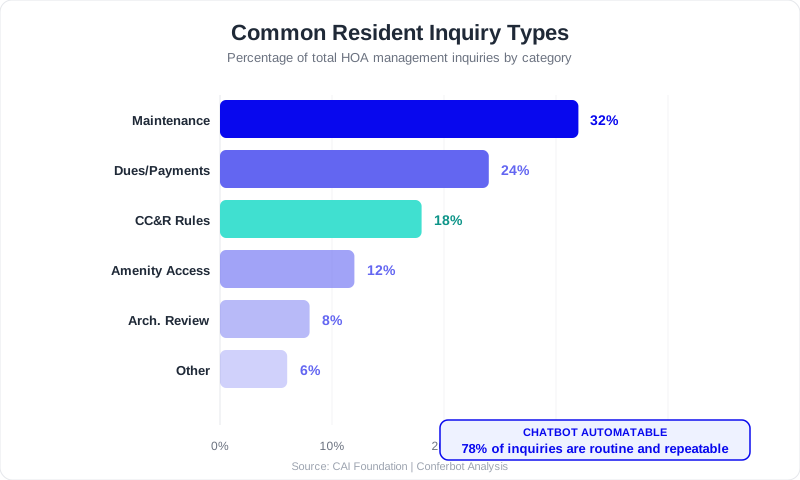
Inquiry Category 1: Maintenance Requests (32%)
Maintenance requests are the highest-volume inquiry category and the most impactful to automate. Common requests include: broken sprinkler heads, damaged common-area fencing, lighting outages in parking lots, pool equipment issues, elevator malfunctions, roof leaks in common areas, and landscaping concerns. The chatbot captures the request with structured information — location, description, severity, and optional photo upload — acknowledges receipt immediately, assigns a tracking number, and routes the request to the appropriate maintenance team or vendor. The resident can check status at any time by asking the chatbot for an update on their tracking number.
Inquiry Category 2: Dues and Payments (24%)
Dues-related inquiries include balance checks, payment due dates, late fee questions, payment plan requests, and special assessment information. The chatbot connects to the association's accounting system and provides real-time balance information: "Your current balance is $275.00. Your next payment of $275.00 is due on June 1, 2026. Would you like to make a payment now?" The chatbot provides a direct payment link, eliminating the friction that contributes to late payments and delinquency.
Inquiry Category 3: CC&R Rules (18%)
CC&R (Covenants, Conditions, and Restrictions) questions are among the most time-consuming for management staff because they require referencing specific sections of governing documents. Common questions: "Can I install a satellite dish?", "What colors can I paint my house?", "Are short-term rentals allowed?", "Can I have a commercial vehicle in the driveway?", "What are the pet weight limits?" The chatbot is trained on the association's specific CC&R documents and provides accurate, section-referenced answers: "Per Section 7.4 of the CC&Rs, exterior paint colors must be selected from the approved palette. The current approved palette includes [list]. You can view the full palette on the community website [link]."
Inquiry Category 4: Amenity Access (12%)
Pool hours, gym access codes, clubhouse reservation procedures, tennis court booking, and guest access policies. These are straightforward informational queries that the chatbot handles instantly.
Inquiry Category 5: Architectural Review (8%)
Modification requests — new fencing, landscaping changes, exterior additions, solar panel installation — require architectural review board approval. The chatbot guides residents through the submission process: required documentation, timeline for review, board meeting schedule, and how to check application status. While the chatbot cannot approve modifications (that requires board review), it can ensure submissions are complete before they reach the board, reducing the back-and-forth that delays approvals.
The bottom line: 78% of all resident inquiries can be resolved instantly by the chatbot. The remaining 22% — complex disputes, legal questions, unique situations — are escalated to management with full context from the chatbot conversation, enabling faster human resolution. For associations seeking to build a comprehensive self-service portal, the HOA chatbot is the ideal starting point.
Violation Reporting and Compliance
A significant portion of HOA management time is spent on CC&R compliance — identifying violations, notifying homeowners, tracking resolution, and escalating unresolved issues. The chatbot assists on both sides of this process. Residents can report potential violations (parking violations, unkempt yards, unauthorized modifications) through the chatbot with photos and location details, creating a documented record. On the homeowner side, when a violation notice is issued, the chatbot provides the homeowner with specific CC&R references, resolution requirements, deadlines, and appeal procedures. This transparency reduces the hostility that often accompanies violation enforcement — the homeowner sees the specific rule, understands what needs to change, and knows their rights, rather than receiving a generic letter that feels arbitrary and heavy-handed.
Communities using chatbot-facilitated violation management report 30-40% faster violation resolution and 50% fewer appeals — primarily because homeowners understand the requirement clearly from the first notification rather than needing multiple rounds of correspondence to understand what is expected. The reduction in appeals alone saves significant board and management time, as each appeal hearing consumes hours of preparation and meeting time.
Response Time Transformation: From Days to Seconds
Response time is the metric that most directly correlates with resident satisfaction in community association management. When a resident reports a maintenance issue and receives acknowledgment within minutes, they feel heard. When the same report sits in an email inbox for 48 hours without acknowledgment, they feel ignored — and the next board meeting becomes a venue for accumulated frustration.
The Before State
In a typical HOA without chatbot automation, response times vary by category but are universally slow:
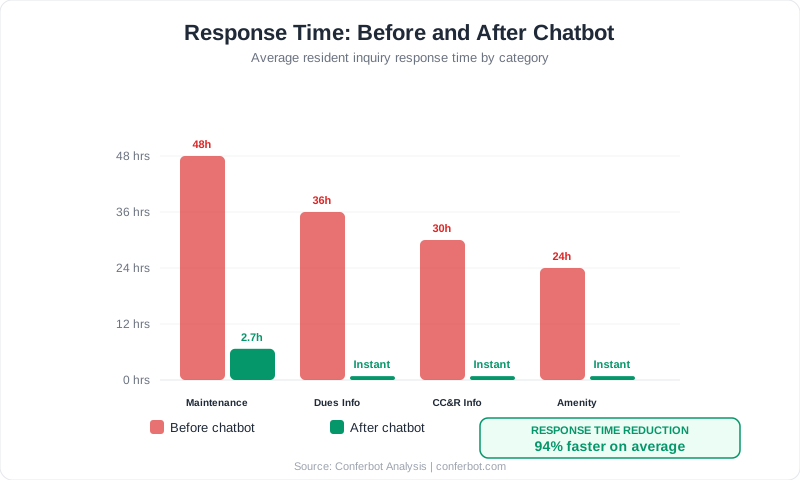
- Maintenance requests: 48 hours average from report to first acknowledgment. The resident emails, the property manager sees it the next day, forwards it to the maintenance vendor, and the vendor responds with a timeline 1-2 days later. During this entire period, the resident has zero visibility.
- Dues information: 36 hours if emailed, or immediate if the resident calls during office hours (but office hours are limited to 20-30 hours per week for most management offices).
- CC&R questions: 30 hours average, because the property manager must reference the governing documents, consult with the board if the interpretation is ambiguous, and draft a response.
- Amenity access: 24 hours for questions that should take seconds to answer — "What time does the pool open?" should not require a business-day response.
The After State
With chatbot automation, the response time picture transforms:
- Maintenance requests: 2.7 hours from report to first human acknowledgment. The chatbot provides instant automated acknowledgment with a tracking number. The maintenance routing happens in the background, and the vendor receives the request within minutes. The 2.7 hours represents the time until a human confirms the repair timeline — not the initial acknowledgment, which is instant.
- Dues information: Instant. The chatbot retrieves real-time balance data and provides it immediately.
- CC&R questions: Instant for documented rules. The chatbot references the governing documents and provides answers with section citations.
- Amenity access: Instant. Pool hours, gym codes, reservation procedures — all delivered within seconds.
The Satisfaction Impact
The response time improvement directly drives the satisfaction metrics described in this guide. Residents who receive instant acknowledgment of their maintenance request are 65% less likely to escalate the issue at a board meeting. Residents who can check their dues balance at 10 PM on a Sunday are 78% less likely to call the management office Monday morning. And residents who get CC&R answers immediately are 50% less likely to violate rules they did not understand — reducing the enforcement actions that create community conflict.
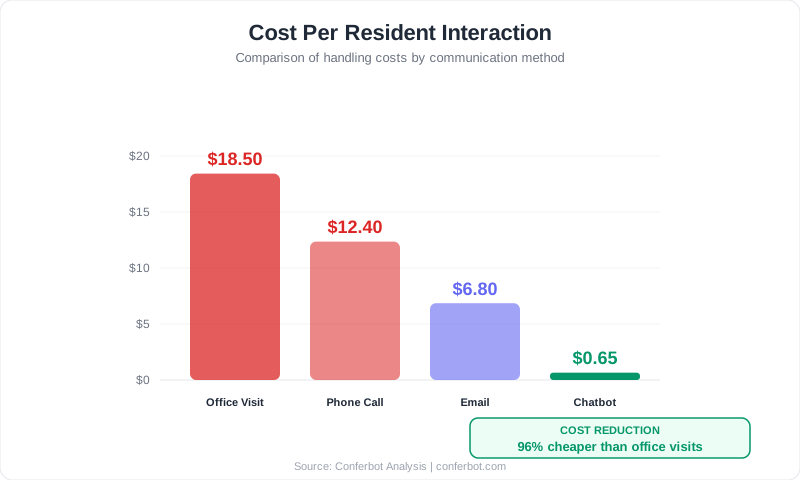
Cost Per Interaction: From $18.50 to $0.65
HOA management costs are ultimately borne by residents through their monthly assessments. Every dollar spent on administrative overhead is a dollar not spent on landscaping, pool maintenance, reserve funds, or community improvements. Reducing the cost per resident interaction frees budget for the services that residents actually value — and the cost reduction from chatbot automation is dramatic.
Cost Breakdown by Channel
The cost per interaction varies dramatically by channel:
- In-person office visit: $18.50. Staff time for greeting, locating information, discussing the issue, and follow-up documentation. Includes allocated office space, utilities, and equipment costs.
- Phone call: $12.40. Staff time for answering, locating information, discussing, and documenting. Includes phone system costs and the opportunity cost of the staff member being unavailable for other tasks during the call.
- Email: $6.80. Lower real-time cost but includes the time to read, research, draft a response, review for accuracy, and send. Complex emails can take 15-20 minutes per response.
- Chatbot: $0.65. Platform cost allocated across interactions. The chatbot handles each interaction in real-time with zero marginal staff cost. A chatbot handling 500 interactions per month at $325/month platform cost = $0.65 per interaction.
Annual Savings Model
For a 300-unit community generating approximately 200 management interactions per month:
- Current cost (blended across channels): approximately $9.50 per interaction x 200 = $1,900/month
- With chatbot handling 78% of interactions: (200 x 0.78 x $0.65) + (200 x 0.22 x $9.50) = $101.40 + $418 = $519.40/month
- Monthly savings: $1,380.60
- Annual savings: $16,567
For a professional management company overseeing 50 communities, the savings multiply to $828,350 per year — a figure that justifies significant investment in chatbot technology. Even for a single self-managed community, the $16,567 annual savings can fund tangible community improvements that residents see and value. According to IBISWorld, the property management industry's operating margins average 12-15%, meaning cost reductions of this magnitude materially impact profitability.
Dues Collection and Delinquency Reduction
Assessment collection is the financial lifeblood of every community association, with delinquency trends tracked by the CAI Foundation's research publications. Delinquent accounts create budget shortfalls that affect every resident — when 10% of homeowners are late on dues, the association may need to defer maintenance, reduce services, or levy special assessments on the remaining 90%. The chatbot significantly reduces delinquency by making payment effortless and removing the friction and stigma from collection interactions.
Proactive Payment Reminders
The chatbot sends automated payment reminders in a structured sequence:
- 7 days before due date: "Your HOA assessment of $275 is due on June 1. Would you like to make a payment now? [Pay Now link]" The payment link takes the resident directly to their balance and payment page — one tap to pay.
- Due date: "Today is the due date for your $275 assessment. Pay now to avoid late fees. [Pay Now]"
- 3 days past due: "Your assessment payment is now 3 days past due. A late fee of $25 will be applied on [date]. Pay now to avoid the fee. [Pay Now]"
- 15 days past due: "Your account has an overdue balance of $300 ($275 assessment + $25 late fee). Would you like to set up a payment plan? Our chatbot can help you arrange installments."
Payment Plan Self-Service
For residents experiencing financial hardship, the chatbot offers payment plan enrollment without requiring a phone call to management — which many residents find embarrassing. The chatbot presents available payment plan options (typically 2-3 monthly installments for overdue balances), collects agreement, and schedules automatic payments. This self-service approach increases payment plan enrollment by 40-60% compared to phone-only enrollment, because it removes the social friction of admitting financial difficulty to another person.
Delinquency Rate Impact
Communities deploying chatbot payment reminders and self-service payment plans see delinquency rates drop by 25-35%. For a 300-unit community with a $275 monthly assessment and a baseline 8% delinquency rate, reducing delinquency to 5% recovers approximately $9,900 in annual assessments that would otherwise require costly collection actions (demand letters, liens, legal fees). The chatbot replaces the adversarial collection process with a frictionless, non-judgmental payment experience.
Special Assessment Communication
Special assessments — one-time charges for major repairs, reserve fund replenishment, or unexpected expenses — are among the most contentious events in community association governance. Residents often learn about special assessments at a board meeting or through a formal letter, leaving them feeling blindsided by an expense they did not anticipate. The chatbot transforms special assessment communication by providing transparent, detailed information on demand:
- What is being assessed: "The board has approved a special assessment of $1,200 per unit for roof replacement on Buildings A and B."
- Why it is necessary: "The reserve study identified the roofs as requiring replacement within 12 months to prevent water damage to units below."
- Payment options: "You may pay the full $1,200 by July 1, or enroll in a 6-month payment plan of $200/month. Would you like to set up installments?"
- Timeline and progress: "Roof replacement is scheduled to begin August 15 and complete by October 1. The contractor is ABC Roofing, a licensed and insured commercial roofer."
By making this information available 24/7 through the chatbot — rather than requiring residents to wait for a board meeting or call the management office — special assessments become a transparent financial event rather than an adversarial surprise. Communities that use chatbot communication for special assessments report 40% faster collection rates and 60% fewer complaint calls to management compared to letter-only notification.
Autopay Enrollment Campaigns
The chatbot can proactively promote autopay enrollment to residents who pay manually, reducing the likelihood of missed payments and the administrative burden of processing individual checks. A targeted campaign — "Set up automatic payments and never worry about late fees. It takes 60 seconds. Would you like to enroll now?" — converts 15-25% of manual payers to autopay within the first campaign cycle. Each autopay conversion reduces the administrative cost of processing that unit's payments permanently, while virtually eliminating delinquency risk for that homeowner. Over time, increasing autopay penetration from the typical 30-40% to 60-70% creates a predictable, low-maintenance revenue stream that stabilizes the association's cash flow and reduces the management company's collection workload.
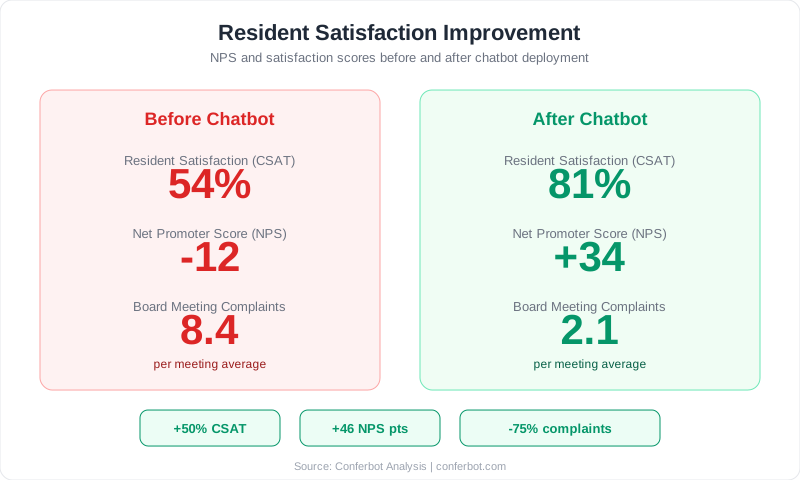
Resident Satisfaction: From 54% to 81% CSAT
Resident satisfaction is the ultimate measure of HOA management effectiveness, a metric that J.D. Power's property management satisfaction studies benchmark across the industry — and it is the metric that determines board elections, management contract renewals, and community harmony. The chatbot's impact on satisfaction is dramatic and measurable across multiple indicators.
What Drives the Satisfaction Improvement
The 27-point CSAT improvement is not driven by a single factor — it results from the cumulative effect of multiple friction reductions:
Instant acknowledgment: When a resident reports an issue and receives immediate confirmation (with tracking number), they feel heard. The psychological impact of acknowledgment is significant — research on service satisfaction consistently shows that the perception of being ignored drives more dissatisfaction than the speed of actual resolution.
Self-service availability: Residents can resolve 78% of their needs without calling, emailing, or visiting the management office. For working residents who cannot make calls during business hours, the chatbot provides 24/7 access to information and services.
Transparency: Maintenance request status tracking, real-time dues balance information, and clear CC&R answers replace the opacity that breeds suspicion and frustration. Residents who can see that their maintenance request is "scheduled for repair on June 5" are dramatically less likely to complain at the board meeting than residents who have no idea whether their request was even received.
Reduced confrontation: Payment reminders delivered by chatbot are perceived as informational, not confrontational. A chatbot saying "Your assessment is past due" feels different from a property manager calling to say the same thing. The chatbot depersonalizes the collection process, which preserves community relationships.
Board Meeting Impact
The most visible manifestation of improved satisfaction is the board meeting. Before chatbot deployment, the average board meeting includes 8.4 resident complaints — many of which are about issues that could have been resolved through routine communication. After deployment, complaints drop to 2.1 per meeting — and the remaining complaints are genuinely complex issues that benefit from board discussion. Board meetings shift from complaint sessions to productive governance discussions, improving the experience for both residents and board members.
Measuring Satisfaction
The chatbot can also serve as the satisfaction measurement tool. After each resolved interaction, it sends a brief CSAT question: "How satisfied were you with this interaction? (1-5 stars)" This continuous measurement provides real-time satisfaction data instead of the annual or biannual surveys that most associations rely on. Connecting this with NPS survey capabilities gives boards a complete picture of resident sentiment at all times.
Amenity Booking and Community Communication
Community amenities — pools, clubhouses, fitness centers, tennis courts, parks, and event spaces — represent a significant portion of the HOA experience and a frequent source of resident inquiries. The chatbot streamlines both amenity information delivery and reservation management.
Amenity Information On Demand
The chatbot provides instant answers to the most common amenity questions:
- Pool hours, seasonal schedules, and guest policies
- Fitness center access codes and equipment availability
- Clubhouse rental procedures, capacity limits, and fees
- Tennis/pickleball court reservation rules and booking
- Playground hours and age restrictions
- Parking rules and visitor parking procedures
Reservation and Booking
For reservable amenities (clubhouse, event spaces, courts), the chatbot handles the entire booking process: checking availability, confirming the reservation, collecting any required deposit or rental fee, and sending confirmation with facility rules and access instructions. Post-event, the chatbot sends a feedback request and damage deposit refund notification.
Community Announcements and Emergency Communication
The chatbot serves as a broadcast channel for community-wide communication:
- Scheduled maintenance: "The west parking lot will be resurfaced June 10-12. Please move vehicles by 7 AM on June 10."
- Emergency alerts: "Water main break on Oak Street. Water service temporarily suspended. Estimated restoration: 4 hours."
- Community events: "Annual summer BBQ is Saturday, July 15 at 4 PM. RSVP through the chatbot to help us plan."
- Rule reminders: "Reminder: Fireworks are prohibited on all community property per Section 12.3 of the CC&Rs."
Chatbot-delivered announcements achieve 65-80% open rates compared to 15-25% for email newsletters — a significant improvement in communication reach. For urgent communications (water outages, security issues), the immediacy of chatbot push notifications ensures that residents receive critical information in real time.
Vendor and Service Directory
Many associations maintain a list of approved or recommended service providers — plumbers, electricians, landscapers, handymen — that residents frequently request. The chatbot serves as a searchable vendor directory: "I need a plumber" returns the association's recommended plumbing contractors with contact information, availability, and any negotiated resident discounts. This service adds value for residents, strengthens vendor relationships (approved vendors receive referrals), and reduces the management time spent responding to individual vendor recommendation requests. Communities that deploy a chatbot vendor directory report 15-20 fewer vendor inquiry calls per month — time that the management team can redirect to higher-value activities.
New Resident Onboarding
When a new homeowner moves into the community, the chatbot delivers a structured welcome sequence: introduction to the community, CC&R summary, amenity overview, dues payment setup, maintenance request instructions, and key contacts. This automated onboarding replaces the paper welcome packet that most new residents skim and discard, ensuring that new homeowners understand their rights and obligations from day one.
For Property Management Companies: Scaling Across Communities
Professional property management companies, operating within the framework of NARPM (National Association of Residential Property Managers) standards, — firms like FirstService Residential, Associa, and RealManage, as well as thousands of regional operators — manage multiple community associations simultaneously. For these companies, the chatbot ROI is multiplied across their entire portfolio.
Multi-Community Deployment
The chatbot can be configured with community-specific knowledge bases while sharing the same platform infrastructure. Each community's chatbot knows its specific CC&Rs, amenity schedules, dues structure, board contacts, and vendor relationships. A resident in Community A receives answers specific to their governing documents, while a resident in Community B receives different answers appropriate to theirs.
Portfolio-Level Analytics
Management companies gain visibility across their entire portfolio: which communities generate the most inquiries, what topics drive the highest volume, which communities have satisfaction scores trending up or down, and where delinquency rates are improving or worsening. This data enables proactive management — if a community's inquiry volume spikes, it signals a developing issue before it reaches the board meeting.
Staff Efficiency at Scale
A community manager who oversees 8 communities (a typical portfolio for a regional manager) currently spends 60-70% of their time on routine communication — answering the same questions across different communities. The chatbot handles 78% of these interactions automatically, freeing the manager to focus on complex issues, vendor management, and board relationships — the high-value activities that drive contract retention and community satisfaction. A management company with 20 community managers redeploying 50% of their communication time to high-value activities effectively gains the equivalent of 7-10 additional staff members without adding headcount.
Client Acquisition and Differentiation
For property management companies competing for new community contracts, chatbot technology serves as a powerful differentiator. During the RFP process, a management company that can demonstrate 24/7 resident self-service, automated maintenance tracking, real-time satisfaction analytics, and digital dues collection capabilities presents a fundamentally different value proposition than a competitor offering traditional phone-and-email management. Board members evaluating management proposals are increasingly tech-savvy — many work in industries where digital self-service is the norm — and they respond positively to a management company that brings modern communication infrastructure to their community.
Management companies can also use chatbot analytics as retention tools. Monthly reports showing 78% inquiry resolution without human intervention, 81% resident satisfaction, and 30% delinquency reduction provide quantifiable evidence of value that makes contract renewal discussions straightforward. In an industry where management company turnover is a persistent challenge — driven primarily by perceived unresponsiveness and poor communication — the chatbot provides measurable proof of performance that protects contracts and justifies management fees.
Onboarding New Communities Efficiently
When a management company wins a new community contract, the chatbot accelerates the onboarding timeline. The company uploads the community's governing documents, configures the dues structure and amenity information, and deploys a customized chatbot within days rather than the weeks it takes to train staff on a new community's unique rules and procedures. The chatbot provides consistent, accurate service from day one of the contract — even before the community manager has memorized the CC&Rs — ensuring that the transition between management companies is seamless for residents. This rapid deployment capability also allows management companies to scale their portfolio more aggressively, taking on new communities without proportional increases in staffing that would erode margins.
Implementation Guide and Best Practices
Deploying an HOA chatbot involves community-specific configuration that goes beyond a generic business chatbot. Here is the implementation roadmap.
Week 1: Document Gathering and Configuration
Gather governing documents: CC&Rs, bylaws, architectural guidelines, rules and regulations, and the current budget. The chatbot's knowledge base is trained on these documents to provide accurate, section-referenced answers.
Configure community profile: Community name, property type (single-family HOA, condo, townhouse), number of units, amenity list, management contact information, board member names, and meeting schedule.
Set up dues structure: Monthly assessment amount, due dates, late fee policy, payment methods accepted, and payment plan options. Connect to the accounting system if API access is available.
Week 2: Flow Building and Integration
Build maintenance request flow: Configure the maintenance request intake: location categories (common areas by name/address), request types, severity levels, photo upload capability, and routing rules (which vendor handles which type of request).
Configure amenity information: Hours, rules, reservation procedures, and fees for each amenity. Set up booking flows for reservable spaces.
Integrate with management software: Connect to property management platforms (AppFolio, Buildium, CINC Systems) for real-time data access where API integrations are available.
Week 3: Testing and Launch
Board review: Present the chatbot to the board of directors for feedback. Board members should test the chatbot with questions they commonly receive from residents. Incorporate feedback before launch.
Resident announcement: Announce the chatbot to residents through email, community newsletter, and physical signage in common areas. Frame it as a service improvement: "Your HOA now offers 24/7 self-service for dues information, maintenance requests, CC&R questions, and amenity booking."
Soft launch with monitoring: Launch with active monitoring for the first 2 weeks. Review every conversation for accuracy, identify unhandled topics, and refine the knowledge base. Pay particular attention to CC&R answers — inaccurate CC&R interpretations can create legal liability.
Best Practices
- Keep CC&R answers factual: The chatbot should quote governing documents, not interpret them. For ambiguous situations, the chatbot should direct residents to the board or management for interpretation.
- Respect privacy: The chatbot should not disclose information about other residents' accounts, violations, or complaints. Each resident sees only their own data.
- Escalation paths: Every flow should include a clear path to reach a human — the chatbot supplements human management, it does not replace it for complex or sensitive issues.
- Multilingual support: For communities with diverse resident populations, deploy the chatbot in multiple languages. Conferbot supports multilingual chatbots that detect and respond in the resident's preferred language.
- Regular knowledge base updates: CC&Rs can be amended, amenity schedules change seasonally, and dues may be adjusted annually. Assign a staff member to update the chatbot knowledge base whenever governing documents or community policies change.
- Board reporting: Generate monthly chatbot reports for the board: total interactions, top inquiry categories, satisfaction scores, delinquency trends, and maintenance request volume. This data demonstrates the chatbot's value and informs governance decisions.
Was this article helpful?
About the Author

Conferbot Team specializes in conversational AI, chatbot strategy, and customer engagement automation. With deep expertise in building AI-powered chatbots, they help businesses deliver exceptional customer experiences across every channel.
View all articles