Insurance AI Adoption at 92%: Why Agencies Cannot Afford to Wait
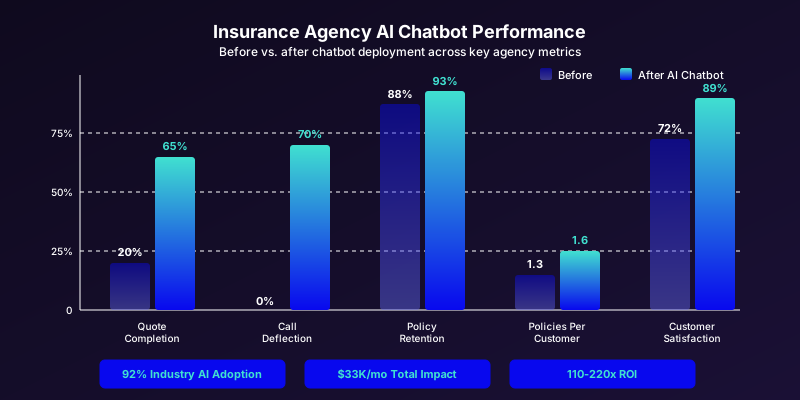
The insurance industry has reached an inflection point in AI adoption. According to McKinsey's 2025 Global Insurance Report, 92% of insurance carriers and large agencies have either deployed or are actively implementing AI-powered customer interaction tools, with conversational AI chatbots being the most common entry point. For independent agencies and mid-market brokerages, this means the competitive baseline has permanently shifted: offering only phone and email communication is now a disadvantage, not the standard.
The numbers behind this shift are compelling. The National Association of Insurance Commissioners (NAIC) reports that the US insurance industry processes over 280 million policy transactions annually, with customer service interactions averaging 12-15 minutes per call. At an average cost of $8-15 per call, routine inquiries alone cost the industry an estimated $40-60 billion per year. AI chatbots handle the same inquiries for $0.05-0.15 per conversation — a 98% cost reduction.
But the economic argument extends beyond cost savings. J.D. Power's 2025 US Insurance Digital Experience Study found that policyholders who interact with AI chatbots report 23% higher satisfaction scores than those who rely solely on traditional phone support, driven primarily by instant response times and 24/7 availability. Customer satisfaction in insurance directly correlates with retention: each point of NPS improvement translates to approximately 0.5% improvement in policy retention, which for a mid-size agency with $10M in annual premiums represents $50,000 in protected revenue per NPS point.
For independent insurance agencies — the 37,000+ businesses that form the backbone of US insurance distribution — chatbots are particularly transformative. These agencies typically operate with 3-15 staff members handling hundreds or thousands of policies across multiple carriers. The operational leverage that a chatbot provides — automating routine inquiries, capturing quotes around the clock, and managing renewal campaigns — effectively doubles the capacity of existing staff without adding headcount. For a comprehensive overview of insurance chatbot capabilities, see our insurance chatbot guide.

This guide provides a complete implementation blueprint for insurance agencies — from quote automation and claims intake to compliance with state regulations and cross-selling strategies — with specific ROI metrics and deployment timelines that apply to agencies of every size.
Quote Generation: 3x More Completions Through Conversational AI
Quote generation is the lifeblood of agency revenue, and it is where most agencies experience their greatest conversion failures. Traditional online quoting requires prospects to navigate multi-page forms with 20-40 fields, make decisions about coverage options they do not understand, and provide information they may not have readily available. The result: over 60% of online quote attempts are abandoned before completion, according to insurance industry benchmarks from the Insurance Information Institute.
A chatbot transforms the quoting experience from a form submission into a guided conversation that adapts to the prospect's knowledge level, answers questions in real time, and makes the process feel effortless rather than burdensome.
Auto Insurance Quote Flow
The chatbot walks the prospect through a structured but conversational quoting process:
- Vehicle identification: "Let's get you an auto insurance quote. What's the year, make, and model of your vehicle? Or if you have your VIN handy, I can look up the details automatically."
- Driver profile: "Got it — 2024 Toyota Camry. How old is the primary driver? Any tickets or accidents in the past 3 years?"
- Coverage preferences: Instead of presenting a grid of coverage options, the chatbot asks: "What matters most to you — keeping costs as low as possible, getting the best coverage, or finding a middle ground?" Based on the answer, it recommends appropriate coverage levels with plain-language explanations.
- Current insurance status: "Are you currently insured? If so, when does your policy expire? This helps me find the best rates."
- Instant estimate or agent appointment: For simple risks, the chatbot provides an instant ballpark estimate. For complex situations (multiple vehicles, young drivers, claims history), it schedules a call with a licensed agent who already has all the prospect's information.
Homeowners Insurance Quote Flow
Homeowners quoting requires more information but benefits even more from conversational guidance:
- Property details: Address (with automatic property data lookup where available), year built, square footage, construction type, roof age and material
- Protection features: Security systems, smoke detectors, fire extinguishers, backup generators, water leak detection — each of which may qualify for discounts the prospect does not know about
- Coverage needs: The chatbot explains dwelling coverage, personal property, liability, and additional living expenses in plain language, helping the prospect make informed decisions
- Bundling opportunities: "I see you're also interested in auto insurance. Bundling home and auto typically saves 15-25%. Want me to quote both?"
Conversion Rate Impact
Insurance agencies deploying chatbot-based quoting on their website report dramatic improvements:
| Metric | Traditional Web Form | AI Chatbot | Improvement |
|---|---|---|---|
| Quote completion rate | 15-25% | 45-65% | 3x |
| Time to complete quote | 8-12 minutes | 3-5 minutes | 60% faster |
| After-hours quotes captured | Form submission only | Interactive + immediate | 40% more leads |
| Cost per qualified lead | $25-60 | $8-20 | 60-70% lower |
Build your quote capture flows with Conferbot's AI chatbot builder, connect to your rating engine through the integrations hub, and deploy across your website for 24/7 lead capture. For tips on designing effective lead qualification conversations, see our lead qualification guide.
Claims Intake Automation: First Notice of Loss in 5 Minutes
Claims handling is where policyholders form their strongest opinions about their insurance experience. According to J.D. Power, claims satisfaction is the single strongest predictor of policy renewal — more influential than price, coverage, or agent relationship. Yet traditional claims intake is one of the most frustrating touchpoints: long hold times, repetitive information requests, and opaque processes that leave policyholders feeling anxious and uninformed.
AI chatbots transform the First Notice of Loss (FNOL) from a 15-30 minute phone ordeal into a 5-minute guided conversation available 24/7.
Auto Claims FNOL Flow
The chatbot guides the policyholder through a structured intake process:
- Safety check: "First and most importantly — are you and all passengers safe? If anyone needs medical attention, please call 911 immediately."
- Policy verification: Confirm identity with policy number and date of birth, or name and address lookup.
- Incident details: Date, time, and location of the accident. What happened in the policyholder's own words. Weather and road conditions. Number of vehicles involved.
- Other party information: Other driver's name, insurance company, policy number, and vehicle details. The chatbot prompts for photos of the other driver's insurance card and license plate.
- Damage documentation: The chatbot requests photos of vehicle damage from multiple angles: front, rear, both sides, and close-ups of specific damage areas. It also accepts dashcam footage if available.
- Police report: Was a police report filed? If yes, the report number and filing department. If not, the chatbot advises whether one should be filed based on the incident severity.
- Claim creation: All information is compiled, structured, and submitted to the claims management system. The policyholder receives an immediate claim number and next-step timeline.
Property Claims FNOL Flow
For homeowners or renters claims (water damage, fire, theft, storm damage), the chatbot adapts its intake to the peril type:
- Water damage: Source identified? Water shut off? Professional mitigation contacted? Photos of affected areas including walls, flooring, and any visible mold.
- Storm damage: Type of storm (wind, hail, tornado, hurricane). Areas of damage (roof, siding, windows, interior). Whether temporary repairs have been made to prevent further damage.
- Theft/burglary: Police report filed? Inventory of missing items with estimated values. Photos of entry point damage. Security camera footage available?
Claims Processing Improvements
Agencies using chatbot-based FNOL consistently report:
- FNOL completion time reduced from 20 minutes to 5 minutes
- Data completeness improved by 45% because the chatbot ensures every required field is captured
- Photo documentation rate increased from 30% to 85% because the chatbot makes it easy to submit photos in-chat
- After-hours FNOL capability: Over 40% of insurance claims events (accidents, storms, break-ins) occur outside business hours. The chatbot captures these immediately rather than requiring policyholders to call back the next business day
- Claims satisfaction scores improved by 18-25% driven by faster response and real-time status visibility
Ongoing Claims Communication
After FNOL, the chatbot manages ongoing claims communication:
- Status updates: "Your claim #IC-78432 has been assigned to adjuster Maria Torres. She'll contact you within 2 business days to schedule an inspection."
- Document requests: When the adjuster needs additional information, the chatbot sends a clear request with instructions.
- Payment notifications: "Great news — your claim payment of $4,250 has been approved and will be deposited to your bank account within 3 business days."
The transparency and accessibility of chatbot-powered claims communication transforms the claims experience from anxiety-inducing to reassuring — which directly impacts renewal rates and referral willingness.

Policy FAQ and Self-Service: Deflecting 70% of Routine Calls
Insurance policy documents are notoriously complex. The average homeowners policy is 40-60 pages of dense legal language, and even simple questions — "Am I covered if a tree falls on my car?" or "What's my deductible for wind damage?" — require staff time to look up and explain. These routine inquiries represent 60-70% of all inbound calls to insurance agencies, consuming hours of staff time that could be spent on revenue-generating activities like selling new policies or deepening client relationships.
A chatbot handles these inquiries instantly, accurately, and tirelessly.
Coverage Questions
The chatbot draws from the agency's knowledge base and carrier documentation to answer policy questions in plain language:
- "Does my homeowners insurance cover flooding?" "Standard homeowners policies typically do not cover flood damage. Flood insurance is a separate policy, usually through the National Flood Insurance Program (NFIP) or private flood insurers. Based on your property's location, I'd recommend discussing flood coverage with your agent. Want me to schedule a quick call?"
- "Am I covered if I rear-end someone?" "Yes, your auto liability coverage pays for damage you cause to other vehicles and their occupants. Your collision coverage (which you have with a $500 deductible) pays for repairs to your own vehicle. The other driver would file a claim against your policy for their damages."
- "What happens if my car is totaled?" "If your vehicle is declared a total loss, your collision or comprehensive coverage (depending on the cause) pays the actual cash value (ACV) of your vehicle minus your deductible. If you owe more on your loan than the ACV, gap insurance covers the difference. You currently have gap coverage on your policy."
Billing and Payment Self-Service
Payment-related calls are among the most frequent and least productive for agency staff. The chatbot handles them completely:
- Balance inquiries: "Your next payment of $187.50 is due on July 15, 2026. Your account is current with no outstanding balance."
- Payment processing: The chatbot can accept payments through secure in-chat payment processing, eliminating the need for staff to take credit card numbers over the phone.
- Payment plan options: "Your annual premium of $2,250 can be paid annually (one payment), semi-annually (two payments of $1,155), or monthly ($195/month with a $20 installment fee). Want to change your payment schedule?"
- Autopay enrollment: Guide policyholders through setting up automatic payments, reducing late payments and policy cancellations.
Document Requests
Policyholders frequently need insurance documents — declarations pages, certificates of insurance, ID cards, proof of coverage letters. These requests are simple but time-consuming for staff. The chatbot fulfills them instantly:
"I can send you your auto insurance ID card right now. Would you like it for all vehicles on the policy or just a specific one?"
The chatbot delivers the document as a downloadable PDF within the chat, or emails it to the policyholder's address on file. No phone call, no email to the agency, no waiting.
Deflection Rate Impact
Agencies deploying Conferbot for policy FAQ and self-service report 65-75% deflection rates for routine inquiries. For a mid-size agency handling 150 calls per day, that means 100+ calls per day resolved without staff involvement — freeing up approximately 12-15 hours of staff time daily for revenue-generating activities. See our banking and finance chatbot guide for related financial services automation strategies.

Renewal Management and Cross-Selling: Protecting and Growing Revenue
Renewal retention is the most important financial metric for insurance agencies. Acquiring a new policyholder costs 5-7x more than retaining an existing one, and the average agency's book of business represents years of accumulated client relationships and commission revenue. A 1% improvement in retention rate can translate to tens of thousands of dollars in protected annual revenue. Yet many agencies manage renewals through manual processes — spreadsheet tracking, staff reminders, and phone calls — that inevitably let some renewals slip through the cracks.
Automated Renewal Campaign Sequences
The chatbot manages the entire renewal lifecycle through timed, personalized outreach:
- 90 days before renewal: "Hi Michael, your homeowners policy with Hartford renews on October 1. Your current premium is $1,850/year. I'll start checking rates across our carriers to make sure you're getting the best deal. Any changes to your home I should know about? New roof, security system, or renovations?"
- 60 days before renewal: "Good news — I've compared rates across our carrier panel for your homeowners policy. Your renewal premium with Hartford is $1,920 (4% increase). We also have a competitive quote from Travelers at $1,780 with comparable coverage. Want to review the comparison with your agent?"
- 30 days before renewal: "Your homeowners policy renews in 30 days. Based on our review, we recommend [carrier] at $X/year. Reply RENEW to confirm, or CALL to schedule a 15-minute review call with your agent."
- 14 days before renewal: Final reminder with one-click renewal confirmation.
- Post-renewal: "Your policy has been renewed! New policy documents are attached. Your next payment of $X is due on [date]. Any questions about your coverage?"
At-Risk Policyholder Detection
The chatbot identifies renewal risk signals and alerts agents proactively:
- Policyholders who do not respond to renewal communications
- Policyholders who have recently filed claims (dissatisfaction risk)
- Policyholders facing significant premium increases (price-shopping risk)
- Policyholders who have declined coverage recommendations (engagement risk)
These at-risk policyholders are flagged for personal agent outreach, while standard renewals are handled automatically by the chatbot.
Cross-Selling: Increasing Policies Per Customer
The average independent agency client holds 1.3 policies, but agency profitability improves dramatically at 2+ policies per client (retention improves by 30-40% with bundling). The chatbot identifies cross-sell opportunities and presents them contextually:
- Auto-only clients: "I noticed you have auto insurance with us but not homeowners. Did you know bundling home and auto saves 15-25%? I can get you a homeowners quote in 2 minutes."
- No umbrella coverage: "With your home valued at $450,000 and two vehicles, an umbrella policy provides an extra $1-2 million in liability protection for as little as $200-300/year. Would you like to learn more?"
- Life events: When a client adds a teenage driver to their auto policy, the chatbot suggests: "Congratulations on the new driver! This is also a great time to review your life insurance coverage. Would you like a quick quote?"
Revenue Impact of Automated Cross-Selling
Agencies using chatbot-powered cross-selling report 15-25% increases in policies per customer within the first year of deployment. For an agency with 2,000 clients, moving the average from 1.3 to 1.6 policies per client adds 600 new policies — representing significant commission revenue and dramatically improved retention through the bundling effect. Deploy cross-selling flows across your website chatbot and through WhatsApp for maximum reach.

Compliance With State Insurance Regulations
Insurance is regulated at the state level, creating a complex patchwork of requirements that chatbot implementations must navigate carefully. Unlike e-commerce or general customer service chatbots that operate under relatively uniform rules, insurance chatbots must account for licensing requirements, disclosure obligations, advertising regulations, and data privacy laws that vary across all 50 states plus territories.
Licensing and Advisory Boundaries
The most critical compliance consideration is the boundary between information and advice. In most states, providing specific insurance recommendations — "You should buy this coverage" or "This policy is best for you" — requires a producer license. Chatbots must be designed to:
- Provide information, not advice: "Umbrella policies typically cost $200-400/year for $1 million in coverage" is information. "You need an umbrella policy" is advice. The chatbot should present options and facts, then route to a licensed agent for recommendations.
- Quote, not bind: Unless the chatbot workflow includes licensed agent approval, quotes provided should be labeled as estimates rather than binding offers.
- Disclose AI identity: Many states now require chatbots to identify themselves as artificial intelligence rather than human agents. The chatbot should clearly state: "I'm an AI assistant for [Agency Name]. I can help with quotes, policy questions, and claims filing. For personalized insurance advice, I can connect you with a licensed agent."
State-Specific Disclosure Requirements
Several states have enacted specific requirements for AI interactions in insurance:
| Regulation Area | Requirement | Chatbot Implementation |
|---|---|---|
| AI Disclosure | Identify bot as non-human | Opening message + persistent indicator |
| Privacy Notice | Explain data collection and use | Link to privacy policy in first interaction |
| Record Retention | Store communications 3-7 years | Automatic conversation archival |
| Advertising Rules | No misleading coverage claims | Approved language templates with guardrails |
| Unfair Trade Practices | No misrepresentation of terms | Rule-based responses for coverage details |
| Data Security | NAIC Insurance Data Security Model Law | Encryption, access controls, incident response |
NAIC Model Law Compliance
The NAIC's Insurance Data Security Model Law, adopted by over 20 states and counting, requires insurance licensees to implement a comprehensive information security program. For chatbots, this means:
- Written security program: Document your chatbot's security architecture, data handling procedures, and incident response plan.
- Risk assessment: Conduct and document a risk assessment specific to chatbot data flows — what PHI and PII is collected, where it is stored, who has access, and what the risks are.
- Access controls: Implement role-based access, multi-factor authentication for administrative access, and regular access reviews.
- Encryption: All data in transit (TLS 1.2+) and at rest (AES-256) must be encrypted.
- Third-party management: Your chatbot vendor must demonstrate compliance — request SOC 2 reports, security documentation, and contractual commitments to data protection.
- Incident response: Have a documented plan for chatbot security incidents, including breach notification procedures that comply with state-specific timelines (as short as 24 hours in some states).
Practical Compliance Approach
The most effective compliance strategy is to build guardrails into the chatbot's conversation design rather than trying to retrofit compliance after deployment:
- Use approved language templates for all coverage descriptions, claim status communications, and policy change confirmations.
- Implement hard escalation rules that route any conversation involving specific insurance advice, coverage adequacy assessment, or binding decisions to a licensed agent.
- Maintain conversation logs with timestamps, user identification, and complete interaction records for the required retention period.
- Conduct quarterly compliance reviews of chatbot conversations to identify any responses that approach or cross regulatory boundaries.
Conferbot's AI chatbot builder supports compliance-first conversation design with configurable guardrails, approved response templates, and comprehensive conversation logging that meets insurance regulatory requirements across all 50 states.
ROI Metrics: The Complete Insurance Agency Chatbot Business Case
Insurance agency principals and decision-makers need hard numbers to justify technology investments. Here is the complete ROI analysis for a chatbot deployment at a mid-size independent agency — 10 staff members, 3,000 clients, $15M in annual written premiums, handling 120 calls per day.
Cost Savings: Call Deflection
Chatbot deflects 70% of routine calls (84 calls/day). At an average cost of $10 per call (staff time + overhead): 84 calls x $10 x 22 working days = $18,480/month in staff time freed. Even if you do not reduce headcount, this time is redirected to revenue-generating activities — prospecting, cross-selling, and deepening client relationships.
Revenue Growth: Quote Capture
The chatbot captures quotes 24/7 with 3x completion rates. For an agency website averaging 2,000 monthly visitors with 5% quote intent: traditional form captures 15-20 leads/month; chatbot captures 45-60 leads/month. At a 25% close rate and $1,200 average premium: additional 7-10 new policies/month = $8,400-12,000/month in new annual premium, generating $840-1,200/month in first-year commission (assuming 10% commission rate).
Retention Improvement: Renewal Automation
Chatbot renewal campaigns improve retention by 5% (from 88% to 93%). On a 3,000-client book with $5,000 average premium: 5% = 150 retained clients x $5,000 x 12% commission = $90,000/year in protected commission = $7,500/month.
Cross-Sell Revenue: Policies Per Customer
Moving average policies per customer from 1.3 to 1.5 over 12 months = 600 new policies. At $1,000 average premium and 12% commission: $72,000/year in new commission = $6,000/month.
Total Monthly ROI
| Category | Monthly Impact |
|---|---|
| Call deflection (staff time) | $18,480 freed |
| New policy commission | $840-1,200 |
| Retention protection | $7,500 |
| Cross-sell commission | $6,000 |
| Total monthly impact | $32,820-33,180 |
Against a chatbot platform cost of $149-299/month, the ROI is 110-220x. Even the most conservative estimates (halving every category) produce an ROI exceeding 50x. Most agencies achieve positive ROI within the first week of deployment. For a detailed approach to measuring chatbot returns, see our chatbot ROI calculator framework. Explore pricing plans to find the right fit for your agency.

Multi-Line Agency Strategies: P&C, Life, Health, and Commercial
Independent agencies that write multiple lines of business — personal auto and home, commercial, life, health, and benefits — face unique chatbot design challenges. A homeowners insurance question requires a fundamentally different conversation flow than a group health enrollment inquiry or a commercial general liability quote. The chatbot must be sophisticated enough to route each interaction to the appropriate product-specific flow while maintaining a unified, professional agency identity.
Intelligent Product Routing
The chatbot begins every conversation with a routing question that determines the product context:
"Welcome to [Agency Name]! I can help with personal insurance (auto, home, umbrella), business insurance, life insurance, or health/benefits. What brings you in today?"
Alternatively, the chatbot can be contextually aware based on which page the visitor is viewing — a visitor on the commercial insurance page enters a commercial flow automatically.
Personal Lines Flows
Personal auto, homeowners, renters, umbrella, and personal articles coverage. These are high-volume, relatively standardized products where chatbot automation is most immediately impactful. The chatbot handles quoting, policy questions, claims FNOL, and billing for all personal lines products.
Commercial Lines Flows
Commercial insurance is more complex — the chatbot serves a qualification and routing function rather than attempting to quote directly:
- Business type identification: Industry, number of employees, annual revenue, locations
- Coverage need assessment: General liability, professional liability, workers' compensation, commercial property, commercial auto, cyber liability, EPLI
- Risk profile questions: Claims history, current coverage, specific concerns or exposures
- Agent scheduling: All information is compiled and the chatbot schedules a consultation with the appropriate commercial lines producer
For commercial lines, the chatbot's value is in qualifying and preparing the prospect — ensuring the agent walks into a consultation with complete background information rather than spending the first 30 minutes gathering basic details.
Life and Health Flows
Life insurance and health benefits conversations require particular sensitivity and often involve complex needs assessments:
- Life insurance: The chatbot can collect basic information (age, health status, coverage amount interest, type preference) and provide indicative rate ranges, but should route to a licensed agent for needs analysis and specific recommendations.
- Group health/benefits: For employee benefits, the chatbot qualifies the employer (number of employees, current benefits, renewal date) and schedules a benefits consultation.
- Individual health: During open enrollment, the chatbot can provide plan comparison information and guide individuals through the enrollment process.
Unified Client View
Regardless of which product flow a client enters, the chatbot maintains a unified client profile. When a personal auto client asks about homeowners coverage, the chatbot already knows their name, address, and contact information. When a commercial client calls about a workers' comp claim, the chatbot has their business details on file. This unified view — powered by the integrations hub connecting to your agency management system — eliminates redundant data collection and creates a seamless client experience across all lines of business.
Implementation Roadmap: From Zero to Production in 30 Days
Insurance agency chatbot deployment requires more upfront planning than most industries due to compliance requirements and system integrations. Here is the 30-day implementation roadmap that balances speed-to-market with the thoroughness insurance demands.
Week 1: Foundation and Compliance
- Compliance framework. Work with your E&O carrier and compliance team to establish chatbot interaction guidelines. Define the boundary between information and advice. Document required disclosures for your operating states. Identify which functions require licensed agent involvement.
- System inventory. Audit the systems the chatbot will integrate with — agency management system (Applied Epic, Vertafore AMS360, HawkSoft, EZLynx), rating engines, claims systems, and CRM. Assess API availability.
- Account setup. Create your Conferbot account, install the website embed code, and configure WhatsApp Business API if applicable.
- Knowledge base creation. Compile your most common client questions and approved answers covering all product lines. Include carrier-specific information, coverage explanations, billing policies, and claims procedures. Upload to the knowledge base.
Week 2: Core Flow Development
- Quote capture flows. Build conversational quoting for your highest-volume products (typically personal auto and homeowners). Connect to your rating engine for real-time or near-real-time quotes.
- Policy FAQ automation. Deploy the knowledge base-powered FAQ that handles coverage questions, billing inquiries, and document requests.
- Claims FNOL intake. Build FNOL flows for auto and property claims with photo documentation, incident detail collection, and claims system integration.
- Compliance integration. Embed required disclosures, AI identification, consent captures, and agent escalation triggers into all flows.
Week 3: Advanced Features
- Renewal campaign automation. Build the 90/60/30/14-day renewal sequence with personalized outreach and one-click renewal confirmation.
- Cross-selling flows. Create contextual cross-sell recommendations for mono-line clients — auto-only, home-only, no umbrella, no life insurance.
- Agent routing. Configure intelligent escalation that routes conversations to the appropriate agent based on product line, complexity, and client relationship.
Week 4: Testing, Training, and Launch
- Compliance review. Have your compliance officer review every chatbot flow for regulatory adherence across all operating states.
- Staff training. Train all producers and CSRs on the chatbot system — how to monitor conversations, handle escalations, review captured leads, and provide feedback.
- Pilot launch. Deploy to 25-50% of website traffic for 5 days. Monitor conversations closely for accuracy, compliance, and client satisfaction.
- Full launch. Deploy to 100% traffic across all channels. Enable analytics monitoring and set up weekly review cadence.
Post-Launch Optimization Cadence
- Weekly (first month): Review conversation logs, identify unanswered questions, refine flows, and expand the knowledge base.
- Monthly (ongoing): Analyze conversion metrics, update carrier information, add seasonal content (hurricane prep, winter driving tips), and expand to additional product lines.
- Quarterly: Compliance audit, ROI review, and strategic planning for feature expansion.
Insurance agencies that follow this structured approach typically see measurable results within the first two weeks of deployment — reduced call volume, captured after-hours leads, and improved client response times — with full ROI realization within 30-60 days. Start building your insurance chatbot today with Conferbot's AI chatbot builder.
The Future of AI in Insurance Agency Operations
The current generation of insurance chatbots — handling quotes, claims, FAQs, and renewals — is the foundation layer of a much broader AI transformation that will reshape how independent agencies operate over the next 3-5 years. Agencies that deploy chatbot technology today are building the data infrastructure and client interaction patterns that will power these next-generation capabilities.
Predictive Underwriting Support
AI models will analyze client interaction patterns, claims history, and behavioral signals to support underwriting decisions. A chatbot conversation that reveals a client's recent home renovation (new roof, updated electrical) can automatically update the property profile and trigger a re-rate for potential premium reduction — proactively delivering value that strengthens the client relationship.
Automated Coverage Gap Analysis
Using data from client conversations, policy records, and life event signals, AI will continuously analyze each client's coverage portfolio for gaps and recommend appropriate additions. Rather than waiting for the annual review, the chatbot will identify and present opportunities throughout the year: "You mentioned starting a small online business. Your homeowners policy doesn't cover business equipment or liability. Let me get you a quote for a business owner's policy."
Claims Prevention Through Risk Intelligence
AI chatbots will evolve from reactive claims handlers to proactive risk managers. Integrating with weather data, IoT sensors, and public records, the chatbot will alert policyholders before events occur: "Severe hailstorm forecast for your area Thursday evening. Here are 5 steps to protect your home and vehicles. If you do experience damage, I can start a claim immediately."
Natural Language Policy Comparison
Future chatbots will read and compare policy documents in real time, helping clients understand the differences between carrier options in plain language: "Hartford offers replacement cost coverage for your roof with no age restriction, while Travelers applies actual cash value for roofs over 15 years old. Your roof is 12 years old, so this difference won't affect you now but will matter in 3 years."
Voice AI for Agency Operations
Voice-enabled AI will extend the chatbot's capabilities to phone calls — the channel many insurance clients still prefer. An AI voice agent will handle routine calls (policy inquiries, payment processing, appointment scheduling) with the same capabilities as the text chatbot, seamlessly escalating to human agents for complex conversations. This creates true omnichannel coverage without requiring additional staff.
Embedded Insurance at Point of Sale
Chatbots will enable embedded insurance offerings at the point of purchase — a car dealership chatbot offering auto insurance during the vehicle purchase, a mortgage lender chatbot presenting homeowners options at closing, or an e-commerce checkout presenting shipping insurance. For agencies, this creates new distribution channels powered by the same chatbot technology used on their own website.
The independent agency channel's greatest strength — local presence, personal relationships, and multi-carrier choice — is amplified by AI technology that handles the routine while freeing agents to do what they do best: advise, advocate, and build trust. The agencies that invest in chatbot technology today will lead this transformation. Get started with Conferbot's AI chatbot builder and explore our pricing plans to begin your AI-powered agency transformation.
Was this article helpful?
AI Chatbot for Insurance Agencies FAQ
Everything you need to know about chatbots for ai chatbot for insurance agencies.
About the Author

Conferbot Team specializes in conversational AI, chatbot strategy, and customer engagement automation. With deep expertise in building AI-powered chatbots, they help businesses deliver exceptional customer experiences across every channel.
View all articles