The $48 Billion Loyalty Program Problem: Members Who Forget, Points That Expire
The global loyalty management market is projected to reach $24 billion by 2028, according to Fortune Business Insights, with businesses investing heavily in programs designed to increase repeat purchases, customer lifetime value, and competitive differentiation. Yet the industry carries a paradox that undermines the entire investment: the majority of loyalty program members do not actively engage with the programs they have joined.
Research from Bond Brand Loyalty's annual report reveals staggering engagement gaps. The average consumer belongs to 16.7 loyalty programs but actively uses only 7.6 of them. Approximately 75 percent of loyalty members cannot recall their current points balance. An estimated 40 to 48 percent of earned loyalty points expire unredeemed across the industry, representing $48 billion in perceived value that members earned but never claimed. Member drop-off -- the rate at which enrolled members stop engaging entirely -- averages 22 to 35 percent annually across programs.
The root cause is not program design or reward value -- it is communication friction. Members enroll with genuine intent to participate, then gradually disengage because checking point balances requires logging into a portal they rarely visit, understanding redemption options requires navigating complex reward catalogs, the gap between earning points and redeeming them creates a disconnect that weakens perceived value, and there is no proactive mechanism reminding members of their earned value at moments when redemption is relevant.
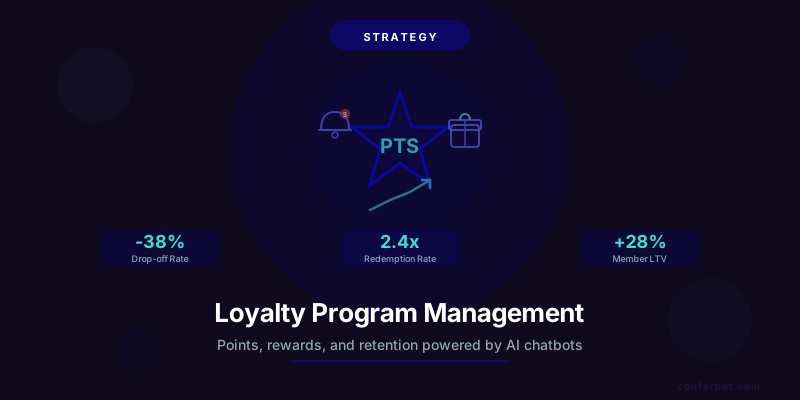
AI chatbots address every one of these friction points by bringing the loyalty program to the member rather than requiring the member to seek out the program. A loyalty chatbot proactively notifies members when they reach meaningful point thresholds, guides first-time redeemers through the process conversationally, surfaces personalized reward recommendations based on purchase history and preferences, and re-engages dormant members with targeted activation messages. Organizations deploying loyalty chatbots report 38 percent reduction in program drop-off, 2.4 times higher redemption rates, and 28 percent improvement in member lifetime value.
The economics are damning. McKinsey's research on loyalty programs found that companies spend billion annually on loyalty program operations, yet only 30 percent of program members consider themselves "highly engaged." Meanwhile, Accenture's study on brand loyalty found that 78 percent of consumers are rethinking their loyalty program participation, with complexity and lack of perceived value being the top two reasons for disengagement. The industry is spending unprecedented amounts to acquire loyalty members while failing to keep them engaged, a classic leaky-bucket problem that no amount of enrollment marketing can solve without fixing the engagement mechanism.
This guide covers the complete strategy for AI chatbot-powered loyalty program management: proactive engagement architectures, redemption optimization, first-time claim assistance, dormant member reactivation, and the measurable business impact on retention and revenue.
Proactive Point Notifications: Bringing the Program to the Member
The single most impactful loyalty chatbot capability is proactive notification -- reaching out to members with relevant information at the right moment rather than waiting for members to remember to check their account. This inverts the traditional loyalty model from pull (member must seek information) to push (program delivers information to member).
Threshold-Based Notifications
Configure the chatbot to send personalized messages when members cross meaningful point thresholds. A threshold notification might read: "Hi Sarah, great news! You have reached 2,500 points, which means you have enough for a free premium product of your choice. Want me to show you your top redemption options?" The key elements are personalization (using the member's name and specific balance), clear value translation (what the points are worth in tangible terms), and an immediate action opportunity (offering to show options rather than just informing).
Threshold triggers should be set at levels that correspond to meaningful redemption opportunities. If your lowest redemption tier is 1,000 points, set notifications at 1,000, 2,500, 5,000, and premium tiers. Each notification includes the specific reward or rewards available at that level, creating a direct connection between the abstract points number and a concrete benefit.
Expiration Warning Notifications
Points expiration is the single largest source of member frustration and disengagement. The chatbot should send graduated expiration warnings: 60 days before expiration with a friendly reminder and redemption suggestions, 30 days before with increased urgency and specific recommended actions, 7 days before with a final reminder emphasizing the value about to be lost, and the day of expiration with a last-chance notification.

The chatbot's conversational format makes expiration warnings significantly more effective than email notifications. While emails achieve 15 to 25 percent open rates and 2 to 5 percent click-through rates, chatbot messages achieve 75 to 90 percent read rates and 35 to 50 percent action rates. The interactive nature -- the member can immediately ask questions, explore options, and complete a redemption within the same conversation -- removes the multi-step friction of opening an email, clicking a link, logging into a portal, and navigating to the redemption page.
Purchase-Triggered Notifications
After each qualifying purchase, the chatbot can provide instant gratification by confirming points earned: "Thanks for your purchase! You just earned 150 points, bringing your total to 3,200 points. You are only 300 points away from a free weekend stay upgrade. Would you like to see what is available?" This post-purchase notification reinforces the value of the loyalty program at the moment of maximum engagement (immediately after a purchase), creates anticipation for the next earning milestone, and encourages the next purchase by framing it as progress toward a specific reward.
Personalized Recommendation Notifications
Using purchase history and preference data, the chatbot delivers personalized reward recommendations: "Based on your recent purchases, we think you would love our new seasonal collection. You have enough points for 40 percent off any item in the collection. Want to take a look?" These notifications feel like helpful suggestions rather than marketing messages because they are grounded in the member's actual behavior and available point balance. The psychology behind notification effectiveness is grounded in behavioral economics. Richard Thaler's Nobel Prize-winning work on nudge theory demonstrates that default options and timely reminders have outsized influence on human decision-making. A loyalty chatbot acts as a persistent, personalized nudge engine that makes the desired behavior (engagement and redemption) the path of least resistance. By surfacing relevant information at contextually appropriate moments, the chatbot transforms loyalty programs from passive databases of accumulated value into active drivers of customer behavior and spending.
The multi-channel nature of chatbot delivery ensures notifications reach members regardless of their communication preferences. A notification sent via WhatsApp to a member who never opens marketing emails achieves a fundamentally different engagement result. The chatbot's ability to detect preferred channels and route notifications accordingly increases aggregate reach from the typical 25 to 30 percent of email-only programs to 65 to 80 percent across multi-channel chatbot delivery.
For strategies on personalizing chatbot interactions for maximum engagement, see our chatbot customer experience guide.
Redemption Guidance: Making It Easy to Claim Earned Value
The redemption experience is the moment of truth for any loyalty program. It is when the member receives tangible value for their loyalty, reinforcing the behavior loop that drives repeat business. Yet redemption processes are often the weakest link in the loyalty chain: confusing catalogs, unclear point values, restrictive terms, and multi-step checkout processes create friction that suppresses redemption rates and erodes program satisfaction.
The Redemption Friction Problem
A typical loyalty program redemption requires: logging into the loyalty portal (most members have forgotten their password), navigating to the rewards catalog (often buried in the site architecture), understanding point-to-value conversion (how many points is this actually worth?), comparing options across categories (travel, merchandise, gift cards, experiences), selecting a reward and completing checkout (another multi-step form), and understanding any restrictions or blackout dates (fine print that creates surprises).
Each step represents a drop-off point. Industry data shows that for every 100 members who begin the redemption process on a traditional loyalty portal, only 35 to 45 complete a redemption. That means 55 to 65 percent of members with intent to redeem abandon the process due to friction.
Conversational Redemption Experience
A chatbot transforms redemption from a multi-step web process into a guided conversation. The interaction feels like working with a knowledgeable concierge rather than navigating a self-service portal.
The chatbot opens with context: "You have 4,200 points to use. Here are three options I think you will love based on your history." It then presents curated recommendations with clear value translations: "Option 1: Free standard shipping on your next 5 orders (worth $45). Option 2: $20 off any purchase over $50. Option 3: Exclusive early access to our summer sale plus a $15 credit. Which sounds good, or would you like to see more options?"
The member selects an option, the chatbot handles all processing steps, and confirms the redemption in a single conversational flow that takes 60 to 90 seconds -- compared to 5 to 8 minutes on a traditional portal. The result: chatbot-guided redemptions achieve completion rates of 78 to 88 percent, nearly double the traditional portal rate.

Intelligent Value Optimization
The chatbot can help members maximize their point value through intelligent suggestions. If a member is about to redeem 5,000 points for a $25 gift card but could get $40 in value by waiting until they reach 6,000 points for a premium redemption, the chatbot can suggest: "You could redeem now for the $25 gift card, or if you make one more purchase (about 800 points away), you will qualify for our premium tier redemption where your points are worth 60 percent more. Would you like to wait for the better value?" This advisory capability increases perceived program value and encourages the additional purchase that reaches the premium tier, benefiting both the member and the business.
Points-Plus-Pay and Partial Redemptions
Many loyalty programs allow members to combine points with cash payment for higher-value rewards. This "points plus pay" model unlocks premium redemption options for members who have not accumulated enough points for a full redemption but want access to better rewards. The chatbot handles these hybrid transactions conversationally: "You have 3,200 points toward this reward. You can redeem your points for off and pay the remaining , or continue earning and redeem the full reward when you reach 10,000 points. Which would you prefer?" The chatbot calculates the optimal points-to-cash ratio in real-time and presents it clearly, enabling members to make informed decisions about whether to redeem now or save for a higher-value option later. This capability alone increases total redemption volume by 22 to 30 percent because it eliminates the binary choice between "have enough" and "do not have enough" that suppresses redemptions for members between earning milestones.
Handling Complex Redemptions
Some redemptions involve complexity that overwhelms self-service portals: travel bookings with date restrictions, experience reservations with limited availability, or product selections with size and color variations. The chatbot handles these conversationally: "I see you want to use your points for a weekend stay. Let me check availability. What dates work for you?" followed by "Great, the weekend of July 12th is available at three of our partner properties. Here are your options with point costs for each." The conversational format handles complexity naturally because it mirrors how a human concierge would guide the process. For more on how chatbots drive revenue through personalized product recommendations, see our upselling and cross-selling guide.
First-Time Claim Assistance: Converting Enrollment Into Active Participation
The first redemption is the most critical moment in a loyalty member's lifecycle. Members who complete their first redemption within 90 days of enrollment are 4.2 times more likely to remain active program participants over the following two years compared to members who never redeem. Yet first-time redemption rates are shockingly low: only 35 to 45 percent of enrolled members ever make a single redemption, meaning more than half of loyalty members receive zero tangible value from programs they voluntarily joined.
Barriers to First Redemption
First-time redeemers face unique psychological and practical barriers. They are unfamiliar with the redemption process and uncertain about how it works. They may not realize they have enough points for anything worthwhile. They perceive the process as complicated and time-consuming. They have not yet experienced the positive reinforcement of receiving a reward, so the perceived effort-to-value ratio is uncertain. They may not know what options are available or which represents the best value.
The First-Redemption Chatbot Flow
Design a dedicated first-redemption flow that activates when a member reaches their first eligible redemption threshold. The chatbot initiates with celebration and clear value communication: "Congratulations, you have earned your first reward! Your 1,000 points are worth $10 toward anything in our store. Would you like to claim it now? It takes less than a minute."
The low-effort promise (less than a minute) is critical for first-timers who have not yet experienced the process. The chatbot then guides them through a simplified three-step flow: confirm the reward selection (presenting the single most appealing option for their profile, not the full catalog), apply the reward to their account or generate a redemption code, and confirm completion with immediate positive reinforcement: "Done! Your $10 credit is applied to your account and will be automatically used on your next purchase. You have already earned 200 more points toward your next reward."

Proactive First-Redemption Outreach
Do not wait for members to discover they are eligible for their first reward. The chatbot should proactively reach out when members cross the first redemption threshold, with messaging calibrated by the time since enrollment. Within the first week: "Welcome to the program! You are already halfway to your first reward. Here is how points add up." At first eligible threshold: "Great news -- you have earned enough for your first reward! Let me help you claim it." If no redemption after 30 days of eligibility: "Your 1,500 points are waiting to be used. The most popular first reward is our $15 store credit. Want me to add it to your account now?" If still no redemption after 60 days: "You have $15 in rewards expiring in 30 days. I can apply them to your account right now -- it takes 10 seconds."
This graduated urgency increases first-redemption rates from 35 to 45 percent (passive) to 62 to 74 percent (proactively guided by chatbot). The improvement has a compounding effect on program ROI: members who redeem become active participants who earn more, spend more, and remain loyal longer.
Segmented First-Redemption Strategies
Different member segments require different first-redemption approaches. High-value members who spend significantly above average but have never redeemed should receive premium reward suggestions that match their spending tier: "Based on your purchase history, our Gold tier members like you typically start with our exclusive early-access rewards. Would you like to see what is available?" Budget-conscious members who accumulate points slowly should receive low-threshold redemption options that provide quick wins: "You have enough for a free shipping upgrade on your next order. Want me to apply it?" The key is matching the first redemption to the member's demonstrated behavior pattern so the experience feels relevant and achievable rather than aspirational and out of reach.
Post-First-Redemption Nurturing
After the first redemption, the chatbot shifts to a nurturing cadence that maintains engagement momentum. Within 24 hours of first redemption: "How did you enjoy your reward? Your next reward is only X points away." After the next qualifying purchase: "You are making great progress! Your next reward is just Y points away. At this pace, you will earn it by [estimated date]." At next threshold: the standard redemption notification flow activates. This nurturing sequence converts the first-time redeemer into an habitual participant, building the behavior loop that drives long-term program value. For broader strategies on reducing customer churn through proactive engagement, see our customer retention chatbot guide.
Reducing Program Drop-Off by 38%: Re-Engaging Dormant Members
Loyalty program drop-off -- the rate at which active members become inactive -- is the silent killer of program ROI. Industry benchmarks show 22 to 35 percent annual drop-off rates, meaning programs must continuously recruit new members just to maintain flat enrollment. For programs investing $5 to $15 to acquire each new member, this churn represents a significant and recurring cost that erodes the program's net value to the business.
Identifying At-Risk and Dormant Members
The chatbot's engagement analytics enable early identification of members trending toward drop-off. Define behavioral thresholds that signal declining engagement: reduced purchase frequency (a member who purchased monthly now has not purchased in 60 days), reduced chatbot interaction (a member who regularly checked their balance has not interacted in 45 days), accumulated but unredeemed points past typical redemption cycles, and declining email open or click rates for program communications.
Segment at-risk members into tiers based on recency, frequency, and monetary value to prioritize re-engagement efforts. High-value dormant members warrant the most aggressive reactivation investment because their lifetime value justifies higher intervention costs.
Re-Engagement Conversation Strategies
The chatbot deploys different re-engagement approaches based on the dormancy stage and member value.
Early dormancy (30 to 60 days inactive): A gentle reminder that emphasizes accumulated value: "Hi Alex, it has been a while! You have 3,400 points sitting in your account -- that is enough for [specific reward]. Want me to show you what is new in our rewards catalog?"
Mid dormancy (60 to 120 days inactive): A value-acceleration offer that creates urgency: "We miss you, Alex! We have added a special bonus: earn 2x points on your next purchase within 14 days. Plus, you already have 3,400 points waiting for you."
Late dormancy (120 to 365 days inactive): A high-value reactivation offer: "Alex, we noticed you have not used your 3,400 points (worth $34). As a special thank you for being a member, we are adding 500 bonus points to your account if you make a purchase this month. That brings you to 3,900 points -- enough for our premium reward tier."

Reactivation Performance Data
| Dormancy Stage | Email Reactivation Rate | Chatbot Reactivation Rate | Chatbot Advantage |
|---|---|---|---|
| Early (30 - 60 days) | 18% | 45% | 2.5x higher |
| Mid (60 - 120 days) | 11% | 28% | 2.5x higher |
| Late (120 - 365 days) | 5% | 14% | 2.8x higher |
| Blended average | 12% | 31% | 2.6x higher |
The chatbot's superior reactivation performance comes from higher message visibility (chatbot messages are read, emails are often filtered), conversational interactivity (the member can immediately explore options and redeem), personalized recommendations (the chatbot knows their purchase history and preferences), and reduced friction to action (one-tap redemption versus multi-step portal navigation).
Measuring Drop-Off Reduction Impact
Track these metrics monthly to quantify the chatbot's impact on program health: monthly active member rate (target: 5 to 10 percentage point increase within six months), 90-day retention rate for new enrollees (target: 15 to 25 percentage point improvement), average member lifetime (months active before drop-off), reactivation rate by dormancy stage and re-engagement message variant, and revenue per active member compared to pre-chatbot baseline. The aggregate impact of reduced drop-off, higher redemption rates, and reactivated dormant members typically produces a 38 to 45 percent net reduction in annual program attrition.
Win-Back Campaign Strategies
For members who have been dormant beyond 365 days, a structured win-back campaign through the chatbot can recover 5 to 8 percent of lapsed members, which is economically significant given the to cost of acquiring a new member versus the to cost of reactivating a lapsed one. Win-back messages should lead with the strongest possible offer: "We miss having you as a member. We have added 1,000 bonus points to your account and extended your existing 2,400 points for another 12 months. That is in rewards ready for you right now. Would you like to claim them?" The combination of new value (bonus points) and preserved value (extended expiring points) creates a compelling reason to re-engage. Track win-back costs carefully to ensure the bonus point investment is justified by the reactivated member's projected lifetime value.
For organizations exploring A/B testing strategies to optimize these engagement messages, see our chatbot A/B testing guide.
Loyalty Program Analytics: Measuring Chatbot Impact on Retention and Revenue
Deploying a loyalty chatbot without rigorous measurement is like investing in a marketing campaign without tracking conversions. The analytics framework must connect chatbot engagement metrics to loyalty program KPIs to business revenue outcomes, creating a clear line of sight from chatbot activity to financial impact.
Chatbot Engagement Metrics
Track these chatbot-specific metrics to assess platform health: monthly interactions per enrolled member (target: 2 to 4 meaningful interactions, not counting system messages), self-service point balance checks (indicates member awareness of their standing), redemption conversations initiated (intent to redeem), redemption conversations completed (actual redemptions through the chatbot), proactive notification read and action rates, and first-time chatbot interaction rate among new enrollees (adoption indicator).
Loyalty Program KPIs
Connect chatbot engagement to program performance metrics: redemption rate (total points redeemed divided by total points earned), which should increase from the industry average of 52 to 60 percent to 72 to 82 percent with chatbot deployment. Points liability reduction (the financial reserve for outstanding unredeemed points) improves as redemption rates increase, freeing balance sheet capacity. Active member percentage (members who earned or redeemed in the past 90 days) should increase by 15 to 25 percentage points. Enrollment-to-first-redemption conversion (target: 62 to 74 percent within 90 days). Average member tenure before drop-off should extend by 4 to 8 months.
Revenue Attribution Model
| Revenue Driver | Before Chatbot | After Chatbot | Revenue Impact |
|---|---|---|---|
| Active members (of 100,000 enrolled) | 45,000 | 62,000 | +17,000 active spenders |
| Average annual spend per active member | $840 | $920 (engaged members spend more) | +$80 per member |
| Total loyalty member revenue | $37.8M | $57.0M | +$19.2M (+51%) |
| Incremental revenue attributable to chatbot | - | - | $11.4M (adjusting for organic growth) |

The $11.4 million incremental revenue figure in this model comes from two compounding effects: more members actively participating (17,000 additional active members who would have been dormant) and higher per-member spending (engaged members who receive proactive value communication and easy redemption spend 9.5 percent more on average). The chatbot investment -- typically $30,000 to $100,000 annually -- represents a 114-to-1 to 380-to-1 return on investment.
Points Liability Management
From a financial accounting perspective, unredeemed loyalty points represent a liability on the company's balance sheet. IFRIC 13 and ASC 606 revenue recognition standards require companies to estimate the fair value of loyalty points and defer revenue recognition until points are redeemed or expire. Higher redemption rates driven by the chatbot actually improve financial reporting clarity: when more points are redeemed, there is less estimation uncertainty around the remaining liability. Finance teams should monitor the chatbot's impact on breakage rate (the percentage of points expected to expire unredeemed), as reducing breakage from 40 percent to 20 percent shifts revenue recognition timing and may affect quarterly financial results. The net financial impact is positive because redeemed points drive incremental purchases that exceed the cost of the reward, but the accounting treatment requires coordination between marketing, finance, and the chatbot analytics team.
Cohort Analysis
Compare member cohorts to isolate the chatbot's effect: pre-chatbot enrollees versus post-chatbot enrollees (do members who join after chatbot deployment show higher engagement from day one?), chatbot-engaged members versus non-engaged members within the same enrollment cohort (controlling for enrollment timing), and high-interaction members versus low-interaction members (does more chatbot engagement correlate with higher spending and longer tenure?). Cohort analysis validates that observed improvements are attributable to the chatbot rather than external factors like program changes or market conditions. For comprehensive chatbot analytics frameworks applicable across business use cases, see our chatbot analytics and metrics guide.
Implementing a Loyalty Chatbot: Technical Architecture and Deployment
A loyalty chatbot requires tighter integration with business systems than most chatbot deployments because it must access real-time point balances, transaction histories, and reward catalogs. Here is the technical architecture and deployment roadmap.
System Integration Requirements
The chatbot must integrate with three core systems. Loyalty management platform: Real-time API access to member profiles (points balance, tier status, transaction history, preferences), reward catalog (available rewards, point costs, availability, restrictions), and earn and burn transaction processing (crediting points for purchases, debiting points for redemptions). CRM or customer data platform: Purchase history, communication preferences, segmentation data, and interaction history across all channels. E-commerce or POS system: Product catalog for reward-linked offers, purchase event triggers for post-purchase notifications, and coupon or discount code generation for point-based discounts.
Data Flow Architecture
The loyalty chatbot operates on a real-time data flow. Incoming data feeds include point balance updates after each qualifying transaction, reward catalog updates when new rewards are added or availability changes, member profile updates from CRM changes, and purchase events from the e-commerce or POS system. Outgoing data flows include redemption transactions processed through the loyalty platform API, member interaction logs stored for analytics and personalization, segment updates pushed to the CRM based on chatbot engagement patterns, and notification triggers based on threshold crossings or behavioral signals.
Deployment Roadmap
| Phase | Timeline | Deliverables |
|---|---|---|
| Phase 1: Foundation | Weeks 1 - 3 | Loyalty platform API integration, point balance lookup, basic reward catalog display |
| Phase 2: Core Flows | Weeks 3 - 5 | Redemption processing, first-time claim flow, post-purchase notifications |
| Phase 3: Proactive Engagement | Weeks 5 - 7 | Threshold notifications, expiration warnings, personalized recommendations |
| Phase 4: Reactivation | Weeks 7 - 9 | Dormant member identification and re-engagement flows, bonus point campaigns |
| Phase 5: Analytics and Optimization | Weeks 9 - 12 | Revenue attribution dashboard, A/B testing of notification messages, cohort analysis setup |
The phased approach delivers value incrementally: Phase 1 provides immediate utility (members can check balances and browse rewards), Phase 2 enables the highest-impact revenue action (redemption), and subsequent phases add the proactive engagement that drives the 38 percent drop-off reduction and incremental revenue.
Security and Fraud Considerations
Loyalty programs are frequent targets for fraud, including points theft, fake account creation, and redemption manipulation. The chatbot must implement identity verification before allowing point balance access or redemption processing. Multi-factor authentication through SMS or email verification, transaction velocity limits (flagging multiple redemptions in short timeframes), and anomaly detection (alerting when a dormant account suddenly attempts to redeem all points) protect both the business and the member. Configure the chatbot to escalate suspicious activities to the fraud team rather than blocking the member outright, as false positives create member frustration that undermines the engagement the chatbot was designed to drive.
For more on deploying chatbots across multiple customer touchpoints, see our chatbot channel overview. For insights on securing chatbot interactions against fraud and abuse, see our chatbot security guide.
Managing Loyalty Programs With Conferbot: Platform Capabilities
Conferbot provides the conversational AI platform to deploy loyalty program chatbots with the real-time integration and proactive engagement capabilities this use case requires.
Real-Time Loyalty Data Access
Conferbot's API integration layer connects to major loyalty management platforms and custom loyalty databases, providing real-time access to point balances, tier status, transaction history, and reward catalogs. When a member asks "How many points do I have?" the chatbot queries the loyalty system and responds with their current balance, recent earning activity, and the nearest redemption threshold within two seconds.
Proactive Engagement Engine
Configure trigger-based notifications using Conferbot's automation rules: point threshold crossings, expiration warnings at configurable intervals, post-purchase point confirmations, dormancy-based re-engagement sequences, and milestone celebrations (anniversary, tier upgrade, 100th purchase). Each trigger executes a configurable conversation flow that can include personalized reward recommendations, bonus point offers, and one-tap redemption.
Multi-Channel Loyalty Presence
Deploy the loyalty chatbot on every channel where members interact with your brand: website and mobile app embedded widget for always-available balance checks and redemption, WhatsApp and SMS for proactive notifications that reach members outside your owned properties, Facebook Messenger and Instagram for social-channel loyalty engagement, and Slack or Teams for employee loyalty programs within corporate environments. Consistent loyalty management across all channels ensures members always have frictionless access to their program benefits.
Redemption Processing
The chatbot processes redemptions end-to-end within the conversation: presenting curated reward options, confirming the selection, processing the point debit through the loyalty platform API, generating discount codes or applying account credits, and confirming completion with a summary. No portal login required, no multi-page checkout, no password recovery. The frictionless experience is why chatbot-guided redemptions achieve 78 to 88 percent completion rates.
Loyalty Analytics Dashboard
Conferbot's analytics dashboard tracks loyalty-specific metrics: redemption rates and revenue attribution, active member percentage trends, reactivation campaign performance, first-redemption conversion rates by enrollment cohort, notification engagement rates by type and channel, and member lifetime value trends correlated with chatbot interaction frequency.
Getting Started
Launch your loyalty chatbot on Conferbot in three to four weeks with the phased deployment approach described in this guide. Start with Phase 1 (balance lookup and reward catalog) to provide immediate member value, then expand to proactive engagement and reactivation over the following weeks. Visit our pricing page to explore plans that include the real-time integration and automation features required for loyalty program management. For enterprise loyalty deployments requiring complex integration with existing loyalty platforms, our team provides dedicated implementation support and architecture consultation.
Was this article helpful?
AI Chatbots for Loyalty Program Management FAQ
Everything you need to know about chatbots for ai chatbots for loyalty program management.
About the Author

Conferbot Team specializes in conversational AI, chatbot strategy, and customer engagement automation. With deep expertise in building AI-powered chatbots, they help businesses deliver exceptional customer experiences across every channel.
View all articles