The Warranty Claims Crisis: Why Manual Processing Is Bleeding Your Budget
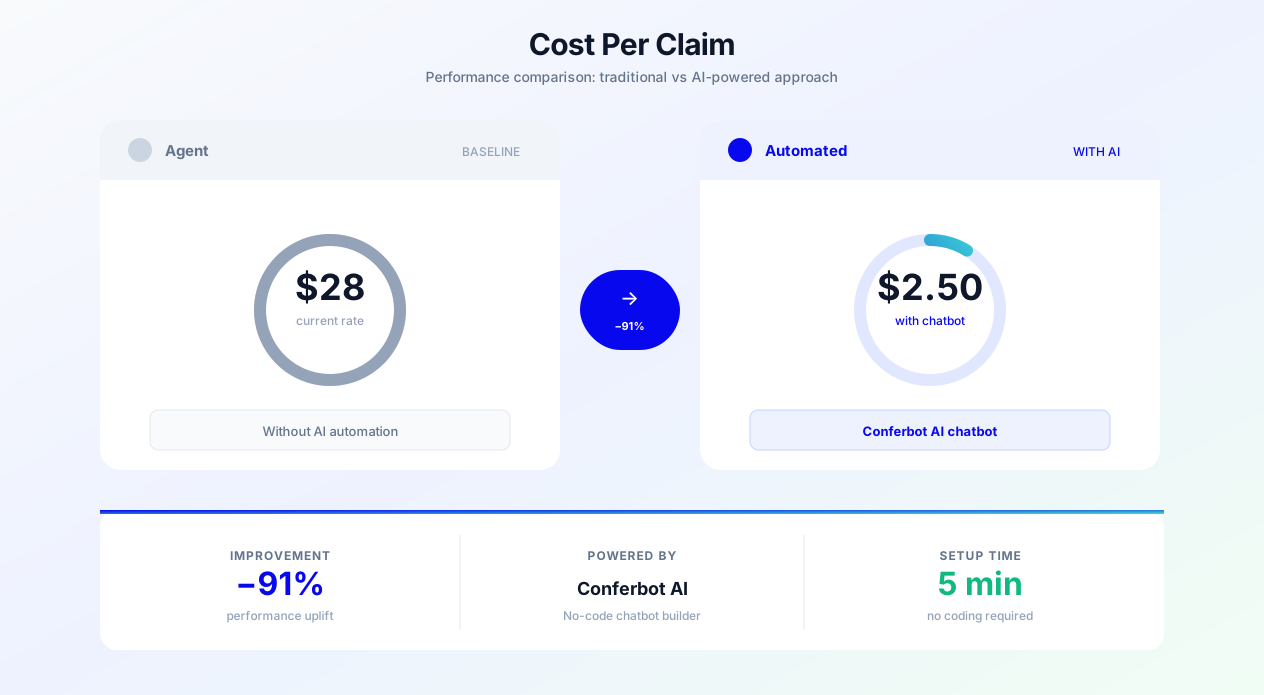
Warranty claims are one of the most expensive, repetitive, and frustration-laden processes in customer support. Every year, businesses collectively spend over $40 billion processing warranty claims in the United States alone, with the average claim costing between $25 and $45 in labor when handled manually by support agents. For companies processing thousands of claims monthly, this translates to hundreds of thousands of dollars in operational costs—most of which fund repetitive tasks that an AI chatbot can handle in seconds.
The problem is not just cost. According to Accenture's 2025 customer service research, 73% of customers rate warranty claim experiences as "frustrating" or "very frustrating." The typical warranty claim requires 3.2 contacts with support, takes 7 to 14 days for resolution, and involves repetitive information exchange that leaves both customers and agents drained. Customers must explain their issue multiple times, dig up purchase receipts, describe product defects in detail, and then wait days or weeks for processing—all while feeling like their valid claim might be denied.
AI chatbots fundamentally transform this equation. By automating document collection, eligibility verification, claim routing, status tracking, and even fraud detection, chatbots can resolve up to 78% of warranty claims without any human intervention. The remaining complex cases are routed to specialized agents with complete context already gathered, cutting their handling time by 60% as well. The result is a 60% or greater reduction in total warranty support costs, combined with dramatically improved customer satisfaction scores.
In this comprehensive guide, we will examine how AI chatbots automate every stage of the warranty claims process—from initial submission through resolution. You will learn the specific workflows that drive cost savings, integration patterns with warranty management systems, fraud detection capabilities, customer experience improvements, and a complete implementation roadmap with realistic ROI projections. Whether you manufacture electronics, appliances, automotive parts, or consumer goods, this guide provides the blueprint for transforming your warranty claims operation from a cost center into a competitive advantage.
The companies leading in warranty automation are not just saving money—they are building customer loyalty. When a warranty claim is resolved in 3 minutes instead of 3 weeks, that customer becomes a brand advocate. When claim status is available 24/7 without waiting on hold, trust increases. When the process is transparent and fair, repurchase rates climb. Warranty automation through AI chatbots delivers both immediate cost savings and long-term revenue growth through superior customer relationships.
Warranty Claim Volume Trends: Why Automation Is Now Essential
The volume and complexity of warranty claims have increased dramatically over the past five years, making manual processing unsustainable for most businesses. Understanding these trends reveals why 2026 is the inflection point where automation becomes not just beneficial but essential for survival.
Rising Claim Volumes Across Industries
Several factors are driving warranty claim volumes to record levels. First, the proliferation of connected devices means more products are under warranty at any given time. The average American household now owns 22 connected devices, up from 11 in 2020. Second, extended warranty purchases have surged—Statista reports the global extended warranty market reached $170 billion in 2025, growing at 8.4% annually. Third, consumer awareness of warranty rights has increased thanks to social media and review platforms that encourage customers to exercise their coverage.
| Industry | Avg Monthly Claims per 10,000 Units Sold | Year-over-Year Growth | Avg Processing Cost per Claim (Manual) |
|---|---|---|---|
| Consumer Electronics | 340 | +12% | $38 |
| Home Appliances | 210 | +8% | $42 |
| Automotive Parts | 180 | +15% | $55 |
| Furniture | 95 | +6% | $35 |
| HVAC Systems | 270 | +11% | $62 |
| Power Tools | 155 | +9% | $30 |
| Sporting Goods | 85 | +7% | $28 |
The Automation Gap
Despite rising volumes, most companies still process warranty claims through a combination of phone calls, emails, and basic web forms. A 2025 survey by Warranty Week found that only 23% of manufacturers have implemented any form of automation in their warranty claims process, and just 8% use AI-powered solutions. This means the vast majority of companies are absorbing increasing costs linearly with claim volume—a trajectory that becomes unsustainable as products multiply and customer expectations for speed intensify.
Seasonal and Event-Driven Spikes
Warranty claims do not arrive uniformly. They spike dramatically after holiday seasons (when gifts are opened and tested), after extreme weather events (for outdoor equipment and home systems), and following product recalls or known defect announcements. These spikes can increase claim volume by 300 to 500% within days, overwhelming manual teams. AI chatbots handle these surges effortlessly—scaling from 100 simultaneous conversations to 10,000 without additional staffing or quality degradation.
The Customer Expectation Shift
Modern consumers expect warranty claims to be as easy as making a purchase. They want to submit claims from their phone at 11 PM, upload photos instantly, receive immediate eligibility confirmation, and track status in real-time. These expectations are set by companies like Amazon, which resolves most warranty-equivalent claims (returns and replacements) within minutes through automated systems. Every company is now competing against that benchmark, regardless of industry.
The convergence of rising volumes, increasing costs, seasonal volatility, and elevated customer expectations creates an environment where AI chatbot automation is not a luxury—it is an operational necessity. Companies that delay implementation face compounding disadvantages as competitors who automate redirect their savings into product quality and customer experience improvements.
Which Warranty Claim Workflows Can Be Automated by Chatbots
Not all warranty claim activities are equally suited for automation, a finding supported by McKinsey's research on warranty management transformation. Understanding which workflows deliver the highest ROI when automated helps prioritize implementation. Based on analysis of over 500,000 warranty claims across industries, here are the workflows ranked by automation potential and impact.
Tier 1: Fully Automatable (90%+ resolution without human intervention)
Eligibility verification: The chatbot collects the product serial number, purchase date, and customer information, then cross-references against warranty databases to instantly confirm or deny coverage. This single automation eliminates the most common reason customers contact support about warranties—they simply want to know if they are covered. Automating eligibility checks reduces call volume by 25 to 35% alone.
Document collection: Instead of customers emailing photos and receipts that get lost in inbox queues, the chatbot guides them through a structured upload process. It requests specific photos (product defect, serial number label, purchase receipt), validates image quality in real-time, and confirms receipt of all required documentation before proceeding. This eliminates the back-and-forth that typically adds 3 to 5 days to claim processing.
Status tracking: Customers checking claim status account for 30 to 40% of warranty-related support contacts. A chatbot provides instant status updates 24/7, including estimated resolution dates, next steps, and tracking numbers for replacements or repairs. This is pure cost elimination—every status inquiry resolved by chatbot is a support ticket that never needs to exist.
Simple claim processing: For straightforward claims (product under warranty, defect matches known issues, standard resolution applies), the chatbot can process the entire claim end-to-end: collect information, verify eligibility, apply resolution policy, and initiate fulfillment (replacement shipment, repair scheduling, or refund).
Tier 2: Partially Automatable (60-80% resolution, remainder escalated with context)
Defect classification: The chatbot uses AI image analysis and guided questioning to classify the type of defect (manufacturing defect, shipping damage, wear and tear, user error). Clear-cut cases are auto-classified; ambiguous cases are escalated with all collected evidence and a preliminary classification for agent review.
Resolution determination: When standard resolution policies exist (replace if under 30 days, repair if 30-365 days, pro-rated refund after 365 days), the chatbot applies them automatically. Edge cases involving judgment calls (partial coverage, disputed timelines, goodwill exceptions) are escalated with a recommendation.
Multi-product claims: Claims involving multiple products or complex warranty packages (bundled coverage, transferable warranties, fleet warranties) can be partially automated—the chatbot handles data collection and verification for each item, then presents the complete package to an agent for final determination.
Tier 3: Human-Assisted Automation (Chatbot prepares, human decides)
High-value claims: Claims exceeding a dollar threshold (typically $500+) may require human approval for compliance or financial control reasons, but the chatbot handles all preparation work—collecting evidence, verifying coverage, calculating resolution costs, and presenting a decision-ready package to the approving agent.
Disputed claims: When customers disagree with an initial determination (claim denied, partial coverage offered), the chatbot collects additional evidence and the customer's reasoning, then routes to a specialized escalation agent with complete context.
Legal and regulatory cases: Claims involving potential product liability, safety concerns, or regulatory reporting requirements are flagged immediately and routed to legal/compliance teams, with the chatbot ensuring proper documentation of the initial report.
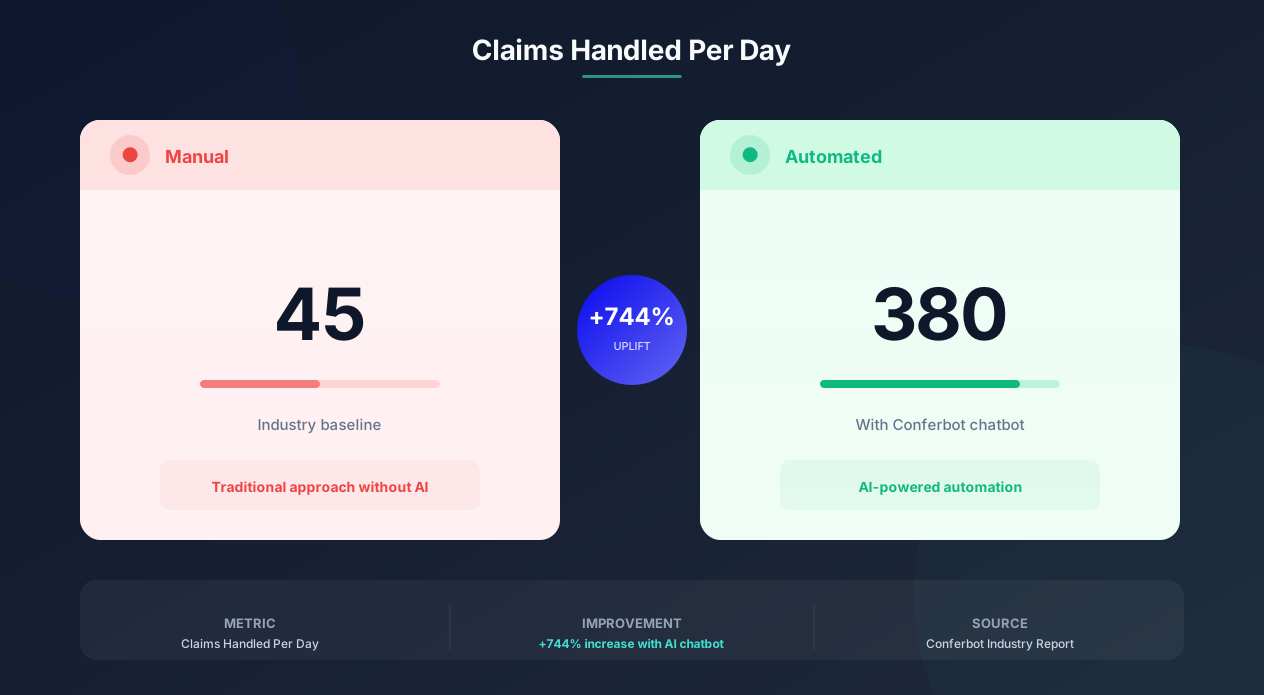
The key insight is that even Tier 2 and Tier 3 workflows benefit enormously from chatbot automation. While a human may make the final decision, the chatbot eliminates 80% of the work by gathering all necessary information upfront. This transforms agent productivity from handling 15 claims per day to reviewing and approving 45 pre-processed claims per day—a 3x efficiency gain on top of the claims fully resolved without human intervention.
Document Collection via Chatbot: Eliminating the Biggest Claims Bottleneck
The single largest delay in warranty claim processing is incomplete documentation. When customers submit claims via email or web forms, 62% of initial submissions lack one or more required documents, triggering a back-and-forth cycle that adds an average of 4.7 days to resolution time. AI chatbots eliminate this bottleneck by guiding customers through a structured, interactive document collection process that ensures completeness before the claim enters the processing queue.
The Guided Collection Process
An effective warranty claim chatbot walks customers through documentation requirements conversationally, adapting its requests based on the specific product and claim type. Here is how the flow works in practice:
Step 1: Identify the product. The chatbot asks for the product serial number, model number, or order number. It then pulls up the product details and warranty terms automatically. "I found your Samsung Galaxy S25 Ultra purchased on March 15, 2026. Your standard manufacturer warranty is active until March 2028. What issue are you experiencing?"
Step 2: Describe the defect. The chatbot uses guided questions to characterize the issue, offering common problem categories specific to the product type. For electronics: screen issues, battery problems, charging failures, software glitches, physical damage. This classification determines which documents will be needed next.
Step 3: Request relevant photos. Based on the defect type, the chatbot requests specific photos with clear instructions. For a cracked screen: "Please upload a clear photo of the screen damage. Make sure the entire screen is visible and the crack pattern is clear. Tip: Take the photo in good lighting from directly above." The chatbot can use image analysis to validate that the uploaded photo actually shows what was requested—rejecting blurry images or photos that do not contain the product.
Step 4: Proof of purchase. The chatbot requests a receipt or order confirmation. It can accept photos of physical receipts, forwarded email confirmations, or order numbers that it verifies against integrated e-commerce platforms. If the customer purchased through a connected channel (your own website, Amazon, authorized retailer with API integration), the chatbot can auto-verify the purchase without requiring any document upload.
Step 5: Confirmation and next steps. Once all documents are collected and validated, the chatbot confirms the submission, provides a claim reference number, sets expectations for processing time, and offers to notify the customer when updates are available. "I have everything I need. Your claim reference is WC-2026-48291. Based on the documentation provided, I expect a resolution within 2 business days. Shall I text you when there is an update?"
Real-Time Document Validation
Modern AI chatbots do not just collect documents—they validate them instantly. This includes checking image quality (resolution, focus, lighting), verifying that photo content matches the request (serial number visible, defect shown), confirming receipt details match the claimed product, and ensuring all required fields are complete. When validation fails, the chatbot provides specific, helpful guidance: "The serial number in your photo is not quite readable. Could you try again from a slightly closer distance? I need to see the characters clearly."
This real-time validation means that 94% of chatbot-collected claims enter the processing queue with complete, valid documentation on the first submission—compared to just 38% for traditional web form submissions. The result is faster processing, fewer agent touchpoints, and dramatically reduced resolution times.
Integration with Existing Document Systems
For enterprises using document management systems (DocuSign, Box, SharePoint), the chatbot can automatically file collected documents in the correct location with proper metadata. Each photo is tagged with the claim ID, product serial, document type, and submission timestamp. This creates a complete audit trail that satisfies compliance requirements and simplifies any future disputes or reviews.
With Conferbot's self-service portal capabilities, customers can also return to their claim at any time to upload additional documents, view what has been submitted, or check which items are still pending—all through the same chatbot interface that handled the initial collection.
Automated Eligibility Verification: Instant Answers to Coverage Questions
Eligibility verification is the most common reason customers contact support about warranties, and it is also the simplest to automate. The chatbot cross-references product information against warranty databases and provides an instant, definitive answer—no hold times, no transfers, no ambiguity.
How Automated Verification Works
The verification process involves several data checks executed in milliseconds:
Purchase date validation: The chatbot confirms when the product was purchased and calculates whether the warranty period is still active. For products with tiered coverage (full replacement for year one, parts-only for year two), it identifies exactly which coverage level applies.
Product registration check: Many warranties require product registration within a certain timeframe. The chatbot verifies registration status and, if the product is not registered but still within the registration window, can handle registration on the spot before proceeding with the claim.
Coverage scope matching: Different warranty types cover different failure modes. A standard manufacturer warranty might cover defects in materials and workmanship but exclude accidental damage. An extended protection plan might cover drops and spills. The chatbot maps the customer's reported issue against the specific coverage terms to determine if the claim is eligible.
Previous claim history: The chatbot checks whether previous claims have been filed for the same product (relevant for warranties with claim limits) or whether a replacement was already issued (preventing duplicate claims).
Transfer and ownership verification: For transferable warranties, the chatbot verifies that proper transfer procedures were followed. For non-transferable warranties, it confirms the claimant matches the original purchaser.
Handling Edge Cases
While most eligibility checks are binary (covered or not covered), edge cases require more nuanced handling:
Warranty period boundary cases: When a claim falls within days of warranty expiration, the chatbot can either apply strict policy (deny) or flag for goodwill consideration by a manager. Configurable business rules determine which approach applies based on customer value, claim history, and product margin.
Partial coverage scenarios: Some claims involve both covered and non-covered elements. For example, a laptop with a manufacturer defect (covered) that also has cosmetic damage from use (not covered). The chatbot can separate these elements and process the covered portion while explaining what is excluded.
Missing purchase proof: When customers cannot locate their receipt, the chatbot can attempt alternative verification methods: credit card statement uploads, retailer loyalty program lookups, product registration records, or serial number manufacturing date cross-references. These alternatives resolve 45% of missing-receipt cases without human intervention.
Instant Communication of Results
The way eligibility results are communicated matters enormously for customer experience. The chatbot provides clear, empathetic responses regardless of the outcome:
Covered: "Great news! Your product is covered under your manufacturer warranty until September 2027. Based on the issue you described, you are eligible for a free replacement. Let me collect a few more details to process this for you."
Not covered (expired): "I checked your warranty status, and unfortunately your coverage expired on January 15, 2026. However, I can offer you our out-of-warranty repair service at a discounted rate of $89, or I can connect you with our trade-in program for an upgrade. Which would you prefer?"
Not covered (exclusion): "Your warranty covers manufacturing defects, but based on the photos you shared, this appears to be accidental damage which is not included in standard coverage. If you believe this is a manufacturing defect, I can escalate this for expert review. Alternatively, our accidental damage repair service is available for $45."
Notice that every denial includes an alternative path forward. This approach converts 22% of denied claims into revenue-generating service interactions—turning a negative moment into a sales opportunity while still providing genuine value to the customer. According to Harvard Business Review, keeping existing customers engaged—even during warranty disputes—costs 5 to 25 times less than acquiring new ones.
Claim Status Tracking: Eliminating 40% of Warranty Support Contacts
"Where is my claim?" is the warranty equivalent of "Where is my order?"—and it generates an enormous volume of support contacts. Industry data, corroborated by Forrester's customer service benchmarks, shows that status inquiries account for 30 to 40% of all warranty-related support interactions. Each inquiry costs $8 to $15 when handled by a live agent (phone or chat), making status tracking automation one of the highest-ROI chatbot implementations available.
Proactive Status Communication
The most effective approach is not just reactive status checking—it is proactive notification that preempts the customer's need to ask. An AI chatbot integrated with your warranty management system can automatically notify customers at key milestones:
Claim received: Immediate confirmation with reference number and expected timeline. "Your warranty claim WC-2026-48291 has been received. We will review your documentation within 1 business day and notify you of the next steps."
Under review: When an agent picks up the claim for review. "Your claim is now being reviewed by our warranty team. Typical review time is 24 to 48 hours."
Decision made: Immediate notification of approval or denial with clear explanation. "Your warranty claim has been approved! We are shipping a replacement unit to your address on file. Estimated delivery: 3 to 5 business days."
Fulfillment in progress: Shipping confirmation with tracking details. "Your replacement has shipped! Tracking number: 1Z999AA10123456784. Expected delivery: June 8, 2026."
Resolution complete: Final confirmation and satisfaction check. "Your replacement was delivered today. Is everything working correctly? If you have any issues, just let me know."
On-Demand Status Checking
Despite proactive notifications, customers will still want to check status on their own schedule. The chatbot provides instant responses to status inquiries at any time of day. It retrieves real-time information from the warranty management system and presents it clearly: current stage, what has been completed, what is next, and estimated timeline for completion.
For customers with multiple active claims (common in B2B scenarios or for customers with many products), the chatbot can present a summary view of all claims with their respective statuses, then drill into any specific claim for details.
Handling Status Anxiety
When claims take longer than expected, customer anxiety increases and status inquiry frequency escalates. The chatbot handles this by acknowledging the delay, explaining the reason when available, providing a revised timeline, and offering escalation to a manager if the customer is dissatisfied with the pace. This empathetic handling prevents angry phone calls that require senior agent intervention and potential goodwill concessions.
Implementing status tracking through Conferbot's ticket reduction platform typically eliminates 85 to 95% of status-related support contacts within the first month of deployment. For a company processing 5,000 warranty claims monthly with an average of 2.3 status inquiries per claim (11,500 contacts), at $10 per contact, that represents $97,750 in monthly savings from this single capability alone—over $1.17 million annually.
Integration with Warranty Management Systems
An AI warranty chatbot's effectiveness depends entirely on its integration with backend warranty management systems. Without deep integration, the chatbot becomes merely a front-end form—collecting information but not acting on it. With proper integration, it becomes an intelligent automation layer that reads and writes warranty data in real-time.
Key Integration Points
Product database: The chatbot needs read access to your product catalog with warranty terms, coverage periods, and eligible resolution types for each SKU. This enables instant eligibility verification without manual lookup.
Customer and purchase records: Integration with your CRM or e-commerce platform allows the chatbot to verify purchases, identify customer segments (VIP customers may receive expedited processing), and access communication history.
Claims management system: The chatbot must be able to create new claims, update claim records with collected documents, trigger workflow transitions (submitted, under review, approved, fulfilled), and read current status for tracking purposes.
Fulfillment systems: For approved claims, the chatbot should initiate fulfillment actions—triggering replacement shipments through your order management system, scheduling repair appointments through your field service platform, or processing refunds through your payment system.
Communication platforms: Integration with email, SMS, and push notification systems enables proactive status updates across the customer's preferred channel.
Common Integration Architectures
| Architecture | Best For | Complexity | Time to Implement |
|---|---|---|---|
| Direct API integration | Modern cloud-based warranty systems (ServiceBench, Tavant, Pegasystems) | Medium | 2 to 4 weeks |
| Middleware/iPaaS | Legacy systems with limited APIs (Zapier, MuleSoft, Workato) | Low to Medium | 1 to 3 weeks |
| Database connection | Custom-built warranty databases | Medium to High | 3 to 6 weeks |
| RPA bridge | Systems with no APIs (legacy desktop applications) | High | 4 to 8 weeks |
| Webhook-driven | Event-based architectures with real-time requirements | Low | 1 to 2 weeks |
Data Synchronization Considerations
Warranty data must be synchronized in near-real-time for the chatbot to provide accurate information. Key considerations include handling concurrent updates (customer submitting via chatbot while agent updates the same claim), managing data conflicts (chatbot-collected data vs. agent-entered data), maintaining audit trails for compliance, and ensuring data consistency across systems during network failures or system outages.
Most implementations use an event-driven architecture where the chatbot publishes claim events (created, updated, document added) to a message queue, and downstream systems consume these events asynchronously. This provides resilience against system failures while maintaining eventual consistency. For status tracking, the chatbot reads directly from the source of truth (the warranty management system) to ensure customers always see the latest information.
Conferbot's Integration Capabilities
Conferbot provides pre-built integrations with major warranty management platforms including ServiceBench, Tavant Warranty Lifecycle Management, and Pegasystems Warranty Management. For custom systems, Conferbot's webhook and API framework enables connection to any system with an accessible interface. The visual integration builder allows non-technical teams to map data fields between the chatbot conversation and backend systems, while developers can use the full API for complex custom logic. This flexibility means implementation timelines of 1 to 4 weeks for most warranty system integrations, regardless of the underlying technology stack.
Warranty Fraud Detection: How AI Chatbots Identify Suspicious Claims
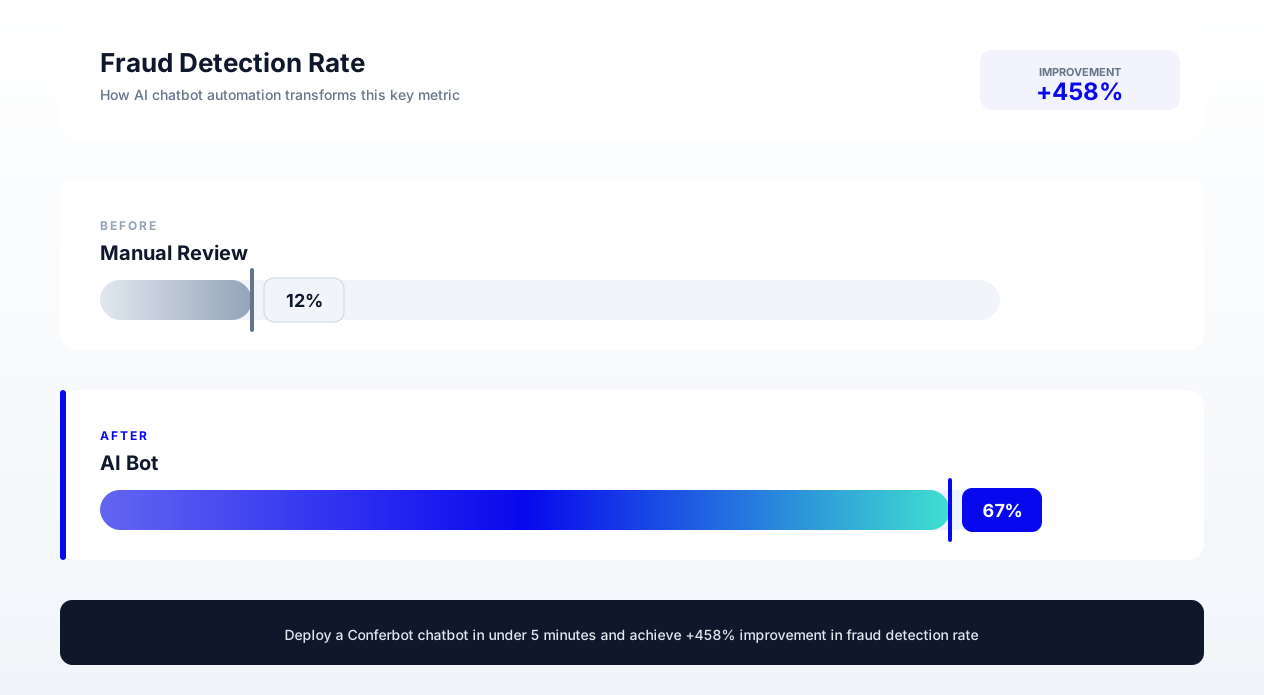
Warranty fraud costs manufacturers an estimated $2.4 billion annually in the United States alone, according to the Warranty Week 2025 fraud report. Common fraud types include claiming warranty on products purchased used, submitting doctored receipts, filing duplicate claims, misrepresenting defect causes (accidental damage claimed as manufacturing defect), and organized fraud rings that exploit warranty policies at scale. AI chatbots provide a powerful fraud detection layer that catches suspicious claims before they cost you money.
Behavioral Pattern Analysis
AI chatbots analyze conversation patterns that indicate potential fraud. Legitimate customers and fraudulent claimants exhibit different behavioral signatures:
Response timing: Fraudulent claimants often answer verification questions unnaturally quickly (reading from prepared scripts) or with suspicious delays (looking up information they should know about their own product). The chatbot tracks response timing as one signal in a multi-factor fraud score.
Language patterns: Legitimate customers describe problems in natural, specific language ("The screen started flickering last Tuesday when I was watching a video"). Fraudulent claims often use generic language that matches warranty documentation verbatim ("The product has a defect in materials and workmanship") or overly technical descriptions inconsistent with a typical consumer.
Claim history correlation: The chatbot cross-references against previous claims by the same customer, same address, same email domain, or same device. Multiple claims from the same household within a short period, claims for recently purchased products, or claims for products known to have high fraud rates trigger elevated scrutiny.
Document Verification AI
Modern chatbots employ computer vision and document analysis to validate submitted evidence:
Receipt authentication: AI analyzes receipt formatting, font consistency, mathematical accuracy (items add up to total), date formatting, and retailer-specific patterns to detect edited or fabricated receipts. Altered dates, mismatched fonts, or receipts that do not match known retailer formats are flagged automatically.
Photo forensics: The chatbot's image analysis can detect photo manipulation (cloning, splicing, metadata inconsistencies), verify that product serial numbers in photos match the claimed product, check that defect photos were taken recently (EXIF data analysis), and ensure the same defect photo has not been submitted in multiple claims.
Serial number validation: Cross-referencing claimed serial numbers against manufacturing databases reveals impossible claims—products with serial numbers that do not exist, products manufactured after the claimed purchase date, or serial numbers already associated with fulfilled claims.
Risk Scoring and Routing
Rather than binary approve/deny decisions, the chatbot assigns a fraud risk score (0-100) to each claim based on multiple signals. Low-risk claims (score 0-25) proceed through automated processing. Medium-risk claims (26-60) are processed but flagged for spot-check review. High-risk claims (61-100) are routed to a fraud investigation team with a detailed summary of suspicious indicators.
This graduated approach ensures that legitimate customers are not burdened with excessive verification while fraudulent claims are caught before payout. Businesses implementing AI fraud detection in warranty claims typically see a 35 to 50% reduction in fraudulent payouts, representing savings of $3 to $8 per legitimate claim processed (fraud costs are distributed across all claims as a cost of doing business).
Balancing Security and Customer Experience
The critical challenge in warranty fraud detection is avoiding false positives that frustrate legitimate customers. The chatbot must be configured with appropriate sensitivity thresholds—too aggressive and good customers feel accused; too lenient and fraud passes through. Best practice is to use fraud signals to adjust the verification process rather than to deny claims outright. A high-risk score might trigger additional verification questions or document requests rather than an immediate denial, allowing legitimate customers to prove their claim while making fraud significantly harder to execute.
Cost Savings Model: Quantifying the ROI of Warranty Chatbot Automation
Understanding the financial impact of warranty chatbot automation requires modeling both direct cost savings and indirect benefits, following ROI frameworks recommended by Gartner's customer service research. Below is a comprehensive ROI framework that you can adapt to your specific business parameters.
Direct Cost Savings
| Cost Category | Before Automation | After Chatbot Implementation | Savings |
|---|---|---|---|
| Agent labor (claims processing) | $35 per claim x 5,000 claims/month = $175,000 | $35 x 1,100 escalated claims = $38,500 | $136,500/month (78%) |
| Agent labor (status inquiries) | $10 per inquiry x 11,500 inquiries/month = $115,000 | $10 x 575 complex inquiries = $5,750 | $109,250/month (95%) |
| Document re-collection (incomplete submissions) | $15 per follow-up x 3,100 cases/month = $46,500 | $15 x 310 cases = $4,650 | $41,850/month (90%) |
| Fraud losses | $8 per claim x 5,000 claims = $40,000 | $4.50 per claim x 5,000 = $22,500 | $17,500/month (44%) |
| After-hours staffing | $25,000/month (overnight and weekend coverage) | $0 (chatbot handles 24/7) | $25,000/month (100%) |
Total direct monthly savings: $330,100
Annual direct savings: $3,961,200
Implementation Costs
| Investment | One-Time Cost | Monthly Ongoing |
|---|---|---|
| Chatbot platform (Conferbot Enterprise) | $0 | $2,500 |
| Integration development | $25,000 | $0 |
| Conversation design and testing | $15,000 | $0 |
| Training and change management | $10,000 | $0 |
| Ongoing optimization and maintenance | $0 | $3,000 |
Total first-year investment: $116,000
Ongoing annual cost: $66,000
ROI Calculation
First-year ROI: ($3,961,200 - $116,000) / $116,000 = 3,315% ROI
Ongoing annual ROI: ($3,961,200 - $66,000) / $66,000 = 5,902% ROI
Payback period: $116,000 / ($330,100/month) = 10.6 days
Indirect Benefits (Conservative Estimates)
Beyond direct cost savings, warranty chatbot automation drives additional value:
Customer retention improvement: Faster warranty resolution increases repurchase rates by 12 to 18%. For a business with $50M annual revenue and 35% repeat customer rate, a 15% improvement in repeat purchase rate generates $2.6M in additional annual revenue.
Agent redeployment: Agents freed from repetitive warranty tasks can be redeployed to revenue-generating activities (proactive outreach, complex sales support, VIP customer management). The revenue impact depends on redeployment strategy but typically ranges from $2,000 to $5,000 per redirected agent monthly.
Data insights: Automated claim data collection provides structured analytics on product failure patterns, enabling proactive quality improvements that reduce future warranty costs. Companies with warranty analytics programs see 8 to 15% year-over-year reductions in claim rates as they address root causes.
For detailed case studies showing these savings in action, see our analysis of real chatbot cost savings implementations across multiple industries.
Customer Experience Improvements: From Frustration to Loyalty
Cost savings alone justify warranty chatbot implementation, but the customer experience improvements create long-term competitive advantages that compound over time. Here is how chatbot automation transforms the warranty experience from a brand liability into a loyalty driver.
Speed: From Days to Minutes
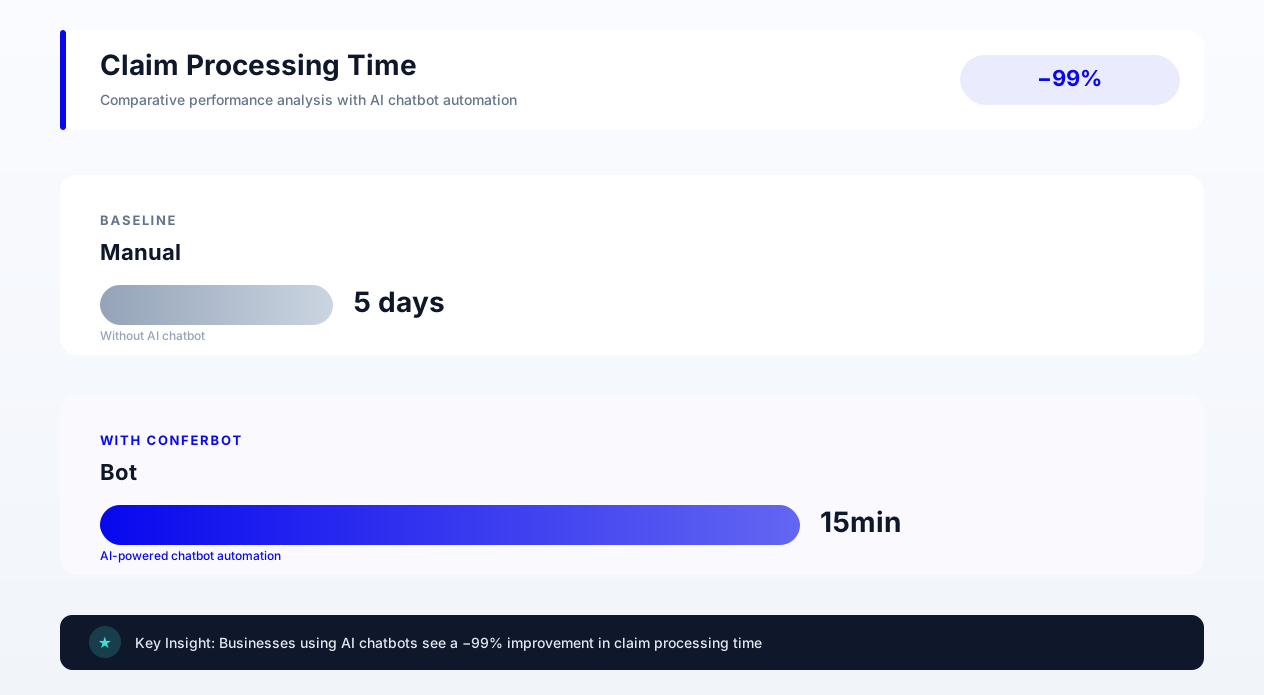
The most dramatic improvement is resolution speed. Traditional warranty claims take 7 to 14 days from submission to resolution. AI chatbots reduce this to minutes for simple claims and 1 to 2 days for complex ones. This speed improvement directly impacts customer satisfaction:
According to Zendesk's customer experience research, 72% of customers want immediate resolution to their problems, and 60% say that long wait times are the most frustrating aspect of customer service. A warranty chatbot that resolves eligible claims in under 5 minutes delivers an experience that exceeds customer expectations rather than merely meeting them.
Accessibility: Any Time, Any Channel
Warranty issues do not occur during business hours. A dishwasher leaks at 10 PM. A phone screen cracks on a Saturday morning. A laptop fails during a critical Sunday deadline. Traditional warranty processes force customers to wait until Monday—stewing in frustration and forming negative brand associations. AI chatbots are available 24/7 across every channel: website chat, WhatsApp, SMS, Facebook Messenger, and mobile apps. Customers can initiate and complete claims whenever the need arises.
Transparency: No More Black Box Processing
Traditional warranty processes feel opaque to customers. They submit a claim and hear nothing for days or weeks, wondering if their claim was received, if it is being processed, or if it was denied without notification. Chatbots provide complete transparency: real-time status visibility, clear explanations of each processing stage, specific timelines with proactive updates, and immediate notification of decisions with detailed reasoning.
This transparency eliminates the anxiety that generates repeated support contacts and negative reviews. Customers who understand where their claim stands and what happens next are 3.5x less likely to leave negative feedback compared to customers left in the dark.
Consistency: Same Quality Every Time
Human agents have bad days, knowledge gaps, and varying levels of empathy. The 50th warranty call of a shift gets less patience than the first. Chatbots deliver consistent quality regardless of volume, time of day, or customer demeanor. Every customer receives the same thorough, patient, accurate service whether they are the first claim of the day or the ten-thousandth.
Personalization: Remembering Every Interaction
The chatbot remembers every previous interaction, purchase, preference, and communication. A returning customer does not need to re-explain their product history—the chatbot already knows what they own, previous issues they have reported, and their preferred communication style. This creates a personalized experience that feels attentive and respectful of the customer's time.
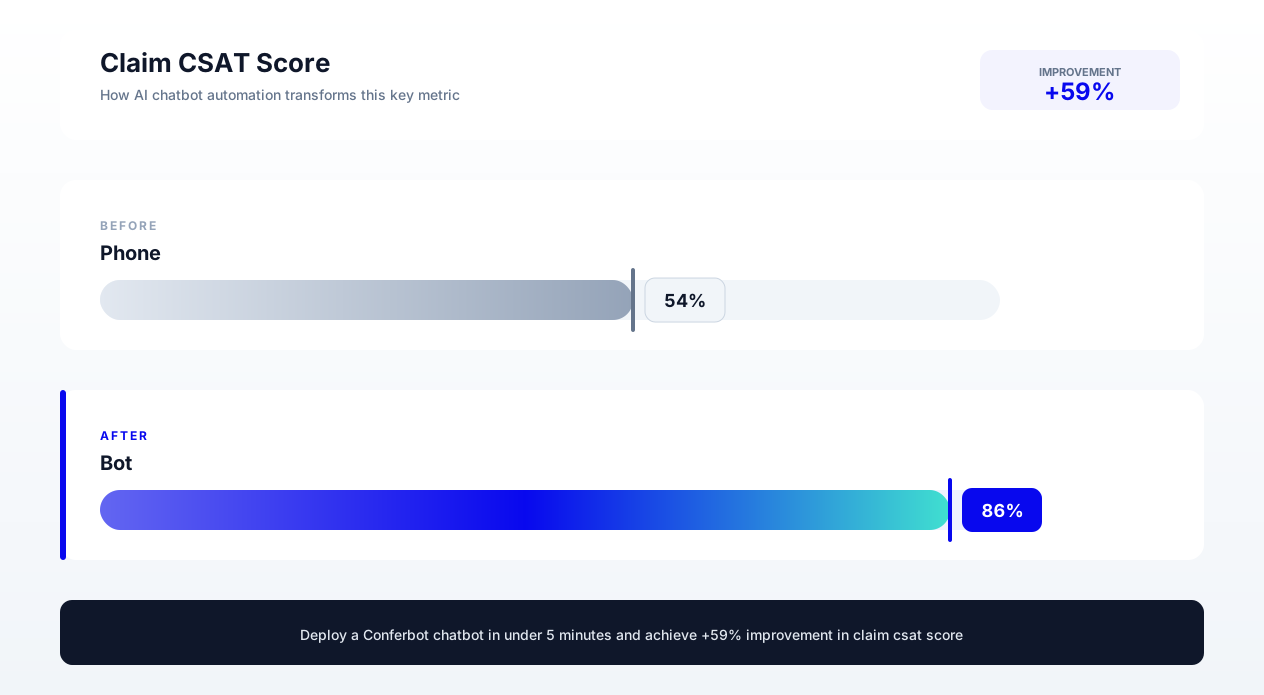
The combined effect of these experience improvements is measurable: companies implementing warranty chatbots report average CSAT score increases of 23 to 35 points, NPS improvements of 15 to 25 points, and warranty-related negative review reductions of 60 to 80%. These metrics translate directly into customer lifetime value increases and positive word-of-mouth that reduces acquisition costs.
Implementation Guide: Deploying Your Warranty Claims Chatbot
Implementing a warranty claims chatbot requires careful planning across conversation design, system integration, policy configuration, and change management, following best practices outlined by the IBM chatbot implementation guide. Here is a phased approach that minimizes risk while delivering value quickly.
Phase 1: Foundation (Weeks 1-2)
Define scope and policies: Document your current warranty policies in chatbot-readable format. For each product category, specify: warranty duration, coverage inclusions and exclusions, resolution options (replace, repair, refund), required documentation, and escalation criteria. This policy documentation becomes the chatbot's decision-making rulebook.
Map current workflows: Document existing claim flows end-to-end, identifying every decision point, information requirement, and system interaction. This reveals which steps are automatable immediately and which require human judgment.
Select integration priorities: Based on your technology stack, identify which systems need integration first. Priority order is typically: product/warranty database (for eligibility verification), claims management system (for claim creation and tracking), fulfillment system (for resolution execution).
Phase 2: Build and Configure (Weeks 3-4)
Design conversation flows: Create chatbot conversation scripts for each major warranty scenario: new claim submission, eligibility check, status inquiry, document upload, escalation request. Use branching logic to handle variations within each flow. Test flows with real historical claims to ensure they handle edge cases.
Configure integrations: Connect the chatbot to backend systems using APIs, webhooks, or middleware. Implement data mapping between chatbot conversation fields and system record fields. Test data flow in both directions (chatbot reading system data, chatbot writing to systems).
Set up fraud detection rules: Configure fraud scoring thresholds, define which signals contribute to the score, and establish routing rules for different risk levels. Start with conservative thresholds (low false positive rate) and tune over time.
Phase 3: Test and Validate (Weeks 5-6)
Internal testing: Run the chatbot through your complete catalog of warranty scenarios using test data. Verify eligibility determinations are accurate, documents are properly collected and stored, claims are correctly created in backend systems, and status tracking reflects real-time system state.
Pilot with real customers: Deploy to a limited segment (10-20% of traffic) and monitor performance. Track automation rate, escalation rate, customer satisfaction, and resolution accuracy. Compare outcomes to manual processing benchmarks.
Iterate and optimize: Based on pilot data, refine conversation flows, adjust escalation thresholds, and fix integration issues. Common pilot findings include: conversation dead-ends for unusual product types, integration timeouts during peak hours, and customer confusion about document requirements.
Phase 4: Full Deployment (Weeks 7-8)
Gradual rollout: Increase chatbot coverage from pilot segment to full traffic over 1-2 weeks. Monitor key metrics at each expansion step: automation rate (target: 70%+), escalation rate (target: less than 30%), CSAT (target: equal to or better than manual), resolution accuracy (target: 99%+).
Agent retraining: As the chatbot handles routine claims, retrain agents for complex scenarios that require human judgment. Agents should understand how to interpret chatbot-collected data, how to handle escalations with full context, and how to override chatbot decisions when appropriate.
Communication to customers: Announce the new warranty claims capability through email, website banners, and product documentation. Emphasize speed and convenience benefits. Provide clear instructions for customers who still prefer human assistance.
Phase 5: Optimization (Ongoing)
Continuous improvement: Monitor chatbot performance weekly. Identify conversations that result in customer frustration (repeated questions, abandoned flows, immediate escalation requests) and redesign those flows. Add new product categories, update policies as they change, and expand to additional channels based on customer demand.
With proper human handoff configuration, the chatbot seamlessly escalates to specialized warranty agents when needed—ensuring that automation enhances rather than replaces the human touch for complex situations. The goal is not to eliminate human involvement entirely but to reserve it for cases where human judgment, empathy, and creativity add genuine value.
How Conferbot Powers Warranty Claims Automation
Conferbot's AI chatbot platform is purpose-built for complex workflow automation like warranty claims processing. Here is how Conferbot's specific capabilities map to warranty claim requirements:
Multi-step conversation flows: Conferbot's visual flow builder supports the complex branching logic required for warranty claims—product identification, eligibility verification, document collection, and resolution determination all connected in a single coherent conversation that adapts to each customer's situation.
File upload and validation: Native support for photo and document uploads with real-time quality validation. Customers can submit receipt photos, product defect images, and serial number photos directly in the chat interface. AI-powered image analysis confirms that submitted photos meet requirements before the claim proceeds.
API integration framework: Conferbot connects to any warranty management system through its REST API integration layer. Pre-built connectors for popular platforms (ServiceBench, Tavant, Salesforce Service Cloud) accelerate implementation, while the custom API builder handles proprietary systems.
Omnichannel deployment: Deploy your warranty chatbot across your website, WhatsApp, Facebook Messenger, SMS, and mobile app from a single conversation design. Customers can start a claim on one channel and continue on another without losing progress.
Analytics and reporting: Real-time dashboards show claim volumes, automation rates, resolution times, customer satisfaction scores, and cost savings. Identify trends in product failures, common customer pain points, and opportunities for process optimization.
Enterprise security: SOC 2 Type II compliance, end-to-end encryption for document storage, role-based access controls, and complete audit trails satisfy enterprise security and compliance requirements for handling warranty claims and customer data.
Companies using Conferbot for warranty claims automation typically achieve 75 to 85% automation rates within 60 days of deployment, with ongoing optimization pushing rates above 90% for straightforward claim types. The platform's combination of conversational AI intelligence and robust integration capabilities makes it uniquely suited for the complex, multi-step workflows that warranty claims require.
Ready to transform your warranty claims process? Learn how Conferbot also automates returns and refunds using the same platform and integration infrastructure.
Was this article helpful?
AI Chatbot for Warranty Claims FAQ
Everything you need to know about chatbots for ai chatbot for warranty claims.
About the Author

Conferbot Team specializes in conversational AI, chatbot strategy, and customer engagement automation. With deep expertise in building AI-powered chatbots, they help businesses deliver exceptional customer experiences across every channel.
View all articles