The Return and Refund Problem: Why E-Commerce Needs Automation Now
Returns are the silent profit killer of e-commerce. According to the National Retail Federation's 2025 report, online return rates average 20 to 30 percent across categories, with fashion reaching 40 percent in some segments. For a business processing $10 million in annual online revenue, that means $2 to $3 million in products flowing backward through the supply chain—each one generating support tickets, shipping labels, warehouse processing, and refund transactions that consume agent time and operational resources.
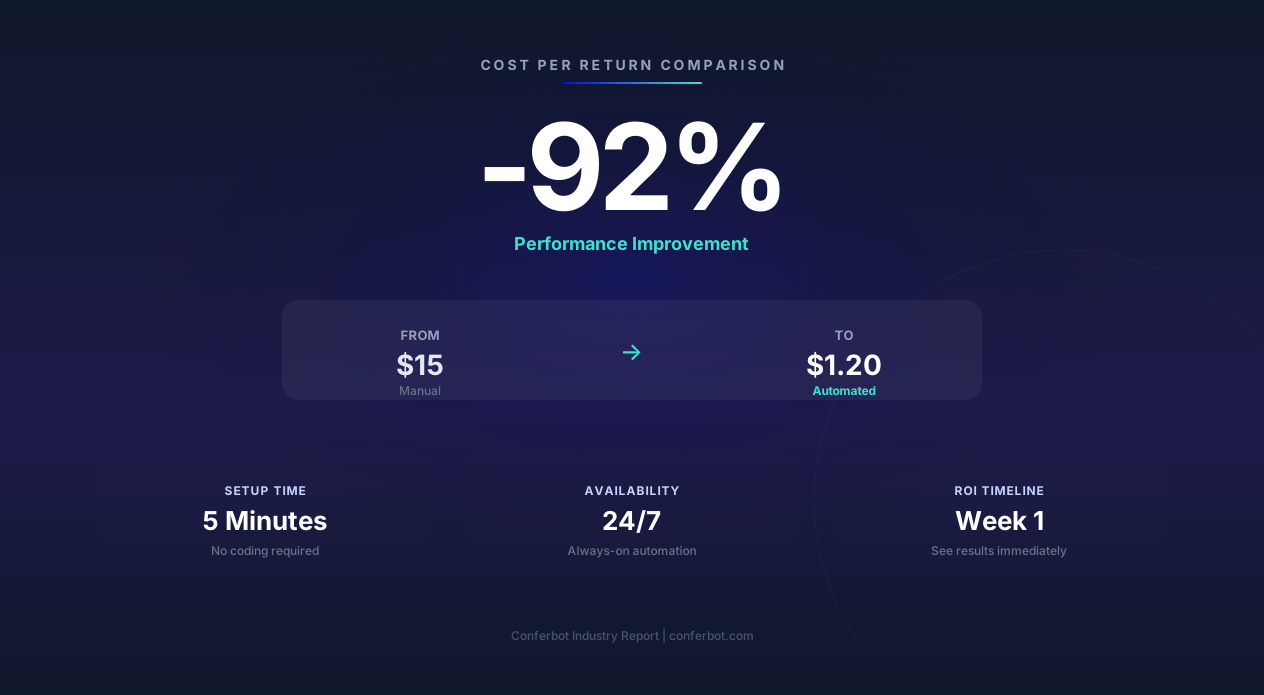
The human cost is staggering. Industry data shows the average return request takes 8 to 12 minutes of agent time when handled manually—from reading the request, verifying eligibility, looking up the order, applying policy rules, generating return labels, and issuing refunds or exchanges. At an average support agent cost of $22 per hour (fully loaded), each manually handled return costs $2.93 to $4.40 in labor alone, before shipping and restocking expenses.
Now multiply that by volume. A mid-size e-commerce business processing 500 return requests per week spends $76,000 to $114,000 annually just on the labor to process those returns. And that is before considering the customer experience impact: wait times, inconsistent policy application, and the frustration of navigating complex return processes that drive customers to competitors.
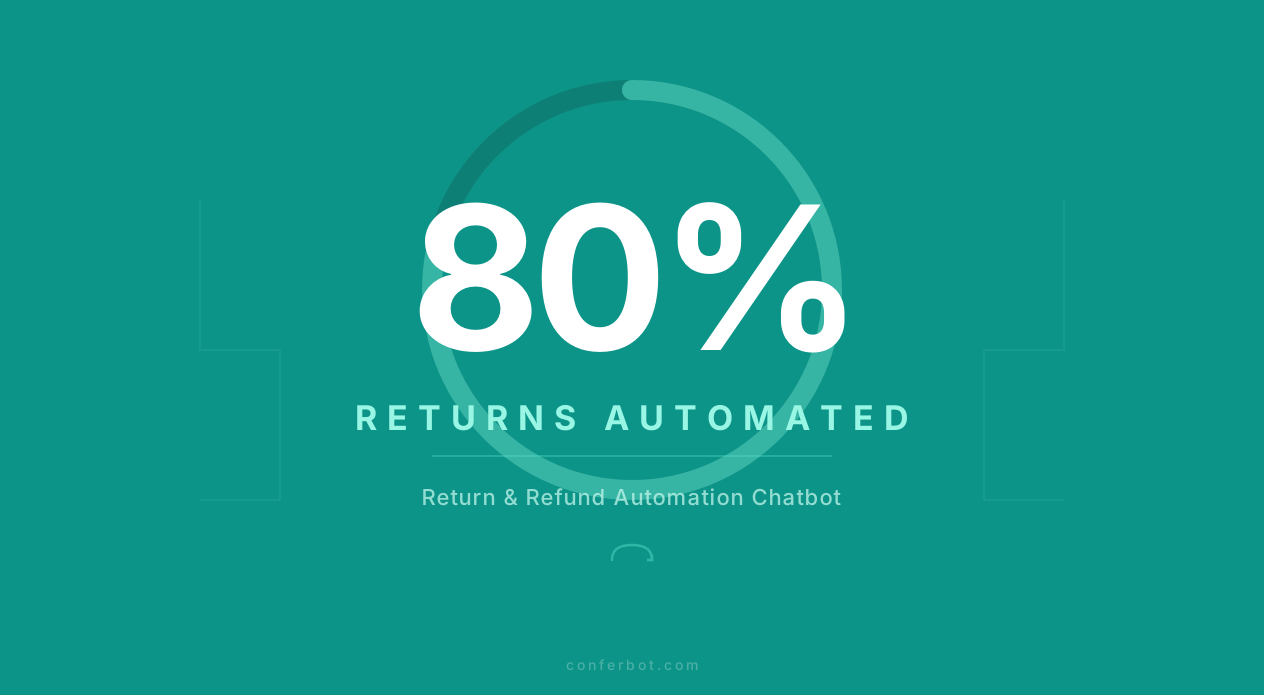
This is where return and refund automation chatbots transform the economics entirely. By handling the 80 percent of returns that follow standard, policy-compliant patterns, chatbots free human agents to focus on the complex 20 percent that genuinely require judgment, empathy, and exception handling. The result: 60 percent reduction in return-related support costs, 24/7 instant processing (no more waiting until Monday for a weekend return), and paradoxically, higher customer satisfaction because the process becomes frictionless.
In this guide, we will cover everything you need to know about implementing a return and refund automation chatbot: the volume statistics that build the business case, the specific flows that can be automated, policy enforcement strategies, shipping and logistics integration, fraud detection capabilities, exchange-first strategies that preserve revenue, detailed cost savings models, and a step-by-step implementation guide. Whether you process 50 returns per week or 5,000, the principles and ROI apply at every scale.
Return Request Volume: Understanding the Scale of the Problem
Before designing a solution, you need to understand the scope of the problem. Here is a data-driven breakdown of return volumes and patterns across e-commerce categories:
| Product Category | Average Return Rate | Primary Return Reason | Percent Automatable |
|---|---|---|---|
| Fashion and Apparel | 25 to 40% | Size or fit issues (52%) | 85% |
| Electronics | 15 to 20% | Product not as described (38%) | 75% |
| Home and Furniture | 10 to 15% | Damaged in shipping (45%) | 70% |
| Beauty and Cosmetics | 8 to 12% | Allergic reaction or wrong shade (41%) | 80% |
| Sports and Outdoors | 12 to 18% | Size or fit issues (48%) | 82% |
| Books and Media | 5 to 8% | Received wrong item (55%) | 90% |
| Food and Beverage | 3 to 5% | Damaged or spoiled (62%) | 75% |
| Toys and Games | 8 to 12% | Defective product (35%) | 78% |
The "Percent Automatable" column is critical—it represents the portion of returns in each category that follow standard patterns where no human judgment is required. These are returns that meet eligibility criteria (within time window, product in returnable condition, customer provides valid reason) and can be processed end-to-end by a chatbot: verify eligibility, generate return label, provide shipping instructions, and process refund upon receipt confirmation.
According to Statista's 2025 e-commerce data, the total value of returned merchandise in the United States alone exceeded $743 billion, with online returns accounting for approximately $280 billion. The operational cost of processing these returns—labor, shipping, restocking, and value depreciation—averages 59 percent of the original item price. Automation addresses the labor component directly and reduces the other costs through faster processing and better routing.
Seasonal Return Patterns
Return volumes are not constant—they spike predictably after major shopping events:
- Post-holiday (January): Return volumes increase 2.5 to 4x compared to normal months, with the first two weeks of January being the peak period
- Post-BFCM (December): Impulse purchases during Black Friday and Cyber Monday generate return spikes 2 to 3 weeks later
- Post-Prime Day: Similar impulse-driven return spike approximately 2 weeks after major sale events
- End of season: Seasonal clearance purchases have 30% higher return rates than full-price purchases
These spikes make automation even more critical. Hiring temporary support staff for seasonal return surges is expensive (recruitment, training, quality inconsistency) and slow. A chatbot scales instantly—handling 500 returns per day with the same quality and speed as 50 returns per day, with zero additional cost.
Which Return Flows Can a Chatbot Fully Automate?
Not every return scenario is suitable for full automation, as Baymard Institute's e-commerce UX research demonstrates. The key is identifying which flows are rules-based (follow deterministic policy logic) versus judgment-based (require human discretion). Here is a comprehensive mapping:
Fully Automatable Flows (80% of volume)
1. Standard Return Within Policy Window: Customer requests return within the allowed timeframe, product is in eligible condition, and the reason is a standard category (does not fit, changed mind, found better price). The chatbot verifies eligibility, confirms the return reason, generates a prepaid shipping label, provides packaging instructions, and confirms the refund timeline. Zero human touch required.
2. Exchange for Different Size or Color: The most common return reason in fashion (52% of returns). The chatbot checks if the desired size or color is in stock, processes the exchange, generates the return label for the original item, and ships the replacement—often before the return arrives, if inventory allows.
3. Damaged or Defective Product Claims (with photo verification): Customer reports damage or defect. The chatbot requests a photo, uses image recognition to verify visible damage, and processes an immediate replacement or refund without requiring the damaged item to be shipped back (for items under a cost threshold). This saves return shipping costs on items that cannot be resold anyway.
4. Wrong Item Received: Customer received a different product than ordered. The chatbot verifies by asking for the item name or barcode on the package, cross-references with the order, and processes immediate reshipping of the correct item plus a return label for the wrong item.
5. Order Cancellation (pre-shipment): Customer wants to cancel before the order ships. The chatbot checks fulfillment status via the warehouse management system. If not yet shipped, it cancels immediately and processes the refund. If already shipped, it transitions to the standard return flow.
6. Refund Status Inquiry: Customer asking about the status of a previously initiated return. The chatbot checks tracking, warehouse receipt confirmation, and refund processing status—providing real-time updates without any agent involvement.
Partially Automatable Flows (15% of volume)
7. Out-of-Policy Returns: The chatbot can gather information and assess whether the case qualifies for an exception (VIP customer, manufacturing defect discovered late, goodwill gesture for loyal customer). For cases that do not meet exception criteria, the chatbot explains the policy compassionately. For borderline cases, it escalates to a human with full context pre-gathered.
8. High-Value Item Returns: Returns above a certain value threshold (e.g., over $500) may require human approval for fraud prevention. The chatbot handles all the information gathering and eligibility verification, then routes to a human for final approval—reducing the human handling time from 12 minutes to 2 minutes.
Human-Required Flows (5% of volume)
9. Disputes and Escalations: Customer disagrees with return eligibility determination, claims the product is counterfeit, or requires a complex resolution involving multiple orders or partial refunds. These require human empathy and judgment.
10. Legal or Regulatory Returns: Returns involving product recalls, safety issues, or regulatory compliance requirements that need documented human oversight.
The critical insight is that the 80% of fully automatable flows consume the most agent time in aggregate because they are high-volume and repetitive. By automating these, you achieve disproportionate cost savings while improving speed and consistency for the majority of customers. For the flows that require human involvement, the chatbot's pre-gathering of information cuts handling time by 60 to 75 percent even when escalation occurs. Learn more about building effective customer self-service chatbot portals that handle these flows seamlessly.
Policy Enforcement via Chatbot: Consistent, Fair, and Customer-Friendly
One of the biggest challenges with human-handled returns is inconsistent policy application, a pain point highlighted by Shopify's returns management research. Different agents interpret policies differently, leading to unfair outcomes (some customers get exceptions while identical cases are denied) and policy erosion (agents grant exceptions too freely to avoid difficult conversations). A chatbot applies policies with perfect consistency while still being customer-friendly in its communication.
How Chatbot Policy Enforcement Works
The chatbot encodes your return policy as decision logic:
Time eligibility check: Order placed on date X, today is date Y, policy allows returns within Z days. If Y minus X is less than or equal to Z, the return is eligible. If not, the chatbot explains the policy clearly and offers alternatives (store credit, exchange, escalation to manager for exceptional circumstances).
Condition eligibility: The chatbot asks specific questions about product condition: "Is the product in its original packaging? Has it been used or worn? Are all tags still attached?" Based on answers, it determines eligibility or requests photos for verification.
Category restrictions: Some product categories have different return rules (final sale items, personalized products, hygiene products). The chatbot checks the product category against rule sets and explains category-specific policies when applicable.
Return reason routing: Different reasons trigger different flows. "Does not fit" routes to the size exchange flow (preserving revenue). "Defective" routes to the damage verification flow. "Changed mind" routes to the standard return flow. Each reason has appropriate policies and response templates.
Policy Communication That Maintains Satisfaction
The key to chatbot policy enforcement is not just applying rules—it is communicating them in a way that maintains customer satisfaction even when the answer is "no." Here are proven frameworks:
Empathy first, policy second: "I understand how frustrating it must be to receive an item that does not meet your expectations. Let me check what options are available for you." This acknowledges the customer's feeling before discussing policy constraints.
Options, not rejections: Instead of "Your return is not eligible because it is past the 30-day window," the chatbot says: "The standard return window has passed, but I have a few options for you: I can offer store credit, connect you with a specialist who may be able to help, or process an exchange for a different item."
Transparency about reasoning: "Our 30-day return window is designed to ensure product quality for all customers. Since your purchase was 45 days ago, I cannot process a standard refund, but here is what I can do..." Explaining the why behind the policy builds understanding.
Exception Handling Framework
Even with strict automation, you need an exception framework. The chatbot should grant automatic exceptions in specific scenarios:
- VIP or high-LTV customers: Customers above a certain lifetime value threshold get extended windows automatically
- First-time return: Customers making their first-ever return get more flexibility (policy window extended by 7 days)
- Shipping delays: If delivery was delayed (verified via tracking), the policy window starts from delivery date, not order date
- Manufacturing defects: Defective products are eligible for return regardless of time window (verified via photo)
For cases that do not meet automatic exception criteria but involve a borderline situation, the chatbot should offer to escalate: "This falls slightly outside our standard policy, but I would like to connect you with a specialist who has more flexibility. They will have all the details of your case so you will not need to repeat anything." This maintains the customer relationship while respecting policy boundaries. For best practices on seamless agent handoff, see our guide on chatbot-to-human handoff strategies.
Integration with Shipping and Logistics: Automated Label Generation and Tracking
A return automation chatbot needs tight integration with your shipping and logistics infrastructure to deliver a truly end-to-end automated experience. Here is how the integration architecture works across the return lifecycle.
Return Label Generation
When a return is approved, the chatbot must generate a prepaid return shipping label instantly—no waiting for an email, no manual downloads. Integration with major carriers enables this:
- UPS: UPS Returns API generates prepaid return labels with customizable service levels (Ground, 2-Day, Next Day) based on product value and urgency
- FedEx: FedEx Returns Technology API creates labels with multiple drop-off or pickup options presented to the customer
- USPS: USPS Web Tools API generates Pay-on-Use return labels (you only pay when the label is actually used)
- Regional carriers: Integration with DHL, Royal Mail, Australia Post, and other regional carriers for international returns
The chatbot presents the label in the most convenient format for the customer: as a downloadable PDF, a QR code that can be shown at the carrier location, or instructions for scheduling a carrier pickup at their door. The optimal format depends on customer preference and carrier availability in their area.
Drop-Off Location Intelligence
Modern return chatbots go beyond just generating labels—they help customers find the most convenient drop-off point. Using the customer's zip code and carrier integrations, the chatbot can say: "I have generated your return label. The nearest UPS drop-off is 0.3 miles from you at the CVS on Main Street. They are open until 9 PM tonight. Would you like directions?"
This small convenience factor significantly impacts actual return completion rates. Research from Narvar's State of Returns report shows that returns with location guidance have 23% higher completion rates and 1.8 days faster average return transit time compared to returns with just a generic label.
Real-Time Tracking Integration
Once a return is shipped, the chatbot provides proactive status updates without requiring the customer to ask:
- Package picked up or dropped off: "Your return package has been scanned by UPS. Estimated delivery to our warehouse: Thursday."
- In transit updates: Automated tracking check with notification if delays are detected
- Received at warehouse: "We have received your return package. Your refund will be processed within 2 business days."
- Refund processed: "Your refund of $67.50 has been issued to your original payment method. Please allow 3 to 5 business days for it to appear on your statement."
Warehouse Management System Integration
For the refund to be processed accurately, the chatbot system needs integration with your warehouse management system (WMS) or returns processing center:
- Receipt confirmation: When the warehouse scans the returned item, the system verifies the contents match the return authorization
- Condition inspection results: The warehouse grades the item's condition. If it matches the customer's description, the refund processes automatically. If it does not match (customer said "unworn" but item shows wear), the system flags for human review
- Inventory restock: Items in resalable condition are automatically restocked and made available for sale again, reducing the window of inventory unavailability
International Returns Complexity
International returns add layers of complexity that the chatbot must handle: customs declarations, duties refund processing, longer transit times, and carrier limitations. A well-integrated return chatbot handles these by detecting the customer's country, selecting appropriate international return carriers, generating customs paperwork automatically, and setting accurate refund timeline expectations (international refunds typically take 10 to 15 business days rather than 3 to 5).
Return Fraud Detection: Protecting Revenue While Maintaining Customer Trust
Return fraud costs retailers an estimated $24 billion annually in the United States alone, according to the NRF's 2025 data. While automation enables faster processing, it also requires intelligent fraud detection to prevent abuse. Here is how chatbot-based fraud detection works without creating friction for legitimate customers.
Types of Return Fraud
Wardrobing: Purchasing items (especially apparel) with the intent to wear once and return. The item is returned technically within policy but has been used. Estimated to account for 35% of return fraud according to Appriss Retail's fraud analysis.
Receipt fraud: Returning stolen merchandise using fraudulent receipts or manipulated order confirmations. Less relevant for online returns with order verification but still a concern for in-store returns of online orders.
Price arbitrage: Buying a product on sale, then returning a previously purchased identical item at full price using the sale receipt. The chatbot verifies the specific order ID and item against the return to prevent this.
Empty box fraud: Claiming to have returned an item but shipping an empty or weighted box. Integration with warehouse inspection prevents this from resulting in fraudulent refunds.
Serial returning: Customers who return an extraordinarily high percentage of purchases, effectively using the retailer as a free try-on service with no intent to keep items.
Chatbot-Powered Fraud Signals
The chatbot system monitors multiple signals to assess fraud risk for each return request:
| Fraud Signal | Detection Method | Risk Score Impact |
|---|---|---|
| Return frequency above 3x average | Customer history analysis | High risk |
| High-value items returned repeatedly | Order pattern analysis | High risk |
| Return reason inconsistencies | NLP analysis of stated reasons vs. product category | Medium risk |
| Return within 24 hours of delivery | Timestamp analysis | Medium risk (possible wardrobing) |
| Photo evidence mismatch | Image AI comparing submitted photos to product catalog | High risk |
| Multiple accounts same address | Address clustering analysis | High risk |
| Return rate above 50% of purchases | Customer lifetime return rate | Medium to high risk |
Risk-Based Processing Tiers
Rather than blocking suspected fraud outright (which creates terrible experiences for legitimate customers wrongly flagged), the chatbot uses a tiered approach:
Low risk (0 to 30 score): Fully automated processing. Instant label generation, refund on shipment confirmation. This covers 85% of returns.
Medium risk (31 to 60 score): Automated processing with additional verification. The chatbot requests photos of the item and packaging, verifies condition before generating the return label. Refund processed upon warehouse receipt and inspection. This covers 10% of returns.
High risk (61 to 100 score): Human review required. The chatbot gathers all information and routes to a specialist with the fraud signals highlighted. The specialist makes the final decision. This covers 5% of returns.
This approach catches fraudulent returns without penalizing the 95% of customers who are returning legitimately. The key is that the experience for low and medium-risk customers remains fast and frictionless—they never know a fraud check occurred in the background.
Fraud Prevention Through Conversation Design
The chatbot's conversation design itself can deter fraud without explicitly accusing anyone. When the chatbot asks specific questions like "Can you confirm the item is in its original packaging with tags attached?" and "Please upload a photo of the item showing its current condition," it signals to potential fraudsters that verification is occurring, which deters many opportunistic attempts without creating friction for legitimate returners who are happy to provide this information.
Exchange-First Strategy: Preserve Revenue by Offering Alternatives
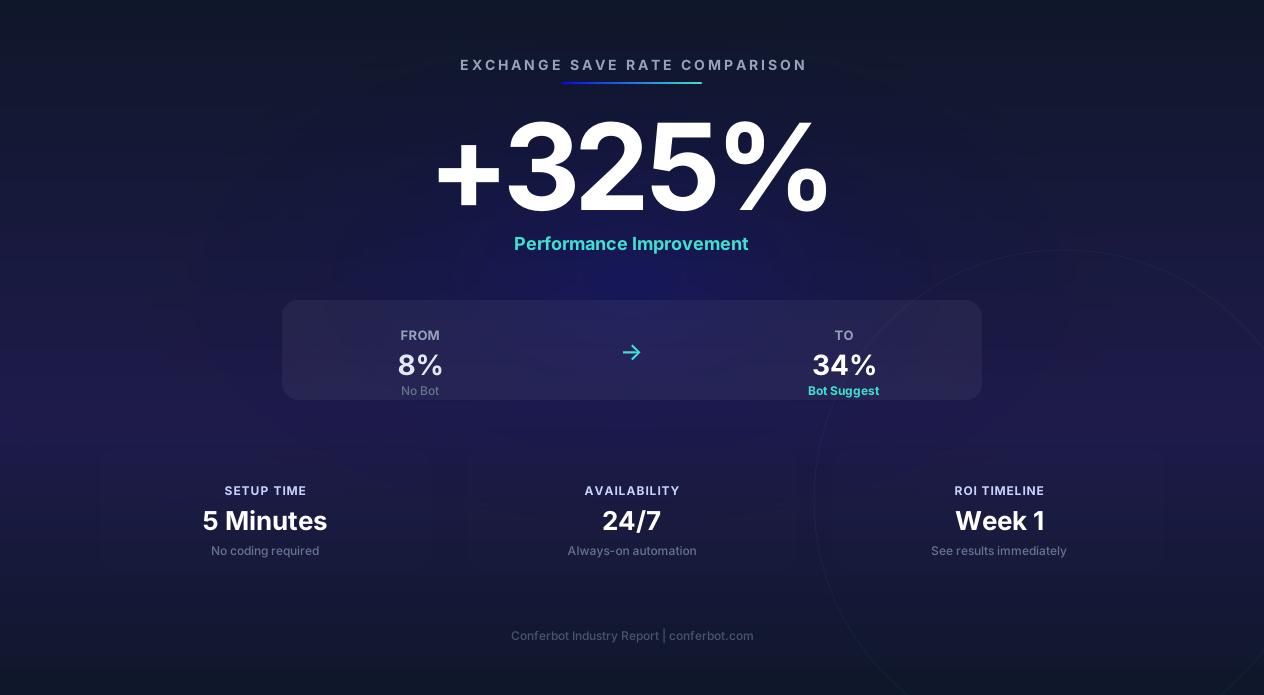
Every return that becomes an exchange instead of a refund preserves revenue, a strategy that National Retail Federation research shows can recover 20-30% of otherwise lost sales. Data from leading e-commerce platforms shows that 30 to 45 percent of return requests can be converted to exchanges when the right alternative is offered at the right moment. A well-designed chatbot implements an exchange-first strategy that benefits both the business (preserved revenue) and the customer (faster resolution, better-fitting product).
How Exchange-First Conversations Work
When a customer initiates a return, the chatbot's first response is not "I will process your refund." Instead, it explores whether an exchange might better serve the customer's needs:
Size and fit returns: "I see the medium did not fit right. Would you like to try a different size? I can ship the new size today and you can return the original once it arrives—no need to wait."
Color or style returns: "I understand this was not quite what you expected. We have 4 other colorways in this style—would you like to see them? I can do a direct swap with free shipping."
Quality or defect returns: "I am sorry about the defect. I can send a replacement of the same item immediately, or if you prefer, I can suggest a similar product from our premium line that customers rate even higher."
Changed mind returns: "No problem! Before I process the refund, would you like to exchange for something else? You will get free shipping on the exchange, and I can recommend some popular alternatives in the same category."
Exchange Incentive Strategies
Smart chatbots offer incentives that make exchanges more attractive than refunds:
- Instant shipping: Ship the exchange item before the return arrives (for trusted customers), eliminating the wait time that makes refunds more attractive
- Free upgrade shipping: Offer expedited shipping on exchanges at no extra cost (standard shipping for refund, express for exchange)
- Bonus credit: "If you choose an exchange, I will add $5 store credit to your account for the inconvenience"
- Extended return window on exchange: "Your exchange will come with a fresh 60-day return window, so you have plenty of time to decide"
Revenue Preservation Metrics
| Metric | Without Exchange-First Strategy | With Exchange-First Chatbot | Revenue Impact |
|---|---|---|---|
| Returns resulting in refund | 85% | 55% | 30% revenue preserved |
| Returns resulting in exchange | 12% | 38% | Direct revenue retention |
| Returns resulting in store credit | 3% | 7% | Future revenue secured |
| Average exchange order value | Same as original | 12% higher than original | Additional upsell on exchange |
| Post-exchange customer satisfaction | 72/100 | 84/100 | Improved retention |
The numbers speak clearly: an exchange-first chatbot strategy converts 30 percentage points of would-be refunds into exchanges, preserving significant revenue. For a business processing $500,000 in monthly returns, this strategy retains approximately $150,000 per month in revenue that would otherwise walk out the door.
Additionally, the 12% higher exchange order value represents a cross-sell opportunity within the return flow itself. When a customer exchanges a $60 dress for a different style, the chatbot can suggest that the new style pairs beautifully with a $20 accessory—and acceptance rates on these in-exchange cross-sells are surprisingly high (22%) because the customer is already in a "shopping" mindset. For more on upselling strategies during customer interactions, see our guide to e-commerce chatbot strategies.
Cost Savings Model: Quantifying the Financial Impact of Return Automation
Building a compelling business case for return automation requires hard numbers. Here is a detailed cost savings model you can adapt to your business metrics.
Current State Cost Analysis
First, calculate your current return handling costs:
Direct labor cost per return:
- Average agent handling time: 10 minutes per return request
- Fully loaded agent cost (salary plus benefits plus tools plus management): $25/hour
- Labor cost per return: $4.17
Indirect costs per return:
- Queue wait time impact on CSAT: -3 to 5 CSAT points per 5 minutes of wait
- Email response delay (average 24 hours) causing customer to contact again: 1.3 contacts per return resolution
- Training cost for return policy knowledge: $500 per agent, amortized across return volume
- Quality assurance and auditing: $0.50 per return
- Inconsistent policy application error correction: $0.75 per return
Total cost per manually handled return: $5.42 to $7.15
Automated State Cost Analysis
With chatbot automation handling 80% of returns:
Automated returns (80% of volume):
- Chatbot platform cost per interaction: $0.15 to $0.30
- API costs (shipping label, payment processor): $0.40
- Infrastructure cost: $0.05
- Total cost per automated return: $0.60 to $0.75
Human-handled returns (20% of volume):
- Pre-gathered context reduces handling time to 4 minutes: $1.67 labor
- Higher complexity returns (exception handling, disputes): $2.50 average
- Total cost per human-handled return: $4.17
Blended Cost and Savings Calculation
| Business Size | Monthly Returns | Current Monthly Cost | Automated Monthly Cost | Monthly Savings | Annual Savings |
|---|---|---|---|---|---|
| Small (Shopify store) | 200 | $1,264 | $407 | $857 | $10,284 |
| Mid-size | 1,000 | $6,320 | $1,434 | $4,886 | $58,632 |
| Large | 5,000 | $31,600 | $6,170 | $25,430 | $305,160 |
| Enterprise | 20,000 | $126,400 | $23,680 | $102,720 | $1,232,640 |
Additional Revenue Impact
Beyond direct cost savings, return automation generates additional revenue through:
- Exchange conversion: 30% of returns converted to exchanges at average $65 order value = significant retained revenue
- Faster refund processing: Instant automated processing reduces chargebacks by 40% (customers file chargebacks when refunds take too long)
- Improved CSAT driving retention: 15% higher satisfaction scores for automated returns (instant vs. 24-hour wait) leads to 8% higher repeat purchase rate
- Agent reallocation: Freed agents can be redeployed to high-value activities (proactive outreach, upselling, VIP support) generating $3 to $5 per hour in additional value
For more detailed ROI analysis frameworks and real-world savings examples, see our chatbot cost savings case studies.
Customer Satisfaction Impact: Why Automated Returns Score Higher Than Human-Handled
Counter-intuitively, customers rate automated return experiences higher than human-handled ones. This seems paradoxical—surely a human agent provides better service than a bot? The data tells a different story, and understanding why reveals important principles about what customers actually value in return experiences.
Why Automation Wins on Satisfaction
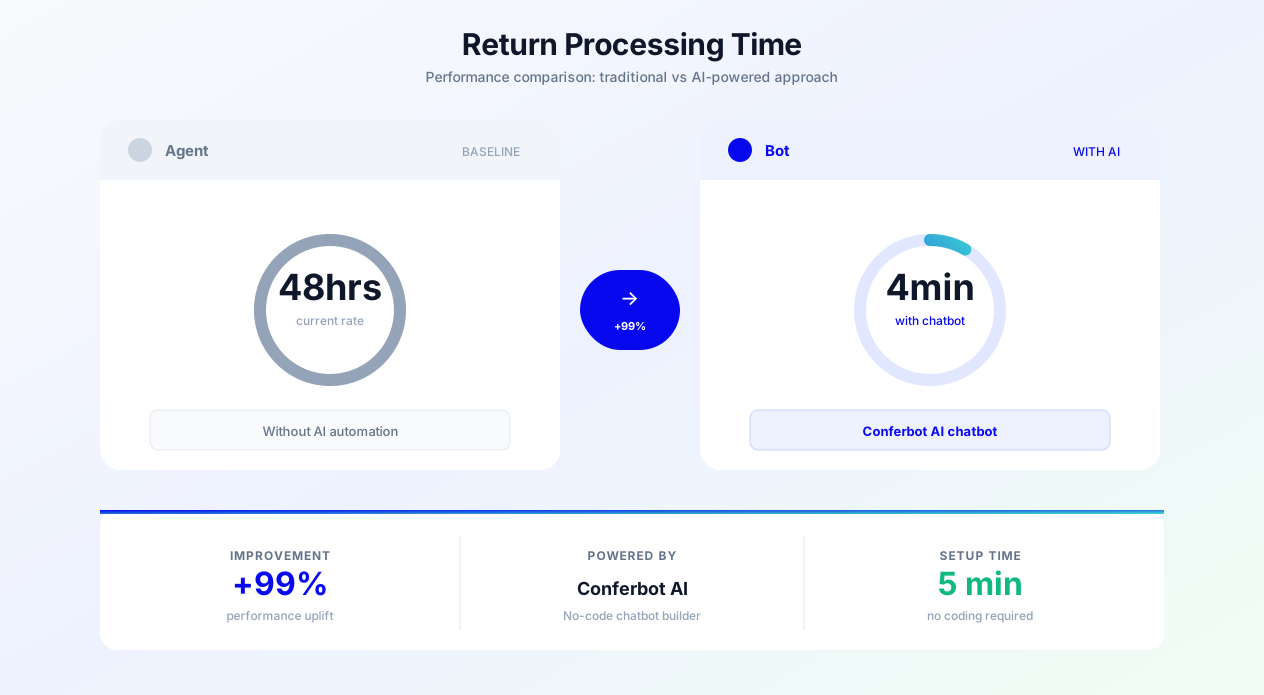
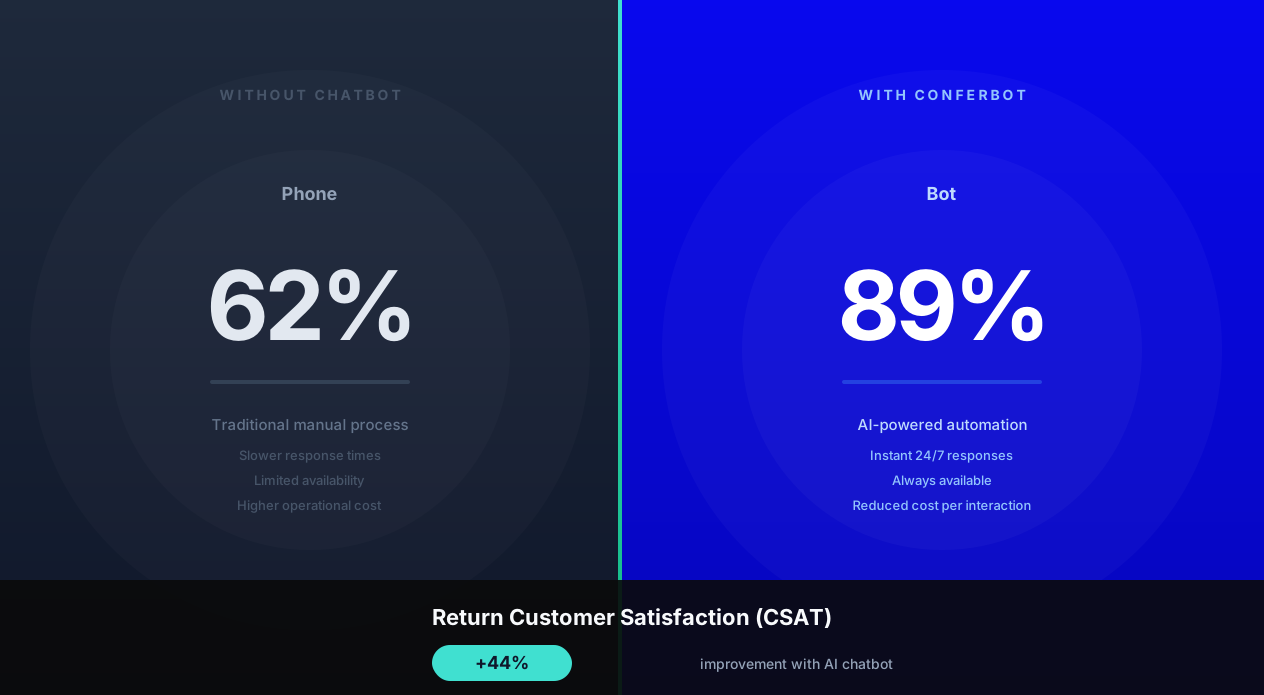
Speed is the number one driver of return satisfaction. According to Forrester's CX research, the single biggest predictor of return satisfaction is resolution speed—not empathy, not flexibility, not agent friendliness. Customers initiating a return have already decided they want their money back or a different product. They do not want a conversation—they want resolution. A chatbot that processes a return in 90 seconds outscores a friendly agent who takes 15 minutes (including wait time) on every satisfaction metric.
24/7 availability eliminates timing friction. 43% of return decisions happen outside business hours—on evenings and weekends when customers inspect purchases, try on clothing, or unbox electronics. A chatbot processes these returns immediately rather than making customers wait until Monday at 9 AM, or worse, making them remember to call back during business hours.
Consistency eliminates perceived unfairness. When different agents give different answers to the same question, customers who get the unfavorable response feel cheated. Chatbots apply policies identically every time, eliminating the frustration of "but the last agent said yes."
No hold times and no transfers. The most hated aspects of customer service—waiting on hold and being transferred between agents—simply do not exist in chatbot interactions. The experience starts immediately and resolves in one continuous conversation.
Satisfaction Metrics Comparison
| Metric | Human-Handled Returns | Chatbot-Automated Returns | Difference |
|---|---|---|---|
| CSAT score (out of 100) | 72 | 84 | +12 points |
| Average resolution time | 14 minutes (plus wait) | 90 seconds | 89% faster |
| First-contact resolution rate | 78% | 94% | +16 percentage points |
| Customer effort score (1 to 7, lower is better) | 4.2 | 2.1 | 50% less effort |
| Post-return repeat purchase rate (30 days) | 34% | 41% | +7 percentage points |
| Negative review likelihood after return | 18% | 7% | -11 percentage points |
The 7 percentage point increase in repeat purchase rate is particularly significant—it means that automated return handling actually drives future revenue by preserving the customer relationship. A smooth, frictionless return experience signals to customers that the brand is trustworthy and easy to work with, reducing the perceived risk of future purchases.
The Exception: When Humans Still Win
There is one category where human agents consistently outperform chatbots on satisfaction: emotionally charged situations where the customer is genuinely upset (defective expensive product, safety concern, repeated issues). In these cases—approximately 5 to 10 percent of returns—human empathy matters. This is why the optimal approach is automation for the 80 to 90 percent of routine returns, with seamless handoff to humans for emotionally complex cases. The chatbot should detect frustration signals (aggressive language, repeated attempts, escalation requests) and route to humans proactively.
Implementation Guide: Deploying a Return Automation Chatbot in 4 Weeks
Here is a practical implementation timeline for deploying a return and refund automation chatbot that handles 80% of your return volume from day one.
Week 1: Policy Digitization and Flow Mapping
Days 1 and 2: Document your complete return policy
- Map every return eligibility rule (time windows, condition requirements, category exceptions)
- Document exception criteria (who gets exceptions, under what circumstances)
- Identify all return reasons and their corresponding flows (refund, exchange, store credit)
- Define fraud thresholds and risk tiers
Days 3 and 4: Map conversation flows
- Design the main return initiation flow (order lookup, reason selection, eligibility check)
- Design the exchange-first branching flow
- Design the refund processing flow (label generation, timeline communication)
- Design edge case flows (out-of-policy, high-value, damaged items requiring photos)
- Design escalation flow with context handoff to human agents
Days 5 through 7: Identify integration requirements
- Order management system API for order lookup and status
- Shipping carrier APIs for label generation (UPS, FedEx, USPS)
- Payment processor API for refund issuance
- Warehouse management system API for receipt confirmation
- Customer data platform for purchase history and risk scoring
Week 2: Platform Setup and Integration
Days 8 through 10: Configure Conferbot platform
- Set up the chatbot project with return-specific intent recognition
- Build conversation flows in the visual flow builder
- Configure eligibility logic rules and policy decision trees
- Set up response templates for each scenario (approved, denied, exchange offer)
Days 11 through 14: Connect integrations
- Integrate order management system for real-time order lookup
- Connect shipping carrier APIs and test label generation
- Integrate payment processor for automated refund processing
- Set up webhook for warehouse receipt confirmation
- Connect fraud detection scoring system
- Test end-to-end flow with sample orders
Week 3: Testing and Refinement
Days 15 through 17: Comprehensive QA testing
- Test every conversation path with realistic scenarios
- Verify label generation across all carriers and regions
- Confirm refund processing works correctly for all payment methods
- Test fraud detection triggers (do not block legitimate returns)
- Mobile testing (60% or more of returns are initiated on mobile)
- Test escalation handoff—verify context transfers completely to human agent
Days 18 through 21: Pilot with subset of returns
- Route 20% of return requests to the chatbot (remaining 80% still go to human agents)
- Monitor completion rates, error rates, and escalation frequency
- Gather customer feedback on automated experience
- Identify and fix conversation dead-ends or confusion points
- Verify refund accuracy (correct amounts, correct payment methods)
Week 4: Optimization and Full Launch
Days 22 through 25: Optimize based on pilot data
- Refine conversation language based on where customers drop off or escalate
- Adjust eligibility logic if edge cases were missed
- Optimize exchange-first prompts based on conversion data
- Fine-tune fraud detection thresholds (reduce false positives if legitimate customers are being flagged)
Days 26 through 28: Scale to full volume
- Increase chatbot routing from 20% to 50% to 100%
- Monitor performance metrics at each scaling step
- Ensure human agent queue shrinks proportionally (reallocate freed capacity)
- Set up automated monitoring and alerting for anomalies
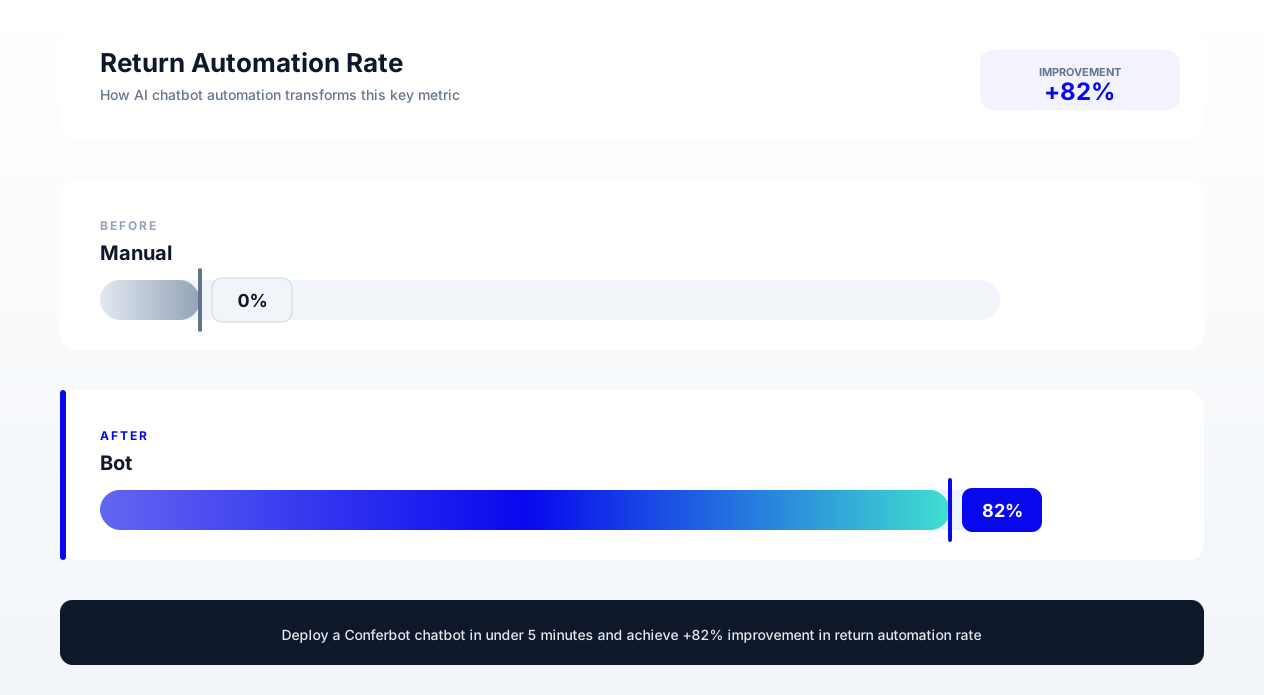
By end of week 4, your chatbot should be handling 80% of return requests fully automatically, with the remaining 20% receiving human handling enhanced by chatbot-gathered context. For guidance on reducing overall support ticket volume beyond returns, see our comprehensive guide on reducing support tickets with chatbots.
Measuring Success: KPIs for Return Automation
Track these key performance indicators to measure and optimize your return automation chatbot:
Operational Efficiency KPIs
- Automation rate: Percentage of returns handled end-to-end without human intervention. Target: 75 to 85%
- Average resolution time: From customer initiation to return label generated. Target: under 2 minutes
- First-contact resolution: Percentage resolved without escalation or follow-up. Target: 90%+
- Escalation rate: Percentage routed to human agents. Target: under 20%. If higher, investigate common escalation reasons and add automation for those scenarios.
- Error rate: Percentage of returns processed incorrectly (wrong refund amount, invalid label). Target: under 1%
Financial KPIs
- Cost per return: Blended cost across automated and human-handled returns. Target: 60%+ reduction vs. pre-automation baseline
- Exchange conversion rate: Percentage of return requests converted to exchanges. Target: 30 to 40%
- Revenue retained through exchanges: Dollar value of orders preserved via exchange-first strategy
- Chargeback reduction: Decrease in payment disputes due to faster refund processing. Target: 30 to 50% reduction
- Agent time savings: Hours of agent time freed per week, and value of reallocation activities
Customer Experience KPIs
- Return CSAT: Customer satisfaction score specifically for the return experience. Target: 80+ (out of 100)
- Customer effort score: How much effort the customer perceives. Target: under 2.5 (on 7-point scale)
- Post-return repeat purchase rate: Customers who buy again within 30 days of a return. Target: 35%+ (indicating the return experience did not damage the relationship)
- Return completion rate: Percentage of initiated returns that are actually shipped back (higher is better—it means the process is easy enough that customers follow through rather than abandoning or doing chargebacks)
Reporting Cadence
Review operational metrics daily during the first month, then weekly. Review financial metrics weekly during the first month, then monthly. Review customer experience metrics monthly. Set up automated alerts for any metric that deviates more than 15% from target in either direction (drops indicate problems; unexpected improvements should be investigated and replicated).
How Conferbot Handles Return and Refund Automation
Conferbot provides purpose-built return automation capabilities designed for e-commerce businesses of all sizes, from Shopify stores to enterprise retailers.
Intelligent Return Initiation
Customers can initiate returns through natural language: "I want to return my order" or "This shirt does not fit" or "I received the wrong item." Conferbot's NLU understands the intent regardless of how it is phrased, identifies the relevant order automatically (or asks to look it up if the customer is not authenticated), and begins the appropriate flow.
Automated Policy Engine
Configure your return policy once—Conferbot applies it perfectly every time. Set time windows, condition requirements, category rules, exception criteria, and escalation triggers through a visual policy builder. The engine evaluates eligibility in milliseconds and communicates the result clearly and empathetically.
Carrier Integration Hub
Native integrations with UPS, FedEx, USPS, DHL, and regional carriers for instant return label generation. Customers receive labels via their preferred method (email, in-chat download, QR code) within seconds of return approval. Drop-off location finder included.
Exchange-First Intelligence
Before processing any refund, Conferbot's exchange-first module checks inventory for alternatives and presents relevant options to the customer. The system learns which exchange suggestions convert best for each product category and continuously optimizes its recommendations.
Fraud Detection Layer
Built-in risk scoring evaluates every return request against behavioral patterns, return history, and order characteristics. Low-risk returns process instantly; medium-risk returns get additional verification; high-risk returns route to human review with all evidence pre-gathered.
Seamless Human Handoff
When escalation is needed, Conferbot transfers the full conversation context—order details, return reason, eligibility determination, fraud score, customer history, and sentiment analysis—to the human agent. The customer never repeats themselves, and the agent resolves the issue in 2 to 3 minutes rather than 10 to 12 minutes.
Whether you are processing 50 returns per month or 50,000, Conferbot scales seamlessly. Start automating your returns today and redirect your support team's energy toward activities that genuinely require human creativity and empathy.
Was this article helpful?
Return and Refund Automation Chatbot FAQ
Everything you need to know about chatbots for return and refund automation chatbot.
About the Author

Conferbot Team specializes in conversational AI, chatbot strategy, and customer engagement automation. With deep expertise in building AI-powered chatbots, they help businesses deliver exceptional customer experiences across every channel.
View all articles