
Financial Literacy Educator
Free Finance Chatbot Template
A complete financial literacy educator chatbot template - deploy in minutes to automate conversations, capture leads, and provide 24/7 assistance.



How this template opens - rendered from its flow. Use the interactive preview to click through the full conversation.
What Is a Financial Literacy Educator Chatbot?
A financial literacy educator chatbot is a conversational AI system designed to teach personal finance concepts through interactive, personalized dialogue rather than static courses or generic articles. It covers the complete spectrum of personal financial knowledge - budgeting fundamentals, debt management strategies, credit score optimization, investment principles, retirement planning, tax efficiency, and financial goal setting - adapting its teaching approach, complexity level, and examples to each learner's current knowledge level, financial situation, and specific goals. In 2026, with most Americans living paycheck to paycheck and only a small minority able to correctly answer FINRA's basic financial literacy quiz questions, the need for accessible, engaging financial education has never been more critical.
Why Financial Literacy Delivery Needs Conversational AI
Traditional financial education fails for a specific reason: it delivers generic content to diverse audiences with vastly different starting points, priorities, and learning styles. A 22-year-old with student debt and a 55-year-old concerned about retirement readiness have fundamentally different financial education needs, yet most financial literacy programs put them through the same curriculum. The result is high dropout rates for online financial courses and low knowledge retention at 30 days, a pattern well documented in financial education research.
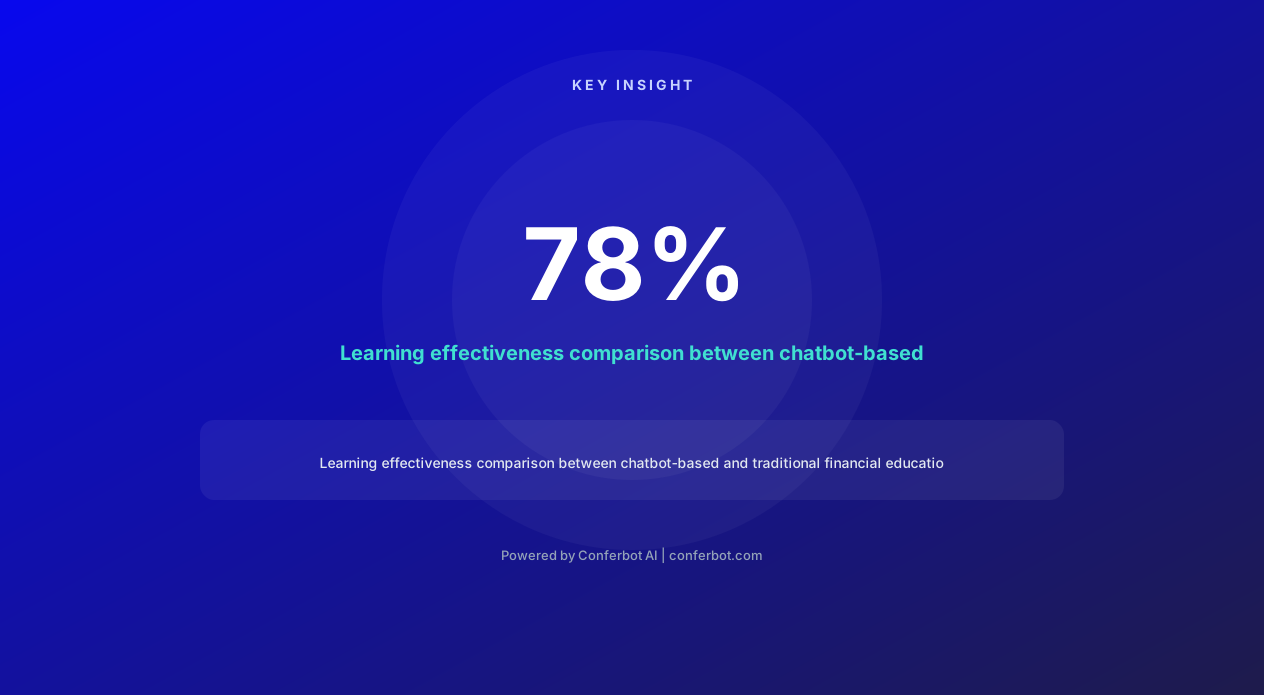
The chatbot solves this through personalization at scale. By assessing each learner's current knowledge, financial situation, and immediate goals at the start of the conversation, it delivers education that is immediately relevant and personally applicable. A learner struggling with credit card debt receives debt management strategies with calculations based on their actual balances and interest rates. A learner saving for a home receives guidance on down payment strategies, mortgage qualification requirements, and timeline planning specific to their income and savings rate. This personalization drives dramatically higher knowledge retention at 30 days than the traditional course retention rate because learners apply concepts to their real situations rather than absorbing abstract principles.
Who Deploys This Template
- Banks and credit unions: Educate customers to improve financial health, reduce delinquencies, and build loyalty through value-added financial guidance.
- Financial wellness platforms: Deliver personalized education as a core product feature for employee benefits programs and consumer applications.
- Nonprofit financial counseling organizations: Scale one-on-one counseling capacity without proportional staff increases.
- Schools and universities: Supplement personal finance curricula with interactive practice and real-world application.
- Employers offering financial wellness benefits: Provide employees with financial education that reduces financial stress and improves productivity.
- Government agencies: Deliver financial literacy programs to underserved communities through accessible conversational interfaces.
Deploy on your website for always-available financial education, or on WhatsApp for micro-learning delivered in daily bite-sized lessons. Built with Conferbot's AI chatbot builder with adaptive learning logic that adjusts difficulty and topic selection based on learner progress and engagement patterns.
How the Financial Literacy Educator Chatbot Works
The financial literacy educator uses an adaptive learning approach that combines assessment-driven personalization, spaced repetition for retention, real-world application exercises, and progressive complexity increases as the learner demonstrates mastery. Unlike linear courses that present material in fixed sequence, the chatbot dynamically selects topics, adjusts explanation depth, and determines pacing based on continuous assessment of the learner's comprehension and engagement.
Stage 1: Financial Knowledge Assessment
The conversation begins with a brief assessment that establishes the learner's baseline knowledge across core financial literacy domains: budgeting (understanding income vs. expenses, fixed vs. variable costs), debt management (interest rate concepts, minimum payment trap, snowball vs. avalanche strategies), credit (score composition, factors that affect scores, credit report interpretation), investing (risk/return relationship, diversification, compound growth), and retirement planning (employer matching, tax-advantaged accounts, time value of money). The assessment uses scenario-based questions rather than textbook definitions - "If you have $1,000 and two debts, one at 5% and one at 22%, which would you pay first?" - to evaluate practical understanding rather than vocabulary memorization.
Stage 2: Goal-Driven Curriculum Design
After assessment, the chatbot asks about the learner's immediate financial goals and concerns: paying off debt, building an emergency fund, improving credit score, saving for a major purchase, starting to invest, or planning for retirement. These goals determine curriculum prioritization - a learner focused on credit improvement receives immediate education on credit score factors and actionable improvement strategies, while a learner focused on retirement receives compound growth demonstrations and account type comparisons. This goal-driven approach ensures every lesson feels relevant and immediately applicable, which is the primary driver of engagement and retention.
Stage 3: Adaptive Lesson Delivery
Lessons are delivered conversationally with built-in comprehension checks. The chatbot explains a concept, provides an example, asks a question to verify understanding, and adjusts based on the response. Correct answers advance to the next concept. Incorrect answers trigger re-explanation from a different angle with additional examples. The chatbot uses multiple explanation approaches for each concept - visual metaphors for visual learners, numerical examples for analytical learners, and real-life scenarios for experiential learners - selecting the approach most likely to resonate based on the learner's demonstrated preferences in earlier interactions.
Stage 4: Real-World Application Exercises
After concept delivery, the chatbot presents application exercises using the learner's actual financial situation (if shared) or realistic scenarios. A lesson on debt payoff strategies is followed by: "Based on the debts you mentioned - $4,200 on a credit card at 21% and $8,000 on a car loan at 5.5% - let's calculate which strategy saves you the most: paying minimum on everything and putting extra toward the highest rate, or paying off the smallest balance first for motivation. Which approach would you like to explore first?" These exercises transform abstract knowledge into concrete action plans.
Stage 5: Spaced Repetition and Progress Tracking
The chatbot implements spaced repetition - revisiting previously taught concepts at increasing intervals to strengthen long-term retention. A concept taught on Monday is briefly reviewed on Wednesday, then the following Monday, then two weeks later. These reviews are woven naturally into new lessons: "Last week we discussed emergency funds. Quick check - how many months of expenses is the recommended target? Great. Today we'll discuss where to keep that emergency fund for the best combination of accessibility and growth." This systematic review addresses the forgetting curve that makes traditional one-time courses ineffective for lasting behavior change.
Key Features of the Financial Literacy Educator Template
The financial literacy educator template includes capabilities specifically designed for effective financial knowledge transfer: adaptive difficulty scaling, multiple explanation modalities, progress-based curriculum sequencing, real-number personalization, and behavioral nudging that connects knowledge to action. These features collectively create a learning experience that produces measurable financial behavior improvement, not just information consumption.
Feature Matrix
| Feature | Description | Operational Benefit | Customer Benefit |
|---|---|---|---|
| Adaptive knowledge assessment | 15-question scenario-based assessment across 6 financial domains | Identifies knowledge gaps precisely for targeted curriculum delivery | Never wastes time on concepts already understood |
| Goal-driven curriculum engine | Prioritizes topics based on learner's stated financial goals | Higher completion rates from immediately relevant content | Every lesson feels directly applicable to current situation |
| Multi-modal explanations | Each concept explained through metaphors, numbers, and scenarios | Reaches diverse learning styles without separate content creation | Understands concepts through preferred learning approach |
| Real-number personalization | Uses learner's actual financial data in examples and calculations | Dramatically higher engagement from personally relevant content | Sees exactly how concepts apply to their specific finances |
| Spaced repetition scheduler | Reviews previous concepts at optimal intervals for retention | Measurably higher knowledge retention at 30/60/90 days | Actually remembers and applies what was learned |
| Behavioral action prompts | Translates each lesson into specific next-step actions | Converts knowledge into measurable behavioral change | Clear, achievable action items after every lesson |
| Progress gamification | Points, streaks, badges, and level progression for sustained engagement | Meaningfully higher daily return rates versus non-gamified delivery | Motivation through visible progress and achievement recognition |
| Financial calculator suite | Interactive calculators for debt payoff, compound growth, mortgage affordability | Demonstrates concepts with real math that builds conviction | See the actual numbers that prove financial strategies work |
| Micro-learning delivery | 5-7 minute daily lessons optimized for mobile and messaging platforms | Fits financial education into busy schedules without dedicated time blocks | Learn personal finance in coffee break sized sessions |
| Knowledge certification | Competency assessments with shareable certificates upon completion | Measurable program outcomes for reporting and program justification | Tangible proof of financial knowledge for personal satisfaction |
Real-Number Personalization Deep Dive
The most powerful engagement feature is real-number personalization - using the learner's actual financial data to demonstrate concepts. When teaching compound interest, the chatbot does not use textbook examples with round numbers. Instead: "You mentioned you have $3,200 in a savings account earning 0.4%. In 30 years, that grows to $3,588 - just $388 in growth. If you moved that same $3,200 to a high-yield savings account at 4.5%, it grows to $11,907 - that is $8,319 more just from choosing a different account. And if you invested it in a diversified stock index fund averaging 10% annually, it becomes $55,771. Same starting amount, dramatically different outcomes based on where you put it." These personal calculations create moments of realization that abstract teaching cannot replicate.
This personalization extends across all topics: debt payoff calculations use actual balances and rates, retirement projections use actual income and current savings, credit improvement guidance references actual score ranges and specific factors affecting their score, and budget recommendations are based on actual income and expense categories. The learner sees their own financial future under different scenarios, making the consequences of financial decisions viscerally real rather than theoretical.
Ready to try Financial Literacy Educator?
Deploy this template in under 10 minutes. No coding required.
Use This Template Free →Before and After: Financial Education Effectiveness Metrics
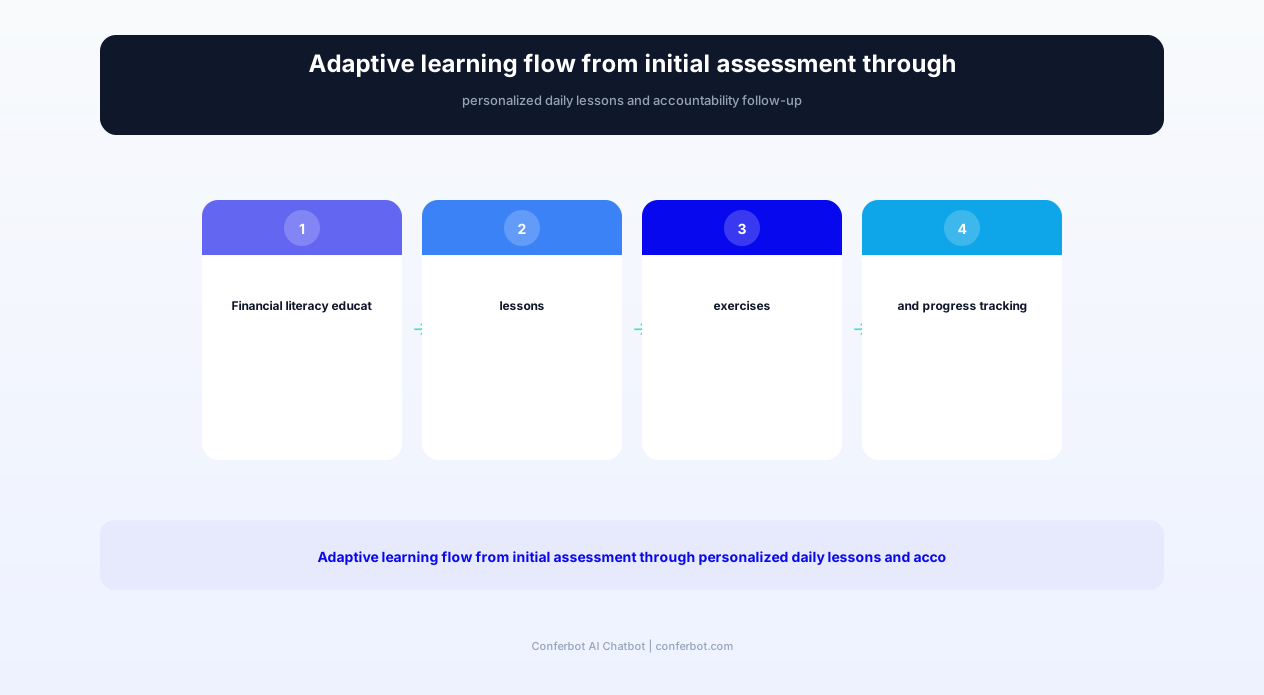
Organizations that deploy the financial literacy educator chatbot measure improvements across learning effectiveness metrics (knowledge retention, behavioral change) and business metrics (engagement rates, program completion, measurable financial outcomes for participants). The chatbot's personalized, conversational approach produces dramatically better outcomes than traditional financial education delivery methods.
Performance Comparison: Traditional Financial Education vs. Chatbot Education
| Metric | Traditional Courses | Chatbot Education |
|---|---|---|
| Program completion rate | Low - most learners never finish | Substantially higher, driven by short daily sessions |
| Knowledge retention at 30 days | Low without reinforcement | Meaningfully higher with spaced repetition |
| Knowledge retention at 90 days | Very low | Meaningfully higher, sustained by ongoing review |
| Behavioral change (measurable action taken) | Rare | Substantially more common with accountability follow-up |
| Daily engagement rate | Occasional login at best | Frequent, near-daily interaction |
| Average time to complete core curriculum | Most abandon before finishing | Completed by most learners within weeks |
| Learner satisfaction score | Middling | Consistently high |
| Credit score improvement (6-month follow-up) | Modest average gains | Larger average gains |
| Emergency fund established (participants with none) | Rarely by 6 months | Meaningfully more often by 6 months |
| Debt reduction (participants with consumer debt) | Modest average reduction at 6 months | Larger average reduction at 6 months |
Why Behavioral Change Rates Are Dramatically Higher
The gap in behavioral change - the metric that ultimately matters for financial education - reflects the chatbot's fundamental design difference: it does not just teach concepts but guides implementation. After every concept lesson, the chatbot presents a specific, achievable action: "Based on what we just discussed about high-yield savings accounts, here is your action item: move $500 from your Chase checking account to a Marcus or Ally savings account this week. It takes 10 minutes online and will earn you meaningfully more interest per year - that is your first step toward making your money work harder. Can you commit to doing this before our next session?" This action-oriented approach, combined with follow-up accountability ("Did you open that high-yield account we discussed?"), transforms education into behavior.
The Knowledge Retention Advantage
The gains in 30-day and 90-day knowledge retention demonstrate the effectiveness of the chatbot's spaced repetition and application exercise approach. Traditional courses deliver information in concentrated blocks and never revisit it - the well-documented forgetting curve erases most of what was learned within 30 days without reinforcement. The chatbot's systematic review schedule, combined with application exercises that require using previously learned concepts, creates durable neural pathways that persist months and years rather than days. Learners who complete the 42-day core curriculum demonstrate sustained financial knowledge improvement at 12-month follow-up assessments.
Financial Outcome Improvements
The most compelling metrics are real financial outcomes: meaningful average credit score improvement, a higher emergency fund establishment rate among participants who previously had no savings, and larger average debt reduction within 6 months. These outcomes reflect the chatbot's emphasis on actionable guidance rather than theoretical knowledge. Participants do not just learn about credit scores - they receive specific actions to improve their score (dispute errors, reduce utilization, request credit limit increases, avoid new applications) and are held accountable for implementation. The result is measurable financial improvement that justifies program investment for any organization deploying financial education.
Comprehensive Financial Literacy Curriculum
The chatbot's curriculum covers six major domains of personal finance, each containing multiple modules that progress from foundational concepts through advanced strategies. The curriculum is comprehensive enough to serve as a complete personal finance education while remaining accessible through conversational delivery and personalized pacing.
Domain 1: Budgeting and Cash Flow Management
The budgeting curriculum transforms the often-dreaded topic of budgeting into practical cash flow management that feels empowering rather than restrictive. Modules include: understanding income after taxes (the gap between gross and net that surprises many learners), categorizing expenses into needs, wants, and savings (the 50/30/20 framework with personalized adjustments), tracking spending without obsessive monitoring (the key insight that awareness changes behavior), building a budget that actually works (starting from actual spending rather than idealized targets), handling irregular income (freelancers, commission, seasonal work), and automating finances for effortless execution (the "set and forget" system that makes budgets sustainable).
Each module uses the learner's actual or estimated numbers: "Based on your $4,800 monthly take-home pay, the 50/30/20 framework suggests $2,400 for needs, $1,440 for wants, and $960 for savings and debt payoff. Let's look at your current spending to see where you are relative to these targets and identify the most impactful adjustments." This personalization makes budgeting feel like a strategy conversation rather than a lecture about discipline.
Domain 2: Debt Management and Elimination
The debt management curriculum acknowledges the emotional weight of debt while providing systematic strategies for elimination. Modules cover: understanding interest and how debt grows (the minimum payment trap demonstration - "Paying minimum on $5,000 at 21% means you will pay $7,800 total over 18 years"), choosing a payoff strategy (avalanche vs. snowball with personalized calculations for both), negotiating with creditors (when and how to request lower rates, settlement options for severely delinquent debt), student loan optimization (repayment plan selection, forgiveness programs, refinancing analysis), mortgage management (extra payment impact, biweekly payments, refinancing decision framework), and the relationship between debt payoff and investing (when to prioritize each).
Domain 3: Credit Score Mastery
The credit curriculum demystifies credit scoring and provides actionable strategies for score improvement. Modules include: how credit scores are calculated (the 5 factors with weighting), reading and disputing credit reports (how to obtain, review, and correct errors), strategies for building credit from scratch (authorized user, secured card, credit builder loan), optimizing credit utilization (the 30% myth versus the reality of per-card and overall utilization), managing credit mix and age (when to open new accounts, when to close), and advanced credit strategies (strategic credit limit requests, balance transfer optimization, garden period timing for mortgage applications). The chatbot provides specific guidance: "Your reported utilization of 67% is significantly hurting your score. If you can pay your Capital One card from $3,400 to $1,500 before the statement closes on the 15th, your utilization drops to 28% and your score should improve 30-50 points within one billing cycle."
Domain 4: Investing Fundamentals
The investing curriculum makes the stock market accessible to complete beginners while providing depth for intermediate investors. Modules cover: why investing matters (inflation erosion demonstration, compound growth visualization), risk and return relationship (what volatility means practically, historical market returns by time horizon), investment vehicles (stocks, bonds, mutual funds, ETFs - what each is and when to use it), asset allocation (age-appropriate allocation frameworks, risk tolerance assessment), index investing (why most professional fund managers underperform the index), getting started (account types, first investment selection, amount needed to begin), and common mistakes to avoid (timing the market, emotional selling, concentration risk, high-fee funds). Every concept is grounded in the learner's situation: "If you invest $200 per month starting now at age 28, by age 65 you'll have approximately $780,000 at historical average returns. If you wait until 35 to start the same amount, you'll have $430,000. That 7-year delay costs you $350,000."
Domain 5: Retirement Planning
The retirement curriculum addresses the most consequential long-term financial decision most people make - and the one most frequently neglected until it feels too late. Modules include: defining retirement needs (replacement ratio, lifestyle cost estimation), account types and their advantages (401k employer matching as "free money," Traditional vs. Roth IRA, HSA triple tax advantage), calculating your retirement number (the 25x rule, Monte Carlo simulation concepts), Social Security optimization (claiming age strategies, spousal benefits, the impact of timing), catch-up strategies for late starters (maximizing contributions, expense reduction, working longer analysis), and withdrawal strategies in retirement (the 4% rule, Roth conversion ladders, Required Minimum Distributions). The chatbot makes distant concepts immediate: "Your employer matches 50% up to 6% of your salary. You're currently contributing 3%. By increasing to 6%, you get an extra $1,800 per year in free money - that is a guaranteed 50% return on your increased contribution."
Domain 6: Tax Optimization
The tax curriculum teaches strategies for legally minimizing tax burden - a topic that directly affects net wealth but receives minimal attention in traditional financial education. Modules cover: understanding marginal tax brackets (the common misconception that earning more can net you less), tax-advantaged accounts strategy (optimal ordering of 401k, Roth IRA, HSA, and taxable accounts), common deductions and credits (standard vs. itemized, education credits, child credits, energy credits), self-employment tax strategy (estimated payments, business deductions, retirement account options), capital gains optimization (holding periods, tax-loss harvesting, asset location), and estate planning basics (beneficiary designations, gifting strategies, basic will and trust concepts). Each lesson connects to the learner's tax situation: "In the 22% bracket, every dollar you contribute to your Traditional 401k saves you $0.22 in taxes this year while growing tax-deferred until retirement."
Engagement System and Learning Gamification
The chatbot's engagement system addresses the fundamental challenge of financial education: it is important but rarely urgent, making it easy to deprioritize. Through gamification mechanics, habit-building structures, and social accountability features, the chatbot maintains daily engagement over the 42-day core curriculum and beyond into ongoing financial mastery.
Daily Learning Streak System
The streak system leverages loss aversion - one of the most powerful behavioral motivators - to build consistent learning habits. Each day the learner interacts with the chatbot, their streak increases. Visual progress indicators show the current streak alongside their longest streak, and milestone celebrations occur at 7, 14, 21, 30, and 60 days. Habit formation research shows that sustained daily behavior over the first few weeks is what makes a habit loop stick. The chatbot targets this early window with increasing engagement intensity - more frequent reminders, shorter lessons, and quicker rewards - to establish the daily habit before reducing external motivation as the internal habit takes over.
Points and Level Progression
Learners earn points for: completing daily lessons (50 points), answering comprehension questions correctly (25 points), completing action items (100 points - the highest reward for actual behavior change), maintaining streaks (bonus points at milestones), and helping others (points for sharing knowledge or encouraging peers in group deployments). Points accumulate toward levels (Financial Beginner → Budget-Aware → Debt Warrior → Investment Ready → Wealth Builder → Financial Master) that unlock increasingly advanced content and features. This progression system provides visible evidence of growth that motivates continued engagement.
Achievement Badges
Badges reward specific accomplishments rather than just participation: "First Budget Created," "Emergency Fund Started," "Credit Score Improved 50 Points," "First Investment Made," "Debt-Free Achievement," "Six-Month Streak," and topic mastery badges for completing each curriculum domain. These badges are shareable for platforms that support social features, creating peer influence effects where one person's badge achievement motivates their network to engage with the chatbot. Achievement badges tied to real financial actions (not just learning) reinforce the connection between education and behavior that drives outcomes.
Micro-Learning Architecture
The chatbot delivers education in 5-7 minute daily sessions - the optimal duration for retention without attention fatigue. Each micro-session contains: a brief review of the previous lesson's key concept (30 seconds), the new concept with personalized example (3 minutes), a comprehension check question (30 seconds), a practical application exercise (1.5 minutes), and a specific action item for that day (30 seconds). This structure fits into any schedule - a morning coffee routine, a lunch break, or an evening wind-down - making consistent engagement achievable for busy adults who cannot dedicate 30-60 minute blocks to financial education.
Accountability and Follow-Up
The chatbot follows up on action items assigned in previous sessions: "Three days ago, you committed to calling your credit card company to request a rate reduction. Did you make that call? What was the result?" This accountability loop is the critical difference between education that produces behavior change and education that produces only knowledge. When learners report completing actions, they receive positive reinforcement and points. When they report not completing actions, the chatbot explores barriers - "What prevented you from making the call? Would it help to practice what to say first?" - and provides support rather than judgment. This accountability approach produces a behavioral change rate well above traditional courses.
Community and Social Features
For group deployments (employer programs, organizational implementations), the chatbot supports social learning features: anonymous leaderboards showing streaks and levels within the group, celebration of group milestones ("This month, 47 members of your team completed the budgeting module - collectively they identified $34,000 in annual savings opportunities"), and peer encouragement mechanics. These social features leverage positive peer pressure - knowing that colleagues are progressing motivates continued engagement - while maintaining privacy about individual financial details. Only streak length, level, and badge achievements are visible to peers, never financial information.
businesses worldwide use Conferbot templates to automate conversations
Implementation Guide: Deploying Your Financial Education Chatbot
Deploying the financial literacy educator chatbot requires curriculum configuration, engagement system setup, integration with your platform, and ongoing content management. This guide covers the implementation process with considerations specific to educational chatbot deployment.
Phase 1: Audience Analysis and Curriculum Selection (Days 1-3)
Begin by defining your target audience's characteristics: average age range, income level, primary financial challenges, existing knowledge baseline, and learning context (workplace benefit, banking customer resource, community program, educational institution). These audience characteristics determine which curriculum modules to prioritize, what complexity level to default to, which examples and scenarios will resonate, and what action items are realistically achievable. A program for entry-level employees emphasizes budgeting and debt management; a program for mid-career professionals emphasizes investment optimization and retirement planning; a program for financially vulnerable populations emphasizes immediate cash flow improvement and avoiding predatory products.
Phase 2: Personalization Configuration (Days 2-4)
Configure the chatbot's personalization parameters: what financial information to collect from learners (the more data collected, the more personalized the experience, but excessive data collection creates friction), how to handle sensitive disclosures (some learners share significant financial distress - configure appropriate empathetic responses and resource referrals), and integration with financial data if available (bank account connections, credit score APIs, or payroll data for employer deployments). Define the privacy boundaries: what data is stored, how long it is retained, and whether it is used for purposes beyond education delivery. Clear privacy policy presentation builds the trust necessary for learners to share the financial information that enables personalization.
Phase 3: Engagement System Configuration (Days 3-5)
Configure the gamification elements for your specific audience. Younger audiences respond strongly to streaks, badges, and competitive leaderboards. Mature audiences may prefer progress tracking without competitive elements. Professional audiences may value certification upon completion more than gamification mechanics. Configure reminder timing and channel (morning versus evening, push notification versus email versus SMS), streak rules (what counts as daily engagement - a full lesson? answering one question? any interaction?), and reward structures if tangible incentives are offered (some employers offer financial incentives for completing financial wellness programs - configure these within the chatbot's recognition system).
Phase 4: Platform Integration (Days 4-7)
Integrate the chatbot with your delivery platform through Conferbot's deployment options. Website deployment embeds the chatbot on your financial education page or within your application. WhatsApp deployment enables daily micro-lessons delivered through a messaging channel already in daily use. Integration with your website chatbot creates a consistent experience across touchpoints. For employer deployments, integrate with the company's benefits platform or intranet. For banking deployments, integrate within the banking app for seamless access alongside account data that enables real-number personalization.
Phase 5: Content Review and Compliance (Days 5-8)
Have your compliance and legal team review the chatbot's financial education content for accuracy, appropriate disclaimers, and clear boundaries between education and advice. The chatbot teaches financial concepts and presents calculations but does not provide personalized financial advice in the fiduciary sense - this distinction must be clearly communicated. Review content for currency (tax law changes annually, account contribution limits change, investment products evolve) and accuracy. Ensure all calculations use current tax brackets, contribution limits, and regulatory parameters for 2026.
Phase 6: Pilot Launch and Iteration (Days 8-14)
Launch to a pilot group (50-200 participants) to establish baseline engagement metrics, identify curriculum gaps, and test the adaptive learning system's effectiveness. Monitor: daily engagement rates (target 35%+), lesson completion rates (target 80%+ of those who engage), comprehension check accuracy (target 75%+ indicating appropriate difficulty), action item completion rates (target 40%+), and qualitative feedback on content quality and relevance. Iterate on content, pacing, and engagement mechanics based on pilot data before broader rollout. Most implementations achieve optimal performance after 2-3 iteration cycles informed by user behavior data.
Use Cases and Measurable Financial Outcomes
The financial literacy educator chatbot produces measurable outcomes that justify investment for every organization deploying it. These outcomes span financial knowledge improvement, behavioral change, and downstream financial health metrics that affect organizational goals - whether those are customer retention, employee productivity, or community financial resilience.
Banking and Credit Union Deployment
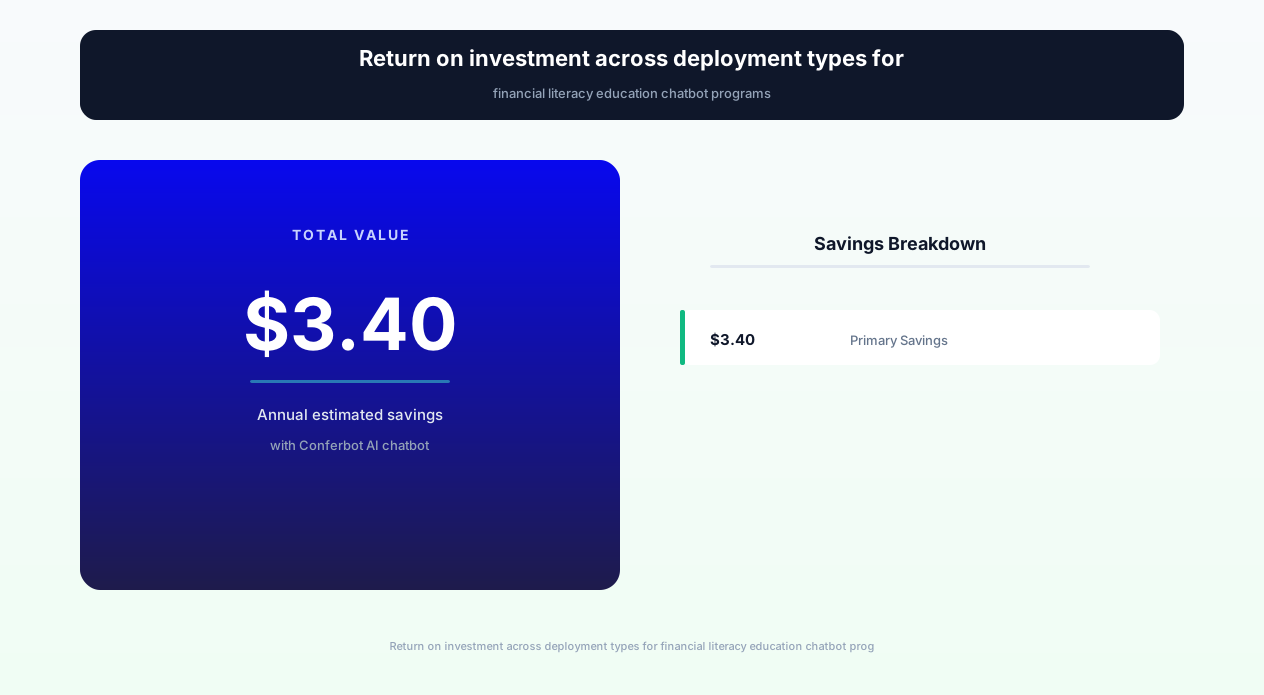
Banks and credit unions deploy the chatbot to improve customer financial health - which directly reduces delinquencies, charge-offs, and customer attrition. A regional bank deploying the chatbot to customers showing early distress signals (declining balances, increasing overdrafts, minimum-only credit card payments) can expect to see: a meaningful reduction in delinquency rates among chatbot participants, fewer overdrafts, lower charge-off losses, and stronger customer retention (financially healthy customers are less likely to leave for competitors). Because the chatbot's platform cost is modest relative to even a small reduction in loan losses, the return on investment for this kind of deployment is typically substantial.
Employer Financial Wellness Program
Employers deploy the chatbot as a financial wellness benefit that reduces financial stress - a documented driver of absenteeism, presenteeism, and turnover. Financial stress is a well-documented drag on employee productivity. A mid-size employer achieving strong chatbot engagement among its workforce can expect to see fewer 401k early withdrawals, higher 401k participation, reduced garnishment processing costs, and improved employee satisfaction on financial wellness measures - outcomes that typically outweigh the combined cost of the chatbot and program administration.
Nonprofit Financial Counseling Scale
Nonprofit financial counseling organizations face impossible demand versus capacity ratios - waitlists of months for one-on-one counseling while people in financial crisis need help immediately. The chatbot serves as first-line support that handles the large majority of incoming needs (budgeting guidance, debt strategy, credit improvement basics) without counselor involvement, reserving human counselors for complex situations (bankruptcy evaluation, negotiation with creditors, crisis intervention). A community nonprofit that deployed the chatbot was able to serve substantially more community members in its first year than its prior one-on-one capacity allowed, while maintaining quality outcomes - escalating only the cases that genuinely required human intervention and guiding the rest through self-directed financial improvement programs.
Higher Education Financial Literacy
Universities deploy the chatbot to prepare students for financial independence - addressing the knowledge gap that leads to excessive student loan borrowing, credit card debt accumulation, and poor early financial decisions that compound for decades. A university requiring incoming freshmen to complete the chatbot's core curriculum can expect to see: reduced reliance on private student loans (students better understand federal loan benefits and work-study alternatives), lower credit card delinquency among students, more graduates reporting they created a budget within 6 months of graduation compared with peer institutions without the program, and higher alumni giving rates (financially stable alumni contribute more).
Government and Community Programs
Government agencies deploying financial literacy programs for underserved communities use the chatbot to reach populations that do not access traditional financial education: immigrants navigating an unfamiliar financial system, formerly incarcerated individuals rebuilding financial identities, low-income households unbanked or underbanked, and young adults aging out of foster care. The chatbot's conversational format, available 24/7 on mobile devices, reaches these populations more effectively than classroom-based programs with attendance barriers. Multilingual configuration enables service in the community's primary languages without separate curricula for each language.
Financial Literacy Educator FAQ
Everything you need to know about chatbots for financial literacy educator.
Why Use a Template vs Building from Scratch?
Templates give you a proven starting structure instead of a blank canvas.
| Factor | Conferbot Template | Build from Scratch | Hire a Developer |
|---|---|---|---|
| Time to deploy | 10 minutes | 2-8 hours | 2-6 weeks |
| Cost | Free | Your time | Custom dev quote |
| Proven flows | Yes, pre-built | No | Depends |
| Updates included | Automatic | Manual | Paid |
| Multi-channel | 8+ channels | 1 channel | Extra cost |
| Analytics | Built-in | Must build | Extra cost |
Related Finance Templates
Explore more chatbot templates like this one






Learn More About Chatbots
Go deeper on how finance chatbots work and how to pick the right builder.
Ready to Deploy Financial Literacy Educator?
Start with a free-forever plan. No credit card required.