
B2B Lead Qualification Bot
Free B2B Services Chatbot Template
A complete b2b lead qualification bot chatbot template - deploy in minutes to automate conversations, capture leads, and provide 24/7 assistance.



How this template opens - rendered from its flow. Use the interactive preview to click through the full conversation.
What Is a B2B Lead Qualification Chatbot?
A B2B lead qualification chatbot is a conversational AI assistant that engages business-to-business prospects in real-time qualification conversations -- assessing budget, authority, need, and timeline (BANT) along with company size, decision-making structure, pain point specificity, and purchase readiness -- to determine which leads warrant sales team attention and which should enter nurture sequences. It operates on your website, landing pages, WhatsApp Business, and LinkedIn to capture and qualify prospects 24/7 without requiring human SDR availability.
The B2B lead qualification challenge is fundamentally a volume-and-timing problem. Marketing generates leads through content, events, ads, and organic traffic -- but the majority of these leads are not ready to buy. Industry data consistently shows that only a small minority of B2B leads are sales-ready at the point of first contact. The rest need qualification to determine whether they are worth pursuing now, should be nurtured for later, or are not a fit at all. Without systematic qualification, sales teams either waste time on unqualified leads (reducing productivity) or cherry-pick only the most obvious opportunities (missing viable deals that require deeper discovery).
Human SDRs are the traditional solution, but they have structural limitations. SDRs work business hours in one time zone, handle one conversation at a time, take 3-5 minutes per qualification call, and cost $50,000-$80,000 annually in compensation plus management overhead. A qualification chatbot operates 24/7 across all time zones, handles unlimited parallel conversations, qualifies in 90 seconds, and costs a fraction of SDR compensation. The math is compelling: B2B chatbots qualify leads dramatically faster than human SDRs while maintaining qualification accuracy close to human performance for standard qualification frameworks.
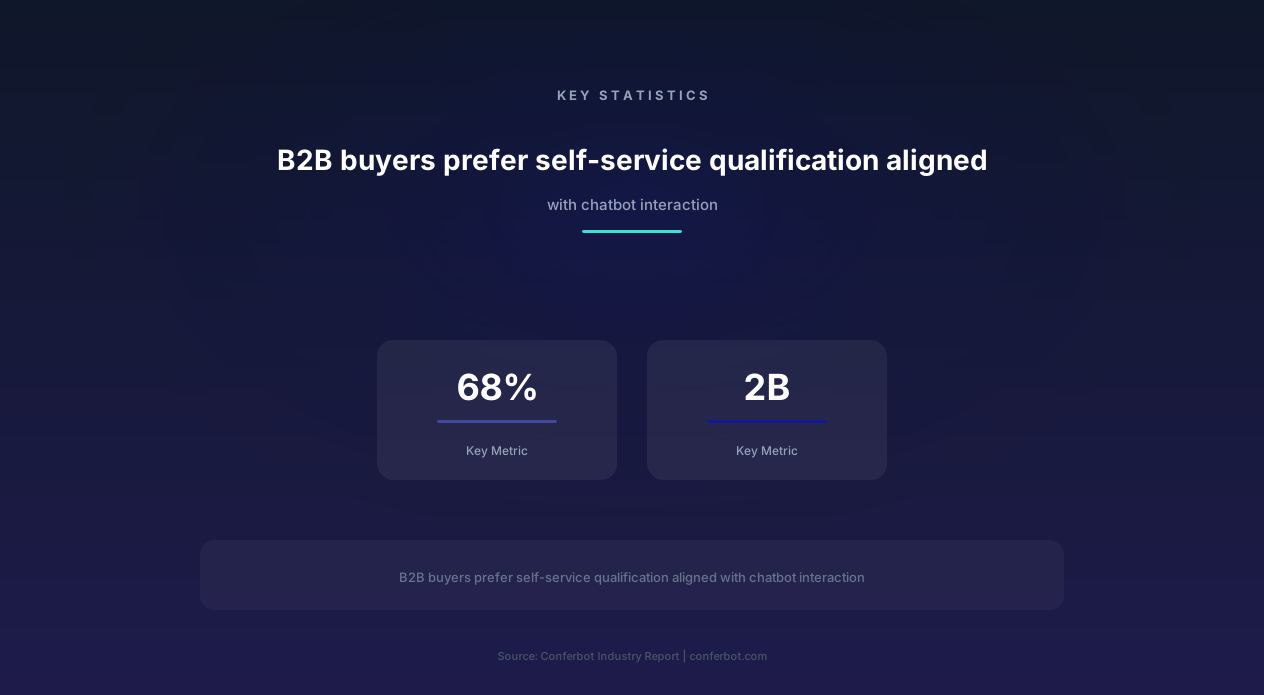
The buyer behavior shift makes chatbot qualification not just efficient but preferred. Gartner's B2B buying research has repeatedly found that roughly two-thirds of B2B buyers prefer a rep-free, self-service research experience over engaging with sales representatives during the early buying stages. They want information, answers to specific questions, and the ability to evaluate fit on their own terms -- not an immediate phone call from an eager SDR. The chatbot aligns with this preference by providing a low-pressure qualification experience that respects the buyer's autonomy while systematically collecting the information sales teams need to prioritize effectively.
In 2026, B2B organizations deploying qualification chatbots report dramatically faster lead qualification, meaningfully higher sales-accepted lead rates, a real reduction in cost per qualified lead, and measurably higher buyer satisfaction scores during the initial engagement phase. Conferbot's AI chatbot builder powers this template with BANT, MEDDIC, and custom qualification frameworks configurable through the no-code interface.
How the B2B Lead Qualification Chatbot Works: From First Touch to Meeting Booked
The B2B qualification chatbot follows a structured yet conversational flow that feels like a helpful interaction to the prospect while systematically collecting every data point the sales team needs to prioritize, prepare, and engage effectively.
Engagement Trigger and Opening
The chatbot activates based on visitor behavior signals: time on a pricing page (indicating commercial intent), repeated visits to product documentation (indicating evaluation), content download completion (indicating research phase), or direct message initiation. The opening is calibrated to the trigger context -- a visitor on the pricing page receives "Looking at our pricing options? I can help you figure out which plan fits your team" rather than a generic greeting. This contextual opening achieves meaningfully higher engagement rates than standard welcome messages because it demonstrates immediate relevance to what the visitor is already doing.
For prospects arriving from specific campaigns (LinkedIn ads, webinar follow-ups, content syndication), the chatbot references the campaign context: "Thanks for downloading our enterprise security whitepaper. Are you evaluating solutions for your organization, or researching for a project?" This acknowledgment of the prospect's journey builds trust and provides a natural entry into qualification without the cold-start feeling of generic chatbot interactions.
Company and Role Identification
The first qualification dimension is firmographic: who is this person and what company do they represent? The chatbot collects company name and the prospect's role through natural conversation: "What company are you with?" followed by "What is your role there?" For visitors whose company is identified through IP lookup or form pre-fill, the chatbot confirms rather than re-asks: "I see you are from Acme Corp -- is that right? What is your role on the team?" The company name triggers real-time enrichment: company size, industry, revenue range, technology stack, and recent news -- all data that informs the qualification score and the eventual sales conversation without requiring the prospect to self-report these details.
Need Discovery and Pain Point Mapping
The most valuable qualification dimension is the specificity and urgency of the prospect's need. The chatbot explores this through open-ended questions: "What challenge brought you here today?" and "How are you handling this currently?" Prospects who articulate specific, urgent pain points ("We are losing 20% of leads because our response time is too slow and our current tool does not support automation") score dramatically higher than those with vague exploration intent ("We are just looking at what is available in the market"). The chatbot identifies and categorizes pain points using your product's value proposition mapping: each stated pain point is matched to the product capability that addresses it, creating the foundation for a personalized sales conversation.
BANT Qualification Flow
With company, role, and need established, the chatbot moves through the BANT framework conversationally:
- Budget: "Do you have a budget allocated for solving this, or is this still in the planning stage?" The chatbot does not demand a specific number -- it categorizes into budget confirmed, budget planned, or no budget -- which is sufficient for qualification without creating the pricing objection that premature budget discussions often trigger.
- Authority: "Are you the person who would make the final decision on this, or would others need to be involved?" The chatbot identifies decision makers, influencers, and researchers -- each with different follow-up strategies.
- Need: Already established through pain point discovery. The chatbot scores need intensity based on language specificity and urgency indicators.
- Timeline: "When are you looking to have a solution in place?" Timeline responses are categorized: immediate (this month), near-term (this quarter), planning (next quarter), and exploring (no specific timeline).
Scoring, Routing, and Meeting Scheduling
Based on the qualification data collected, the chatbot generates a composite lead score and routes accordingly. High-score leads (confirmed budget, decision maker, urgent need, near-term timeline) receive immediate meeting scheduling: "Based on what you have told me, I think a conversation with our solutions team would be valuable. I can schedule a 30-minute call -- what works best this week?" The meeting is booked directly through the calendar integration with the appropriate sales rep, including full qualification context in the meeting invite.
Medium-score leads (partial qualification -- need confirmed but budget unclear, or authority not yet identified) receive targeted follow-up: relevant case studies, ROI calculators, or content specific to their stated pain points, with a scheduled touchpoint to re-engage. Low-score leads (no clear need, no budget, no timeline) receive educational content and enter long-term nurture. All routing happens automatically based on the score thresholds you configure.
Key Features of the B2B Lead Qualification Chatbot
B2B qualification requires capabilities that go beyond generic chatbot functionality -- handling the nuances of multi-stakeholder purchases, complex product-market fit assessment, and the delicate balance between information gathering and buyer respect.
| Feature | Description | Operational Benefit | Customer Benefit |
|---|---|---|---|
| BANT/MEDDIC qualification frameworks | Implements standard B2B qualification methodologies with configurable weighting and scoring | Consistent qualification criteria applied to every lead regardless of volume or time of day | Prospects are asked relevant, intelligent questions rather than generic form fields |
| Real-time firmographic enrichment | Enriches company data (size, revenue, industry, tech stack) from company name input | Sales reps receive pre-researched accounts without manual discovery effort | Prospects are not asked to self-report information that is publicly available |
| Decision-maker identification | Maps organizational authority through conversational questions about buying process | Sales team knows whether they are talking to the buyer, influencer, or researcher | Each stakeholder type receives appropriately targeted follow-up content |
| Pain point categorization | Maps stated challenges to product capabilities using value proposition matching | Sales conversations start with validated pain points and relevant solution positioning | Prospects receive personalized information addressing their specific challenge |
| Behavioral intent scoring | Incorporates website behavior (pages visited, time spent, content downloaded) into lead score | Combines stated qualification with behavioral signals for higher scoring accuracy | High-intent visitors receive faster, more relevant engagement |
| Intelligent meeting scheduling | Books qualified meetings directly into sales rep calendars with full context and prep notes | Eliminates the scheduling back-and-forth that delays qualified lead engagement by days | Prospects book a call immediately while their interest is highest |
| Nurture sequence triggering | Enrolls non-ready leads in targeted content sequences based on qualification data | Partially qualified leads continue receiving value until they reach sales readiness | Buyers who are not ready to talk receive helpful content rather than pushy outreach |
| Competitive intelligence capture | Identifies when prospects mention competitors and captures competitive context | Sales team enters conversations knowing the competitive landscape for each deal | Prospects receive relevant differentiation content based on their evaluation set |
| Multi-language qualification | Conducts qualification conversations in 40+ languages for global B2B operations | Captures international leads without multilingual SDR staff in every market | Prospects engage in their business language regardless of vendor's primary market |
| ABM account detection | Identifies visitors from target accounts and triggers VIP qualification paths with priority routing | High-value target accounts receive white-glove treatment automatically | Enterprise buyers from strategic accounts get immediate, personalized attention |
Behavioral Intent Scoring: Beyond Stated Qualification
The chatbot incorporates behavioral signals that indicate purchase intent beyond what the prospect explicitly states. A visitor who has viewed the pricing page 3 times, read 4 case studies in their industry, and downloaded the ROI calculator is demonstrating evaluation-stage behavior regardless of what they say in conversation. The chatbot combines this behavioral data with conversational qualification data to produce a composite score that is more accurate than either source alone.
Behavioral signals that increase qualification scores include: pricing page visits (strongest commercial intent signal), competitor comparison page views, multiple sessions in a short period, content consumption in a logical evaluation sequence, and return visits after initial engagement. These signals are weighted and combined with stated BANT data to identify the prospects who are genuinely evaluating versus those who are casually browsing. Organizations using composite scoring (behavioral + conversational) report meaningfully higher accuracy in predicting which leads will convert to opportunities compared to conversational scoring alone.
Account-Based Marketing (ABM) Integration
For organizations running ABM programs with defined target account lists, the chatbot provides differentiated treatment for visitors from priority accounts. When a visitor from a target account is identified (through IP matching, email domain, or explicit company name), the chatbot triggers a VIP qualification path: more personalized opening, priority routing to named account owners, immediate notification to the account team, and white-glove follow-up regardless of score. This ensures that the 50-500 accounts you have invested marketing resources in targeting receive exceptional first-touch experiences when they finally visit your site.
The ABM integration also captures account-level intelligence: which pages target account visitors view, what content they download, and what questions they ask the chatbot -- all flowing to the account owner as engagement intelligence that informs their outreach strategy. Connect ABM account lists and intelligence reporting through the API integration with your ABM platform (6sense, Demandbase, Terminus).
Ready to try B2B Lead Qualification Bot?
Deploy this template in under 10 minutes. No coding required.
Use This Template Free →Before and After: Lead Qualification Without and With the Chatbot
The impact of deploying a B2B qualification chatbot is measurable across lead processing speed, qualification consistency, sales team efficiency, and pipeline quality metrics. The following data represents aggregated results from B2B organizations with 50-500 monthly inbound leads.
| Metric | Before (SDR/Manual) | After (Chatbot) | Direction |
|---|---|---|---|
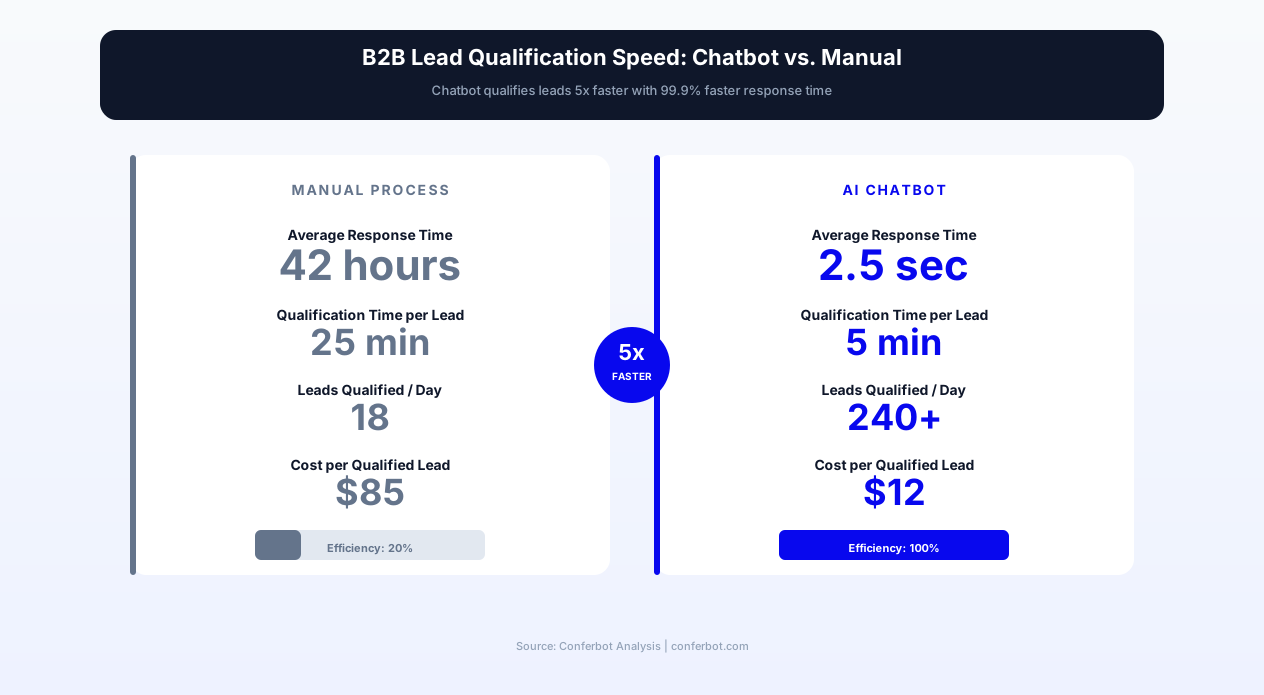
| Average qualification time per lead | Minutes (during business hours) | Under 90 seconds (24/7) | Much faster qualification |
| Lead response time (first touch) | Hours on average | Under 10 seconds | Far faster response |
| After-hours lead capture | Unqualified until next business day | Qualified immediately | Captures leads that would otherwise wait |
| Sales-accepted lead rate | Lower share of leads passed to sales are accepted | Meaningfully higher share accepted | Better lead quality |
| Cost per qualified lead | Higher (SDR salary / leads qualified) | Much lower | Sharp cost reduction |
| Qualification consistency | Varies by SDR skill, mood, and workload | Fully consistent criteria application | Minimal variance in qualification standards |
| Data completeness (required fields populated) | Lower share of fields completed | Much higher share completed | More complete records |
| Meeting show rate (qualified leads who attend booked call) | Lower | Meaningfully higher | Fewer no-shows |
The Before Experience: Traditional SDR Qualification
Without the chatbot, inbound leads follow a delayed, inconsistent path. A prospect fills out a form on the website at 11pm (outside business hours). The form submission sits in the lead queue until an SDR reviews it the following morning -- 10+ hours later. The SDR scans the form data (often just name, email, and company), attempts a phone call (frequently reaching voicemail), sends a follow-up email, and adds the lead to a callback sequence. If they do connect, the qualification call takes several minutes of the SDR's time per lead. Across a busy week of leads, this qualification workload consumes a significant chunk of SDR time, leaving limited capacity for outbound prospecting.
The inconsistency problem is equally damaging. SDRs apply qualification criteria differently based on experience, training, current workload, and personal judgment. A lead that one SDR qualifies as sales-ready might be deprioritized by another. This inconsistency means that sales teams receive unevenly qualified leads, leading to frustration and the perception that "marketing sends us bad leads" -- a perception that damages marketing-sales alignment regardless of actual lead quality.
The After Experience: Chatbot Qualification
With the chatbot, the same prospect visiting at 11pm engages immediately. The chatbot conducts the full qualification conversation in 90 seconds, generates a lead score, enriches the company data, and -- if the score is high -- offers to book a meeting with a sales rep for the next available slot. The prospect books a call for 10am the following day. When the sales rep arrives in the morning, they have a fully qualified lead with complete context: company details, pain points, budget status, timeline, decision-making process, and competitive evaluators. The rep's meeting prep takes 2 minutes because the chatbot has done the discovery work. The conversation starts at a higher level than a cold first call.
The consistency is absolute. Every lead -- whether arriving at 2pm or 2am, whether it is the first lead of the day or the hundredth -- receives the same thorough qualification against the same criteria. This consistency eliminates the qualification variance that creates friction between marketing and sales teams.
Impact on Meeting Quality and Show Rates
Chatbot-qualified meetings consistently show meaningfully higher attendance rates compared to SDR-booked meetings. The reason is timing and commitment: when a prospect qualifies and books a meeting in the same conversation -- while their interest is at peak -- their psychological commitment to the meeting is stronger than when a meeting is scheduled days later through an email sequence. The meeting context is also richer: the rep has the full qualification data, the prospect has already articulated their needs, and both parties enter the call with shared context rather than starting from zero.
Qualification Frameworks: BANT, MEDDIC, CHAMP, and Custom Models
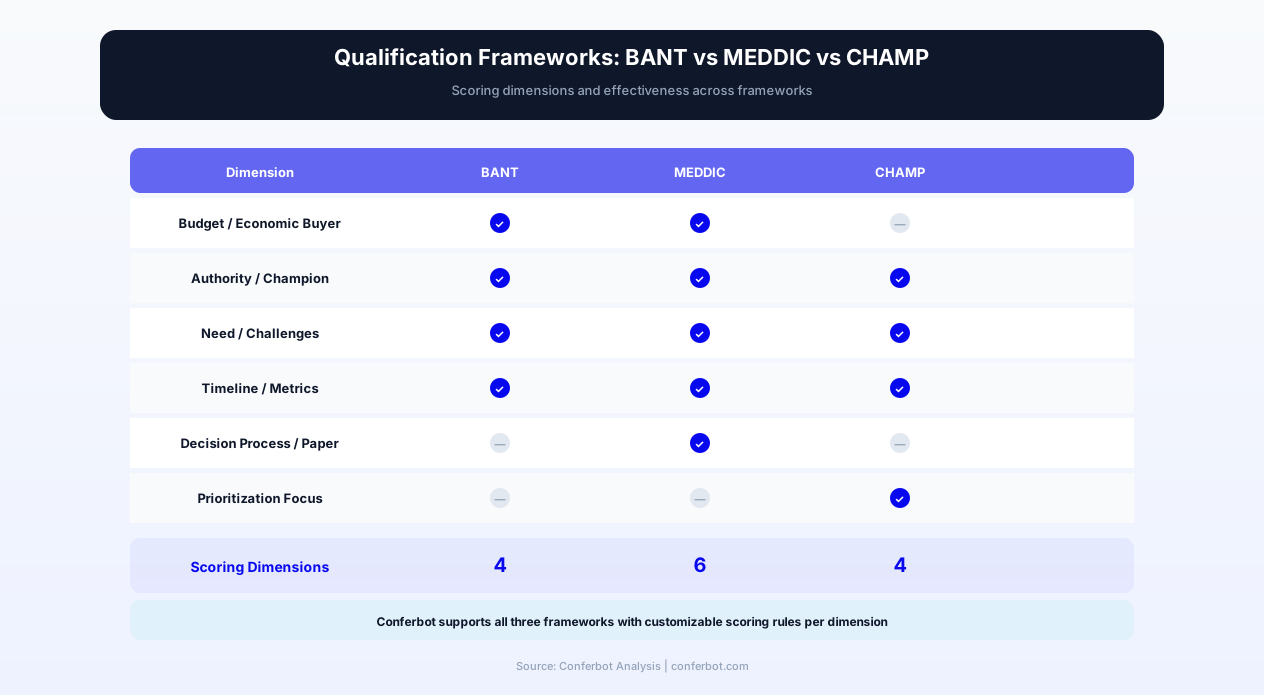
The chatbot supports multiple established B2B qualification frameworks and custom hybrid models. Each framework emphasizes different qualification dimensions based on your sales motion, deal complexity, and market positioning.
BANT (Budget, Authority, Need, Timeline)
BANT is the most widely used B2B qualification framework and the default configuration for the chatbot. It assesses four dimensions:
- Budget: The chatbot determines whether the prospect has financial capacity without demanding specific numbers. Questions like "Do you have budget allocated for this initiative?" and "Is this a funded project or still in the business case stage?" categorize budget status without creating pricing objection. Prospects with confirmed budget score highest; those building a business case score medium (they may close but need ROI support); those with no budget consideration score low.
- Authority: The chatbot maps the buying group structure: "Who else would be involved in evaluating and approving this decision?" identifies whether the prospect is the economic buyer, a technical evaluator, a champion, or an early researcher. Each role type warrants different engagement -- the chatbot adjusts its follow-up recommendation based on authority level.
- Need: Assessed through pain point specificity and urgency. Prospects who describe specific, quantified pain ("We are losing $50K monthly from slow response times") score higher than those with general interest ("We want to improve our processes").
- Timeline: Categorized into immediate (this month), near-term (this quarter), future (next quarter or later), and exploratory (no defined timeline). Timeline scoring interacts with authority scoring -- an immediate timeline from a decision maker is the highest-urgency combination.
MEDDIC (Metrics, Economic Buyer, Decision Criteria, Decision Process, Identify Pain, Champion)
MEDDIC is designed for complex enterprise sales where deal sizes justify deeper qualification. The chatbot implements the MEDDIC framework for organizations selling into enterprise accounts:
- Metrics: "How are you measuring the impact of this problem today? What would success look like in numbers?" identifies whether the prospect has quantified their challenge.
- Economic Buyer: "Who signs off on investments of this size in your organization?" goes deeper than BANT's authority question to identify the actual budget holder.
- Decision Criteria: "What are the most important factors you will evaluate solutions on?" surfaces the competitive criteria that the sales team needs to position against.
- Decision Process: "What does the evaluation process look like at your company? How many stages or approvals are typical?" maps the procurement journey.
- Identify Pain: Deep pain exploration with probing follow-ups on impact, urgency, and consequence of inaction.
- Champion: "Is there someone on your team who is particularly passionate about solving this?" identifies the internal advocate who will drive the deal forward.
CHAMP (Challenges, Authority, Money, Prioritization)
CHAMP reorders BANT to lead with challenges rather than budget -- a more natural conversation flow that prospects experience as helpful rather than interrogative:
- Challenges: Open exploration of the prospect's problems and goals before any commercial qualification.
- Authority: Mapping the decision-making group after establishing rapport through challenge discussion.
- Money: Budget assessment positioned in the context of solving the identified challenge.
- Prioritization: Understanding where this initiative sits relative to other organizational priorities.
Custom Hybrid Models
Many B2B organizations use hybrid qualification models that combine elements from multiple frameworks with industry-specific criteria. The chatbot's qualification builder in the no-code interface allows you to define custom qualification dimensions, assign point weights, create conditional logic (if the prospect is in healthcare, add compliance questions), and set routing rules based on composite scores. This flexibility ensures the chatbot aligns with your specific sales motion rather than forcing your process into a generic framework.
Use Cases: SaaS, Professional Services, Manufacturing, and Enterprise Technology
B2B lead qualification chatbots serve different industries with varying deal complexities, buying group sizes, and qualification priorities. The chatbot adapts its conversation flow to the specific buying dynamics of each sector.
SaaS Companies (Product-Led and Sales-Led)
SaaS companies generate high volumes of inbound interest through free trials, freemium products, content marketing, and digital advertising. The qualification challenge is separating the small percentage of prospects who will become paying customers from the larger volume of browsers, students, and competitors doing research. The chatbot qualifies based on use case validity (does this prospect have a real business application for the product?), team size (is this a viable commercial account or a single-user hobby project?), and current solution (are they using a competitor they might switch from, or building from scratch?).
For product-led growth (PLG) companies, the chatbot activates within the free product experience when user behavior indicates expansion potential: reaching usage limits, adding team members, or exploring enterprise features. It qualifies these product-qualified leads (PQLs) and routes high-potential accounts to sales for expansion conversations. This PLG-to-sales handoff through the chatbot captures revenue from accounts that would otherwise self-serve indefinitely without ever connecting with a sales rep.
Professional Services (Consulting, Agencies, Legal)
Professional services firms face a different qualification dynamic: every engagement is custom-scoped, so qualification must assess not just budget and timeline but project scope, organizational readiness, and engagement model fit. The chatbot qualifies professional services leads by exploring: project scope and objectives, organizational context (company stage, team size, current capabilities), timeline and urgency drivers, budget range or historical spend on similar engagements, and stakeholder alignment (is the inquiry coming from someone who can authorize the engagement, or from a team member who needs to build internal buy-in?).
For agencies and consultancies, the chatbot also serves as a triage mechanism: routing prospects to the correct service line (strategy vs. implementation, branding vs. performance marketing) based on their stated needs, ensuring that the first conversation happens with the right expert rather than a generalist who then needs to make a warm handoff.
Manufacturing and Industrial B2B
Manufacturing and industrial B2B companies deal with long procurement cycles, technical requirements, and volume-based pricing that makes qualification complex. The chatbot qualifies manufacturing leads on: application specifics (what will the product be used for?), volume requirements (sample order vs. production volume), technical specifications (material, tolerance, certification requirements), and supply chain context (existing supplier they are looking to replace, or new project requirement). These technical qualification questions ensure that sales engineers spend their limited time on prospects with viable, well-defined applications rather than speculative inquiries.
Enterprise Technology (Large Deal, Long Cycle)
Enterprise technology sales involve $100K-$10M deal sizes with 6-18 month cycles and buying groups of 5-15 stakeholders. The chatbot's role in enterprise qualification is to identify high-value opportunities early and route them to strategic account resources immediately. It qualifies on: company size (enterprise means different things to different vendors -- configure your ICP threshold), initiative scope (department-level vs. enterprise-wide deployment), procurement stage (early research vs. active RFP), and competitive landscape (incumbent vendor, shortlisted alternatives). Enterprise leads that match ICP criteria receive immediate routing to named account executives with full context, ensuring that six-figure opportunities never sit in a general lead queue waiting for SDR review.
The chatbot also serves enterprise prospects during off-hours (critical for global companies spanning time zones) and on weekends -- times when enterprise buyers often do research without work interruptions. A VP evaluating solutions on a Sunday morning receives the same quality engagement as one visiting during business hours, through the website chatbot or WhatsApp.
businesses worldwide use Conferbot templates to automate conversations
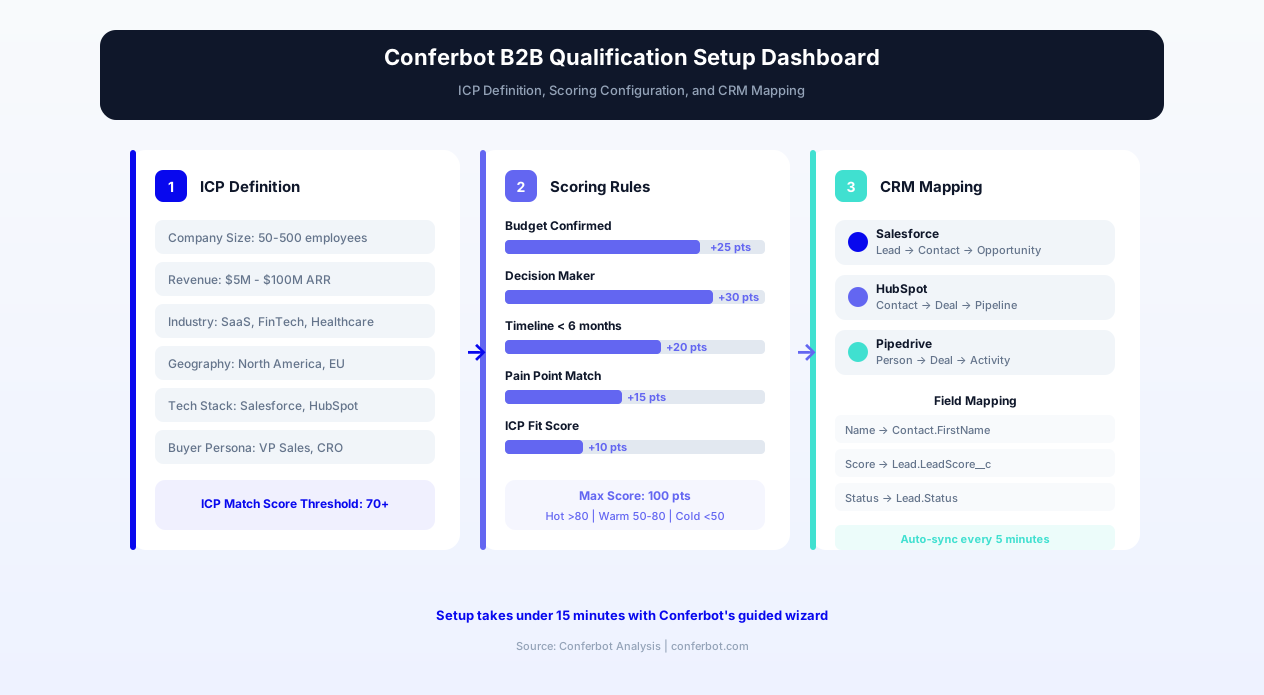
Setup Guide: Deploying Your B2B Lead Qualification Chatbot
Setting up the B2B qualification chatbot requires defining your ideal customer profile, configuring qualification criteria, connecting CRM and calendar systems, and deploying on your highest-traffic lead capture surfaces. Most organizations complete setup in half a day.
Step 1: Define Your Ideal Customer Profile (ICP)
In the Conferbot dashboard, open the B2B Lead Qualification template and start with your ICP definition. Enter the firmographic criteria that define your best customers: company size ranges (employees and/or revenue), target industries, geographic focus, technology requirements, and any disqualifying criteria (company too small, wrong industry, wrong geography). These ICP parameters drive the chatbot's scoring -- prospects matching ICP criteria receive higher base scores, while those outside ICP parameters are flagged for review or auto-routed to nurture.
Step 2: Configure Qualification Framework and Scoring
Select your qualification framework (BANT, MEDDIC, CHAMP, or custom) and configure the scoring model. For each qualification dimension, set: the questions the chatbot asks, the response categories and their point values, any conditional logic (if budget is "no budget," skip timeline questions and route to nurture), and the weighting relative to other dimensions. Set the score thresholds that determine routing: what score triggers immediate sales routing? What score enters nurture? What score is a disqualification? Test the scoring model with 10-15 historical leads to verify that it would have routed them correctly.
Step 3: Connect CRM and Marketing Automation
Connect your CRM (Salesforce, HubSpot, Pipedrive) through the API integration panel. Map chatbot qualification fields to your CRM lead/contact fields -- company name, role, pain points, budget status, timeline, and qualification score all sync to the corresponding CRM fields. Connect your marketing automation platform (Marketo, Pardot, HubSpot Marketing, ActiveCampaign) for nurture sequence enrollment -- when the chatbot routes a lead to nurture, it triggers the appropriate email sequence in your marketing platform automatically.
Step 4: Set Up Calendar Integration for Qualified Meetings
Configure the calendar integration for direct meeting scheduling. Connect sales rep calendars (Google Calendar or Microsoft Outlook) and define the routing rules: which reps receive which leads (by geography, deal size, industry, or round-robin). Set available meeting slots, meeting duration (typically 30 minutes for first calls), and buffer time between meetings. The chatbot presents available slots to qualified prospects and books directly into the correct rep's calendar with full qualification context included in the meeting invite.
Step 5: Deploy on High-Intent Pages
Deploy the chatbot on the pages where qualified prospects are most likely to be: pricing pages (strongest buying signal), product comparison pages, case study pages for target industries, and demo request landing pages. Configure page-specific opening messages that reference the visitor's current context. For website deployment, use the provided embed code with targeting rules that control when the chatbot activates (time on page, scroll depth, exit intent). Deploy on WhatsApp Business for prospects who prefer messaging-first engagement.
Step 6: Test, Calibrate, and Optimize
Run the chatbot through test scenarios representing your common lead types: a perfect ICP match with full BANT qualification, a partial match (good company but unclear budget), an ICP mismatch (wrong size or industry), and a tire-kicker with no real intent. Verify that each scenario routes correctly. Launch with live traffic and monitor the first 50 qualified leads through Conferbot Analytics: review the qualification conversations, check that scores correlate with actual sales outcomes, and adjust scoring weights if certain dimensions are over- or under-weighted based on real data. Refinement typically takes 2-3 weeks of live data to calibrate scoring to your specific market dynamics.
Advanced Qualification Strategies: Intent Signals, Enrichment, and Predictive Scoring
Beyond basic BANT qualification, advanced B2B chatbot strategies leverage data enrichment, behavioral analytics, and predictive models to achieve qualification accuracy that exceeds human SDR performance.
Third-Party Intent Data Integration
Intent data providers (Bombora, G2, TrustRadius) identify companies actively researching your product category based on content consumption patterns across the web. When a visitor from a company showing high intent signals engages with the chatbot, their score receives a significant boost before the conversation even begins. The chatbot can reference this intent: "I see your team has been researching automation solutions -- are you actively evaluating options?" This acknowledgment of their buying journey demonstrates awareness and accelerates the conversation toward substantive qualification rather than surface-level discovery.
Progressive Profiling Across Sessions
Not every B2B buyer qualifies in a single session. Enterprise buyers may visit multiple times over weeks before engaging substantively. The chatbot implements progressive profiling: each interaction adds to the prospect's profile without re-asking questions already answered. A first visit might capture company and role; a second visit captures use case; a third visit -- when the prospect is ready -- triggers the full qualification flow with context from prior visits already populated. This progressive approach respects the buyer's journey pace while ensuring that every interaction adds qualification value.
Predictive Lead Scoring Models
After accumulating sufficient historical data (typically 200-500 qualified leads with known outcomes), the chatbot's scoring model can be enhanced with predictive analytics that identify which qualification response patterns correlate with closed-won outcomes. The system might discover that prospects who mention a specific competitor convert at a meaningfully higher rate, or that companies in a particular revenue range close noticeably faster. These patterns, invisible in small samples, become powerful predictive signals at scale -- automatically incorporated into the scoring model to improve qualification accuracy over time.
Conversational A/B Testing
The chatbot supports A/B testing of qualification conversation flows: testing whether leading with pain point questions produces higher engagement than leading with company information, whether asking about budget early or late affects conversion, or whether a casual tone outperforms a formal one for specific audience segments. Each test runs with statistical significance tracking, and winning variants are automatically promoted. This continuous optimization means the chatbot's qualification effectiveness improves over time rather than remaining static after initial deployment.
Buyer Committee Mapping
Complex B2B purchases involve multiple stakeholders. When the chatbot identifies that the current prospect is an influencer rather than the decision maker ("My VP would need to approve this"), it adapts its strategy: instead of pushing for a meeting that the prospect cannot authorize, it asks "Would it be helpful if I sent you a brief overview you could share with your VP? I can include the specific points relevant to your use case." This stakeholder-aware approach generates champion-enabling content that advances the deal through the buying committee rather than stalling because the chatbot optimized only for decision-maker conversion.
Competitive Intelligence Capture
When prospects mention evaluating competitors ("We are also looking at Competitor X and Y"), the chatbot captures this intelligence for the sales team while providing immediate differentiation: "Happy to help you compare. Most customers evaluating Competitor X tell us that [key differentiator]. Would a detailed comparison document be helpful?" This approach serves dual purposes: it provides the prospect with genuinely useful comparison content, and it captures competitive intelligence that prepares the sales rep for the specific positioning needed in each deal.
ROI Analysis: The Economics of Automated B2B Qualification
The financial case for B2B lead qualification chatbots is built on three pillars: cost reduction (qualifying leads at lower cost than SDR headcount), revenue acceleration (faster response and higher meeting quality), and opportunity capture (qualifying leads outside business hours and across languages that would otherwise be lost).
Cost Per Qualified Lead Reduction
The most direct ROI metric is the reduction in cost per qualified lead (CPQL). A typical SDR qualifying a modest number of leads per day at a fully-loaded annual salary produces a meaningfully higher CPQL than a chatbot qualifying a much larger daily volume at a platform cost that is a fraction of SDR compensation. Model your own CPQL reduction using this framework:
- Monthly leads processed: Your actual monthly lead volume
- Previous CPQL (SDR): Fully-loaded SDR cost / leads qualified per month
- New CPQL (chatbot): Platform cost / leads qualified per month
- Monthly savings: Previous CPQL minus new CPQL, multiplied by lead volume
- Annual savings: Monthly savings x 12
Revenue Acceleration from Speed-to-Lead
The landmark MIT/InsideSales.com Lead Response Management study found that companies responding to leads within 5 minutes were 21x more likely to qualify them compared to companies responding after 30 minutes. The chatbot's sub-10-second response time puts your organization at the extreme fast end of this curve, capturing the conversion premium that speed-to-lead provides. Model the incremental revenue from even a modest close-rate improvement against your own monthly lead volume and average deal size -- the compounding effect is typically substantial.
After-Hours and International Lead Capture
A significant share of B2B website leads arrive outside standard business hours (evenings, weekends, and different time zones). Without 24/7 qualification, these leads experience long response delays that dramatically reduce conversion probability. The chatbot qualifies these after-hours leads immediately, capturing opportunities that would otherwise decay. Model the additional revenue recovered by estimating your after-hours lead share, the portion historically lost to delayed response, and the share the chatbot can realistically recover.
SDR Capacity Reallocation
The chatbot does not necessarily eliminate SDR roles -- it reallocates them from inbound qualification (a reactive, repetitive task) to higher-value activities like outbound prospecting, account-based outreach, and deeper discovery conversations with complex leads. SDRs freed from inbound qualification triage can focus on the leads that genuinely benefit from human discovery -- complex enterprise accounts, strategic partnerships, and multi-stakeholder opportunities where conversational nuance matters. This reallocation maximizes SDR value rather than eliminating it.
B2B Lead Qualification Bot FAQ
Everything you need to know about chatbots for b2b lead qualification bot.
Why Use a Template vs Building from Scratch?
Templates give you a proven starting structure instead of a blank canvas.
| Factor | Conferbot Template | Build from Scratch | Hire a Developer |
|---|---|---|---|
| Time to deploy | 10 minutes | 2-8 hours | 2-6 weeks |
| Cost | Free | Your time | Custom dev quote |
| Proven flows | Yes, pre-built | No | Depends |
| Updates included | Automatic | Manual | Paid |
| Multi-channel | 8+ channels | 1 channel | Extra cost |
| Analytics | Built-in | Must build | Extra cost |
Related B2B Services Templates
Explore more chatbot templates like this one




Learn More About Chatbots
Go deeper on how b2b services chatbots work and how to pick the right builder.
Ready to Deploy B2B Lead Qualification Bot?
Start with a free-forever plan. No credit card required.