Why Dental Practices Need AI Chatbots in 2026
Dental practices face a unique operational challenge: a high volume of repetitive patient communication — appointment requests, insurance questions, treatment follow-ups — that consumes front desk staff time while patients wait on hold. The average dental office receives 50-80 phone calls per day, and studies show that 30-40% of those calls go unanswered during peak hours, lunch breaks, or after-hours periods. Every missed call is a potentially lost patient.
The financial impact is significant. According to G2's dental practice management research, a single no-show costs a dental practice an estimated $150-200 in lost revenue when you factor in the reserved chair time, staff allocation, and the opportunity cost of turning away other patients. With average no-show rates of 10-15% in general dentistry and even higher in specialty practices, a busy office with 30 appointments per day could be losing $3,000-6,000 per month to no-shows alone.
Meanwhile, patient expectations have shifted. According to the American Dental Association (ADA), over 70% of patients prefer to book appointments online rather than by phone, and 60% expect same-day responses to inquiries. Younger demographics — millennials and Gen Z — increasingly choose providers based on digital convenience, and a dental practice without modern communication tools risks losing this growing patient segment to competitors who offer it.
AI chatbots address all of these pain points simultaneously. A dental chatbot operates 24/7, handling appointment scheduling, patient intake, insurance verification questions, treatment reminders, and post-procedure follow-ups without requiring additional staff. For broader healthcare chatbot strategies, see our healthcare chatbot guide. It works across your website, WhatsApp, and Instagram, meeting patients wherever they prefer to communicate.
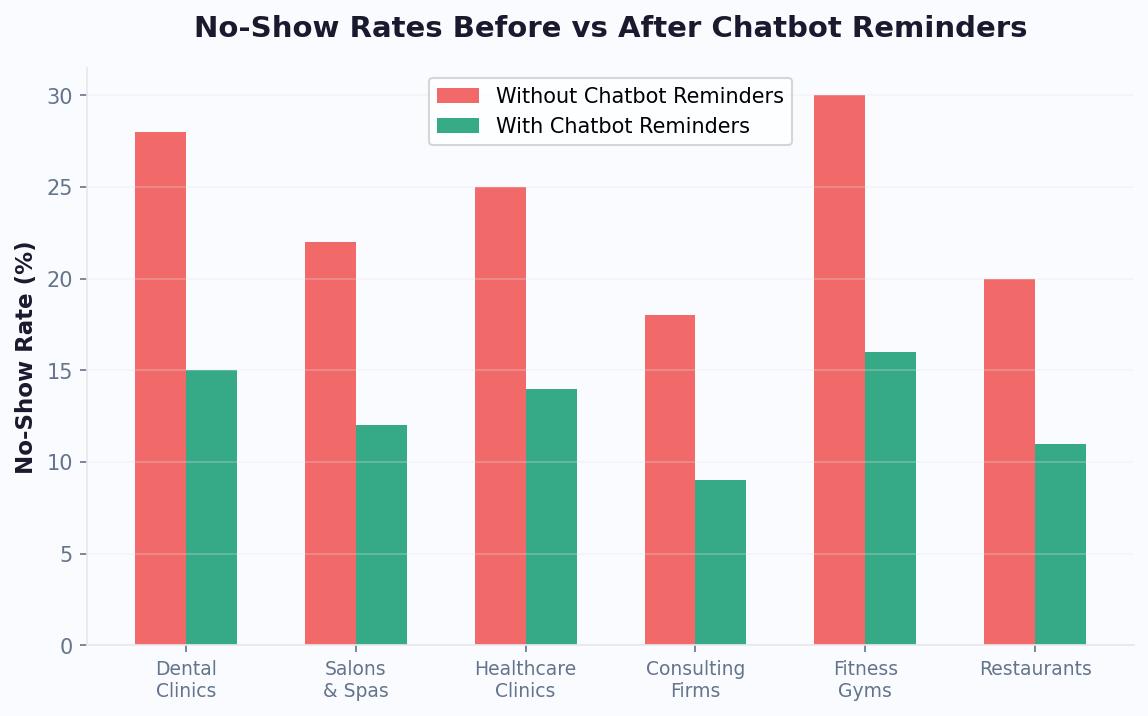
The results are measurable and fast. Dental practices implementing chatbots report 20% increases in cosmetic procedure bookings (where after-hours browsing and impulse inquiries are common), 30-50% reductions in phone call volume, and 25-40% decreases in no-show rates through automated reminders with interactive confirmation. For a practice looking to grow revenue without adding front desk staff, a chatbot is one of the highest-ROI investments available.
Automated Appointment Scheduling That Works Around the Clock
Appointment scheduling is the lifeblood of a dental practice, yet the traditional phone-based booking process is inefficient for both patients and staff. Patients call during work hours (when your front desk is busiest), wait on hold, navigate schedule availability verbally, and sometimes hang up before booking. A chatbot transforms this into a seamless, self-service experience available 24 hours a day, 7 days a week.
How Dental Appointment Chatbots Work
The chatbot guides patients through a structured booking flow:
- Service selection: The patient selects the type of appointment — routine cleaning, exam, whitening consultation, emergency visit, cosmetic evaluation, or a specific procedure. The chatbot adjusts appointment duration based on the selected service.
- Provider preference: If your practice has multiple dentists or hygienists, the patient can choose their preferred provider or accept the next available slot.
- Date and time selection: The chatbot presents available slots from your practice management system in an easy-to-browse format, filtered by the patient's stated preferences (morning vs. afternoon, specific days of the week).
- Patient verification: For existing patients, the chatbot verifies identity with name and date of birth. For new patients, it collects basic contact information and initiates the intake process.
- Confirmation: The appointment is booked, confirmation is sent instantly, and the patient receives calendar integration options.
After-Hours Appointment Capture
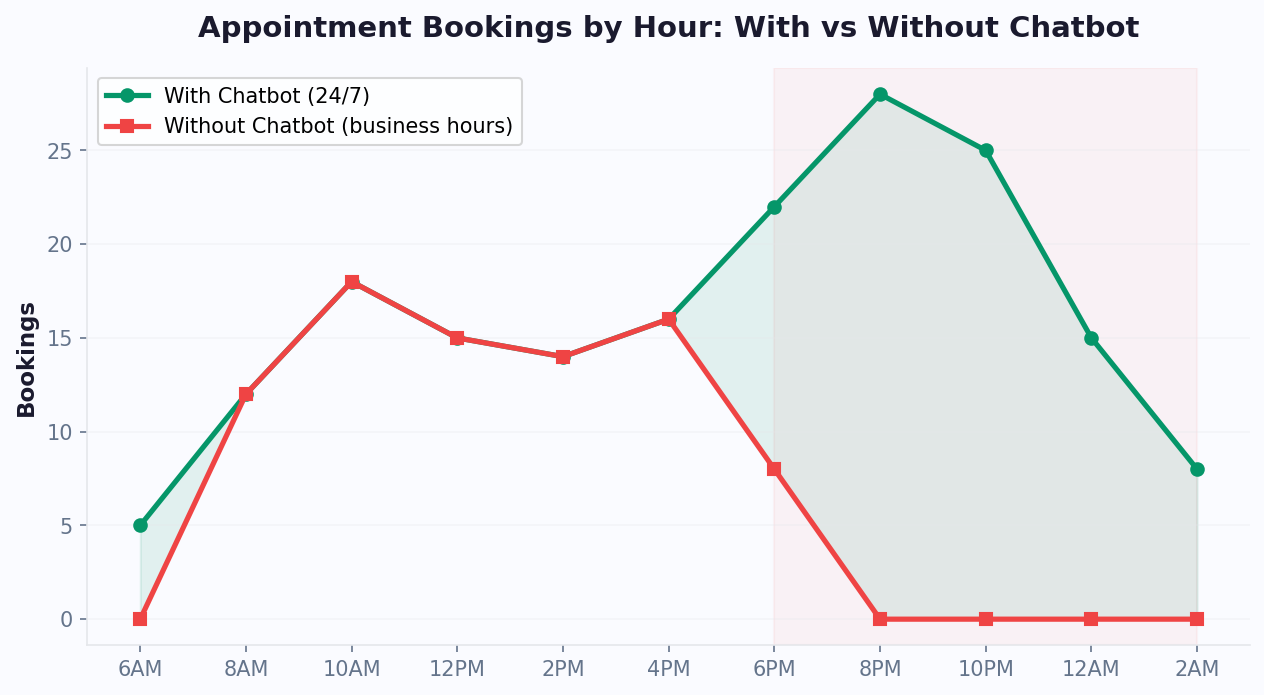
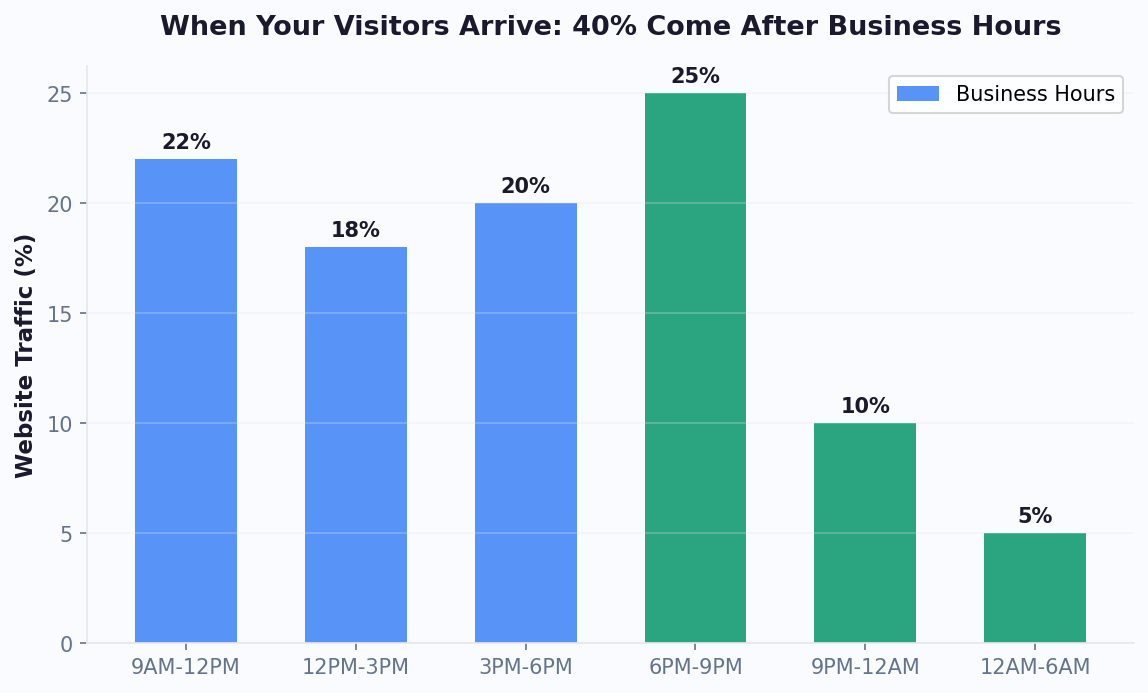
One of the most valuable capabilities of a dental chatbot is after-hours appointment capture. Research shows that 35-40% of dental appointment requests happen outside of business hours — evenings, weekends, and early mornings when patients have time to think about their dental needs. Without a chatbot, these patients either call and get voicemail (and many never call back) or search for a competitor who offers online booking.
A chatbot captures these after-hours inquiries and converts them directly into booked appointments. For cosmetic procedures like teeth whitening, veneers, and Invisalign consultations, after-hours browsing is particularly common as patients research options on their own time. Practices report 20% increases in cosmetic bookings — a finding consistent with PatientPop practice growth data directly attributable to after-hours chatbot availability.
Integration with Practice Management Software
Connect your chatbot to your practice management system (Dentrix, Eaglesoft, Open Dental, or others) through the integrations hub so that appointments booked through the chatbot appear instantly on your schedule. The chatbot reads real-time availability, respects provider schedules and blocked times, and prevents double-booking. Use calendar booking to provide a smooth scheduling experience that syncs with your existing tools. No manual entry, no reconciliation — just seamless booking that patients and staff both appreciate.
Patient Intake Automation: Eliminate Clipboards and Paper Forms
The traditional dental intake process — handing a new patient a clipboard with multiple pages of forms — is slow, error-prone, and creates a poor first impression. Patients arrive early, spend 15-20 minutes filling out paper forms with tiny handwriting, and then a staff member manually enters that information into the practice management system. Errors creep in at every step, from illegible handwriting to data entry mistakes.
Conversational Intake Through Chatbot
A dental chatbot transforms intake into a conversational process that patients complete before they arrive at the office. When a new patient books an appointment, the chatbot automatically sends a pre-visit intake sequence:
- Personal information: Name, date of birth, address, contact details, emergency contact — collected through a natural chat conversation rather than a static form.
- Medical history: The chatbot asks about current medications, known allergies, chronic conditions (diabetes, heart conditions, blood disorders), and previous surgeries. It uses conditional logic — if a patient indicates they take blood thinners, the chatbot asks follow-up questions about the specific medication and dosage.
- Dental history: Date of last dental visit, previous dental work, current concerns or pain, history of dental anxiety, and preferences for sedation options.
- Insurance information: The chatbot collects insurance provider, group number, subscriber information, and can even accept photos of insurance cards via rich media upload for accurate data capture.
- Consent forms: Digital consent for treatment, privacy practices (HIPAA), and financial responsibility — completed with electronic acknowledgment.
Benefits for Practice and Patient
The impact on practice efficiency is substantial:
- Time savings: Staff spend an average of 8-12 minutes per new patient on manual data entry from paper forms. With chatbot intake flowing directly into your practice management system, this drops to near zero.
- Data accuracy: Typed responses eliminate handwriting interpretation errors. Structured data collection ensures no required fields are missed.
- Patient satisfaction: Patients complete intake on their own device, at their own pace, from the comfort of home. They arrive at the office ready for their appointment rather than spending their first 20 minutes filling out forms.
- Insurance verification head start: With insurance information collected in advance, your billing team can verify coverage and benefits before the patient arrives, eliminating day-of surprises about coverage.
HIPAA Compliance Considerations
When collecting patient health information through a chatbot, HIPAA compliance is essential. The Office of the National Coordinator for Health IT (ONC) provides detailed guidance on safeguarding patient data in digital communications. Ensure your chatbot platform uses end-to-end encryption, stores data on HIPAA-compliant servers, and includes a Business Associate Agreement (BAA). Conferbot's platform is designed with healthcare data security in mind, providing the encryption and access controls needed for dental practice patient intake. All data transmitted through the chatbot is encrypted in transit and at rest, and access is restricted to authorized practice staff.
Treatment Reminders and Follow-Up Automation
Dental health depends on consistent follow-through — regular cleanings every six months, multi-visit procedures completed on schedule, post-operative care instructions followed properly, and prescribed treatments not delayed indefinitely. Yet dental practices struggle with patient compliance: 30-40% of patients do not return for their recommended six-month cleaning according to DentistryIQ research, and incomplete treatment plans represent significant lost revenue.
Automated Recall and Reactivation
The chatbot manages patient recall — the process of reminding patients when they are due for their next visit — with a multi-touch approach:
- Pre-due reminder (30 days before): "Hi Sarah, your next dental cleaning is due in about a month. Want to book your appointment now? Morning or afternoon works best for you?"
- Due date reminder: "Your six-month cleaning is now due. We have openings this week on Tuesday at 10 AM and Thursday at 2 PM. Shall I book one for you?"
- Overdue follow-up (2 weeks past due): "It's been 7 months since your last cleaning. Regular cleanings prevent cavities and catch issues early. Book your appointment here — it only takes 30 seconds."
- Reactivation (3+ months overdue): "We haven't seen you in a while and want to make sure your smile stays healthy. Book a cleaning this month and receive a complimentary fluoride treatment."
This automated sequence runs continuously, ensuring no patient falls through the cracks. Practices using chatbot-based recall report 25-35% improvements in recall rates compared to phone-only recall systems.
Treatment Plan Follow-Through
For patients with multi-visit treatment plans — crown preparations, root canals, orthodontic adjustments, implant stages — the chatbot tracks the treatment timeline and sends reminders for each subsequent visit:
- Next-step reminders: "Your temporary crown was placed two weeks ago. It's time to schedule your permanent crown fitting. Available slots this week..."
- Post-procedure care: After extractions, surgeries, or other procedures, the chatbot sends timed aftercare instructions: "Day 1: Keep gauze in place for 30 minutes. Avoid hot food and drink. Take prescribed pain medication as directed..."
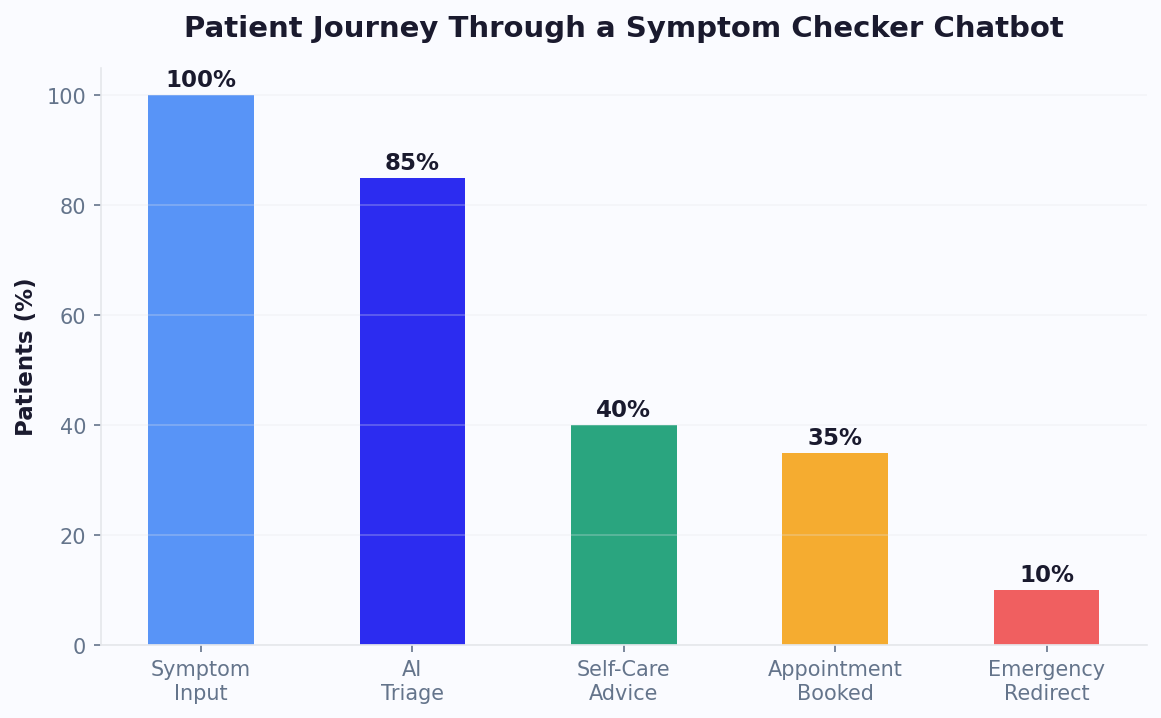
- Symptom check-ins: "It's been 3 days since your extraction. How are you feeling? Any unusual pain, swelling, or bleeding?" If the patient reports concerning symptoms, the chatbot escalates to the clinical team immediately.
No-Show Reduction Through Smart Reminders
The chatbot sends appointment reminders at strategic intervals — 48 hours, 24 hours, and 2 hours before the appointment — with interactive confirmation:
"Your appointment with Dr. Patel is tomorrow at 3:00 PM. Reply CONFIRM to keep your appointment, RESCHEDULE to change the time, or CANCEL if you can't make it."
This interactive approach is dramatically more effective than passive reminders. Patients who might simply not show up are given a frictionless way to reschedule, and confirmed appointments have a 95%+ show rate. For the detailed methodology behind these results, see our guide on automating appointment reminders to reduce no-shows. Open cancelled slots are immediately offered to patients on the waitlist through WhatsApp notifications, minimizing revenue loss from cancellations.
Insurance and Billing FAQ Automation
Insurance and billing questions are among the most time-consuming inquiries dental front desk staff handle. Patients want to know if their insurance covers a specific procedure, what their copay will be, how to submit claims, and why they received a particular bill. These conversations are repetitive — the same questions come up dozens of times per week — but they require accurate, specific answers that vary by insurance plan.
Common Insurance Questions Automated
A dental chatbot handles the most frequent insurance inquiries instantly:
- "Do you accept my insurance?" The chatbot maintains an up-to-date list of accepted insurance providers and can confirm whether a specific plan is in-network. "Yes, we accept Delta Dental PPO. Your plan typically covers preventive services at 100%, basic procedures at 80%, and major procedures at 50%, subject to your annual maximum."
- "How much will my procedure cost?" For common procedures, the chatbot provides cost ranges and typical insurance coverage: "A dental crown typically costs $900-1,300. Most PPO plans cover 50% after the deductible. Based on Delta Dental PPO, your estimated out-of-pocket cost would be $450-650. We can verify your exact benefits before your appointment."
- "What's my remaining annual benefit?" While the chatbot cannot access real-time insurance databases, it can explain how to check benefits and offer to have the billing team verify specific amounts before the appointment.
- "Do you offer payment plans?" The chatbot explains financing options: "We offer CareCredit and Lending Club financing with 0% interest for 12 months on treatments over $500. We also offer in-house payment plans for treatments over $1,000. Would you like more details on either option?"
Treatment Cost Transparency
One of the biggest barriers to treatment acceptance in dentistry is cost uncertainty. When a dentist recommends a procedure and the patient does not know what it will cost, they often delay or decline treatment. A chatbot that proactively provides cost estimates and insurance coverage information increases treatment acceptance rates by 15-25%.
The chatbot can walk a patient through a recommended treatment plan:
- Procedure explanation: "Dr. Patel has recommended a dental crown for tooth #19. A crown protects a weakened tooth from further damage and restores its shape and function."
- Cost breakdown: "The total cost for a porcelain crown is $1,100. Your insurance covers 50% after your $50 deductible, so your estimated out-of-pocket cost is $575."
- Financing options: "We can split this into 4 monthly payments of $143.75 at 0% interest through CareCredit. Would you like to apply?"
- Scheduling: "Ready to proceed? The crown procedure takes two visits — about 90 minutes for the preparation and 45 minutes for the placement. I can schedule your first visit now."
Reducing Billing Disputes
Billing misunderstandings create patient dissatisfaction and consume staff time. The chatbot reduces disputes by setting clear expectations upfront and providing detailed breakdowns after treatment. Post-treatment, the chatbot sends a summary: "Here's your visit summary: Dental crown preparation — $1,100. Insurance payment: $525. Your responsibility: $575. Payment is due within 30 days. Questions? Reply here or call our billing team." Use analytics to track which insurance questions come up most frequently and refine your chatbot's responses to address them proactively.
Cosmetic Dentistry Conversions: Using Chatbots to Sell High-Value Procedures
Cosmetic dentistry represents the highest-margin segment of most dental practices, with procedures ranging from $300 for professional whitening to $20,000+ for full smile makeovers. Yet conversion rates for cosmetic inquiries are notoriously low — patients browse, research, and hesitate for weeks or months before committing. A strategically designed chatbot dramatically shortens this decision cycle.
Why Cosmetic Patients Need Different Handling
Unlike patients with a toothache (who need treatment and will book regardless), cosmetic patients are making an elective, emotional purchase. They are motivated by self-image, social pressure, or life events (weddings, career changes, reunions). The decision factors are different: cost, pain expectations, time commitment, results predictability, and social proof all weigh heavily. A generic appointment booking chatbot misses these conversion triggers entirely.
The Cosmetic Consultation Funnel
Design a dedicated chatbot flow for cosmetic inquiries that addresses each decision barrier:
- Procedure education: When a visitor browses your whitening, veneer, or Invisalign pages, the chatbot proactively offers information: "Interested in a brighter smile? I can show you options, pricing, and before/after results. What are you considering?"
- Before/after gallery: Share relevant before/after images (with patient consent) directly in the chat. Visual proof is the single most persuasive element for cosmetic decisions.
- Cost transparency: Provide clear price ranges and financing options upfront. Cosmetic patients appreciate transparency — vague pricing creates distrust. "Porcelain veneers range from $900-1,500 per tooth. Most patients do 6-10 teeth for a complete smile transformation. We offer 0% financing through CareCredit for 12-24 months."
- Time commitment: Explain the process duration clearly. "Invisalign treatment typically takes 6-18 months depending on complexity. Veneers require just 2 visits over 2 weeks."
- Consultation booking: Once the patient is educated and engaged, offer a free or low-cost consultation: "Ready to explore your options? Our cosmetic consultations include a digital smile preview showing how your results would look. Book your 30-minute consultation now."
After-Hours Cosmetic Capture
According to the ADA, cosmetic procedure research peaks between 8 PM and 11 PM — when patients have leisure time to browse transformation possibilities. A chatbot available during these hours captures this high-intent traffic that would otherwise leave and potentially never return. Practices report that 45-55% of cosmetic consultation bookings come from after-hours chatbot interactions, making 24/7 availability particularly critical for the cosmetic segment.
The Revenue Impact
A dental practice averaging 5 cosmetic consultations per week from the chatbot, with a 40% case acceptance rate at an average case value of $4,000, generates $8,000 per week in incremental cosmetic revenue — or $416,000 annually. Even at modest assumptions (2 extra consultations per week, 30% acceptance), the chatbot adds $125,000+ in annual cosmetic revenue while running on autopilot.
Multi-Location Dental Practices: Centralized vs. Location-Specific Chatbots
Dental groups with 2-10+ locations face unique chatbot implementation decisions. Should each location have its own chatbot, or should a single centralized bot serve all locations? The answer impacts patient experience, operational efficiency, and scalability.
The Centralized Approach (Recommended for Most Groups)
A single chatbot serves all locations, routing patients to the appropriate office based on zip code or preference. Benefits include:
- Consistent experience: Every patient interaction follows the same high-quality flows regardless of location
- Single knowledge base: Update policies, pricing, or insurance acceptance once and it applies everywhere
- Cross-location scheduling: If a patient's preferred location is fully booked, the chatbot can offer the next available slot at a nearby sister location — capturing appointments that would otherwise be lost
- Centralized analytics: Compare performance metrics across locations from a single dashboard to identify which offices excel and which need improvement
Location-Specific Customization Within the Centralized Bot
While the core logic is shared, certain elements should be location-specific:
- Provider names and specialties per location
- Operating hours (which may differ by location)
- Specific services offered (not all locations may offer orthodontics or oral surgery)
- Insurance networks (may vary if locations have different provider agreements)
- Parking and access instructions
Configure these as variables within your chatbot platform so the same flow dynamically adjusts based on which location the patient selects.
Patient Routing Logic
The chatbot should determine the appropriate location early in the conversation:
- Existing patient: Look up their home location from your practice management system
- New patient: Ask for their zip code and suggest the closest location
- Specific provider request: Route directly to the location where that provider practices
- First available appointment: Search all locations and present the soonest available slot regardless of location
The Group Practice ROI Multiplier
Multi-location practices see disproportionately higher chatbot ROI because the platform cost is shared across locations while benefits multiply. A $149/month chatbot platform serving 4 locations costs $37.25 per location — less than one prevented no-show per month per location to break even. Meanwhile, each location independently generates $8,000-15,000/month in chatbot-driven value through after-hours bookings, cosmetic consultations, reduced no-shows, and decreased phone volume.
According to DentistryIQ, multi-location dental groups are the fastest-growing segment of dentistry, and those investing in centralized digital patient communication systems grow 2-3x faster than those managing each location independently. A unified chatbot is the foundation of this centralized communication strategy.
Implementing a Dental Practice Chatbot: Step-by-Step Guide
Implementing a chatbot for your dental practice does not require technical expertise. Our chatbot for small business guide covers the fundamentals applicable to any practice size. Here is a practical, phased approach that any dental office can follow to get up and running within two weeks.
Phase 1: Foundation Setup (Week 1)
- Choose your channels. Start with your practice website and WhatsApp. These two channels capture the highest volume of patient inquiries. Your website chatbot handles new patient acquisition, while WhatsApp serves existing patients who prefer messaging over calling.
- Build your knowledge base. Document your most common patient questions and answers: office hours, location and parking, accepted insurance plans, emergency protocols, new patient procedures, and basic pricing for common services. This forms the foundation of your chatbot's FAQ capabilities.
- Connect your practice management system. Integrate with Dentrix, Eaglesoft, Open Dental, or your PMS of choice through the integrations hub to enable real-time appointment scheduling and patient data sync.
Phase 2: Build Core Flows (Week 2)
Build these flows in priority order:
- Appointment scheduling: New and existing patient booking with service selection, provider preference, and real-time availability through calendar booking.
- FAQ automation: Insurance acceptance, pricing estimates, office hours, emergency instructions, and new patient information.
- Appointment reminders: 48-hour, 24-hour, and 2-hour reminders with interactive confirm/reschedule/cancel options.
- New patient intake: Pre-visit medical history, dental history, insurance information, and consent forms.
Phase 3: Launch and Optimize (Week 3-4)
- Soft launch with staff testing. Have your team test every flow as if they were patients. Common issues include missing insurance plans, incorrect appointment durations for specific procedures, and edge cases in the scheduling logic.
- Go live and monitor. Enable the chatbot for patients and monitor conversations closely for the first week. Look for questions the chatbot cannot answer, flows where patients drop off, and opportunities to improve responses.
- Promote to patients. Add the chatbot link to appointment confirmation emails, post-visit communications, recall reminders, and your Google Business profile. Include a QR code in the waiting room: "Skip the phone — book your next appointment instantly!"
Measuring Success
Track these KPIs weekly to measure your chatbot's impact:
- Phone call reduction: Target 30-50% decrease in incoming calls within the first month
- After-hours bookings: Track appointments booked outside of business hours — these are patients you would have lost without the chatbot
- No-show rate: Target reduction from 10-15% to under 5% with interactive reminders
- New patient conversion: Percentage of website visitors who interact with the chatbot and book an appointment
- Treatment acceptance rate: Track whether patients who receive chatbot cost estimates are more likely to accept recommended treatments
- Patient satisfaction: Include a quick satisfaction question in post-visit chatbot follow-ups
Review your analytics dashboard regularly to identify improvement opportunities. Use our chatbot ROI calculation guide to model your specific practice economics. Most dental practices see positive ROI within the first two weeks as reduced no-shows and after-hours bookings immediately offset the chatbot cost. For a deeper look at chatbot economics, explore our chatbot cost savings case studies and chatbot vs phone support comparison.
Was this article helpful?
AI Chatbots for Dental Practices FAQ
Everything you need to know about chatbots for ai chatbots for dental practices.
About the Author
Conferbot Team specializes in conversational AI, chatbot strategy, and customer engagement automation. With deep expertise in building AI-powered chatbots, they help businesses deliver exceptional customer experiences across every channel.
View all articles