The Silent Revenue Killer: How Failed Payments Drain 9 to 12 Percent of Your MRR
Every subscription business has two churn problems. Voluntary churn -- customers who actively decide to cancel -- gets most of the attention because it feels actionable: improve the product, fix the onboarding, reduce pricing friction. But involuntary churn -- customers who lose access because their payment method fails -- is often larger, more damaging, and far more solvable. According to ProfitWell's analysis of 23,000 subscription companies, involuntary churn accounts for 20 to 40 percent of total churn, draining 9 to 12 percent of monthly recurring revenue for companies without robust recovery processes.
The mechanics are straightforward. A customer's credit card expires, their bank declines the charge due to insufficient funds, the card is replaced after fraud, or the billing address changes. The subscription platform attempts the charge, it fails, and a dunning sequence begins -- typically a series of 3 to 5 emails over 7 to 14 days asking the customer to update their payment method. If the customer does not respond, their subscription is cancelled.
The problem is that email dunning alone has a recovery rate of just 25 to 35 percent. Emails about payment failures land in promotions tabs, get filtered by spam algorithms, or simply go unread amid the 121 emails the average professional receives daily. The customer often has no idea their payment failed until they try to use the product and find their account suspended -- by which point frustration has compounded and the likelihood of recovery has dropped precipitously.
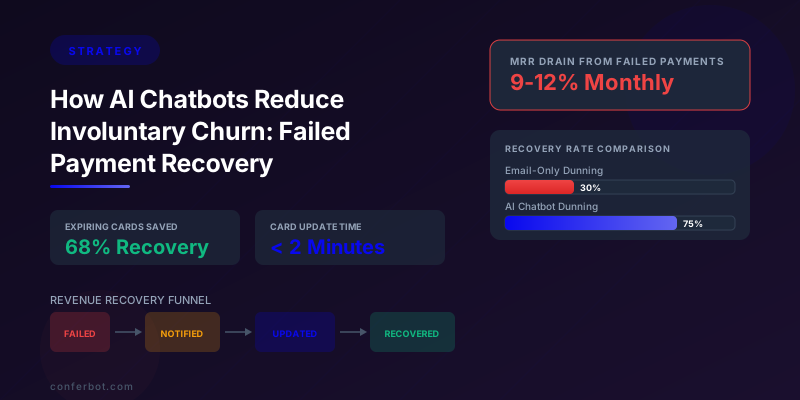
AI chatbots transform dunning from a passive, email-dependent process into an active, multi-channel, conversational recovery system. Instead of sending an email and hoping the customer opens it, the chatbot reaches the customer where they actually engage: WhatsApp, SMS, in-app messages, or web chat. The chatbot explains the issue in plain language ("Your Visa ending in 4821 expired. Want to update it now?"), enables the customer to update their card directly in the conversation (through a secure payment link or embedded form), and confirms the successful charge in real time. The entire interaction takes under 2 minutes.
The results are dramatic. Companies deploying conversational dunning chatbots report recovery rates of 68 to 75 percent -- more than double the email-only baseline. For a SaaS company with $500,000 MRR losing 10 percent to failed payments, improving recovery from 30 to 72 percent saves $21,000 per month -- $252,000 annually -- from a single chatbot workflow. This is not speculative; it is arithmetic applied to a problem that every subscription business faces every month.
This guide covers the complete strategy for chatbot-powered payment recovery: the anatomy of payment failures, proactive expiring-card outreach that prevents failures before they happen, reactive dunning workflows for failed charges, the conversational card update experience, multi-channel delivery strategies, revenue recovery modeling, and integration with subscription billing platforms. Whether you run a SaaS product, a membership site, a subscription box, or any recurring billing model, these strategies apply directly to your revenue. For a broader view of chatbot-driven retention, see our customer retention strategy guide.
Anatomy of Payment Failures: Why Cards Fail and What Determines Recovery
Understanding why payments fail is essential for designing effective recovery workflows. Different failure types have different recovery probabilities, optimal outreach timing, and resolution paths. Stripe's analysis of billions of payment attempts provides the definitive breakdown.
Failure Type Distribution
| Failure Type | Percentage of Failures | Recovery Without Intervention | Recovery With Chatbot Dunning |
|---|---|---|---|
| Expired card | 30-35% | 0% (requires new card) | 72-80% |
| Insufficient funds | 25-30% | 40-50% (auto-retry success) | 65-75% (with retry + outreach) |
| Card replaced (fraud, lost, upgraded) | 15-20% | 0% (requires new card) | 60-70% |
| Issuer decline (generic) | 10-15% | 20-30% (auto-retry) | 50-60% |
| Do not honor / restricted | 5-8% | 5-10% | 30-40% |
| Invalid card number | 3-5% | 0% | 55-65% |
The Recovery Window
Recovery probability declines rapidly with time. Data from Chargebee's dunning analysis across thousands of subscription businesses shows a clear decay curve.
- Day 1 after failure: 65-70% recovery probability with immediate outreach
- Day 3: 50-55% recovery probability
- Day 7: 35-40% recovery probability
- Day 14: 20-25% recovery probability
- Day 30: 10-15% recovery probability
The steep decay underscores why channel choice matters so much. An email sent on Day 1 that is not opened until Day 5 has already lost 15 to 20 percentage points of recovery probability. A WhatsApp message sent on Day 1 that is read within 3 minutes maintains the full Day 1 recovery window. Channel speed is directly correlated with revenue recovery.
Behavioral Segmentation for Recovery
Not all customers with failed payments should receive the same treatment. Segment by engagement level to optimize recovery approach.
- Active users (logged in within 7 days): Highest recovery probability (80-plus percent). These customers want the product -- they just have a payment issue. The chatbot should use in-app messaging or push notifications for immediate visibility. Tone: helpful and urgent but not alarming.
- Semi-active users (logged in 8-30 days ago): Moderate recovery probability (55-65 percent). These customers may not notice the failure for days. Use WhatsApp or SMS for higher open rates. Tone: informational with a reminder of product value.
- Inactive users (not logged in 30-plus days): Lower recovery probability (25-35 percent). These customers may have mentally churned already. The payment failure is an opportunity to re-engage, but the bar is higher. Use email plus a follow-up SMS. Tone: value-focused ("Here is what you have been missing") combined with the payment update request.

For AI-driven behavioral segmentation strategies in chatbot interactions, see our guide on AI chatbot customer experience.
Proactive Expiring Card Outreach: Preventing Failures Before They Happen
The highest-ROI payment recovery strategy is prevention. By identifying cards that will expire before the next billing cycle and proactively requesting updates, you eliminate the failure entirely. This approach recovers 80 to 90 percent of at-risk subscriptions -- far higher than any reactive dunning strategy.
How Proactive Outreach Works
The subscription billing platform (Stripe, Chargebee, Recurly, Braintree) stores each customer's card expiration date. A weekly or bi-weekly batch job identifies customers whose cards expire within the next 30 to 45 days. The chatbot initiates a proactive conversation with each identified customer through their preferred channel.
Sample Proactive Conversation:
Chatbot: "Hi Sarah, this is a quick heads-up from [Product Name]. Your Visa ending in 4821 expires next month, and your subscription renews on July 15. Want to update your card now so there is no interruption? It takes under 60 seconds."
[Update Card Now] [Remind Me Later] [I Have Questions]
If the customer taps "Update Card Now," the chatbot provides a secure payment link (PCI-compliant, tokenized) where the customer enters their new card details. Upon successful update, the chatbot confirms: "All set. Your new card ending in 7293 is saved, and your July 15 renewal will charge automatically. No further action needed."
If the customer taps "Remind Me Later," the chatbot schedules a follow-up in 7 days. If the customer does not update by 5 days before renewal, the chatbot sends a final reminder with increased urgency.
Proactive Outreach Timing Strategy
| Days Before Expiry | Action | Channel | Tone |
|---|---|---|---|
| 30-45 days | First proactive notification | Email + in-app | Informational, low urgency |
| 14 days | Reminder if not updated | WhatsApp or SMS | Helpful, moderate urgency |
| 5 days | Final reminder | SMS + in-app banner | Urgent, "avoid interruption" |
| 1 day | Last-chance notification | Push notification + SMS | Direct, "update now to avoid account pause" |
The Card Account Updater Complement
Most payment processors offer Card Account Updater (CAU) services that automatically update stored card numbers when banks issue replacement cards. Visa Account Updater and Mastercard Automatic Billing Updater cover approximately 50 to 60 percent of card replacements automatically. However, CAU does not cover all scenarios: some banks do not participate, prepaid cards are excluded, and cross-network changes (Visa to Mastercard) are not captured.
The chatbot proactive outreach is complementary to CAU, catching the 40 to 50 percent of cases that CAU misses. Together, the combination of CAU (automatic backend updates) and chatbot proactive outreach (conversational customer-initiated updates) can prevent 85 to 92 percent of expiring-card failures before they occur.
Measuring Proactive Outreach Effectiveness
- Card update rate: Percentage of notified customers who update their card before expiry. Target: 60 to 70 percent.
- Prevented failures: Number of billing cycles that would have failed but succeeded because the card was updated proactively. This is the direct revenue impact metric.
- Cost per prevented failure: The messaging cost (WhatsApp template, SMS) divided by prevented failures. Typically $0.15 to $0.40 per prevented failure versus $8 to $15 for reactive dunning per recovered customer.
For more on proactive chatbot outreach strategies, see our guide on chatbot marketing strategy.
Reactive Dunning Workflows: Multi-Channel Recovery After Payment Failure
When a payment fails despite proactive measures, the reactive dunning workflow activates. This is where the chatbot's multi-channel reach and conversational capability create the largest improvement over email-only dunning.
The Multi-Channel Dunning Sequence
The optimal dunning sequence uses escalating channels over a 14-day window, starting with the channels the customer is most likely to see and progressing to more intrusive channels as urgency increases.
Hour 0 (Immediate, Automated Retry): The billing platform automatically retries the charge. If the failure was due to temporary insufficient funds or a transient issuer decline, the retry may succeed without any customer action. Retry on a different day or time of day (early morning retries on business days have higher success rates).
Hour 1 (First Chatbot Contact): If the retry fails, the chatbot sends the first recovery message through the customer's highest-engagement channel (determined by historical interaction data).
For active users, the chatbot appears as an in-app notification: "We could not process your payment for [Product Name]. Your Visa ending in 4821 was declined. Update your card to keep your account active." [Update Card] [Contact Support]
For customers with WhatsApp opted in, the message goes via WhatsApp: "Hi [Name], your [Product Name] subscription payment did not go through. Your Visa ending in 4821 was declined by your bank. Tap below to update your card -- it takes under a minute." [Update Payment Method]
Day 3 (Second Contact + Context): If the customer has not responded, the chatbot sends a second message on an alternate channel with additional context. "Your [Product Name] account is on hold because we could not charge your Visa ending in 4821. Here is what you will lose access to: [top 2-3 features the customer uses most]. Update your card to restore full access." This personalized value reminder creates urgency by making the impact concrete.
Day 7 (Escalation + Human Offer): A third message with a human-handoff option: "We have been trying to reach you about your [Product Name] payment. Your account will be cancelled on [date] unless we can resolve this. Want to chat with our team? We can help with payment plans, alternative payment methods, or any questions." [Chat With Us] [Update Card] [Cancel Subscription]

Day 10 (Final Warning): SMS message (highest urgency channel): "[Product Name]: Your subscription cancels in 4 days due to unpaid balance. Update your payment: [link]. Questions? Reply to this message."
Day 14 (Cancellation + Win-Back Offer): If no response after 14 days, the subscription is cancelled. The chatbot sends a final message that pivots to win-back: "Your [Product Name] subscription has been cancelled due to payment failure. We have saved your data for 30 days. If you would like to reactivate, you can do so anytime with a new payment method: [link]. We would love to have you back."
Channel Performance Data
| Channel | Open/Read Rate | Response Rate | Card Update Conversion | Best For |
|---|---|---|---|---|
| In-app notification | 85-90% | 35-45% | 28-35% | Active users |
| 90-95% | 40-50% | 30-40% | All segments | |
| SMS | 95-98% | 25-35% | 20-28% | Urgent final notices |
| Push notification | 40-60% | 15-25% | 12-18% | Mobile app users |
| 18-25% | 8-15% | 6-12% | Baseline (always include) |
The data is clear: WhatsApp and in-app messaging achieve 3x to 5x the card update conversion of email. For companies deploying chatbots across multiple channels, see our guide on conversational commerce for multi-channel best practices.
The Conversational Card Update Experience: Secure, Fast, and Frictionless
The card update experience is the critical conversion moment in the dunning flow. Even if the chatbot successfully reaches the customer and communicates the issue, a clunky update process ("log into your account, go to Settings, click Billing, click Update Payment Method") creates friction that reduces conversion by 30 to 50 percent. The chatbot should enable card updates within the conversation itself.
Secure In-Conversation Card Updates
There are three patterns for enabling card updates within a chatbot conversation, each balancing security, convenience, and PCI compliance.
Pattern 1: Embedded Payment Form (Recommended)
The chatbot generates a tokenized, PCI-compliant payment form that renders within the chat interface (on web) or as a secure webview (on WhatsApp/SMS). The customer enters their new card details directly in the conversation flow without navigating to a separate page. The form is hosted by the payment processor (Stripe Elements, Braintree Hosted Fields, or equivalent), ensuring that card data never touches the chatbot server. Upon successful tokenization, the chatbot updates the stored payment method and immediately retries the failed charge.
Pattern 2: Secure Payment Link
The chatbot generates a unique, time-limited (24-hour expiry) payment update URL that takes the customer directly to a pre-authenticated card update page. This pattern works on all channels (including SMS where embedded forms are not possible) and is the simplest to implement. The customer taps the link, enters their new card on the hosted page, and the chatbot receives a webhook confirmation when the update succeeds.
Pattern 3: Apple Pay / Google Pay Quick Update
For mobile users, the chatbot offers a one-tap payment update using Apple Pay or Google Pay. The customer authenticates with Face ID or fingerprint, and their default wallet card replaces the expired one. This pattern has the highest conversion rate (45 to 55 percent tap-through) because it eliminates manual card entry entirely. However, it only works for customers who have a wallet configured and for channels that support the wallet API.
The Complete Card Update Conversation
Here is a complete conversational flow for the most common scenario -- expired card recovery via WhatsApp.
Chatbot: "Hi [Name], your [Product] subscription payment of $49/month could not be processed because your Visa ending in 4821 has expired. Want to update your card now? It takes under 60 seconds."
[Update My Card] [I Need Help] [Cancel Subscription]
Customer taps: "Update My Card"
Chatbot: "Great. Here is a secure link to enter your new card details. Your data is encrypted and processed by Stripe -- we never see your full card number." [Secure Card Update Link]
Customer completes the form.
Chatbot: "Your new Mastercard ending in 7293 has been saved. I have retried your $49 payment and it went through successfully. Your subscription is fully active -- no further action needed. Here is your updated receipt: [receipt link]."
Total time: 90 seconds.
PCI Compliance Considerations
Payment card data is regulated by the PCI Security Standards Council. The chatbot itself should never collect, store, or process raw card numbers. All three patterns above maintain PCI compliance by delegating card handling to the payment processor's hosted infrastructure. The chatbot only receives tokenized references (last 4 digits, card brand, token ID) -- never the full card number, CVV, or expiration date.
Key compliance requirements:
- Card data entry must occur on a PCI-certified hosted form, not within the chatbot's own interface
- The chatbot must not log or store any portion of the card number beyond the last 4 digits
- Secure payment links must use HTTPS with TLS 1.2 or higher
- Time-limited payment links (24-hour expiry maximum) prevent link reuse
- All card update events must be logged for audit purposes (timestamp, customer ID, token change, but never card data)
For more on chatbot security in payment-adjacent workflows, see our chatbot security guide.
Revenue Recovery Model: Calculating the MRR Impact of Conversational Dunning
The financial case for chatbot dunning is built on a simple equation: failed payments x recovery rate improvement x average subscription value = recovered revenue. Here is a detailed model for three company sizes.
Model Assumptions
| Metric | Startup ($100K MRR) | Growth ($500K MRR) | Scale ($2M MRR) |
|---|---|---|---|
| Monthly Recurring Revenue | $100,000 | $500,000 | $2,000,000 |
| Failed payment rate | 10% | 10% | 10% |
| Monthly failed payment MRR | $10,000 | $50,000 | $200,000 |
| Current recovery rate (email-only) | 30% | 30% | 30% |
| Current monthly loss | $7,000 | $35,000 | $140,000 |
Chatbot Dunning Impact
| Metric | Startup | Growth | Scale |
|---|---|---|---|
| Chatbot recovery rate (proactive + reactive) | 72% | 72% | 72% |
| Monthly recovered MRR | $7,200 | $36,000 | $144,000 |
| Previous recovery (email-only) | $3,000 | $15,000 | $60,000 |
| Incremental monthly recovery | $4,200 | $21,000 | $84,000 |
| Annual incremental revenue recovered | $50,400 | $252,000 | $1,008,000 |
Cost Analysis
| Cost Item | Startup | Growth | Scale |
|---|---|---|---|
| Chatbot platform (Conferbot) | $228/mo ($2,736/yr) | $299/mo ($3,588/yr) | $299/mo ($3,588/yr) |
| WhatsApp Business API messages | $120/mo | $600/mo | $2,400/mo |
| SMS messages | $80/mo | $400/mo | $1,600/mo |
| Integration development (amortized) | $200/mo | $400/mo | $800/mo |
| Total monthly cost | $628 | $1,699 | $5,099 |
| Total annual cost | $7,536 | $20,388 | $61,188 |
ROI Summary
| Metric | Startup | Growth | Scale |
|---|---|---|---|
| Annual incremental revenue | $50,400 | $252,000 | $1,008,000 |
| Annual cost | $7,536 | $20,388 | $61,188 |
| Net annual ROI | $42,864 | $231,612 | $946,812 |
| ROI multiple | 6.7x | 12.4x | 16.5x |
| Payback period | 1.8 months | 1.0 months | 0.7 months |

The ROI scales with company size because the cost base is nearly fixed (platform fees do not scale linearly with revenue) while the revenue recovery scales directly with MRR. For a growth-stage company, the chatbot pays for itself in the first month and generates $231,612 in net annual revenue recovery -- making it one of the highest-ROI investments available to a subscription business.
For a broader ROI framework that applies to all chatbot use cases, see our chatbot ROI calculator guide. For companies also dealing with B2B invoice disputes, our companion guide on automating invoice dispute resolution covers the accounts receivable side of payment recovery.
Billing Platform Integration: Connecting Stripe, Chargebee, and Recurly
The chatbot's effectiveness depends on real-time integration with your subscription billing platform. The integration must support four capabilities: detecting failures, triggering outreach, enabling card updates, and confirming recovery.
Stripe Integration
Stripe provides the most comprehensive webhook system for dunning automation. Key events to subscribe to include invoice.payment_failed (triggers the reactive dunning sequence), customer.subscription.updated (detects plan changes during dunning), payment_method.updated (confirms card update), and invoice.paid (confirms recovery). For proactive outreach, query the Payment Methods API to retrieve card expiration dates and identify at-risk customers. Stripe's Customer Portal can be linked directly from the chatbot for self-service card updates, or use Stripe Elements for embedded payment forms.
Chargebee Integration
Chargebee's event system mirrors the dunning lifecycle. Subscribe to payment_failed, subscription_renewal_reminder, card_expiring, and payment_succeeded events. Chargebee provides a built-in dunning management module that can work alongside the chatbot -- use Chargebee for retry logic and the chatbot for customer communication. Chargebee's Hosted Page URLs can be sent directly in chatbot messages for card updates.
Recurly Integration
Recurly's dunning engine handles automatic retries, while the chatbot handles customer outreach. Subscribe to failed_payment, successful_payment, and updated_account webhooks. Recurly's Account Management hosted pages serve as the card update destination. Recurly also provides Account Updater as a built-in feature, complementing the chatbot's proactive outreach.
Generic Integration Pattern
For billing platforms without direct integrations, the following webhook-based pattern works universally.
- Payment failure webhook: Your billing platform sends a webhook when a payment fails. The chatbot platform receives the webhook and initiates the dunning sequence.
- Customer lookup: The chatbot queries the billing platform's API for customer details (name, email, phone, subscription plan, last 4 digits of card, failure reason).
- Outreach execution: The chatbot sends the appropriate message through the configured channel with a secure payment update link.
- Card update webhook: When the customer updates their card, the billing platform sends a webhook confirming the update. The chatbot receives it and sends the confirmation message.
- Recovery confirmation: When the retry succeeds, the billing platform sends a payment success webhook. The chatbot sends the receipt and closes the dunning case.
Conferbot's integration framework includes pre-built connectors for Stripe, Chargebee, and Recurly, with webhook receivers and API connectors for any billing platform with a REST API. The no-code builder allows non-technical teams to configure the dunning flow without developer involvement.
Email-Only Dunning vs Chatbot Dunning: A Head-to-Head Comparison
Most subscription businesses already have email dunning in place. The question is whether adding conversational chatbot dunning justifies the implementation effort. The data strongly supports it.
Head-to-Head Performance Comparison
| Metric | Email-Only Dunning | Chatbot Multi-Channel Dunning | Improvement |
|---|---|---|---|
| Overall recovery rate | 25-35% | 68-75% | +117% to +143% |
| Time to first customer contact | Immediate (but 4-24hr open delay) | Immediate (1-5 min read time) | 10x faster effective contact |
| Average time to card update | 3-5 days | Under 2 minutes (from message open) | 99% faster |
| Customer effort to update | Open email, click link, log in, navigate to billing, enter card | Tap button in message, enter card on hosted form | 3 fewer steps |
| Personalization | Name and plan only | Usage data, feature reminders, behavioral context | Significantly richer |
| Two-way communication | No (one-directional) | Yes (customer can ask questions) | Full conversational support |
| Escalation to human | Requires separate support ticket | Instant handoff within conversation | Seamless |
Why Email Dunning Underperforms
Email dunning suffers from three structural problems that chatbot dunning solves.
1. Deliverability and visibility: Payment failure emails compete with 121 other daily emails. Gmail's promotions tab, corporate spam filters, and inbox overload reduce the effective open rate to 18 to 25 percent. Chatbot messages on WhatsApp and SMS achieve 90 to 98 percent read rates because they appear in the customer's primary messaging interface alongside personal and work conversations.
2. Friction to update: Email dunning links typically route the customer to a login page, then to account settings, then to the billing section, then to the card update form. Each navigation step loses 15 to 25 percent of users. Chatbot dunning provides a direct link to the card update form with pre-authenticated context -- the customer enters their new card and is done. According to Baymard Institute research on checkout friction, every additional step in a payment flow reduces completion by 10 to 20 percent.
3. No two-way communication: Email dunning is broadcast-only. If the customer has a question ("Why was my card declined?", "Can I switch to annual billing?", "Is there a payment plan?"), they must open a separate support ticket and wait for a response. The chatbot handles these questions in real time, resolving objections within the same conversation that initiated the recovery.
The Hybrid Approach (Recommended)
The optimal strategy is not chatbot instead of email but chatbot plus email. Email serves as the baseline (it reaches 100 percent of customers regardless of channel preferences), while chatbot messages on WhatsApp, SMS, and in-app serve as the high-conversion layer that reaches customers faster and converts at 3x to 5x the rate.
The sequencing matters: send the chatbot message first (for immediate engagement), followed by the email (for customers who prefer email or do not have other channels configured). Never send both simultaneously -- stagger by at least 30 minutes to avoid overwhelming the customer with duplicate notifications.
Advanced Strategies: Smart Retries, Win-Back Flows, and Predictive Prevention
Beyond the core dunning workflow, three advanced strategies can further improve recovery rates and reduce involuntary churn.
Smart Retry Optimization
The timing and frequency of automatic payment retries significantly affects recovery rates. Spreedly's payment optimization research shows that retry timing should be based on the failure reason.
- Insufficient funds: Retry on the next business day (payroll deposits often clear overnight), then again on the 1st and 15th of the month (common pay dates). Avoid retrying on weekends when bank processing is slower.
- Issuer decline (generic): Retry after 24 hours, then after 72 hours. Some generic declines are temporary holds that clear within 1 to 3 days.
- Expired card: Do not retry automatically (the card will never work). Focus entirely on customer outreach for a new card.
- Do not honor: Retry once after 48 hours. If it fails again, outreach to the customer is the only path.
The chatbot integrates with the retry logic by timing its outreach messages to complement retries. After a retry fails, the chatbot sends the next dunning message within 1 hour. After a retry succeeds, the chatbot sends a confirmation message and closes the case. This coordination prevents the awkward scenario where the chatbot asks for a card update moments after a successful retry.
Win-Back Flows for Cancelled Subscriptions
Customers who churn due to payment failure are the easiest to win back because they did not actively choose to leave. The chatbot's win-back flow activates 7, 14, and 30 days after cancellation.
Day 7 win-back: "Hi [Name], we noticed your [Product] subscription ended due to a payment issue. Your data and settings are still saved. Reactivate in 30 seconds with a new card: [link]. As a welcome-back bonus, here is 20% off your next month."
Day 14 win-back: "[Name], just a reminder that your [Product] data will be deleted in 16 days. Here is what you built: [summary of user's content/data]. Reactivate to keep everything: [link]."
Day 30 win-back: "Last chance: your [Product] data is scheduled for deletion tomorrow. Reactivate now to save everything you have built: [link]."
Win-back flows recover an additional 8 to 15 percent of involuntarily churned customers, adding meaningful revenue on top of the dunning recovery. The urgency of data deletion is a powerful motivator -- it creates a concrete, time-bound consequence that generic "we miss you" emails lack.
Predictive Churn Prevention
Machine learning models can predict which customers are at highest risk of payment failure before it happens, based on signals like declining login frequency, reduced feature usage, support ticket patterns, and historical payment reliability. The chatbot uses these predictions to prioritize proactive outreach.
- High-risk customers: Start proactive card update outreach 45 days before expiry (instead of 30). Send an additional "account health check" message that combines payment status with a product value recap.
- Medium-risk customers: Standard 30-day proactive timeline with an additional engagement touchpoint (product tips, feature highlight) to reinforce value before the renewal date.
- Low-risk customers: Standard proactive outreach at 14 days before expiry. These customers are engaged and likely to update quickly.
For more on predictive chatbot strategies, see our guide on agentic AI chatbots, which covers autonomous decision-making workflows that include predictive outreach. For the broader customer retention context, our retention strategy guide covers churn prediction models in detail.
Implementation Guide: Deploying Chatbot Dunning in 3 Weeks
Chatbot dunning is one of the fastest chatbot implementations because the workflow is well-defined, the integration points are clear, and the success metric (recovery rate) is immediately measurable.
Week 1: Foundation
- Baseline your current metrics: Document your current failed payment rate, email dunning recovery rate, average time to recovery, and monthly MRR loss. These baselines measure the chatbot's incremental impact.
- Configure billing platform webhooks: Set up webhook subscriptions for payment failure, payment success, and card update events from your billing platform (Stripe, Chargebee, Recurly).
- Set up chatbot channels: Configure the messaging channels you will use for dunning: WhatsApp Business API, SMS (Twilio, MessageBird), in-app messaging, and web chat on your billing portal.
- Build the proactive outreach flow: Create the expiring-card identification query and the proactive notification conversation in your chatbot builder.
Week 2: Dunning Flows
- Build the reactive dunning sequence: Implement the multi-channel dunning workflow from Section 4 with all 5 touchpoints (Hour 1, Day 3, Day 7, Day 10, Day 14).
- Implement secure card update: Configure the payment update mechanism (Stripe Elements embedded form, hosted payment link, or Apple Pay / Google Pay quick update).
- Build confirmation and win-back flows: Create the recovery confirmation message and the post-cancellation win-back sequence (Day 7, 14, 30).
- Test end-to-end: Use Stripe's test mode (or your billing platform's sandbox) to simulate payment failures and verify the complete flow from failure detection to recovery confirmation.
Week 3: Launch and Monitor
- Soft launch: Enable chatbot dunning for 20 percent of new payment failures while keeping email dunning active for all failures. This parallel run validates the chatbot's impact without risk.
- Monitor daily: Track message delivery rates, card update conversion rates, recovery rates, and any error cases for the first 7 days.
- Full rollout: After validating performance, enable chatbot dunning for 100 percent of payment failures. Keep email dunning as the baseline layer.
- Set monthly review: Schedule a monthly review to compare recovery rates, MRR impact, and cost efficiency against pre-chatbot baselines.

Measuring Launch Success
Track these metrics during the first 30 days post-launch to validate the implementation and identify optimization opportunities.
- Message delivery rate: Percentage of dunning messages successfully delivered across all channels. Target: over 95 percent. Low delivery rates indicate channel configuration issues (WhatsApp template rejections, SMS carrier filtering, incorrect phone number formats).
- Message-to-card-update conversion: Percentage of delivered messages that result in a card update. Target: 25 to 35 percent. This is the core funnel metric that determines recovery rate.
- Recovery rate by channel: Compare WhatsApp, SMS, in-app, and email recovery rates independently. This data drives channel allocation optimization in month two.
- Time to card update: Average time from first message delivery to successful card update. Target: under 4 hours for active users, under 48 hours for semi-active users.
- False positive rate: Percentage of dunning messages sent for payments that were subsequently recovered by automatic retry (meaning the message was unnecessary). Some overlap is acceptable, but a high rate suggests retry timing should be adjusted to precede chatbot outreach.
For teams new to chatbot deployment, our no-code chatbot builder guide walks through the platform setup process. Visit Conferbot's pricing page to evaluate plans that include WhatsApp and SMS channel support for dunning workflows.
Was this article helpful?
How AI Chatbots Reduce Involuntary Churn FAQ
Everything you need to know about chatbots for how ai chatbots reduce involuntary churn.
About the Author

Conferbot Team specializes in conversational AI, chatbot strategy, and customer engagement automation. With deep expertise in building AI-powered chatbots, they help businesses deliver exceptional customer experiences across every channel.
View all articles