Why Businesses Are Leaving Chatbase in 2026
Chatbase burst onto the scene in 2023 as one of the first "upload your data and get a GPT chatbot" platforms. The pitch was irresistible: paste a URL or upload a PDF, and Chatbase would spin up a custom ChatGPT-style bot trained on your content in minutes. For early adopters hungry for AI chatbots without the engineering overhead, it was a revelation.
Fast-forward to 2026, and the landscape has changed dramatically. What was once a differentiator -- training a chatbot on your own data -- is now table stakes. Every serious chatbot platform offers document ingestion, website crawling, and RAG-based retrieval. And as the market matured, Chatbase's limitations became harder to overlook.
According to G2 reviews, Chatbase averages 4.3 out of 5 stars overall but drops to 3.8 when users specifically evaluate advanced features and scalability. The most consistent complaints cluster around three pain points: pricing that punishes growth, a missing live-agent handoff capability, and limited channel deployment beyond a web embed.
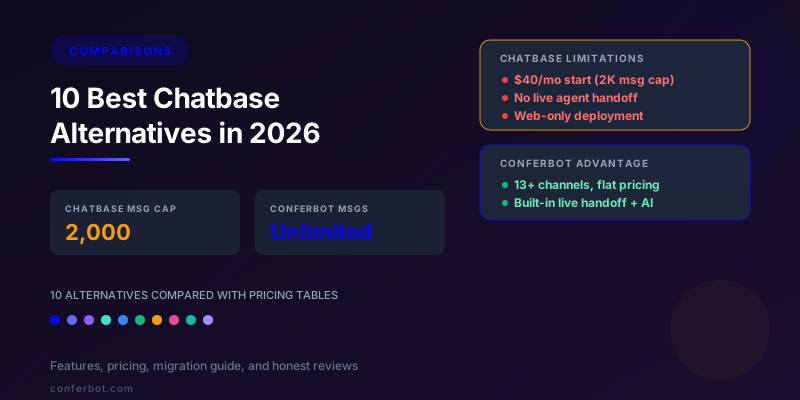
The pricing structure is the first concern for growing teams. Chatbase's Hobby plan starts at $40 per month for just 2,000 message credits. The Standard plan jumps to $100 per month for 10,000 credits, and the Unlimited plan costs $400 per month. But "unlimited" is misleading -- it refers to unlimited chatbots, not unlimited messages. Overage fees of $0.01 to $0.02 per message kick in once you exhaust your credit allocation. For a business handling 20,000 conversations per month, the effective cost can reach $200 to $500 depending on message volume per conversation -- and that is before factoring in the cost of supplementary tools needed to fill Chatbase's feature gaps.
The second deal-breaker for customer-facing deployments is the absence of native live-agent handoff. When Chatbase's AI cannot answer a question or when a customer requests a human, there is no built-in escalation path. The chatbot either loops, offers a contact form, or provides a generic "please email us" response. For businesses where customer experience directly impacts revenue -- e-commerce, SaaS, healthcare, professional services -- this gap is disqualifying. A Chatimize analysis of Chatbase alternatives identified the lack of human handoff as the single most cited reason for migration.
Third, Chatbase is fundamentally a web-widget chatbot. While it offers API access for custom integrations, there is no native deployment to WhatsApp, Messenger, Slack, Telegram, or SMS. In a market where Gartner projects that omnichannel AI will handle 40 percent of all service interactions by 2027, a web-only chatbot leaves the majority of customer touchpoints unserved.
This guide compares 10 Chatbase alternatives across pricing, AI quality, channel support, live-chat handoff, integrations, and ease of use. We include detailed pricing tables, a feature matrix, real user feedback from review platforms, a migration playbook, and use-case recommendations. Whether you need a no-code builder for marketing teams, an open-source platform for developers, or an enterprise-grade solution with omnichannel deployment, there is a better option for your use case.
If you are evaluating chatbot platforms more broadly, our comparison hub covers dozens of head-to-head matchups. For teams coming from other platforms, see our dedicated guides for Ada CX alternatives and Freshdesk chatbot alternatives.
Chatbase Limitations: Pricing Traps, No Live Handoff, and the Channel Gap
Before diving into alternatives, let us break down exactly where Chatbase falls short in 2026. Understanding these gaps helps you evaluate which alternatives actually solve the problems versus just repackaging the same limitations.
Per-Message Pricing That Punishes Engagement
Chatbase's pricing model charges per message credit. Every message the AI sends or receives counts against your allocation. This creates a perverse incentive: the more engaging and helpful your chatbot is (longer conversations, follow-up questions, detailed answers), the faster you burn through credits. A typical customer-support conversation runs 6 to 12 messages. At that rate, 2,000 message credits on the Hobby plan translates to just 167 to 333 conversations per month -- roughly 5 to 11 per day.
For context, a small business website receiving 5,000 monthly visitors with a 10 percent chat engagement rate generates 500 conversations. On the Hobby plan, you would exhaust credits in the first two weeks and face overage charges for the remainder. The Standard plan at $100 per month extends the runway but still caps at approximately 833 to 1,666 conversations before overages.

No Native Live-Agent Handoff
This is Chatbase's most critical limitation for customer-facing deployments. When the AI reaches its knowledge boundary or a customer explicitly asks for a human, there is no seamless transfer mechanism. Chatbase does not include a live-chat agent console, agent routing, queue management, or real-time notification system. The best you can do is configure the chatbot to display a "contact us" message with an email address or phone number.
In practice, this means frustrated customers leave the chat, pick up the phone, and start their conversation over from scratch -- destroying the efficiency gains the chatbot was supposed to create. According to a Product Hunt community discussion on Chatbase, several users reported abandonment rates above 40 percent at the handoff point specifically because customers refuse to switch channels mid-conversation.
Web-Widget-Only Deployment
Chatbase deploys as a web embed (iframe or chat bubble). There is no native WhatsApp Business API integration, no Messenger deployment, no Slack or Teams bot, no SMS capability, and no Telegram bot. While the API technically allows developers to build custom integrations, the effort required to build and maintain channel adapters, handle rich media formatting, manage session state across channels, and process channel-specific events (delivery receipts, typing indicators, read receipts) is substantial. Most teams do not have the engineering bandwidth to build and maintain custom channel integrations when purpose-built platforms offer them out of the box.

Limited Analytics and Optimization
Chatbase provides basic conversation logs and message counts. It does not offer conversation funnel analysis, drop-off point identification, A/B testing of chatbot responses, confidence-score tracking, revenue attribution, or customer satisfaction measurement. Without these analytics, improving chatbot performance is guesswork -- you can see that the chatbot had 500 conversations but not why 30 percent of them ended without resolution or which conversation paths drive the most conversions.
No Workflow Automation or Actions
Chatbase is a question-answering chatbot, not an action-taking agent. It cannot process a refund, schedule an appointment, update a CRM record, modify an order, or trigger a workflow in a third-party tool mid-conversation. Every request that requires an action beyond providing information results in the chatbot saying "I cannot do that, please contact support." In a market where no-code chatbot builders now offer visual workflow editors with API connectors, this limitation makes Chatbase feel like a previous-generation product.
Single-Model Lock-In
Chatbase uses OpenAI models (GPT-4o and GPT-3.5 Turbo). You cannot switch to Claude, Gemini, Llama, or Mistral. This matters because different models excel at different tasks: Claude tends to produce more nuanced, less formulaic responses; Gemini handles multilingual content well; and open-source models offer cost advantages for high-volume deployments. Model lock-in also means you absorb any pricing changes OpenAI makes without the option to switch.
10 Best Chatbase Alternatives Compared: Pricing, AI, Channels, and Live Handoff
The table below compares all 10 alternatives against Chatbase across the dimensions that matter most. Pricing reflects published rates as of June 2026.
| Platform | Starting Price | AI Model(s) | Live Agent Handoff | Channels | Free Tier | Best For |
|---|---|---|---|---|---|---|
| Chatbase | $40/mo (2K msgs) | GPT-4o only | No | Web only | 20 msgs/mo | Quick prototypes |
| Conferbot | Free / $19/mo | GPT-4o, Claude, Gemini | Yes (built-in) | 13+ channels | Yes | Best overall |
| Botpress | Free / $0 self-host | Any LLM | Yes (via Zendesk/Intercom) | Web, WhatsApp, Messenger, Slack, Telegram | Yes | Developers |
| Voiceflow | Free / $50/mo | GPT-4o, Claude | Yes (via integrations) | Web, WhatsApp, voice | Yes (2 agents) | Conversation designers |
| CustomGPT | $89/mo | GPT-4o | No | Web, API | Trial only | Enterprise knowledge bots |
| Chatfuel | $14.99/mo | GPT-4o | Yes (built-in) | WhatsApp, Messenger, Instagram, Web | Trial only | Social media bots |
| Tidio | Free / $29/mo | Lyro AI (Claude) | Yes (built-in) | Web, Messenger, Instagram, email | Yes | Small e-commerce |
| DocsBot | $19/mo | GPT-4o | No | Web, API, Slack, Zendesk | Trial only | Documentation bots |
| SiteGPT | $49/mo | GPT-4o | Yes (email escalation) | Web, Crisp, Intercom | Trial only | Website Q&A |
| Dante AI | Free / $29/mo | GPT-4o, Claude, Gemini | No | Web, API | Yes (30 msgs/mo) | Multilingual bots |
| Botsonic (Writesonic) | $49/mo | GPT-4o | No | Web, Slack, Telegram, WhatsApp | Trial only | Content-trained bots |
Monthly Cost Comparison: 5,000 Conversations per Month
The real cost only becomes clear at scale. The table below estimates the monthly cost for a business handling 5,000 conversations per month, assuming an average of 8 messages per conversation (40,000 total messages).
| Platform | Monthly Cost | Annual Cost | Savings vs Chatbase |
|---|---|---|---|
| Chatbase Unlimited | $400 | $4,800 | -- |
| Conferbot Business | $299 | $3,588 | 25% |
| Botpress Cloud | ~$150-350 | ~$1,800-4,200 | 13-63% |
| Voiceflow Pro | $250 | $3,000 | 38% |
| CustomGPT Standard | $449 | $5,388 | -12% (costlier) |
| Chatfuel Business | $69.99 | $839 | 83% |
| Tidio Lyro | $394 | $4,728 | 1% |
| DocsBot Pro | $49 | $588 | 88% |
| SiteGPT Growth | $99 | $1,188 | 75% |
| Dante AI Pro | $99 | $1,188 | 75% |
| Botsonic Business | $249 | $2,988 | 38% |
Price alone does not determine value. Chatbase at $400 per month still lacks live handoff, multi-channel deployment, and workflow automation -- features that cheaper alternatives include by default. The value gap compounds: Chatbase costs more and delivers less.
For a broader view of chatbot pricing across the market, see our pricing page with interactive cost calculator.
Detailed Reviews: Strengths, Weaknesses, and Best-Fit Scenarios for Each Alternative
1. Conferbot -- Best Overall Chatbase Alternative
Conferbot addresses every Chatbase limitation head-on. Built as an AI-first customer interaction platform, it combines custom-data training, live-agent handoff, omnichannel deployment, workflow automation, and advanced analytics in a single dashboard. Where Chatbase is a chatbot builder, Conferbot is a complete conversational AI platform.
Why it beats Chatbase:
- Live agent handoff: Built-in agent console with real-time queue management, conversation takeover, and AI-assisted agent responses. When the bot reaches its limit, it seamlessly transfers to a human with full context -- no channel switching required.
- 13+ channel deployment: Native support for WhatsApp, Messenger, web widget, Slack, Telegram, SMS, Instagram, and more -- all from one configuration.
- Multi-model AI: Choose between GPT-4o, Claude, and Gemini. Switch models without rebuilding your chatbot. Use different models for different tasks (Claude for nuanced support, GPT-4o for structured data extraction).
- Workflow automation: The visual chatbot builder lets you create flows that call APIs, process payments, update CRM records, and trigger third-party webhooks mid-conversation.
- Flat-rate pricing: No per-message fees. The Business plan at $299 per month covers unlimited conversations, eliminating the credit-counting anxiety that plagues Chatbase users.
Limitations: Smaller pre-built template library compared to Chatfuel for social media use cases. Custom industry templates are growing rapidly.
Best for: Businesses that need a complete AI chatbot platform with live handoff, omnichannel deployment, and workflow automation -- essentially everyone who outgrew Chatbase's web-widget-only approach.
2. Botpress -- Best Open-Source Alternative for Developers
Botpress is an open-source conversational AI platform that gives developers complete control over every aspect of the chatbot. It supports any LLM (GPT, Claude, Llama, Mistral), offers a visual conversation studio for non-technical team members, and can be self-hosted for data sovereignty requirements.
Why it beats Chatbase: Unlimited customization, any-model support, self-hosting option, and native integrations with WhatsApp, Messenger, Slack, and Telegram. Botpress also supports live-agent handoff through integrations with Zendesk and Intercom.
Limitations: Requires developer resources for setup and maintenance. Cloud pricing is token-based and can be unpredictable. The learning curve is steeper than Chatbase's paste-a-URL simplicity.
Best for: Developer-led teams that want full code control, custom AI pipelines, or on-premise deployment. Not ideal for non-technical marketing teams.
3. Voiceflow -- Best for Conversation Design Teams
Voiceflow is a collaborative conversation design platform built for teams. Its canvas-based visual builder lets designers, product managers, and developers co-create complex conversational flows with branching logic, API integrations, and multi-modal responses (text, images, carousels, voice).
Why it beats Chatbase: Far superior conversation design tooling, collaborative team features, knowledge-base integration with entity extraction, and native voice bot support. Voiceflow treats conversation design as a first-class discipline rather than a data-ingestion afterthought.
Limitations: Higher starting price ($50/month). The platform's power can feel overwhelming for simple FAQ bots. Channel deployment requires additional configuration compared to Conferbot's one-click setup.
Best for: Product teams and conversation designers building sophisticated multi-turn AI agents with complex logic, particularly those who also need voice bot capabilities.
4. CustomGPT -- Best for Enterprise Knowledge Bots
CustomGPT focuses on building AI chatbots trained on large, structured knowledge bases. It excels at ingesting thousands of documents, maintaining citation accuracy, and providing enterprise-grade security (SOC 2, GDPR). The platform's anti-hallucination guardrails are among the strongest in the market.
Why it beats Chatbase: Superior document processing (handles complex PDFs, tables, and multi-format knowledge bases), stronger accuracy guardrails with source citations, and enterprise security certifications that Chatbase lacks.
Limitations: No live-agent handoff. No native multi-channel deployment. Higher pricing ($89/month starting) with conversation-based limits. Essentially Chatbase with better accuracy but the same structural gaps.
Best for: Enterprises with large knowledge bases (legal, technical documentation, research libraries) that prioritize accuracy and citation over customer-facing support features.
5. Chatfuel -- Best for Social Media and WhatsApp Bots
Chatfuel pioneered no-code chatbot building for Facebook Messenger and has expanded to WhatsApp, Instagram, and web. Its strength is social-channel-native: rich media support, quick replies, persistent menus, and ad-click-to-chat automations that convert social media ads into conversations.
Why it beats Chatbase: Native WhatsApp and Messenger deployment with full rich-media support, built-in live-chat handoff, social-media-specific features like comment auto-reply and ad attribution, and dramatically lower pricing ($14.99/month starting).
Limitations: AI capabilities are less sophisticated than Conferbot or Botpress. The visual builder is optimized for structured flows rather than free-form AI conversations. Limited analytics compared to purpose-built analytics platforms.
Best for: Social-media-first businesses, DTC brands running Meta ads, and WhatsApp-heavy markets (APAC, LATAM, Middle East).
6. Tidio -- Best for Small E-Commerce Stores
Tidio combines live chat, an AI chatbot (Lyro), and helpdesk features in an affordable package purpose-built for e-commerce. Lyro uses Claude-based AI to answer product questions, check Shopify order status, and recommend products.
Why it beats Chatbase: Built-in live-chat handoff, native Shopify and WooCommerce integrations, product recommendation engine, and a combined live-chat-plus-AI approach that covers both automated and human conversations.
Limitations: Lyro conversation caps (50 to 200 per month on standard plans) are restrictive for growing stores. Limited beyond e-commerce use cases. No WhatsApp on lower tiers.
Best for: Shopify and WooCommerce stores with under 2,000 monthly support conversations that want live chat and AI in one tool.
7. DocsBot -- Best for Documentation and Internal Knowledge Bots
DocsBot is narrowly focused on turning documentation into conversational AI. Upload your docs, API references, help articles, or internal wikis, and DocsBot creates a chatbot that answers questions with source citations. It integrates natively with Zendesk and Slack.
Why it beats Chatbase: Better document parsing (handles code blocks, API references, and technical documentation more accurately), native Zendesk and Slack deployment, and lower pricing ($19/month starting).
Limitations: No live-agent handoff. No workflow automation. No multi-channel deployment beyond web, Slack, and Zendesk widgets. Narrowly scoped -- it is a documentation bot, not a customer-interaction platform.
Best for: SaaS companies and developer tools that want an AI-powered documentation assistant. Not suited for customer support, sales, or marketing use cases.
8. SiteGPT -- Best for Quick Website Q&A
SiteGPT follows a similar model to Chatbase: crawl your website, create a chatbot, embed it. Where it differentiates is in its integration with live-chat platforms (Crisp, Intercom) that provide the agent-handoff capability Chatbase lacks, plus more granular control over training data sources.
Why it beats Chatbase: Email escalation for unresolved queries, Crisp and Intercom integration for live handoff, and per-page training control that lets you include or exclude specific URLs from the chatbot's knowledge.
Limitations: Still primarily web-only. AI model limited to GPT-4o. Limited workflow automation. The Crisp/Intercom integration adds a second subscription to your stack.
Best for: Businesses that want Chatbase's simplicity with better escalation, and are willing to add Crisp or Intercom for the live-chat layer.
9. Dante AI -- Best for Multilingual Deployments
Dante AI supports 100-plus languages out of the box with model selection across GPT-4o, Claude, and Gemini. Its strength is multilingual knowledge base management: upload documents in multiple languages and Dante AI handles cross-lingual retrieval, delivering answers in the customer's preferred language regardless of the source document's language.
Why it beats Chatbase: Superior multilingual support, multi-model selection (GPT, Claude, Gemini), and a generous free tier (30 messages per month for testing). White-label options available on all paid plans.
Limitations: No live-agent handoff. Web-only deployment (API available but no native channel integrations). Analytics are basic compared to Conferbot or Voiceflow.
Best for: Businesses serving multilingual audiences that need cross-lingual knowledge retrieval without maintaining separate chatbots per language.
10. Botsonic (by Writesonic) -- Best for Content-Trained Marketing Bots
Botsonic is Writesonic's chatbot product, leveraging the same content-generation DNA that powers Writesonic's writing tools. It excels at training on marketing content, blog posts, and product pages to create chatbots that speak in your brand's voice. Native integrations with Slack, Telegram, and WhatsApp provide multi-channel reach.
Why it beats Chatbase: Better brand-voice customization, native Slack, Telegram, and WhatsApp deployment, and integration with the broader Writesonic ecosystem for content generation. Custom CSS styling offers more visual control over the widget.
Limitations: No live-agent handoff. Pricing jumps quickly once you exceed the starter tier's limits. AI quality depends on how well your content is structured -- garbage in, garbage out.
Best for: Marketing teams at content-heavy businesses (publishers, SaaS with large blogs, e-commerce with extensive product catalogs) that want a chatbot matching their brand voice across multiple channels.
Feature-by-Feature Matrix: What Each Platform Actually Delivers
Beyond pricing and high-level positioning, the feature depth of each platform determines whether it can serve as a genuine Chatbase replacement or simply reshuffles the same limitations. This matrix evaluates the capabilities most frequently cited in G2 chatbot category reviews and Capterra chatbot software comparisons as purchase-decision factors.
| Feature | Chatbase | Conferbot | Botpress | Voiceflow | CustomGPT | Chatfuel | Tidio | DocsBot | SiteGPT | Dante AI | Botsonic |
|---|---|---|---|---|---|---|---|---|---|---|---|
| Live agent handoff | No | Yes | Via integration | Via integration | No | Yes | Yes | No | Via Crisp/Intercom | No | No |
| Multi-LLM support | GPT only | GPT, Claude, Gemini | Any LLM | GPT, Claude | GPT only | GPT only | Claude-based | GPT only | GPT only | GPT, Claude, Gemini | GPT only |
| WhatsApp native | No | Yes | Yes | Yes | No | Yes | Paid add-on | No | No | No | Yes |
| Workflow automation | No | Yes | Yes | Yes | No | Basic | Limited | No | No | No | No |
| A/B testing | No | Yes | Custom | Yes | No | No | No | No | No | No | No |
| Source citations | Yes | Yes | Custom | Yes | Yes (strong) | No | Yes | Yes (strong) | Yes | Yes | Yes |
| Custom training data | URL, PDF, text | Any source | Any source | Any source | 20+ formats | URL, manual | URL, docs | Docs, URLs, Notion | URL crawl | URL, PDF, video | URL, PDF, docs |
| Analytics depth | Basic | Advanced | Advanced | Advanced | Moderate | Moderate | Moderate | Basic | Basic | Basic | Moderate |
| Self-hosting option | No | No | Yes | No | No | No | No | No | No | No | No |
| White-label | Paid add-on | Yes (Business+) | Yes | Yes | Yes | Yes | Paid add-on | No | No | Yes | Yes |

The pattern is unmistakable: Chatbase leads on exactly one dimension -- initial setup simplicity (paste a URL and go). On every other measure -- live handoff, channels, workflow automation, analytics, model flexibility -- multiple alternatives score higher. For businesses moving beyond the prototyping phase, Chatbase's simplicity advantage evaporates as the feature gaps become operational bottlenecks.
For teams specifically evaluating no-code chatbot builders, our best no-code chatbot builders guide covers the builder experience in more depth.
Which Alternative Is Right for You? Decision Guide by Use Case
Choosing the right Chatbase alternative depends on your primary use case, technical capacity, team size, and budget. This decision guide maps eight common scenarios to the best-fit platform.
Scenario 1: Customer Support With Live Handoff (Any Industry)
Best choice: Conferbot. The only platform on this list that combines advanced AI, live-agent handoff, omnichannel deployment, and flat-rate pricing in a single product. No need to stitch together a chatbot tool plus a live-chat tool plus a channel integration layer.
Scenario 2: Developer Team Building Custom AI Agents
Best choice: Botpress. Open-source flexibility, any-LLM support, self-hosting for compliance, and a developer-centric API make Botpress the default for engineering teams. Pair with Conferbot if the team also needs a non-technical interface for support staff.
Scenario 3: Conversation Design for Complex Products (SaaS, Fintech, Healthcare)
Best choice: Voiceflow. The visual canvas, collaborative team features, and entity-extraction capabilities make Voiceflow ideal for designing sophisticated multi-turn conversations that require conditional logic, API lookups, and variable management.
Scenario 4: Enterprise Knowledge Base With Thousands of Documents
Best choice: CustomGPT. Superior document processing, anti-hallucination guardrails, and enterprise security certifications justify the premium pricing for organizations where accuracy is non-negotiable (legal, medical, regulatory).
Scenario 5: Social-Media-First Business (DTC, Retail, Food and Beverage)
Best choice: Chatfuel. Native WhatsApp, Messenger, and Instagram deployment with ad-click-to-chat attribution. The lowest-priced option with live-agent handoff ($14.99/month).
Scenario 6: Small E-Commerce Store on Shopify or WooCommerce
Best choice: Tidio. Purpose-built e-commerce integrations, combined live-chat-plus-AI, and affordable entry pricing. Upgrade to Conferbot when you outgrow Lyro's conversation caps.
Scenario 7: Technical Documentation Bot for Developer Tools
Best choice: DocsBot. Purpose-built for technical documentation with code-block handling, API-reference parsing, and Slack deployment for developer communities.
Scenario 8: Multilingual Customer Base Across 10-Plus Languages
Best choice: Dante AI or Conferbot. Dante AI excels at cross-lingual retrieval from mixed-language knowledge bases. Conferbot offers broader features (live handoff, channels, workflows) with strong multilingual support across its supported models.
No matter which platform you select, the migration from Chatbase follows a predictable pattern. The next section provides a step-by-step playbook.
Migration Playbook: Moving From Chatbase in 3 Weeks
Migrating from Chatbase is simpler than migrating from most platforms because Chatbase's scope is narrow: data sources, chatbot configuration, and a web embed. There are no complex integrations, workflow automations, or channel deployments to recreate. The entire migration typically completes in three weeks.
Week 1: Audit and Data Export
- Export conversation logs: Download your Chatbase conversation history. This data reveals top question categories, common failure points, and the topics your customers ask about most. It becomes your prioritization guide for the new platform.
- Document data sources: List every URL, PDF, and text file you uploaded to Chatbase. Organize them into categories (product info, support articles, policies, FAQs). Remove outdated or redundant content -- migration is a good opportunity to clean your knowledge base.
- Baseline metrics: Record Chatbase's current performance: average conversations per day, resolution rate (how often the bot answers satisfactorily), escalation volume (how often customers leave to contact support another way), and any available CSAT data.
- Choose your replacement: Use the decision guide in Section 6 to select your platform. Sign up and explore the interface before committing data.
Week 2: Build and Configure
- Import knowledge base: Upload your organized data sources to the new platform. Most alternatives accept URLs for crawling, PDF uploads, and plain-text imports. Conferbot, Botpress, and Voiceflow also accept Notion pages, Google Docs, and API endpoints as data sources.
- Configure conversation flows: If your new platform supports workflow automation (Conferbot, Botpress, Voiceflow), build flows for your top 5 customer intents. Focus on the queries that Chatbase handled poorly -- these are the quick wins that demonstrate immediate improvement.
- Set up live-agent handoff: If your new platform includes live chat (Conferbot, Tidio, Chatfuel), configure the agent console, set operating hours, define escalation triggers, and invite your support team. Test the handoff flow end-to-end.
- Deploy to channels: Configure WhatsApp, Messenger, Slack, or other channels as needed. Test each channel with sample conversations.

Week 3: Test, Deploy, and Optimize
- Parallel deployment (days 1 to 3): Run both chatbots simultaneously. Send 50 percent of visitors to Chatbase and 50 percent to the new platform using URL-based routing or random split. Compare resolution rates, user satisfaction, and escalation volume side by side.
- Full cutover (day 4): Switch 100 percent of traffic to the new chatbot. Remove the Chatbase embed code from your site.
- Monitor and optimize (days 5 to 7): Watch for conversation topics the new chatbot has not encountered. Add training data for gaps. Adjust conversation flows based on real user interactions. Set up analytics dashboards to track the metrics that matter.
- Cancel Chatbase: Once you are satisfied with the new platform's performance (most teams reach parity within 48 hours and exceed Chatbase within a week), cancel your Chatbase subscription to eliminate the overlapping cost.
For additional context on migrating between chatbot platforms, see our guides on switching from Ada CX and Freshdesk.
Head-to-Head: Chatbase vs Conferbot Deep Dive
Since Conferbot is the recommended overall alternative, this section provides a granular comparison for teams weighing the two platforms directly.
AI Quality and Model Flexibility
Chatbase uses OpenAI's GPT-4o for all responses. Conferbot supports GPT-4o, Claude (Anthropic), and Gemini (Google), allowing you to choose the best model for your use case or A/B test models against each other. In our testing, Claude produced fewer hallucinations on ambiguous customer queries, while GPT-4o excelled at structured data extraction (order numbers, dates, addresses). Conferbot's multi-model approach lets you leverage each model's strengths.
Data Ingestion and Training
Both platforms accept URL crawling, PDF uploads, and text files. Conferbot additionally supports Notion imports, Google Docs, database connections, and custom API endpoints. Conferbot's chunking strategy is configurable (fixed-size, semantic, or hybrid), giving you control over retrieval precision -- a setting Chatbase does not expose.
Live Chat and Agent Handoff
Chatbase: not available. Conferbot: full-featured agent console with queue management, conversation history, AI-suggested responses for agents, priority routing, operating-hour scheduling, and automated after-hours messaging. This single difference eliminates the need for a separate live-chat subscription (saving $30 to $150 per month) and ensures customers never hit a dead end.
Channel Deployment
Chatbase deploys to web only (embed code or iframe). Conferbot deploys to 13-plus channels: web widget, WhatsApp Business, Facebook Messenger, Instagram DM, Slack, Microsoft Teams, Telegram, SMS, email, and more. Each channel receives a tailored experience with rich-media support appropriate to that channel's capabilities.
Automation and Actions
Chatbase answers questions. Conferbot answers questions and takes actions. The visual workflow builder lets you create flows that process refunds, update CRM records, book appointments, check order status, modify subscriptions, and trigger webhooks in third-party tools -- all without the customer leaving the conversation. This is the difference between a chatbot that deflects and a chatbot that resolves.
Pricing at Scale
| Monthly Volume | Chatbase Cost | Conferbot Cost | Savings |
|---|---|---|---|
| 1,000 conversations | $40-100 | $19-49 | 50-80% |
| 5,000 conversations | $100-400 | $149-299 | 0-63% |
| 10,000 conversations | $400+ | $299 | 25%+ |
| 25,000 conversations | $400+ (with overages) | $299 | 25%+ |
At lower volumes, both platforms are affordable. As volume scales, Conferbot's flat-rate model becomes increasingly advantageous, while Chatbase's per-message credits create unpredictable costs. Factor in the $0 incremental cost for live handoff, multi-channel deployment, and workflow automation that Conferbot includes and Chatbase lacks, and the total cost of ownership gap widens further.
For the full head-to-head comparison, visit our comparison page.
Verdict: The Best Chatbase Alternative for Every Budget and Use Case
Chatbase deserves credit for popularizing the "train a chatbot on your data" concept. But in 2026, that concept is no longer a product -- it is a feature. Every platform on this list offers data-trained AI chatbots. The question is what else they offer: live-agent handoff, multi-channel deployment, workflow automation, advanced analytics, and scalable pricing.
Here is the final recommendation matrix:
| Priority | Best Alternative | Key Reason |
|---|---|---|
| Best overall replacement | Conferbot | Live handoff + 13 channels + workflows + flat pricing |
| Best for developers | Botpress | Open source, any LLM, self-hosting |
| Best conversation design | Voiceflow | Visual canvas, team collaboration, voice support |
| Best enterprise accuracy | CustomGPT | Anti-hallucination guardrails, SOC 2, 20+ doc formats |
| Best for social channels | Chatfuel | Native WhatsApp/Messenger/IG, $14.99/mo start |
| Best for small e-commerce | Tidio | Shopify/WooCommerce native, live chat + AI combo |
| Best for documentation | DocsBot | Technical doc parsing, Slack/Zendesk integration |
| Best for quick website Q&A | SiteGPT | Chatbase-like simplicity + Crisp/Intercom handoff |
| Best multilingual | Dante AI | 100+ languages, cross-lingual retrieval, multi-model |
| Best for content brands | Botsonic | Brand-voice matching, Writesonic ecosystem |

The evidence from G2, Capterra, and Product Hunt is consistent: the era of web-widget-only, question-answering-only chatbots is ending. Businesses that upgrade to platforms with live handoff, multi-channel deployment, and autonomous action capabilities see faster ROI, higher customer satisfaction, and dramatically better unit economics.
If you are ready to move beyond Chatbase, start with Conferbot's free tier to test the platform with your own data. The migration takes less than three weeks, the flat-rate pricing eliminates message-credit anxiety, and the live-agent handoff ensures no customer ever hits a dead end again.
Was this article helpful?
10 Best Chatbase Alternatives in 2026 (Features, Pricing, and Honest Comparison) FAQ
Everything you need to know about chatbots for 10 best chatbase alternatives in 2026 (features, pricing, and honest comparison).
About the Author

Conferbot Team specializes in conversational AI, chatbot strategy, and customer engagement automation. With deep expertise in building AI-powered chatbots, they help businesses deliver exceptional customer experiences across every channel.
View all articles