The Call Center Volume Crisis: Why Phones Are the Most Expensive Support Channel
Call centers are drowning. The average contact center handles 4,400 calls per agent per year, with each call costing between $6 and $25 depending on industry complexity. For a 200-agent operation, that translates to $5.3 million to $22 million in annual labor costs alone -- before accounting for infrastructure, training, attrition (which runs 30-45% annually in the industry), and quality assurance overhead. And the problem is getting worse, not better.

According to Gartner's contact center forecast, 75% of customer service interactions will be handled by AI by 2027, up from less than 5% in 2023. This is not a gradual shift -- it is an inflection point driven by the convergence of large language models, voice AI, and customer willingness to use self-service. Organizations that fail to act will find themselves spending 3-5x more per interaction than competitors who have already automated.
The financial case is staggering. Deloitte's Global Contact Center Survey found that organizations deploying AI-powered self-service reduced operational costs by 25-40% within the first year, with leading organizations achieving 60%+ cost reduction within 24 months. Juniper Research projects that AI chatbots will save businesses $80 billion in annual labor costs by 2027, up from $11 billion in 2023.
But the problem with most call deflection strategies is that they focus on blocking customers from reaching agents rather than genuinely resolving their issues through alternative channels. The result is frustrated customers who call back repeatedly, driving up repeat contact rates and destroying customer satisfaction. This playbook takes a different approach: we focus on resolution, not deflection. When you resolve the customer's issue through an AI chatbot before they need to call, call volume drops naturally because the underlying demand is satisfied -- not suppressed.
Here is the reality of where most contact centers stand today:
- 60-70% of inbound calls are for issues that can be fully resolved through self-service (password resets, order status, billing inquiries, appointment scheduling, FAQ answers)
- Average handle time (AHT) for these simple calls is 4-8 minutes -- not because the resolution is complex, but because of hold times, agent lookup time, identity verification, and post-call wrap-up
- First-call resolution (FCR) averages 70-75% across industries, meaning 25-30% of customers call back about the same issue
- Agent utilization in most centers runs 80-85%, leaving almost no capacity for complex, high-value interactions that actually require human judgment
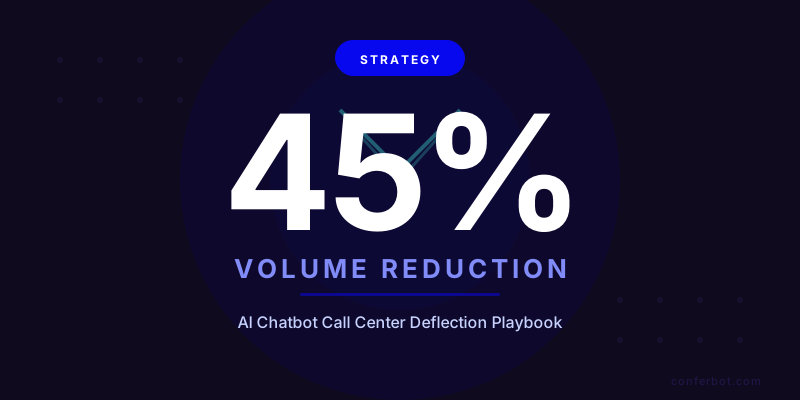
This guide provides a step-by-step playbook for reducing inbound call volume by 45% or more using AI chatbots, covering call driver analysis, deflection flow design, IVR-to-chatbot migration, agent handoff optimization, and measurement frameworks. The approach is proven across contact centers ranging from 10 agents to 10,000 agents, across industries from telecommunications to healthcare to financial services.
If you are still weighing whether chatbot or phone support makes more sense for your business, start with our chatbot vs phone support cost comparison for a data-driven breakdown of both channels.
Step 1: Identify Your Top 15 Call Drivers and Rank by Deflectability
Before building a single chatbot flow, you need to understand exactly why customers are calling. Most contact centers have a vague sense of their top call reasons, but few have the granular, ranked data needed to prioritize AI deflection efforts. This analysis is the foundation of every successful call reduction program.

How to Build Your Call Driver Taxonomy
Pull data from three sources to build a comprehensive call driver map:
- IVR disposition codes: Your existing IVR system captures the reason for each call when the customer selects a menu option. Export 90 days of disposition data and group by category. This gives you volume by broad category but lacks nuance
- CRM ticket categories: Post-call categorization by agents provides more specific reason codes. Export 90 days of closed tickets and analyze the distribution. Watch for the "Other" or "General Inquiry" category -- it often contains 15-30% of volume and needs manual review to subcategorize
- Call transcript analysis: Use speech analytics or manually review a random sample of 200-300 call transcripts to identify patterns that disposition codes miss. AI-powered speech analytics tools can process thousands of transcripts and cluster them by topic automatically
The Deflectability Scoring Framework
Once you have your call driver list ranked by volume, score each driver on deflectability -- the likelihood that an AI chatbot can fully resolve the issue without human intervention:
| Deflectability Score | Criteria | Examples | Expected Chatbot Resolution Rate |
|---|---|---|---|
| 5 - Fully automatable | Structured data lookup, no judgment required, clear resolution path | Order status, account balance, store hours, password reset, tracking number | 85-95% |
| 4 - Highly automatable | Rule-based decision with limited branching, standard procedures | Return initiation, appointment scheduling, plan changes, billing explanation | 70-85% |
| 3 - Partially automatable | Some judgment required, multiple resolution paths, may need agent escalation for edge cases | Troubleshooting (guided), claim filing, product recommendations, complaint initial intake | 50-70% |
| 2 - Assist-only | Complex judgment required, but chatbot can gather information and route intelligently | Dispute resolution, technical support (complex), policy exceptions | 20-40% (full resolution), 80%+ (information gathering) |
| 1 - Human required | Emotional, legal, safety, or highly subjective situations | Bereavement, fraud investigation, legal threats, safety incidents | 0-10% (triage and route only) |
Sample Call Driver Analysis
Here is a real-world example from a mid-size e-commerce company (120,000 monthly inbound calls):
| Rank | Call Driver | Monthly Volume | % of Total | Deflectability | Priority |
|---|---|---|---|---|---|
| 1 | Where is my order / tracking | 28,800 | 24% | 5 | Highest |
| 2 | Return or exchange request | 16,800 | 14% | 4 | High |
| 3 | Billing question / charge explanation | 13,200 | 11% | 4 | High |
| 4 | Product availability / restock date | 10,800 | 9% | 5 | High |
| 5 | Cancel or modify order | 9,600 | 8% | 4 | High |
| 6 | Account login / password issues | 7,200 | 6% | 5 | High |
| 7 | Promo code or discount questions | 6,000 | 5% | 5 | Medium |
| 8 | Shipping options and costs | 4,800 | 4% | 5 | Medium |
| 9 | Product troubleshooting | 4,800 | 4% | 3 | Medium |
| 10 | Size / fit guidance | 3,600 | 3% | 4 | Medium |
| 11 | Warranty claim | 3,600 | 3% | 3 | Medium |
| 12 | Subscription management | 2,400 | 2% | 4 | Lower |
| 13 | Complaint / escalation request | 3,600 | 3% | 2 | Lower |
| 14 | Gift card balance / issue | 2,400 | 2% | 5 | Lower |
| 15 | Fraud / unauthorized charge | 2,400 | 2% | 1 | Lowest |
Deflection opportunity: Call drivers ranked 1-8 (scored 4-5) represent 81% of total volume and are highly automatable. If an AI chatbot resolves even 70% of these calls, that is 57% of total call volume eliminated -- well above the 45% target.
Prioritization Formula
Rank your call drivers using this weighted priority score:
Priority Score = (Monthly Volume x 0.4) + (Deflectability Score x 0.3) + (Average Handle Time x 0.2) + (Customer Frustration Score x 0.1)
Start with the top 5 drivers by priority score. These will deliver 60-70% of your total deflection opportunity and provide the fastest ROI proof for stakeholders.
For a comprehensive guide to automating your entire support operation, see our how to automate customer support playbook.
Step 2: Build AI Deflection Flows That Actually Resolve Issues
The difference between a failed deflection strategy and one that reduces call volume by 45% comes down to one word: resolution. A deflection flow that tells customers "visit our FAQ page" or "try again later" does not reduce calls -- it creates frustrated customers who call back with even higher expectations. Effective AI deflection flows resolve the customer's issue completely within the chatbot conversation, leaving no reason to pick up the phone.
Deflection Flow Architecture
Every high-performing deflection flow follows the same four-phase architecture:
- Intent identification: The chatbot identifies what the customer needs within the first 1-2 exchanges. LLM-powered intent recognition handles natural language variations ("where's my stuff" = "order tracking" = "when will my package arrive") with 92-97% accuracy
- Authentication: If the issue requires account access, the chatbot verifies identity through order number + email, phone number + last 4 of card, or SSO/login integration. This replaces the 2-3 minute identity verification process agents perform on every call
- Resolution delivery: The chatbot pulls real-time data from backend systems (OMS, CRM, billing, inventory) and delivers the answer conversationally. "Your order #4521 shipped yesterday via FedEx. Here is your tracking link: [link]. It is estimated to arrive Thursday by 8pm."
- Confirmation and follow-up: The chatbot confirms the issue is resolved: "Did that answer your question, or is there anything else I can help with?" If the customer says no, the chatbot offers to connect them with an agent -- preserving the safety net
Flow Templates for the Top 5 Call Drivers
Flow 1: Order Status / Where Is My Order (WISMO)
WISMO calls represent 20-30% of e-commerce contact center volume. The resolution is almost always a data lookup.
- Customer: "Where is my order?"
- Bot: "I can look that up for you right away. What is your order number or the email address you used to place it?"
- Customer: "[provides order number]"
- Bot: [API call to OMS] "Your order #8842 is on its way! It shipped on May 30 via UPS Ground. Current status: In transit, last scanned at Memphis, TN. Estimated delivery: June 4 by end of day. Here is your tracking link: [UPS tracking URL]. Want me to send you text notifications for delivery updates?"
- Customer: "Yes please"
- Bot: "Done! You will get a text at [phone number] when it is out for delivery and when it is delivered. Anything else I can help with?"
Resolution rate: 88-93%. The remaining 7-12% are cases with shipping exceptions (lost, damaged, delayed beyond estimate) that require agent intervention for replacement or refund decisions.
Flow 2: Return or Exchange Initiation
- Bot identifies the order and item(s) to return
- Bot checks return eligibility against policy rules (within return window, item condition, final sale exclusions)
- If eligible: Bot generates return label, provides drop-off instructions, confirms refund timeline
- If ineligible: Bot explains why with the specific policy rule, offers alternatives (store credit, exchange for different size)
- If edge case: Bot escalates to agent with full context (order details, return reason, eligibility check results)
Resolution rate: 72-80%. Escalations typically involve damaged items requiring photo review or policy exceptions.
Flow 3: Billing Question / Charge Explanation
- Bot authenticates the customer
- Bot pulls recent billing history and presents charges clearly: "I see your last charge was $47.99 on May 28. This breaks down as: Product A ($29.99) + Shipping ($8.00) + Tax ($3.60) + Protection Plan ($6.40). Does a specific charge look unexpected?"
- If the customer identifies a charge: Bot explains it with context (subscription renewal, pre-authorization, split shipment charge)
- If the customer disputes a charge: Bot initiates a dispute workflow or escalates to billing team with pre-collected information
Resolution rate: 75-82%. Most billing calls are simply customers not recognizing a charge or wanting an itemized breakdown.
Flow 4: Account Access / Password Reset
- Bot sends a password reset link or SMS code
- Bot walks the customer through the reset process step by step
- If account locked: Bot unlocks after identity verification
- If email changed: Bot escalates to security team with verification
Resolution rate: 90-95%. This is the highest-resolution call driver for chatbot automation.
Flow 5: Cancel or Modify Order
- Bot checks order status (can it still be modified before shipping?)
- If pre-shipment: Bot makes the modification or cancellation instantly via API
- If post-shipment: Bot explains the order has already shipped and offers return process instead
- For subscription cancellations: Bot presents a retention offer (discount, pause, plan change) before processing
Resolution rate: 68-78%. Lower resolution rate because post-shipment modifications often require agent judgment on exceptions.
Conferbot's AI chatbot builder includes pre-built deflection flow templates for the top 20 call drivers with API connectors for Shopify, WooCommerce, Stripe, and major OMS platforms, making it possible to build and deploy these flows in days rather than weeks.
Step 3: Measure What Matters -- Containment Rate vs Deflection Rate
Most organizations confuse two fundamentally different metrics: deflection rate and containment rate. This confusion leads to inflated success metrics, poor optimization decisions, and executive distrust of chatbot programs. Getting the measurement right is essential for proving ROI and earning budget for expansion.

Definitions
| Metric | Definition | Formula | What It Actually Measures |
|---|---|---|---|
| Deflection rate | Percentage of potential calls that are redirected to the chatbot channel | Chatbot sessions for call-type issues / (Chatbot sessions + Actual calls for same issues) | Channel shift -- are customers starting in the chatbot instead of calling? |
| Containment rate | Percentage of chatbot conversations that are fully resolved without agent escalation | Chatbot conversations resolved without agent / Total chatbot conversations | Resolution effectiveness -- does the chatbot actually solve the problem? |
| True resolution rate | Percentage of chatbot-contained conversations where the customer did not call back within 48 hours | Contained conversations with no callback / Total contained conversations | Genuine resolution -- was the issue actually resolved, not just contained? |
Why Containment Rate Is the Metric That Matters
A high deflection rate with a low containment rate is worse than no chatbot at all. Here is why:
- Scenario A (good): 10,000 customers attempt to contact support. 6,000 start with the chatbot (60% deflection). Of those, 4,800 are fully resolved (80% containment). Net call reduction: 4,800 calls avoided = 48% call volume reduction
- Scenario B (bad): 10,000 customers attempt to contact support. 8,000 start with the chatbot (80% deflection -- higher!). Of those, only 2,400 are resolved (30% containment). 5,600 escalate to agents, now frustrated. Net call reduction: only 2,400 calls avoided = 24% call volume reduction, plus 5,600 angry customers who waited in a chatbot queue before waiting in a phone queue
Scenario B has a higher deflection rate but delivers half the call reduction and significantly worse customer experience. This is why Forrester's chatbot research emphasizes containment rate as the primary measure of chatbot success, not deflection rate.
Benchmark Containment Rates by Call Driver
| Call Driver | Industry Avg Containment | Top Quartile Containment | Optimization Focus |
|---|---|---|---|
| Order status / WISMO | 78% | 93% | API reliability, shipping exception handling |
| Password reset / account access | 85% | 96% | Multi-factor auth flow, edge case handling |
| Billing inquiry | 68% | 82% | Charge explanation clarity, dispute workflow |
| Return initiation | 62% | 80% | Policy clarity, label generation, exception handling |
| Appointment scheduling | 75% | 91% | Calendar integration, rescheduling flows |
| FAQ / general questions | 70% | 88% | Knowledge base coverage, RAG accuracy |
| Product troubleshooting | 45% | 68% | Guided diagnostic flows, visual aids |
| Complaint handling | 25% | 42% | Empathy scripting, escalation speed |
The True Resolution Rate: Catching False Containments
Containment rate alone can be gamed. A chatbot that says "Is there anything else?" and closes the conversation when the customer types nothing has a high containment rate but may not have resolved the issue. The customer simply gave up and called instead.
To measure true resolution, track callback rate: within 48 hours of a chatbot-contained conversation, did the same customer call about the same issue? If the callback rate is above 15%, the containment metric is inflated and the chatbot is not actually resolving issues.
True Resolution Rate = Containment Rate x (1 - 48-hour Callback Rate)
Example: 80% containment rate with 20% callback rate = 80% x 80% = 64% true resolution rate. That 16-point gap between containment and true resolution is where optimization efforts should focus.
According to ICMI (International Customer Management Institute) benchmarks, the industry average true resolution rate for AI chatbots is 58%, while top-performing organizations achieve 78-85%. The gap represents a significant optimization opportunity.
For a deep dive into the metrics framework for chatbot performance, see our chatbot analytics metrics guide.
Step 4: IVR-to-Chatbot Migration -- Replace the Phone Tree with Conversational AI
Interactive Voice Response (IVR) systems were the first generation of call deflection technology, and they have reached their ceiling. The average IVR containment rate is just 23% -- meaning 77% of customers who enter the IVR eventually reach an agent anyway, often after spending 2-4 minutes navigating frustrating menu trees. Migrating from IVR to AI chatbot is the single highest-impact change a contact center can make.
Why IVR Fails Where Chatbots Succeed
| Dimension | IVR | AI Chatbot | Impact |
|---|---|---|---|
| Containment rate | 20-25% | 65-80% | 3x more calls resolved without agents |
| Customer effort | High (listen to menus, press buttons, repeat yourself) | Low (type or tap your question naturally) | 37% lower customer effort score |
| Resolution time | 4-8 minutes (including hold and transfer) | 45-90 seconds | 80% faster resolution |
| Personalization | None (same menus for everyone) | Full (knows customer history, preferences, context) | 28% higher satisfaction |
| Hours of operation | 24/7 (but complex issues queue for agents) | 24/7 (resolves complex issues autonomously) | 100% after-hours resolution |
| Update cycle | Weeks (requires vendor involvement, recording, testing) | Minutes (update knowledge base or flow in real time) | Agility for seasonal or urgent changes |
Migration Strategy: Parallel Operation, Then Phase-Out
Do not shut off your IVR on day one. Instead, follow this proven migration path:
Phase 1: Digital-First Deflection (Weeks 1-4)
- Deploy the AI chatbot on your website, mobile app, and messaging channels
- Add chatbot links to hold messages: "For faster service, chat with us at [URL] or text HELP to [number]"
- Add QR codes on printed materials (invoices, packaging, mailers) that open the chatbot
- Measure: What percentage of customers opt for chatbot when offered during hold?
Phase 2: IVR Chatbot Prompt (Weeks 5-8)
- Add a pre-queue IVR message: "We can help you faster through our AI assistant. I can text you a link right now -- press 1 to get the link, or stay on the line to speak with an agent"
- For callers who press 1: Send an SMS with a chatbot deep link prepopulated with their phone number for identity matching
- Measure: Opt-in rate (typically 15-25% initially, growing to 30-40% as word spreads)
Phase 3: Smart Routing (Weeks 9-16)
- For call drivers with 80%+ chatbot containment rate, make chatbot the default channel: "I see you are calling about your order status. I can get you that information instantly via text. Sending you a link now -- your tracking details will be there in seconds. If you prefer to wait for an agent, stay on the line."
- For call drivers with lower containment, keep agent as default but offer chatbot as the faster option
- Measure: Per-call-driver deflection rates and containment rates
Phase 4: IVR Sunset for High-Containment Drivers (Weeks 17+)
- For call drivers where chatbot containment exceeds 85% and true resolution exceeds 75%, transition to chatbot-first with agent escalation within the chatbot (no IVR at all for these call types)
- Maintain IVR as a fallback for call drivers that still require human judgment
- Measure: Overall call volume trend, CSAT across channels, agent utilization
Technical Integration Requirements
IVR-to-chatbot migration requires these integrations:
- SMS gateway: To send chatbot links to callers who opt in (Twilio, Vonage, or native carrier integration)
- Caller ID matching: Match the inbound phone number to a customer record to pre-populate chatbot context
- IVR platform API: Programmatically route calls between IVR and chatbot paths (Genesys, NICE, Five9, Talkdesk all support this)
- Unified analytics: Track the customer journey across IVR, chatbot, and agent channels in a single dashboard
For organizations still evaluating the chatbot vs. phone question, our chatbot vs phone support comparison provides a detailed cost and performance analysis across both channels.
Step 5: Optimize Agent Handoff to Protect Customer Experience
The handoff from chatbot to human agent is the single most fragile moment in the customer journey. Get it wrong and you undo all the goodwill the chatbot built. Get it right and the agent receives a pre-qualified, pre-authenticated customer with full context -- reducing handle time by 30-40% and dramatically improving first-call resolution.
The Handoff Problem
According to Zendesk's CX Trends Report, 68% of customers say the most frustrating part of a service interaction is repeating their information to a new agent. In a chatbot-to-agent handoff, this frustration is amplified because the customer already invested time explaining their issue to the chatbot and now fears they will need to start over.
The Context-Rich Handoff Model
Every chatbot-to-agent handoff should transfer the following context packet:
| Context Element | Example | Agent Benefit |
|---|---|---|
| Customer identity | John Smith, [email protected], Account #4521 | No identity verification needed (already done by chatbot) |
| Issue summary | "Customer wants to return item #882 (Blue Widget) from order #9921 due to wrong size. Item is within return window. Return label generated but customer has questions about refund timeline." | Agent knows the issue instantly, no discovery needed |
| Actions already taken | "Chatbot verified return eligibility, generated return label, explained 5-7 business day refund timeline. Customer wants to know if exchange is possible instead." | Agent does not repeat steps or suggest actions already offered |
| Customer sentiment | "Sentiment: Neutral/Positive. No frustration signals detected." | Agent calibrates tone appropriately |
| Conversation transcript | Full chatbot conversation history | Agent can skim for context without asking customer to repeat |
| Recommended resolution | "Suggest offering exchange for correct size with expedited shipping at no charge" | Agent has a suggested resolution to validate, not invent from scratch |
Handoff Trigger Rules
The chatbot should escalate to a human agent when:
- Confidence threshold breach: The chatbot's confidence in its response drops below 70% (LLM confidence scoring)
- Customer requests agent: The customer explicitly asks to speak with a human ("let me talk to a person"). Never trap customers in the chatbot
- Sentiment deterioration: Sentiment analysis detects frustration, anger, or repeat phrasing (the customer is going in circles)
- Policy exception needed: The customer's request falls outside automated policy rules (e.g., return outside window, unusual refund amount)
- Failed resolution attempts: The chatbot has made 2 resolution attempts and the customer is not satisfied
- High-value customer flag: CRM flags the customer as VIP, enterprise, or at-risk for churn -- route to specialized agent team
Handoff UX Patterns
Warm handoff (recommended): "I want to make sure we get this exactly right for you, so I am connecting you with a specialist who can help with the exchange. They will have all the details from our conversation -- no need to repeat anything. One moment while I connect you."
Scheduled callback: "Our support team can call you back within 15 minutes with a resolution. Would you like a callback at [phone number], or would you prefer to wait for a live chat agent?"
After-hours handoff: "Our team is not available right now (we are back at 8am ET), but I have created a priority ticket with all the details. You will hear from us first thing tomorrow morning. Want me to send you a confirmation email?"
Conferbot's live chat feature supports context-rich handoff with automatic transfer of conversation history, customer profile, sentiment score, and recommended resolution to the receiving agent -- eliminating the "can you repeat that" problem entirely.
The 90-Day Implementation Playbook: From Analysis to 45% Reduction
Reducing call center volume by 45% does not happen overnight, but it does not require a year-long enterprise project either. This 90-day playbook has been executed successfully across contact centers ranging from 15 to 5,000 agents.
Phase 1: Foundation (Days 1-30)
| Week | Activities | Deliverables |
|---|---|---|
| 1 | Pull 90-day call data, build call driver taxonomy, calculate baseline metrics (volume by driver, AHT, FCR, cost per call) | Call driver analysis report, baseline dashboard |
| 2 | Score all call drivers by deflectability, identify top 5 priority drivers, map resolution flows for each | Priority matrix, 5 resolution flow diagrams |
| 3 | Set up chatbot platform, configure CRM/OMS/billing integrations, build and test top 2 deflection flows (highest volume + highest deflectability) | Connected chatbot platform, 2 working flows |
| 4 | Build remaining 3 priority flows, internal testing, soft launch on website with 10% traffic sample | 5 live deflection flows, soft launch performance data |
Phase 2: Scale (Days 31-60)
| Week | Activities | Deliverables |
|---|---|---|
| 5-6 | Full website deployment, add chatbot to mobile app, begin IVR-to-chatbot SMS redirect pilot, analyze soft launch containment rates and optimize weak points | Full deployment, IVR pilot running, optimization log |
| 7-8 | Build deflection flows for call drivers 6-10, A/B test greeting variants and escalation triggers, begin agent training on chatbot-assisted handoff workflows | 10 live deflection flows, A/B test results, trained agents |
Phase 3: Optimize (Days 61-90)
| Week | Activities | Deliverables |
|---|---|---|
| 9-10 | Deploy remaining call driver flows (11-15), expand IVR redirect to all callers, review true resolution rates and fix false containments | 15 live deflection flows, expanded IVR redirect, true resolution audit |
| 11-12 | Build proactive outbound flows (order delay notifications, appointment reminders, billing alerts) to prevent calls before they happen, compile 90-day ROI report | Proactive notification flows, executive ROI report |
Expected Results by Day 90
| Metric | Day 0 (Baseline) | Day 30 | Day 60 | Day 90 |
|---|---|---|---|---|
| Monthly inbound calls | 120,000 | 108,000 (-10%) | 84,000 (-30%) | 66,000 (-45%) |
| Chatbot containment rate | N/A | 62% | 72% | 78% |
| True resolution rate | N/A | 51% | 62% | 70% |
| Average handle time (agent) | 7.2 min | 6.8 min | 5.9 min | 5.1 min |
| Cost per interaction (blended) | $14.50 | $11.20 | $7.80 | $5.90 |
| Monthly cost savings | $0 | $156,000 | $468,000 | $702,000 |
| Agent CSAT (internal) | 65% | 68% | 74% | 81% |
Why agent CSAT improves: When the chatbot handles 45% of calls -- and those are the repetitive, low-complexity calls that agents find most tedious -- agents spend more of their time on interesting, complex problems that use their skills and judgment. This reduces burnout, improves job satisfaction, and lowers attrition, which further reduces training and hiring costs.

The Financial Case: ROI Model and Executive Presentation Framework
CFOs do not approve chatbot budgets based on containment rates -- they approve them based on dollars saved, revenue protected, and payback period. Here is the financial model for presenting the call center AI business case.
Cost Savings Model
| Cost Element | Before AI Chatbot | After AI Chatbot (45% Reduction) | Annual Savings |
|---|---|---|---|
| Agent labor (200 agents at $42K avg) | $8,400,000 | $4,620,000 (110 agents needed) | $3,780,000 |
| Hiring and training (45% annual attrition) | $1,890,000 | $1,039,500 | $850,500 |
| Infrastructure (seats, licenses, telecom) | $1,200,000 | $660,000 | $540,000 |
| QA and supervision | $840,000 | $462,000 | $378,000 |
| AI chatbot platform cost | $0 | $180,000 | -$180,000 |
| Total | $12,330,000 | $6,961,500 | $5,368,500 |
Payback period: At $180,000 annual platform cost and $447,375 in monthly savings by month 3, the chatbot investment pays for itself in 12 days after reaching full deployment.
Revenue Protection Metrics
Cost savings tell only half the story. Call volume reduction also protects revenue:
- Abandoned call recovery: Contact centers with long hold times lose 5-8% of callers who hang up and never return. If 10% of these were potential buyers (product questions, purchase help), that is lost revenue the chatbot captures instantly
- Faster resolution drives loyalty: According to Forrester's CX Index, customers who have their issue resolved in under 2 minutes are 2.4x more likely to purchase again and 3.1x more likely to recommend the brand
- 24/7 availability captures after-hours demand: 35% of customer interactions occur outside business hours. Without a chatbot, these become next-day callbacks (often lost to competitors) or abandoned inquiries
Executive Dashboard KPIs
Present these metrics monthly to maintain stakeholder buy-in:
- Call volume reduction % -- the headline metric, reported as month-over-month and cumulative vs baseline
- Cost per interaction (blended) -- combines chatbot cost ($0.50-$1.50/interaction) with agent cost ($12-$25/call) weighted by channel mix
- Chatbot containment rate -- by call driver, with trend over time
- True resolution rate -- containment minus callback rate, by call driver
- CSAT by channel -- chatbot CSAT vs agent CSAT vs IVR CSAT (chatbot should be equal or higher)
- Agent utilization and satisfaction -- track that agents are spending more time on complex, rewarding work
For a complete ROI calculation framework, see our chatbot ROI calculator and benchmarks. Conferbot's chatbot analytics dashboard provides real-time visibility into all these metrics with exportable reports for executive presentations.
Advanced Strategy: Proactive Deflection -- Prevent Calls Before They Happen
The most sophisticated call reduction strategy is not deflection at all -- it is prevention. Proactive outbound communication resolves customer issues before they become calls, eliminating demand at the source rather than redirecting it after the fact.
Proactive Notification Types
| Notification Type | Trigger | Channel | Call Prevention Rate |
|---|---|---|---|
| Shipping delay alert | Carrier reports delay > 24 hours | SMS + chatbot link | 65-80% of WISMO calls prevented |
| Delivery confirmation | Package delivered | SMS + photo if available | 25-35% of post-delivery calls prevented |
| Payment confirmation | Charge processed | Email + SMS | 40-55% of billing calls prevented |
| Appointment reminder | 24h and 2h before appointment | SMS with reschedule chatbot link | 30-45% of scheduling calls prevented |
| Service outage notification | System detects outage | Email + SMS + in-app banner | 70-90% of outage-related calls prevented |
| Subscription renewal notice | 7 days before renewal | Email with chatbot link to manage | 35-50% of renewal calls prevented |
The Proactive-Reactive Flywheel
Proactive notifications do not just prevent calls -- they create a feedback loop that continuously reduces volume:
- Proactive notification goes out (e.g., "Your order is delayed by 2 days. New estimated delivery: June 6. Need help? Tap here.")
- Some customers engage the chatbot through the notification link (20-30% tap-through rate)
- Chatbot resolves any follow-up questions ("Can I get a discount for the delay?" -> Bot applies $5 credit automatically)
- Data from chatbot interactions reveals new call drivers ("Customers are asking about partial shipments after delay notifications -- build a flow for that")
- New proactive notifications and chatbot flows are created from the data, preventing even more calls
This flywheel compounds over time. Organizations running proactive notifications for 6+ months typically see an additional 10-15% call reduction on top of their reactive deflection gains.

Implementation Priority for Proactive Notifications
Start with the notification types that prevent the highest-volume call drivers:
- Shipping status updates -- prevents WISMO calls (your #1 call driver)
- Payment and billing confirmations -- prevents billing inquiry calls (#3 call driver)
- Appointment reminders with self-serve reschedule -- prevents scheduling calls
- Service status pages with chatbot -- prevents surge calls during outages
Each proactive notification should include a chatbot deep link so the customer can get immediate help without calling. The chatbot link should be prepopulated with context (order number, appointment details) so the customer starts the conversation at the resolution step, not the identification step.
For a broader look at how automation transforms the entire support operation, see our complete support automation guide.
Pitfalls to Avoid and the Future of Contact Center AI
After working with hundreds of contact centers on AI chatbot deployments, we have seen the same mistakes repeated and the same best practices deliver results. Here are the patterns that separate successful call reduction programs from failed ones.
Top 7 Pitfalls to Avoid
- Pitfall: Measuring deflection instead of containment. As discussed above, a high deflection rate with low containment is worse than doing nothing. Always measure containment and true resolution rate as your north star metrics
- Pitfall: Trapping customers in the chatbot. If the chatbot cannot resolve the issue, it must escalate quickly and gracefully. Customers who feel trapped will leave negative reviews and call back angrier. Always provide a clear, one-click path to a human agent
- Pitfall: Launching with too many flows at once. Start with your top 2-3 call drivers, prove containment, then expand. Launching 15 half-built flows results in poor containment across the board and stakeholder loss of confidence
- Pitfall: Ignoring the agent experience. Agents need training on the new handoff workflow, visibility into what the chatbot handled, and confidence that the chatbot is helping rather than creating more work. Involve agents in testing and feedback loops from day one
- Pitfall: Not connecting to backend systems. A chatbot that says "let me check" and then says "please call us for order status" is useless. Real deflection requires real-time API connections to OMS, CRM, billing, and inventory systems
- Pitfall: Setting unrealistic timelines. A 45% call reduction in 90 days is achievable but requires dedicated resources. Promising 60% reduction in 30 days sets the program up for failure and executive disillusionment
- Pitfall: Forgetting mobile. 55-65% of chatbot interactions happen on mobile devices. If your chatbot is not mobile-optimized with tap-friendly buttons, short messages, and responsive layout, you will lose half your deflection opportunity
Best Practices From Top Performers
- Read every chatbot transcript for the first 2 weeks. Nothing teaches you more about what customers need and where the chatbot fails than reading real conversations. After 2 weeks, sample 10% weekly
- Build escalation monitoring dashboards. Track why customers escalate -- is it a chatbot limitation, a missing flow, or a genuine complex issue? The reason for escalation tells you exactly what to build next
- Run weekly optimization sprints. Dedicate 2-4 hours per week to reviewing chatbot performance data, fixing failed intents, expanding knowledge base coverage, and launching A/B tests on underperforming flows
- Celebrate agent feedback. Agents are your best source of chatbot improvement ideas. They see the cases that escalate and know what information was missing or what the chatbot should have done differently. Create a feedback channel and act on agent suggestions visibly
- Use proactive notifications aggressively. For every call driver you build a reactive chatbot flow for, also build a proactive notification that prevents the call. The combination of reactive + proactive delivers 1.5-2x the call reduction of reactive alone
- Report ROI monthly in dollars. Do not bury stakeholders in containment rates and deflection percentages. Lead with: "The chatbot saved $702,000 in agent labor this month and resolved 54,000 customer issues in under 90 seconds." Translate metrics to money
For pricing details on implementing an AI chatbot for your contact center, see our pricing page or start with a free trial using Conferbot's AI chatbot builder.
The Future: Voice AI, Autonomous Agents, and the Contact Center of 2028
Voice AI Agents (Available Now, Scaling in 2027)
Voice AI agents handle phone calls directly -- the customer calls the same phone number and speaks to an AI voice agent that sounds natural, understands context, and resolves issues autonomously. Unlike IVR, voice AI agents engage in free-form conversation, access backend systems in real time, and escalate to human agents seamlessly when needed.
Gartner predicts that by 2028, 40% of inbound contact center calls will be handled entirely by voice AI agents with no human involvement. Early adopters in telecommunications and banking are already seeing 50-60% containment rates on voice calls -- comparable to text chatbot performance from 2 years ago.
Autonomous Agentic AI (Emerging in 2026-2027)
Current chatbots follow predefined flows with some AI-powered flexibility. The next generation -- agentic AI -- autonomously determines the best resolution path, takes multi-step actions across systems, and handles edge cases that today require human judgment. An agentic AI might autonomously decide to issue a partial refund and expedited reshipping for a damaged order, send a follow-up satisfaction check 3 days later, and flag the supplier quality issue to the operations team -- all without human involvement.
Preparing for the Future
Organizations that execute the playbook in this guide are already future-ready because:
- The backend integrations are in place. Voice AI and agentic AI will use the same OMS, CRM, and billing APIs you built for text chatbot deflection
- The call driver taxonomy is established. Your understanding of why customers contact you transfers directly to any AI modality
- The measurement framework scales. Containment rate, true resolution rate, and cost per interaction apply to voice AI and agentic AI the same way they apply to text chatbots
- The organizational muscle for AI is built. Your team has experience deploying, measuring, and optimizing AI customer service -- the hardest part is getting started, and you have already done that
The contact center of 2028 will handle 80% of interactions through AI across text, voice, and video -- with human agents focusing exclusively on complex, high-empathy, and high-value interactions. The organizations that start building this capability today will have a two-year head start on those that wait.
Start building your AI deflection strategy today with Conferbot's AI chatbot builder -- deploy your first deflection flow in under an hour and begin reducing call volume this week.
Was this article helpful?
How to Reduce Call Center Volume by 45% with AI Chatbots FAQ
Everything you need to know about chatbots for how to reduce call center volume by 45% with ai chatbots.
About the Author

Conferbot Team specializes in conversational AI, chatbot strategy, and customer engagement automation. With deep expertise in building AI-powered chatbots, they help businesses deliver exceptional customer experiences across every channel.
View all articles