The CSAT Paradox: Why Most Companies Fail to Improve Satisfaction While Cutting Costs
Customer satisfaction has become the defining competitive battleground for 2026. According to the Qualtrics XM Institute's 2026 Global Consumer Study, 62% of consumers have stopped purchasing from a brand after a single poor service experience -- up from 49% in 2022. Yet most organizations face a seemingly impossible trade-off: cutting support costs means slower response times, longer queues, and worse customer experience. Improving CSAT means spending more on agents, training, and infrastructure.

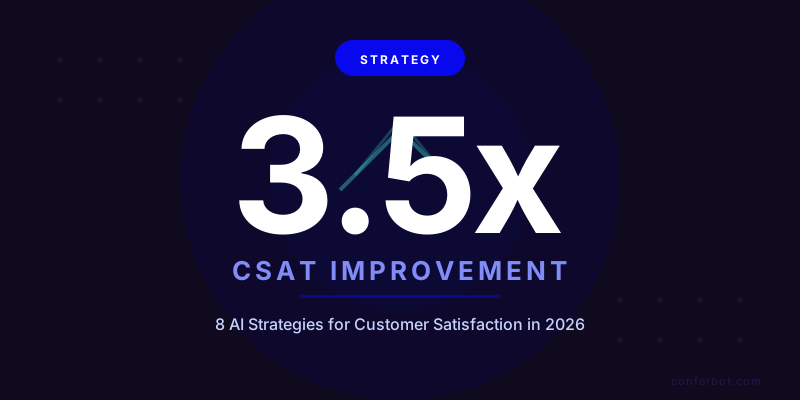
AI changes this equation fundamentally. Forrester's CX Index research found that organizations deploying AI-powered customer service are 3.5x more likely to reduce operational costs while simultaneously improving CSAT compared to organizations using traditional support models. This is not a marginal improvement -- it is a paradigm shift where the cost curve and the satisfaction curve move in the same direction for the first time.
Why does this happen? Because AI resolves the root causes of customer dissatisfaction:
- Speed: AI chatbots respond in under 3 seconds vs. 10-45 minute wait times for phone and 4-24 hour response times for email. Speed is the single largest driver of CSAT in transactional support interactions
- Consistency: AI delivers the same quality of response at 3am as at 3pm, on the 1st call as on the 10,000th. Human agents vary widely in knowledge, patience, and accuracy -- AI does not have bad days
- Personalization: AI accesses the customer's full history, preferences, and context in milliseconds. A human agent scrambles to pull up a CRM record while the customer waits on hold
- Availability: 35% of support interactions happen outside business hours. Every after-hours inquiry that AI resolves is an inquiry that would have waited until morning, generating frustration and often a phone call the next day
The American Customer Satisfaction Index (ACSI) reports that the national CSAT average across all industries sits at 77.1 (on a 100-point scale) in 2026 -- essentially flat for the past decade despite massive investments in customer experience technology. The organizations that are pulling ahead are those deploying AI not as a cost-cutting tool, but as a satisfaction-improving tool that also happens to cost less.
This guide presents 8 strategies for using AI to improve your CSAT score, each backed by benchmark data and accompanied by concrete implementation steps. These are not theoretical concepts -- they are proven approaches deployed across thousands of organizations with measured CSAT improvements ranging from 12 to 38 percentage points.
For a foundational understanding of how chatbots improve overall customer experience, start with our AI chatbot customer experience deep dive.
Strategy 1: Maximize First-Contact Resolution (FCR) with AI-Powered Knowledge
First-contact resolution -- resolving the customer's issue completely on the first interaction without requiring a callback, transfer, or follow-up -- is the single most predictive metric for CSAT. Zendesk's CX Trends Report found that every 1% improvement in FCR drives a 1.4% improvement in CSAT. Conversely, every transfer or callback reduces satisfaction by 12-15 points.
Why AI Dramatically Improves FCR
Traditional support fails at FCR for structural reasons:
- Knowledge gaps: Agents cannot memorize every product, policy, and procedure. They search knowledge bases (slowly), ask colleagues (creating delays), or guess (creating errors). AI has instant access to your entire knowledge base, every product specification, and every policy document -- simultaneously
- Skill-based routing failures: Calls are often routed to the wrong department or skill group, requiring transfers. AI identifies the issue and routes to the right resource on the first try -- or resolves it without any routing at all
- Partial information: Agents often resolve the stated issue but miss related issues the customer has not yet mentioned. AI can proactively surface related information: "I see you also have a pending return for order #4422 -- want me to check the status of that refund while we are here?"
AI-Powered FCR Optimization Framework
| FCR Lever | How AI Helps | CSAT Impact | Implementation Complexity |
|---|---|---|---|
| Instant knowledge retrieval | RAG pipeline pulls relevant answers from knowledge base in milliseconds | +8-12 CSAT points | Medium (requires knowledge base setup) |
| Contextual issue prediction | AI predicts the customer's issue from page context, purchase history, and behavior before they ask | +5-8 CSAT points | Medium (requires CRM integration) |
| Multi-issue resolution | AI detects and resolves related issues in the same conversation | +6-10 CSAT points | Low (conversation design) |
| Real-time system access | AI queries OMS, billing, inventory in real time to provide specific answers instead of generic responses | +10-15 CSAT points | High (requires API integrations) |
| Proactive follow-up | AI sends follow-up message 24h later to confirm resolution and catch any remaining issues | +4-7 CSAT points | Low (automated trigger) |
FCR Benchmark Data
| Channel | Average FCR (Traditional) | Average FCR (AI-Powered) | Improvement |
|---|---|---|---|
| Phone | 70-75% | 82-88% (AI-augmented agents) | +12-13 points |
| 55-65% | 72-80% (AI triage + response) | +15-17 points | |
| Live chat (human) | 65-72% | 78-85% (AI-assisted) | +13-13 points |
| AI chatbot (autonomous) | N/A | 75-85% (for automatable issues) | Baseline for AI channel |
Implementation: Building an FCR-Optimized Chatbot
- Map your top 20 support issues and document the complete resolution path for each (information needed, systems accessed, decision points, resolution actions)
- Build API connections to every backend system the chatbot needs to resolve these issues (OMS, CRM, billing, inventory, shipping carriers)
- Create a comprehensive RAG knowledge base from your help center articles, product documentation, policy documents, and internal SOPs. Keep it updated with a weekly sync
- Design multi-issue detection prompts so the chatbot checks for related open issues and offers to resolve them in the same session
- Implement 24-hour follow-up automation that sends a brief message after resolution: "Hi [Name], just checking in -- is the [issue] fully resolved, or is there anything else we can help with?"
For guidance on building an effective AI knowledge base, see our how to train a chatbot on your knowledge base guide.
Strategy 2: Deliver Personalization at Scale That Human Agents Cannot Match
Personalization is no longer a nice-to-have -- it is a customer expectation. The Qualtrics XM Institute found that 71% of customers expect personalized service interactions, and 76% feel frustrated when they do not receive them. But delivering personalization through human agents is prohibitively expensive: it requires agent training, CRM access during calls, and time to review customer history -- all of which increase handle time and cost.
AI flips this equation. An AI chatbot accesses the customer's entire relationship history in milliseconds and uses it to personalize every response at zero marginal cost.

Personalization Dimensions
| Dimension | Generic Response | AI-Personalized Response | CSAT Difference |
|---|---|---|---|
| Greeting | "Hello, how can I help you?" | "Hi Sarah, welcome back! I see you placed an order yesterday -- is this about that, or something else?" | +14 points |
| Product context | "Can you describe the product you need help with?" | "I see you purchased the ProWidget 3000 two weeks ago. Are you having an issue with it?" | +18 points |
| History awareness | "Let me look into that for you." | "Last time you contacted us about shipping speed, and we upgraded you to express. I can do the same for this order if you would like." | +22 points |
| Preference memory | "Would you like email or SMS updates?" | "I will send tracking updates to your phone like last time -- same number ending in 4521?" | +16 points |
| Lifecycle stage | "Thanks for contacting us." | "Thanks, Sarah! You have been a customer for 3 years and we really appreciate your loyalty. As a thank you, I have applied a 15% loyalty discount to your next order." | +25 points |
How to Build Personalization at Scale
Effective AI personalization requires data from three layers:
- Identity layer: Customer name, account status, loyalty tier, lifetime value, acquisition channel. Source: CRM
- Interaction layer: Previous support conversations, issues raised, resolutions received, satisfaction scores. Source: Support platform, chatbot history
- Behavioral layer: Products purchased, pages browsed, features used, engagement patterns. Source: E-commerce platform, product analytics, website analytics
The AI chatbot synthesizes all three layers in real time to generate personalized responses. This is not about inserting the customer's name into a template -- it is about fundamentally changing the conversation based on who the customer is and what they need.
Personalization Scripts That Drive CSAT
For a loyal customer with a complaint:
"Sarah, I am really sorry about this experience -- especially because you have been with us for 3 years and this is not the level of service you deserve. Let me fix this right now. I am processing a full refund and shipping a replacement via overnight express at no charge. You should receive it by tomorrow evening. Is there anything else I can do to make this right?"
For a new customer with a question:
"Welcome to [Brand], Marcus! I see this is your first order with us -- exciting! Your order shipped this morning and should arrive Thursday. By the way, first-time customers get 10% off their next order. Want me to send you the code?"
For a customer who contacted support last week:
"Hey David, good to hear from you again. Last week we resolved your billing question about the annual plan charge. Is this about the same topic, or something new?"
Each of these responses would take a human agent 2-3 minutes to research and compose. The AI generates them in under 1 second, with higher consistency and accuracy.
For more on how AI personalization drives customer experience, see our AI chatbot customer experience strategy.
Strategy 3: Shift from Reactive to Proactive Support
The highest CSAT scores come from interactions that never become support tickets. Proactive support -- reaching out to customers before they encounter problems or before they need to contact you -- transforms the customer relationship from reactive problem-solving to anticipatory care.
The Qualtrics XM Institute found that proactive support interactions receive CSAT scores 18-25 points higher than reactive interactions, even when addressing the same issue. The reason is psychological: when a company reaches out proactively, the customer perceives care and competence rather than obligation.
Proactive Support Framework
| Proactive Trigger | AI Action | Example Message | CSAT Impact |
|---|---|---|---|
| Shipping delay detected | Send notification before customer checks | "Heads up -- your order is delayed by 1 day due to weather. New ETA: Thursday. Want to chat about alternatives?" | +20 CSAT points vs reactive |
| Feature adoption stall | Offer help after 3 days of inactivity | "I noticed you have not set up automated reports yet. It takes 2 minutes and most teams find it saves hours. Want a quick walkthrough?" | +15 CSAT points (and reduces churn) |
| Known issue match | Alert affected customers before they notice | "We fixed a bug that may have caused incorrect totals on your last invoice. Your corrected invoice is attached -- no action needed." | +22 CSAT points vs discovering the bug |
| Renewal approaching | Proactive value recap + renewal offer | "Your plan renews in 14 days. This year, your chatbot handled 42,000 conversations and saved an estimated $180K. Want to review your plan before renewal?" | +12 CSAT points + 18% higher renewal rate |
| Post-purchase check-in | Follow up after delivery or service completion | "Your order arrived yesterday. Everything look good? If anything is not right, I can start a return or exchange in seconds." | +16 CSAT points |
| Abandoned process detected | Offer help when customer drops off mid-flow | "Looks like you started a return but did not finish. Need help completing it? I have your details saved." | +10 CSAT points + higher completion |
Implementing Proactive Support with AI
Proactive support requires three components:
- Event detection: Monitor backend systems for trigger events -- shipping delays (carrier API), billing anomalies (payment processor), feature adoption gaps (product analytics), approaching deadlines (CRM). Each event maps to a proactive flow
- Audience targeting: Not every event warrants a notification. Define rules for which customers receive proactive messages based on severity, customer tier, communication preferences, and frequency caps (no more than 2 proactive messages per week per customer)
- Response handling: Every proactive message should include a chatbot link so the customer can get immediate help if they have follow-up questions. The chatbot should have context about the proactive notification: "I see you got our message about the shipping delay. Here is the updated tracking info..."
Proactive Support ROI
Proactive support generates compounding returns:
- CSAT improvement: 18-25 point increase on proactively managed interactions
- Call volume reduction: Each proactive notification prevents 0.4-0.7 inbound contacts on average
- Churn reduction: Proactive outreach to at-risk customers reduces churn by 15-25%
- NPS improvement: Proactive support is the #1 driver of promoter-level NPS scores (9-10)
For more on using chatbots for proactive retention, see our chatbot customer retention guide.
Strategy 4: Deploy Real-Time Sentiment Detection to Rescue Unhappy Customers
The difference between a detractor (CSAT 1-2) and a passive (CSAT 3) is often a single mishandled moment in the conversation. Real-time sentiment detection gives you the ability to identify and intervene at that critical moment -- before the customer gives up or escalates to social media.

How Sentiment Detection Works
Modern LLM-based sentiment detection goes far beyond the keyword-matching approaches of the past. Instead of flagging every message with the word "angry," AI sentiment analysis evaluates:
- Emotional trajectory: Is sentiment improving, stable, or deteriorating over the conversation?
- Frustration signals: Repeated questions (customer feels unheard), ALL CAPS (anger), shortened responses (disengagement), explicit frustration phrases ("this is ridiculous," "I've been trying for hours")
- Effort signals: Is the customer being asked to do too much? Multiple authentication steps, repeated information requests, and long wait times all signal high effort that predicts low CSAT
- Sarcasm and subtlety: "Great, another chatbot" and "Sure, that's really helpful" are negative despite containing positive words. LLMs detect these nuances reliably
Sentiment-Triggered Interventions
| Sentiment Level | Detection Signal | AI Intervention | CSAT Recovery Rate |
|---|---|---|---|
| Green (positive) | Polite language, engagement, quick responses | Continue normal flow, offer proactive value-adds | N/A (already satisfied) |
| Yellow (neutral declining) | Shorter responses, repeated questions, mild impatience | Acknowledge effort, accelerate resolution, offer shortcut: "I want to get this resolved for you as quickly as possible -- let me skip ahead and pull up your details." | 72% recover to positive |
| Orange (frustrated) | Explicit frustration phrases, ALL CAPS, sarcasm, demands for agent | Empathize, take ownership, offer immediate escalation: "I can see this has been frustrating and I apologize. Let me connect you with a specialist right now who can resolve this -- they will have all the context from our conversation." | 58% recover to neutral or positive |
| Red (angry/at-risk) | Threats to leave, social media mentions, abusive language, demands for manager | Immediate warm handoff to senior agent with full context, proactive concession (credit, discount, expedited resolution), follow-up from manager within 24 hours | 41% recover to neutral, 15% to positive |
The Save Rate: Turning Detractors into Promoters
The most powerful application of sentiment detection is the "save" -- intervening at the right moment to transform a negative experience into a positive one. Research from the Zendesk CX Trends Report shows that customers whose issues are resolved after an initial failure actually report higher satisfaction than customers who had no issue at all -- a phenomenon known as the service recovery paradox.
AI enables service recovery at scale:
- Detect the failure point in real time (sentiment shift from positive to negative)
- Intervene immediately with empathy and a resolution offer (no waiting for a supervisor)
- Deliver a concession calibrated to the customer's value and the severity of the issue (VIP customers get more generous recovery offers)
- Follow up proactively 24 hours later to confirm satisfaction
Organizations implementing sentiment-based save programs see a 12-18 point improvement in overall CSAT because they are converting their worst interactions into their best ones.
For more on collecting and acting on customer feedback, see our chatbot customer feedback and NPS collection guide.
Strategy 5: Implement Smart Routing That Matches Customers to the Right Resource
Routing the customer to the right resource on the first attempt is the operational foundation of high CSAT. Misrouting -- sending a technical issue to a billing agent, or a VIP customer to the general queue -- adds 5-8 minutes to resolution time and drops CSAT by 15-20 points per transfer. AI-powered smart routing eliminates misrouting by analyzing the customer's issue, context, and value in real time.
Smart Routing Decision Matrix
| Routing Factor | Traditional Routing | AI Smart Routing | Impact |
|---|---|---|---|
| Issue classification | Customer selects from menu (often wrong) | NLU analyzes free-text description with 95%+ accuracy | 68% fewer transfers |
| Complexity assessment | All issues treated equally | AI scores complexity 1-10 and routes simple issues to chatbot, complex to senior agents | 22% lower AHT |
| Customer value | First-come, first-served queue | VIP customers routed to dedicated team with priority queue | +18 CSAT points for VIP segment |
| Agent skill matching | Round-robin within department | AI matches issue type to agent skill profile and recent performance | +11 CSAT points, +8% FCR |
| Language detection | Customer selects language (if available) | AI detects language from first message and routes to matching agent or multilingual chatbot | +15 CSAT points for non-English speakers |
| Emotional state | Not considered | Angry customers routed to agents with highest empathy scores | +9 CSAT points for frustrated customers |

Implementing AI Smart Routing
Smart routing operates in three stages:
Stage 1: Classification (0-2 seconds)
- Customer submits their issue via chatbot, chat, or form
- AI classifies the issue into one of your predefined categories (return, billing, technical, etc.) with 95%+ accuracy
- AI assesses complexity based on issue type, customer history, and keywords (simple lookup vs. multi-step troubleshooting)
Stage 2: Routing Decision (0-1 seconds)
- If complexity is low and the issue is automatable: route to AI chatbot for autonomous resolution
- If complexity is medium: route to AI-augmented agent (agent with real-time AI suggestions)
- If complexity is high: route to senior specialist with full context packet
- If customer is VIP or at-risk: route to dedicated retention/VIP team regardless of complexity
- If customer is frustrated: route to agent with highest empathy rating
Stage 3: Context Transfer (0-1 seconds)
- The receiving resource (chatbot or agent) gets the full context: customer profile, issue classification, complexity score, sentiment assessment, and recommended resolution path
- The customer sees a seamless transition: "I am connecting you with Alex, who specializes in exactly this type of issue. He already has all the details."
Routing Optimization Through Continuous Learning
Smart routing improves over time through a feedback loop:
- Route the customer to a resource based on current routing rules
- Measure the outcome (CSAT score, FCR, handle time, transfer rate)
- Feed outcomes back into the routing model ("customers with shipping issues routed to Agent A receive 12% higher CSAT than those routed to Agent B")
- Adjust routing weights to favor higher-performing paths
After 60-90 days of continuous learning, AI smart routing typically delivers 68% fewer transfers, 22% lower average handle time, and 11-15 point CSAT improvement compared to traditional queue-based routing.
For a comprehensive look at how analytics drive chatbot performance, see our chatbot analytics and metrics guide.
Strategy 6: Augment Human Agents with AI Copilots for Complex Issues
Not every interaction should be handled by a chatbot. Complex complaints, sensitive situations, and high-value negotiations require human empathy and judgment. But these human interactions can still benefit enormously from AI -- not replacing the agent, but augmenting them with real-time information, response suggestions, and automated post-interaction tasks.
The Agent Augmentation Stack
| AI Capability | How It Helps the Agent | CSAT Impact | AHT Impact |
|---|---|---|---|
| Real-time knowledge surfacing | AI listens to the conversation and automatically surfaces relevant knowledge base articles, policy documents, and past case resolutions | +8 CSAT points | -25% AHT |
| Response suggestions | AI generates draft responses the agent can send with one click or edit before sending | +6 CSAT points (consistency) | -30% AHT |
| Sentiment dashboard | Real-time sentiment score visible to agent, alerts when sentiment drops below threshold | +10 CSAT points (early intervention) | Neutral |
| Customer 360 summary | AI generates a one-paragraph summary of the customer's history, open issues, recent purchases, and predicted needs | +12 CSAT points (personalization) | -15% AHT |
| Next-best-action recommendations | AI suggests the optimal resolution based on issue type, customer value, and past successful outcomes | +7 CSAT points | -20% AHT |
| Automated wrap-up | AI generates case summary, categorizes the ticket, and creates follow-up tasks automatically | Neutral (post-interaction) | -40% wrap-up time |
Agent + AI Performance Data
The combination of human empathy and AI speed produces results neither can achieve alone:
| Metric | Human Agent Only | AI Chatbot Only | Human Agent + AI Augmentation |
|---|---|---|---|
| CSAT (complex issues) | 72% | 58% (struggles with nuance) | 86% |
| CSAT (simple issues) | 78% | 84% (faster resolution wins) | 82% |
| Average handle time | 8.5 min | 1.2 min | 5.1 min |
| FCR rate | 72% | 78% (for automatable issues) | 88% |
| Agent satisfaction | 62% | N/A | 81% |
The data is clear: for complex issues where human judgment matters, the AI-augmented agent delivers the highest CSAT (86%) -- 14 points higher than unaugmented agents and 28 points higher than AI alone. For simple issues, the AI chatbot outperforms because speed is the dominant satisfaction driver.
Implementation: Deploying Agent AI Copilots
- Start with knowledge surfacing. This is the highest-impact, lowest-risk augmentation. Connect your knowledge base to the agent interface and display relevant articles based on the conversation topic
- Add response suggestions. Use your LLM to generate draft responses based on the conversation context and knowledge base content. Agents review and send with one click
- Deploy sentiment monitoring. Show a real-time sentiment score in the agent dashboard. When sentiment drops below 50%, trigger an alert and offer the agent a recovery script
- Build customer 360 summaries. Before the agent sees the first message, the AI generates a brief: "Repeat customer (2 years), 3 previous support contacts (all resolved), last purchase was $450 laptop bag on May 15, currently in loyalty tier Gold"
- Automate post-interaction tasks. After the conversation ends, the AI categorizes the ticket, writes a summary, identifies any follow-up actions needed, and creates tasks in the CRM automatically
Conferbot's live chat platform includes built-in agent augmentation with AI-powered response suggestions, automatic customer context display, and sentiment-triggered escalation alerts.
Strategy 7: Build Continuous Feedback Loops That Drive Iterative Improvement
CSAT improvement is not a one-time project -- it is a continuous process powered by feedback loops. The organizations with the highest CSAT scores are not necessarily the ones with the best technology; they are the ones with the tightest feedback loops between customer input, analysis, and action.
The Three Feedback Loops
Loop 1: Post-Interaction CSAT Collection (Real-Time)
Collect CSAT after every chatbot and agent interaction. AI chatbots have a structural advantage here: they can ask for feedback seamlessly within the conversation flow, achieving 35-45% response rates compared to 8-12% for email surveys.
- Timing: Ask immediately after issue resolution, not hours later via email
- Format: Simple 1-5 scale within the chat interface with an optional open-text follow-up for low scores (1-3)
- Response handling: Scores of 1-2 trigger an immediate follow-up: "I am sorry we did not meet your expectations. Would you like me to connect you with a specialist who can help further?" This recovery attempt converts 20-30% of detractors to passives or promoters
Loop 2: Root Cause Analysis (Weekly)
Aggregate CSAT data weekly and analyze patterns:
- By topic: Which issue types receive the lowest CSAT? These are your improvement priorities
- By flow: Which chatbot conversation flows have the highest drop-off or lowest satisfaction? Review transcripts and optimize
- By time: Are there time-of-day or day-of-week patterns? (CSAT often drops during peak hours when response times increase)
- By customer segment: Do new customers score differently than returning customers? Do VIP customers have different satisfaction drivers?
Loop 3: Predictive CSAT Modeling (Monthly)
Build a predictive model that estimates CSAT before the customer even provides feedback:
- Input signals: Resolution time, number of transfers, sentiment trajectory, FCR achieved, customer effort score
- Output: Predicted CSAT score (1-5) with confidence interval
- Action: For interactions with predicted CSAT below 3, trigger a proactive recovery outreach within 24 hours
Feedback-to-Action Pipeline
| Feedback Signal | Analysis | Action | Timeline |
|---|---|---|---|
| CSAT 1-2 with open text | NLP categorizes complaint and identifies root cause | Individual recovery outreach + add to weekly improvement backlog | Within 2 hours |
| Chatbot flow with CSAT below 3.5 | Transcript review identifies specific failure point | Flow redesign, knowledge base update, or new escalation trigger | Within 1 week |
| Topic cluster with declining CSAT trend | Correlation analysis with recent changes (policy, product, process) | Cross-functional review with product/ops team, systemic fix | Within 2 weeks |
| Agent CSAT variance (some agents score 20+ points higher) | Conversation analysis to identify what top performers do differently | Train lower performers on techniques from top performers, update AI response suggestions | Ongoing |
The Compounding Effect of Feedback Loops
Organizations that run all three feedback loops simultaneously see compounding CSAT improvement:
- Month 1: Baseline CSAT established, worst-performing flows identified and fixed. Typical improvement: +3-5 points
- Month 3: Root cause patterns identified, systemic fixes implemented. Typical improvement: +8-12 points cumulative
- Month 6: Predictive model deployed, proactive recovery catching issues before feedback. Typical improvement: +15-20 points cumulative
- Month 12: Mature feedback ecosystem with continuous optimization. Typical improvement: +20-30 points cumulative from baseline
Conferbot's chatbot analytics dashboard includes built-in CSAT collection, topic-level satisfaction analysis, and exportable reports for weekly review cycles.
Strategy 8: Optimize Speed and Availability -- The Two Most Underrated CSAT Drivers
Ask any CX leader what drives CSAT and they will mention empathy, personalization, and resolution. These matter -- but the data shows that two more fundamental factors explain the majority of CSAT variance: speed and availability.
Speed: The Data
According to the Forrester CX Index, response speed is the #1 driver of CSAT in transactional support interactions (order status, billing, returns). The relationship is not linear -- it is exponential:
| Response Time | Average CSAT Score | Drop from Instant |
|---|---|---|
| Under 30 seconds | 92 | Baseline |
| 30 seconds - 2 minutes | 85 | -7 points |
| 2 - 5 minutes | 74 | -18 points |
| 5 - 15 minutes | 61 | -31 points |
| 15 - 60 minutes | 48 | -44 points |
| 1 - 4 hours | 38 | -54 points |
| 4 - 24 hours | 29 | -63 points |
The implication is clear: a chatbot that resolves an issue in 45 seconds -- even with less empathy than a human agent -- will receive a higher CSAT score than a human agent who resolves the same issue in 10 minutes. Speed is not a secondary factor; for routine interactions, it is the primary factor.
Availability: The After-Hours Gap
35% of customer support interactions occur outside standard business hours (before 8am, after 6pm, weekends). For organizations without 24/7 support, these interactions result in:
- Abandoned inquiries: 28% of customers who cannot reach support after hours give up and do not come back
- Frustrated morning calls: 42% call the next morning, already dissatisfied from the wait. These calls start at CSAT 55 before the agent says a word
- Competitor switching: 18% of customers who cannot get after-hours help research competitors during the wait. For subscription businesses, this is a direct churn driver
An AI chatbot that resolves after-hours inquiries transforms these negative experiences into positive ones. A customer who gets their order status at 11pm via chatbot rates the experience 88 CSAT -- higher than the same customer getting the same information from an agent at 2pm (82 CSAT), because the after-hours resolution exceeds expectations.

Speed Optimization Techniques
- Pre-fetch customer context: When a customer initiates a chat, immediately pull their profile, recent orders, and open tickets in parallel. Do not wait until the customer states their issue to start looking up information
- Predictive intent: Based on the page the customer is on and their recent activity, predict the most likely issue and pre-load the resolution. If a customer with a pending delivery opens the chatbot, pre-load their tracking information
- Streaming responses: Display the AI response as it is generated (word by word) rather than waiting for the complete response. This reduces perceived wait time by 40-60% even though actual response time is the same
- Cached common answers: For your top 50 most-asked questions, cache the responses so they are delivered in under 200ms rather than generating them fresh each time
- Parallel API calls: When the resolution requires data from multiple systems (order status + billing + shipping), make all API calls simultaneously rather than sequentially. This can reduce resolution time from 8 seconds to 2 seconds
Availability Optimization
- 24/7 chatbot deployment: The chatbot should be available around the clock with no degradation in capability
- After-hours escalation path: When the chatbot cannot resolve an issue after hours, create a priority ticket with guaranteed morning response time and send the customer a confirmation: "I have created a priority ticket for you. Sarah from our team will follow up by 9:15am ET tomorrow. You will receive an email confirmation now."
- Weekend and holiday coverage: Configure the chatbot with holiday-specific flows (extended return windows, holiday shipping deadlines) and ensure backend integrations are operational during holidays
For implementation details on deploying 24/7 chatbot support, see our after-hours customer support chatbot guide. For analytics on tracking these CSAT improvements, visit our chatbot analytics feature page.
Putting It All Together: The CSAT Improvement Measurement Framework
Implementing all 8 strategies requires a structured measurement framework to track progress, prove ROI, and identify which strategies are contributing the most to your CSAT improvement.
CSAT Measurement Architecture
| Metric | Measurement Method | Frequency | Target |
|---|---|---|---|
| Overall CSAT | Post-interaction 1-5 survey (all channels) | Continuous, reported weekly | 85+ (from industry avg of 77) |
| Channel CSAT | CSAT broken out by chatbot, live chat, phone, email | Weekly | Chatbot: 82+, Agent: 85+ |
| Topic CSAT | CSAT by issue type (billing, shipping, returns, etc.) | Weekly | No topic below 75 |
| FCR rate | % of issues resolved without transfer or callback | Weekly | 80+ across all channels |
| Response time | Time from customer first message to first response | Real-time dashboard | Under 30 seconds (chatbot), under 60 seconds (agent) |
| Resolution time | Time from first message to confirmed resolution | Real-time dashboard | Under 2 minutes (chatbot), under 8 minutes (agent) |
| Transfer rate | % of interactions requiring transfer to another resource | Weekly | Below 12% |
| Customer effort score (CES) | Post-interaction 1-7 effort survey | Monthly sample | 5.5+ (low effort) |
| NPS | Relationship survey (quarterly or after key interactions) | Quarterly | 40+ (industry: 25-35) |
| Sentiment recovery rate | % of negative-sentiment interactions that recover to neutral/positive | Weekly | 55+ |
Attribution: Which Strategy Is Driving Your CSAT Improvement?
Use this attribution framework to track the contribution of each strategy:
| Strategy | Leading Indicator | Lagging Indicator | Expected CSAT Contribution |
|---|---|---|---|
| 1. FCR optimization | FCR rate improvement | CSAT for resolved-first-contact interactions | +8-15 points |
| 2. Personalization | % of interactions with personalized greetings | CSAT for personalized vs. generic interactions | +12-22 points (on personalized interactions) |
| 3. Proactive support | Proactive message volume and engagement rate | CSAT for proactive vs. reactive interactions | +18-25 points (on proactive interactions) |
| 4. Sentiment detection | Sentiment alert volume and intervention rate | Detractor-to-passive conversion rate | +12-18 points (on recovered interactions) |
| 5. Smart routing | Transfer rate reduction | CSAT for zero-transfer interactions | +11-15 points |
| 6. Agent augmentation | AI suggestion adoption rate by agents | Agent CSAT for augmented vs. non-augmented sessions | +8-14 points (on agent interactions) |
| 7. Feedback loops | Time from feedback to action | CSAT trend slope (rate of improvement) | Accelerates all other strategies |
| 8. Speed and availability | Average response and resolution time | CSAT for under-30-second vs. over-2-minute responses | +18-31 points (speed-dependent interactions) |
90-Day CSAT Improvement Roadmap
| Phase | Strategies Deployed | Expected CSAT Improvement |
|---|---|---|
| Days 1-30 | Strategy 1 (FCR), Strategy 8 (Speed/Availability), Strategy 7 (Feedback loops) | +5-8 points from baseline |
| Days 31-60 | Add Strategy 2 (Personalization), Strategy 5 (Smart Routing) | +10-15 points cumulative |
| Days 61-90 | Add Strategy 3 (Proactive), Strategy 4 (Sentiment), Strategy 6 (Agent Augmentation) | +18-25 points cumulative |
The strategies are sequenced by implementation complexity and dependency. FCR, speed, and feedback loops provide the foundation. Personalization and smart routing build on the data infrastructure from Phase 1. Proactive support, sentiment detection, and agent augmentation require the most sophisticated AI capabilities and benefit from the data collected in earlier phases.
Start improving your CSAT today with Conferbot's AI chatbot builder. Deploy your first CSAT-optimized chatbot flow in under an hour and see results within the first week. View our pricing plans to find the right fit for your support volume.
Was this article helpful?
How to Improve Your CSAT Score with AI FAQ
Everything you need to know about chatbots for how to improve your csat score with ai.
About the Author
Conferbot Team specializes in conversational AI, chatbot strategy, and customer engagement automation. With deep expertise in building AI-powered chatbots, they help businesses deliver exceptional customer experiences across every channel.
View all articles