Why Businesses Are Looking for Tidio Alternatives in 2026
Tidio has built a strong reputation as a live chat and chatbot tool, earning high marks on G2, especially among Shopify and WooCommerce store owners. Its visual chatbot builder is intuitive, and its Lyro AI assistant was one of the earliest e-commerce-focused AI chat features. But as businesses scale and customer expectations rise, several pain points have emerged that push teams to explore alternatives.
1. AI Features Come at a Steep Premium
Tidio's free plan includes live chat and basic chatbot flows, but its AI-powered Lyro assistant is a separate add-on starting at $39/month. Even then, you are limited to 50 AI conversations on the base Lyro plan. For businesses handling hundreds of conversations daily, costs escalate quickly. Competitors like Conferbot include AI capabilities in their base plans without per-conversation caps.
2. Limited Channel Support
Tidio supports website chat, email, Messenger, Instagram, and WhatsApp (beta). That covers the basics, but businesses increasingly need presence on Slack, Telegram, Microsoft Teams, SMS, and other channels. If your customers reach you through diverse touchpoints, Tidio's five-channel limit becomes a bottleneck.
3. Pricing Scales by Operator Count
Tidio's paid plans charge per operator (agent seat). As your support team grows from 3 to 10 agents, your monthly bill grows proportionally. Platforms with flat-rate pricing or more generous seat allowances can save growing teams significant money.
4. Customization Ceilings
While Tidio's chatbot builder is user-friendly, advanced users often hit customization limits. Complex conditional logic, API-driven responses, and deeply branded chat experiences require workarounds or are simply not possible. Teams that outgrow the builder's capabilities need a more flexible platform.
5. Analytics Could Be Deeper
Tidio provides basic conversation metrics, but lacks the granular analytics that data-driven teams want: funnel drop-off analysis, per-flow conversion tracking, sentiment analysis, and custom reporting dashboards. If you rely on analytics to optimize your chatbot strategy, you may find Tidio's reporting insufficient.
None of this means Tidio is a bad tool. For small e-commerce stores with basic needs, it remains a solid choice. But if you need more AI power, broader channel coverage, deeper analytics, or better value at scale, the alternatives below are worth serious consideration.
Tidio vs. Alternatives: 2026 Pricing Comparison
Pricing is often the primary reason businesses explore Tidio alternatives. Here is a transparent comparison of what each platform costs for a team of 3-5 agents with AI chatbot capabilities.
| Platform | Starting Price | 5-Agent Cost | AI Included? | Free Tier? |
|---|---|---|---|---|
| Tidio | Free (basic) | $99-199/mo + $39 Lyro | $39/mo add-on | Yes |
| Conferbot | Free tier | $49-149/mo | Yes, included | Yes |
| Intercom | $39/seat/mo | $195-495/mo | $0.99/resolution | Trial only |
| Crisp | Free tier | $95/mo (flat) | Yes, paid plans | Yes |
| Drift | $2,500/mo | $2,500+/mo | Premium only | No |
| Zendesk | $55/agent/mo | $275-495/mo | $1/resolution | Trial only |
| Freshdesk | Free tier | $0-79/agent/mo | Freddy AI extra | Yes |
| ChatBot.com | $52/mo | $52-142/mo | Yes | Trial only |
| Tawk.to | Free | Free | $29/mo add-on | Yes (fully) |
| BotPenguin | Free tier | $5-49/mo | Yes | Yes |
Key insight: When you add Lyro AI to Tidio's paid plans, the total cost for a 5-agent team with AI ranges from $138-238/month. Conferbot delivers equivalent or better AI capabilities for $49-149/month with AI included. Over a year, that is a savings of $1,068-1,068+ depending on your plan.
The cost gap widens further at scale. Tidio's per-operator pricing and Lyro's conversation limits mean costs grow linearly (or faster) with usage. Platforms like Conferbot and Crisp that use flat-rate or tier-based pricing become increasingly economical as your team and conversation volume grow.
Also note that several platforms charge extra for specific channels. Tidio's WhatsApp integration, for example, carries additional per-conversation fees from Meta. Conferbot includes WhatsApp in its channel lineup without surcharges, and the integrations hub connects natively to HubSpot, Zoho, Sheets, and Stripe, making total cost of ownership more predictable.
The 10 Best Tidio Alternatives, Ranked
1. Conferbot — Best Overall Tidio Alternative
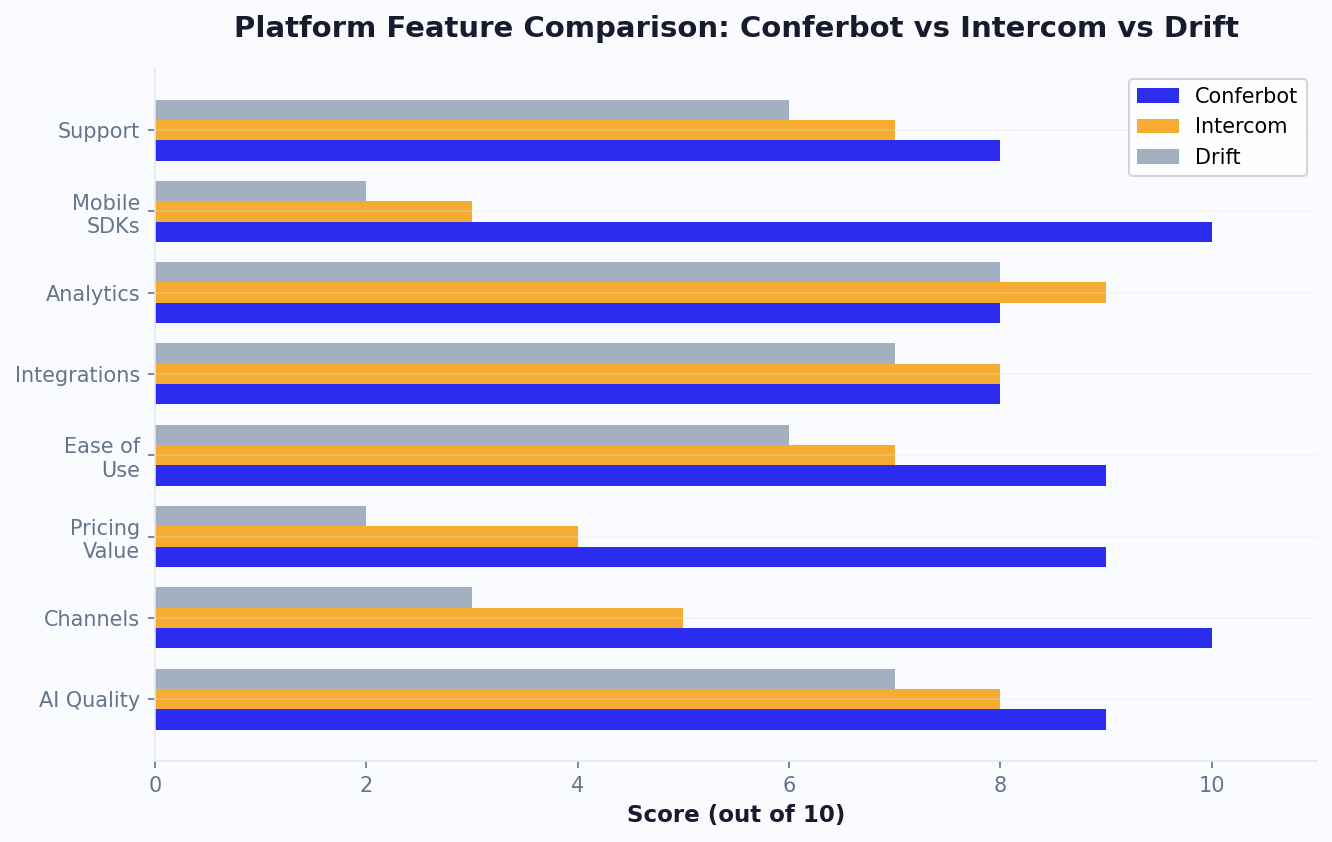
Conferbot is an AI-first chatbot platform that addresses every major Tidio limitation: AI is included in all paid plans, it supports 13+ channels, analytics are built-in, and pricing stays flat as your team grows. Its no-code chatbot builder is comparable to Tidio's in ease of use but offers significantly more flexibility for advanced flows.
Why it tops this list:
- AI chatbot with GPT-powered responses — including AI agent handover — included in base pricing — no per-conversation charges
- Deploys across website, WhatsApp, Messenger, Slack, Telegram, and 8+ more channels
- Advanced analytics with conversation flow analysis, drop-off tracking, and custom reports
- Visual no-code builder with conditional logic, API calls, and dynamic variables
- E-commerce templates for product recommendations, order tracking, and cart recovery
Pros: Best AI value, broadest channel support, excellent analytics, no per-seat pricing pressure
Cons: Newer than Tidio, fewer native Shopify/WooCommerce plugins (uses API integrations instead)
Best for: Businesses that want Tidio's ease of use with enterprise-level AI and channel coverage
See the full Conferbot vs. Tidio comparison
2. Intercom — Best for B2B SaaS
Intercom is the premium option for B2B companies that need advanced user segmentation, product tours, and in-app messaging alongside chatbots. Its Fin AI is powerful but charges per resolution.
Pros: Mature platform, excellent product tours, strong B2B features
Cons: Expensive ($39+/seat plus AI charges), complex for simple use cases
Best for: Funded SaaS companies with complex customer journeys
3. Crisp — Best Flat-Rate Pricing
Crisp charges a flat monthly rate regardless of team size, making it the most predictable option for growing teams. It includes live chat, chatbot, CRM, and knowledge base.
Pros: No per-seat charges, built-in CRM, clean interface
Cons: AI less mature, fewer integrations, smaller user community
Best for: Teams tired of per-agent pricing surprises
4. ChatBot.com — Best Standalone Bot Builder
ChatBot.com (from the LiveChat family) focuses purely on chatbot automation. Its visual builder rivals Tidio's and supports more complex flows.
Pros: Excellent flow builder, strong templates, good AI training
Cons: No live chat included, separate purchase needed
Best for: Businesses wanting pure chatbot automation without live chat
5. Freshdesk — Best Free Tier for Support
Freshdesk offers a genuinely useful free tier for up to 10 agents, including basic ticketing and chat. Freddy AI is an additional cost but integrates deeply with the Freshworks ecosystem.
Pros: Generous free tier, strong ticketing, part of larger ecosystem
Cons: Chatbot features are secondary, AI costs extra, interface can feel busy
Best for: Teams needing ticketing plus basic chat on a budget
Alternatives 6-10: Budget and Niche Options
For a deeper comparison of enterprise options, see our dedicated Zendesk alternative guide.
6. Zendesk — Best for Enterprise Support
Zendesk is the industry standard for large-scale customer support operations. Its chat and chatbot features are part of a comprehensive suite that includes ticketing, knowledge base, community forums, and advanced reporting.
Pros: Enterprise-grade, extensive integrations, powerful reporting and SLA management
Cons: Expensive ($55+/agent), complex setup, AI charges per resolution, overkill for small teams
Best for: Companies with 10+ agents and complex support workflows
For more on conversational sales platforms, read our Drift alternative comparison.
7. Drift — Best for Sales Conversations
Drift (now part of Salesloft) is designed for conversational sales, not support. Its Revenue AI qualifies leads and books meetings automatically. If your goal is pipeline generation rather than customer service, Drift is purpose-built.
Pros: Best-in-class sales automation, strong ABM features, excellent lead routing
Cons: Starts at $2,500/month, not designed for support, overkill for most SMBs
Best for: Enterprise B2B sales teams focused on pipeline and meetings
8. Tawk.to — Best Completely Free Option
Tawk.to offers unlimited free live chat with unlimited agents. It is monetized through optional paid services (hired agents, AI assist, and customization). For businesses with zero budget, it is hard to beat free.
Pros: Truly free live chat, unlimited agents, no feature gating on core chat
Cons: AI is basic and paid ($29/mo), limited chatbot builder, monetization through upselling
Best for: Startups and micro-businesses with no chat budget
9. BotPenguin — Best Ultra-Budget Chatbot
BotPenguin provides multi-channel chatbot building at rock-bottom prices. It supports website, WhatsApp, Facebook Messenger, and Telegram with a generous free tier.
Pros: Extremely affordable, multi-channel, easy to set up, generous free tier
Cons: AI capabilities are basic, limited customization options, smaller ecosystem
Best for: Solopreneurs and micro-businesses needing basic chatbot functionality
10. HubSpot Service Hub — Best CRM Integration
If your team already uses HubSpot for CRM and marketing, Service Hub adds live chat and basic chatbot functionality that ties directly into your contact database and deals pipeline.
Pros: Seamless HubSpot CRM integration, free tier with basic chat, strong marketing synergy
Cons: Advanced chat features need expensive Pro plan ($800+/mo), chatbot builder is basic
Best for: Teams already invested in the HubSpot ecosystem
Each of these alternatives addresses specific Tidio limitations. The best choice depends on your priorities: if AI value and omnichannel coverage matter most, Conferbot is the strongest option. If you need enterprise support tools, Zendesk wins. For pure budget optimization, Tawk.to and BotPenguin deliver at the lowest cost points.
Feature Comparison: What Each Platform Does Best
Beyond pricing, the features you need day-to-day determine which Tidio alternative is the right fit. Reviews on TrustRadius highlight that real-world feature usage often differs significantly from feature checklists. Here is how the top contenders stack up across the capabilities that matter most.
| Feature | Tidio | Conferbot | Intercom | Crisp | Zendesk |
|---|---|---|---|---|---|
| No-code bot builder | Good | Excellent | Good | Good | Basic |
| AI/NLP chatbot | Add-on ($39) | Included | $0.99/resolution | Included | $1/resolution |
| Live chat | Yes | Yes | Yes | Yes | Yes |
| Channel count | 5 | 13+ | 8 | 6 | 8 |
| E-commerce integrations | Excellent | Good | Basic | Basic | Basic |
| Analytics depth | Basic | Advanced | Advanced | Basic | Advanced |
| Knowledge base | No | Yes | Yes | Yes | Yes |
| Custom branding | Full | Full | Full | Full | Full |
| API access | Yes | Yes | Yes | Yes | Yes |
| Mobile app for agents | Yes | Yes | Yes | Yes | Yes |
Analysis: Where Each Platform Wins
Tidio's strength remains its e-commerce integrations. Native Shopify and WooCommerce plugins display product cards, show cart contents, and pull order data directly into the chat window. If your entire operation runs through Shopify, this integration depth is genuinely valuable.
Conferbot excels in three areas that increasingly matter: AI included in base pricing (saving hundreds monthly at scale), 13+ channel support for true omnichannel presence, and advanced analytics that help optimize chatbot performance over time. Its no-code builder supports complex conditional logic that Tidio's builder cannot match.
Intercom dominates in B2B product-led growth scenarios. Product tours, in-app messaging, and user segmentation based on product usage data are features no other platform matches. But you pay a premium for them.
Crisp wins on predictability. Flat-rate pricing means no surprises as your team grows. For teams burned by per-seat pricing models, this alone is worth the switch.
Zendesk wins at enterprise scale. Complex routing, SLAs, compliance certifications, and a massive integration marketplace make it the default for large organizations with complex needs.
The bottom line: Tidio is a good tool for small e-commerce stores with basic needs. But if your business is growing, needs AI at scale, or serves customers across multiple channels, the alternatives listed here offer better value and capabilities for 2026 and beyond.
Switching From Tidio: Migration Tips
Migrating from Tidio to a new chatbot platform is straightforward if you plan ahead. Here is a practical checklist to ensure a smooth transition.
Before You Switch
- Export your conversation data. Tidio allows you to export chat transcripts and contact information from the dashboard. Do this first to preserve your customer interaction history.
- Document your chatbot flows. Screenshot or map out every chatbot flow you have built in Tidio. Note the trigger conditions, response paths, and any integrations each flow uses. This documentation saves hours when rebuilding flows in the new platform.
- List your integrations. Document every tool connected to Tidio: Shopify, WooCommerce, Mailchimp, Google Analytics, CRM systems, etc. Verify that your new platform supports each integration before committing.
- Note your customizations. Record your chat widget colors, position, welcome messages, offline messages, and operating hours. These details are easy to forget but important for brand consistency.
During the Switch
- Run both platforms in parallel. Install the new platform on a test page or low-traffic section of your site. Let your team use it for a week before full deployment. This catches issues without disrupting customer experience.
- Rebuild flows strategically. Do not just replicate your Tidio flows exactly. Use the migration as an opportunity to improve. Which flows had high drop-off? Which questions did your bot fail to answer? Address these gaps in the new platform.
- Train your AI. If moving to an AI-powered platform like Conferbot, upload your FAQ content, product documentation, and past conversation data to train the AI. The more context it has, the better it performs from day one.
- Test on every channel. If you are expanding from Tidio's 5 channels to a platform with broader coverage, test each new channel (WhatsApp, Telegram, Slack, etc.) thoroughly before announcing availability to customers.
After the Switch
- Monitor performance metrics for the first 30 days. Compare response times, resolution rates, and customer satisfaction scores against your Tidio benchmarks.
- Gather agent feedback. Your support team's experience matters. Are they faster with the new tool? Are there features they miss? Address concerns early to ensure adoption.
- Optimize based on data. Use your new platform's analytics to identify opportunities. Which chatbot flows need refinement? Where are customers dropping off? Data-driven optimization is where the real ROI of switching platforms materializes.
Most businesses complete a Tidio migration in 1-2 weeks. For a broader view of available platforms, see our best no-code chatbot builders comparison. The key is parallel operation: keep Tidio running while your new platform is tested and validated, then switch over cleanly.
Why Real Users Switched From Tidio: Common Breaking Points
To move beyond feature checklists and into real-world decision-making, we analyzed reviews from G2, Capterra, and TrustRadius to identify the most common reasons businesses leave Tidio. Understanding these breaking points helps you anticipate whether you will hit the same limitations.
Breaking Point #1: Lyro AI Conversation Limits
The most frequently cited frustration is Lyro AI's conversation cap. On the base Lyro plan ($39/month extra), you get 50 AI conversations. For an e-commerce store with 200+ daily visitors engaging the chatbot, that limit is reached in days, not weeks. When the cap is hit, conversations fall back to basic keyword matching or queue for human agents — defeating the purpose of AI automation. Alternatives like Conferbot include AI without per-conversation limits, making costs predictable regardless of volume.
Breaking Point #2: Scaling Cost With Team Growth
Several reviewers described a pattern: they started on Tidio's free tier with 1-2 operators, loved it, then saw their bill jump 300-400% as the team grew to 5-8 agents. Per-operator pricing models create a direct tension between team scaling and budget control. Platforms with flat-rate or tier-based pricing (Conferbot, Crisp) eliminate this friction entirely — you pay the same whether you have 3 agents or 10.
Breaking Point #3: Channel Limitations During Expansion
Businesses that start website-only but want to expand to Telegram, Slack, SMS, or Microsoft Teams find Tidio lacking. The platform supports website, email, Messenger, Instagram, and WhatsApp (beta) — but businesses going omnichannel need broader coverage. The switching cost increases the longer you wait, as accumulated chatbot flows, customer data, and team familiarity all need migration.
Breaking Point #4: Analytics Insufficient for Optimization
Growth-stage businesses that want to optimize chatbot performance systematically describe Tidio's analytics as inadequate. They need per-flow conversion tracking, A/B testing results, drop-off point identification, and custom date range comparisons. Without these capabilities, optimization becomes guesswork rather than data-driven. Platforms with advanced analytics (Conferbot, Intercom, Zendesk) enable the weekly optimization cycles that drive 5-10% continuous improvement.
Breaking Point #5: Chatbot Builder Complexity Ceiling
Power users describe hitting walls with Tidio's visual builder when implementing complex conditional logic, API-driven responses, or multi-step validation flows. While the builder handles simple if/then flows well, advanced automation scenarios require workarounds or are simply impossible. This matters most for businesses with custom qualification logic, dynamic pricing, or integration-heavy workflows.
The Switching Decision Framework
Based on these patterns, consider switching from Tidio when: you are spending $150+/month and hitting AI conversation limits, your team has grown past 5 operators, you need more than 5 channels, your analytics needs exceed basic metrics, or your chatbot flows require complex conditional logic. If none of these apply, Tidio may still serve you well — it remains an excellent tool for its target use case of simple e-commerce chat.
Total Cost of Ownership: A 12-Month Comparison
Comparing monthly subscription prices is misleading because the total cost of owning a chatbot platform includes setup time, ongoing optimization, integration costs, and opportunity costs from feature gaps. Here is a realistic 12-month TCO analysis for a growing e-commerce business (5 agents, 3,000 monthly conversations, 3 channels).
12-Month TCO Breakdown
| Cost Component | Tidio | Conferbot | Intercom |
|---|---|---|---|
| Base plan (12 months) | $1,908 ($159/mo x 12) | $1,188 ($99/mo x 12) | $5,880 ($490/mo x 12) |
| AI add-on | $468 ($39/mo x 12) | $0 (included) | $2,970 ($0.99 x ~250 resolutions/mo x 12) |
| Additional channels | $0 (5 channels included) | $0 (13+ channels included) | $0 (8 channels included) |
| Setup and migration time | ~$500 (staff time) | ~$500 (staff time) | ~$2,000 (staff time, complex setup) |
| Integration costs | $0-240 (Zapier for gaps) | $0 (native integrations) | $0 (native integrations) |
| Over-limit conversations | ~$360 (Lyro overages) | $0 (no caps) | Variable (per resolution) |
| 12-Month Total | $3,236-$3,476 | $1,688 | $10,850+ |
Opportunity Cost Analysis
Beyond direct costs, consider the opportunity cost of feature gaps:
- Limited AI on Tidio: If your AI cap prevents automation of 100 conversations/month that would otherwise convert at 10%, and each lead is worth $200, the opportunity cost is $2,000/month ($24,000/year).
- Missing channels on Tidio: If 15% of your customers prefer Telegram or Slack (common in tech-savvy audiences) and you cannot reach them, the lost engagement represents 450 conversations/month of unrealized value.
- Basic analytics on Tidio: Without per-flow optimization data, you miss the 5-10% monthly improvement that compounds to 80-160% over 12 months. A chatbot converting at 10% vs. one optimized to 18% represents enormous revenue difference on the same traffic.
The Break-Even Decision
Based on this TCO analysis, switching from Tidio to Conferbot saves $1,548-$1,788 in direct costs over 12 months while gaining unlimited AI conversations, 8 additional channels, and advanced analytics. The switch pays for itself in month 1 through direct cost savings alone — before considering the opportunity cost of better AI, broader channels, and deeper optimization capabilities.
For businesses evaluating Intercom, the value proposition is different: you are paying a significant premium for B2B-specific features (product tours, user segmentation, in-app messaging). If those features are critical to your business, Intercom's premium is justified. If you primarily need chat + chatbot + AI, Conferbot delivers equivalent or better capability at 85% lower cost. According to Tidio's current pricing, costs escalate further on their Chatbots+ and Tidio+ plans for businesses needing higher limits.
How to Choose the Right Tidio Alternative
With ten alternatives to evaluate, narrowing your choice requires honest self-assessment. Here is a decision framework based on the most common business scenarios.
Choose Conferbot If:
- You want AI chatbot capabilities without paying extra for every conversation
- Your customers reach you on more than 3 channels (website, WhatsApp, Messenger, Slack, etc.)
- You need advanced analytics to optimize chatbot performance over time
- You want a platform that scales affordably as your team and volume grow
- You value a no-code builder with advanced conditional logic and API integration capabilities
Stay With Tidio If:
- You run a small Shopify or WooCommerce store with under 100 conversations per month
- Tidio's native e-commerce plugins are critical to your workflow
- You only need website chat and Messenger, no other channels
- Your chatbot flows are simple and do not require AI or complex logic
Choose Intercom If:
- You are a B2B SaaS company with budget for premium tools ($500+/month)
- You need product tours and in-app messaging alongside chat
- User segmentation based on product usage is important to your strategy
Choose Zendesk If:
- You have 10+ support agents with complex routing and SLA requirements
- Regulatory compliance and enterprise certifications are non-negotiable
- You need a full helpdesk suite, not just chat and chatbots
Choose Crisp If:
- Predictable flat-rate pricing is your top priority
- You want an all-in-one tool (chat, CRM, knowledge base) at one price
- Your team size is growing and you want to avoid per-seat cost increases
Choose Tawk.to If:
- Your budget is literally zero and you primarily need live chat
- AI chatbot capabilities are nice-to-have, not must-have
- You can accept a less polished interface for the price of free
Regardless of which platform you choose, check our dedicated alternative guides for Intercom and Drift if those platforms are on your shortlist. The most important step is to start a free trial and test with real scenarios. Build your most common chatbot flow, have agents test the live chat experience, and evaluate the analytics dashboard. The right platform will feel intuitive for both your team and your customers within the first few days of testing.
For most businesses outgrowing Tidio, Conferbot delivers the strongest combination of AI power, channel coverage, and value. But every business is different, and we encourage you to compare using the framework above before making your decision.
Migration Complexity Assessment
Switching from Tidio is straightforward for most businesses because Tidio stores conversation flows in a visual format that maps easily to other platforms. Export your top-performing flows as screenshots, recreate them in your new platform using equivalent logic blocks, and run both platforms in parallel for one week to verify performance parity. Most migrations complete within 5-7 business days without any customer-facing disruption.
Was this article helpful?
10 Best Tidio Alternatives in 2026 FAQ
Everything you need to know about chatbots for 10 best tidio alternatives in 2026.
About the Author

Conferbot Team specializes in conversational AI, chatbot strategy, and customer engagement automation. With deep expertise in building AI-powered chatbots, they help businesses deliver exceptional customer experiences across every channel.
View all articles