Cart Abandonment by the Numbers: What You Are Losing
Cart abandonment is the single largest controllable revenue leak in e-commerce. According to Baymard Institute's aggregated research, the global average cart abandonment rate stands at 70.19% across 49 studies conducted between 2012 and 2026. That number has remained stubbornly consistent for over a decade, fluctuating between 68% and 74% regardless of how much retailers invest in checkout optimization.
The financial impact of that rate is enormous. Industry analysts estimate that $260 billion in annual revenue is potentially recoverable through better checkout experiences and post-abandonment engagement. For an individual store processing $500,000 per year in completed orders, a 70% abandonment rate means roughly $1.17 million worth of carts were started but never converted. Even recovering a fraction of that total transforms the bottom line.
Abandonment Rates by Industry
The 70% average masks significant variation across verticals. Some industries face far steeper cliffs than others:
| Industry | Abandonment Rate | Primary Driver |
|---|---|---|
| Travel and hospitality | 81.7% | Comparison shopping, multi-step booking |
| Airlines | 87.9% | Price volatility, fare comparisons |
| Fashion and apparel | 68.3% | Sizing uncertainty, browsing behavior |
| Electronics | 74.1% | Price sensitivity, feature comparisons |
| Beauty and cosmetics | 70.8% | Shade matching, ingredient research |
| Home and furniture | 73.2% | High price points, delivery logistics |
| Food and grocery | 61.4% | Perishability urgency reduces abandonment |
| Subscription services | 66.5% | Commitment anxiety, unclear cancellation |
Why Shoppers Abandon
Baymard's usability research identifies the top reasons customers leave without completing their purchase:
- Unexpected costs at checkout (48%): Shipping fees, taxes, and handling charges that appear only at the final step create sticker shock. A cart that looked like $45 suddenly costs $62.
- Required account creation (26%): Forcing registration before payment introduces friction that pushes browsers away entirely.
- Delivery too slow (23%): When estimated delivery dates extend beyond the customer's patience threshold, competing retailers with faster shipping win.
- Complex checkout process (22%): Every additional field, page, or confirmation step loses a percentage of shoppers.
- Did not trust the site with payment info (18%): Missing trust signals like SSL badges, recognizable payment logos, and review scores create hesitation.
- Just browsing or comparing (58%): The single largest segment. These shoppers were never in buying mode but used the cart as a wishlist or comparison tool.
Each of these reasons maps to a specific chatbot intervention strategy. A chatbot that proactively surfaces shipping costs, offers guest checkout guidance, or provides trust reassurance at the moment of hesitation addresses the root cause rather than chasing the symptom with a generic "come back" email hours later.
The Revenue Recovery Opportunity
Not every abandoned cart is recoverable. The "just browsing" segment and shoppers who found a better price elsewhere represent carts that no amount of follow-up will convert. Baymard estimates that approximately 35-40% of abandoned carts are recoverable through better checkout UX and proactive engagement. That narrows the $260 billion figure to roughly $91-104 billion in genuinely recoverable revenue, but even that reduced number dwarfs most marketing budgets.
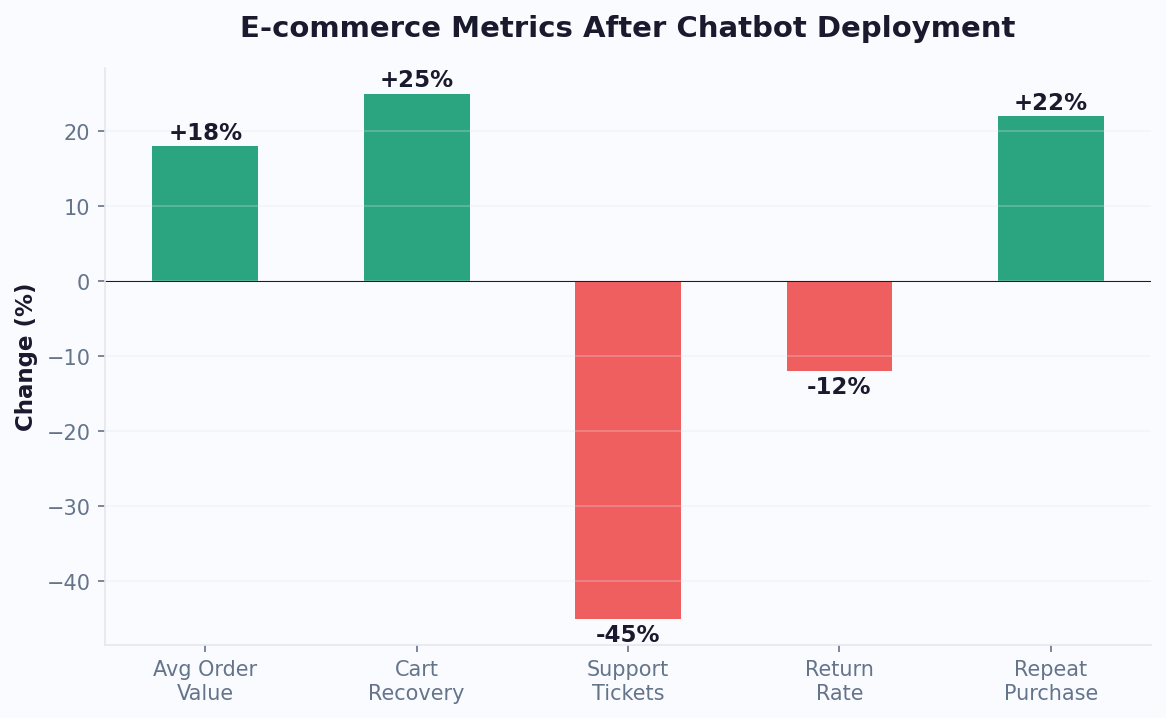
For a mid-market e-commerce store, the math is straightforward. If 1,000 carts are abandoned per month at an average cart value of $95, that is $95,000 in abandoned revenue. A chatbot recovering 22% of those carts generates $20,900 per month in revenue that would otherwise disappear. Against a chatbot platform cost of $100-300 per month, the return on investment is measured in multiples, not percentages.
Why Chatbots Outperform Email for Cart Recovery
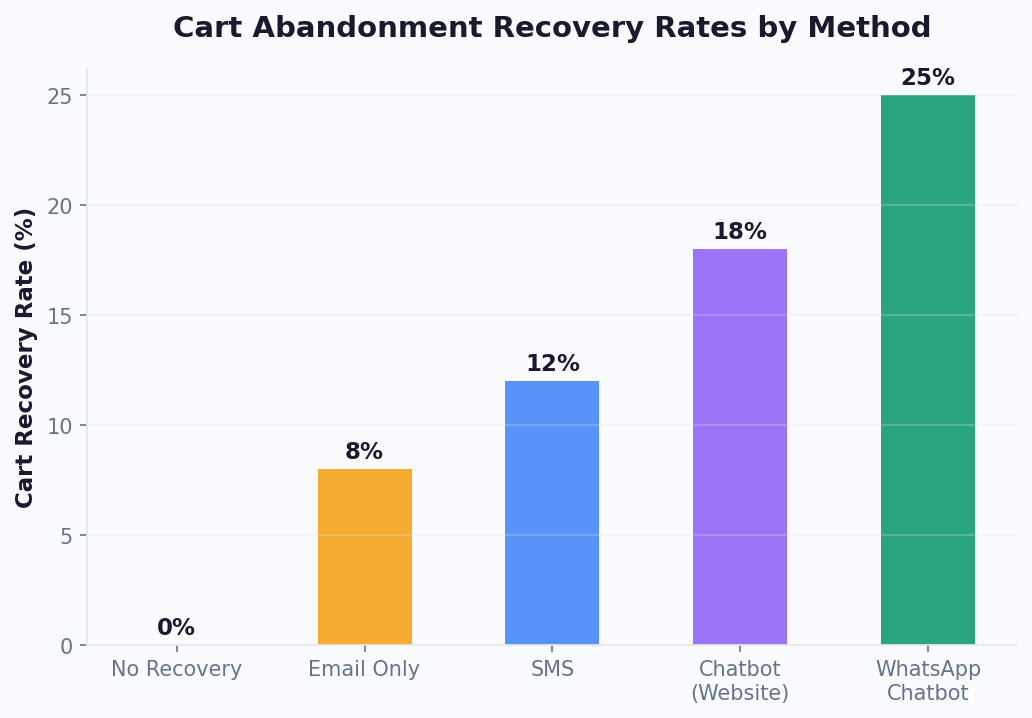
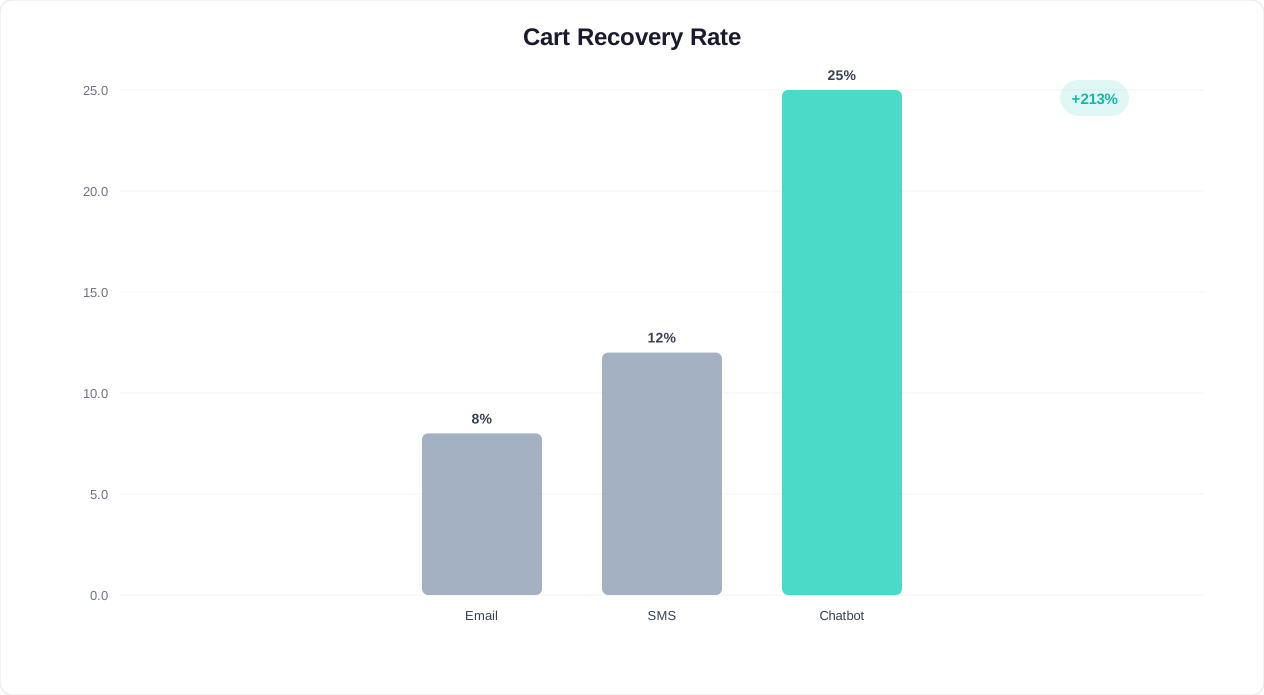
Email has been the default cart recovery tool since the early days of e-commerce. It works, but it works slowly and with diminishing returns. Klaviyo's 2025 benchmarks show that email-based cart recovery campaigns convert at 5-8% of abandoned carts, with the best-in-class stores reaching 10% through aggressive multi-email sequences and deep personalization. Those numbers have barely moved in five years.
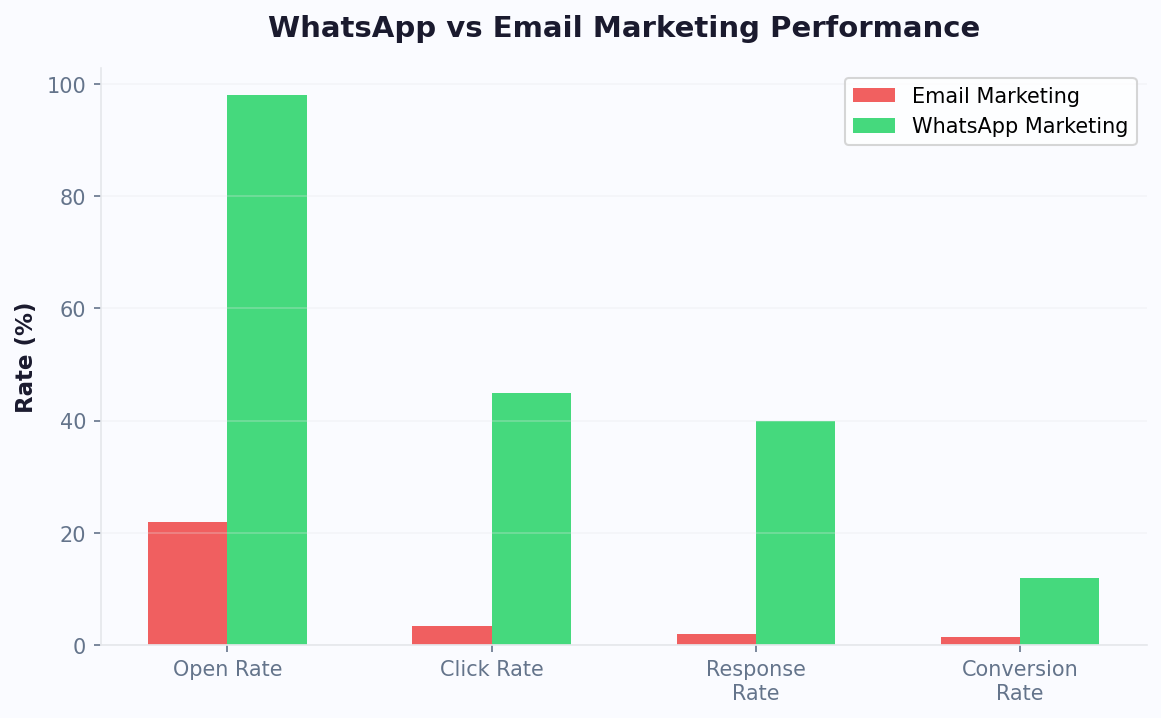
Chatbot-driven recovery campaigns, by contrast, convert at 20-35% across website, WhatsApp, and Messenger channels. That is a 3-5x improvement over email, and the gap continues to widen as messaging channel adoption grows and email fatigue intensifies.
Channel-by-Channel Performance Comparison
| Metric | Website Chatbot | WhatsApp Chatbot | Messenger Chatbot | |
|---|---|---|---|---|
| Open / Read rate | 40-45% | 100% (on-site) | 98% | 80-88% |
| Click-through rate | 8-12% | 20-30% | 35-45% | 25-35% |
| Recovery conversion rate | 5-8% | 12-18% | 22-35% | 15-25% |
| Median time to recovery | 12-48 hours | Under 5 minutes | 1-4 hours | 2-6 hours |
| Two-way conversation | No | Yes | Yes | Yes |
| Objection handling | Static links | Real-time AI | Real-time AI | Real-time AI |
Five Structural Advantages of Chatbot Recovery
1. Speed of engagement. The single most critical variable in cart recovery is time. Purchase intent decays exponentially after abandonment. A chatbot engaging a shopper within seconds of exit-intent behavior catches them while their desire for the product is still active. Email, even with a 30-minute send delay, arrives after the shopper has closed the tab, opened a new app, or started a different activity entirely. The chatbot vs email comparison consistently favors real-time engagement for conversion-critical interactions.
2. Two-way conversation. Email is a monologue. The retailer sends a message, and the customer either clicks or does not. A chatbot opens a dialogue. When a customer hesitates because of shipping costs, the chatbot can ask what their concern is, explain shipping options, or offer a free-shipping threshold. When the hesitation is about sizing, the chatbot pulls up a size guide or connects them to a product specialist. This conversational ability resolves objections in real time rather than hoping a static email addresses the right concern.
3. Rich, interactive content. Chatbots display the abandoned product with images, current pricing, stock status, and one-tap checkout buttons inside the conversation. The customer does not need to navigate back to a website, find their cart, and re-enter payment details. The rich media capabilities create a self-contained recovery experience that minimizes friction between intent and purchase.
4. Personalization depth. While email personalization is limited to merge tags (name, product name, discount code), chatbot personalization adapts in real time based on the customer's responses. If the customer says "It is too expensive," the chatbot can offer a payment plan. If they say "I am not sure it will fit," the chatbot shows sizing reviews from customers with similar measurements. This dynamic personalization is impossible in a static email format.
5. Multi-channel reach. A chatbot platform like Conferbot for e-commerce deploys recovery conversations across website chat, WhatsApp, Facebook Messenger, and SMS from a single flow builder. Customers are reached on the channel they are most active on, not forced into checking a channel (email) they may only visit once or twice a day.
The Compounding Effect
Chatbot recovery does not just convert more carts. It generates data that improves future recovery. Every chatbot conversation reveals why the customer abandoned. Was it price, shipping, product uncertainty, or distraction? That objection data feeds back into product pages, pricing strategy, and checkout design, reducing future abandonment rates while improving recovery rates on carts that are still abandoned. Email tells you whether someone clicked. Chatbots tell you what they were thinking.
Exit-Intent Triggers: Catching Shoppers Before They Leave
The most effective cart recovery happens before the cart is technically abandoned. Exit-intent detection identifies behavioral signals that a shopper is about to leave the checkout flow and triggers a chatbot conversation at exactly that moment. This pre-abandonment intervention recovers 10-18% of would-be abandonments before they become a recovery challenge at all.
How Exit-Intent Detection Works
Exit-intent systems monitor a combination of browser and behavioral signals to predict when a user is about to navigate away from the checkout page:
- Cursor trajectory: On desktop, the mouse cursor moving rapidly toward the browser's close button, address bar, or back button is the strongest single predictor of exit. The chatbot triggers when the cursor crosses into the top 10-15% of the viewport.
- Tab switching: The Page Visibility API detects when the checkout tab loses focus. If a user switches to another tab during checkout, there is a 65-70% probability they will not return.
- Scroll velocity: A sudden, rapid scroll back to the top of a checkout page often precedes a back-button click or tab close. This deceleration-then-reverse pattern is distinct from normal page browsing.
- Inactivity timeout: If a user stops interacting with the checkout page for 45-90 seconds after having been active, the chatbot triggers with a gentle re-engagement prompt.
- Mobile back-button prediction: On mobile devices, cursor tracking is not available. Instead, exit intent is inferred from scroll-to-top gestures, app-switch patterns, and the orientation of touch movements toward the bottom navigation bar.
Designing the Exit-Intent Chatbot Conversation
The exit-intent chatbot message must accomplish three things in under 15 words: acknowledge the hesitation, offer help, and avoid feeling intrusive. The worst exit-intent popups are aggressive discount offers that feel like desperation. The best ones feel like a knowledgeable store associate who noticed you looking confused.
High-performing exit-intent opening lines:
- "Have a question about your order? I can help with shipping, sizing, or returns."
- "Before you go, can I help you find the right [product category]?"
- "Checking out can be tricky. Want me to walk you through the options?"
- "Still deciding? Here is what other customers say about [product name]." [followed by a review snippet]
Lines that underperform:
- "Wait! Do not leave!" (creates pressure, not value)
- "Get 20% off right now!" (trains abandonment behavior, erodes margins)
- "Your cart is about to expire!" (false urgency damages trust)
Branching Logic After the Trigger
Once the exit-intent chatbot engages the shopper, the conversation branches based on their response. A well-designed flow covers the five most common abandonment reasons with dedicated resolution paths:
| Customer Response | Chatbot Action | Recovery Rate |
|---|---|---|
| "Shipping costs are too high" | Show free-shipping threshold or offer flat-rate option | 25-30% |
| "Not sure about the size/fit" | Display size guide, show reviews from similar body types | 18-22% |
| "I want to compare prices" | Highlight price-match guarantee or unique value props | 12-15% |
| "Just browsing for now" | Offer to save cart and send a reminder via preferred channel | 8-12% (delayed) |
| "The total is more than I expected" | Show payment plan options or suggest similar lower-priced items | 15-20% |
Technical Implementation
Implementing exit-intent triggers with Conferbot's API integration involves three components:
- Event listener on checkout pages: A lightweight JavaScript snippet (under 3KB) monitors the behavioral signals described above. It fires a custom event when exit intent is detected with a confidence score above 0.7.
- Chatbot activation hook: The custom event opens the Conferbot widget with a pre-configured recovery flow. The flow receives context about the customer's cart contents, cart value, session duration, and any previous interactions.
- Suppression rules: To avoid annoying repeat visitors, the exit-intent trigger fires a maximum of once per session and no more than twice per week for the same visitor. Customers who have already completed a purchase in the current session are excluded entirely.
The suppression rules are critical. Without them, exit-intent triggers become the digital equivalent of an aggressive salesperson who follows you around the store. The goal is a single, well-timed, genuinely helpful intervention, not persistent nagging.
Measuring Exit-Intent Effectiveness
Track these metrics specifically for exit-intent interventions, separate from post-abandonment recovery:
- Trigger rate: Percentage of checkout visitors who trigger the exit-intent chatbot (target: 15-25%)
- Engagement rate: Percentage of triggered visitors who interact with the chatbot (target: 30-45%)
- Same-session conversion: Percentage of engaged visitors who complete checkout in the same session (target: 10-18%)
- Deferred conversion: Percentage who save their cart and return to purchase within 72 hours (target: 5-10%)
The First-Hour Rule: Timing Your Recovery Messages
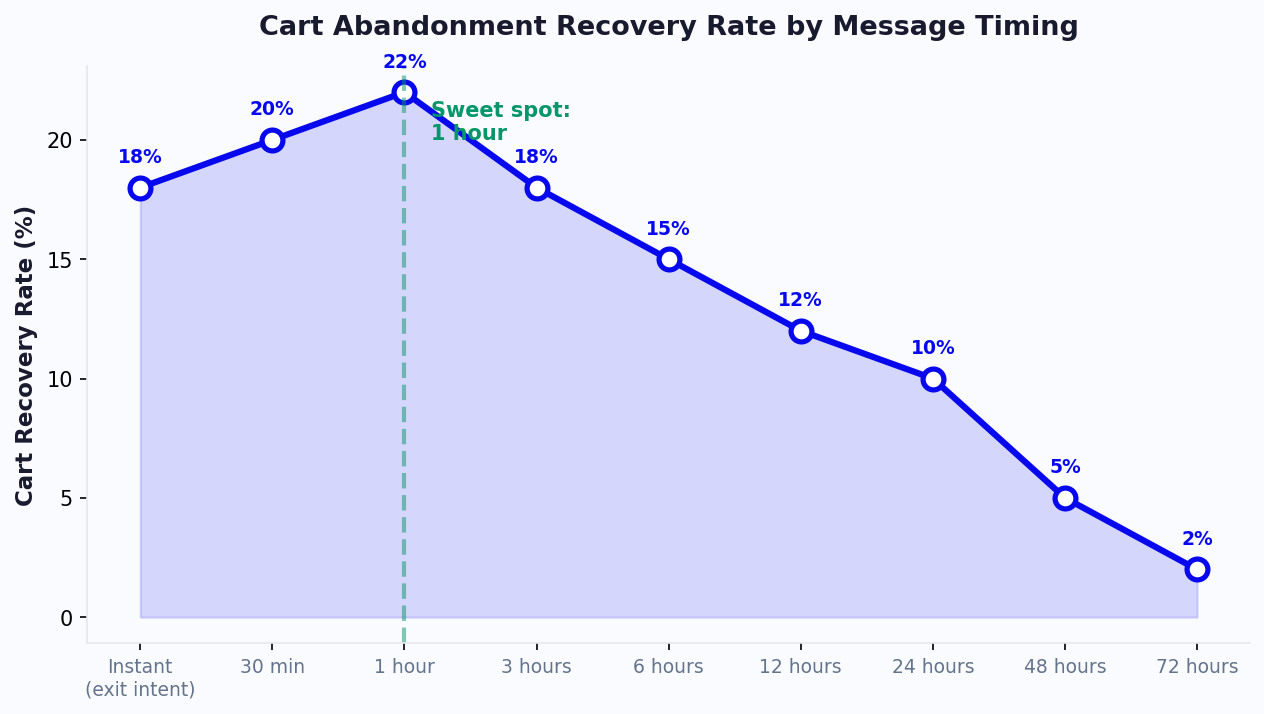
After a cart is abandoned and the shopper has left the site, timing becomes the most important variable in recovery success. Data from across millions of recovery campaigns reveals a consistent pattern: conversion probability drops by approximately 50% for every hour that passes after abandonment. This is the first-hour rule, and it should govern every aspect of your recovery message timing.
The Recovery Timing Curve
Purchase intent is a perishable asset. The moment a customer adds an item to their cart, their intent is at peak. Every minute that passes without conversion erodes that intent as competing priorities, second thoughts, and alternative options fill the mental space the product once occupied.
| Time After Abandonment | Relative Conversion Probability | Optimal Channel | Recommended Action |
|---|---|---|---|
| 0-5 minutes | 100% (baseline) | Website chatbot (exit-intent) | Address objections in real time |
| 5-15 minutes | 85% | WhatsApp or Messenger | Friendly reminder with cart summary |
| 15-60 minutes | 60% | WhatsApp or Messenger | Helpful nudge, offer to answer questions |
| 1-3 hours | 35% | WhatsApp, Messenger, or SMS | Social proof, product reviews, urgency |
| 3-12 hours | 20% | WhatsApp or email | Free shipping offer or small incentive |
| 12-24 hours | 12% | Email with chatbot link | Stronger incentive, limited-time offer |
| 24-48 hours | 7% | Email or SMS | Final discount, scarcity messaging |
| 48-72 hours | 3% | Last-chance message, cart expiration | |
| Beyond 72 hours | Under 2% | None (add to retargeting) | Move to ad retargeting audiences |
The Three-Touch Recovery Sequence
Based on the timing curve, the highest-performing recovery campaigns use a three-touch sequence that balances urgency with restraint:
Touch 1: The Quick Check-In (10-30 minutes)
This is your highest-converting message. The customer's memory of the product is fresh, and many abandonments at this stage are the result of distraction rather than deliberate decision. The message should be conversational, not promotional.
Content framework: Personalized greeting + product name and image + "Can I help with anything?" + one-tap return-to-cart button.
Expected recovery: 10-15% of recipients complete their purchase from this single touch.
Touch 2: The Value Builder (3-6 hours)
Customers who did not respond to Touch 1 either have a genuine objection or were not in a position to act. Touch 2 adds value rather than repeating the reminder. Include customer reviews, answer the most common product questions, or highlight a benefit the customer may not have noticed (warranty, free returns, loyalty points).
Content framework: "Still thinking about [product]?" + social proof element (star rating, review quote, purchase count) + secondary benefit highlight + return-to-cart button.
Expected recovery: 5-8% additional conversions.
Touch 3: The Incentive (18-24 hours)
Only at this stage should an incentive enter the conversation. By waiting 18-24 hours, you have already recovered the customers who did not need a discount, preserving margin. The incentive targets the remaining segment that needs a financial nudge to convert.
Content framework: Acknowledge time has passed + specific incentive (free shipping, percentage off, or bonus item) + clear expiration (24-48 hours) + direct checkout link with incentive pre-applied.
Expected recovery: 3-6% additional conversions.
Timing Adjustments by Product Category
The standard timing sequence works well for mid-range consumer goods ($30-150). Adjust for different product categories:
- Impulse purchases (under $30): Compress the sequence. Touch 1 at 5-10 minutes, Touch 2 at 1-2 hours, Touch 3 at 6-12 hours. Purchase intent for low-cost items evaporates faster, but conversion barriers are also lower.
- Considered purchases ($150-500): Extend the sequence. Touch 1 at 30-60 minutes, Touch 2 at 12-24 hours, Touch 3 at 48 hours. Customers spending more need more time to deliberate, and rushing them feels pushy.
- High-value purchases (over $500): Add a human handoff option. Touch 1 at 1-2 hours (chatbot), Touch 2 at 24 hours (chatbot with live chat escalation option), Touch 3 at 48-72 hours (personal outreach from a sales representative). High-value purchases often require human trust-building.
Day-of-Week and Time-of-Day Patterns
Recovery message effectiveness also varies by when the message arrives, not just how long after abandonment it is sent:
- Weekday mornings (8-10 AM): Highest open and click rates for recovery messages. Customers are in planning mode and receptive to completing unfinished tasks.
- Weekday evenings (7-9 PM): Strong performance, especially for lifestyle and fashion products. Customers are relaxed and in browsing mode.
- Weekend afternoons (1-4 PM): Good for considered purchases. Customers have time to evaluate options and complete larger purchases.
- Late night (11 PM - 6 AM): Avoid sending recovery messages during sleeping hours. Schedule them for the next morning window instead.
When the timing formula (minutes-after-abandonment) would deliver a message at 3 AM, the chatbot should hold the message and deliver it at the next optimal window. A well-timed message at 8 AM will always outperform a technically-on-schedule message that arrives at 3 AM and is buried under morning notifications.
Personalization: Product-Specific Recovery Conversations
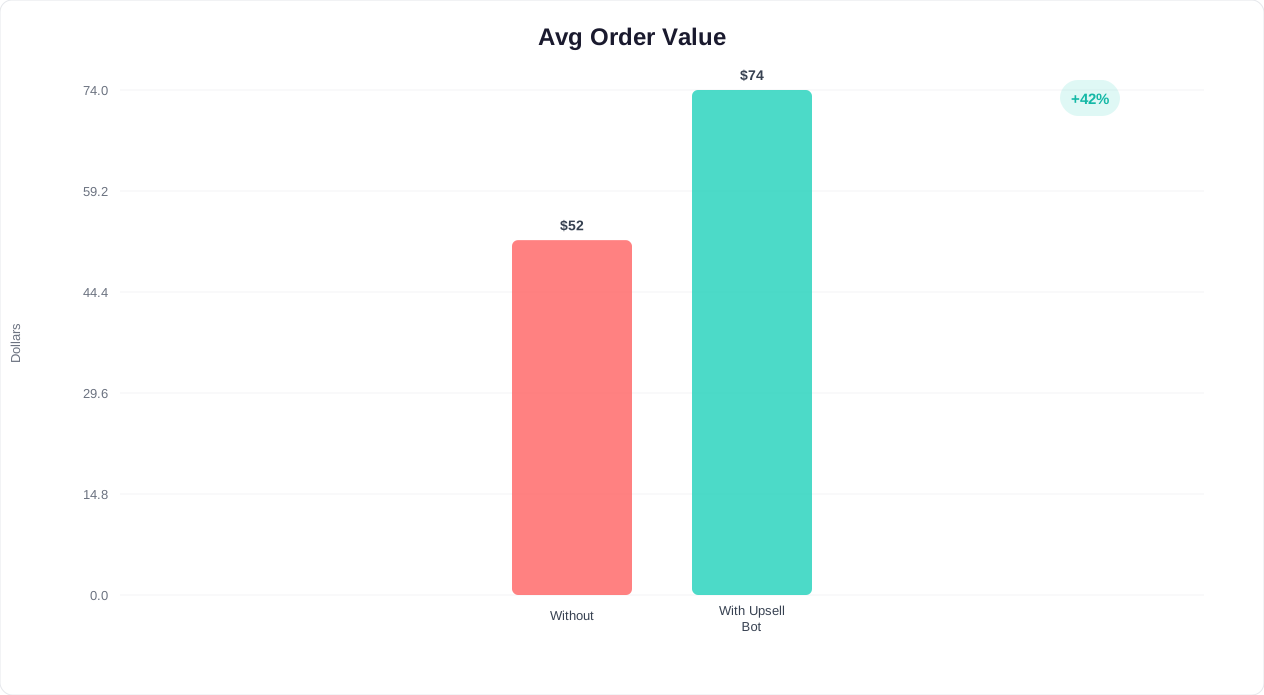
Generic "You left something in your cart" messages are the minimum viable recovery strategy. They work, but they leave significant conversion potential on the table. Product-specific personalization, where the chatbot tailors its entire conversation to the specific product abandoned and the customer's browsing behavior, increases recovery rates by 25-40% over generic templates.
Levels of Recovery Personalization
Think of personalization as a spectrum with four levels, each delivering incrementally better results:
Level 1: Basic (5-8% recovery rate). Uses the customer's first name and mentions "items in your cart" without specifying what those items are. This is what most email recovery campaigns do. It is better than nothing but barely above the noise floor of promotional messaging.
Level 2: Product-Aware (12-18% recovery rate). Includes the specific product name, image, price, and a direct link back to the pre-loaded cart. The customer sees exactly what they left behind and can return to it with one tap. This is the minimum standard for chatbot recovery.
Level 3: Context-Aware (18-25% recovery rate). In addition to product details, the chatbot incorporates session context: which pages the customer visited before checkout, how long they spent on the product page, whether they viewed the size guide or return policy, and whether they compared the product to alternatives. This context informs the chatbot's approach. A customer who spent three minutes on the return policy page gets a message emphasizing the hassle-free return process. A customer who viewed three similar products gets a comparison summary.
Level 4: Predictive (25-35% recovery rate). The chatbot uses AI to predict the most likely abandonment reason based on behavioral signals and tailors the recovery conversation to address that specific objection before the customer even voices it. This requires AI agent capabilities combined with e-commerce session data.
Product-Specific Message Templates
Different product categories require different recovery approaches. A one-size-fits-all message for a $12 phone case and a $400 winter jacket misses the nuance that drives conversion:
Fashion and apparel: Lead with fit confidence. "Still thinking about the [Product Name] in [Size]? Customers your size rate the fit 4.7 out of 5. Free returns within 30 days if it does not work out." Include a customer photo review if available.
Electronics: Lead with specs and comparison. "The [Product Name] you were looking at has [key differentiating spec]. Here is how it compares to [competitor product the customer viewed]." Address the research-heavy nature of electronics purchasing.
Beauty and cosmetics: Lead with shade matching and reviews. "Not sure about [Shade Name]? Here is what it looks like on customers with similar skin tones." Include user-generated content showing the product in use.
Home and furniture: Lead with visualization and logistics. "Wondering how the [Product Name] would look in your space? Here are customer photos. Delivery is free and includes setup in your room of choice." Address the two biggest furniture purchase anxieties: will it look right, and how does delivery work.
Subscription products: Lead with flexibility and value. "The [Subscription Plan] you were considering includes [key benefit]. You can cancel anytime with no fees. Start with a single month to try it out." Address commitment anxiety directly.
Dynamic Content Assembly
Product-specific recovery requires the chatbot to pull real-time data from your product catalog and customer database. The integration hub connects the chatbot to:
- Product database: Name, images, price, stock status, variants, reviews, and ratings
- Customer profile: Name, purchase history, browsing history, preferred channel, past interactions
- Inventory system: Real-time stock levels to enable genuine scarcity messaging ("Only 3 left in your size")
- Review aggregation: Relevant review excerpts and ratings to include as social proof
- Pricing engine: Current promotions, bundle opportunities, and loyalty discounts the customer qualifies for
With these data sources connected, the chatbot assembles a recovery message that feels hand-crafted for each customer, even though it is generated automatically. The result is a recovery conversation that mirrors the experience of a skilled salesperson who remembers the customer, knows the product, and understands the hesitation.
A/B Testing Personalization Elements
Not every personalization element improves conversion. Test systematically to find what moves the needle for your specific audience:
- Product image vs. no image: In most cases, including the product image increases click-through by 15-20%. Exception: very high-end products where the image in a chat context feels cheap.
- Review quotes vs. star ratings: Specific customer quotes ("Best running shoes I have owned") outperform generic star ratings (4.8/5) by 10-15% in recovery contexts because they provide narrative confidence.
- Stock urgency vs. no urgency: Genuine low-stock messaging increases recovery by 12-18%, but only when the scarcity is real. Fake scarcity (showing "Only 2 left" on items with 500 in stock) is easily detected and erodes trust.
- Name personalization vs. no name: Using the customer's first name improves open rates by 5-8% on messaging channels. On website chatbot popups, it improves engagement rate by 10-12% because it signals the message is relevant to them specifically.
Offering Incentives Without Training Customers to Abandon
The most common mistake in cart recovery is leading with a discount. It works in the short term, recovering carts that would otherwise be lost, but it creates a destructive long-term pattern: customers learn that abandoning their cart triggers a discount, so they abandon deliberately. Over time, your recovery program becomes an expected step in the buying process rather than a safety net for genuine abandonments.
Shopify's cart recovery benchmarks reveal that stores which lead with discounts in their first recovery message see abandonment rates increase by 8-15% over six months. The discounts recover carts in the short term but cause more carts to be abandoned in the first place, creating a negative feedback loop that erodes margins.
The Incentive Escalation Framework
The solution is a staged approach where discounts are a last resort, not a first move. This framework recovers the maximum number of carts at the minimum cost:
| Stage | Timing | Incentive | Target Segment | Margin Impact |
|---|---|---|---|---|
| Stage 1: Help | 10-30 min | None (pure assistance) | Confused or distracted shoppers | Zero cost |
| Stage 2: Value | 3-6 hours | Social proof, reviews, benefits | Uncertain shoppers | Zero cost |
| Stage 3: Soft incentive | 18-24 hours | Free shipping or bonus item | Price-sensitive shoppers | Low (shipping cost only) |
| Stage 4: Moderate discount | 48 hours | 5-10% off | Holdout shoppers | Moderate |
| Stage 5: Final offer | 72 hours | 15-20% off with expiration | Last-chance conversions | Higher, but still profitable |
The key insight is that Stages 1 and 2 recover 50-65% of all recoverable carts without any discount at all. Those customers did not need a financial incentive; they needed a reminder, a question answered, or reassurance about the product. By handling them first, you preserve full margin on the majority of recovered revenue.
Why Free Shipping Outperforms Percentage Discounts
When you do need an incentive, free shipping consistently outperforms equivalent percentage discounts. A customer with a $100 cart and $8 shipping will respond more positively to "free shipping" than to "8% off," even though the financial value is identical. The psychology is straightforward:
- Shipping feels like a penalty. Customers perceive shipping costs as a fee for something that should be free, not as part of the product price. Removing a penalty feels better than receiving a discount.
- Shipping costs are the top abandonment reason. By addressing the number-one abandonment reason directly, free shipping resolves the most common objection.
- No perceived product devaluation. A 10% discount subtly suggests the product was overpriced. Free shipping does not affect the perceived value of the product itself.
Segment-Based Incentive Logic
Not every customer should receive the same incentive sequence. Use chatbot analytics data to segment customers and customize the incentive approach:
First-time visitors: Use the full five-stage escalation. These customers have no history with your brand and may need more nudging.
Repeat customers: Skip directly to Stage 2 (value reinforcement) since they already trust your brand. If an incentive is needed, offer a loyalty reward ("As a returning customer, here is 10% off") rather than a generic discount. This frames the incentive as earned, not given.
High-value carts (over $200): Extend timing between stages and consider a human handoff at Stage 3. High-value purchases often require more deliberation, and the customer may interpret rapid-fire messages as pressure.
Serial abandoners: Customers who have abandoned multiple carts in the past 30 days may be deliberately gaming the system. For these customers, reduce or eliminate discount offers and focus on Stages 1-2 only. If they do not convert without a discount, they are not your target customer at full margin.
Protecting Margins: The Discount Budget
Set a monthly discount budget for cart recovery as a percentage of recovered revenue. A healthy target is 3-5% of recovered revenue allocated to discounts and free shipping. If your recovery program generates $20,000 in monthly revenue, your discount budget should be $600-1,000. Track actual discount spend against this budget weekly. If you are consistently over budget, your escalation stages are triggering discounts too quickly and need adjustment.
When done correctly, the incentive escalation framework recovers 20-30% of abandoned carts with an average discount cost of under $2 per recovered cart, compared to $8-15 per recovered cart when leading with discounts. The ROI calculation becomes overwhelmingly favorable.
Multi-Channel Recovery: Website, WhatsApp, and Messenger
Relying on a single channel for cart recovery is like fishing with one hook when you could use a net. Each channel reaches a different segment of your abandoned-cart audience, and combining them in an intelligent waterfall sequence maximizes total recovery without overwhelming any individual customer.
The Channel Waterfall Strategy
A waterfall sequence attempts recovery on the highest-converting channel first, then cascades to alternatives based on the customer's response (or lack of response):
Step 1: Website chatbot (0-5 minutes). If the customer is still on the site showing exit intent, the website chatbot engages immediately. This is the highest-converting touchpoint because the customer is still in the buying context. Recovery happens in real time, and the chatbot can address objections conversationally. If the customer leaves without engaging, move to Step 2.
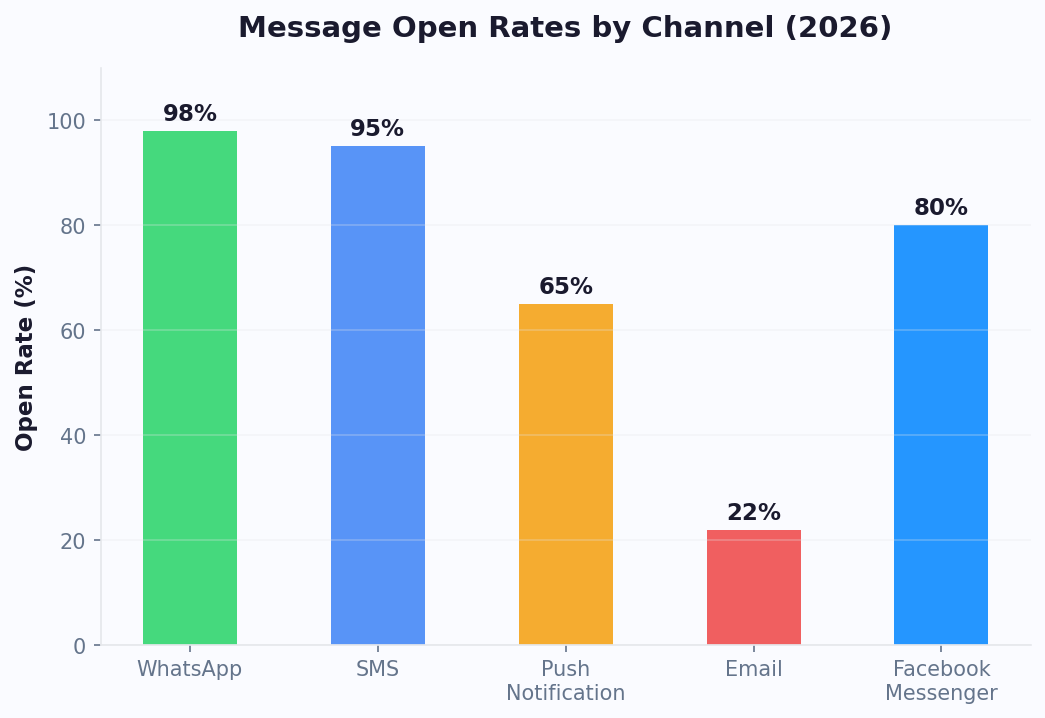
Step 2: WhatsApp (15-30 minutes). For customers who have opted in to WhatsApp communications, send the first recovery message via WhatsApp. With 98% read rates and 35-45% click-through, this is the most effective post-exit channel. The message includes the product image, name, price, and a one-tap checkout button. If no response within 3-4 hours, move to Step 3.
Step 3: Facebook Messenger (3-6 hours). For customers connected via Messenger, send a recovery message through this channel. Messenger is particularly effective for customers acquired through Facebook and Instagram advertising, since the brand relationship already exists in that ecosystem. If no response within 12 hours, move to Step 4.
Step 4: Email with chatbot link (18-24 hours). Email serves as the fallback channel for customers where messaging channel data is not available or previous messages went unread. The email includes the standard recovery content but adds a "Chat with us" button that opens a live chat or chatbot conversation for customers who have questions before completing their purchase.
Step 5: SMS (48 hours, final attempt). A short, direct SMS with the cart link serves as the last touchpoint. SMS has high read rates (95%) but limited interactive capability, so the message should be concise and link directly to the pre-loaded checkout.
Channel Selection Logic
The waterfall order adjusts based on what customer data is available. Not every customer has opted in to every channel:
| Available Data | Channel Sequence | Expected Combined Recovery |
|---|---|---|
| WhatsApp opt-in + email | Website > WhatsApp > Email | 25-35% |
| Messenger + email | Website > Messenger > Email | 20-28% |
| Phone + email | Website > SMS > Email | 15-22% |
| Email only | Website > Email | 10-15% |
| Anonymous (no contact data) | Website chatbot only | 8-12% |
This data makes a compelling case for collecting messaging channel opt-ins early in the customer journey, not just at checkout. An e-commerce store that collects WhatsApp opt-ins via a pre-checkout widget ("Get order updates on WhatsApp") or a lead generation chatbot on product pages has a dramatically larger addressable audience for cart recovery than one that only collects email at checkout.
Cross-Channel Coordination
The critical technical requirement for multi-channel recovery is coordination. When a customer recovers their cart via WhatsApp, the Messenger and email messages must be suppressed. Nothing erodes trust faster than receiving a "Your cart is waiting!" message on three channels after you have already completed the purchase.
Coordination requires:
- Unified customer profile: A single view of each customer's recovery status across all channels, updated in real time when they convert, engage, or unsubscribe.
- Event-driven suppression: When a purchase event fires from the e-commerce platform, all pending recovery messages for that customer are immediately cancelled across every channel.
- De-duplication: If a customer is reachable on both WhatsApp and Messenger, the waterfall selects the higher-converting channel rather than messaging both simultaneously.
- Frequency caps: A maximum of 4-5 total recovery touchpoints across all channels for a single abandoned cart. Beyond that threshold, additional messages generate irritation, not conversion.
Building this coordination from scratch requires significant engineering effort. Platforms like Conferbot provide built-in omnichannel orchestration that handles suppression, de-duplication, and frequency capping automatically, allowing e-commerce teams to configure the waterfall logic without writing coordination code.
Regional Channel Preferences
Channel effectiveness varies significantly by region. Optimize your waterfall based on your customer geography:
- North America: SMS and email remain strong. WhatsApp is growing but not yet dominant. Use SMS as the primary messaging channel.
- Europe: WhatsApp dominates in Western Europe. Messenger is secondary. Email engagement is moderate.
- Southeast Asia: WhatsApp and LINE are the primary channels. Email open rates are below 15%.
- Latin America: WhatsApp is nearly universal. Recovery via WhatsApp achieves the highest rates globally in this region.
- Middle East: WhatsApp is the dominant channel with 85%+ penetration in key markets.
Measuring Recovery Rate and Revenue Impact
Cart recovery is one of the most precisely measurable activities in e-commerce. Unlike brand awareness campaigns or social media efforts, every element of the recovery funnel, from trigger to conversion, can be tracked, attributed, and optimized with concrete numbers.
Core Recovery Metrics
Build your analytics dashboard around these primary metrics. Track each one daily and analyze weekly trends:
1. Cart abandonment rate. Formula: (Carts created - Carts completed) / Carts created. This is your baseline. If you cannot measure how many carts are abandoned, you cannot measure recovery. Target: monitor the trend, not just the number. A 70% rate is industry standard, but your goal is to reduce it over time through the combined effect of checkout optimization and chatbot intervention.
2. Recovery rate. Formula: Carts recovered / Carts abandoned. This is the headline metric for your chatbot recovery program. Break it down by channel (website chatbot, WhatsApp, Messenger, email) and by touch number (first, second, third message). Benchmark: 20-35% for chatbot-powered multi-channel recovery.
3. Revenue recovered. Formula: Number of recovered carts multiplied by the average value of recovered carts. Note: average recovered cart value often differs from average abandoned cart value because lower-priced carts tend to recover at higher rates than high-priced carts. Track this metric as both a monthly total and a per-message figure.
4. Recovery cost. Formula: Total chatbot platform cost plus messaging costs (WhatsApp per-conversation fees, SMS costs) plus discount costs, divided by total recovered carts. Benchmark: $1-5 per recovered cart. Compare against the cost of acquiring a new customer ($15-50 for most e-commerce verticals) to demonstrate the efficiency of recovery versus acquisition.
5. Net recovery revenue. Formula: Revenue recovered minus total recovery costs (platform, messaging, and discounts). This is the true bottom-line impact of your recovery program.
Setting Up Attribution
Accurate attribution ensures every recovered cart is correctly credited to the chatbot program rather than lost in organic traffic noise:
- UTM parameters on every link: Tag all cart recovery links with UTM parameters identifying the source (chatbot), medium (whatsapp/messenger/website/email), campaign (cart_recovery), and content (touch1/touch2/touch3). This feeds directly into Google Analytics and your e-commerce platform's reporting.
- Conversation-to-order mapping: Link each chatbot conversation ID to the resulting order ID. This creates an auditable trail from the recovery message to the completed purchase, eliminating attribution ambiguity.
- Last-touch vs. multi-touch: Decide on your attribution model. Last-touch credits the final chatbot message before conversion. Multi-touch distributes credit across all recovery touchpoints. Last-touch is simpler but undervalues early messages that primed the customer for the converting message.
- View-through attribution: Some customers receive a recovery message, do not click the link, but return to the site independently to complete their purchase within 24-72 hours. Setting a view-through attribution window (typically 48-72 hours) captures these influenced conversions.
The Recovery Revenue Dashboard
Build a weekly dashboard that answers four questions at a glance. Use Conferbot's analytics as the data source:
- How much revenue did we recover this week? Total net recovery revenue, compared to the previous week and the same week in the prior month. Trend direction matters more than the absolute number.
- Which channel performed best? Recovery rate and revenue by channel. If WhatsApp consistently outperforms other channels, invest in growing your WhatsApp subscriber base.
- Which products are hardest to recover? Recovery rate by product or product category. Products with below-average recovery rates may need better product page content, revised pricing, or improved shipping options.
- What are customers saying? Common objections and questions from chatbot conversations. This qualitative data is as valuable as the quantitative metrics because it reveals why carts are abandoned and informs improvements beyond the recovery program itself.
ROI Calculation Template
Use this template to calculate the monthly ROI of your chatbot cart recovery program. The math deliberately uses conservative estimates to ensure the result is credible when presented to stakeholders:
| Line Item | Conservative Estimate | Your Numbers |
|---|---|---|
| Monthly abandoned carts | 800 | --- |
| Average abandoned cart value | $85 | --- |
| Chatbot recovery rate | 22% | --- |
| Carts recovered per month | 176 | --- |
| Gross revenue recovered | $14,960 | --- |
| Average discount per recovery | $3.50 | --- |
| Total discount cost | $616 | --- |
| Chatbot platform cost | $149/month | --- |
| Messaging costs (WhatsApp/SMS) | $85/month | --- |
| Total recovery cost | $850 | --- |
| Net revenue recovered | $14,110 | --- |
| Monthly ROI | 1,560% | --- |
At $14,110 in net monthly revenue recovered against $850 in total costs, the chatbot recovery program pays for itself within the first two days of each month. The remaining 28 days are pure profit contribution. For a detailed walkthrough of this calculation method, see the chatbot ROI calculator guide.
Continuous Optimization Cycle
Recovery performance is not static. Establish a monthly optimization cycle:
- Week 1: Review dashboard metrics. Identify the lowest-performing channel, touch, and product category.
- Week 2: Develop and launch A/B tests targeting the weakest areas. Test one variable at a time: message copy, timing, incentive level, or product image.
- Week 3: Collect test data with a minimum sample size of 200 recovery attempts per variant.
- Week 4: Analyze results, implement winning variants, and plan next month's tests.
Over 3-6 months of this cycle, expect recovery rates to improve by 15-30% relative to your starting baseline as you systematically eliminate underperforming elements and scale what works. The stores that treat cart recovery as an ongoing optimization discipline rather than a set-and-forget automation consistently achieve the highest recovery rates in their category.
Was this article helpful?
Build and deploy in 10 minutes. No coding needed.
Recover Abandoned Carts With a Chatbot FAQ
Everything you need to know about chatbots for recover abandoned carts with a chatbot.
About the Author
Deepak is the founder of Conferbot and writes about building, deploying, and improving AI chatbots.
View all articles