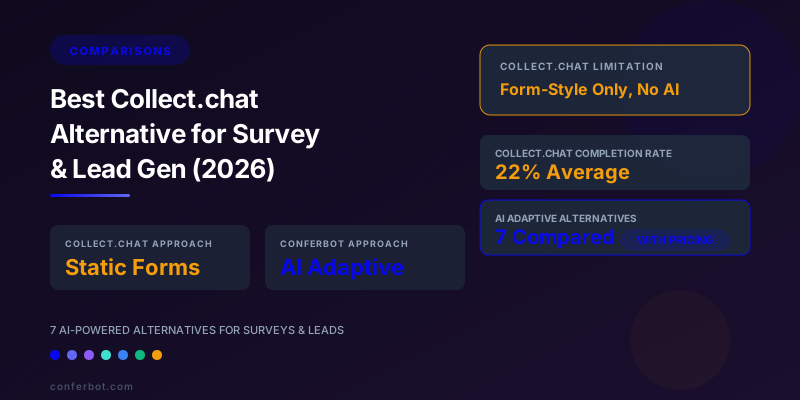
Why Collect.chat's Form-Style Approach Is Failing Lead Generation Teams in 2026
Collect.chat built its reputation on a simple premise: turn static web forms into chatbot-style conversations. Instead of presenting visitors with a wall of form fields, Collect.chat displays one question at a time in a chat interface, creating the illusion of a conversation. For several years, this was a meaningful improvement over traditional forms. But in 2026, the gap between a form disguised as a chat and a genuinely intelligent conversation has become impossible to ignore.
The core problem is architectural. Collect.chat is a sequential form renderer, not a conversational AI. Every visitor sees the same questions in the same order regardless of their answers. There is no branching based on intent, no AI that adapts questions based on previous responses, no natural language understanding, and no ability to handle unexpected inputs. If a visitor types a freeform question instead of selecting a multiple-choice option, Collect.chat has no mechanism to understand or respond -- it simply moves to the next pre-programmed question.
The data tells the story. According to Typeform's industry research, form-style chatbots like Collect.chat achieve average completion rates of 20 to 25 percent -- better than static web forms (which average 12 to 17 percent) but dramatically worse than AI-powered conversational chatbots that routinely achieve 55 to 75 percent completion rates. The difference is not marginal. AI-adaptive conversations capture 2.5 to 3.5 times more leads from the same traffic volume.
This gap exists because modern visitors expect conversations, not questionnaires. When a chatbot asks "What is your budget?" and the visitor responds "I am not sure yet, I am just exploring options," an AI chatbot adapts -- it might say "No problem! Let me understand your needs first, and I can suggest options at different price points." Collect.chat, lacking any NLU capability, either ignores the freeform response or displays an error, breaking the conversation and losing the lead.

This guide is for marketing teams, growth hackers, and business owners currently using Collect.chat (or evaluating it) who need higher completion rates, smarter lead qualification, and conversational experiences that actually feel like conversations. We compare seven alternatives that use AI to adapt in real time, qualify leads based on intent signals, personalize questions based on visitor behavior, and achieve completion rates that justify the investment in conversational lead generation. For teams evaluating other chatbot platforms, our comparison hub covers head-to-head matchups across dozens of tools.
Each alternative on this list goes beyond form replacement. They understand natural language, branch conversations dynamically, integrate with CRMs for real-time data enrichment, and use AI to determine which questions to ask (and which to skip) based on what the visitor has already revealed. The result is not just higher completion rates -- it is higher-quality leads with richer data captured through conversations that visitors actually enjoy.
5 Fundamental Problems With Collect.chat's Form-First Architecture
Understanding Collect.chat's specific limitations clarifies what to prioritize when choosing a replacement. The problems are not bugs to be fixed -- they are architectural constraints baked into the product's design philosophy.
Problem 1: Zero AI or Natural Language Understanding
Collect.chat does not use any form of artificial intelligence, machine learning, or natural language processing. It is a visual form builder that renders questions sequentially in a chat-bubble UI. When a visitor types a freeform response, Collect.chat cannot interpret meaning, extract entities (like names, emails, or product preferences), or adjust the conversation flow based on what was said. Every response is treated as a raw text string stored in a spreadsheet column -- not as a meaningful signal that should influence the next question.
In contrast, AI-powered alternatives like Conferbot use large language models to understand visitor intent, extract structured data from natural language, and dynamically adjust the conversation path. If a visitor says "I need help choosing between your Pro and Enterprise plans for my 50-person team," an AI chatbot extracts the team size (50), the consideration set (Pro vs Enterprise), and the intent (comparison/decision support) -- then tailors every subsequent question accordingly. Collect.chat would treat this as an unstructured text blob and move to the next generic question.
Problem 2: Linear Question Sequences With Minimal Branching
Collect.chat supports basic conditional logic (if answer A, show question B; if answer C, show question D), but the branching is shallow and predetermined. You must anticipate every possible path at build time. Real conversations are not linear -- visitors change direction, ask clarifying questions, circle back to earlier topics, and provide information that makes certain questions irrelevant. Collect.chat cannot handle any of these patterns because it has no mechanism to deviate from pre-built paths.
According to Forrester's conversational AI research, chatbots that dynamically adapt question sequences based on real-time responses achieve 40 to 60 percent higher data quality than those using pre-determined paths. The adaptive approach eliminates redundant questions, digs deeper on high-value signals, and creates a conversational rhythm that feels natural rather than interrogative.

Problem 3: No Personalization Based on Visitor Context
Collect.chat treats every visitor identically. Whether someone arrives from a Google ad for "enterprise pricing," a blog post about "getting started," or a referral from an existing customer, they see the same chatbot with the same questions in the same order. There is no mechanism to personalize the greeting, adjust the question set, or prioritize different information based on traffic source, page context, previous visits, or any other signal.
AI chatbot platforms integrate with analytics and CRM data to personalize conversations before the first message. A returning visitor who previously asked about pricing gets a different greeting than a first-time visitor from organic search. A visitor on the pricing page gets different questions than one on the blog. This personalization increases engagement rates by 35 to 50 percent compared to generic, one-size-fits-all chatbot experiences. For more on personalization strategies, see our chatbot conversation design guide.
Problem 4: Limited Integration Ecosystem
Collect.chat offers basic integrations with Google Sheets, email notifications, and a handful of CRMs through Zapier. But the integrations are one-directional: data flows out of Collect.chat into other tools. There is no ability to pull data from your CRM into the conversation (for example, recognizing a returning lead and skipping questions you already have answers to), no real-time API calls during the conversation (for example, checking inventory or appointment availability), and no webhook-triggered conversation branches.
Modern AI chatbot platforms support bidirectional integrations that enrich conversations in real time. Conferbot's API integration framework lets you query your CRM, check product availability, calculate custom quotes, and verify appointment slots -- all within the conversation flow, without the visitor ever knowing a backend system was consulted.
Problem 5: Pricing That Punishes Growth
Collect.chat's pricing is based on conversation volume, with plans ranging from free (50 conversations per month) to $299 per month (unlimited). While the free tier is attractive for testing, growing businesses quickly hit volume caps that force expensive upgrades. More critically, Collect.chat charges the same rate whether your chatbot captures 10 percent or 50 percent of leads -- there is no AI helping maximize the value of each conversation. According to G2 user reviews, customers frequently cite poor value at higher tiers when completion rates remain low despite paying more for volume.
AI-powered alternatives deliver dramatically better unit economics. If Collect.chat captures 22 leads per 100 conversations and Conferbot captures 65, the cost per lead on Conferbot is 3x lower even at the same subscription price -- and for businesses measuring marketing ROI, that cost-per-lead difference compounds into significant revenue impact over time.
7 Best Collect.chat Alternatives Compared: AI Capability, Pricing, and Lead Capture Rates
Every alternative on this list uses AI to power adaptive conversations that go beyond form replacement. The comparison focuses on the metrics that matter for survey and lead generation use cases: completion rates, lead quality, personalization depth, and integration breadth.
| Platform | Starting Price | AI Engine | Avg Completion Rate | Personalization | G2 Rating | Free Tier |
|---|---|---|---|---|---|---|
| Collect.chat | Free / $24/mo | None (form-based) | 22% | None | 4.3 | Yes (50/mo) |
| Conferbot | Free / $19/mo | GPT-4o, Claude, Gemini | 65-74% | Full (context + CRM) | 4.7 | Yes |
| Typeform | $25/mo | Basic AI (beta) | 45-55% | Logic jumps | 4.5 | Trial |
| Landbot | $40/mo | OpenAI integration | 50-60% | Conditional + AI | 4.6 | Trial |
| Tidio | Free / $29/mo | Lyro (Claude) | 55-65% | E-commerce context | 4.7 | Yes |
| Intercom | $39/seat/mo | Fin AI (GPT-4) | 60-70% | Full CRM context | 4.5 | Trial |
| Tally | Free / $29/mo | None (logic-based) | 35-45% | Logic branching | 4.7 | Yes |
| Botpress | Free / self-host | Any LLM | 55-68% | Full (developer-built) | 4.6 | Yes |
Annual Cost Comparison for a Growth-Stage Business (5,000 Monthly Conversations)
| Platform | Annual Cost | Leads Captured (at avg rate) | Cost Per Lead |
|---|---|---|---|
| Collect.chat (Pro plan) | $1,188 | 13,200 (22%) | $0.09 |
| Conferbot Business | $3,588 | 42,000 (70%) | $0.085 |
| Typeform Plus | $948 | 30,000 (50%) | $0.032 |
| Landbot Pro | $1,560 | 33,000 (55%) | $0.047 |
| Tidio Lyro | $4,728 | 36,000 (60%) | $0.131 |
| Intercom | $14,640+ | 39,000 (65%) | $0.375 |
| Tally Pro | $348 | 24,000 (40%) | $0.015 |
| Botpress Cloud | $3,600 | 37,200 (62%) | $0.097 |
The unit economics reveal the real story. Collect.chat's low subscription price is offset by its low completion rate -- the cost per captured lead is comparable to platforms that cost 2 to 3 times more but capture 3 times more leads. When you factor in the revenue value of each additional lead, the AI-powered alternatives deliver dramatically better ROI despite higher sticker prices. For an in-depth look at chatbot cost analysis, see our chatbot ROI framework guide.

Detailed Alternative Reviews: From Form Replacement to AI-Powered Lead Generation
1. Conferbot -- Best Overall Collect.chat Replacement for AI-Powered Lead Capture
Conferbot represents the architectural opposite of Collect.chat. Where Collect.chat renders pre-built forms in a chat UI, Conferbot uses large language models (GPT-4o, Claude, or Gemini) to conduct genuinely adaptive conversations that understand visitor intent, personalize questions in real time, and qualify leads with the sophistication of a trained sales representative.
Why it beats Collect.chat:
- AI-adaptive conversations: Every conversation dynamically adjusts based on visitor responses. If a visitor mentions they are comparing products, the chatbot shifts to comparison mode. If they mention budget constraints, it focuses on value-oriented messaging. Collect.chat cannot adapt because it has no AI.
- 3x higher completion rates: Conferbot achieves 65 to 74 percent completion rates versus Collect.chat's 22 percent average. The AI keeps conversations engaging by asking relevant follow-ups, skipping redundant questions, and maintaining natural conversational flow.
- Real-time lead scoring: Conferbot assigns lead quality scores during the conversation based on intent signals, engagement depth, and qualification criteria you define. Hot leads get instant notifications; cold leads enter nurture sequences. Collect.chat captures raw data with no scoring.
- 13-plus channel deployment: Deploy the same AI chatbot on your website, WhatsApp, Facebook Messenger, Instagram, Telegram, SMS, and more. Collect.chat is limited to website widgets and a hosted page.
- Bidirectional CRM integration: Pull data from HubSpot, Salesforce, or Zoho into the conversation (skip questions for known contacts) and push enriched lead data back. Collect.chat only pushes data out.
Limitations: Conferbot's AI capabilities require more initial configuration than Collect.chat's simple drag-and-drop form builder. Teams that just need a quick form replacement may find the setup more involved.
Best for: Marketing teams, SaaS companies, and lead-generation-focused businesses that need maximum capture rates and intelligent qualification from their chatbot investment.
2. Typeform -- Best for Beautiful Survey Experiences With Basic AI
Typeform pioneered the one-question-at-a-time survey format that Collect.chat later emulated. Typeform's design quality, logic jumps, and brand customization remain best-in-class for survey-focused use cases. In 2026, Typeform has added basic AI features (beta) that enhance the conversational feel without fully committing to LLM-powered conversations.
Why it beats Collect.chat: Superior design quality (brand-matched themes, full CSS control), deeper logic branching (nested conditions, calculated fields, hidden fields from URL parameters), and early AI features that generate follow-up questions based on open-text responses.
Limitations: AI features are still in beta and limited to specific plan tiers. Not a true chatbot -- it is a form tool with conversational UI. No multi-channel deployment (website embed and hosted link only). Per-response pricing on higher tiers creates unpredictable costs. For deeper Typeform alternatives, see our chatbot marketing strategy guide.
Best for: Brands that prioritize visual design in their surveys and need sophisticated branching without full AI capabilities.
3. Landbot -- Best Visual Builder With OpenAI Integration
Landbot combines a visual conversation-flow builder (similar to Collect.chat but far more capable) with native OpenAI integration for AI-powered responses. It bridges the gap between Collect.chat's simplicity and Conferbot's full AI capabilities, offering a visual drag-and-drop builder where you can insert AI nodes alongside traditional form elements.
Why it beats Collect.chat: Native OpenAI/GPT integration within conversation flows, WhatsApp deployment (Collect.chat lacks this), visual builder with substantially deeper branching logic, and API integration nodes that query external systems mid-conversation.
Limitations: The visual builder can become unwieldy for complex flows (hundreds of nodes). WhatsApp deployment requires the Business tier ($200/month). AI capabilities depend on OpenAI API costs on top of the subscription.
Best for: Teams that want a visual builder familiar to Collect.chat users but with AI capabilities and WhatsApp support.
4. Tidio -- Best AI Chatbot for E-Commerce Lead Capture
Tidio's Lyro AI uses Claude to power product-aware conversations that handle lead capture, product recommendations, and purchase assistance in a single flow. For e-commerce businesses using Collect.chat for product inquiry forms, Tidio is a substantial upgrade.
Why it beats Collect.chat: AI understands product catalogs and inventory, native Shopify and WooCommerce integration, can recommend products based on conversation context, and captures leads within a genuine product-discovery conversation rather than a form.
Limitations: Conversation caps on lower tiers (50 to 200/month) limit scalability. AI is optimized for e-commerce -- less flexible for general survey and lead-gen use cases. For a comprehensive Tidio evaluation, see our Tidio alternative analysis.
Best for: E-commerce stores currently using Collect.chat for product inquiry or lead capture forms.
5. Intercom -- Best Premium AI for High-Value Lead Qualification
Intercom's Fin AI agent uses GPT-4 to conduct sophisticated lead qualification conversations. For businesses where each lead is worth hundreds or thousands of dollars, Intercom's AI quality and CRM depth justify the premium pricing. Fin does not just capture form data -- it qualifies leads through genuine dialogue, asks intelligent follow-up questions, and routes high-value prospects to sales in real time.
Why it beats Collect.chat: Enterprise-grade AI qualification, deep CRM integration (reads and writes customer data during conversation), real-time routing to sales for high-value leads, and a mature messenger platform with proven engagement metrics.
Limitations: Per-seat pricing ($39/seat/month) plus per-AI-resolution fees ($0.99 each) makes it expensive for volume use cases. Overkill for simple survey or feedback collection. For a detailed comparison, see our Intercom alternative guide.
Best for: SaaS and B2B companies where lead quality matters more than volume and each qualified lead is worth $500-plus.
6. Tally -- Best Free Form Builder With Advanced Logic
Tally is a form builder (not a chatbot) that offers unlimited forms and responses on its free tier, with advanced logic, calculations, and payment collection. While it lacks AI and conversational UI, its generous free tier and powerful logic make it a pragmatic Collect.chat replacement for teams focused purely on data collection rather than conversational engagement.
Why it beats Collect.chat: Unlimited forms and submissions on the free tier (Collect.chat caps at 50 conversations/month), more powerful conditional logic and calculations, payment integration, and a cleaner builder interface.
Limitations: Not a chatbot -- it is a traditional form builder. No conversational UI, no AI, no multi-channel deployment. Lower completion rates than AI chatbots because it lacks the engagement benefit of a conversational interface.
Best for: Teams on tight budgets that need a powerful form tool and are willing to sacrifice the chatbot conversational format.
7. Botpress -- Best Open-Source AI Chatbot for Developer Teams
Botpress provides maximum flexibility: any LLM, any integration, full code ownership, and the ability to build arbitrarily complex conversation flows with AI branching. For developer teams that found Collect.chat too limited, Botpress offers the opposite end of the complexity spectrum.
Why it beats Collect.chat: Any-LLM flexibility (GPT-4, Claude, Llama, Mistral), self-hostable for data sovereignty, API-first architecture for complex integrations, and community-contributed templates for common use cases like surveys and lead gen.
Limitations: Requires developer resources to build and maintain. No drag-and-drop simplicity for non-technical users. Cloud pricing is token-based and can be unpredictable.
Best for: Engineering-led teams that need full control over their survey and lead-generation chatbot with custom AI pipelines.
Feature Gap Analysis: What Form-Style Bots Miss vs AI-Powered Conversations
The feature gap between form-based chatbots (Collect.chat) and AI-powered conversational platforms is not incremental -- it is categorical. This analysis maps every capability that matters for survey and lead generation.
| Capability | Collect.chat | Conferbot (AI) | Impact on Lead Gen |
|---|---|---|---|
| Natural language understanding | None | Full (GPT-4o/Claude) | Handles freeform responses, extracts entities |
| Adaptive question sequencing | Basic branching | Dynamic AI-driven | Skips irrelevant questions, deepens on high-value signals |
| Visitor personalization | None | Traffic source, page, CRM data | 35-50% higher engagement |
| Freeform response handling | Stores as raw text | Understands, categorizes, responds | Eliminates drop-off from confused visitors |
| Lead scoring during conversation | None | Real-time scoring + routing | Prioritizes follow-up, reduces response time |
| Multi-channel deployment | Website + hosted link | 13+ channels | Captures leads wherever customers are |
| CRM bidirectional sync | One-way (push only) | Read + write during conversation | Avoids re-asking known information |
| A/B testing | None | Built-in with statistical significance | Continuous improvement of capture rates |
| Conversation analytics | Basic (count + responses) | Intent analysis, drop-off mapping, funnel | Data-driven optimization |
| Real-time API calls | None | During conversation (quotes, inventory) | Delivers value within the conversation |

The analysis reveals that Collect.chat occupies a narrow functional niche: simple, sequential data collection in a chat-bubble UI. Every capability that drives higher completion rates, better lead quality, and greater marketing ROI -- NLU, personalization, adaptive sequencing, real-time integrations, lead scoring, A/B testing -- is absent from Collect.chat and present in AI-powered alternatives. For teams serious about lead generation performance, the feature gap makes the upgrade decision straightforward.
For a broader perspective on chatbot capabilities and how they map to business outcomes, our chatbot analytics and metrics guide details the 15 metrics that drive real business impact.
Migrating From Collect.chat: 3-Week Transition Plan
Collect.chat's simplicity means migration is straightforward -- there is less to move than with complex enterprise platforms. Here is a three-week plan that minimizes disruption and maximizes improvement.
Week 1: Audit and Select
- Export Collect.chat data: Download all conversation logs and captured responses from your Collect.chat dashboard. Export to CSV for backup and analysis.
- Analyze current performance: Document your baseline metrics: total conversations, completion rate, unique questions asked, most common responses, and drop-off points. These baselines measure whether your new platform improves performance.
- Map your conversation flows: Document every Collect.chat flow you use -- the questions, branching logic, and what happens with captured data (which CRM it feeds, which team receives notifications). This becomes the blueprint for your replacement.
- Select your platform: Use the comparison table in Section 3 to choose based on your primary use case. Sign up for a free tier or trial.
Week 2: Build, Test, and Enhance
- Recreate core flows with AI enhancement: Rebuild your top 2 to 3 Collect.chat flows on the new platform. The key difference: instead of rigidly replicating the same sequential questions, redesign flows to leverage AI. Define the information you need to capture, set qualification criteria, and let the AI determine the optimal question sequence for each visitor.
- Configure integrations: Connect your CRM, email marketing platform, and notification systems. Test bidirectional data flow -- verify that existing contacts are recognized and that new data is properly routed.
- Add personalization: Configure different greetings for traffic sources (paid ads versus organic), page contexts (pricing page versus blog), and return visitors. This personalization was impossible on Collect.chat and often produces the largest immediate improvement.
- Internal testing: Run your team through every conversation flow. Test edge cases: what happens when someone gives unexpected answers, asks off-topic questions, or abandons mid-conversation. Refine AI responses and fallback behaviors.
Week 3: Deploy and Optimize
- Parallel deployment: If possible, run both Collect.chat and your new chatbot simultaneously (on different pages or for different traffic segments) for 5 to 7 days. Compare completion rates, lead quality, and visitor feedback.
- Full cutover: Replace Collect.chat widgets with your new chatbot across all pages. Remove the Collect.chat embed code and add the new platform's script.
- Monitor and iterate: Track performance daily for the first two weeks. Most teams see a 2 to 3x increase in completion rates immediately, with further improvement as AI learns from conversations and you refine flows based on real data.
- Set up A/B testing: Begin testing greeting variations, question sequences, and CTA copy. Systematic testing produces 20 to 40 percent additional improvement within the first 90 days.
For advanced conversation flow design principles, see our conversation design masterclass. For A/B testing methodology, our chatbot A/B testing guide provides a complete framework with statistical rigor.
Collect.chat Replacement by Use Case: Survey, Lead Gen, Feedback, and Booking
Your optimal replacement depends on your primary use case. Collect.chat's user base spans four major categories -- here is the best alternative for each.
Use Case 1: Lead Generation and Qualification
Choose Conferbot. Lead generation demands the highest conversational intelligence -- understanding visitor intent, asking the right qualifying questions, scoring leads in real time, and routing hot prospects to sales immediately. Conferbot's AI delivers all of this at 65 to 74 percent completion rates. The AI chatbot builder lets you define qualification criteria, and the AI handles the conversational strategy. For lead-gen-specific strategies, see our chatbot marketing strategy guide.
Use Case 2: Customer Surveys and Research
Choose Typeform for design-focused surveys or Conferbot for AI-adaptive surveys. If your surveys prioritize brand aesthetics and the respondent experience, Typeform's design quality is unmatched. If your surveys need to adapt based on responses (asking deeper follow-ups when respondents reveal interesting insights), Conferbot's AI-powered approach captures richer, more actionable data.
Use Case 3: Customer Feedback Collection
Choose Conferbot or Tidio. Feedback collection benefits enormously from AI that understands sentiment in real time. When a customer expresses frustration, the AI chatbot can probe for specifics, offer immediate resolution, and escalate to support -- turning a feedback form into a retention tool. Collect.chat collects the complaint and moves to the next question, missing the opportunity for immediate service recovery.
Use Case 4: Appointment and Demo Booking
Choose Conferbot. Booking flows require real-time integration with calendar systems, the ability to handle rescheduling requests in natural language ("Actually, can we do Thursday instead?"), and confirmation workflows. Conferbot's calendar integration and natural language understanding handle the full booking lifecycle. Collect.chat can collect preferred dates in a form field but cannot check availability or complete the booking.
Use Case 5: E-Commerce Product Inquiries
Choose Tidio. For Shopify and WooCommerce stores capturing product interest through chatbot forms, Tidio's native e-commerce integration understands product catalogs, checks inventory, and recommends alternatives -- converting product inquiry forms into product-discovery conversations that drive purchases.
| Use Case | Best Alternative | Key Advantage Over Collect.chat | Expected Completion Rate Lift |
|---|---|---|---|
| Lead generation | Conferbot | AI qualification + real-time scoring | 22% to 65-74% |
| Customer surveys | Typeform / Conferbot | Design quality / AI adaptiveness | 22% to 45-74% |
| Feedback collection | Conferbot / Tidio | Sentiment detection + immediate response | 22% to 55-70% |
| Appointment booking | Conferbot | Real-time calendar + natural language | 22% to 65-74% |
| Product inquiries | Tidio | Product catalog awareness + recommendations | 22% to 55-65% |
The Data Quality Gap: Why AI Conversations Produce Better Leads Than Forms
Beyond completion rates, the quality of data captured through AI conversations versus form-style chatbots differs fundamentally. This section examines the data quality dimensions that impact downstream marketing and sales effectiveness.
Dimension 1: Intent Signals vs Raw Answers
Collect.chat captures what visitors type or select. AI chatbots capture what visitors mean. When a visitor tells Collect.chat "I am interested in your services," that text string is stored verbatim. When the same visitor tells Conferbot the same thing, the AI extracts the intent (general interest, early stage), identifies the missing information (which services, timeline, budget, decision criteria), and probes accordingly. The result is a lead record enriched with intent signals that inform sales follow-up strategy.
Dimension 2: Conversation Depth vs Question Count
Collect.chat conversations are limited to the number of questions you pre-programmed. If you built a 7-question flow, every visitor answers exactly 7 questions (or drops off). AI conversations have no fixed length -- they go as deep as the visitor's engagement allows. A highly interested visitor might answer 15 questions across a 5-minute conversation, providing detailed context that makes sales follow-up dramatically more effective. A less interested visitor might answer 3 questions and still provide enough for basic qualification.
According to McKinsey's research on AI in customer engagement, AI-driven conversations generate 2.8 times more actionable data points per interaction than form-based collection methods, directly correlating with higher conversion rates in downstream sales processes.
Dimension 3: Contextual Data vs Isolated Fields
Collect.chat stores responses as isolated fields in a spreadsheet: name in column A, email in column B, budget in column C. The relationship between these data points is lost. AI chatbots preserve the full conversation context -- why the visitor mentioned a specific budget ("We just closed our Series A so we have flexibility"), how they described their problem (in their own words, not a multiple-choice selection), and what objections or concerns they raised. This contextual richness gives sales teams conversational ammunition that form data never provides.

Dimension 4: Progressive Enrichment vs One-Shot Collection
AI chatbots support progressive enrichment: when a visitor returns, the chatbot recognizes them (via CRM sync or cookie) and picks up where the conversation left off, gathering additional information without re-asking what it already knows. Collect.chat treats every visit as a new form submission, creating duplicate records and frustrating returning visitors who must re-enter previously provided information. For more on progressive lead engagement, see our customer retention chatbot guide.
The Downstream Impact
Sales teams that receive AI-captured leads report 40 to 55 percent higher conversion rates compared to form-captured leads, according to industry benchmarks. The combination of intent signals, conversation depth, contextual data, and progressive enrichment creates a lead quality differential that compounds through the entire sales funnel. A 3x improvement in lead capture (completion rate) combined with a 1.5x improvement in lead-to-customer conversion (quality) produces a 4.5x improvement in total customer acquisition from the same traffic volume.
Verdict: Move Beyond Form Replacement to Genuine AI Conversations
Collect.chat served a purpose when the alternative was static HTML forms that visitors ignored. It proved that presenting questions in a chat-bubble format increases engagement. But the category has evolved far beyond form replacement, and Collect.chat has not evolved with it. In 2026, using a chatbot without AI is like using a typewriter with a sleek case -- the packaging is modern, but the technology inside is a generation behind.
The numbers make the case definitively:
- Completion rates: Collect.chat averages 22 percent. AI-powered alternatives achieve 55 to 74 percent -- a 2.5 to 3.4x improvement from the same traffic.
- Lead quality: Form-captured leads contain 5 isolated data fields. AI-captured leads contain 12 to 18 contextual data points with intent signals, producing 40 to 55 percent higher downstream conversion rates.
- Personalization: Collect.chat treats every visitor identically. AI chatbots personalize based on traffic source, page context, CRM data, and conversation signals.
- Adaptiveness: Collect.chat follows a fixed path. AI chatbots dynamically adjust question sequences, skip irrelevant questions, and dig deeper on high-value signals.
- Cost per lead: Despite lower subscription prices, Collect.chat's low capture rates produce comparable or higher cost-per-lead versus AI alternatives that capture 3x more leads.
For the majority of teams currently using Collect.chat, Conferbot is the best replacement. It delivers the highest completion rates (65 to 74 percent), full AI adaptiveness powered by GPT-4o or Claude, 13-plus channel deployment, bidirectional CRM integration, real-time lead scoring, and built-in A/B testing -- all at a flat monthly rate with no per-conversation charges on business plans.
For teams focused specifically on survey design aesthetics, Typeform remains the visual benchmark. For e-commerce stores, Tidio's native product awareness creates compelling product-discovery conversations. For developer teams wanting full control, Botpress offers maximum flexibility. And for teams on the tightest budgets who prioritize form power over conversational AI, Tally's unlimited free tier is hard to beat.
The path forward is clear: stop disguising forms as conversations and start deploying chatbots that actually converse. Visit our comparison hub for head-to-head platform matchups, or start with Conferbot's free tier to test AI-powered lead generation against your own traffic before replacing Collect.chat entirely.
Additional resources: G2 Chatbot Category Reviews, Capterra Chatbot Software Directory, Gartner's Conversational AI definition and market overview, and HubSpot's marketing engagement statistics.
Was this article helpful?
Best Collect.chat Alternative for Survey & Lead Generation Chatbots (2026) FAQ
Everything you need to know about chatbots for best collect.chat alternative for survey & lead generation chatbots (2026).
About the Author

Conferbot Team specializes in conversational AI, chatbot strategy, and customer engagement automation. With deep expertise in building AI-powered chatbots, they help businesses deliver exceptional customer experiences across every channel.
View all articles