What Omnichannel Customer Service Actually Means (and Why Multichannel Is Not Enough)
The terms "omnichannel" and "multichannel" are often used interchangeably, but they describe fundamentally different approaches to customer service. Understanding the distinction is critical to building a strategy that actually works.
Multichannel: Being Everywhere
A multichannel approach means you are available on multiple channels — website chat, email, phone, WhatsApp, social media. Most businesses are multichannel. But here is the problem: each channel operates independently. A customer who emails about an issue and then messages on WhatsApp has to repeat their problem because the two channels do not share information.
Multichannel creates channel silos: separate inboxes, separate conversation histories, separate agent teams, separate tools. Each channel works, but they do not work together.
Omnichannel: Being Connected Everywhere
An omnichannel approach means all channels are connected into a single, unified experience. A customer who starts a conversation on your website chatbot, continues via WhatsApp, and follows up by email has one continuous conversation thread. The agent (or AI chatbot) has full context regardless of which channel the customer uses.
The difference in practice:
| Scenario | Multichannel | Omnichannel |
|---|---|---|
| Customer switches channels | Must repeat everything | Conversation continues seamlessly |
| Agent handles inquiry | Sees only this channel's history | Sees all interactions across channels |
| Chatbot assists customer | Separate bot per channel | One bot, all channels |
| Customer data | Fragmented across channels | Unified customer profile |
| Analytics | Separate reports per channel | Unified analytics dashboard |
Why Omnichannel Matters in 2026
Customer behavior has made omnichannel mandatory:
- 73% of customers use 3+ channels during a single purchase journey (Harvard Business Review)
- 89% of customers are frustrated by having to repeat information to different agents (Accenture)
- Omnichannel customers spend 4-10% more than single-channel customers
- Customer retention rates are 91% higher for companies with strong omnichannel strategies (Aberdeen Group via G2)
The message is clear: customers do not think in channels. They think in conversations. Your service strategy needs to match how customers actually behave, not how your internal systems are organized.
Conferbot's omnichannel platform was designed for this reality — one chatbot, one inbox, one analytics dashboard, across 13+ channels.
The 2026 Channel Landscape: Which Channels Matter
Not all channels are equally important for every business. Here is an assessment of the major customer service channels in 2026 and who they serve best.
Website Chat — The Universal Channel
Website chat is the foundation of any omnichannel strategy. Every business has a website, and visitors expect chat. In 2026, websites without chat feel outdated — like businesses without email in 2010.
Best for: All businesses. Non-negotiable for e-commerce, SaaS, and service businesses.
Volume share: 25-40% of total customer conversations
Key capability: Proactive engagement (trigger-based messages based on visitor behavior)
WhatsApp — The Global Messaging Leader
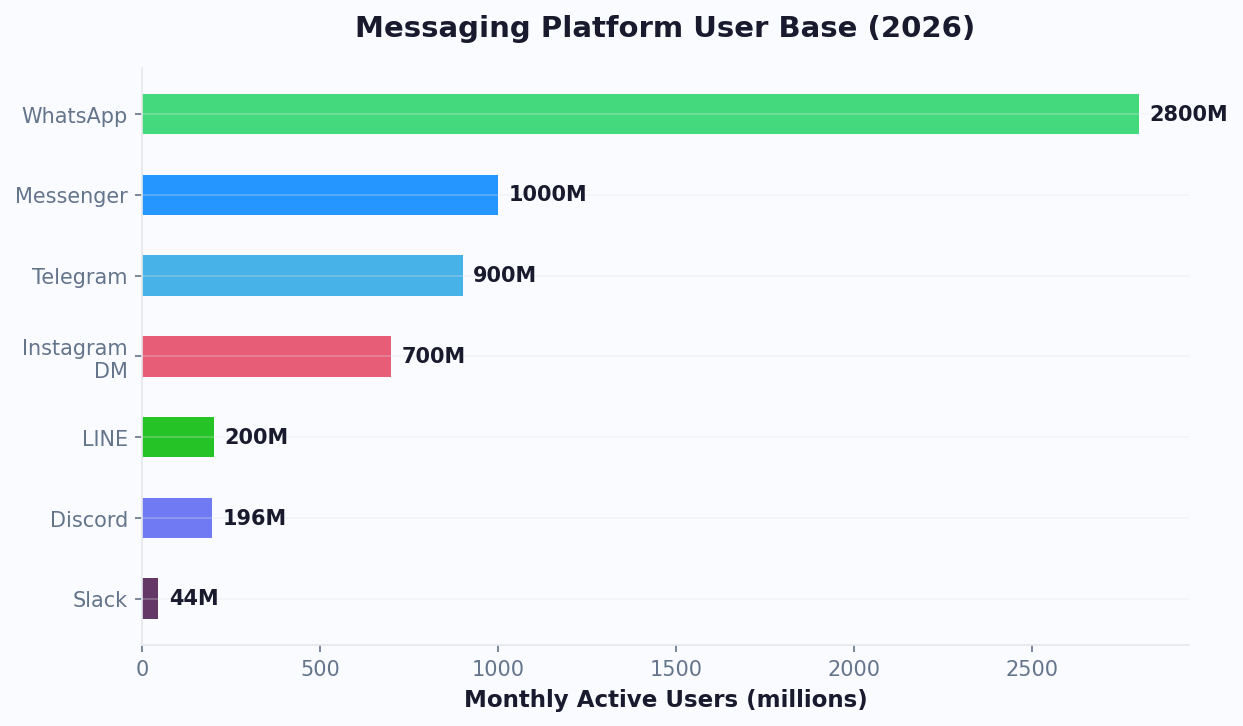
WhatsApp has 2+ billion users and dominates messaging in Europe, Latin America, Asia, and Africa. For businesses with international customers, WhatsApp is often the preferred channel.
Best for: International businesses, e-commerce, healthcare, professional services
Volume share: 15-35% of conversations (varies dramatically by geography)
Key capability: Asynchronous conversation (customers message when convenient, replies do not need to be instant)
Facebook Messenger — Social Commerce
Messenger connects to your Facebook and Instagram presence, capturing customers who discover you through social media.
Best for: Businesses with active social media presence, D2C brands, local businesses
Volume share: 10-20% of conversations
Key capability: Social commerce integration (product catalogs, instant purchasing within chat)
Instagram — Visual Product Support
Instagram DM is increasingly important for brands that sell visual products (fashion, home decor, food). Customers DM about products they see in posts and stories.
Best for: Fashion, beauty, food, lifestyle brands
Volume share: 5-15% of conversations
Key capability: Product inquiry handling from visual discovery
Telegram — Tech-Savvy Audiences
Telegram is popular among tech-savvy users and in specific markets (Eastern Europe, Middle East). Its bot API is powerful and well-documented.
Best for: Tech companies, crypto/fintech, communities
Volume share: 3-10% of conversations
Slack and Microsoft Teams — B2B Internal
Slack and Teams are essential for B2B businesses that integrate into their clients' workflows. Deploying a support chatbot in the client's Slack or Teams workspace provides embedded, always-available assistance.
Best for: B2B SaaS, enterprise services, IT support
Volume share: 10-25% for B2B businesses
Email — Still Alive, Still Important
Email's share of customer service is declining but it remains important for complex issues, documentation-heavy interactions, and formal communication. In an omnichannel strategy, email is one channel among many, not the primary channel.
Best for: Formal communication, complex issue documentation, regulated industries
Volume share: 15-30% of conversations
Choosing Your Channel Mix
Start with website chat (universal), add WhatsApp (if you have international customers or high mobile traffic), then Messenger (if you have a social media presence). Expand to additional channels based on customer demand and analytics data. The Conferbot channel lineup supports 13+ channels from a single platform, with a mobile SDK for embedding chat into native apps.
Building Your Omnichannel Strategy: A 5-Step Framework
Transitioning from multichannel (or single-channel) to omnichannel requires strategic planning. Here is a proven framework.
Step 1: Map Your Customer Journey Across Channels
Before choosing technology, understand how your customers actually move across channels. Interview 10-20 customers or analyze support data to map common journeys:
- Discovery: Where do customers first find you? (Google, social media, referral)
- Research: Where do they ask pre-purchase questions? (Website, WhatsApp, social)
- Purchase: Where do they buy? (Website, in-store, phone, social commerce)
- Support: Where do they seek help after purchase? (All channels)
- Channel-switching patterns: When and why do customers switch channels? (Convenience, urgency, preference)
This mapping reveals which channels are critical for each stage and where cross-channel handoffs need to be seamless.
Step 2: Choose a Unified Platform
The technical foundation of omnichannel is a single platform that connects all channels. This is where multichannel strategies fail — they use different tools for different channels, creating the silos you are trying to eliminate.
Your unified platform should provide:
- Single inbox: All conversations from all channels in one view
- Unified customer profiles: Every interaction from every channel linked to one customer record, accessible through team management tools
- One chatbot, all channels: Build once, deploy everywhere
- Consistent experience: Same capabilities and quality regardless of channel
- Unified analytics: Cross-channel reporting and insights
Conferbot meets all these requirements with 13+ channels, a unified inbox, and single-build chatbot deployment.
Step 3: Design Channel-Aware Chatbot Flows
While your chatbot logic should be consistent across channels, the presentation needs to adapt to each channel's strengths and constraints:
- Website: Rich media, carousels, forms, proactive triggers based on page content
- WhatsApp: Quick reply buttons (max 3), list messages (max 10 items), shorter messages
- Messenger: Persistent menus, webview for complex forms, carousel cards
- Slack: Block Kit formatting, thread-based conversations, channel integration
Design your core conversation flow once, then optimize the presentation for each channel's UI capabilities.
Step 4: Implement Cross-Channel Context Passing
The defining feature of omnichannel is context preservation. When a customer switches channels, the conversation should continue, not restart. This requires:
- Customer identification across channels (email, phone number, or account ID) plus calendar booking sync
- Conversation history accessible to agents regardless of channel
- Chatbot context maintained across channel switches
- CRM integration that links all touchpoints to one customer record
Step 5: Measure and Optimize Across Channels
Use unified analytics to compare performance across channels and identify optimization opportunities:
- Which channels have the highest CSAT? (Optimize lagging channels to match)
- Which channels have the fastest resolution? (Identify best practices to replicate)
- Where do customers switch channels? (These are friction points to address)
- What is the cost per resolution by channel? (Shift volume to more cost-effective channels)
The Role of Chatbots in Omnichannel Strategy
Chatbots are the connective tissue of an omnichannel strategy. They provide consistent, instant responses across every channel while maintaining context and intelligently escalating to live chat with human agents when needed.
Chatbot as the First Line of Response
In an omnichannel strategy, the chatbot is the first touchpoint on every channel. It provides instant responses 24/7, handles routine queries, and qualifies complex issues before routing to the appropriate human agent. This creates a consistent first-response experience regardless of which channel the customer uses.
With AI-powered chatbots, the quality of this first response is remarkably high. The chatbot understands natural language, maintains conversation context, and draws from a centralized knowledge base — ensuring customers get accurate answers whether they ask on WhatsApp at midnight or on website chat at noon.
Chatbot as the Context Bridge
When a customer switches channels, the chatbot carries the conversation context. The customer does not need to re-identify themselves or re-explain their issue because the chatbot knows:
- Who they are (matched across channels via email, phone, or account)
- What they previously discussed (conversation history from all channels)
- What stage they are at (initial inquiry, waiting for resolution, follow-up)
- What they have already tried (solutions offered in previous interactions)
This context preservation is what makes omnichannel feel seamless to customers.
Chatbot as the Traffic Director
Not all queries should be handled the same way on every channel. An omnichannel chatbot intelligently routes conversations based on:
- Query complexity: Simple queries resolved by AI, complex queries routed to specialized agents
- Channel capability: Payment processing works better on website than WhatsApp; file sharing works better on Slack than SMS
- Agent availability: Route to available agents across any channel, not just the channel where the query originated
- Customer value: High-value customers may be routed to dedicated agents regardless of channel
Building a Cross-Channel Chatbot
Using Conferbot's no-code builder, you build one chatbot that deploys across all channels:
- Core flow: Design the conversation logic (greeting, intent identification, response, escalation)
- Channel adaptations: Adjust message formatting and UI elements for each channel's capabilities
- Shared knowledge base: One knowledge base feeds AI responses across all channels
- Unified analytics: Analytics show performance across all channels in one dashboard
The result: customers get a consistent, high-quality experience on every channel, while your team manages everything from a single platform. This is the practical reality of omnichannel in 2026 — not a theoretical framework, but a technology-enabled strategy that platforms like Conferbot make accessible to businesses of any size. Forrester's research on customer service automation confirms that businesses with unified chatbot platforms resolve issues 35% faster than those using separate tools per channel. For details on how chatbot handoff works across channels, see our chatbot human handoff guide.
Omnichannel Implementation Roadmap: Month-by-Month
Implementing a full omnichannel strategy is a journey, not a project. Here is a realistic month-by-month roadmap for going from single-channel or multichannel to true omnichannel.
Month 1: Foundation
Goals: Establish your primary channel with chatbot automation and unified platform.
- Deploy chatbot on your website (highest-traffic channel)
- Set up your unified inbox and team access
- Build core chatbot flows for your top 5 customer questions using a no-code chatbot builder
- Enable AI-powered responses with your knowledge base
- Configure live chat handoff from chatbot to agents
- Baseline your current metrics (response time, resolution rate, CSAT)
Key metric to track: Chatbot resolution rate on website (target: 50%+ within first month)
Month 2: Second Channel
Goals: Add your most-requested messaging channel and establish cross-channel continuity.
- Deploy chatbot on WhatsApp or Messenger (based on customer preference)
- Ensure customer identity matching across channels (email or phone number)
- Verify conversation context carries between channels
- Adapt chatbot messages for the new channel's UI (shorter messages, quick replies)
- Train agents on handling conversations from multiple channels in the unified inbox
Key metric to track: Cross-channel context preservation rate (target: 90%+ of channel-switching customers are recognized)
Month 3: Third Channel and Optimization
Goals: Add a third channel and optimize based on first two months of data.
- Deploy on third channel (Instagram, Telegram, Slack, etc.)
- Analyze chatbot performance across channels: where are drop-off rates highest?
- Optimize underperforming flows based on analytics data
- Expand knowledge base based on common unresolved queries
- Implement proactive messaging: trigger chatbot on specific pages or after specific events
Key metric to track: Cross-channel CSAT parity (target: less than 5-point CSAT difference between any two channels)
Month 4-6: Scale and Refine
Goals: Expand to additional channels, deepen integrations, and optimize the end-to-end experience.
- Add remaining channels based on customer demand
- Deepen CRM integration through the integrations hub for richer customer profiles
- Implement advanced routing (skill-based, value-based, territory-based)
- Set up cross-channel campaigns (proactive outreach on preferred channel)
- Establish quarterly channel performance reviews
- Compare metrics against month-1 baseline to measure improvement
Key metric to track: Overall resolution rate across all channels (target: 70%+ automated, under 5 minutes for human-handled)
Ongoing: Continuous Improvement
- Monthly knowledge base reviews and updates
- Quarterly channel performance analysis
- Bi-annual customer journey mapping refresh
- Ongoing chatbot flow optimization based on analytics
- New channel evaluation as customer preferences evolve
5 Omnichannel Mistakes That Cost Businesses Customers
Many businesses attempt omnichannel and fail — not because of technology limitations, but because of strategic mistakes. Here are the most common and how to avoid them.
1. Adding Channels Without Connecting Them
The mistake: Launching on WhatsApp, Messenger, and Telegram — but each channel has its own inbox, its own chatbot, and its own agent team. This is multichannel, not omnichannel. Customers still repeat information when switching channels, and agents lack cross-channel context.
The fix: Use a unified platform that connects all channels to a single inbox, single chatbot, and single customer profile. The technology must enforce omnichannel — good intentions are not enough.
2. Prioritizing Channel Count Over Channel Quality
The mistake: Launching on 8 channels simultaneously but delivering a mediocre experience on each. A poorly-configured WhatsApp chatbot or a buggy Messenger integration does more harm than not being on those channels at all.
The fix: Launch on 2-3 channels and deliver an excellent experience. Then expand. Quality on fewer channels beats mediocrity on many channels. Customers judge you by their worst channel experience, not their best.
3. Ignoring Channel-Specific UX
The mistake: Deploying the exact same chatbot messages across all channels without adapting to each channel's UI capabilities and user expectations. A message that works on website chat (with rich carousels and large images) may be overwhelming on SMS or poorly formatted on Telegram.
The fix: Design one core conversation flow but adapt the presentation for each channel. Short messages for WhatsApp, rich carousels for website, block formatting for Slack. The logic is the same; the presentation adapts.
4. No Clear Escalation Path Across Channels
The mistake: When a chatbot cannot help on WhatsApp, it says "Please visit our website for further assistance." This forces a channel switch that the customer did not choose, creating friction and frustration.
The fix: Every channel should have a complete escalation path powered by proper API integration: chatbot to live agent to ticket, all within the same channel. If live agent is not available on a channel, create a ticket with a promise of follow-up via the customer's preferred channel — do not force them to switch.
5. Measuring Channels in Isolation
The mistake: Reporting CSAT, resolution rate, and response time separately for each channel without understanding the cross-channel journey. This misses the reality that a single customer interaction may span multiple channels.
The fix: Implement unified analytics that track the customer journey across channels. Measure resolution rate and CSAT for the customer, not the channel. A customer who starts on chatbot and is resolved by a human agent on WhatsApp should count as one interaction, not two.
These mistakes are avoidable with the right platform and strategic approach. Conferbot's omnichannel architecture prevents mistakes 1, 3, and 5 by design — unified inbox, channel-adaptive messaging, and cross-channel analytics are built into the platform.

Measuring Omnichannel Success: The Metrics That Matter
Effective omnichannel measurement requires metrics that capture the cross-channel customer experience, not just individual channel performance. Here are the metrics that define omnichannel success.
Customer-Centric Metrics
1. Cross-Channel Resolution Rate
Percentage of customer issues resolved without requiring the customer to switch channels or repeat information. Target: 85%+
2. Channel Switching Frequency
How often customers need to switch channels to resolve an issue. In a good omnichannel setup, channel switches are customer-initiated (by choice), not business-forced (by necessity). Target: less than 15% of conversations involve forced channel switches.
3. Omnichannel CSAT
Satisfaction score for customers who interact across multiple channels. This should match or exceed single-channel CSAT. If multi-channel customers are less satisfied, your omnichannel implementation has gaps.
4. Context Preservation Rate
Percentage of channel-switching conversations where the agent or chatbot has full context from previous channels. Target: 95%+ (anything less means customers are repeating themselves).
Operational Metrics
5. First Response Time (Unified)
Average time to first response across all channels combined. Target: under 30 seconds (chatbot) or under 2 minutes (human agent).
6. Cost Per Resolution by Channel
Identify which channels are most cost-effective for resolution. Use this to guide customers toward efficient channels when appropriate (without forcing channel switches).
7. Channel Volume Distribution
Track how conversation volume distributes across channels over time. Shifts in distribution signal changing customer preferences and inform resource allocation.
8. Automation Rate by Channel
What percentage of conversations the chatbot resolves on each channel without human intervention. Some channels may have higher automation rates due to the nature of inquiries they attract.
Business Impact Metrics
9. Customer Retention Rate
Compare retention rates for customers who interact through multiple channels versus single-channel customers. Omnichannel customers typically have 91% higher retention (Aberdeen Group).
10. Revenue Per Customer (Omnichannel vs. Single-Channel)
Omnichannel customers spend 4-10% more on average. Track whether this holds true for your business and by how much.
Building Your Dashboard
Use Conferbot's analytics combined with your CRM data to build a monthly omnichannel dashboard that tracks these metrics. Review monthly and share with stakeholders to demonstrate the impact of your omnichannel investment. The dashboard should answer one fundamental question: Is our customer experience consistent and excellent regardless of which channel a customer uses? If the answer is yes, your omnichannel strategy is working. For a deep dive into which metrics to track and how to interpret them, see our chatbot analytics metrics guide. Additionally, our chatbot vs live chat comparison helps you understand when automation handles a channel well versus when human agents should take over.
Omnichannel Cost Comparison: DIY vs Platform vs Enterprise
One of the most common objections to omnichannel is cost. Business leaders assume it requires enterprise-level budgets and a team of developers. In 2026, that assumption is outdated. Here is a transparent cost comparison across three implementation approaches, helping you choose the path that matches your budget and timeline.
Total Cost of Ownership: Three Approaches
| Cost Component | DIY (Custom Dev) | Platform (Conferbot) | Enterprise (Salesforce/Genesys) |
|---|---|---|---|
| Setup / Implementation | $30,000-80,000 | $0-500 | $50,000-200,000 |
| Monthly platform cost | $500-2,000 (hosting) | $49-299 | $5,000-25,000 |
| Per-channel integration cost | $5,000-15,000 each | $0 (included) | $2,000-10,000 each |
| Ongoing maintenance | $3,000-8,000/month (developer time) | $0 (managed by platform) | $2,000-5,000/month (admin + CS team) |
| Time to first channel live | 2-4 months | 1-3 days | 1-3 months |
| Time to full omnichannel (5+ channels) | 6-12 months | 2-4 weeks | 4-8 months |
| Year 1 Total Cost | $80,000-200,000 | $600-4,000 | $120,000-500,000 |
When Each Approach Makes Sense
DIY Custom Development: Only appropriate if you have unique technical requirements that no platform can meet (custom protocols, proprietary hardware integration, extreme scale above 1 million conversations/month). For 99% of businesses, this is over-engineering.
Platform-Based (Recommended for SMB to Mid-Market): Modern platforms like Conferbot provide pre-built integrations for all major channels, visual flow builders, AI capabilities, unified analytics, and team management. The setup is self-serve, the cost is predictable, and you can start generating value within days. This is the right choice for businesses with 100 to 100,000 monthly customer conversations.
Enterprise Suites: Appropriate for businesses with 50+ agents, complex routing requirements, deep CRM needs (Salesforce native), and compliance requirements that demand on-premise hosting. The cost is justified when the scale of operations demands enterprise infrastructure.
Hidden Costs to Watch For
- Per-agent licensing: Many enterprise platforms charge $50-200 per agent per month. A 20-agent team adds $12,000-48,000/year. Look for platforms with unlimited seats.
- Per-conversation charges: Some platforms charge per conversation or per AI interaction. At scale, these fees can exceed the base subscription. Conferbot includes unlimited conversations on paid plans.
- Integration fees: Adding WhatsApp, Messenger, or Telegram should not cost extra. If a platform charges per-channel fees, those add up quickly when deploying true omnichannel.
- Training and onboarding: Enterprise platforms often require paid professional services for onboarding. Self-serve platforms with intuitive interfaces eliminate this cost entirely.
ROI Timeline by Approach
| Milestone | DIY | Platform | Enterprise |
|---|---|---|---|
| First automated conversation | Month 3-4 | Day 1-3 | Month 2-3 |
| Break-even on investment | Month 8-14 | Month 1-2 | Month 6-12 |
| Full omnichannel operational | Month 10-14 | Month 1-2 | Month 5-9 |
| Positive ROI (net revenue gain) | Month 12-18 | Month 1-3 | Month 8-14 |
The data overwhelmingly favors platform-based approaches for businesses under $50M in revenue. You get to value faster, spend less, and maintain flexibility to switch if needs change. For a complete pricing comparison across chatbot platforms, see our chatbot pricing comparison guide.
Measuring Omnichannel ROI
To prove the value of your omnichannel investment and secure ongoing budget, track these cross-channel metrics that demonstrate business impact:
- Channel-switching resolution rate: What percentage of customers who switch channels still get their issue resolved without repeating information? Target 90%+ to demonstrate seamless context passing.
- Cross-channel customer lifetime value: Compare the CLV of customers who interact across 3+ channels versus single-channel customers. Omnichannel customers typically spend 15-30% more and churn 25% less, providing a direct revenue justification.
- First-contact resolution across all channels: Measure FCR holistically rather than per-channel. If a customer contacts you on WhatsApp and you resolve it on first contact regardless of whether you needed to reference a website chat history, that counts as FCR. Unified platforms make this possible by connecting conversation context.
- Cost per resolution by channel mix: Calculate the average cost to resolve an issue across your channel ecosystem. This metric reveals which channels are most efficient and helps you strategically route inquiries to lower-cost channels without sacrificing customer satisfaction.
Was this article helpful?
Build and deploy in 10 minutes. No coding needed.
Omnichannel Customer Service Strategy FAQ
Everything you need to know about chatbots for omnichannel customer service strategy.
About the Author
Deepak is the founder of Conferbot and writes about building, deploying, and improving AI chatbots.
View all articles