Why Chatbot ROI Calculation Is Critical in 2026
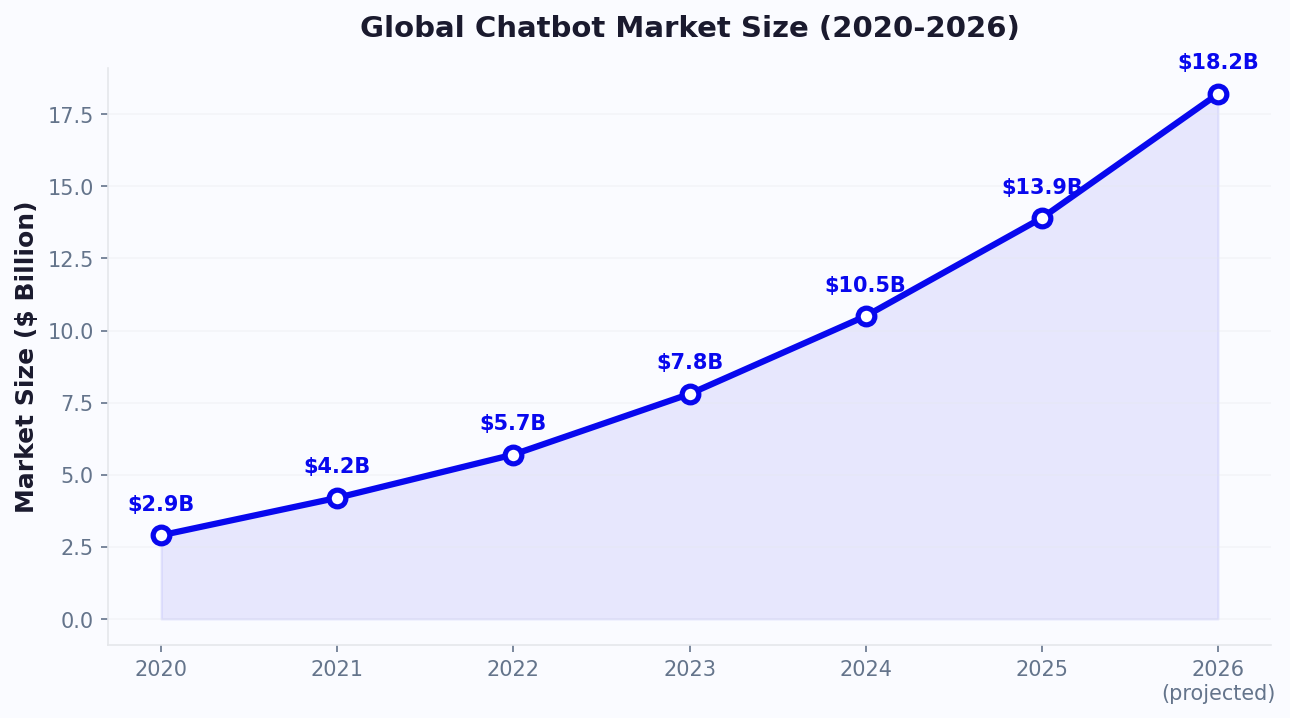
Every technology investment needs justification, and chatbots are no exception. As Statista's chatbot market forecast projects the industry to reach $15.5 billion by 2028, organizations need clear financial justification for their share of that investment. Whether you are a startup founder evaluating your first chatbot platform or a department head presenting a business case to the C-suite, quantifying the return on investment is essential for making an informed decision and securing budget approval.
The ROI Question Has Evolved
Forrester's Total Economic Impact methodology provides a rigorous framework for calculating technology ROI, and we apply similar principles here. In 2023-2024, the question was "Should we invest in chatbots?" In 2026, the question has shifted to "How much value should we expect, and how do we measure it?" Chatbot adoption is mainstream — Gartner predicts that chatbots will become a primary customer service channel, with over 80% of businesses using some form of automated chat. The question is no longer if but how much.
Why Leaders Demand ROI Numbers
Presenting a chatbot proposal without ROI numbers is like asking for a budget without a business plan. Decision-makers want to know:
- How much will we save? (Cost reduction from automating support, reducing agent workload)
- How much will we earn? (Revenue from better lead capture, cart recovery, upselling)
- When will we break even? (Time to recoup the investment)
- What is the risk? (What happens if the chatbot underperforms expectations?)
The ROI Framework Overview
Chatbot ROI comes from four categories:
- Cost savings: Reduced support costs, fewer agents needed, lower cost per interaction
- Revenue generation: More leads, recovered carts, higher conversion rates, upselling
- Efficiency gains: Faster response times, higher agent productivity, reduced training costs
- Customer lifetime value: Better satisfaction, lower churn, more referrals
Research from HubSpot's State of Service report confirms that most ROI calculations focus only on cost savings, which underestimates chatbot value by 40-60%. A complete ROI model captures all four categories. This guide provides formulas, benchmarks, and a step-by-step approach for each.
By the end of this guide, you will have a concrete, defensible ROI number that you can present to any stakeholder. Whether you are evaluating Conferbot or any other platform, the framework applies universally.
Calculating Cost Savings: The Foundation of Chatbot ROI
Cost savings from support automation is the most straightforward and usually largest component of chatbot ROI. Here is how to calculate it precisely.
Formula: Support Cost Savings
Monthly Savings = (Conversations Automated x Cost Per Human Conversation) - Monthly Chatbot Cost
Step 1: Determine Your Current Cost Per Conversation
The average cost of a human-handled support conversation varies by channel and team:
| Channel | Avg Cost Per Conversation | Avg Handle Time |
|---|---|---|
| Phone support | $8-12 | 6-8 minutes |
| Email support | $5-8 | 10-15 minutes |
| Live chat (human) | $3-6 | 8-12 minutes |
| AI chatbot | $0.10-0.50 | Instant |
To calculate your specific cost per conversation:
Cost Per Conversation = (Total Support Team Cost / Month) / (Total Conversations Handled / Month)
Include in Total Support Team Cost: salaries, benefits, workspace, tools, management overhead, and training. A support agent costing $4,000/month in total compensation who handles 400 conversations/month has a cost per conversation of $10.
Step 2: Estimate Conversations Your Chatbot Will Automate
Based on industry benchmarks and the type of chatbot deployed:
- Rule-based chatbot (FAQ only): Automates 30-40% of conversations
- AI chatbot (knowledge base): Automates 50-65% of conversations
- AI chatbot (with integrations): Automates 65-80% of conversations
For a business handling 2,000 support conversations/month with an AI chatbot automating 60%:
- Conversations automated: 2,000 x 60% = 1,200/month
- Cost savings per automated conversation: $5 (human cost) - $0.20 (chatbot cost) = $4.80
- Monthly savings: 1,200 x $4.80 = $5,760/month
- Annual savings: $69,120/year
Step 3: Subtract Chatbot Platform Costs
Using Conferbot's pricing as an example:
- Monthly platform cost: $149
- Net monthly savings: $5,760 - $149 = $5,611
- Net annual savings: $67,332
- ROI: ($67,332 / $1,788 annual cost) x 100 = 3,766% ROI
Step 4: Factor in Agent Reallocation
Automated conversations do not just save money — they free up agent time for higher-value work. If automating 1,200 conversations/month saves 200 agent hours/month, those hours can be redirected to:
- Complex issue resolution (higher customer satisfaction)
- Proactive customer outreach (retention and upselling)
- Training and quality improvement
- Or reducing headcount through natural attrition (cost saving)
For detailed real-world savings examples, see our chatbot cost savings case studies. The reallocation value is harder to quantify but often exceeds the direct cost savings. Use chatbot analytics to track agent time freed up and how it is redeployed. Conferbot's ticket system helps quantify how many tickets are deflected versus escalated.
Calculating Revenue Impact: The Often-Missed ROI Component
Many ROI models ignore revenue impact, but chatbots directly drive revenue through lead generation, cart recovery, and conversion rate improvement. Here is how to quantify each.
Lead Generation Revenue
Formula: Additional Revenue = New Leads from Chatbot x Lead-to-Customer Rate x Average Customer Value
A chatbot on your website engages visitors who would otherwise leave without interacting. Typical benchmarks:
- Website visitors who engage with chatbot: 2-5% of total traffic (HubSpot marketing benchmarks)
- Chatbot visitors who become leads (provide contact info): 15-30%
- Chatbot leads who become customers: 10-20% (varies by industry)
Example calculation:
- Monthly website visitors: 20,000
- Chatbot engagement rate: 3% = 600 conversations
- Lead capture rate: 20% = 120 new leads/month
- Lead-to-customer conversion: 15% = 18 new customers/month
- Average customer value: $500
- Monthly revenue from chatbot leads: 18 x $500 = $9,000
Cart Recovery Revenue
For e-commerce businesses, chatbot cart recovery adds significant revenue:
Formula: Recovered Revenue = Abandoned Carts x Recovery Rate x Average Cart Value
- Monthly abandoned carts: 500
- Chatbot recovery rate: 15%
- Average cart value: $85
- Monthly recovered revenue: 500 x 0.15 x $85 = $6,375
Conversion Rate Improvement
Chatbots improve website conversion rates by answering purchase questions in real time, providing product recommendations, and guiding visitors through the buying process.
Formula: Additional Revenue = Monthly Visitors x Conversion Rate Increase x Average Order Value
Typical conversion rate improvement from chatbot: 10-30% increase over baseline.
- Monthly visitors: 20,000
- Current conversion rate: 2%
- Chatbot-influenced improvement: +0.3% (to 2.3%)
- Additional conversions: 20,000 x 0.003 = 60
- Average order value: $100
- Monthly additional revenue: 60 x $100 = $6,000
Total Revenue Impact
Combining all revenue sources:
- Lead generation: $9,000/month
- Cart recovery: $6,375/month
- Conversion improvement: $6,000/month
- Total monthly revenue impact: $21,375
- Annual revenue impact: $256,500
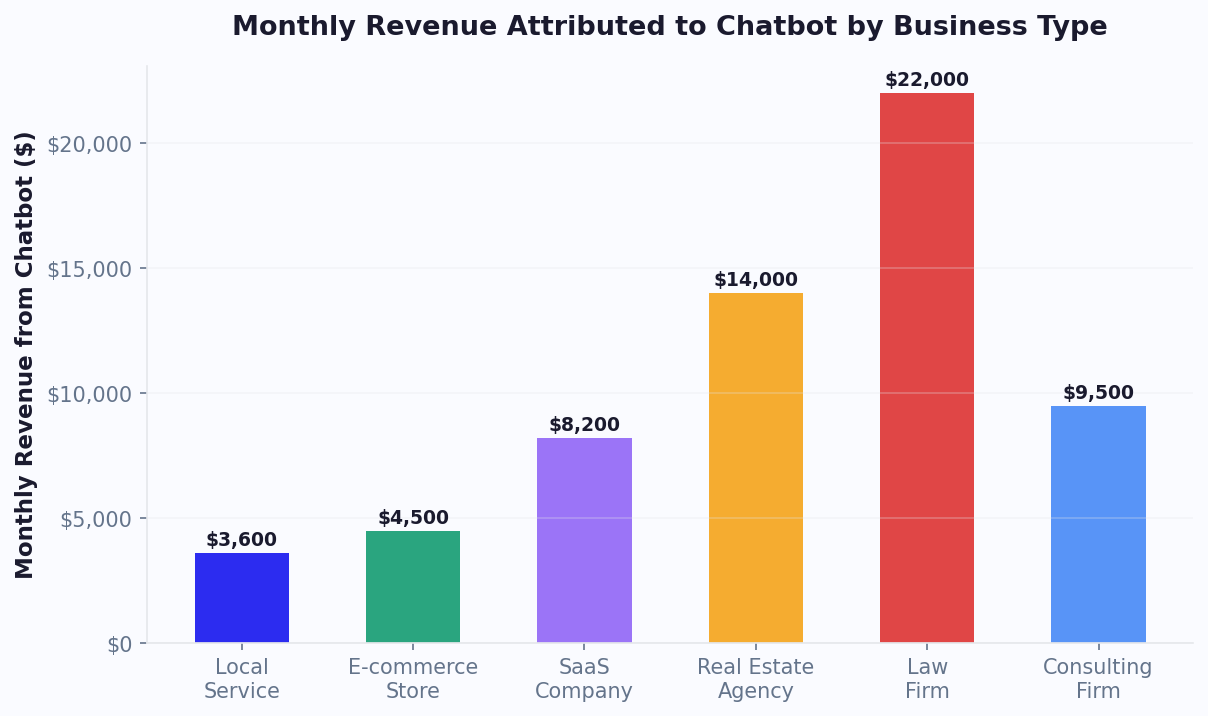
Even if your chatbot achieves half these benchmarks, the revenue impact alone dwarfs the platform cost. Most businesses underestimate revenue impact because they only measure cost savings. Use your analytics dashboard to attribute revenue to chatbot interactions and quantify this component of ROI.
Calculating Efficiency Gains and Productivity Improvements
Beyond direct cost savings and revenue, chatbots improve operational efficiency in ways that compound over time. Here is how to quantify these gains.
1. Response Time Improvement
Chatbots respond instantly. Humans do not. The gap matters:
| Metric | Without Chatbot | With Chatbot | Improvement |
|---|---|---|---|
| First response time | 3-5 minutes | Under 3 seconds | 98% faster |
| After-hours response | 8-16 hours | Under 3 seconds | 99.9% faster |
| Average resolution time | 12-24 hours | 2-5 minutes (automated) | 95% faster |
Faster response times correlate directly with customer satisfaction. Every minute of response time reduction improves CSAT scores by approximately 1-2 points (Freshdesk benchmark data). Higher CSAT leads to lower churn, more referrals, and higher lifetime value.
2. Agent Productivity Multiplier
When chatbots handle routine queries, agents become more productive with the conversations they do handle. The productivity improvement comes from:
- Reduced context switching: Agents handle fewer, more focused conversations instead of bouncing between simple and complex queries
- Pre-qualified conversations: The chatbot collects initial information before handing off, so agents start with context rather than asking basic questions
- Lower cognitive load: Agents are not fatigued by repetitive questions, maintaining quality on complex interactions
Benchmark: agents handle complex conversations 20-30% faster when routine queries are filtered by chatbots, because they can focus and maintain flow state.
3. Training Cost Reduction
AI chatbots encode organizational knowledge, reducing the training burden for new agents:
- New agent ramp-up time with chatbot: 2-3 weeks (versus 4-6 weeks without)
- Training cost reduction: 30-50% per new hire
- Knowledge consistency: Every chatbot conversation uses the same, up-to-date knowledge base
For a business hiring 4 agents per year at $2,000 training cost each, reducing training time by 40% saves $3,200/year.
4. Scalability Without Proportional Cost
Human support scales linearly: double the conversations, double the agents, double the cost. Chatbot support scales logarithmically: the same chatbot handles 500 or 5,000 conversations at essentially the same cost.
This scalability benefit is most visible during:
- Seasonal peaks: Holiday rush, sales events, product launches
- Viral moments: Unexpected traffic spikes from social media or press coverage
- Business growth: Your chatbot does not need a raise or additional seats as your customer base grows
Quantify this by calculating the cost of adding temporary agents for peak periods versus the chatbot handling the surge within existing costs.
5. Data Collection Value
Every chatbot conversation generates structured data: what customers ask about, where they get confused, what products they are interested in, what objections they raise. This data informs product development, marketing messaging, and sales strategies. While harder to quantify directly, this operational intelligence has significant strategic value. Track it through chatbot analytics and review monthly for actionable insights.
The Complete Chatbot ROI Model: Putting It All Together
Here is a complete ROI model that combines all components. Use your own numbers to calculate your business-specific return.
The Complete Formula
Annual Chatbot ROI = (Cost Savings + Revenue Impact + Efficiency Gains) - Annual Platform Cost
Example: Mid-Size E-Commerce Business
| ROI Component | Monthly Value | Annual Value |
|---|---|---|
| Cost Savings | ||
| Support conversations automated (1,200 x $4.80) | $5,760 | $69,120 |
| Revenue Impact | ||
| Lead generation revenue | $4,500 | $54,000 |
| Cart recovery revenue | $6,375 | $76,500 |
| Conversion improvement | $3,000 | $36,000 |
| Efficiency Gains | ||
| Agent productivity improvement | $1,200 | $14,400 |
| Training cost reduction | $267 | $3,200 |
| After-hours availability value | $2,000 | $24,000 |
| Total Value | $23,102 | $277,220 |
| Platform Cost (Conferbot) | $149 | $1,788 |
| Net ROI | $22,953 | $275,432 |
| ROI Percentage | 15,405% | |
| Payback Period | 2.3 days |
Conservative vs. Optimistic Scenarios
Always present multiple scenarios to account for uncertainty:
| Scenario | Automation Rate | Revenue Impact | Annual Net ROI |
|---|---|---|---|
| Conservative | 40% | 50% of benchmark | $115,000 |
| Expected | 60% | 75% of benchmark | $210,000 |
| Optimistic | 75% | 100% of benchmark | $275,000 |
Even the conservative scenario produces substantial ROI. This three-scenario approach builds credibility with decision-makers who are naturally skeptical of optimistic projections.
Break-Even Analysis
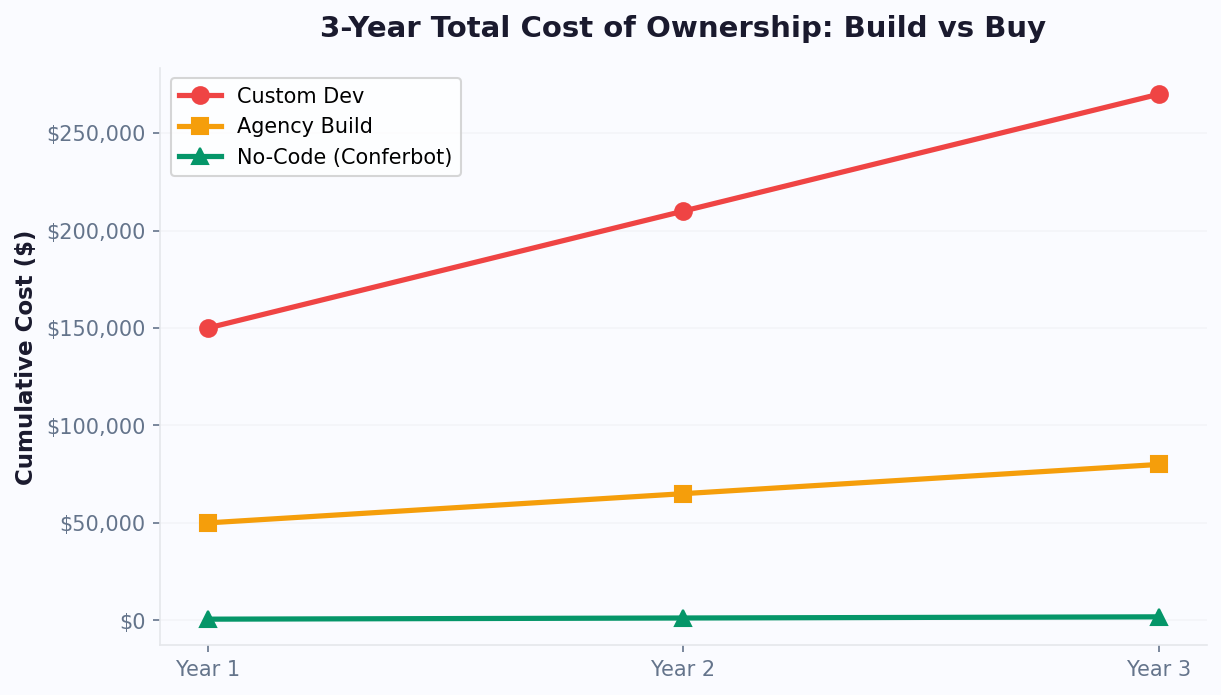
At Conferbot's $149/month cost, you break even by automating just 31 conversations per month (at $4.80 savings per automated conversation). Most businesses automate hundreds or thousands of conversations monthly, making payback nearly instant.
For platforms with higher costs (Intercom at $500+/month, Zendesk at $500+/month), break-even requires 100-200+ automated conversations monthly — still achievable for any business with meaningful support volume, but a slower path to ROI.
How to Measure Chatbot ROI After Deployment
Calculating projected ROI is step one. Measuring actual ROI after deployment is equally important for ongoing optimization and continued budget justification.
Key Metrics to Track Monthly
Cost Savings Metrics:
- Conversations automated: Total conversations handled by chatbot without human intervention
- Cost per automated conversation: Platform cost / conversations automated
- Agent hours saved: Automated conversations x average handle time per conversation
- Support cost per conversation (before vs. after): Total support cost / total conversations — this should decrease after chatbot deployment
Revenue Metrics:
- Chatbot-attributed leads: Leads captured through chatbot interactions
- Chatbot-attributed revenue: Revenue from leads that first engaged through the chatbot
- Cart recovery revenue: Revenue from recovered abandoned carts
- Conversion rate lift: Compare conversion rates for visitors who interact with chatbot vs. those who do not
Efficiency Metrics:
- Average response time: Should approach zero for chatbot-handled queries
- Resolution rate: Percentage of queries resolved without human escalation
- Agent handle time: Should decrease for human-handled conversations (because chatbot pre-qualifies)
- CSAT score: Customer satisfaction for chatbot interactions vs. human interactions
Setting Up ROI Tracking
- Baseline your current metrics before deploying the chatbot: current cost per conversation, response time, resolution rate, conversion rate, agent productivity
- Tag chatbot interactions in your CRM and analytics tools so you can attribute leads and revenue to chatbot engagement
- Use Conferbot's analytics for chatbot-specific metrics (resolution rate, drop-off analysis, conversation volume)
- Create a monthly ROI dashboard that combines chatbot analytics with CRM revenue data and support cost data
- Review monthly for the first quarter, then quarterly once metrics stabilize
Common Measurement Pitfalls
- Ignoring the counterfactual: Compare chatbot performance against what would have happened without it (using baseline data), not against perfection
- Measuring too early: Give your chatbot 30-60 days to optimize before judging ROI. Initial performance improves significantly as you refine flows based on real conversations
- Not accounting for indirect benefits: Improved CSAT, faster response times, and 24/7 availability create value that is harder to measure but very real
- Over-attributing: Be honest about attribution. A customer who chatted with the bot and also received email marketing should not have 100% of their revenue attributed to the chatbot
Presenting the Chatbot Business Case to Leadership
Having the ROI numbers is necessary but not sufficient. How you present the business case matters as much as the numbers themselves. Here is a proven framework for getting chatbot budget approved.
The One-Page Business Case
Executives do not have time for 20-page proposals. Condense your case to one page with these sections:
1. Problem Statement (2 sentences)
"Our support team handles 2,000 conversations/month at $5 per conversation, with average response times of 4 minutes during business hours and 8+ hours after hours. This costs $120,000/year and leaves 40% of customer inquiries unanswered until the next business day."
2. Proposed Solution (2 sentences)
"Deploy an AI chatbot on our website and WhatsApp to automate 60% of support conversations, provide 24/7 instant responses, and capture leads from website visitors. Recommended platform: Conferbot at $149/month."
3. Expected ROI (Table)
| Metric | Conservative | Expected |
|---|---|---|
| Annual cost savings | $46,000 | $69,000 |
| Annual revenue impact | $60,000 | $120,000 |
| Annual platform cost | $1,788 | $1,788 |
| Net annual value | $104,212 | $187,212 |
| Payback period | 6 days | 3 days |
4. Implementation Plan (3 bullets)
- Week 1-2: Platform setup, knowledge base configuration, chatbot flow building
- Week 3: Testing and team training
- Week 4: Deploy on website, monitor and optimize
5. Risk Mitigation
- Start with free tier to validate before committing budget
- Deploy on low-traffic page first to test real-world performance
- Monthly ROI review to ensure benchmarks are met
Handling Common Objections
"What if customers do not want to talk to a bot?"
Research from McKinsey Digital shows 74% of customers prefer chatbots for simple queries. The chatbot always offers human escalation for complex issues. Satisfaction scores for well-designed chatbots match or exceed human agent scores for routine inquiries.
"Is our IT team prepared for this?"
No-code platforms require zero IT involvement for setup and management. The support team can manage the chatbot independently. IT is only needed for optional API integrations with internal systems.
"What if the chatbot gives wrong answers?"
AI chatbots are grounded in our knowledge base — they only answer from approved content. Confidence thresholds ensure uncertain answers are escalated to humans. We can review and improve responses weekly based on analytics.
"Can we try it before committing budget?"
Yes. Start with Conferbot's free tier to build and test a chatbot with real customers before any financial commitment. This de-risks the investment entirely.
Chatbot ROI Benchmarks by Industry
ROI varies significantly by industry based on conversation volume, average transaction value, and the complexity of customer interactions. Here are benchmarks for the most common chatbot-adopting industries.
E-Commerce
- Primary ROI drivers: Cart recovery, product recommendations, order status automation
- Typical automation rate: 65-80%
- Average monthly savings: $3,000-8,000 (support cost reduction)
- Average monthly revenue impact: $5,000-15,000 (cart recovery + conversion lift)
- Typical payback period: 1-5 days
SaaS / Software
- Primary ROI drivers: Lead qualification, onboarding support, tier-1 tech support
- Typical automation rate: 50-65%
- Average monthly savings: $4,000-12,000
- Average monthly revenue impact: $8,000-25,000 (lead generation)
- Typical payback period: 1-7 days
Healthcare
- Primary ROI drivers: Appointment scheduling, FAQ automation, prescription refill requests
- Typical automation rate: 40-55%
- Average monthly savings: $5,000-15,000
- Average monthly revenue impact: $3,000-10,000 (reduced no-shows, increased bookings)
- Typical payback period: 2-10 days
Financial Services
- Primary ROI drivers: Account inquiries, product information, lead generation
- Typical automation rate: 45-60%
- Average monthly savings: $6,000-20,000
- Average monthly revenue impact: $5,000-15,000
- Typical payback period: 1-5 days
Real Estate
- Primary ROI drivers: Lead qualification, property inquiry handling, viewing scheduling
- Typical automation rate: 55-70%
- Average monthly savings: $2,000-6,000
- Average monthly revenue impact: $10,000-50,000 (due to high transaction values)
- Typical payback period: 1-3 days
Education
- Primary ROI drivers: Student inquiry automation, admissions support, FAQ handling
- Typical automation rate: 60-75%
- Average monthly savings: $3,000-10,000
- Average monthly revenue impact: $2,000-8,000 (enrollment conversion improvement)
- Typical payback period: 3-14 days
These benchmarks are based on businesses using modern AI chatbot platforms with knowledge base integration. Rule-based chatbots without AI typically achieve 30-50% lower ROI due to lower automation rates and limited conversation handling. Leveraging an AI agent with a well-curated knowledge base is the most reliable path to maximizing ROI across all industries. Visit our ROI calculator to input your specific numbers and get a personalized projection.
Regardless of industry, the pattern is consistent: chatbot ROI is overwhelmingly positive for any business with meaningful customer conversation volume (100+ conversations/month). The only businesses where chatbot ROI is marginal are those with very low conversation volume or entirely offline customer interactions. For more detailed calculation approaches, see our step-by-step ROI calculation guide, real chatbot case studies with ROI data, chatbot analytics metrics to track, and our complete chatbot implementation cost breakdown.
5 Common Mistakes That Undermine Your Chatbot ROI Calculation
Even well-intentioned ROI calculations can produce misleading results if they contain methodological errors. Avoid these five common mistakes to ensure your projections are credible and your actual results match expectations.
Mistake 1: Only Counting Cost Savings
The most common ROI error is calculating only support cost reduction while ignoring revenue impact. For most businesses, chatbot-driven revenue (lead generation, cart recovery, conversion improvement) exceeds cost savings by 2-4x. A cost-savings-only calculation underestimates total ROI by 40-60%, which can mean the difference between a project that barely clears the approval threshold and one that gets enthusiastic executive support.
Mistake 2: Using Peak Performance as the Baseline
Do not assume your chatbot will hit 75% automation rate from day one. Real deployments follow a performance curve: 30-40% automation in weeks 1-2, improving to 50-60% by month 2, and reaching 65-80% by month 6 as you refine flows and expand the knowledge base. Use conservative month-1 estimates and show the improvement trajectory over 6-12 months.
Mistake 3: Ignoring Implementation Costs
Platform subscription is not the only cost. Account for: team time spent building chatbot flows (10-20 hours), integration setup (5-10 hours), training and testing (5 hours), and ongoing optimization (2-4 hours/week for the first quarter). These costs are real but one-time (or diminishing), so they affect payback period more than annual ROI.
Mistake 4: Not Establishing a Pre-Deployment Baseline
Without baseline metrics, you cannot prove improvement. Before launching your chatbot, document: current support ticket volume, average cost per ticket, response time, resolution time, conversion rate, and customer satisfaction scores. These become the "before" in your before-and-after ROI story.
Mistake 5: Treating ROI as a One-Time Calculation
ROI is not a number you calculate once at project inception. It is a metric you track monthly, refine quarterly, and report annually. Initial projections are estimates. Actual ROI data from your first 90 days is far more powerful for securing ongoing budget and expanding the chatbot's scope. Build a monthly ROI review into your chatbot management process.
ROI Reporting Templates: Monthly, Quarterly, and Annual Formats
Proving chatbot ROI to stakeholders requires consistent, well-formatted reporting. Here are the templates that work best for different reporting cadences and audiences.
Monthly Report (for Direct Manager / Team Lead)
Keep it short — one Slack message or a half-page email:
- Headline metric: "Chatbot handled X conversations this month, saving $Y in support costs and generating $Z in attributed revenue."
- Trend: Month-over-month change in key metrics (automation rate, leads, cost savings)
- Top gap: The #1 unanswered question category and what you are doing about it
- Next action: What you plan to add or improve next month
Quarterly Report (for VP / Director Level)
One page with visuals:
| Section | Content |
|---|---|
| Executive summary | 3-sentence summary of quarterly performance and ROI |
| Key metrics table | Conversations handled, automation rate, cost savings, revenue impact, CSAT |
| Trend charts | Line charts showing improvement trajectory over the quarter |
| ROI calculation | Total value generated minus platform cost = net ROI |
| Expansion recommendation | Next use case or channel to deploy, with projected incremental ROI |
Annual Report (for C-Suite / Board)
The annual report anchors chatbot ROI in strategic business outcomes:
- Total annual value: Cost savings + revenue impact + efficiency gains — the single number that justifies the investment
- Year-over-year comparison: How chatbot performance improved from year 1 to year 2 (or from baseline to year 1)
- Strategic impact: How the chatbot contributed to broader business goals (customer satisfaction, competitive positioning, operational scalability)
- Forward projection: Expected ROI for the coming year based on planned expansions (new channels, new use cases, increased traffic)
The most effective ROI reports combine hard numbers (cost savings, revenue) with customer quotes (verbatim positive feedback from chatbot conversations) and before-and-after comparisons (response time went from 4 hours to 3 seconds). This combination speaks to both the analytical and emotional decision-making processes of senior leaders.
When presenting to stakeholders, emphasize that the conservative scenario alone delivers substantial returns, making the investment essentially risk-free for any business with meaningful customer conversation volume exceeding 200 interactions per month.
Was this article helpful?
Build and deploy in 10 minutes. No coding needed.
Chatbot ROI Calculator Guide FAQ
Everything you need to know about chatbots for chatbot roi calculator guide.
About the Author
Deepak is the founder of Conferbot and writes about building, deploying, and improving AI chatbots.
View all articles