The AI Chatbot Landscape in 2026: A Fundamentally Different World
If you last evaluated chatbot technology in 2023 or 2024, the landscape in 2026 would be almost unrecognizable. The combination of large language model maturation, dramatic cost reduction, and no-code platform innovation has created a new reality for conversational AI. Here are the forces reshaping the industry.
The Three Megatrends
Every specific trend in this article stems from three megatrends:
1. AI capability has leaped forward. GPT-4 and its successors, Claude, Gemini, and open-source models have made AI chatbots genuinely conversational. They understand context, handle ambiguity, maintain multi-turn conversations, and generate natural responses. The gap between AI and human conversation quality has narrowed to the point where many customers cannot tell the difference for routine interactions.
2. Costs have collapsed. AI inference costs dropped 85% between 2023 and 2026. What cost $1 per conversation in 2023 costs $0.05-0.15 in 2026. This democratization means every business — not just enterprises — can afford AI chatbots. Platforms like Conferbot include AI in standard plans without per-conversation charges, making the cost equation even simpler.
3. No-code has won. 72% of new chatbot deployments use no-code platforms. The days of needing developers to build chatbots are over for most use cases. Marketing managers, support leads, and business owners build and manage chatbots themselves, using visual builders that abstract away all technical complexity.
What This Means for Your Strategy
These megatrends have practical implications:
- If you have not deployed a chatbot: The barriers (cost, complexity, quality) that may have stopped you before are largely eliminated. 2026 is the year to deploy.
- If you have a rule-based chatbot: The cost of upgrading to AI is now marginal, and the capability improvement is dramatic. Consider using the AI chatbot builder to add AI-powered responses to your existing flows.
- If you have an AI chatbot: The trends below show where to invest next — autonomous actions, multi-channel expansion, and deeper integration with business systems.
Let us dive into the specific trends that define 2026.
The Market Size Explosion
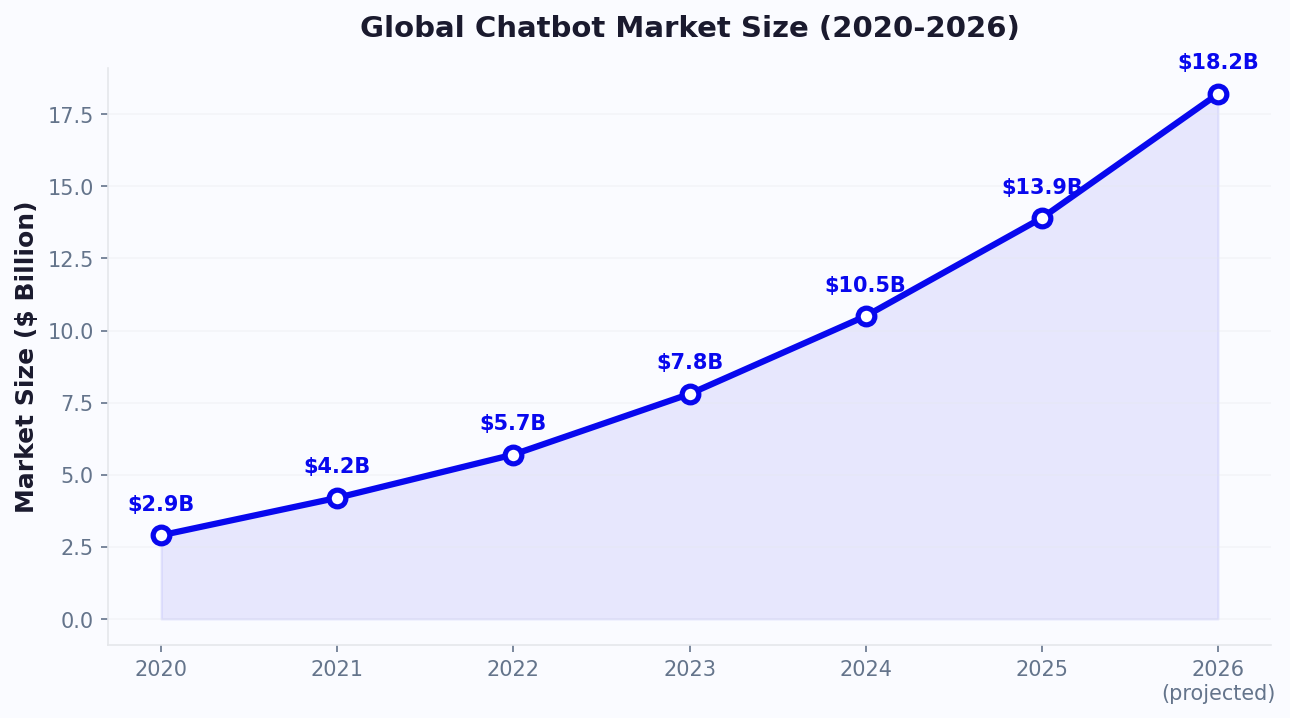
The global chatbot market has grown from $2.9 billion in 2020 to an estimated $18.2 billion in 2026, according to industry analysts. This six-fold growth reflects both the expansion of use cases and the broadening of adopters from enterprise-only to businesses of every size. North America and Europe lead adoption, but Asia-Pacific is the fastest-growing region, driven by WhatsApp and LINE adoption in customer service contexts. By industry, financial services, healthcare, e-commerce, and SaaS lead chatbot adoption, but the fastest growth is happening in traditionally offline industries: real estate, home services, legal, and hospitality.
Trend 1: From Chatbots to Autonomous Agents
The most transformative trend in 2026 is the evolution from chatbots (that answer questions) to autonomous agents (that take actions). Traditional chatbots provide information. Agents perform tasks.
What Autonomous Agents Do
An autonomous agent does not just tell a customer their order status — it can modify the order, change the delivery address, apply a discount, process a return, and send a confirmation email, all within the conversation. The customer describes what they want, and the agent does it.
Real-world examples in production today:
- E-commerce: Process returns, modify orders, apply promo codes, initiate refunds — all through chat
- SaaS: Change account settings, upgrade plans, reset configurations, generate reports — via chatbot
- Healthcare: Schedule appointments, send prescriptions to pharmacies, update patient records — through messaging
- Finance: Transfer funds, set up automatic payments, dispute charges — conversationally
How It Works
Autonomous agents connect to business systems through APIs and use AI to determine which actions to take based on the conversation. The process:
- Customer describes their need: "I want to return the blue shirt from my last order"
- Agent identifies the order, specific item, and intent (return)
- Agent checks return policy eligibility automatically
- Agent initiates the return process in the order management system
- Agent generates a return label and sends it to the customer
- Agent confirms the refund timeline
All of this happens in a single conversation, in under 2 minutes, without any human involvement.
What This Means for Businesses
Autonomous agents dramatically expand what chatbots can do — and therefore what they can save. While traditional chatbots automate 50-65% of conversations (the informational ones), autonomous agents can automate 75-90% because they handle both informational and transactional queries.
Platforms like Conferbot are building autonomous agent capabilities through deep integrations hub connections and API integrations that let chatbots not just read from business systems but write to them. This is the future of customer service automation: not just answering questions, but resolving issues end-to-end.
Adoption Timeline
While autonomous agent capabilities are available today, adoption is still in the early majority phase. Enterprise early adopters have deployed agents for 12-18 months, with mid-market adoption accelerating through 2026 and SMB adoption expected to reach mainstream levels by 2027. The key enabler is integration simplicity — as platforms like Conferbot make API connections easier through pre-built connectors and visual integration builders, the technical barrier that historically limited autonomous agents to enterprises is disappearing. Businesses that begin building their integration infrastructure now will be positioned to activate autonomous capabilities as they mature.
Trend 2: Omnichannel Becomes the Default
In 2023, deploying a chatbot on your website was sufficient. In 2026, customers expect to reach you through whichever channel they prefer — and they expect a consistent experience across all of them.
The Numbers
- 73% of customers use 3+ channels during a single journey
- WhatsApp chatbot adoption grew 180% in two years
- Omnichannel deployments grew 150% in 2025
- Businesses with omnichannel strategies retain 91% more customers
What Is Changing
The shift is from "we have a chatbot on our website" to "we have a chatbot wherever our customers are." This includes:
- Website: Website chat remains the foundation
- WhatsApp: WhatsApp chatbots are growing fastest, driven by 98% message open rates
- Messenger: Facebook Messenger for social commerce and social support
- Instagram: Instagram DMs for visual product discovery
- Telegram: Telegram bots for tech-savvy audiences
- Slack/Teams: Slack and Teams for B2B embedded support
- SMS: SMS chatbots for universal reach
The Technical Challenge
True omnichannel is not just deploying on multiple channels — it is connecting those channels into a unified experience. The customer who starts on WhatsApp and continues on your website should not repeat their question. The agent should see all interactions in one live chat view. The chatbot should know the customer's history regardless of channel.
This requires platforms built for omnichannel from the ground up. Conferbot's omnichannel architecture connects 13+ channels to a single inbox, single chatbot, and single analytics dashboard — solving the technical challenge that has historically made omnichannel difficult to implement.
What You Should Do
- If you are only on website chat, add WhatsApp as your second channel (highest ROI messaging channel)
- If you are on 2-3 channels, ensure they are connected (not siloed) with unified customer profiles
- If you are on 4+ channels, focus on cross-channel context preservation and unified analytics
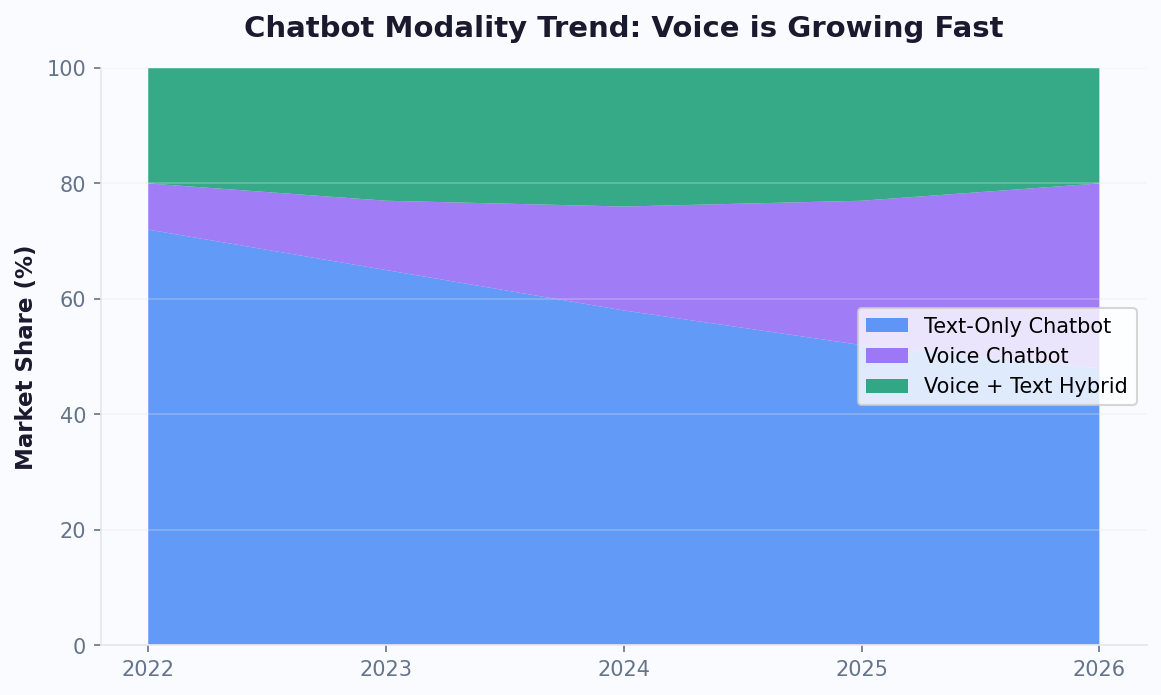
The omnichannel imperative is particularly strong for businesses serving younger demographics. Gen Z consumers show a strong preference for messaging-first communication, with 65% preferring WhatsApp or Instagram DM over phone or email for business interactions. As this generation gains purchasing power, businesses without messaging-channel presence will find themselves increasingly irrelevant to their target market.
Trend 3: AI Costs Collapse, Democratizing Access
The 85% reduction in AI inference costs between 2023 and 2026 has fundamentally changed who can deploy AI chatbots and how they are priced.
The Cost Curve
| Year | Cost Per AI Conversation | Who Could Afford It |
|---|---|---|
| 2023 | $0.50-1.00 | Enterprise only |
| 2024 | $0.20-0.50 | Mid-market and up |
| 2025 | $0.05-0.20 | SMBs and up |
| 2026 | $0.02-0.10 | Everyone |
Pricing Model Shift
This cost collapse is driving a pricing model shift in the chatbot industry. In 2023, charging per AI resolution made sense because AI was expensive. In 2026, per-resolution pricing is increasingly seen as a legacy model that overcharges customers. The trend is toward platforms that include AI in flat-rate pricing — because the underlying cost of AI no longer justifies per-usage charges.
Conferbot was among the first platforms to include AI in standard plans without per-conversation charges. As costs continue to drop, more platforms will follow this model. Businesses currently on per-resolution pricing (Intercom at $0.99/resolution, Zendesk at $1/resolution) should evaluate whether their platform's AI pricing still reflects actual costs or represents a markup that alternatives have eliminated.
What Democratization Means Practically
- Solopreneurs can afford AI chatbots. At $49/month with AI included, a one-person business can deploy the same AI technology that cost enterprises $50,000+/year in 2023.
- AI is default, not premium. Businesses should expect AI in their chatbot platform's base plan, not as an add-on. If your platform charges extra for AI, you are likely overpaying.
- Experimentation is risk-free. At these cost levels, testing AI chatbot capabilities costs less than a team lunch. There is no financial barrier to trying AI-powered customer engagement. Start with ready-made chatbot templates to go live faster.
- The ROI bar is trivially low. When AI chatbot platforms cost $49-149/month, you need to automate just 10-30 conversations to break even. Any business with meaningful customer traffic exceeds this threshold immediately.
Trend 4: No-Code AI and Hyper-Personalization
No-Code Goes AI-First
The no-code chatbot builder category has evolved from simple drag-and-drop flow builders to AI-powered creation tools. In 2026, you can describe what you want in plain language and the platform generates the chatbot:
- "Create a chatbot for my dental practice that handles calendar booking and answers common questions about our services"
- The AI generates the complete conversation flow, suggests questions to ask, and populates initial responses from your website content
- You review, refine, and deploy — total time under 30 minutes
This AI-assisted building reduces chatbot creation time by 60-80% compared to manual flow building. It also produces better chatbots because the AI draws on patterns from millions of successful chatbot deployments.
Hyper-Personalization
AI chatbots in 2026 do not treat every customer the same. They personalize conversations based on:
- Customer history: Previous purchases, support interactions, preferences, and communication style
- Real-time behavior: Current page, time on site, items viewed, cart contents
- Segment data: Customer segment (new vs. returning, high-value vs. standard, enterprise vs. SMB)
- Contextual signals: Time of day, device, location, referral source
What this looks like in practice:
A returning customer who purchased running shoes last month visits the same store:
- Chatbot: "Welcome back, Sarah! How are the Trail Runner 5s working out? Looking for anything new today?"
- If Sarah says she is looking for socks, the chatbot recommends socks specifically designed for the shoes she already owns
- The entire conversation feels personal because it is informed by Sarah's actual history
Compare this to a generic: "Hi! How can I help you today?" — the personalized experience converts at 2-3x the rate of the generic experience.
What This Means for Businesses
- Chatbot building is now accessible to anyone who can describe what they want in plain language
- Personalization drives measurably higher conversion and satisfaction rates
- The combination of AI building + AI personalization creates a compounding advantage for early adopters
- Platforms with strong NLP capabilities and CRM integration enable the deepest personalization
Trend 5: Voice AI and Multimodal Interactions
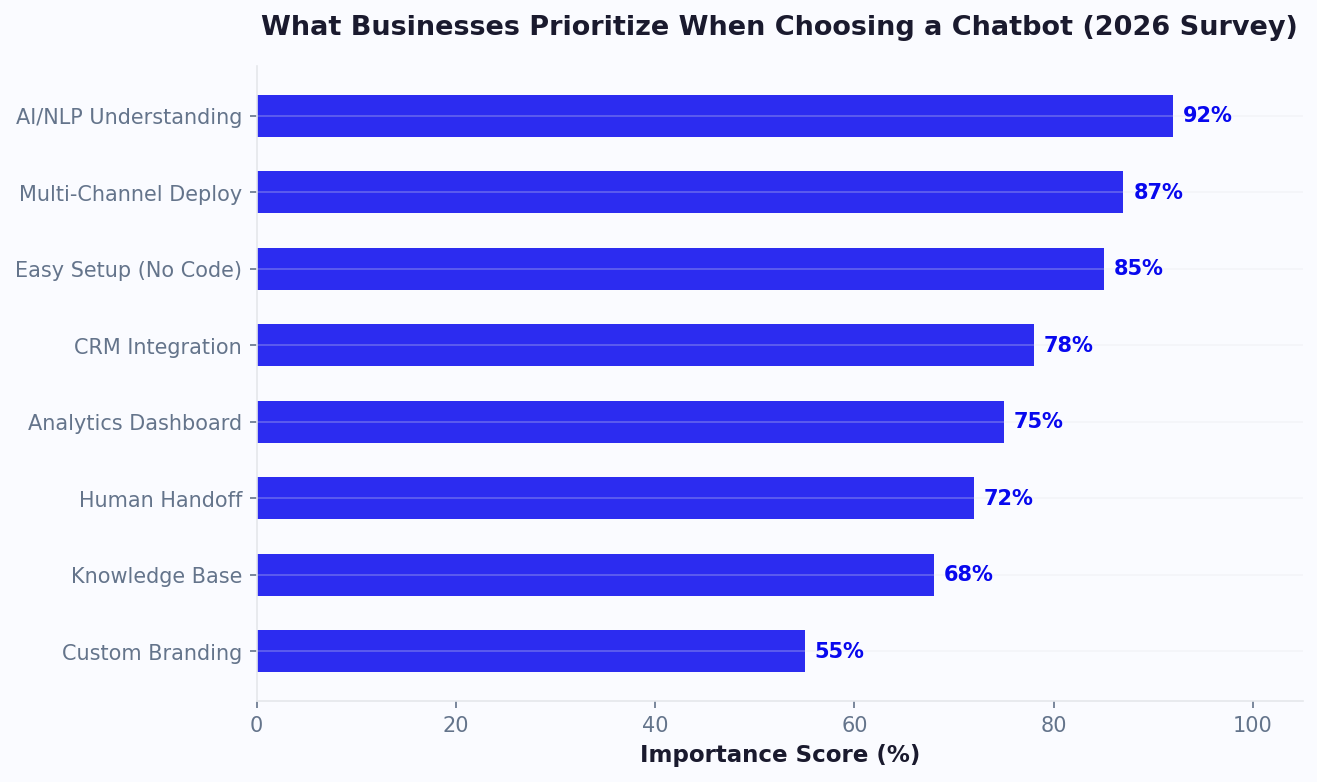
Chatbots are expanding beyond text. In 2026, the most forward-thinking deployments include voice and multimodal capabilities that let customers interact in whatever way is most natural for their situation.
Voice AI Chatbots
Voice-based chatbots handle phone calls, voice messages, and smart speaker interactions using the same AI that powers text chatbots. The technology has reached a point where voice AI sounds natural and understands diverse accents, speech patterns, and industry jargon.
Use cases gaining traction:
- Phone IVR replacement: Instead of "Press 1 for sales, press 2 for support," callers speak naturally and the AI routes and responds accordingly
- Voice-first WhatsApp: Customers send voice messages on WhatsApp; the chatbot transcribes, understands, and responds (via text or voice)
- Accessibility: Voice chatbots serve customers who cannot type easily — elderly users, those with disabilities, or anyone driving
Multimodal Interactions
Multimodal means customers can share images, documents, videos, and location data within the conversation — and the AI understands and responds to all of them:
- Visual product search: Customer photos an item and asks "Do you have anything like this?" — the AI identifies the product and shows matches
- Document processing: Customer uploads an invoice, receipt, or form — the AI extracts information and processes it
- Screen sharing: Customer shares a screenshot of an error — the AI identifies the issue and provides a solution
- Location sharing: Customer shares their location — the chatbot provides directions to the nearest store or calculates delivery estimates
Where We Are in 2026
Voice AI and multimodal capabilities are available on leading platforms but not yet universal. They represent the cutting edge of chatbot technology, with adoption concentrated in large enterprises and tech-forward businesses. However, as costs continue to drop and platform support expands, these capabilities will become standard within 1-2 years.
For businesses planning their 2026-2027 chatbot strategy, the key is choosing a platform that is investing in voice and multimodal capabilities — even if you do not need them today. Platforms like Conferbot that are actively developing these features will give you a smooth upgrade path when you are ready.
Trend 6: Advanced Analytics and Privacy-First Design
Analytics Gets Predictive
Chatbot analytics in 2026 has evolved from descriptive (what happened) to predictive (what will happen) and prescriptive (what to do about it):
Descriptive (2023-2024): "Your resolution rate was 55% last month."
Predictive (2025-2026): "Based on current trends, your resolution rate will drop to 48% next month if you do not add content about the new product launch to your knowledge base."
Prescriptive (Emerging): "Add these 15 Q&A pairs to your knowledge base to maintain 55%+ resolution rate. I have drafted them based on unresolved conversation patterns. Review and approve."
Advanced chatbot analytics platforms now provide:
- Anomaly detection: Automatic alerts when metrics deviate from normal patterns
- Root cause analysis: AI-identified reasons for metric changes (not just the what, but the why)
- Optimization recommendations: Data-driven suggestions for improving specific flows
- Revenue attribution: Clear mapping of chatbot interactions to revenue outcomes
- Sentiment trending: Real-time monitoring of customer sentiment across conversations
Privacy-First Chatbot Design
As chatbots handle more sensitive conversations and personal data, privacy has become a critical design consideration, not an afterthought. Key trends:
- Data minimization: Chatbots collecting only the data necessary for the interaction, not hoovering up everything possible
- On-device processing: Some AI processing happens on the customer's device rather than in the cloud, reducing data exposure
- Consent management: Clear opt-in/opt-out mechanisms within the chatbot conversation for data processing and marketing communications
- Right to deletion: Easy mechanisms for customers to request deletion of their chatbot conversation data
- Data residency: Ability to specify where conversation data is stored (EU, US, etc.) for GDPR and regional compliance
GDPR, CCPA, and AI Regulations
Regulatory frameworks are catching up with AI chatbot capabilities. Businesses need to ensure their chatbot implementations comply with:
- GDPR (Europe): Consent for data processing, right to access and deletion, data portability
- CCPA (California): Consumer rights to know, delete, and opt out of data sales
- EU AI Act: Transparency requirements for AI systems interacting with consumers
- Industry-specific regulations: HIPAA (healthcare), PCI DSS (payment), SOX (finance)
Choose chatbot platforms that build compliance into the platform rather than leaving it as your responsibility. Features like automatic data retention policies, consent tracking, and audit trails should be standard, not optional.
Trend 7: Industry-Specific AI Models and Vertical Solutions
General-purpose AI chatbots are giving way to industry-specific models trained on domain-specific data. This trend reflects a maturation of the market where one-size-fits-all AI is being supplemented by specialized intelligence.
What Industry-Specific AI Means
Instead of a generic language model answering healthcare questions, an industry-specific model is trained on medical terminology, treatment protocols, insurance procedures, and patient communication best practices. The result: more accurate, more relevant, and more compliant responses for that specific domain.
Industry Specializations Emerging in 2026
Healthcare AI: Understands medical terminology, triages patient symptoms according to clinical guidelines, handles HIPAA-compliant conversations, and integrates with EHR systems. Reduces inappropriate medical advice while providing accurate informational support.
E-Commerce AI: Trained on product recommendation patterns, understands size/fit/color queries, handles return and exchange workflows, and integrates with inventory and order management systems. Provides product expertise that generic AI cannot match.
Financial Services AI: Understands financial products, regulatory requirements, transaction processing, and fraud detection. Provides compliant responses for banking, insurance, and investment queries.
Real Estate AI: Understands property terminology, mortgage calculations, market comparisons, and viewing scheduling. Qualifies buyer leads based on budget, timeline, and preferences.
Legal AI: Handles basic legal inquiries, document intake, case status updates, and appointment scheduling. Understands legal terminology while clearly disclaiming that responses are not legal advice.
How to Access Industry-Specific AI
Two approaches are emerging:
- Platform-provided industry models: Chatbot platforms offer pre-configured AI models for specific industries. These include industry-specific training data, compliance guardrails, and domain-specific intent recognition.
- Custom fine-tuning: Businesses train the base AI on their own domain data — product catalogs, knowledge bases, industry documentation — creating a custom model that understands their specific context deeply.
Conferbot supports both approaches: the AI knowledge base and AI-powered responses can be trained on your specific business content, while industry templates provide pre-built flows and knowledge for common verticals. Explore industry-specific solutions for your vertical.
What This Means for Your Strategy
If you are deploying a chatbot in a specialized industry, look for platforms that offer domain-specific capabilities rather than relying solely on generic AI. The accuracy and compliance improvements from industry-specific models translate directly into better customer experiences and reduced risk.
Preparing Your Business for the AI Chatbot Future
With these trends reshaping the landscape, here is how to position your business to benefit from the evolving AI chatbot ecosystem.
Short-Term Actions (Next 3 Months)
- If you do not have a chatbot: Deploy one. The barriers are lower than ever, and platforms like Conferbot offer free tiers to start. Focus on your top 5 customer questions and build from there.
- If you have a rule-based chatbot: Add AI capabilities. The cost is marginal (often included in your existing plan or a small upgrade), and the improvement in handling natural language is transformative.
- If you have an AI chatbot on one channel: Expand to WhatsApp or Messenger. Multi-channel reach is becoming a competitive necessity, not a nice-to-have.
Medium-Term Strategy (3-12 Months)
- Build your knowledge base: The quality of AI chatbot responses depends directly on the quality of your knowledge base. Invest in comprehensive, accurate, up-to-date content that the AI can draw from.
- Implement advanced analytics: Move beyond basic conversation metrics to funnel analysis, sentiment tracking, and ROI attribution. Data-driven optimization is what separates good chatbot deployments from great ones.
- Train your team: As chatbots handle routine conversations, your human agents should upskill for complex, high-value interactions. The chatbot-human partnership is more effective than either alone.
- Explore autonomous agent capabilities: Identify transactions your chatbot could handle end-to-end (order modifications, returns, scheduling) and set up the API integrations needed to enable them.
Long-Term Vision (1-3 Years)
- Plan for voice and multimodal: As these capabilities mature, ensure your platform roadmap includes them. Choose vendors investing in these technologies.
- Evaluate industry-specific AI: As domain-specific models improve, consider whether generic AI or specialized AI better serves your customers.
- Rethink your service model: AI chatbots are not just a cost reduction tool — they are a new service paradigm. The most innovative businesses are redesigning their entire customer service model around AI-first engagement with human escalation, rather than bolting chatbots onto a human-first model.
The One Thing You Should Not Do
Wait. Every month you delay chatbot deployment is a month of higher support costs, slower response times, missed leads, and lost revenue. The technology is mature, the costs are minimal, and the ROI is proven. The best time to deploy was last year. The second best time is today.
Start with a free Conferbot account, build a chatbot for your top use case, and deploy it this week. You will see value within days, not months.
Key Statistics to Guide Your Decision
According to Gartner's 2025 research, by 2027, chatbots will become the primary customer service channel for approximately 25% of organizations. McKinsey's digital insights suggest that generative AI will add $2.6 to $4.4 trillion to the global economy annually, with customer service automation as one of the top use cases. Additionally, Forrester Research projects that AI-powered customer engagement will reduce operational costs by 30% for early adopters in 2026-2027.
These projections are not speculative — they are based on the adoption curves already underway. The businesses that deploy AI chatbots today are building competitive advantages that will compound over the next several years.
Further Reading
To dive deeper into specific aspects of the AI chatbot revolution, explore these related resources:
- Chatbot Statistics 2026 — The hard data on adoption rates, conversion improvements, and cost savings across industries
- AI Chatbot vs Rule-Based — Understand when AI adds value versus when simpler rule-based logic suffices
- Chatbot Analytics Metrics — What to measure to ensure your chatbot delivers results
- Omnichannel Customer Service Strategy — How to build a unified presence across every customer touchpoint
- How to Calculate Chatbot ROI — A practical framework for measuring return on your chatbot investment
Also reference the IBM guide to chatbot technology and the Salesforce chatbot overview for additional enterprise perspectives on how AI chatbots are transforming business operations globally.
Was this article helpful?
AI Chatbot Trends 2026 FAQ
Everything you need to know about chatbots for ai chatbot trends 2026.
About the Author

Conferbot Team specializes in conversational AI, chatbot strategy, and customer engagement automation. With deep expertise in building AI-powered chatbots, they help businesses deliver exceptional customer experiences across every channel.
View all articles