What Are Rule-Based Chatbots?
Rule-based chatbots — also called decision-tree chatbots, scripted chatbots, or flow-based chatbots — operate on predefined conversation paths. According to G2's chatbot category research, approximately 60% of chatbot deployments still use some form of rule-based logic. These bots operate on predefined conversation paths. Every possible interaction is mapped out in advance by the chatbot creator, and the bot follows these paths based on user inputs, typically through button clicks, menu selections, or keyword matching.
How They Work
A rule-based chatbot works like a sophisticated flowchart. When a user interacts, the bot presents options (buttons or quick replies), and each selection leads to the next step in the flow. For example:
- Bot: "How can I help you today?" [Order Status] [Returns] [Product Info]
- User clicks: [Order Status]
- Bot: "Please enter your order number."
- User types: "12345"
- Bot looks up order and displays status
The conversation follows a structured path. The bot does not understand natural language — it responds to specific inputs that match its programmed rules. If a user types something unexpected ("I want to know where my package is" instead of clicking the Order Status button), a basic rule-based bot may fail to understand.
Strengths of Rule-Based Chatbots
- Predictable behavior: Every response is pre-written, so you know exactly what the bot will say in every scenario. There are no hallucinations or unexpected answers.
- Easy to build: No AI training or data required. You can build a functional chatbot in hours using a no-code chatbot builder with a drag-and-drop interface.
- Cost-effective: No AI processing costs. The bot runs on simple logic, keeping infrastructure costs minimal.
- Perfect for structured workflows: Appointment booking, order tracking, lead qualification forms, and FAQ menus all work well with decision trees.
- Compliance-friendly: In regulated industries where exact wording matters (healthcare, finance, legal), rule-based bots ensure every response is pre-approved and compliant.
Limitations of Rule-Based Chatbots
- Cannot handle free-text input well: If users type natural language instead of clicking buttons, the bot struggles to understand.
- Maintenance scales poorly: As you add more topics and scenarios, the decision tree becomes exponentially complex to manage.
- No learning capability: The bot never improves from conversations. Every improvement requires manual updates.
- Frustrating for complex queries: Users with nuanced questions often hit dead ends or get routed through irrelevant menu options.
- Limited personalization: Responses are generic by design, lacking the ability to adapt to individual user context.
What Are AI Chatbots?
AI chatbots — also called NLP chatbots, conversational AI, or intelligent chatbots — use natural language processing (NLP) and machine learning to understand the meaning behind user messages, not just match keywords. They can interpret intent, handle variations in phrasing, and generate contextually relevant responses.
How They Work
Modern AI chatbots, particularly those powered by large language models (LLMs) like GPT, process user messages through several layers. Gartner predicts that by 2027, AI chatbots will handle 25% of all customer service interactions as a primary channel:
- Intent recognition: The AI identifies what the user wants (e.g., checking order status, asking about pricing, requesting a refund)
- Entity extraction: The AI pulls out key information (order number, product name, date)
- Context management: The AI tracks the conversation history to understand follow-up questions
- Response generation: The AI generates a relevant, natural-sounding response based on its training data and your business knowledge base
For example, all of these messages would be understood as the same intent:
- "Where is my order?"
- "I want to track my package"
- "Can you check the status of order #12345?"
- "My stuff hasn't arrived yet"
- "Track delivery"
An AI chatbot handles all of these naturally, while a rule-based bot would need each variation explicitly programmed or rely on the user clicking a button instead.
Strengths of AI Chatbots
- Natural conversation: Users can type freely in their own words. The bot understands intent regardless of phrasing, spelling, or language patterns.
- Handles complexity: NLP-powered chatbots can manage nuanced, multi-turn conversations where context from earlier messages matters. Follow-up questions like "What about the blue one?" after discussing products are handled naturally.
- Scales without exponential complexity: Adding new topics does not require building new decision trees. You update the AI-generated knowledge base, and the AI incorporates new information.
- Continuous improvement: AI models can be refined based on conversation data, getting better over time at understanding your specific users and use cases. Advanced platforms offer AI agent handover for seamless bot-to-human transitions.
- Multilingual capability: Modern LLMs understand and respond in dozens of languages without separate bot configurations for each language.
Limitations of AI Chatbots
- Potential for hallucination: AI can generate plausible-sounding but incorrect answers, especially when the question falls outside its training data.
- Less predictable: Because responses are generated dynamically, the exact wording varies between conversations. This can be problematic in compliance-sensitive contexts.
- Higher cost: AI processing (especially LLM inference) costs more than simple rule execution, though prices have dropped dramatically and many platforms like Conferbot include AI in base pricing.
- Requires quality training data: The AI is only as good as the knowledge base it draws from. Incomplete or outdated information leads to poor responses.
- Black box concerns: It can be harder to understand why the AI gave a particular response compared to a transparent decision tree.
AI vs. Rule-Based: Side-by-Side Comparison
Here is a direct comparison across the dimensions that matter most when choosing between the two chatbot types.
| Dimension | Rule-Based Chatbot | AI Chatbot |
|---|---|---|
| User input | Buttons, menus, keywords | Free-text natural language |
| Understanding | Exact match only | Intent and context understanding |
| Response type | Pre-written, fixed | Dynamically generated |
| Build time | Hours to days | Days (plus training time) |
| Maintenance | Manual, scales poorly | Update knowledge base |
| Handling edge cases | Fails on unscripted inputs | Gracefully handles variations |
| Personalization | Limited | Context-aware, adaptive |
| Cost | Lower (no AI processing) | Higher (AI inference costs) |
| Accuracy control | 100% predictable | High but not 100% predictable |
| Multi-language | Requires separate flows | Built-in multilingual |
| Learning ability | None (manual updates) | Improves from interactions |
| Best for | Structured, repetitive tasks | Complex, varied conversations |
The Cost Equation Has Changed
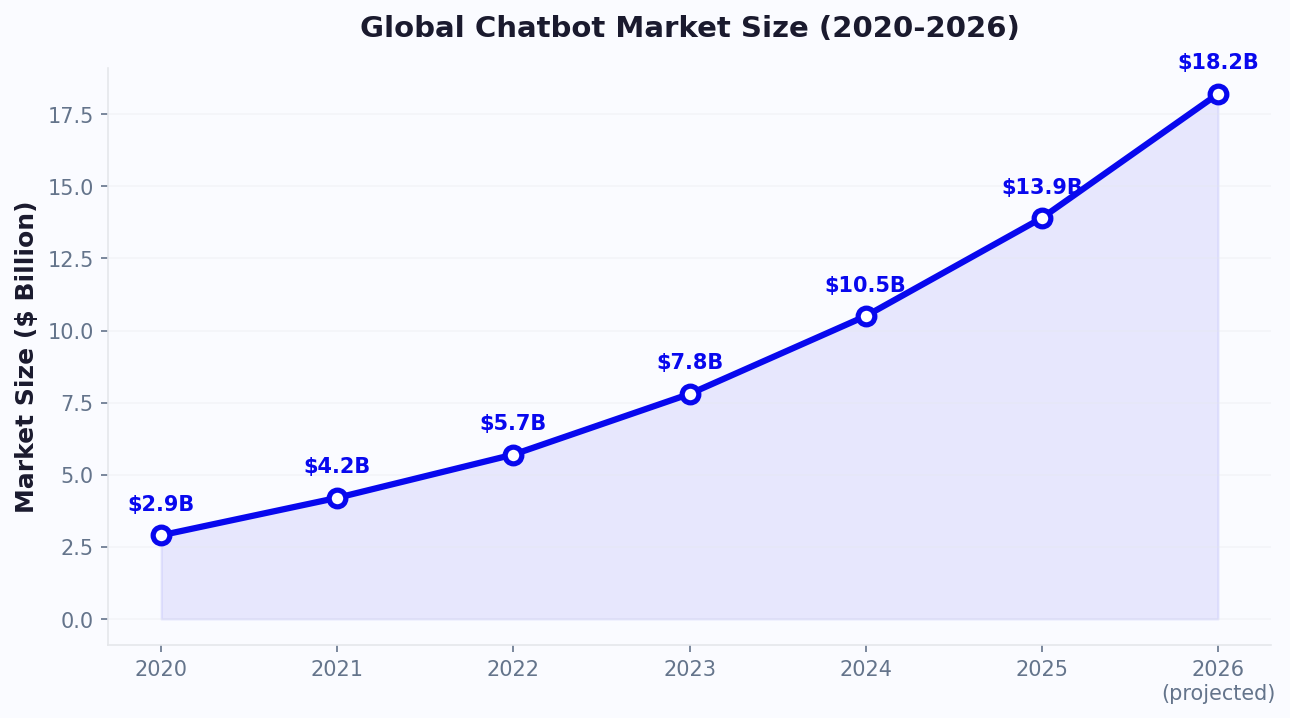
In 2023-2024, the cost of AI chatbots was a significant disadvantage. LLM inference was expensive, and most platforms charged per AI interaction. In 2026, the picture is different:
- AI inference costs have dropped by 80-90% since 2023
- Platforms like Conferbot include AI capabilities in base plans without per-conversation charges
- Open-source models have made self-hosted AI chatbots feasible for mid-size businesses
- The gap between "AI chatbot cost" and "rule-based chatbot cost" has narrowed dramatically
This cost convergence means the decision is increasingly about capability fit rather than budget constraints. AI chatbots are no longer a luxury reserved for enterprise budgets — they are accessible to businesses of all sizes. Statista projects the NLP market will exceed $50 billion by 2028, driven largely by accessible chatbot deployment platforms.
The Accuracy Tradeoff
Rule-based chatbots have 100% predictable responses — they say exactly what you program them to say. AI chatbots are highly accurate but not 100% predictable. For most business use cases, the AI's ability to handle natural conversation and unexpected questions far outweighs the marginal unpredictability. But for compliance-critical scenarios (medical advice, legal disclaimers, financial regulations), the predictability of rule-based responses can be essential.
When to Choose Each Type: Decision Framework
Choose a Rule-Based Chatbot When:
1. Your use case is highly structured. Appointment booking, order status checks, simple lead qualification forms, and FAQ menus with well-defined categories are perfect for rule-based bots. The conversation follows a predictable path, and button-based navigation is actually faster than typing for users.
2. Compliance requires exact wording. In healthcare, finance, insurance, and legal contexts, every word the chatbot says may need to be pre-approved. Rule-based bots guarantee exact responses because every message is pre-written and reviewed.
3. You have limited content. If your chatbot only needs to handle 5-10 topics with straightforward answers, a decision tree is simpler to build and maintain than training an AI model.
4. You want maximum control. Some teams prefer knowing exactly what their chatbot will say in every scenario. Rule-based bots offer this transparency — you can audit every possible conversation path.
5. Quick deployment is essential. A rule-based chatbot can be built and deployed in a single afternoon using a no-code chatbot builder. AI chatbots require more setup time for knowledge base preparation and training.
Choose an AI Chatbot When:
1. Your users ask diverse, unstructured questions. If customers ask the same question in dozens of different ways, AI chatbots handle this effortlessly. Rule-based bots would need every variation explicitly programmed.
2. You have a large knowledge base. Products with extensive documentation, complex pricing, multiple features, or detailed specifications benefit from AI that can search and synthesize information on the fly.
3. Conversations involve multiple turns. When users need follow-up questions answered in context ("What about for the enterprise plan?" after discussing pricing), AI maintains conversation context naturally.
4. You serve a multilingual audience. AI chatbots — like those created with an AI chatbot builder — with NLP capabilities can understand and respond in multiple languages from a single configuration. Rule-based bots need separate flows for each language.
5. You want to reduce maintenance. As your product or service evolves, updating an AI chatbot means updating the knowledge base. Updating a rule-based bot means modifying every affected decision tree path, which becomes exponentially complex over time.
6. Customer experience is a priority. AI chatbots provide more natural, conversational experiences that feel less robotic. For brands that prioritize customer experience, the conversational quality of AI is a significant differentiator.
The Hybrid Approach: Best of Both Worlds
The most effective chatbot strategies in 2026 do not choose exclusively between AI and rule-based — they combine both in a hybrid approach that leverages the strengths of each type.
How Hybrid Chatbots Work
A hybrid chatbot uses rule-based flows for structured interactions (where predictability is important) and AI for unstructured conversations (where flexibility is needed). The bot seamlessly switches between modes based on the conversation context.
Example hybrid flow:
- Rule-based greeting: "Hi! I can help with Orders, Products, or Support. What do you need?" [Buttons displayed]
- Rule-based routing: User clicks "Products"
- AI takes over: "I would be happy to help you learn about our products. What are you looking for or what questions do you have?"
- AI conversation: User types freely about their needs, AI provides personalized product recommendations based on the knowledge base
- Rule-based checkout: When user is ready to buy, the bot switches to a structured flow for collecting shipping information and processing payment
Why Hybrid Works Best
- Structured entry points guide users efficiently to the right topic area, reducing the chance of AI misunderstanding the initial intent
- AI flexibility handles the nuanced middle of conversations where users have specific, varied questions
- Structured endpoints ensure critical actions (booking, purchasing, form submission) follow predictable paths with validated inputs
- Fallback safety: If the AI is unsure about a response, it can route back to a rule-based menu or escalate to a human agent via live chat
Implementing Hybrid Chatbots
Platforms like Conferbot support hybrid chatbot design natively. You can build rule-based flows using the visual no-code builder and activate AI-powered responses within specific nodes of the flow. This gives you precise control over which parts of the conversation use scripted responses and which leverage AI.
The practical benefits of hybrid chatbots include:
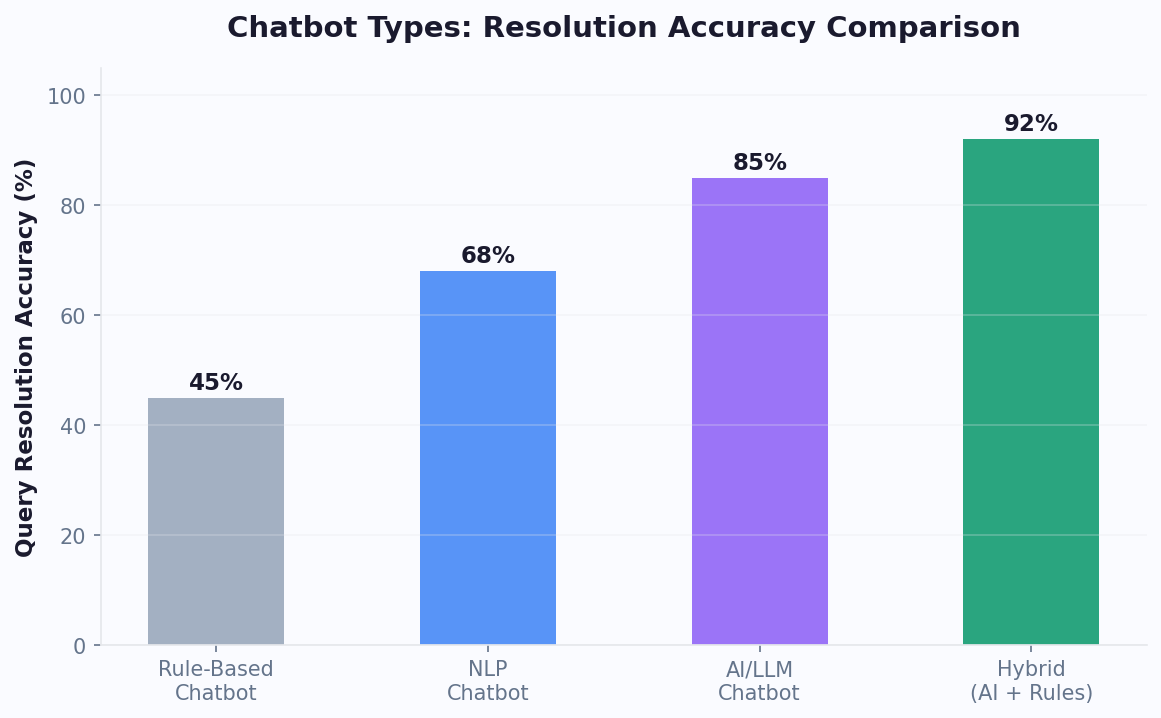
- Higher resolution rates: AI handles the long tail of questions that rule-based bots miss, while structured flows efficiently handle common, predictable queries
- Lower costs than pure AI: By using rule-based logic for simple routing and structured tasks, you reduce AI inference calls (and costs) to only the moments where AI adds genuine value
- Better user experience: Users get the speed of button-based navigation for simple tasks and the flexibility of natural conversation for complex queries
- Easier maintenance: Rule-based sections are easy to update for structured changes (new menu items, updated hours), while AI adapts to new topics through knowledge base updates
For most businesses in 2026, the hybrid approach is the recommended starting point. It delivers the best customer experience while managing costs and maintaining control over critical conversation paths.
Real-World Use Cases: Which Type Wins?
To make the AI vs. rule-based decision concrete, let us walk through common business scenarios and identify which chatbot type performs best in each.
E-Commerce Product Recommendations
Winner: AI chatbot
Customers describe what they are looking for in natural language ("I need a waterproof jacket for hiking in cold weather under $200"). AI chatbots understand the multiple criteria (waterproof, hiking, cold weather, under $200) and provide personalized recommendations from your product catalog. A rule-based bot would need extensive menu drilling (Category > Outerwear > Jackets > Waterproof > Price Range) that frustrates users.
Appointment Booking
Winner: Rule-based chatbot
Booking an appointment follows a predictable structure: select service type, choose date, pick time slot, confirm details. A rule-based flow with calendar integration handles this efficiently with buttons and date pickers. AI adds unnecessary complexity to what is fundamentally a form-filling interaction.
Customer Support for Complex Products
Winner: AI chatbot
Software products, technical equipment, and complex services generate diverse support questions. Users describe problems in their own words, and AI chatbots can understand the issue, search the knowledge base for relevant solutions, and provide step-by-step guidance. Rule-based bots would need hundreds of decision tree paths to cover the same breadth of issues.
Lead Qualification
Winner: Hybrid (rule-based structure + AI personalization)
A structured set of qualifying questions (company size, budget, timeline, use case) works well as a rule-based flow. But adding AI allows the bot to have a natural conversation around those questions, ask intelligent follow-up questions, and provide relevant information based on the prospect's specific situation. The Conferbot no-code builder supports this hybrid approach natively.
Order Status and Tracking
Winner: Rule-based chatbot (with API integration)
Checking order status is a straightforward lookup: collect the order number, query the database, display the result. Rule-based bots with API integration handle this perfectly. AI is not needed for database lookups.
HR and Internal FAQs
Winner: AI chatbot
Employees ask HR questions in many different ways: "How many vacation days do I have?", "What is the PTO policy?", "Can I take time off next Friday?" AI chatbots understand these variations and pull answers from the HR knowledge base. Rule-based bots would need extensive menus covering every HR topic and sub-topic.
The pattern is clear: use rule-based for structured, predictable interactions and use AI for varied, unstructured conversations. Most businesses benefit from a hybrid approach that applies each type where it performs best. For more real-world scenarios, see our chatbot ROI case studies and customer support chatbot guide.
Industry Benchmarks: AI vs. Rule-Based Performance by Sector
The choice between AI and rule-based chatbots varies significantly by industry. Here are performance benchmarks based on aggregate data from chatbot deployments across major sectors, helping you calibrate expectations for your specific vertical.
Performance Comparison by Industry
| Industry | Rule-Based Resolution Rate | AI Resolution Rate | Recommended Approach | Avg. ROI (Year 1) |
|---|---|---|---|---|
| E-commerce | 55-65% | 75-85% | Hybrid (rule-based checkout, AI product advice) | 300-500% |
| SaaS / Tech | 40-50% | 70-80% | AI-first (diverse technical questions) | 400-700% |
| Healthcare | 60-70% | 65-75% | Rule-based (compliance needs) | 200-350% |
| Financial Services | 55-65% | 70-80% | Hybrid (compliance + complex queries) | 350-600% |
| Real Estate | 50-60% | 75-85% | AI-first (varied property questions) | 500-900% |
| Education | 60-70% | 75-85% | AI-first (diverse student queries) | 250-400% |
| Hospitality | 65-75% | 80-90% | Hybrid (booking rules + AI concierge) | 300-500% |
| Professional Services | 45-55% | 70-80% | AI-first (qualification + consultation) | 600-1000% |
Key Insights from the Data
1. AI outperforms rule-based in every sector — but the margin varies. In healthcare, where conversations are more structured and compliance-driven, the gap is narrow (5-10 percentage points). In SaaS and professional services, where queries are diverse and complex, the gap widens to 25-30 percentage points.
2. Rule-based still wins on compliance-critical paths. Healthcare and financial services see strong rule-based performance on specific workflows (appointment booking, claim status) where exact scripted responses are required by regulation. The HIPAA compliance requirements for healthcare chatbots mean that certain response paths must be pre-approved word-for-word.
3. ROI correlates with query diversity, not volume. Industries with highly diverse customer questions (SaaS, professional services, real estate) see the highest ROI from AI because the alternative — building rule-based trees for thousands of query variations — is prohibitively expensive.
4. Hybrid approaches dominate in practice. According to Forrester's customer service automation research, 72% of enterprise chatbot deployments in 2025 used some form of hybrid architecture. Pure rule-based and pure AI deployments are increasingly rare in production environments.
Migration Path: Rule-Based to AI
Many businesses start rule-based and gradually add AI capabilities. Here is the typical evolution path with timeline and investment at each stage:
| Stage | Timeline | Capabilities | Monthly Cost Range |
|---|---|---|---|
| Stage 1: Basic Rule-Based | Week 1-2 | FAQ buttons, simple routing, lead forms | $0-49 |
| Stage 2: Enhanced Rule-Based | Month 1-2 | Conditional logic, API integrations, multi-step flows | $49-99 |
| Stage 3: AI-Assisted | Month 2-4 | NLP intent detection, AI fallback for unrecognized inputs | $99-199 |
| Stage 4: Full Hybrid | Month 4-6 | AI handles free-text, rules handle structured paths, seamless switching | $99-299 |
| Stage 5: AI-First | Month 6+ | AI handles 80%+ of conversations, rules only for compliance-critical paths | $149-399 |
The key advantage of this progressive approach: you generate ROI at every stage. You do not need to wait for a full AI deployment to see returns. A basic rule-based bot deployed in week one starts deflecting tickets immediately, and each subsequent upgrade compounds the value.
Getting Started: Build Your First Chatbot
Whether you choose AI, rule-based, or hybrid, getting started does not require technical expertise or a large budget. Here is how to build and deploy your first chatbot in 2026.
Step 1: Define Your Primary Use Case
Do not try to build a chatbot that does everything. Start with one high-value use case:
- Customer support: Automate answers to your top 20 most-asked questions
- Lead qualification: Qualify website visitors with 3-5 key questions
- Appointment booking: Let customers self-schedule without phone calls
- Order support: Provide order status and tracking information
- Product recommendations: Help visitors find the right product
Step 2: Choose Your Platform
Based on your use case and the decision framework above, select a chatbot platform. Conferbot supports all three chatbot types (rule-based, AI, and hybrid) in a single platform, making it a flexible choice regardless of which approach you start with. Its no-code builder lets non-technical users create chatbots visually, and its AI integration can be activated at any point in your flows.
Step 3: Build Your First Flow
For a rule-based chatbot, map out the conversation as a flowchart before building. Identify every possible user path and prepare responses for each. For an AI chatbot, prepare your knowledge base: gather FAQ documents, product information, policies, and any other content the AI should draw from.
Step 4: Test Thoroughly
Test your chatbot as if you were a customer with no familiarity with your business. Try asking questions in unexpected ways, test edge cases, and verify that the bot handles unknown inputs gracefully (either by offering alternatives or escalating to a human). Common testing scenarios include:
- Questions the bot is designed to handle (should work perfectly)
- Questions the bot is not designed for (should fail gracefully)
- Misspellings and informal language
- Multi-turn conversations with follow-up questions
- Mobile device testing (different screen sizes and input methods)
Step 5: Deploy and Iterate
Deploy on your website or preferred channel and monitor performance using chatbot analytics. Key metrics to watch:
- Resolution rate: What percentage of conversations are resolved without human intervention?
- Drop-off rate: Where do users abandon the conversation?
- Satisfaction score: Are users rating the experience positively?
- Escalation rate: How often does the bot hand off to a human?
Use these metrics to improve your chatbot weekly. Add new responses for common questions the bot could not handle, refine AI training data, and optimize flow paths based on drop-off analysis. The best chatbots are built iteratively, not all at once.
Starting with a focused use case and iterating based on data is the fastest path to chatbot ROI — whether you choose AI, rule-based, or hybrid. The important thing is to start, learn from real interactions, and improve continuously. For ready-to-use conversation scripts, check our copy-paste chatbot flow templates. And if you want to understand the financial returns, our chatbot ROI calculator guide walks you through the math.
Avoiding Common First-Bot Pitfalls
Regardless of whether you choose AI or rule-based, the most common implementation mistakes remain the same: launching without a clear escalation path to human agents, neglecting mobile testing (where 65% of chatbot conversations occur), and failing to review conversation analytics in the first two weeks. Set a reminder to audit your chatbot's unresolved queries after seven days — the patterns in failed conversations reveal exactly where your knowledge base or flow logic needs expansion. Teams that conduct this early review and iterate within the first 14 days achieve 25-35% higher resolution rates by month two compared to those who launch and forget. The most important principle: start narrow, launch quickly, measure rigorously, and expand based on real data rather than assumptions about what customers will ask. Whether you deploy a rule-based FAQ bot this afternoon or plan a full AI-powered support agent rollout over the coming quarter, the competitive advantage goes to businesses that move from evaluation to deployment fastest — every day without a chatbot is a day of missed leads, unanswered questions, and customer frustration that your competitors are already solving.
Was this article helpful?
Build and deploy in 10 minutes. No coding needed.
AI Chatbot vs Rule-Based Chatbot FAQ
Everything you need to know about chatbots for ai chatbot vs rule-based chatbot.
About the Author
Deepak is the founder of Conferbot and writes about building, deploying, and improving AI chatbots.
View all articles